Prospect Medical Holdings goes on hospital divestiture spree

Scoop: Prospect Medical seeks multiple buyers - Axios

Los Angeles-based Prospect Medical Holdings has inked deals to sell its seven hospitals in Connecticut and Pennsylvania. 

The company announced Feb. 10 that it is selling three Connecticut hospitals with a combined 708 beds to Yale New Haven (Conn.) Health System. The deal is expected to close later this year. If the deal is finalized, the hospitals will transition from for-profit to nonprofit organizations.  

Prospect Medical Holdings announced Feb. 11 that it is selling Crozer Health, a four-hospital system based in Springfield, Pa., to Newark, Del.-based ChristianaCare. Under the deal, ChristianaCare would acquire Crozer’s hospitals, medical group, ambulatory centers and clinics. Crozer’s hospitals have more than 800 beds combinded. 

The deal with ChristianaCare was announced the same day Crozer got a new CEO. The health system appointed Kevin Spiegel, senior vice president of strategy and revenue development at Prospect, as its new CEO. He replaced Peter Adamo, who served in that role at Crozer for two years. Mr. Adamo’s last day at Crozer was Feb. 11, according to the Philadelphia Business Journal.

“The pandemic has demonstrated the vital importance of working together to meet the clinical needs of the communities we serve,” Mr. Spiegel said in a Feb. 11 news release. “We are excited by the potential to join these two great organizations so that we can continue to provide the high-quality, accessible care that our communities — Delaware County and beyond — rely on.”

The sale of the hospitals to ChristianaCare is expected to close in the second half of this year. If the deal is finalized, Crozer would become a nonprofit organization. 

20 hospitals, health systems that provide the most ‘unnecessary’ care: Johns Hopkins

Johns Hopkins study names health systems that provide the most 'unnecessary'  care | Modern Healthcare

Health systems that employed fewer primary care physicians, have higher bed counts or are investor owned were more likely to provide more unnecessary or low-value care, a study published Jan. 14 in JAMA found.

For the study, researchers from Baltimore-based Johns Hopkins University analyzed Medicare claims data at 3,745 hospitals for 17 low-value services. The low-value services were previously identified as unnecessary and included services such as pap smears for women older than 65, an abdominal CT scan with and without contrast and spinal fusions for back pain, according to the study.  

The researchers then rated the hospitals using an overuse index, which was based on the Medicare claims for the low-value healthcare services. Health systems rated at least 1.5 standard deviations or more above the average in the overuse index were considered over-users of low-value services.

Below is a breakdown of the 20 hospitals that provided the most unnecessary care based on the overuse index.

1. St. Dominic Health Services (Jackson, Miss.)

2. USMD Health System (Irving, Texas)

3. Community Medical Centers (Clovis, Calif.)

4. Care New England Health System (Providence, R.I.)

5. East Alabama Medical Center (Opelika)

6. Pocono Health System (East Stroudsburg, Pa.)

7. University Health Care System (Augusta, Ga.)

8. Deaconess Health System (Evansville, Ind.)

9. Congregation of the Sisters of St Joseph of Peace (Englewood Cliffs, N.J.)

10. Iredell Health System (Statesville, N.C.)

11. Sacred Heart HealthCare System (Allentown, Pa.)

12. Southeast Health (Dothan, Ala.)

13. Chesapeake (Va.) Regional Medical Center

14. Butler (Pa.) Health System

15. CarolinaEast Health System (New Bern, N.C.)

16. Ohio Valley Health Services and Education Corp. (Wheeling, W.Va.)

17. Slidell (La.) Memorial Hospital

18. Lakeland (Fla.) Regional Health System

19. North Kansas City (Mo.) Hospital

20. Temple University Health System (Philadelphia)

Read more here

HCA Healthcare and Tenet Healthcare acquire more outpatient assets

https://mailchi.mp/0b6c9295412a/the-weekly-gist-january-7-2022?e=d1e747d2d8

FGI releases outpatient facility guide | 2018-01-10 | Health Facilities  Management
  1. HCA has purchased MD Now Urgent Care, Florida’s largest urgent care chain, adding 59 urgent care centers to its existing 170. Meanwhile Tenet’s $1.1B deal to buy SurgCenter Development cements its position as the nation’s largest ambulatory surgery center (ASC) operator, eclipsing Envision-owned AMSURG and Optum-owned Surgical Care Affiliates. 

The Gist: Healthcare services are increasingly moving outpatient and even virtual—a trend only accelerated by the pandemic. With this latest acquisition, Tenet will now own or operate nearly seven times as many ASCs as hospitals. Such national, for-profit systems are looking to add more non-acute assets to their portfolios, to capitalize on a shift fueled by both consumer preference for greater convenience, and purchaser pressure to reduce care costs.  

Tenet inks another $1B deal with SurgCenter Development for ambulatory surgery centers, long-term partnership

Tenet strikes $1.2B surgery center deal - NewsBreak

Dive Brief:

  • Tenet and its subsidiary USPI have entered into a $1.2 billion deal to acquire ambulatory surgery center operator SurgCenter Development, expanding on a previous $1.1 billion cash deal inked with SCD last year.
  • Under the new deal announced Monday, Tenet will acquire SCD’s ownership interests in 92 ambulatory surgery centers and other support services in 21 states.
  • In addition to the acquisition, USPI and SCD plan to enter into a five-year partnership and development agreement in which SCD will help facilitate “continuity and support for SCD’s facilities and physician partners.” USPI will also have exclusivity on developing new projects with SCD during the five-year agreement.

Dive Insight:

Despite being a legacy hospital operator, Tenet’s outpatient surgery business is key to its long-term strategy.

After the latest deal closes, USPI will operate 440 surgery centers in 35 states, Tenet said Tuesday. The acquisition will boost USPI’s footprint in existing markets, such as Florida where it already operates 47 centers and will gain an additional 15. USPI will also enter new markets, such as Michigan, with a sizable footprint at the outset, executives said Tuesday.

The deal includes 65 mature centers and 27 that have opened in the past year or will soon open and start performing their first cases. Tenet may also spend an additional $250 million to acquire equity interests from physician owners.

Tenet leaders touted SCD’s service line mix, pointing out that a significant portion of the cases performed by these centers are for musculoskeletal care, which includes total joint and spine procedures.

The deal is expected to generate $175 million in EBITDA during the first year, executives said. 

SVB Leerink analysts characterized the deal as savvy and said it will reshape the company’s earnings towards a “faster growing, higher margin, and improved capital return profile.”

Heading into 2021, Tenet had expected a greater share of its earnings power to come from its outpatient surgery business. This deal accelerates that aim over the long-term.

In 2014, Tenet’s ambulatory surgery business accounted for just 5% of the company’s overall earnings. Prior to this latest deal, Tenet expected the unit to account for 42% of its overall earnings in 2021.

This latest announcement follows Tenet’s deal in October with Compass Surgical Partners to acquire its ownership and management interests in nine ambulatory surgery centers located in Florida, North Carolina and Texas for an undisclosed sum.

Tenet strikes $1.2B surgery center deal

Tenet Healthcare Corp. signs deal for ambulatory surgery center at Good  Samaritan Hospital with Hospital for Special Surgery - South Florida  Business Journal

Dallas-based Tenet Healthcare and one of its subsidiaries have entered into a definitive agreement to acquire Towson, Md.-based SurgCenter Development. 

Under the agreement, Tenet and its subsidiary United Surgical Partners International will acquire ownership interests in 92 ambulatory surgery centers and related ambulatory support services for approximately $1.2 billion. Of the 92 ASCs, 16 of them are under development and have not yet opened. 

Under the deal, expected to close in the fourth quarter of this year, SurgCenter and USPI will also enter into an agreement to develop at least 50 centers over a five-year period. 

“We are extremely pleased to announce this transformative transaction and partnership, which builds upon USPI’s position as a premier growth partner and SCD’s track record of developing high-quality centers with leading physicians,” Saum Sutaria, MD, CEO of Tenet Healthcare, said in a Nov. 8 news release. “By welcoming these centers into our company, USPI will maintain its reach as the largest ambulatory platform for musculoskeletal services, a high-growth service line.”

Tenet said it expects the deal to generate strong financial returns. 

HCA’s profit more than triples to $2.3B in Q3

HCA's profit more than triples to $2.3B in Q3 - NewsBreak

Nashville, Tenn.-based HCA Healthcare saw strong growth in revenue and profit in the third quarter of 2021 compared to the same period last year. 

The 183-hospital system posted revenue of $15.3 billion in the quarter ended Sept. 30, up 14.8 percent from the $13.3 billion recorded in the third quarter of 2020.

Compared to the third quarter of 2020, HCA said same-facility admissions increased 6.8 percent; emergency room visits increased 31.2 percent; inpatient surgeries declined 4.9 percent; and same-facility outpatient surgeries increased 6.4 percent.

Revenue per equivalent admission increased 5.2 percent because of increases in the acuity of patients and favorable payer mix, HCA said.

After factoring in expenses and nonoperating items, HCA’s net income totaled $2.3 billion in the third quarter of 2021, more than triple the $688 million recorded in the third quarter last year. 

HCA said the results of the third quarter include more than $1 billion in gains on the sale of four hospitals in Georgia and other money from investments. 

For the nine months ending Sept. 30, HCA recorded a net income of $5.1 billion on $43.6 billion in revenue. In the same nine-month period in 2020, HCA saw a net income of $2.3 billion on $37.2 billion in revenue.  

“During the third quarter we experienced the most intense surge yet of the pandemic, and our colleagues and physicians delivered record levels of patient care to meet the demand caused by the delta variant,” said Sam Hazen, CEO of HCA Healthcare. “Once again, the disciplined operating culture and strong execution by our teams were on display. I want to thank them for their tremendous work and dedication to serving others.”

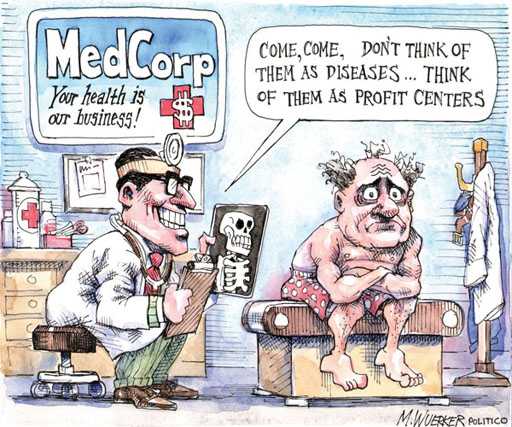
Cartoon – Centers of Profit

MedCorp” by Matt Wuerker, Politico | Kaiser Health News

Investor sues UHS execs, alleging ‘unfair’ stock gains amid pandemic

The US should tax excessive CEO compensation

A Universal Health Services investor is suing several executives of the King of Prussia, Pa.-based system, alleging they unjustly enriched themselves through stock options amid the pandemic, according to Law360

The lawsuit, filed in the Delaware Chancery Court and made public July 9, accuses UHS executives and directors of taking advantage of a pandemic-related temporary hit in the company’s stock price and argues taking the stock options was “grossly unfair to the company and its stockholders.”

“The controllers and other company insiders took advantage of the temporary drop in the company’s stock price to grant and receive options to buy the company’s stock at rock bottom prices, thereby showering themselves in excessive compensation,” the lawsuit claims.

In particular, the lawsuit claims that in just 12 days after the stock options were granted, defendants made over $30 million in gains. 

Several top execs were named as defendants, including Alan Miller, UHS founder and chair and Marc Miller, CEO and president of UHS. Three other UHS execs were named, as well as Warren Nimetz, an administrative partner of law firm Norton Rose Fulbright’s New York office.

“UHS’s directors and officers deny any liability associated with the company’s routine and publicly disclosed options grant in March 2020,” attorney Matthew Madden of Robbins Russell Englert Orseck & Untereiner, representing UHS, its executives and Mr. Nimetz, told Law360. “The options grant was in line with the company’s compensation practices in prior years and took place at a board meeting scheduled months in advance.”

Mr. Madden added that UHS’ executives and officials “acted properly” and that the plaintiff’s claims are “baseless.” 

“UHS is proud of its service to patients, and stewardship of investor capital, during these unprecedented times in the healthcare industry,” Mr. Madden told Law360.

The lawsuit was filed by Robin Knight. 

Biden administration begins to implement a ban on surprise bills

https://mailchi.mp/bfba3731d0e6/the-weekly-gist-july-2-2021?e=d1e747d2d8

Biden Faces Health Industry Fight Over New 'Surprise' Billing Ban

On Thursday, the Biden administration issued the first of what is expected to be a series of new regulations aimed at implementing the No Surprises Act, passed by Congress last year and signed into law by President Trump, which bans so-called “surprise billing” by out-of-network providers involved in a patient’s in-network hospital visit.

The interim final rule, which takes effect in 2022prohibits surprise billing of patients covered by employer-sponsored and individual marketplace plans, requiring providers to give advance warning if out-of-network physicians will be part of a patient’s care, limiting the amount of patient cost-sharing for bills issued by those providers, and prohibiting balance billing of patients for fees in excess of in-network reimbursement amounts.

The rule also establishes a process for determining allowable rates for out-of-network care, involving comparison to prevailing statewide rates or the involvement of a neutral arbitrator, but falls short of specifying a baseline price for arbitrators to use in determining allowable charges. That methodology, along with other details, will be part of future rulemaking, which will be issued later this year.

Of note, the rule does not include a ban on surprise billing for ground ambulance services, which were excluded by Congress in the law’s final passage—even though more than half of all ambulance trips result in an out-of-network bill. Expect intense lobbying by industry interests to continue as the details of future rulemaking are worked out, as has been the case since before the law was passed.

While burdensome for patients, surprise billing has become a lucrative business model for some large, investor-owned specialist groups, who will surely look to minimize the law’s impact on their profits.

Tenet to sell 5 Florida hospitals for $1.1B as it doubles down on surgery centers

Simultaneous Surgeries: Both Sides of the Debate Double Down

Dive Brief:

  • Tenet, a major U.S. health system, has agreed to sell five hospitals in the Miami-Dade area for $1.1 billion to Steward Health Care System, a physician-owned hospital operator and health network.
  • The deal also includes the hospitals’ associated physician practices. Dallas-based Steward has agreed to continue using Tenet’s revenue cycle management firm, Conifer Health Solutions, following the completion of the deal, which is expected to close in the third quarter.
  • Further underscoring Tenet’s strategic focus, the sale will not include Tenet’s ambulatory surgery centers in Florida. Tenet will hold onto those assets as its ambulatory business becomes a bigger focus for the legacy hospital operator.  

Dive Insight:

Dallas-based Tenet continues to bet on its ambulatory surgery business.

It’s noteworthy that this latest billion-dollar sale does not include any of its surgery centers in Florida, but half of its hospitals. Jefferies analyst Brian Tanquilut said the ambulatory segment now becomes even more important as it will contribute a majority of consolidated earnings in the near term. 

That’s a significant leap from 2014 when earnings from the ambulatory unit represented about 4% of the company’s earnings. 

The money generated from the sale could also pay for more ASCs, under Tenet’s unit, United Surgical Partners International (USPI), further bulking up Tenet’s ASC portfolio that already outnumbers its competitors.  

Tenet is traditionally viewed as a hospital operator, even though its surgery center footprint dwarfs its hospital portfolio. Tenet operates 310 ASCs following a $1.1 billion deal in December to acquire 45 centers from SurgCenter Development. Tenet said Wednesday it operates 65 hospitals.  

Of Tenet’s 10 Florida hospitals, Steward will buy up half, including Coral Gables Hospital, Florida Medical Center, Hialeah Hospital, North Shore Medical Center and Palmetto General Hospital.

Tanquilut said that leaves Tenet in control of its “core” south Florida business in the Boca and Palm Beach market, located about 75 miles north of the Miami area where Tenet is selling its hospitals.

During the volatile year of 2020, Tenet was able to post a profit of $399 million for the full year, which includes provider relief funding. As recovery continues, Tenet posted a profit of $97 million during the first quarter, which also includes federal relief due to the pandemic.