The slowdown that wasn’t

Economists anticipated lackluster economic growth last quarter. Instead, growth surged, a sign of the still-resilient economy.

Why it matters: 

The soft landing was very much intact this spring: Price pressures eased, but not at the expense of the strong economy and labor market.

What they’re saying: 

“While these estimates will be revised a few times, they do point to the continued strength of the U.S. economy despite the high interest rate environment we’ve been in for over a year,” NerdWallet senior economist Elizabeth Renter wrote this morning.

The big picture: 

The economy grew at an annualized 2.8% in the second quarter, up from the modest gain of 1.4% at the start of 2024.

  • The consumer was the key driver of last quarter’s strong economic growth. Personal consumption expenditures increased at a 2.3% annualized rate, gaining from the 1.5% pace in the prior period. That category contributed 1.6 percentage point to the increase in GDP figure.
  • Another big contributor to growth: Businesses stocked up inventories at a strong rate, adding 0.8 percentage point to GDP. Given that consumer spending was so brisk last quarter, the stocking was likely to keep up with current demand — not to make up for prior shortfalls.

Capital spending rose at a 5.2% annualized rate, reflecting a surge in spending on equipment (+11.6%) and continued investment in intellectual property (+4.5%).

  • The jump in spending on equipment and intellectual property “affirms our conjecture that the American economy is in the midst of a productivity boom that in turn will result in an improved standard of living across the economy for all cohorts,” RSM economist Joe Brusuelas wrote in a note.

Between the lines: 

A narrower measure of growth affirms the economy’s resiliency in the second quarter.

  • Final domestic private sector sales — which strips out volatile categories like inventory shift, government spending and trade — increased at a 2.6% annualized rate, the same as the previous quarter.

The intrigue: 

The second quarter saw strong growth alongside lower inflation — a reversal of dynamics observed in the January to March period, when inflation resurged and headline GDP moderated.

  • Still, other indicators point to potential risks for the economy. The unemployment rate has risen in recent months to 4.1%, the highest since 2021. Should the labor market lose steam, that could slow consumer spending and crimp the economy.

What to watch: 

The Federal Reserve holds a policy meeting next week. No rate changes are expected, though officials look likely to lay the groundwork for a rate cut in the fall.

U.S. economy surprises with strong 2.8% growth rate in second quarter

The U.S. economy grew at a 2.8% annualized rate in the second quarter—a faster rate than economists expected as consumer spending increased and businesses built up inventories, the Commerce Department said on Thursday.

Why it matters:

The new data raises confidence the economy has achieved a “soft landing” — healthy economic growth alongside cooling inflation.

  • Economists expected an annualized growth rate of 1.9% last quarter. The economy grew at a 1.4% rate in the first three months of the year.

Driving the news:

The accelerated growth stemmed from a jump in inventory investment and consumer spending.

  • Companies also increased spending on equipment and intellectual property. That was partly offset by a slump in housing, the government said.
  • Personal consumption expenditures rose at a 2.3% annualized rate last quarter, up from the 1.4% in the first quarter.
  • Consumer spending contributed 1.6% to the rise in GDP, while private inventories added 0.82 percentage point.

The big picture:

Gloomy forecasts of a recession over the past year have not come to pass.

  • The Federal Reserve raised interest rates to the highest in two-decades to restrain growth and bring down inflation—raising expectations those actions would tip the economy into a sharp slowdown.
  • Fed officials have cautiously suggested the economy has achieved a soft landing as inflation dissipates.
  • The central bank is expected to keep rates on hold at the policy meeting next week and set the table for a rate cut in September.

The bottom line:

The economy continues to defy expectations of a slowdown.

Inside the very good GDP report

Forget the much-discussed prospect of a soft landing for the U.S. economy. In 2023, there was no landing at all.

Why it matters: 

Big economic rules broke last year. The latest data to confirm that is the new GDP report showing very strong economic growth to conclude 2023, even amid a big cooldown in inflation.

  • Mainstream economists and policymakers believed a period of below-trend growth would be necessary to make progress on inflation.
  • Instead, above-trend growth in 2023 coincided with inflation falling sharply, reflecting improvement in the economy’s supply potential.

Driving the news: 

The economy expanded at a 3.3% annualized rate in the fourth quarter, well above the 2% forecasters expected. That followed the previous quarter’s blockbuster 4.9% growth.

  • GDP was 3.1% higher in the fourth quarter than a year earlier.
  • That represents an acceleration from 0.7% GDP growth in 2022, and trounced the growth rates of most other advanced countries — and the 1.8%-ish rate that economists consider the United States’ long-term trend.

Details: 

The fourth quarter’s hot growth resulted from bustling activity across the economy.

  • Consumers spent more on goods and services, with personal consumption expenditures rising at a 2.8% annualized pace. That was responsible for nearly 2 percentage points of the fourth quarter’s GDP rise.
  • Businesses spent on equipment, factories and intellectual property at a solid pace, with nonresidential fixed investment increasing at 1.9% — up from the previous quarter.

The intrigue: 

For two years now, Fed officials have spoken of the need for a period of below-trend growth to bring inflation into line. Now, they face the decision of whether to cut rates — to essentially declare victory on inflation — even as below-trend growth is nowhere to be seen.

  • A flourishing labor market, strong productivity gains and supply-side improvements — more workers joining the workforce, for instance — has (at least so far) meant the economy can keep growing at a solid pace without risking a pickup in price pressure.
  • [W]e had significant supply-side gains with strong demand,” Fed chair Jerome Powell said in his December press conference, adding that potential growth may have been higher than usual “just because of the healing on the supply side.”
  • “So that was a surprise to just about everybody,” Powell said.

What they’re saying: 

“This report feels like a supersonic Goldilocks: very strong GDP reading with cool inflation,” Beth Ann Bovino, chief economist at U.S. Bank, tells Axios. “Good news is good news.”

  • “With high productivity levels, we can have strong growth with less inflation. That was the case during the last soft landing in the 90s,” Bovino adds.

U.S. economy expands at 2.9% annual rate in fourth quarter

The U.S. economy grew at an annualized 2.9% rate in the final months of 2022, the Commerce Department said on Thursday.

Why it matters:

Economists are bracing for a significant slowdown in economic activity as the Federal Reserve’s interest rates hikes take hold, but that certainly wasn’t the case in the final months of last year.

  • Economists expected the Gross Domestic Product figures to show the economy grew at a 2.6% annualized rate last quarter, after expanding at a 3.2% pace in the prior quarter.

Details:

Consumer spending and businesses built up private inventories gave GDP the biggest boost. Among the biggest drags: fixed investment, a category that includes housing.

By the numbers:

Over the calendar year, GDP grew by 2.1% in 2022 — a decent pace, especially considering the historically aggressive rate hikes by the Federal Reserve that sought to restrain economic activity to contain inflation.

  • Those rate hikes hit the housing sector particularly hard, which dragged down overall growth earlier last year.

Catch up quick:

The first half of 2022 was dogged by fears that the economy had entered a recession, after back-to-back quarters of contractions. But by the second half of the year, the economy had returned to growth mode.

  • The growth over 2022 was an expected slowdown from the 5.9% achieved in 2021, when the economy bounced back from the pandemic shock.

November 2022 Health Sector Economic Indicators Briefs

https://altarum.org/publications/november-2022-health-sector-economic-indicators-briefs

Economic Indicators | November 18, 2022

Altarum’s monthly Health Sector Economic Indicators (HSEI) briefs analyze the most recent data available on health sector spending, prices, employment, and utilization. Support for this work is provided by a grant from the Robert Wood Johnson Foundation. Below are highlights from the November 2022 briefs.

Health spending growth continues to lag GDP growth

  • National health spending in September 2022 grew by 4.4%, year over year.
  • Health spending in September 2022 is estimated to account for 17.4% of GDP, essentially identical to the August 2022 value, which was the lowest share since June 2015.
  • Nominal GDP in September 2022 was 8.9% higher than in September 2021 as GDP growth continues to outpace health spending growth.
  • The health spending share of GDP has declined from a recent high of 18.5% of GDP in December 2021, largely because of high economy-wide inflation.

Health care price growth remains moderate amid slowing economywide inflation

  • The Health Care Price Index (HCPI) increased by 2.9% year over year in October, up slightly from 2.8% a month earlier. 
  • Economywide price growth slowed this month, as overall CPI inflation fell to 7.7% and PPI price growth fell to 8.0%. Services CPI growth (excluding health care) held steady at 7.0% year over year, while commodities inflation fell for a fourth straight month to 8.6%.
  • Among the major health care categories, price growth for dental care (5.4%), nursing home care (4.2%), and hospital services (3.5%) were above average, while physician services (0.3%) and prescription drug (2.2%) price growth were the slowest growing categories.
  • Growth in our implicit measure of utilization for September was the slowest it has been in 2022, down to 1.8% year-over-year growth from 2.2% a month prior in August.

Health care job growth remains strong while health care wage growth moderates

  • Health care job growth remained strong in October, with 52,600 jobs added. Health care has averaged 47,000 new jobs per month in 2022.
  • Most of the growth in health care jobs was in ambulatory care, which added 30,700 jobs in October. Hospitals added 10,800 jobs and nursing and residential care added 11,100 jobs.
  • The economy added 261,000 jobs in October, similar to August and September gains. The unemployment rate rose slightly to 3.7%.
  • Health care wage growth appears to be moderating. After peaking at 7.4% growth year over year in July, health care wages grew by 5.6% in September, nearer to economy-wide wage growth of 5.0%.
  • Wage growth fell across all three major health care settings: residential care wages grew at 7.7% compared to a peak of 11% in March 2022, hospital wages grew by 5.8% compared to a peak of 8.5% in June, and ambulatory care wages grew by 4.6% compared to a peak of 5.8% in July.

U.S. economy returned to growth in Q3

The U.S. economy expanded at a 2.6% annual rate in the third quarter, ending the streak of back-to-back contractions that raised fears the country had entered a recession.

Why it matters: Gross domestic product got a boost from trade dynamics, but the underlying details — including weaker housing and decelerating consumer spending — point to an economy that’s slowing.

  • The first estimate of GDP, released by the Commerce Department on Thursday, will be revised in the coming months as the government gets more complete data.
  • The report comes on the heels of negative GDP growth during the first half of the year. In the January through March period, the economy contracted at a 1.6% annual rate. In the second quarter, the economy shrank at a 0.6% annualized pace.

Between the lines: The latest GDP report is among the final major economic data releases before the midterm elections, where voters have ranked the economy as a critical issue.

  • The labor market is solid, with the unemployment rate at the lowest level in over 50 years. But soaring inflation has eaten away at Americans’ wage gains.

The backdrop: The Federal Reserve is trying to engineer an economic slowdown in a bid to crush high inflation. It has swiftly raised borrowing costs five times this year, with another big increase likely ahead at its upcoming policy meeting next week.

What they’re saying: “For months, doomsayers have been arguing that the US economy is in a recession and Congressional Republicans have been rooting for a downturn,” President Biden said in a statement. “But today we got further evidence that our economic recovery is continuing to power forward.”

Why the US healthcare system ranks last among 11 wealthy countries

U.S. Health Care Ranks Last Among Wealthy Countries | Commonwealth Fund

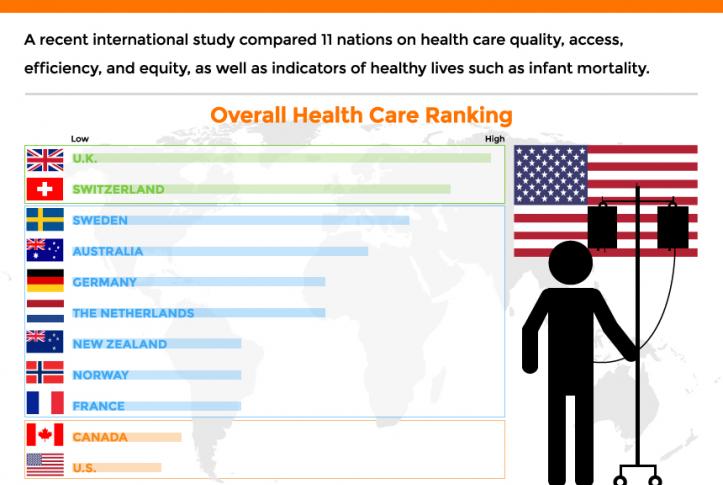
The performance of the U.S. healthcare system ranked last among 11 high-income countries, according to a report released Aug. 4 by the Commonwealth Fund.

To compare the performance of the healthcare systems in 11 high-income countries, the Commonwealth Fund analyzed 71 performance measures across five domains: access to care, care process, administrative efficiency, equity and patient outcomes.

Despite spending far more of its gross domestic product on healthcare than the other nations included in the report, the U.S. ranked last overall, as well as last for access to care, administrative efficiency, equity and patient outcomes. However, the U.S. ranked second on measures of care process, trailing only New Zealand.

Norway, the Netherlands and Australia had the best healthcare system performance, according to the report. In all seven iterations of the study conducted by the Commonwealth Fund since 2004, the U.S. has ranked last. It is the only country included in the study that does not provide its citizens with universal health insurance coverage.

Four features separate the top performing countries from the U.S., according to the report: universal health insurance coverage and removal of cost barriers; investment in primary care systems to ensure equitable healthcare access; reduction of administrative burdens that divert time and spending from health improvement efforts; and investment in social services, particularly for children and working-age adults.

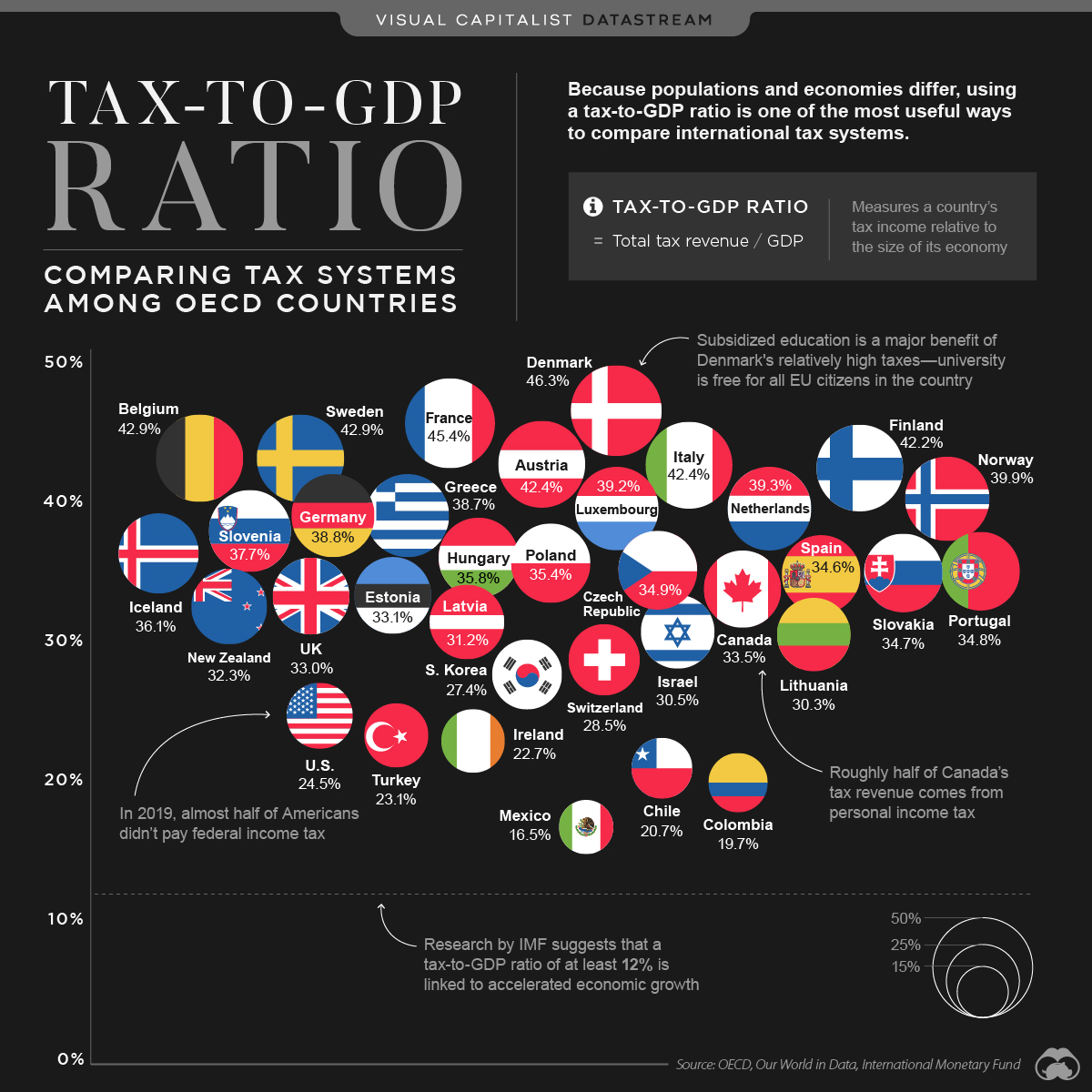
Tax-to-GDP Ratio: Comparing Tax Systems Around the World

Did a third of the economy really vanish in just three months?

https://www.washingtonpost.com/business/2020/07/30/did-third-economy-really-vanish-just-three-months/?utm_campaign=wp_main&utm_medium=social&utm_source=facebook&fbclid=IwAR11oZa1zNZ4rPe-mKLgDKQDwgqCYa_r9DXpQtycSqu0ojgHKGVN8H8ljOs


The second quarter GDP report confused many, but any way you slice it, the economy saw its worst quarter in at least 145 years.

The Commerce Department opened today’s announcement of second-quarter economic growth with an eyeball-blistering observation: “Real gross domestic product (GDP) decreased at an annual rate of 32.9 percent in the second quarter of 2020.”

That 32.9 percent represents the loss of a third of the economy. Let that sink in. Now let it wriggle back out again — it is not exactly true. Why? The Commerce Department reports quarterly GDP at an annual rate to allow easy comparisons to other time periods. Remove the annualization, and we see the economy contracted a still-abysmal 9.5 percent.

In other words, 32.9 percent is how much the economy would shrink if the business closures and spending cuts of the second quarter increased at a compounding 9.5 percent for an entire year, after adjusting for seasonality.

Think of what an apocalypse that would be. Annualization assumes the businesses closed this quarter would remain closed and that just as many more would close in the third quarter. And we’d expand the closures again in the fourth quarter and again in the first quarter of next year.

In other words, take the devastation you saw in the past three months and multiply it by four. That is essentially what annualizing does, though compounding means the actual math is a bit more complicated.

The Commerce Department’s affection for annualization does not stop at percentage change. It also reports quarterly GDP totals at an annualized rate — when Commerce says GDP was at $17.2 trillion in the past quarter, it means GDP would be at $17.2 trillion if this quarter’s $4.3 trillion in output continued for a full year.

With that in mind, here is U.S. GDP, adjusted for inflation and reported as quarterly totals, as suggested by reader Nick Estes.

That chart does not crash by a third, obviously. A 32.9 percent drop would mean a loss of about $1.6 trillion from last quarter. In fact, the economy shrank $0.45 trillion in the second quarter, on the heels of a $0.06 trillion (1.3 percent) decrease in the first quarter of 2020.

To see a third of the economy truly vanish, look at the Great Depression. From 1929 to 1933, GDP contracted about 36 percent, according to data collected by economists Nathan Balke and Robert Gordon. That is the actual contraction — no annualization in sight.

Commerce Department data, which start in 1947, show the previous worst quarter on record was a 2.6 percent drop in 1958. That contraction just happened to coincide with the “Asian flu” pandemic, which claimed about a million lives worldwide.

With Balke and Gordon’s expanded data, we can also establish that a drop of 9.5 percent makes this quarter the worst since at least 1875. The next worst were in 1893, when a legendary panic and run on the banks resulted in a long, painful depression, and 1937, when the Great Depression took a turn for the worse. Then, we saw drops of 8.4 percent and 7.2 percent, respectively.


3 Months Of Hell: U.S. Economy Drops 32.9% In Worst GDP Report Ever

https://www.npr.org/sections/coronavirus-live-updates/2020/07/30/896714437/3-months-of-hell-u-s-economys-worst-quarter-ever?utm_campaign=storyshare&utm_source=facebook.com&utm_medium=social&fbclid=IwAR1L_YW1uYovd5bpjtU6xV7HI_DgGsYPgmdEs3fz0RbOn8XukrKhafRsljE

Economy Shrank At 32.9% Rate In 2nd Quarter

Percent change from the preceding period, seasonally adjusted annual rate

3 Months Of Hell: U.S. Economy Drops 32.9% In Worst GDP Report ...

The coronavirus pandemic triggered the sharpest economic contraction in modern American history, the Commerce Department reported Thursday.

Gross domestic product — the broadest measure of economic activity — shrank at an annual rate of 32.9% in the second quarter as restaurants and retailers closed their doors in a desperate effort to slow the spread of the virus, which has killed more than 150,000 people in the U.S.

The economic shock in April, May and June was more than three times as sharp as the previous record — 10% in 1958 — and nearly four times the worst quarter during the Great Recession.

“Horrific,” said Nariman Behravesh, chief economist at IHS Markit. “We’ve never seen anything quite like it.”

Another 1.43 million people filed for state unemployment last week, an increase of 12,000, the Labor Department reported Thursday. It was the second week in a row of increased unemployment filings and shows that the economic picture continues to remain grim.

GDP swings are typically reported at an annual rate — as if they were to continue for a full year — which can be misleading in a volatile period like this. The overall economy in the second quarter was 9.5% smaller than during the same period a year ago.

After a sharp drop in March and April, economic activity began to rebound in May and June, although that recovery remains halting and could be jeopardized by a new surge of infections.

“As soon as the virus started to take off again in key states like Texas, California, Arizona, Florida, it’s fading very rapidly,” Behravesh said.

Restaurant owner Cameron Mitchell likens the pandemic to a hurricane. What appeared to be a business rebound in June turned out to be merely the eye of the storm, and he’s now being buffeted by gale-force winds again.

“Our associates are more scared to work today and guests are more afraid to go out, so sales have dropped,” Mitchell said.

Business at his restaurants in Florida had nearly recovered to pre-pandemic levels in June but has since fallen sharply.

Other industries have enjoyed a more durable recovery, though few are back to where they were in February.

Dentists’ offices are ordinarily one of the more stable parts of the economy, but they closed for all but emergency services during much of the spring. Dental hygienist Alexis Bailey was out of work for 10 weeks before her office in Lansing, Mich., reopened at the end of May.

At first, she was reluctant to go back to work while the virus was still circulating.

“I was terrified,” Bailey said. “I was not happy to be back. But I have a job to do and I like to do it and I want to help people. We talk about how essential we are, so that’s what we’ve had to do.”

Within an hour of returning to work, Bailey said, she began to feel comfortable, particularly with the additional protective gear and other safety precautions her office has adopted.

“I tell my patients all the time I wouldn’t be here if I didn’t feel safe,” she said.

Nationwide, dental offices added more than a quarter-million jobs in May and another 190,000 in June. And there has been no shortage of patients.

She thought no one would want to come. “But we’re booked,” Bailey said. “People miss getting their teeth cleaned. They want to catch up. Every time they come in, they say, ‘This has been nice to get out of the house and feel safe and talk to somebody.’ ”

Factory production has also begun to rebound, along with construction. But airlines and amusement parks are still struggling.

“It’s very much a sort of two-tiered economy right now,” Behravesh said.

The unemployment rate approached 15% in April, and in June it was still higher — at 11.1% — than during any previous postwar recession.

While the drop in GDP was largely driven by a decline in consumer spending, the economic fallout was cushioned somewhat by an unprecedented level of federal relief.

Wages and salaries fell sharply in April, but that was more than offset by the $1,200 relief payments that the government sent to most adults and by supplemental unemployment benefits of $600 per week.

Those government payments helped prevent an even steeper drop in consumer spending — the lifeblood of the U.S. economy — and allowed struggling families to buy groceries and pay rent.

Federal Reserve Chair Jerome Powell said Wednesday that the money “has been well spent. It has kept people in their homes. It has kept businesses in business. So that’s all a good thing.”

Those extra unemployment benefits are expiring this week, though. With coronavirus infections still threatening the recovery, additional federal support is likely to be necessary.

“Until we get the virus under control, we’re going to need more help,” Behravesh said. “Our view is that we’re not going to get to the pre-pandemic levels of economic activity until some time in 2022.”

Restaurant owner Mitchell says his business lost $700,000 in June alone. He predicts a wave of restaurant bankruptcies unless the federal government provides more relief.

“No one is looking for a handout here,” he said. “We’re looking to survive.”

He’s watching news of vaccine trials closely in hopes that eventually diners will feel comfortable eating out again in large numbers.

“I don’t think it’s the next couple of weeks,” he said. “But I tell our team, ‘Every day that goes by, it’s one day closer to the end of this thing.’ ”