

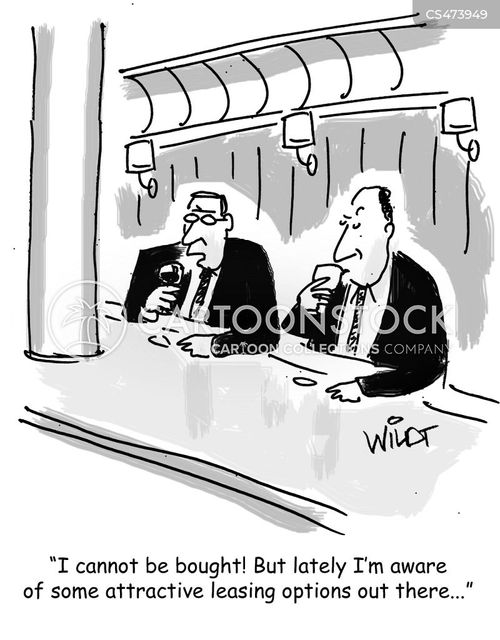
Cartoon – Some Attractive Leasing Options


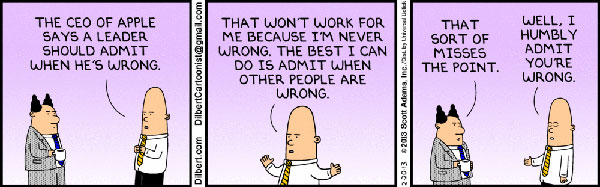

Fauci’s warning stands in obvious contrast to the assertions of his boss, President Trump. As he has so often over the course of the pandemic, Trump waves away questions about whether states are ready to resume normal economic activity, insisting that many places are ready to gear back up. His White House released a set of recommendations for doing so, recommendations to which Fauci will refer. But even as those recommendations were introduced, Trump undercut them. He quickly embraced anti-social-distancing protests in states with blue governors — states where things were not yet ready to return to normal.
The recommendations espoused by Fauci (and, ostensibly, Trump) set an initial baseline of data that states should meet before taking even introductory steps toward reopening their economies. They’re centered on three categories benchmarks: coronavirus symptoms, actual cases and hospital capacity. The initial presentation from the White House explained how those benchmarks could be met:
For the first two, we have publicly available data that allows us to evaluate how states are doing. In the case of demonstrated symptoms, the data are somewhat old, with the most recent metrics reflecting the week of May 2. What’s more, data on the number of people showing up to emergency rooms with symptoms reflecting possible covid-19 cases (the disease caused by the coronavirus) are compiled only by region. Nonetheless, we can get a sense for how many people in each place are showing symptoms as well as up-to-date information on the number of cases and positive tests in each state.
By now, many states appear to meet the benchmarks on these two conditions. (Again, given the limits on the symptomatic data, it’s tricky to say how each fares in the moment.) A number of states that have already begun to reopen, though, don’t. In Texas, for example, the number of new cases is up and the percent of positive tests is flat. In Georgia, the number of new cases is flat and the rate of positive tests has been variable. Both states are nonetheless reopening.
Georgia’s been in the process of reopening for about three weeks, despite missing the basic benchmarks even when that process began. Gov. Brian Kemp (R) made a blanket determination that things could get back to normal, ignoring the sort of regionalized shifts that Trump himself has advocated.
New York, the state hit hardest by the virus, has implemented a deliberate, region-by-region plan for reopening. Gov. Andrew M. Cuomo (D) has outlined seven different criteria in each region of the state before it can resume some normal economic activity (though not all). (Among those? A program sufficient to trace the contacts of individuals with newly confirmed infections.) As of Monday, only three regions met the seven conditions. New York City hit four of the seven.
This is presumably how states are encouraged to reopen to avoid Fauci’s most dire predictions. It’s no guarantee that outbreaks won’t emerge, but New York’s plan is predicated on safety over normalcy while Georgia’s appears to be the opposite.
That’s the important context for Fauci’s testimony. His warnings about moving slowly are not new — though, in the past, they’ve mostly been tempered by the looming physical presence of a president who’s not very interested in diluting his optimistic economic assumptions. Fauci’s language about the ramifications is strong, but the message is consistent.
It also comes a bit too late for states such as Georgia — at least at the official level. One effect of the effort to get the state back to normal is that many Georgians aren’t ready to do so. Economic data shows that, despite businesses being open, they’re often not seeing many customers. The state’s residents are skeptical about getting back to normal. A new Post-Ipsos poll suggests that they are also skeptical of their governor.
Those participating in protests against social distancing are a small minority. Most Americans understand the thrust of Fauci’s concerns and are willing to support continued social distancing measures. While governors are occasionally skipping over the guidelines offered by Fauci and his team, the consumers who can return the economy to normal are still wary — and may be the best audience for Fauci’s warnings.


Criticism of Anthony Fauci from the right has picked up in recent days, with some conservatives calling for Trump to dump the infectious disease expert after he made comments about how imposing social distancing rules earlier could have slowed the spread of the novel coronavirus in the United States.
Fauci has become a national name with his regular presence at the daily coronavirus task force briefings and in other media appearances, and poll numbers show he’s trusted by a majority of Americans. It would set off a political storm if Trump were to sideline him in the middle of a pandemic.
Yet the criticism of Fauci by two conservative lawmakers in a Saturday op-ed and Trump’s own retweet of a conservative’s call to “#FireFauci” were unmistakable signs that the public health official is coming under pressure from some on the right to be loyal to the president.
Tensions between Fauci and Trump have been evident at times in recent weeks. The doctor put his head in his hand at one March briefing where the president quipped about the “Deep State Department,” and Trump stepped in at a briefing this month before Fauci could give his opinion on hydroxychloroquine.
The president had publicly praised Fauci as “extraordinary” and dismissed speculation about a rift between the two, joking on Friday that Fauci is so popular he could run against Rep. Alexandria Ocasio-Cortez (D-N.Y.) and “win easily.” For the most part Fauci has seemed to successfully walk the line between contradicting Trump without outright criticizing him.
But Trump’s tweet on Sunday marked a shift and coincided with a fresh groundswell of conservative push-back toward the doctor as Trump comes under intense criticism for his slow response to the virus.
Some of the more pointed criticism of Fauci came after he said on CNN Sunday that more lives could have been saved if stay-at-home measures were implemented earlier than mid-March.
The comments irked Trump allies who viewed them as revisionist history given how Fauci’s own public statements evolved throughout January and February as scientists learned more about the virus and it spread through the U.S.
Jason Miller, a former Trump adviser who now hosts a radio show focused on the pandemic, said Fauci must be careful with how he talks about the crisis, but also described “finger pointing” as media chatter seeking to pull the administration apart.
“This talk of potential removal from the team is unnecessary media chatter trying to draw a divide where one doesn’t exist,” Miller said.
“I think what this is about is about the accuracy with which Dr. Fauci is communicating with both the president and the American people,” he added. “It’s critical as the lead scientist and health expert advising the president on the coronavirus pandemic that he be spot on with his details. I think the recent finger pointing and revisionist history whether intentional or accidental doesn’t help anybody.”
One source close to the administration said, while some inside would like to see Fauci gone, most recognize there is more value to keeping him on.
“I don’t sense there’s a monolithic view,” the person said. “There are some who dislike him and want him out of the [administration] but I think most recognize it’s better for him to be in the tent than outside of it.”
Fauci’s CNN remarks followed a New York Times article detailing how Trump ignored early warnings about the virus and initially resisted recommendations to implement social distancing recommendations, reporting that Trump has dismissed as “fake.”
One of Trump’s many tweets Sunday night defending his response quoted a former GOP congressional candidate who said it was “time to #FireFauci,” citing his Feb. 29 comments that there was not yet a need for Americans to alter their day-to-day lives.
Fauci has been clear that his realm of expertise is public health, and he has suggested at times that social distancing guidelines will be needed for weeks or months to limit the spread of the virus.
Others inside and outside the administration are advocating that it take steps to open up the economy soon, and emphasizing that health experts can’t be the only voices involved in the decision.
“Anthony Fauci should be deferring to the President when answering questions about timing of economic reopening,” Fox News host Laura Ingraham tweeted on Sunday.
Reps. Andy Biggs (R-Ariz.) and Ken Buck (R-Colo.) penned an op-ed in the Washington Examiner over the weekend arguing that Fauci should not be a primary voice speaking on the coronavirus outbreak after the public health official late last month described social distancing as an “inconvenient” from societal and economic standpoint.
The criticism of Fauci comes amid a concerted effort among Trump and his supporters to shift blame away from the White House for its handling of the coronavirus, which has infected more than 557,000 people in the U.S. and killed more than 22,000 in the country. The president has at various points blamed governors for failing to prepare for the pandemic, deflected criticism toward the World Health Organization (WHO) and accused Democrats of using impeachment as a distraction.
Fauci, director of the National Institute of Allergy and Infectious Diseases since 1984, has been a ubiquitous presence during the coronavirus outbreak, appearing on political talk shows, sports podcasts and Instagram live chats.
He has emerged as something of a beacon for liberals in particular for his willingness to gently correct Trump on matters like a timetable for a vaccine and the efficacy of hydroxychloroquine, an anti-malaria drug the president has touted as a potential treatment for the coronavirus.
But his prominence has made him a target of criticism, so much so that he was given added security at the end of March.
One feature of Trump’s presidency has been his distrust of long-time government officials, particularly those who have served in previous administrations. Another has been Trump’s tendency to tire of aides and advisers who garner more of a spotlight than he does, putting Fauci in a precarious position even at a time when his expertise is most relevant.
Trump would have difficulty firing Fauci, who is not a political appointee, without cause. Attempting to do so would cause a firestorm among even some Republicans who have urged the president to listen to his health experts.
But one former administration official suggested Fauci could see his influence reduced. The official likened it to the way Health and Human Services (HHS) Secretary Alex Azar has been diminished after he warned Trump in January and February about the threat of a pandemic but was dismissed as too alarmist.
“What happens when somebody repeatedly tells the president something he doesn’t want to hear?” said the former administration official, who requested anonymity to speak candidly. “He won’t fire [Fauci], but he’ll just sideline him.”
But doing so could risk damaging public confidence in the administration’s response to the virus.
A Monmouth University poll released last week found that 35 percent of Americans named Fauci when asked who they trust the most among public officials who discuss the outbreak on television, whereas 20 percent named Trump.
“Regardless of the issue, [Trump is] not always his most disciplined messenger,” said GOP strategist Doug Heye. “The more that he’s able to rely on the expertise of scientists, the more credibility that it gives him in this entire process.”

 HENRY KOTULA