Baylor Scott & White to cut, outsource 1,700 jobs

Baylor Scott & White Health To Outsource, Eliminate 1,700 Positions – CBS  Dallas / Fort Worth

Dallas-based Baylor Scott & White Health will outsource, lay off or retrain 1,700 employees who work in information technology, billing, revenue cycle management and other support services, according to The Dallas Morning News

The health system said outsourcing the finance and IT jobs and other support services will help it improve efficiencies and focus on reducing costs in noncore business areas.

About two-thirds of the 1,700 employees will be joining third-party RCM, IT, billing or support staff vendors.
About 600 to 650 positions will be eliminated. 

Baylor Scott & White said that employees whose positions are being eliminated will be invited to participate in retraining programs. 

The retraining program would allow the employees to remain employed at the health system and receive the same pay or higher, depending on their role, according to the report. Some of the retraining programs that will be available are learning to become a certified medical assistant or learning a job in patient support services.

“In no case — in no case — is anyone going to miss a paycheck,” Baylor Scott & White CEO Jim Hinton, told The Dallas Morning News. “We can afford to make these commitments, and we want to do the right thing for the great employees of Baylor, Scott & White. They’ve really done everything we’ve asked and more during this last year.”

This is the third time Baylor Scott & White has announced cost-cutting initiatives related to its workforce since the pandemic began. Last May, 930 Baylor Scott & White employees were laid off, and in December the health system said it would lay off employees and outsource 102 corporate finance jobs. 

Mr. Hinton said that Baylor Scott & White has 2,000 clinical positions open, and it is investing in a new regional medical school campus and a joint venture to improve care for the underinsured. 

“This is a transition to a new business model, a transition to a new way of working,” Mr. Hinton told The Dallas Morning News. 

Economy shrank 3.5 percent in 2020

https://thehill.com/policy/finance/536247-economy-shrank-35-percent-in-2020

How fish and shrimps could be recruited as underwater spies | | News For  Tomorrow

The U.S. economy shrank 3.5 percent in 2020 as the coronavirus pandemic shuttered businesses, schools and events, marking the first annual contraction since the Great Recession, according to data released by the Commerce Department on Thursday.

U.S. gross domestic product (GDP) suffered its largest annual decline since 1946 due to the coronavirus pandemic, according to the Commerce Department release. The outbreak of COVID-19 caused the steepest economic collapse since the Great Depression, wiping out more than 20 million jobs and years of economic growth within two months.

U.S. GDP increased by an annualized rate of 4 percent in the final three months of 2020, according to the data released Thursday, following an annualized gain of 33.4 percent in the third quarter and a 31.4 percent annualized decline in the second quarter. But the economic rebound staged in the second half of 2020 has been dampened by the continued rapid spread of COVID-19 throughout the country.

The U.S. economy came into 2020 remarkably strong. Unemployment reached a 50-year low of 3.5 percent in the previous year, inflation remained low and the U.S. had just set a record for the longest economic expansion in its modern history. While the U.S. was likely to face some headwinds from slowing economies overseas, the stunning emergence of the coronavirus pandemic shattered the strong labor market and forced thousands of businesses to shutter.

Consumer spending — which makes up nearly two-thirds of the U.S. economy — fell 2.6 percent in 2020, driven mainly by a 3.4 percent decline in spending on services. Spending on goods rose 0.8 percent, however, as purchases shifted from gatherings to products that could be used during lockdowns.

Economists expect the U.S. economy to bounce back quickly in the second half of 2021, assuming enough Americans are vaccinated to prevent large coronavirus outbreaks. Both economists and health experts insist that a full return to normal is not possible until the pandemic is defeated. 

Roughly 9 million jobs lost during the onset of the pandemic have yet to be recovered, and those without work have struggled to get by with swaths of the economy still largely shut down by the virus. The federal government approved more than $4 trillion to fund pandemic response and economic rescue in 2020, though Democratic lawmakers and many economists say more is still needed.

President Biden and congressional Democrats are pushing to pass another $1.9 trillion COVID-19 bill meant to ramp up vaccine distribution and offer more economic relief to those in the greatest need.

Republican lawmakers have not ruled out passing another relief bill, but most object to the size and scope of Biden’s proposal after approving a $900 billion measure in December.

Treasury Secretary Janet Yellen and Federal Reserve Chairman Jerome Powell have both warned lawmakers that the risks of holding back on necessary fiscal relief are far greater than adding more to the national debt or risking an increase in inflation.

“I’m much more worried about falling short of a complete recovery and losing peoples’ careers and lives and the damage that will do to productive capacity than about the possibility of higher inflation,” Powell said Wednesday.

New unemployment claims jump to nearly 1 million, the highest level since August

Unemployment rate remains at 6.7%, employers cut 140,000 jobs last month -  ABC News

The number of new unemployment claims filed last week jumped by 181,000 the week before to 965,000, the largest increase since the beginning of the pandemic.

It was the largest number of new unemployment claims since August.

An additional 284,000 claims were filed for the Pandemic Unemployment Assistance, the insurance for gig and self-employed workers.

The weekly report is President Trump’s last before President-elect Joe Biden is sworn in on Jan. 20. Biden will inherit a labor market badly weakened by the coronavirus pandemic and an economic recovery that appears to have stalled: 140,000 people lost their jobs in December, the first decline in months, with the U.S. still down millions of jobs since February.

The dire numbers will serve as a backdrop for Biden as he formally unveils an ambitious stimulus package proposal on Thursday, which could top $1 trillion, and is expected include an expansion of the child tax credit, a $2,000 stimulus payment, and other assistance for the economy.

Democrats were already using the weak labor to argue about the necessity of more aid.

Economists say that the economy’s struggles could be explained, in part, by the delay Congress allowed between the summer, when many fiscal aid programs expired and December, when lawmakers finally agreed on a new package after months of stalemate.

The number of new jobless claims has come down since the earliest days of the pandemic, but remains at a extremely high level week in and week out.

The total number of continuing people in any of the unemployment programs at the end of the year was 18.4 million, although officials have cautioned that the number is inflated by accounting issues and duplicate claims.

The increase in claims is not entirely unexpected. As the aid package passed by Congress in December kicks in, including a $300 a week unemployment supplement, some economists expected that to result in more workers filing claims.

Economy loses 140K jobs in December, first losses since April

https://thehill.com/policy/finance/533242-december-jobs-report

57% of Unemployed Americans Blame COVID-19 for Job Loss - New Jersey  Business Magazine

The economy lost 140,000 jobs in December, the first reported losses since April, as the unemployment rate remained steady at 6.7 percent.

Economists expected a small jobs gain of nearly 50,000. The drop is the latest sign of a weakening economy amid the ongoing COVID-19 crisis. All in all, the economy remains about 10 million jobs below its pre-pandemic levels.

“There’s not much comfort to be taken from the stable unemployment rate, given that millions of Americans have left the labor force with nearly 11 million listed as officially out of work,” said Mark Hamrick, senior economic analyst at Bankrate.com.

“Between the human and economic tolls taken by the pandemic, these are some of the darkest hours of this soon-to-be yearlong tragedy.”

The biggest losses were concentrated in leisure and hospitality, a sector particularly vulnerable to the effects of the pandemic, which lost an astonishing 498,000 jobs.

State and local government payrolls shed 51,000 jobs. Congress deferred passing state and local aid in its latest COVID-19 relief bill.

But the overall loss would have been worse had it not been for gains in professional and business services, which added 161,000 jobs; retail trade, which added 120,500 jobs; and construction, which added 51,000.

Some demographic groups have been hit harder by the economic downturn.

The unemployment rate for Hispanics rose to 9.3 percent in December, while Black unemployment remained elevated at 9.9 percent. The rate for whites was 6 percent, and for Asians it was 5.9 percent.

Over a third of jobless people have been unemployed for over 27 weeks.

Employment in Economic Downturns

Jobless claims remain high

An estimated 803,000 people applied for unemployment aid for the first time last week, the Labor Department said Wednesday, showing the economy’s persistent weakness as new drama swirls over Washington’s response to the crisis. The figure was a slight decrease from the previous week but still much higher than normal.

The new Labor Department data show how weak the economy is, particularly the labor market. The surge in new coronavirus cases and deaths in the past few months has cooled the partial economic recovery from the summer.

Retail sales have weakened, and hiring has slowed markedly. The travel and tourism industries have not recovered much of the business lost since March, and thousands of companies — particularly restaurants and bars — have closed. U.S. household spending slipped in November, marking the first drop since April.

After months of stop-and-start negotiations, the bipartisan stimulus package finally offered some hope for households and businesses fighting to make it through the winter.

If Trump does not sign the bill, up to 14 million Americans would lose unemployment aid after Christmas. An eviction moratorium will expire at the end of the year, and $25 billion in emergency rental assistance will not get out the door. Billions of dollars for nutrition assistance, aid for small businesses, child care, transportation services and more will be in jeopardy, and the government will shut down on Dec. 29.

Trump did not play much of a role in the economic relief talks that resulted in Congress passing the $900 billion stimulus package. In the video Trump posted Tuesday night, his main complaint was that he wanted the $600 stimulus checks in the package to be increased to $2,000. This would add $370 billion to the measure.

Democrats quickly rallied around Trump’s demand, and House Speaker Nancy Pelosi (D-Calif.) plans to try to hold a vote on it as soon as Thursday. But it could be virtually impossible to pass such a measure through Congress with unanimous support, leaving the entire bill’s future uncertain.

The stimulus package would extend unemployment benefits of up to $300 per week, beginning as soon as Dec. 27 and run at least through mid-March. The measure also would extend Pandemic Unemployment Assistance — which targets part-time and gig workers who did not qualify for state unemployment insurance benefits — for 11 weeks.

Wednesday’s data showed nearly 400,000 new claims for the Pandemic Unemployment Assistance program.

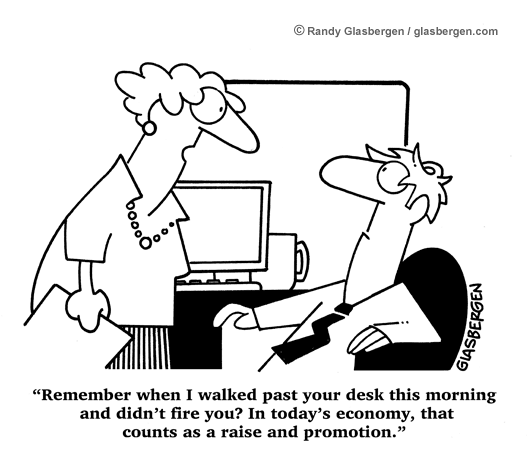
Cartoon – The Current Line

Northern CA News, Sports & Politics | The Sacramento Bee

Unemployment claims rose sharply last week as economic crisis grinds on

U.S. Unemployment Claims Rise Amid Coronavirus Surge - WSJ

Applications for jobless benefits resumed their upward march last week as the worsening pandemic continued to take a toll on the economy.

More than 947,000 workers filed new claims for state unemployment benefits last week, the Labor Department said Thursday. That was up nearly 229,000 from the week before, reversing a one-week dip that many economists attributed to the Thanksgiving holiday. Applications have now risen three times in the last four weeks, and are up nearly a quarter-million since the first week of November.

On a seasonally adjusted basis, the week’s figure was 853,000, an increase of 137,000.

Nearly 428,000 applied for Pandemic Unemployment Assistance, a federal program that covers freelancers, self-employed workers and others who don’t qualify for regular state benefits.

Unemployment filings have fallen greatly since last spring, when as many as six million people a week applied for state benefits. But progress had stalled even before the recent increases, and with Covid-19 cases soaring and states reimposing restrictions on consumers and businesses, economists fear that layoffs could surge again.

“It’s very clear the third wave of the pandemic is causing businesses to have to lay people off and consumers to cut back spending,” said Daniel Zhao, senior economist for the career site Glassdoor. “It seems like we’re in for a rough winter economically.”

Jobless claims rose in nearly every state last week. In California, where the state has imposed strict new limits on many businesses, applications jumped by 47,000, more than reversing the state’s Thanksgiving-week decline.

The monthly jobs report released on Friday showed that hiring slowed sharply in early November and that some of the sectors most exposed to the pandemic, like restaurants and retailers, cut jobs for the first time since the spring. More up-to-date data from private sources suggests that the slowdown has continued or deepened since the November survey was conducted.

Every month, we’re just seeing the pace of the recovery get slower and slower,” said AnnElizabeth Konkel, an economist with the job site Indeed. Now, she said, the question is, “Are we actually going to see it slide backward?”

Many economists say the recovery will continue to slow if the government does not provide more aid to households and businesses. After months of gridlock in Washington, prospects for a new round of federal help have grown in recent days, with congressional leaders from both parties signaling their openness to a compromise and the White House proposing its own $916 billion spending plan on Tuesday. But the two sides remain far apart on key issues.

The stakes are particularly high for jobless workers depending on federal programs that have expanded and extended unemployment benefits during the pandemic. Those programs expire later this month, potentially leaving millions of families with no income during what epidemiologists warn could be some of the pandemic’s worst months.

Hospital workforce tracker: layoffs, furloughs and pay cuts

https://www.healthcaredive.com/news/hospital-workforce-tracker-layoffs-furloughs-and-pay-cuts/576890/

Hospital workforce tracker: layoffs, furloughs and pay cuts | News Break

Many hospitals are temporarily or permanently reducing the size of their workforce as they grapple with depleted revenues and the thorny question of when they can return to normal operating capacity. Here’s a tracker to follow the latest updates.

Hospitals across the country, financially battered as they face the dual challenges of sick COVID-19 patients and a precipitous decline in patient volume, are struggling to balance quickly shifting staffing needs. While some face and others brace for intense demand, many have announced furloughs of specialists and others that work in elective surgeries that have been drastically scaled back.

Thousands of healthcare workers at hospitals big and small have been asked not to return to work, and it’s still unclear how soon non-essential services will return. While some governors announce plans to reopen businesses, others have extended stay-at-home orders.

Most recent data from the U.S Bureau of Labor doesn’t cover the second half of March or early April, but during the first half of March, the healthcare industry shed 43,000 jobs — reversing a decade of growth in the sector. According to BLS data, the industry added 49,000 jobs in March 2019.

“Even our emergency room has seen a significant drop in patients coming in,” Sue Philips, an ICU nurse at Palomar Pomerado Health in Northern San Diego, told Healthcare Dive.

Phillips is a spokesperson with National Nurses United, the country’s largest nurses union. Palomar Health, which runs three medical centers in northern San Diego County, recently instituted 21-day temporary layoffs of 221 employees.

On April 28, Palomar announced that most of those layoffs were becoming permanent. The system laid off 5% of its workforce, eliminating 317 positions. Fifty of those employees were clinical RNs, mostly in part-time positions, and the rest spread across the organization ranging from clerical staff to technicians.

Due to a 50% decrease in patient volumes, Palomar lost $10 million in revenue in March alone, according to a statement. In April the system said it stands to lose $20 million or more.

“I’m an ICU nurse, so my job is pretty much protected,” Phillips said. “But you didn’t think you were expendable until you became expendable, and that’s a hard pill for nurses and caregivers to swallow.”

Congress has attempted to financially support struggling hospitals through ongoing coronavirus relief legislation, approving some $175 billion thus far. But without knowing what will come next, hospitals are attempting to remain nimble while reining in one of their most costly expenses — paying employees.

The following information is based on publicly reported data, along with interviews with hospital representatives and union members.

It’s not an exhaustive list, but features nonprofit and for-profit hospital systems that reported revenue above $10 billion in 2019. It also takes a look at smaller, more regionally based systems that have announced similar cutbacks.

Click on link above to use the dropdown to find a company.