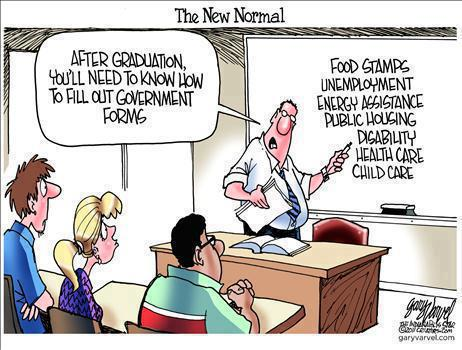
Cartoon – The New Normal

Education to employment: Getting Europe's youth into work - The ...

Cartoon – Jobless Economic Recovery

Unemployment Figure Cartoons and Comics - funny pictures from ...

Cartoon – Long-Term Unemployed (Please Give)

Sack cartoon: Unemployment benefits | Star Tribune

Cartoon – Unemployment Rate vs. Unemployed

Editorial cartoon: The shadow of unemployment

US weekly jobless claims hit 1.4 million, post second straight weekly increase

https://www.businessinsider.com/us-jobless-claims-unemployment-insurance-labor-market-filings-recession-coronavirus-2020-7

  • US jobless claims for the week that ended Saturday totaled 1.43 million, the Labor Department said Thursday. That came in slightly below the consensus economist estimate of 1.45 million.
  • It marked a second consecutive weekly increase after the prior week’s report ended a 15-week streak of declines. This week’s report brought total filings over a 19-week period to more than 54 million.
  • Continuing claims, the aggregate total of people receiving unemployment benefits, totaled 17 million for the week that ended July 18.

More than a million Americans filed for unemployment benefits last week, reflecting the continued high level of pandemic-induced layoffs as the US rolls back its economic-reopening efforts.

New US weekly jobless claims totaled 1.43 million in the week that ended Saturday, the Labor Department reported Thursday. That was slightly below the consensus economist estimate of 1.45 million compiled by Bloomberg. It also was a minor increase over the prior week’s 1.3 million filings, a reading that marked the first gain in 15 weeks.

In just a few months, the more than 54 million unemployment claims filed during the coronavirus pandemic have far surpassed the 37 million during the 18-month Great Recession. The latest figure is more than double the 665,000 filed during the Great Recession’s worst week.

“A combination of uncertainty from rising virus cases to the withdrawal of financial support is concerning for an already fragile recovery,” said Daniel Zhao, senior economist at Glassdoor. “The economy is still in deep risk of falling sideways – where conditions improve so sluggishly that the effects of the crisis become increasingly permanent.”

Continuing claims, which represent the aggregate total of people receiving unemployment benefits, came in at 17 million for the week that ended July 18, a decline from the prior period’s revised number.

Stubbornly high weekly claims for unemployment insurance add to growing concerns that the economic recovery from the pandemic-induced recession is stagnating as coronavirus cases increase. A number of states have had to pause or roll back their reopening plans to deal with COVID-19 spikes, harming the economic recovery.

Going forward, industry watchers will be waiting to see what the July jobs report shows. The report, due August 7, reflects a reference period that includes last week, when initial jobless claims ticked up for the first time in 15 weeks. That could foreshadow a negative headline jobs number in July, although the nonfarm payroll report has become increasingly difficult to predict.

Last week, the additional $600 unemployment benefit from the CARES Act expired, meaning that soon millions of Americans will see a significant decrease in weekly income. The GOP this week introduced its proposal, the HEALS Act, that would cut the weekly benefit to $200 until states could implement a program that’d replace 70% of wages for most filers.

In the week ending July 25, there were 829,697 initial claims from 50 states reporting for Pandemic Unemployment Assistance, the program that extended benefits to gig workers and independent contracts. The total applications for all state programs for the week ending July 11 was 30.2 million. 


July ends on an uncertain note in the pandemic battle

https://mailchi.mp/0fa09872586c/the-weekly-gist-july-31-2020?e=d1e747d2d8

Fighting a losing battle - post - Imgur

After a week that brought the most disastrous economic data in modern history, the death of a former Presidential candidate from COVID, and signs of an alarming surge in virus cases in the Midwest, Congress left Washington for the weekend without reaching a deal on a new recovery bill. That left millions of unemployed Americans without supplemental benefit payments, business owners wondering whether more financial assistance would be forthcoming, and hospitals facing the requirement to begin repaying billions of dollars of advance payments from Medicare.

Also remaining on the table was funding to bolster coronavirus testing, with the top health official in charge of the testing effort testifying on Friday that the system is not currently able to deliver COVID test results to patients in a timely manner. While the surge in cases appears to be shifting to the Midwest, there were early indications of positive news across the Sun Belt, as the daily new case count in Florida, Louisiana, Texas, Arizona and California continued to decline, while daily death counts (a lagging indicator) continued to hit new records.

Nationally, the daily case count appears to have reached a new plateau of around 65,000, with daily deaths rising to a 7-day average above 1,150, matching a level last seen in May.

Meanwhile, new clinical findings continued to refine our understanding of how the virus attacks its victims. Reporting in JAMA Cardiology, researchers used cardiac MRI to examine heart function among 100 coronavirus patients, 67 of whom recovered at home without hospitalization, finding that 78 percent demonstrated cardiac involvement and 60 percent had evidence of active heart muscle inflammation—concerning signs pointing to possible long-term complications, even in patients with relatively mild courses of COVID infection.

And yesterday in JAMA, investigators reported that while young children are typically less affected by COVID-19 than adults, children under 5 may harbor 100 times as much active virus in their nose and throat as infected adults. While the study does not confirm that kids spread the virus to adults, it is sure to raise concerns about reopening schools, which has generally been considered relatively safer for younger children.

US coronavirus update: 4.8M cases; 151K deaths; 52.9M tests conducted.


30 million unemployed lose extra jobless benefits, as talks between Congress and the White House are at an impasse

https://www.washingtonpost.com/us-policy/2020/07/31/congress-bailout-unemployment-insurance/?utm_campaign=wp_main&utm_medium=social&utm_source=facebook&fbclid=IwAR209BwfddkZBp9kx4ot4BY41ncIlgSEDRHn7Ykg4RwGrys6O1dIUeCBjQY

30 million unemployed to lose extra jobless benefits, as talks ...

White House Chief of Staff Mark Meadows says Democrats rejected reasonable offers to extend unemployment insurance; Pelosi disputes pointing out House passed a bill to extend benefits back in May.

Nearly 30 million workers have lost $600 in enhanced weekly unemployment benefits that have kept much of the economy afloat these past four months during the coronavirus pandemic, as top lawmakers in Congress and the White House remain at an impasse over how and whether to extend the benefits.

Most of the last checks went out this week, but the program officially ended Friday, a day that Democrats and Republicans spent trading barbs over who was to blame for the failed negotiations.

White House Chief of Staff Mark Meadows said Democrats had rejected reasonable offers, while House Speaker Nancy Pelosi (D-Calif.) derided Republicans for trying to advance a short-term fix that would have extended the benefits for just a week.

“The president has been very clear for us to be aggressive and forward-leaning to make sure that they get protected, and yet what we’re seeing is politics as usual from Democrats on Capitol Hill,” Meadows said, addressing reporters in the White House briefing room.

As he was speaking, Pelosi held a news conference on Capitol Hill, where she criticized Republicans for proposing the short-term extension with their backs against the wall.

“What are we going to do in a week?” Pelosi asked as she explained why Democrats rejected the proposal to continue enhanced unemployment benefits at the current $600 weekly level for an additional week.

As many as 30 million workers, including gig workers and the self-employed, are currently receiving some form of unemployment insurance, which has been supplemented by $600 in extra benefits each week — on top of whatever state unemployment benefits a worker gets — since the crisis deepened in March.

Many economists and workers credit the additional money with helping them keep up with basic bills during the crisis: rent, mortgage, car and credit card payments, as well as everyday expenses like food. Most states cap weekly unemployment benefits well below $600; some pay as little as $275 a week as their maximum.

Candida Kevorkian, 53, her son and her daughter-in-law have all been laid off and live together with her two grandchildren in a two-bedroom apartment in South San Francisco, Calif. She worked at the Westin St. Francis hotel; her son worked at the Moscone Center, a convention center downtown; and her daughter-in-law worked at a Marriott.

The extra $600 Kevorkian gets brings her overall jobless benefits to about $1,050 a week before taxes. But she has about $1,700 in other fixed expenses on top of rent, which is $2,350 — after she negotiated with her landlord to lower it from $2,850. The family has already cut back on clothing, shoes and food, including cooking with meat once a week. She says she has little hope that her job will return given how poorly the public health side of the crisis is going, and she said she feels powerless.

“People are taking decisions for you and your life,” she said. “In the middle of this pandemic they’re playing with us.”

Back in March, when the economy was beginning to fail, because of the forced shutdowns to stop the spread of the virus, lawmakers rallied around the idea that they were rushing to shore up the economy through a short-lived public health crisis, agreeing to pass more than $2 trillion in stimulus that they thought would see the nation through the summer, when they hoped the pandemic would ease.

But surging coronavirus cases have spurred many states to reverse course and close down restaurants and bars again, weighing on the economic recovery. The novel coronavirus has killed more than 150,000 people in the United States, according to data gathered by The Washington Post.

Indeed, the pandemic outlasted the original relief efforts Congress passed.

Jim Quebman, 61, an engineer in Thousand Oaks, Calif., was initially told he’d be back at work in two weeks when he was furloughed in March from his job at a machine shop. But the date for his return keeps getting pushed back.

He’s been relying on the $600 he gets from the federal government, in addition to $450 in state benefits, to keep up to date with his monthly payments: $2,200 in property taxes, $1,200 to keep his health insurance once his employer stops paying in August, a $300 car payment and other expenses like food and repairs.

Without the $600, he said he might have to have to raid his 401(k) retirement savings.

“I’ll be in trouble within two months, basically,” he said. “How can you retire if you don’t have a pension and health care, that’s paid by, let’s say, a government.”

Raven Holmes, 38, a single mother of two who lost her job as an secretary in New Haven, Conn., back in February, said she already instituted a series of cuts in anticipation of the benefits’ expiration. She started carpooling to the grocery store, split a BJ’s Wholesale Club card with family to buy food in bulk, and has stopped getting takeout or restaurant food.

She also said she’s begun visiting food banks to help feed her and her two sons.

“Once you have absolutely nothing, it’s not hard at all,” she said, about accepting charity.

The longer Congress stalls, the more likely it is that she will have to plead with her landlord, utility companies, and other bill-holders to let accounts go into arrears until she lands on her feet again.

“Money is not a resource that can be depleted. It’s a man made thing: if you need more make more,” she said. “There are other countries — their citizens are fine, nobody is suffering and everybody is healthy. All our government wants is money in their pockets, while the people are poor and starving and scrounging.”

The wrangling over whether and how to extend jobless benefits has occupied Washington for months.

Eager to avoid blame for Friday’s expiration of the enhanced unemployment aid, Republicans have increasingly coalesced around the idea of a short-term fix. But Democrats have repeatedly rejected that approach and continue pushing for a wide-ranging $3 trillion bill the House passed in May. That bill would extend unemployment benefits through January.

Senate Majority Leader Mitch McConnell (R-Ky.) unveiled a $1 trillion counterproposal Monday, but it was quickly rejected by many members of his own conference and has increasingly seemed irrelevant as Republicans look to a short-term fix.

Senate Republicans have proposed cutting the $600 weekly federal benefit to $200 per week for two months while giving states time to transition to a more complicated system that would aim to replace 70 percent of a worker’s prior wages. A second proposal emerged this week that would give states the choice to implement the $200 bonus or move to a system that would replace up to 66 percent of wages.

Pelosi and Meadows have held meetings for four days straight, along with Treasury Secretary Steven Mnuchin and Senate Minority Leader Charles E. Schumer (D-N.Y.).

Pelosi said such a short-term extension might make sense if a deal were in sight on a larger bill and more time was needed to complete it. But, she said, that is not the state of play as the parties remain far apart.

“We anticipate that we will have a bill, but we’re not there yet,” Pelosi said.

Those who are relying the benefits have been watching the debate unfold wearily.

“Just a few men have to make this decision for how many million people? Ten guys to make a decision over these millions of people’s lives?” said Willie Woods, 60, who has been furloughed from his job as a hotel banquet server in New Orleans since April and is also losing the extra $600 a week in jobless benefits. “This country not taking care of American citizens like they’re supposed to. We didn’t bring this pandemic home. We were at work, and you hit us with a pandemic.”


Fed chief: New surge in cases is beginning to weigh on the economy

https://www.washingtonpost.com/business/2020/07/29/powell-fed-economy/?utm_campaign=wp_main&utm_medium=social&utm_source=facebook&fbclid=IwAR2CvBwHTLxHdQVT0I2uItlkVA9TMiJQpxdEyT2wucJ-3r1J3isD2U8y6Ic

US Central Bank Chief Says Surge In Coronavirus (COVID-19) Cases ...

The Federal Reserve is keeping interest rates unchanged at close to zero, but the Fed is also extending programs to buy Treasuries and mortgage-backed securities.

The head of the Federal Reserve said Wednesday that rising numbers of coronavirus cases since mid-June are beginning to weigh on the economy, reinforcing that the fate of the recovery depends on containing the pandemic.

“On balance, it looks like the data are pointing to a slowing in the pace of the recovery,” Federal Reserve Chair Jerome H. Powell said during a news conference on Wednesday. “I want to stress it’s too early to say both how large that is and how sustained it will be.”

Job gains from May and June came “sooner and stronger” than expected, Powell said. But those encouraging signs were closely followed by a surge in coronavirus cases nationwide. Powell said that at the same time people’s lives depend on containing the public health crisis, it is also important to “deal with the economic ramifications.”

Powell said some measures of consumer spending, based on debit card and credit card use, have moved down since late June. Powell also mentioned recent labor market indicators that are pointing to slower job growth, especially for smaller businesses. Hotel occupancy rates have flattened out, Powell said, while Americans are not going to restaurants, gas stations and beauty salons as much as they had been earlier in the summer.

Powell said the upcoming jobs reports and other surveys will help flesh out the Fed’s economic outlook, cautioning that he did not “want to get ahead of where the data are on this.” But as he has for months, Powell again emphasized that the economy’s recovery depends on the country’s ability to stop the virus from spreading.

“The path of the economy is going to depend, to a very high extent, on the course of the virus and on the measures we take to keep it in check,” Powell said. “The two things are not in conflict. Social distancing measures and a fast reopening of the economy actually go together. They’re not in competition with each other.”

As expected, the Fed’s policymaking board decided to keep interest rates, which are already near zero, unchanged as it concluded two days of policy meetings this week. Markets responded optimistically to the news, with the Dow Jones industrial average ending up 160 points at Wednesday’s close.

The Federal Reserve signaled in its statement on Wednesday that the Fed would continue to use “its full range of tools” to steer the economy out of recession, even as the virus significantly shapes the future of the economy.

“The ongoing public health crisis will weigh heavily on economic activity, employment, and inflation in the near term, and poses considerable risks to the economic outlook over the medium term,” the Fed’s top panel of policymakers said in a statement at the conclusion of two days of meetings.

After sharp declines, economic activity and employment “have picked up somewhat in recent months,” the Fed said. Economists have been closely watching July indicators, which could help explain whether the recovery from earlier this summer is beginning to fizzle as some states and cities reimpose restrictions on businesses to combat rising coronavirus cases.

“Overall financial conditions have improved in recent months, in part reflecting policy measures to support the economy and the flow of credit to U.S. households and businesses,” the Fed statement read.

To support the flow of credit to households and businesses, the Fed said it would increase its holdings of Treasury securities and agency residential and commercial mortgage-backed securities at least at the current pace over the coming months. The Fed has said its support of the markets should remain in place to help safeguard the broader financial system during the pandemic.

At his news conference, Powell said the Fed was committed to keeping its lending facilities and other emergency measures in place not only during the shutdown and reopening, but also through the “long tail where a large number of people are struggling to get back to work.”

“We’re in this until we’re well through it,” Powell said.

Powell’s news conference comes as Congress clashes over another stimulus bill and an extension for enhanced unemployment benefits. On Tuesday, President Trump brushed off the new $1 trillion Senate GOP coronavirus legislation as “sort of semi-irrelevant.”

Powell has repeatedly said that the Fed cannot heal the economy alone and that more help will be needed from Congress to ease the pain for millions of Americans. On Wednesday, Powell said funding from the Cares Act has been key to keeping people in their homes and jobs. He praised the Paycheck Protection Program, for example, for getting money directly to businesses that couldn’t necessarily have been saved through a Fed lending program.

“Lending is a particular tool, and we’re using it very aggressively, but fiscal policy is essential here,” Powell said. “As I’ve said, more will be needed from all of us, and I see Congress is negotiating now over a new package, and I think that’s a good thing.”

Powell has stopped short of telling lawmakers exactly what they should do, or how urgently they should act, saying it isn’t his role to tell other parts of government how to do their jobs. But on Wednesday, Powell pushed the success of Congress’s earlier programs as reason for lawmakers to act again, said Skanda Amarnath, research director of Employ America, a policy group that advocates for full employment and higher wages.

Amarnath said Powell’s framing could give some cover to Republican lawmakers who are less convinced more help is needed, or who dispute the connection between the virus and the recovery.

“[Powell] is trying to reiterate that you can’t think of this as ‘either or,’ ” Amarnath said, adding that when it comes to tackling the pandemic and the economy, “you’re going to have to tackle one to tackle the other.”

For months, Powell has insisted that the virus will dictate an economic turnaround, which he says can’t happen until Americans feel safe going about their daily routines. Since the Fed’s last meeting in June, rising case counts have forced states to reimpose restrictions on business activity. Minutes from the Fed’s June meeting showed officials were worried the United States could enter a much worse recession later this year if the pandemic is not contained.

At this week’s Fed meeting, Fed leaders were expected to discuss other policy tools, such as forward guidance and asset purchases, without necessarily coming away with any firm conclusions. Economists are also awaiting the release of the Fed’s long-term monetary policy review, which could change the way the Fed approaches its inflation target.


3 Months Of Hell: U.S. Economy Drops 32.9% In Worst GDP Report Ever

https://www.npr.org/sections/coronavirus-live-updates/2020/07/30/896714437/3-months-of-hell-u-s-economys-worst-quarter-ever?utm_campaign=storyshare&utm_source=facebook.com&utm_medium=social&fbclid=IwAR1L_YW1uYovd5bpjtU6xV7HI_DgGsYPgmdEs3fz0RbOn8XukrKhafRsljE

Economy Shrank At 32.9% Rate In 2nd Quarter

Percent change from the preceding period, seasonally adjusted annual rate

3 Months Of Hell: U.S. Economy Drops 32.9% In Worst GDP Report ...

The coronavirus pandemic triggered the sharpest economic contraction in modern American history, the Commerce Department reported Thursday.

Gross domestic product — the broadest measure of economic activity — shrank at an annual rate of 32.9% in the second quarter as restaurants and retailers closed their doors in a desperate effort to slow the spread of the virus, which has killed more than 150,000 people in the U.S.

The economic shock in April, May and June was more than three times as sharp as the previous record — 10% in 1958 — and nearly four times the worst quarter during the Great Recession.

“Horrific,” said Nariman Behravesh, chief economist at IHS Markit. “We’ve never seen anything quite like it.”

Another 1.43 million people filed for state unemployment last week, an increase of 12,000, the Labor Department reported Thursday. It was the second week in a row of increased unemployment filings and shows that the economic picture continues to remain grim.

GDP swings are typically reported at an annual rate — as if they were to continue for a full year — which can be misleading in a volatile period like this. The overall economy in the second quarter was 9.5% smaller than during the same period a year ago.

After a sharp drop in March and April, economic activity began to rebound in May and June, although that recovery remains halting and could be jeopardized by a new surge of infections.

“As soon as the virus started to take off again in key states like Texas, California, Arizona, Florida, it’s fading very rapidly,” Behravesh said.

Restaurant owner Cameron Mitchell likens the pandemic to a hurricane. What appeared to be a business rebound in June turned out to be merely the eye of the storm, and he’s now being buffeted by gale-force winds again.

“Our associates are more scared to work today and guests are more afraid to go out, so sales have dropped,” Mitchell said.

Business at his restaurants in Florida had nearly recovered to pre-pandemic levels in June but has since fallen sharply.

Other industries have enjoyed a more durable recovery, though few are back to where they were in February.

Dentists’ offices are ordinarily one of the more stable parts of the economy, but they closed for all but emergency services during much of the spring. Dental hygienist Alexis Bailey was out of work for 10 weeks before her office in Lansing, Mich., reopened at the end of May.

At first, she was reluctant to go back to work while the virus was still circulating.

“I was terrified,” Bailey said. “I was not happy to be back. But I have a job to do and I like to do it and I want to help people. We talk about how essential we are, so that’s what we’ve had to do.”

Within an hour of returning to work, Bailey said, she began to feel comfortable, particularly with the additional protective gear and other safety precautions her office has adopted.

“I tell my patients all the time I wouldn’t be here if I didn’t feel safe,” she said.

Nationwide, dental offices added more than a quarter-million jobs in May and another 190,000 in June. And there has been no shortage of patients.

She thought no one would want to come. “But we’re booked,” Bailey said. “People miss getting their teeth cleaned. They want to catch up. Every time they come in, they say, ‘This has been nice to get out of the house and feel safe and talk to somebody.’ ”

Factory production has also begun to rebound, along with construction. But airlines and amusement parks are still struggling.

“It’s very much a sort of two-tiered economy right now,” Behravesh said.

The unemployment rate approached 15% in April, and in June it was still higher — at 11.1% — than during any previous postwar recession.

While the drop in GDP was largely driven by a decline in consumer spending, the economic fallout was cushioned somewhat by an unprecedented level of federal relief.

Wages and salaries fell sharply in April, but that was more than offset by the $1,200 relief payments that the government sent to most adults and by supplemental unemployment benefits of $600 per week.

Those government payments helped prevent an even steeper drop in consumer spending — the lifeblood of the U.S. economy — and allowed struggling families to buy groceries and pay rent.

Federal Reserve Chair Jerome Powell said Wednesday that the money “has been well spent. It has kept people in their homes. It has kept businesses in business. So that’s all a good thing.”

Those extra unemployment benefits are expiring this week, though. With coronavirus infections still threatening the recovery, additional federal support is likely to be necessary.

“Until we get the virus under control, we’re going to need more help,” Behravesh said. “Our view is that we’re not going to get to the pre-pandemic levels of economic activity until some time in 2022.”

Restaurant owner Mitchell says his business lost $700,000 in June alone. He predicts a wave of restaurant bankruptcies unless the federal government provides more relief.

“No one is looking for a handout here,” he said. “We’re looking to survive.”

He’s watching news of vaccine trials closely in hopes that eventually diners will feel comfortable eating out again in large numbers.

“I don’t think it’s the next couple of weeks,” he said. “But I tell our team, ‘Every day that goes by, it’s one day closer to the end of this thing.’ ”


Cartoon – The 2nd Wave

Editorial cartoon for April 23, 2020 - Winnipeg Free Press