Hospitals are bolstering wages. Is it sustainable?

As the workforce shortages worsened and the pandemic caused widespread burnout, many hospitals and health systems saw their labor expenses significantly rise as they were forced to pay more to attract and retain workers.

Hospitals and health systems ramped up wages, provided hiring bonuses and offered new benefits to ensure they could staff beds. However, it left us with one question: Are these rising labor expenses sustainable?

The answer to the question appears to be multifaceted and dependent on an organization’s vantage point. For example, unions say hospitals can afford wage increases and bonuses, while CFOs argue that there needs to be more sustainable methods. 

Northwell Health CFO Michele Cusack lays it out very clearly: “Growth in wages more than revenue trends is not sustainable.”

Moving to a more sustainable method

At the start of the workforce shortage, hospitals and health systems turned to more immediate retention and recruitment efforts: bonuses and pay increases, according to Kaufman Hall’s Senior Vice President Therese Fitzpatrick, PhD, RN, and Managing Director Dawn Samaris. However, now that the staffing shortage has stabilized in some parts of the country — though not all — hospitals are turning to more strategic, long-term strategies to ease the labor shortage, they said.

“Initially, there was a scramble to find bonus structures and increase everybody’s pay,” Ms. Samaris said. “Now, folks are stepping back and saying, ‘Well, that can’t be the only tool. We’ve got to have other options available.”

New Hyde Park, N.Y.-based Northwell Health, for example, has been focused on bending this unsustainable cost curve of rising labor expenses “by focusing on culture, our mission and ensuring that the employees know and recognize their contribution to their communities and that they are special and are making a difference,” Ms. Cusack told Becker’s Hospital Review.  

For Andrew Gaasch, CFO of Centennial, Colo.-based Centura Health, a health system with about 21,000 employees, recruitment and retention is about remaining competitive with the market when it comes to pay, while also keeping the sustainability of the organization in mind.

“That’s paramount for us to be able to deliver high-quality, whole-person care across all of our flourishing communities in Colorado and western Kansas,” Mr. Gaasch said. “At the same time, we have to maintain a healthy margin to be able to continue to invest in our communities, both from a human capital and physical capital perspective. It really is a tightrope between the two.”

He said his health system’s motto around this is, “Save where we can to spend where we should.”

“We need to be able to spend and should be able to spend on employees and in our communities,” Mr. Gaasch said.  

Are hiring bonuses in healthcare here to stay?

In the fall, Centura Health offered a market bonus for bedside registered nurses. The $15,000 one-time payment, which was tied to a certain time commitment to the health system, helped reduce RN turnover from 41 percent last October to 28 percent currently. 

“We took a moment and took a step back and said, ‘We have to do something more creative than just adding more dollars just to the average hourly rate. We need to do something different.’ So that’s why we approached the market bonus for bedside caregivers,” Mr. Gaasch said.

About 2,500 employees accepted the market bonus and of those, only 19 have left Centura Health. About 850 employees turned down the market bonus and of those, 137 have left Centura Health.  

One thing that is staying at Centura Health: sign-on bonuses for hard-to-fill positions.

Mr. Gaasch said there are different tiers of eligibility around the sign-on bonuses, which are based on factors such as market conditions and vacancy rates. The range for sign-on bonuses at Centura Health is $7,500 to $20,000. 

Over the last 14 months, Centura Health has invested more than $200 million in additional employee compensation and benefits. Additionally, the health system recently announced another $31 million investment in employees through market adjustments and benefits including student loan assistance and child care assistance. 

“We’re really trying to listen to the needs of our incredible people because it’s not just about base wages, it’s about the total package and it’s about benefits,” Mr. Gaasch said.

Unions: Hiring bonuses are great, but more long-term change is needed 

One of the health systems that has recently offered major sign-on incentives is Providence in Renton, Wash. In September, the health system announced $1,000 bonuses for all caregivers, referral bonuses of up to $7,500 and sign-on bonuses for 17,000 positions. 

The Providence perks were designed “to reward, retain and recruit,” amid a lack of staff and rising numbers of COVID-19 patients. Though the perks may be successful at attracting more workers, Tyler Kissinger with the National Union of Healthcare Workers says those workers won’t stay for long unless underlying issues are addressed.

“Hospitals were chronically understaffed before the pandemic. Short-term bonus programs might help get more workers hired, but they won’t stay if the hospital is chronically understaffed and their patients aren’t getting the care they need,” Mr. Kissinger said.

Mr. Kissinger is an organizing coordinator with the NUHW in Northern California, focused on Providence hospitals located in Sonoma and Napa counties. He believes incentives like sign-on and referral bonuses only go so far, and improving the workplace itself is key to attracting and retaining employees.

“The only way to sustainably attract and retain workers is to increase staffing to sustainable levels so healthcare workers don’t burn out trying to do everything they can to care for their patients,” Mr. Kissinger said. “Healthcare workers get into this field because they want to help people get better. When they see hospitals skimp on staffing, while paying their CEOs millions of dollars, it’s disheartening, and it results in people leaving.”

The same week Providence announced their incentive programs, a Gallagher survey reported a 75 percent increase in average hourly rates for agency RNs nationwide, rising from $75 pre-pandemic to more than $130 in September 2021. Despite the major increase in pay, the national RN vacancy rate stood at 19 percent, more than double pre-pandemic levels. To find enough nurses, 75 percent of healthcare organizations are turning to agency and travel RN companies.

“We’re seeing major healthcare chains like Providence rely more heavily on travelers and hiring bonuses. That’s not a sustainable solution,” Mr. Kissinger said. “The sustainable solution for hospital chains like Providence is to change their business model to focus less on profit and more on providing care, and that starts with hiring more caregivers and making the work more manageable so more people will enter and stay in the field.”

Other healthcare unions such as the Illinois Nurses Association signaled their full support for sign-on bonuses to boost critical staffing levels, but say these types of incentives may be sustainable for health systems because they aren’t necessarily spending more to fund them. 

“INA understands and supports hospitals that offer signing bonuses to attract nurses if these are used as part of a comprehensive and fair compensation strategy that treats nurses with respect and dignity,” an INA spokesperson said. “All too often, we have found that these bonuses replace compensation and benefits that could be used for senior nurses who have worked several years for institutions that have not treated them well, especially during the last two years.”

It’s a sentiment shared by Mr. Kissinger, who says nurses and physicians may be offered major sign-on bonuses, increased pay and benefits like child care subsidies, but support positions won’t be offered nearly as much, if at all.

“At Providence hospitals, we’ve secured better wages for many workers in certified and licensed positions, but Providence has so far refused our proposals to increase pay for lower-paid workers such as housekeepers, nursing assistants, transporters and kitchen staff,” Mr. Kissinger said. 

Reducing or sunsetting other expenses

Dr. Fitzpatrick of Kaufman Hall said the focus is now on creating a robust pipeline of staff, whether it’s professional staff, technical staff or entry-level staff. One example of how organizations are doing this is through partnerships with higher education to train students and then move them to employment. Ms. Samaris said some places are also creating simulation labs that imitate a real hospital setting for community colleges to train their students.

Another example is through “shadow traveler” programs, or internal travel nursing, Ms. Samaris said. This gives nurses the opportunity to travel within the system for slightly higher pay, rather than forcing them to move to an external agency. Pittsburgh-based UPMC is among the organizations using this approach.

Ms. Samaris added that hospitals are enacting strategies to lower costs in other areas. This includes optimizing staffing in the areas that need it most, analyzing where there is a duplication of services and creating partnerships with other organizations to offer services, like behavioral health or home health.

At Northwell Health, Ms. Cusack said that in response to wage pressures and other COVID-19 costs, the health system has reduced discretionary spending and placed a great focus on increasing product standardization and other operating efficiencies. Northwell is also reducing costs through the remote-work shift. 

“With the growth of the hybrid work environment, we can reduce our administrative real estate portfolio to further counterbalance the expense pressure from wage growth,” Ms. Cusack said. 

Mr. Gaasch cited examples of where the health system is using its motto to save costs to offset this labor pressure, such as leveraging Centura Health’s size and scale where possible; automating processes where possible; considering centralization of services as appropriate; ensuring overhead functions operate as efficiently as possible; and reviewing work-from-home policies and corresponding real estate costs. 

He said Centura Health is also reducing premium pay categories that the health system has been heavily reliant on through the pandemic.

“The pandemic has slowed as far as the number of COVID-19 patients we’re treating, so we’re starting to look at premium pay categories that we instituted and how can we start to ratchet those down, in a corresponding timeline with the number of COVID patients decreasing and regaining our footing on staffing,” he explained.

He said Centura Health is also considering its supply chain and is trying to standardize where possible on products and use across the health system.

Is there a hard stop for how high labor expenses can grow?

Overall, Mr. Gaasch said he doesn’t have a set ceiling on how high labor costs can grow, because paying clinicians is vital to remain competitive.  

Ms. Cusack agreed that there’s not a “hard stop” on how high labor expenses rise, saying that the health system must “ensure we have the appropriate staffing levels in the various clinical functional areas in response to the volume of patients that we care for every day.”

Dr. Fitzpatrick agreed, saying: “There really is no hard stop. … This is a continually evolving situation. … I think the solutions will continue to evolve as well.”

7 hospitals laying off workers

Several hospitals are trimming their workforces due to financial and operational challenges, and some are offering affected workers new positions.

1. Watsonville (Calif.) Community Hospital is preparing to lay off 658 workers, according to a notice filed with the state and shared with Becker’s Hospital Review. The hospital, which filed for Chapter 11 bankruptcy in December, expects the layoffs to occur between May 16 and May 23. 

2. Toledo, Ohio-based ProMedica’s health plan, Paramount, is laying off about 200 employees in July after losing a Medicaid contract. Anthem acquired Paramount’s Medicaid contract, and ProMedica and Anthem have been working to identify open roles for employees affected by the layoffs.

3. NYC Test & Trace Corps, the city’s initiative for COVID-19 testing and contact tracing, is ending universal contact tracing by the end of April. NYC Health + Hospitals, which leads the program in collaboration with the city’s department of health and other agencies, is planning to lay off 874 workers when the program scales back, according to a notice filed with state regulators March 4. The health system said affected temporary employees will be laid off at the end of April. Managerial employees affected by the layoffs will have their employment terminated between May 13 and May 27, according to the notice. 

4. MarinHealth Medical Center is laying off 104 revenue cycle and supply chain employees in April after entering into a contract with Optum to provide those services, according to a notice filed with state regulators in February. Greenbrae, Calif.-based MarinHealth said that as a result of the contract with Optum, all non-contractual revenue cycle and supply chain employees will be terminated from employment with the hospital on April 9. Optum is offering jobs to most workers affected by the layoffs. Employees who accept an offer will begin employment with Optum on the first work day following separation from MarinHealth, a spokesperson for the hospital told Becker’s Hospital Review

5. St. Mary’s Medical Center in West Palm Beach, Fla., is laying off 49 employees, including 21 registered nurses, when it stops providing mental health services in April, according to a notice filed with state regulators.

6. West Reading, Pa.-based Tower Health closed Brandywine Hospital in Coatesville, Pa., on Jan. 31. As a result of the closure, 534 employees were laid off Feb. 7, according to a notice filed with state regulators. 

7. Community Hospital Long Beach (Calif.) shut down and surrendered its acute care license to the state in December, according to the Long Beach Post. The hospital laid off 328 employees early this year, according to a notice filed with state regulators. The hospital said the layoffs would begin Feb. 1 and may come in stages. The hospital’s owner is planning to transition the facility into a behavioral health and wellness campus.

Will baby boomers unretire?

Economists are curious as to whether baby boomers who accelerated their retirement during the pandemic will return to the workforce, and if so, at what rate. 

About 2.6 million older workers retired above ordinary trends since the start of the pandemic two years ago, according to a Bloomberg report citing estimates from the Federal Reserve Bank of St. Louis. Despite this boom, applications for Social Security benefits have remained fairly flat, based on calculations by the Boston College Center for Retirement Research. About 0.1 percent of the U.S. population 55 and older have applied each month, which is in line with pre-pandemic applications.

Pandemic surges in stock and real estate values made this an “opportune time for some workers to step out of the labor force and stay out of the labor force,” Lowell Ricketts, data scientist for the Institute for Economic Equity at the St. Louis Fed, told Bloomberg. “But we’re still expecting a steady, steady trend that some might want to come back,” he noted, citing remote and hybrid work as attractors for seniors eyeing a return to the job market, particularly amid high inflation. 

Bureau of Labor Statistics data on labor participation shows that some baby boomers have come back, while many remain on the sidelines. Pre-pandemic, “unretirement” was not uncommon in the United States, due to financial hardship or personal choice. It’s still too soon to say whether the pandemic has challenged this dynamic.

Some “retirees” may have only one foot out the door, too. The Social Security Administration’s Office of the Chief Actuary suggested older people may have “retired” from one job and continued working in another, which explains why they haven’t applied for benefits, Bloomberg reports. 

Early retirements have stood to further disrupt the healthcare labor force throughout the pandemic. For instance, census microdata from the Current Population Survey provided by the University of Minnesota shows 14,500 nurses had recently retired as of March 2021, an increase of 140 percent over that figure in March 2019, according to a Pew report. The figure represents people who worked in the profession the past year but said they were now retired and not looking for work.

Read the Bloomberg report in full here

New jobless claims fall to 187,000, setting more than five-decade low

https://finance.yahoo.com/news/weekly-jobless-claims-week-ended-march-19-2022-183206198.html

U.S. jobless claims set a more than 50-year low last week as the red-hot labor market shows few signs of cooling in the near-term.

The Labor Department released its latest weekly jobless claims report Thursday at 8:30 a.m. ET. Here were the main metrics from the print, compared to consensus estimates compiled by Bloomberg:

  • Initial jobless claims, week ended March 19: 187,000 vs. 210,000 expected and a revised 215,000 during prior week
  • Continuing claims, week ended March 12: 1.350 million vs. 1.400 million expected and a revised 1.417 million during prior week

At 187,000, new jobless claims improved for a back-to-back week and reached the lowest level since September 1969. Continuing claims also fell further to reach 1.35 million — the least since January 1970.

The labor market has remained a point of strength in the U.S. economy, with job openings still elevated but coming down from record levels as more workers rejoin the labor force from the sidelines.

Going forward, however, some economists warned that new cases of the fast-spreading sub-variant of Omicron, known as BA.2, could at least temporarily disrupt mobility and economic activity across the country. As of this week, about one-third of COVID-19 cases in the U.S. have been attributed to the sub-variant, though overall new infections have still been trending down from January’s record high. The impact on the labor market — and on demand in the service sector especially — remains to be seen.

Right now, U.S. cases are in the sweet spot between the bottom of the initial Omicron wave and the impending explosion in BA.2 cases, but this probably won’t last long,” Ian Shepherdson, chief economist at Pantheon Macroeconomics, wrote in a note this week. “Our bet … is that the coming BA.2 wave will trigger a modest but visible pull-back in the discretionary services sector, thereby dampening consumption in the first month of the second quarter.”

Still, many economists and policymakers have pointed out that the labor market withstood prior disruptions due to the Omicron wave earlier this year. Non-farm payrolls grew more than expected in each of January and February despite the outbreak.

And Federal Reserve Chair Jerome Powell reiterated his assessment of the labor market’s strength earlier this week, just days after calling the current job market “tight to an unhealthy level” in his post-Fed meeting press conference last week.

“The labor market has substantial momentum. Employment growth powered through the difficult Omicron wave, adding 1.75 million jobs over the past three months,” Powell said in a speech Monday. By many measures, the labor market is extremely tight, significantly tighter than the very strong job market just before the pandemic.”

The tightness of the labor market has also strongly informed the Fed’s decisions in pressing ahead with tightening monetary policy, with the economy showing clear signs of strength and the ability to handle less accommodative financial conditions. Last week, the Fed raised interest rates by 25 basis points in its first rate hike since 2018. And St. Louis Fed President Jim Bullard, the lone dissenter of that decision who had called for a more aggressive 50 basis point rate hike last week, justified his vote in part given the strength of the U.S. labor market even in the face of decades-high rates of inflation.

“U.S. labor markets are today already stronger than they have been in a generation,” Bullard said in a statement.

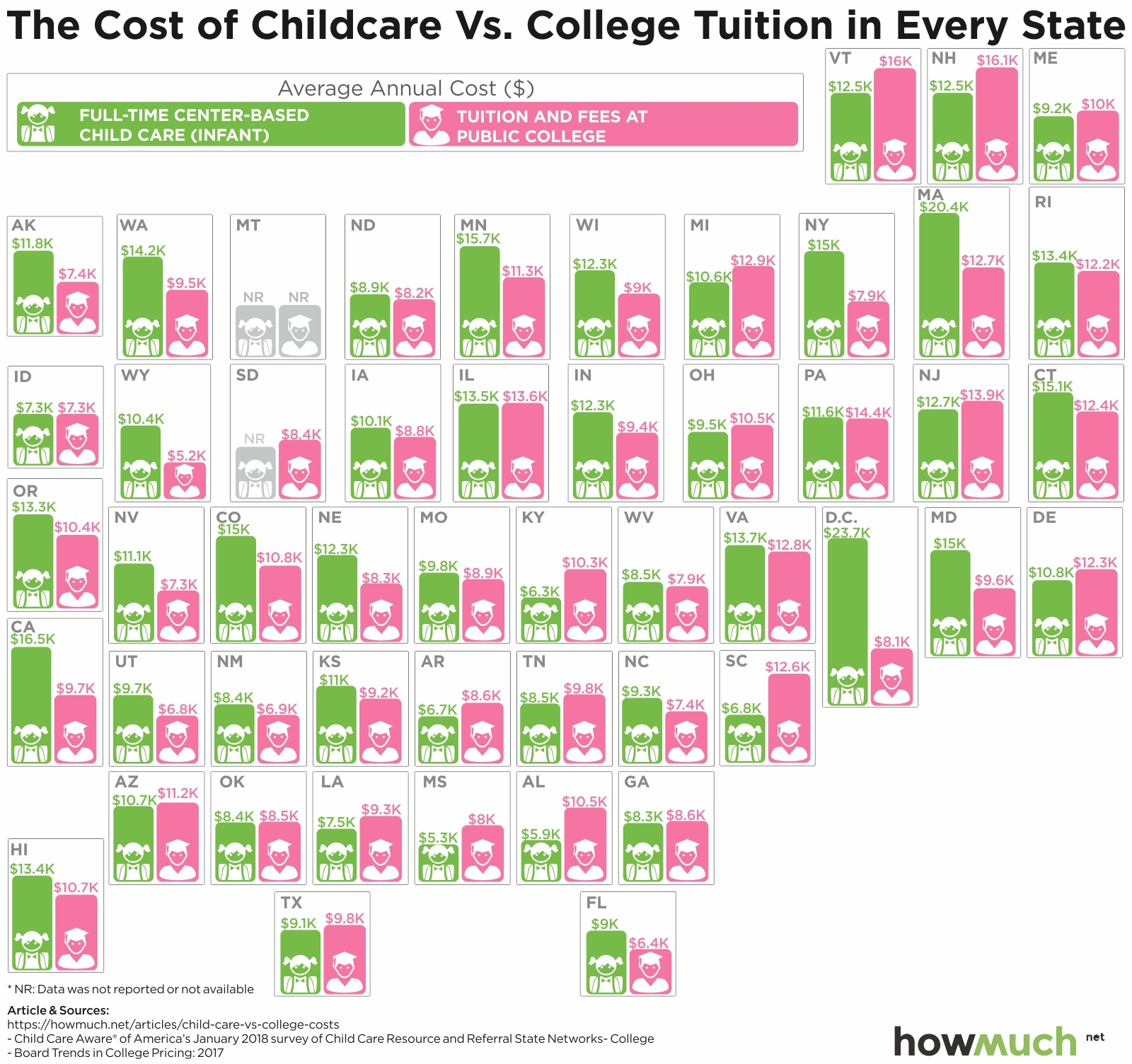
34 states where child care costs more than college tuition 

The annual expense of child care for an infant exceeds the annual cost of in-state tuition at a public four-year university in 34 states, according to the most recent data from the Economic Policy Institute. 

At this point in the pandemic, healthcare is among the top three industries when it comes to people quitting or changing jobs. The quality and cost of child care is top of mind for healthcare decision-makers given its strength as a determining factor to push people from the U.S. labor force. Mothers continue to shoulder the majority of family caregiving responsibilities, making child care a heavier tip of the scale for healthcare, where women make up the majority of the front-line workforce (66 percent) and managers (59 percent), according to research from McKinsey. 

Infant care expenses exceed college tuition in 34 states and Washington, D.C. Below is each state ranked by how much infant care costs exceed or compare to the cost of tuition at a four-year public university, along with the median family income in each state and infant care as a share of income. 

Hospitals see job gains after two months of losses

https://www.healthcarefinancenews.com/news/hospitals-see-job-gains-after-two-months-losses

Despite the gains, employment in healthcare is down by about 378,000 jobs (2.3%) from where it was in February 2020.

After a rough end to 2021 in terms of job losses, healthcare appears to be on the rebound – for now. The latest jobs report from the U.S. Bureau of Labor Statistics showed hospitals gaining jobs in January, though the industry is still below the levels seen before the COVID-19 pandemic.

In total, the healthcare sector saw a gain of 18,000 jobs last month. It lost 3,100 jobs in December; the prior month, November 2021, was the last time the sector saw job gains, when it posted a net gain of 2,100.

Hospitals made up for some, but not all, of the job losses seen during the tail end of 2021. They gained 3,400 jobs in January, after losing 5,100 jobs in December and 3,900 in November.

The last time hospitals gained jobs was in October, when 1,100 were added. Hospitals lost 8,100 jobs in September.

The biggest increase was in ambulatory healthcare services, which gained 14,700 jobs during the month. Physicians’ offices added 9,700 jobs. Nursing and residential-care facilities lost about 100 jobs in January.

Despite the gains, employment in healthcare is down by about 378,000 jobs (2.3%) from where it was in February 2020, at the dawn of the pandemic, according to BLS.

The broader U.S. economy added 467,000 jobs in January, after gaining 199,000 jobs in December, while the unemployment rate held fairly steady at about 4%.

WHAT’S THE IMPACT?

In a preview of the jobs report by economic research firm Glassdoor, researchers predicted that job losses in healthcare and leisure and hospitality would drag down overall payroll employment. Other coronavirus-sensitive sectors, such as retail and education, were also impacted, though seasonal factors helped mute job losses in those sectors.

Over the course of the pandemic, new COVID-19 cases have been somewhat predictive of job market data, but current record levels represent a situation without precedent, and there are few good comparisons, Glassdoor found. Since September 2020, each new 1,000 daily cases has been correlated with 4,000 fewer job gains, but the level of cases seen in January is unlike any other previous point in the pandemic, leading to uncertainty heading into the BLS jobs report.

The Bureau of Labor Statistics’ preliminary benchmark estimates forecast a modest downward revision in payroll employment of 166,000 for March 2021.

THE LARGER TREND

The Great Resignation hit the healthcare sector hard in November. BLS released job numbers in January showing that healthcare is among the top three industries cited in a 3% rise in the monthly “quits rate,” matching a high from September. The number of quits surged to 4.53 million for the month.

The numbers coincide with an already-strapped healthcare staffing market. Shortages and burnout among healthcare staff are a pervasive issue.

Multiple factors are contributing to labor pressures, including staff burnout stemming from the enduring pandemic and an overall shortage of qualified help, which has resulted in higher costs to hire temporary staff, as well as wage inflation.

Further, a Fitch Ratings report in November noted that lack of staff is forcing some in-patient behavioral health and senior housing operators to lower admission rates.

Understanding the implications of using agency nurses

The Great Nursing Resignation, and hospitals’ growing reliance on expensive agency labor (a.k.a. “travelers”) has grabbed headlines, for good reason. But lately we’ve heard a couple of anecdotes from health system leaders about the second-order impacts of the phenomenon that are worth considering as well.

First, as the ranks of agency nurses at hospitals have swelled, full-time employed nurses’ morale has plummeted—tenured nurses are having to orient their new temporary co-workers, then watch them earn up to three times as much money for the same work.

At the same time, willingness to work overtime among employed nurses has dropped. That’s not just because of burnout—it turns out that the nurses who were most likely to take overtime shifts are also more likely to have chosen to leave full-time employment to become travelers, where they are even more richly rewarded for working extra shifts. So, the “productivity” of the remaining corps of staff nurses has dropped, even as caseloads have increased.

One other implication we’ve heard about recently: the economic impact of “observation” cases, where patients are held in a staffed bed but not admitted—already a bad bargain for hospitals—has gotten worse. That’s because the cost of deploying staff to care for those patients has gone up, due to wage inflation and use of travelers. It’s hard to overstate the level of staffing crisis at most hospitals today, and the rapid growth in reliance on temporary staff will have consequences lasting well beyond the current surge.

Hospitals seek government help on staffing costs

The American Hospital Association (AHA) is asking Congress for an additional $25B to help hospitals offset high labor costs, largely incurred by the need to rely on travel nurse staffing firms that charge two to three times pre-pandemic rates. The AHA, along with 200 members of Congress, is urging the Federal Trade Commission to investigate the staffing agencies for anti-competitive activity, although the agency has previously declined to do so. 

The Gist: The Department of Health and Human Services (HHS) is now releasing $2B in of provider relief dollars from the CARES Act. Beyond that, after nearly two years and $178B of federal support, hospitals shouldn’t count on additional funds from the government, even as costs of labor and supplies continue to rise. 

Instead, we’d expect more scrutiny over how the remaining relief dollars are spent. Federal support during the pandemic has masked structural economic flaws in provider economics, and we expect 2022 will be a year of financial reckoning for many hospitals and health systems

Companies ignoring employee demands will falter

Dive Brief:

  • Companies that fail to adjust to labor shortages and satisfy the growing demands of workers will likely falter as they lose the battle for talent, BlackRock CEO Larry Fink said in a letter to CEOs.
  • “No relationship has been changed more by the pandemic than the one between employers and employees,” Fink said, noting that “employees across the globe are looking for more from their employer — including more flexibility and more meaningful work.” Fink, while leading the world’s largest asset manager, has sought for a decade to influence corporate behavior through an annual CEO letter.
  • “As companies rebuild themselves coming out of the pandemic, CEOs face a profoundly different paradigm than we used to,” Fink said. Companies can no longer overlook employee mental health, insist that staff work in the office five days per week and provide modest wage increases for low- and middle-income workers.

Dive Insight:

CFOs considering an increase in prices and employee wages need to balance the imperative to sustain profits with pressures from the worst inflation and labor shortages in decades.

The persistence of COVID-19 has slowed the labor market’s post-lockdown recovery and churned up company payrolls. Fink noted that in November the quits rate, or the number of workers who left their jobs as a percent of total employment, rose to 3%, a record high first breached in September.

CFOs aiming to attract and retain employees with wage increases must take into account a 7% jump in the consumer price index (CPI) during the 12 months through December — the biggest surge since 1982.

“Workers demanding more from their employers is an essential feature of effective capitalism,” Fink said. Describing “a new world of work,” he said, “companies not adjusting to this new reality and responding to workers do so at their own peril.

“Turnover drives up expenses, drives down productivity and erodes culture and corporate memory,” Fink said. BlackRock manages more than $10 trillion in assets for institutional and retail investors.

In order to satisfy workers, CEOs must look beyond pay and workplace flexibility, Fink said. The coronavirus “shone a light on issues like racial equality, childcare and mental health — and revealed the gap between generational expectations at work.”

Fink also reiterated his support for “stakeholder capitalism,” saying that “a company must create value for and be valued by its full range of stakeholders in order to deliver long-term value for its shareholders.”

“Stakeholder capitalism is not about politics. It is not a social or ideological agenda. It is not ‘woke,’” he said. “It is capitalism driven by mutually beneficial relationships between you and the employees, customers, suppliers and communities your company relies on to prosper.”

Most stakeholders expect companies to help “decarbonize” the global economy, Fink said, predicting that so-called sustainable investment will surge well beyond the $4 trillion total.

BlackRock has asked companies to set short-, medium- and long-term targets for greenhouse gas reductions which “are critical to the long-term economic interests of your shareholders,” he said.

At the same time, “divesting from entire sectors — or simply passing carbon-intensive assets from public markets to private markets — will not get the world to net zero,” Fink said, adding that “BlackRock does not pursue divestment from oil and gas companies as a policy.”

Fink’s annual letter drew fire from environmentalists.

The letter “is just another rehashing of the same vague rhetoric, without any meaningful new commitment to actually help lead the necessary transition to a climate-safe future,” Ben Cushing, the Sierra Club’s fossil-free finance campaign manager, said in a statement.

Looking ahead to a year of belt-tightening

Looking ahead to a year of belt-tightening

https://mailchi.mp/92a96980a92f/the-weekly-gist-january-14-2022?e=d1e747d2d8

We’ve been having “year ahead” discussions with our health system members over the past few weeks, although it’s been difficult for some to carve out time for planning in the midst of the Omicron surge.

One common theme is that, from a financial perspective, 2022 is expected to be a more difficult year. For many systems, despite the trying COVID situation, the past two years have been financial record-setters. In 2020, systems benefited from a massive infusion of COVID relief funding from the government, and in 2021, they continued to enjoy enhanced reimbursement due to COVID, plus had a resurgence of volume as patients sought care that was previously postponed.

2022 looks to be a more “normal” year—meaning a return to the financial pressures of pre-pandemic times. Those include mounting price compression from payers, an accelerating shift of care from inpatient to outpatient settings, and increasing competition for patients from disruptors and others. At the same time, patient acuity will continue to rise, with patients presenting sicker and with more comorbidities. The cost of caring for those patients will escalate, as the workforce shortage drives labor costs higher and supply chain woes persist.

We’d anticipate a year or more of belt-tightening among many health systems, as they adjust to the post-pandemic environment.