Inside the Midyear Panic at UnitedHealth

https://healthcareuncovered.substack.com/p/inside-the-midyear-panic-at-unitedhealth

Imagine you’re facing your midyear performance review with your boss. You dread it, even though you’ve done all you thought possible and legal to help the company meet Wall Street’s profit expectations, because shareholders haven’t been pleased with your employer’s performance lately.

Now let’s imagine your employer is a health insurance conglomerate like, say, UnitedHealth Group. You’ve watched as the stock price has been sliding, sometimes a little and on some days crashing through lows not seen in years, like last Friday (down almost 5% in a single day, to $237.77, which is down a stunning 62% since a mid-November high of $630 and change).

You know what your boss is going to say. We all have to do more to meet the Street’s expectations. Something has changed from the days when the government and employers were overly generous, not questioning our value proposition, always willing to pick up the tab and pay many hidden tips, and we could pull our many levers to make it harder for people to get the care they need. 

Despite government and media reports for years that the federal government has been overpaying Medicare Advantage plans like UnitedHealth’s – at least $84 billion this year alone – Congress has pretended not to notice. There is evidence that might be changing, with Republicans and Democrats alike making noises about cracking down on MA plans. 

Employers have complained for ages about constantly rising premiums, but they’ve sucked it up, knowing they could pass much of the increase onto their workers – and make them pay thousands of dollars out of their own pockets before their coverage kicks in. Now, at least some of them are realizing they don’t have to work with the giant conglomerates anymore.

Doctors and hospitals have complained, too, about burdensome paperwork and not getting paid right and on time, but they’ve largely been ignored as the big conglomerates get bigger and are now even competing with them.

UnitedHealth is the biggest employer of doctors in the country. But doctors and hospitals are beginning to push back, too. 

Since last fall, UnitedHealth and its smaller but still enormous competitors have found that “headwinds” are making it harder for them to maintain the profit margins investors demand. That is mainly because, despite the many barriers patients have to overcome to get the care they need, many of them are nevertheless using health care, often in the most expensive setting – the emergency room. They put off seeing a doctor so long because of insurers’ penny-wise-pound-foolishness that they had some kind of event that scared them enough to head straight to the ER. 

It’s not just you who is dreading your midyear review. Everybody, regardless of their position on the corporate ladder, and even the poorly paid folks in customer service, are in the same boat. And so is your boss. Nobody will put the details of what has to be done in writing. They don’t have to. Your boss will remind you that you have to do your part to help the company achieve the “profitable growth” Wall Street demands, quarter after quarter after quarter. It never, ever ends. You know this because you and most other employees watch what happens after the company releases quarterly financials. You also watch your 401K balance and you see the financial consequences of a company that Wall Street isn’t happy with. And Wall Street is especially unhappy with UnitedHealth these days.

And when things are as bad as they are now at UnitedHealth’s headquarters in Minnesota, you know that a big consulting firm like McKinsey & Company has been called in, and that those suits will recommend some kind of “restructuring” and changes in leadership to get the ship back on course. You know the drill. Everybody already is subject to forced ranking, meaning that at the end of the year, some of your colleagues, regardless of job title, will fall below a line that means automatic termination. You pedal as fast as you can to stay above that line, often doing things you worry are not in the best interest of millions of people and might not even be lawful. But you know that if you have any chance of staying employed, much less getting a raise or bonus, you have to convince your superiors you are motivated and “engaged to win.” No one is safe. Look what happened to Sir Andrew Witty, whose departure as CEO to spend more time with his family (in London) was announced days after shareholders turned thumbs down on the company’s promises to return to an acceptable level of profitability. 

If you are at UnitedHealth, you listened to what the once and again CEO, Stephen Hemsley, and CFO John Rex, who got shuffled to a lesser role of “advisor” to the CEO last week, laid out a new action plan to their bosses – big institutional investors who have been losing their shirts for months now. You know that what the C-Suite promised on their July 29 call will mean that you will have to “execute” to enable the company to deliver on those promises. And you know that you and your colleagues will have to inflict a lot more pain on everybody who is not a big shareholder – patients, taxpayers, employers, doctors, hospital administrators. That is your job. And you will try to do it because you have a mortgage, kids in college and maxed-out credit cards.  

Here’s what Hemsley and his leadership team said, out loud in a public forum, although admittedly one that few people know about or can take an hour-and-a-half to listen to:

  • Even though UnitedHealth took in billions more in revenue, its margins shrank a little because it had to pay more medical claims than expected.
  • Still, the company made $14.3 billion in profits during the second quarter. That’s a lot but not as much as the $15.8 billion in 2Q 2024, and that made shareholders unhappy.
  • Enrollment in its commercial (individual and employer) plans increased just 1%, but enrollment in its Medicare Advantage plans increased nearly 8%. That’s normally just fine, but something happened that the company’s beancounters couldn’t stop.
  • Those seniors figured out how to get at least some care despite the company’s high barriers to care (aggressive use of prior authorization, “narrow” networks of providers, etc.)

To fix all of this, Hemsley and team promised:

  • To dump 600,000 or so enrollees who might need care next year
  • To raise premiums “in the double digits” – way above the “medical trend” that PriceWaterhouseCoopers predicts to be 8.5% (high but not double-digit high)
  • Boot more providers it doesn’t already own out of network
  • Reduce benefits

Throughout the call with investors (actually with a couple dozen Wall Street financial analysts, the only people who can ask questions), Hemsley and team went on and on about the “value-based care” the company theoretically delivers, without providing specifics. But here is what you need to know: If you are enrolled in a UnitedHealth plan of any nature – commercial, Medicare or Medicaid or VA (yes, VA, too) – expect the value of your coverage to diminish, just as it has year after year after year.  

The term for this in industry jargon is “benefit buydown.”

That means that even as your premiums go up by double digits, you will soon have fewer providers to choose from, you likely will spend more out-of-pocket before your coverage kicks in, you might have to switch to a medication made by a drug company UnitedHealth will get bigger kickbacks from, and you might even be among the 600,000 policyholders who will get “purged” (another industry term) at the end of the year.

Why do we and our employers and Uncle Sam keep putting up with this?

Yes, we pay more for new cars and iPhones, but we at least can count on some improvements in gas mileage and battery life and maybe even better-placed cup holders. You can now buy a massive high-def TV for a fraction of what it cost a couple of years ago. Health insurance? Just the opposite. 

As I will explain in a future post, all of the big for-profit insurers are facing those same headwinds UnitedHealth is facing. You will not be spared regardless of the name on your insurance card. If you still have one come January 1. Pain is on the way. Once again. 

The Fox Guards the Hen House – Translating AHIP’s Commitments to Streamlining Prior Authorization

We urge the Administration to consider the timing of these policies in the context of the broader scope of requirements and challenges facing the industry that require significant system changes.”

  • AHIP, March 13, 2023 (in a letter to CMS Administrator Chiquita Brooks-LaSure responding to CMS’s proposed rule on Advancing Interoperability and Improving Prior Authorization Processes, proposed Final Rule, CMS-0057-P)

“Health insurance plans today announced a series of commitments to streamline, simplify and reduce prior authorization – a critical safeguard to ensure their members’ care is safe, effective, evidence-based and affordable.”

  • AHIP, June 23, 2025 (press release announcing voluntary prior authorization reforms)

What a difference two years make.

After lobbying aggressively to delay implementation of the PA reforms proposed by the previous administration (successfully delayed one year and counting), AHIP, the big PR and lobbying group for health insurers, now claims the mantle of reformer, announcing a set of voluntary commitments to streamline prior authorization.

So naturally, the industry’s “commitments” deserve closer scrutiny. Let’s unpack them. As a former health insurance industry executive, I speak their language, so allow me to translate. AHIP, which has no enforcement power, by the way, claims that 48 large insurers will:

  1. Develop and implement standards for electronic prior authorization using Fast Healthcare Interoperability Resources Application Programming Interfaces (FHIR APIs).Translation: CMS is already requiring all insurers to do this by 2027. We might as well take credit preemptively.
  2. Reduce the volume of in-network medical authorizations. Translation: We already demand hundreds of millions of unnecessary prior authorizations for thousands of procedures and services, so cutting a few (who knows how many?) should be a layup and won’t cut into profits.
  3. Enhance continuity of care when patients change health plans by honoring a PA decision for a 90-day transition period starting in 2026.Translation: We’re already required to do this in Medicare Advantage. And since we delayed implementation of e-authorization until 2027, we’re in the clear until then anyway.
  4. Improve communications by providing members with clear explanations for authorization determinations and support for appeals. Translation: We’re already required by state and federal law to do this. We’ll double-check our materials.
  5. Ensure 80% of prior authorizations are processed in real time and expand new API standards to all lines of business. Translation: We had to promise to hold ourselves accountable to at least one measurable goal. We will set the denominator – we’ll decide which procedures and medications require PA – so we’ll hit this goal, no problem, and we might even use more non-human AI algorithms to do it.
  6. 6. Ensuring medical review of non-approved requests. Translation: People will be relieved we’re not using robots. And we’ll avoid having Congress insist that reviews must be done by a same-specialty physician, as proposed in the Reducing Medically Unnecessary Delays in Care Act of 2025 (H.R. 2433).

Of course, I wasn’t in the room when AHIP drafted these commitments, so take my translations with a grain of salt. But let’s be honest: These promises are thin on specifics, short on accountability, and devoid of measurable impact.

They also follow a familiar script, blaming physicians for cost escalation by “deviating from evidence-based care” and the “latest research”, while positioning PA as a necessary safeguard to protect patients from “unsafe or inappropriate care.” And largely ignoring how PA routinely delays necessary treatment and harms patients.

It’s also rich coming from an industry still reliant on something called the X12 transaction standard – technology that is now over 40 years old – to process prior authorization requests, while simultaneously pointing the finger at providers for outdated technology and being slow to adopt modern systems. Many insurers did not start accepting electronic submissions of prior authorization until roughly 2019, nearly 20 years after clinicians started using online portals such as MyChart in their regular practice. The claim that providers are the ones behind on technology is another ploy by insurers to dodge scrutiny for their schemes.

We shouldn’t settle for incremental fixes when the system itself is the problem. Nor should we allow the industry that created this problem – and perpetuates it in its own self-interest – to dictate the pace or terms of reforming it.

As we argued in our recent piece, Congress should act to significantly curtail the use of prior authorization, limiting it to a narrow, evidence-based set of high-risk use cases. Insurers should also be required to rapidly adopt smarter, lower-friction cost-control methods, like gold-carding trusted clinicians (if it can be implemented with integrity and fairness), without compromising patient access or clinical autonomy.

Letting the fox design the hen house’s security perimeter won’t protect the hens. It’s time for Congress to build a better fence.

Key Principles for Proactive Management of Patient Denials

https://www.kaufmanhall.com/insights/article/key-principles-proactive-management-patient-denials

The proliferation of claims denials, especially by Medicare Advantage payers, has become a pressing issue for health system operations. In 2023, Medicare Advantage insurers fully or partially denied 3.2 million prior authorization requests—or 6.4% of all requests, according to a Kaiser Family Foundation (KFF) report.

The growth in denials can be partially explained by the increasing popularity of managed Medicare and Medicaid plans, but evolving payer practices, including the adoption of AI for algorithmic denials, have also contributed. Claims denials have emerged as one of the key points of payer-provider tension, and an effective claims denials management and prevention program is a powerful way for health systems to rebalance their payer relationships.

Denied claims result in reduced reimbursement, added administrative burdens, and patient and provider frustrations. Even when denials are successfully appealed and reversed—the KFF report found that in 2023, 82% of Medicare Advantage denials were partially or fully overturned—the time and resources devoted to the appeals process add to the costs of providing healthcare services. Optimizing pre-billing activities to reduce avoidable denials and improve and streamline the patient experience of care is as essential for health systems as a robust appeals strategy. This article addresses critical success factors for both preventing and appealing denials.

Preventing Claims Denials During Pre-Bill Period

Successfully preventing denials requires a centralized program across the workforce, from frontline providers to clinical and revenue cycle staff, to manage pre-bill activities by focusing on identifying the correct patient insurance information, obtaining accurate authorizations, and preventing concurrent denials while the patient is still in the facility. Utilization review nurses, attending providers, and Physician Advisors should be attentive to documenting the full state of patient acuity, while collaborating with the revenue cycle team. This team should focus on the collection and reporting of medically necessary data and documentation, which serves as the evidence payers use to evaluate prior authorization requests. When information about a patient’s condition isn’t recorded, or acknowledged in an authorization request, unnecessary denials can result.

A successful denials prevention program expands beyond the utilization management (UM) team and includes revenue cycle, and provider collaboration. Revenue cycle pre-service procedures should focus on confirming insurance benefits and securing payer authorization for planned services while collaborating with UM and referral sources. A comprehensive and proactive denials prevention program helps conveys to payers the full extent of inpatient clinical work, thanks to a collaborative effort to improve documentation.

The following list can help organize denials prevention programs across all locations, clinics and practices:

  • Establish an enterprise-wide denials prevention strategy which includes a multi-disciplinary denials management committee focused on identifying denials trends, conducting root cause analyses, developing proactive denials mitigation plans, creating enhanced reporting, monitoring improvement, and communicating risk
  • Establish proactive revenue cycle, UM, pre-certification, and peer-to peer workflows procedures to confirm completion of payer requirements prior to scheduled services and discharge
  • Ensure patients are financially cleared through implementation of pre-service protocols, including enhanced medical necessity process for outpatient services, authorization defer and delay procedures to reduce rework and avoidable denials
  • Identify pre-bill edits to increase “clean claim” efficiency, reducing initial denials and expediting reimbursement
  • Deliver education to providers, care management, and nursing teams on key observation concepts, such as clinical documentation improvement, patient status documentation, medical necessity documentation and orders for the Two Midnights rule, and payer reimbursement methodologies

Pursuing Post-Bill Appeals, Reversals and Payer Escalation

A strong denials management and prevention program should include a robust post-bill appeals program with skilled coding, clinical and technical resources. A targeted and strategic appeal process can result in improved overturn rates and increased reimbursement. Appeal letters which are supported by clinical facts, payer policies, and a summary of key components relevant to each case and the associated denial increase the likelihood of success.

Components of the appeal program should include the following:

  • Guidelines for when to appeal based on potential success by payer and appeal level
  • Reviews of upheld appeals for second and third level appeals based on strategy by payer
  • Trends for all upheld appeals by reason and by payer
  • Dashboard for tracking denials activities
  • Appeal letter writing guidelines and tips to support
  • Evaluation process for existing payer escalation workflows, tools and payer communication strategies with consideration for payer
  • Process to measure and monitor overturn rates and improvement opportunities

The collaboration with managed care is vital to the success of the denials management/prevention program. A formal payer escalation process which facilitates transparency between the payer and provider can result in improved relations and a reduction in initial denials. Successful denials management/prevention payer escalation programs are strategic and focus on addressing unfair/incorrect denials and establishing clear bi-directional reporting and communications. These programs can result in improved contract negotiations and reduce incorrect denials.

Artificial Intelligence (AI) can support the post-bill appeals process and can be especially relevant when developing a strategy to combat denials. Not only are payers increasingly using AI to trigger denials, but health systems can also deploy AI to write appeal letters, analyze denial trends, and summarize medically necessary documentation. Although algorithmic denials have become a source of frustration for providers and patients, health systems can also deploy AI to their defense. While payers are often better positioned to devote AI resources to claims, a little bit of investment from health systems, deployed effectively, can go a long way toward evening the playing field.

Closing Thoughts and Seven Questions to Consider

A formal denials management and prevention program is essential to obtaining proper reimbursement for the care provided and reducing rework across the enterprise. A strong program should also improve the patient’s experience of care: ideally, a patient should not need to interact with or hear from their provider between scheduling an appointment and checking in.

Denials management and prevention programs should be led by multi-disciplinary committees and focus on reducing avoidable denials and rework. Reducing denials requires the implementation of a multi-disciplinary program and collaboration between UM, revenue cycle, clinical documentation improvement, managed care, clinical operation and providers. 

Health systems reassessing their claims denials program should consider these questions:

  1. Do you have a reactive or proactive denials management strategy in place?
  2. Does your denials strategy include multi-disciplinary team representation?
  3. What reporting/tools are currently being used to track and manage denials?
  4. What are your top five denial categories and what is being done to address the root cause of these denials?
  5. How are avoidable denial risks managed, communicated and monitored?
  6. Have you implemented a comprehensive denials management strategy with a multi-disciplinary committee?
  7. Are the system’s internal resources and expertise sufficient for addressing identified challenges, or should the system seek external partners to implement changes?

New Senate Report on Prior Authorization in Medicare Advantage Begs a Question: Can Big Insurance Ever Be Regulated Adequately to Ensure Patient Care?

Last week, the Senate Permanent Subcommittee on Investigations, led by Sen. Richard Blumenthal (D-Connecticut), released a Majority Staff Report on rampant prior authorization (PA) abuses in Medicare Advantage (MA).

The report offers unique insight into recent trends in the use of prior authorization by Medicare Advantage plans and the strategy and motives behind insurance corporations’ use of it. 

While the findings won’t surprise those who’ve been following health policy trends, it is immensely concerning that between 2019 and 2022, the prior authorization denial rate for post-acute care in UnitedHealth’s Medicare Advantage plans doubled.

The denial rate for long-term acute care hospitals in Humana’s Medicare Advantage plans increased by 54% from 2020 to 2022. During this time, UnitedHealth, CVS/Aetna, and Humana increased their use of artificial intelligence (AI) for prior authorization reviews, often resulting in increasing denial numbers and decreasing (or absent) review time by human beings.

The report recommends that the Centers for Medicare and Medicaid Services (CMS) collect additional data, conduct audits of prior authorization processes, and expand regulations on the use of technology in PA reviews. While these recommendations would be positive steps, the report’s findings call into question whether Big Insurance can ever be trusted or regulated enough to prevent abuse of patients through prior authorization and other mechanisms. 

This report provides an in-depth look at insurers’ motivations. Sadly, those motivations are not to “make sure a service or prescription is a clinically appropriate option,” as UnitedHealth claims, but to decrease the amount spent on medical care to increase the corporations’ profits.

The report noted that CVS, which owns Aetna, saved $660 million in 2018 by denying Medicare Advantage patients’ claims for treatment at inpatient facilities. Around the same time, CVS found in its testing of a model to “maximize approvals,” which would be a good thing for patients, that the model jeopardized profits because it would lead to more care being covered. In 2022, CVS “deprioritized” a plan to increase auto-approvals because of the lost “savings” from denying patient care. 

The report found that the motivation to increase profits, without regard for patient care, was not unique to CVS/Aetna.

UnitedHealth’s naviHealth subsidiary provided this directive to its employees: “IMPORTANT: Do NOT guide providers or give providers answers to the questions” when speaking to a patient’s doctor about a prior authorization request. Instead of working collaboratively with doctors to get patients the care they need, UnitedHealth told its workers not to bother. In a training session offered to Humana employees involved in prior authorization reviews, the company explained that reviewers should deny a request for post-acute care even if a patient needed more intensive treatment. Humana told reviewers that the lack of an in-network lower-level care facility for patients to go to was not a reason to approve post-acute care and that usually the situations can be “sorted out,” presumably by the patient with no help from the insurer.

All three companies (UnitedHealth, Humana and CVS/Aetna), which dominate the Medicare Advantage program,  demonstrated a striking lack of motivation to protect and enhance patient care, instead showing a primary motivation to increase profits and margins. 

The subcommittee’s report also noted that UnitedHealth, CVS/Aerna, and Humana are increasingly using AI to make care decisions and cutting humans, especially doctors, out of the process. The researchers found that in 2022, UnitedHealth looked into how using AI and machine learning could aid in predicting which denials of post-acute care requests were most likely to be overturned.  One would hope this effort would be to decrease the number of wrongfully denied prior authorization requests and increase patient access to care.

However, the report includes a quote from a recap of a meeting on the project asking “what we could do in the clinical review process to change the outcome of the appeal,” meaning that UnitedHealth was interested in preventing the overturning of denials, not getting the decision right in the first place. The report also found evidence that naviHealth used artificial intelligence to help determine the coverage decisions for a patient’s post-acute care claim before any human post-acute care providers evaluated a case. The report’s authors found that denials for post-acute care facilities rose rapidly once naviHealth began managing these requests for UnitedHealth’s MA plans. 

These are just some of the findings in the 54-page report on Big Insurance’s use of prior authorization to deny Medicare Advantage patient requests for post-acute care.

The report’s findings demonstrate the abuse of prior authorization by the insurers, the motivation to increase profit and decrease patient care, and the use of AI to increase denials. Further, the findings underscore that prior authorization is a tool used by Big Insurance primarily to maximize profits. The report puts forward recommendations to cut down on abusive denials, which would have some positive impact.

More importantly, I believe the report provides more evidence that it is becoming exceedingly less likely that private and for-profit insurance companies can be regulated and act in a way that promotes patient health over profits.

Private Health Insurance Spends Big on Political Contributions and Lobbying

With the election looming and the beginning of annual open enrollment periods for health insurance plans, it is vital to pull back the curtain on the influx of money from Big Insurance corporations to political campaigns and lobbying. 

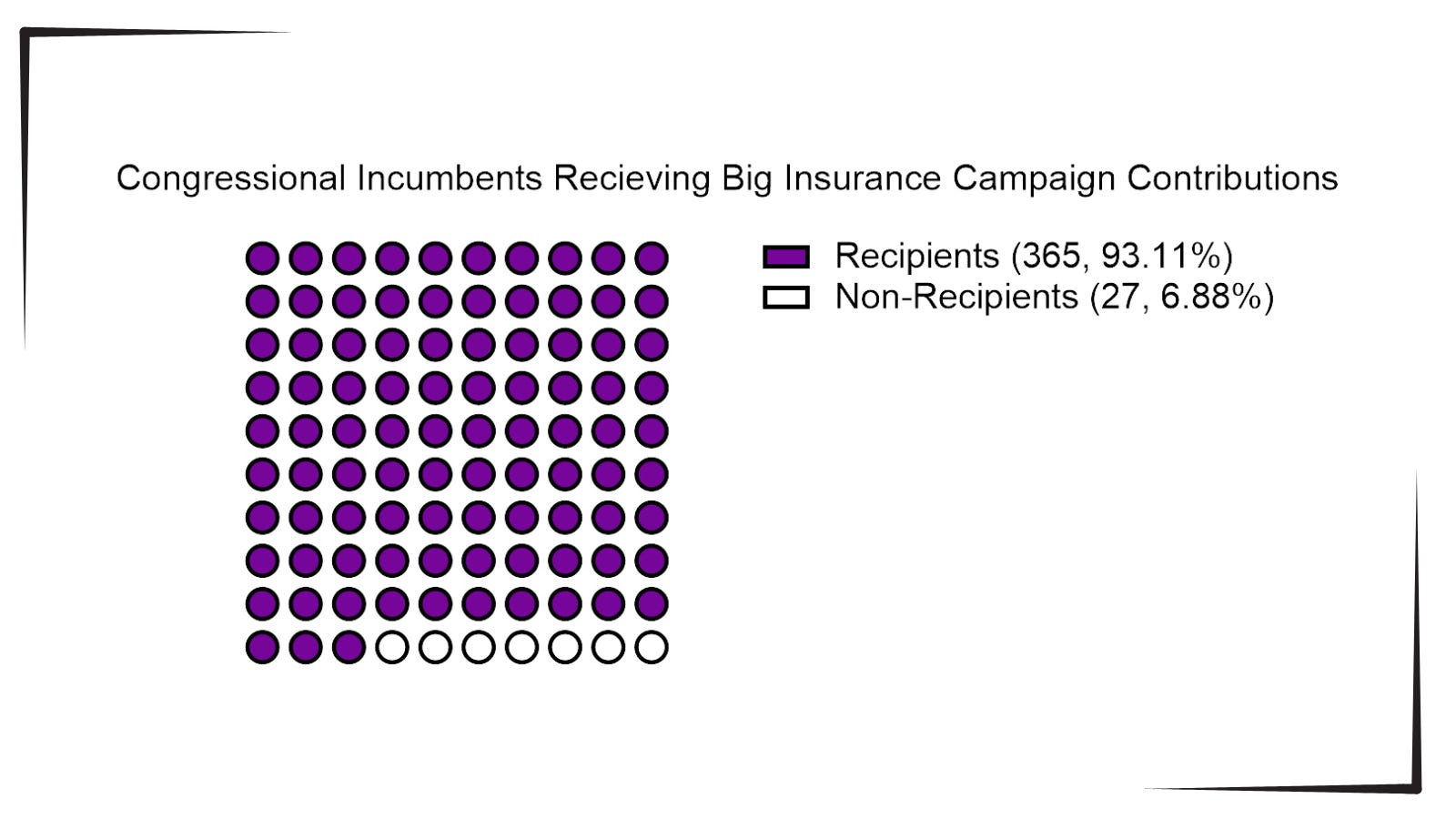
Data available from OpenSecrets.com thus far in 2024 shows that 93% of Congressional incumbents running in 2024 received contributions from Big Insurance, including 100% of Senate incumbents. These insurance corporations run the ten largest Medicare Advantage plans in the country and are known to deny needed health care and defraud the government, but face little to no consequences.

Insurance corporations included in this analysis are UnitedHealth Group, Humana, CVS/Aetna, Kaiser Permanente, Elevance Health, Centene Corp, Cigna, Blue Cross Blue Shield Association (which represents many MA plans, including two of the largest: BCBSMichigan and Highmark), and SCAN.

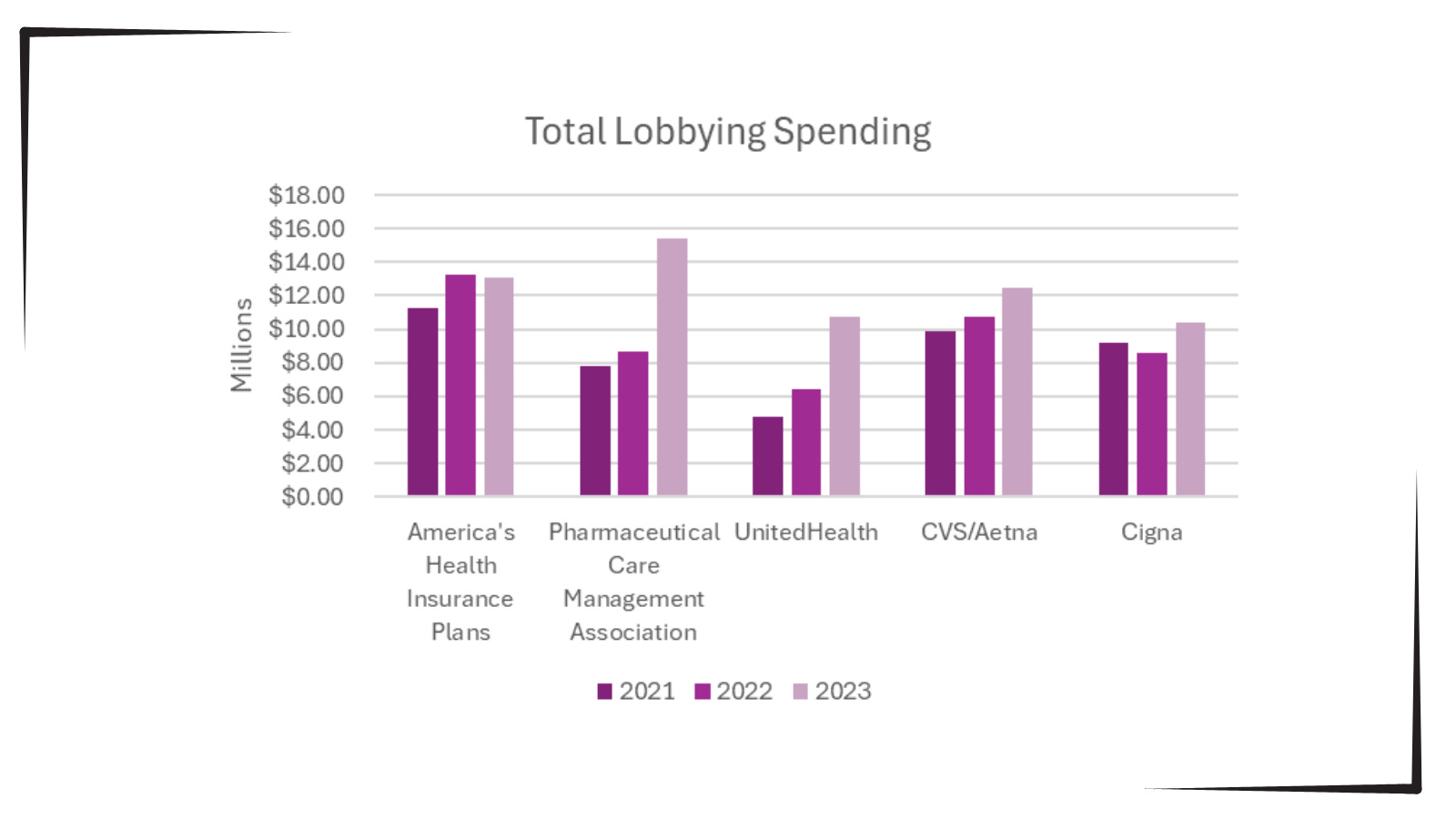
Additionally, as bipartisan scrutiny of pharmacy benefit managers (PBMs) and Medicare Advantage plans has intensified, spending by Big Insurance on lobbying has increased.

Total lobbying spending by America’s Health Insurance Plans; Pharmaceutical Care Management Association; UnitedHealth; CVS/Aetna; and Cigna for the years 2021, 2022 and 2023.

This open enrollment season, people struggling to choose a health insurance plan that they can afford and that provides the care they need may ask themselves, “Why is our health care system like this?” The immense amounts of money Big Insurance spends to blanket members of Congress with contributions and lobbying hold the answer. 

Additional analysis following the election will allow evaluation of just how much Big Insurance spends on politics to help protect industry profits and will give health reform advocates an idea of how to overcome this influence to pass policies for patients, not profits.

What is the Medicare Advantage?

On October 15, the open enrollment period for Medicare begins running through December 7 for coverage starting in January 2025. In this period, 67 million Medicare eligible seniors can review features of Medicare plans offered in their area, switch from traditional Medicare to a Medicare Advantage (MA) plan (or vice versa), change their MA selection and add/change their Medicare Part D prescription drug plans.

In 2024, Medicare Advantage plans enrolled 33 million seniors and Medicare paid private insurers $462 billion to pay for their care.

But conditions for Medicare Advantage have changed in recent years prompting many to ask ‘what is the Medicare Advantage?’

Background:

Medicare began July 30, 1965 as a key element in President Lyndon Baines Johnson’s Great Society program offering federal-government-paid insurance coverage for seniors at the age of 65.  “Original Medicare” had two parts: Part A to cover hospitals and Part B to cover physicians and outpatient services. In 1972, coverage for adults with disabilities was added, and in 2003, coverage for prescription drugs (Part D) was added.

Its funding comes from payroll taxes paid by employers and their employees, and those who are self-employed PLUS income taxes paid on Social Security benefits, interest earned on the Medicare trust fund’s investments and Part A premiums from people who aren’t eligible for premium-free Part A.

Along the way, Congress authorized seniors the option of accessing Medicare through private insurers aka Part C (Balanced Budget Act of 1997), expanded its scope (Medicare Modernization Act of 2003) and supplemented its funding differential above Original Medicare (Patient Protection and Affordable Care Act 2010) to stimulate enrollment growth. The rationale for MA was straightforward: it offered federal regulators a lab to test care management for seniors with the dual aims of lowering their health costs and improving their health. Private insurers responded. By design, funding for MA was set above Original Medicare rates to encourage private insurer participation.

It worked.  This year, the average MA enrollee had 43 plans from which to choose. By three measures, Medicare Part C has been successful:

  • Enrollment growth: Enrollment in MA plans has increased from 31% of Medicare eligible adults in 2014 to 51% in 2024 and is projected to increase in 2025. Notably, enrollment in special needs and employer-sponsored MA plans has increased faster than the individual MA market which is subject to open enrollment periods. Satisfaction appears high (69% of members do not shop for another plan during open enrollment periods) and member churn is low.
  • Medicare has saved money: Per the 2024 Medicare Trustees’ Report, MA has contributed to slower growth in Medicare spending than forecast. “The Social Security and Medicare programs both continue to face significant financing issues…The Hospital Insurance (HI) Trust Fund will be able to pay 100% of total scheduled benefits until 2036, 5 years later than reported last year. At that point, that fund’s reserves will become depleted and continuing program income will be sufficient to pay 89% of total scheduled benefits.”
  • Private insurer participation has been strong: For health insurers, Medicare Advantage is profitable: PMPM contribution margins are 50-100% higher than individual and group lines of business. And, as CMS payments to MA have tightened, the MA insurer market consolidated with 3 (UnitedHealth, Humana, CVS-Aetna) taking advantage of operating pressures on small players to increase their share to 58% of total enrollment. Advantage: Seniors, Medicare and Corporate Insurance.

But conditions going forward suggest the MA advantage might not be as strong. The market signals are clear:

  • Insurer belt tightening: Since 2023, seniors’ use of hospitals, specialty care and prescription drugs has returned to pre-pandemic normalcy cutting into insurer margins. In its CY 2025 Rate Announcement September 27, CMS announced “The average monthly plan premium for all MA plans, which includes MA plans that provide prescription drug coverage and MA Special Needs Plans (SNPs), is projected to decrease from $18.23 in 2024 to $17.00 in 2025. Benefit options will remain stable, including MA supplemental benefit offerings such as hearing, dental, and vision. The amount of rebate dollars, which can be used for supplemental benefits, will remain stable, with a slight increase, from 2024 to 2025. Enrollment in MA is projected to be 35.7 million in 2025, an increase from 2024, with MA enrollment representing approximately 51% of all people enrolled in Medicare.” This translates to lower margins for MA plans, fewer supplemental benefits for enrollees and lower payments to hospitals and physicians.
  • Increased regulatory scrutiny: The Medicare Payment Advisory Commission (MedPAC) concluded that MA plans receive payments from CMS that are 122%of spending for similar beneficiaries in traditional Medicare, on average, translating to an estimated $83 billion in overpayments in 2024. Congress is investigating. In 2023, CMS adopted tougher audit standards specific to diagnosis codes used by private MA plans to bill Medicare on behalf of their enrollees. Audits conducted by the U.S. Department of Human Services’ Office of Inspector General (OIG) applying the new standards found the majority of private MA plans guilty of upcoding and thereby overpaid by Medicare. In 2025, cut points used by CMS to award star ratings have been modified resulting in fewer plans getting 4-star ratings that enable their participation in 5% bonus payments—a major reason recent stock declines for UHG, HUM, CVS and others. Regulatory scrutiny of MA plan marketing practices, coding, denials and prior authorization procedures will intensify reflecting bipartisan intent to constrain MA profits.

Understandably, tension between MA insurers and providers has intensified as insurers seek to protect their margins.  The Change Healthcare (CH) cyber-attack (February 21, 2024) that disabled insurer payments to hospitals and physicians stoked animosity since CH is a subsidiary of UnitedHealth Group–the largest sponsor of MA plans and the healthcare juggernaut. Though operating margins for half of U.S. hospitals have recovered, insurer cuts coupled with labor and prescription drug costs have decimated care delivery in almost every community. Participation in MA plan provider networks, once SOP is now a tough call for hospitals, medical groups and other providers.

My take:

What is the Medicare Advantage?

  • As a lab for innovation in care management for seniors, it’s promising.
  • As an engine to drive lower costs for senior health and extended solvency to the Medicare program, it’s unclear.
  • As a platform to shift incentives from fee-for-service to value across the system, it’s helpful.

But until and unless hospitals, physicians, insurers, business leaders and regulators commit to implement a transformed system of health that’s comprehensive, affordable, efficient and accountable, the Medicare Advantage will be marginalized.

In many ways, the headwinds facing MA are part of the larger narrative facing healthcare:

public sentiment against consolidation and corporatization has eroded its cherished trust and confidence. It’s true for insurance, hospitals, prescription drug companies and PBMs. The blame is shared: no one of these owns the moral high ground (though a few organizations in their ranks aspire).

15 health systems dropping Medicare Advantage plans | 2024

Medicare Advantage provides health coverage to more than half of the nation’s seniors, but some hospitals and health systems are opting to end their contracts with MA plans over administrative challenges.

Among the most commonly cited reasons are excessive prior authorization denial rates and slow payments from insurers.

In 2023, Becker’s began reporting on hospitals and health systems nationwide that dropped some or all of their Medicare Advantage contracts.

In January, the Healthcare Financial Management Association released a survey of 135 health system CFOs, which found that 16% of systems are planning to stop accepting one or more MA plans in the next two years. Another 45% said they are considering the same but have not made a final decision. The report also found that 62% of CFOs believe collecting from MA is “significantly more difficult” than it was two years ago.

Fifteen health systems dropping Medicare Advantage plans in 2024:


1. Canton, Ohio-based Aultman Health System‘s hospitals will no longer be in network with Humana Medicare Advantage after July 1, and its physicians will no longer be in network after Aug. 1.

2. Albany (N.Y.) Med Health System stopped accepting Humana Medicare Advantage on July 1.

3. Munster, Ind.-based Powers Health (formerly Community Healthcare System) went out of network with Humana and Aetna’s Medicare Advantage plans on June 1.

4. Lawton, Okla.-based Comanche County Memorial Hospital stopped accepting UnitedHealthcare Medicare Advantage plans on May 1.

5. Houston-based Memorial Hermann Health System stopped contracting with Humana Medicare Advantage on Jan. 1.

6. York, Pa.-based WellSpan Health stopped accepting Humana Medicare Advantage and UnitedHealthcare Medicare Advantage plans on Jan. 1. UnitedHealthcare D-SNP plans in some locations are still accepted.

7. Newark, Del.-based ChristianaCare is out of network with Humana’s Medicare Advantage plans as of Jan. 1, with the exception of home health services.

8. Greenville, N.C.-based ECU Health stopped accepting Humana’s Medicare Advantage plans in January.

9. Zanesville, Ohio-based Genesis Healthcare System dropped Anthem BCBS and Humana Medicare Advantage plans in January.

10. Corvallis, Ore.-based Samaritan Health Services’ hospitals went out of network with UnitedHealthcare’s Medicare Advantage plans on Jan. 9. Samaritan’s physicians and provider services will be out of network on Nov. 1.

11. Cameron (Mo.) Regional Medical Center stopped accepting Aetna and Humana Medicare Advantage in 2024.

12. Bend, Ore.-based St. Charles Health System stopped accepting Humana Medicare Advantage on Jan. 1 and Centene MA on Feb. 1. 

13. Brookings (S.D.) Health System stopped accepting all Medicare Advantage plans in 2024.

14. Louisville, Ky.-based Baptist Health went out of network with UnitedHealthcare Medicare Advantage and Centene’s WellCare on Jan. 1.

15. San Diego-based Scripps Health ended all Medicare Advantage contracts for its integrated medical groups, effective Jan. 1.

Creating partnerships with high-priority Medicare Advantage plans

https://www.kaufmanhall.com/insights/blog/gist-weekly-june-28-2024

A health system CEO recently reached out to me with a specific complaint that’s become a hot-button issue for an increasing number of systems: 

“Medicare Advantage (MA) is no longer a good payer for us. When you factor in all the pre-auths and denials, we’re now getting four points less yield from our MA patients than from our traditional Medicare patients. 

But our market is swinging hard toward MA, and I know the program’s not going anywhere…so how can we rethink our MA business model to make it more profitable?

After more than a decade of rapid growth, MA plans are now running into headwinds that are reducing their margins and creating an even more contentious negotiating environment with providers. However, these heightened competitive pressures could also be seen as an opportunity for provider organizations. 

Rather than treating all of their MA payers as a monolith, a health system or other larger provider organization should be reassessing its MA book of business with the goal of identifying priority MA payers with which to pursue deeper, mutually beneficial partnerships. 

The first step here is usually for a system to undergo a holistic tiering or ranking exercise for all of their MA payers according to factors like market share, contribution margin, value-based incentives, overall relationship dynamic, and projected market growth.

This exercise will identify not only which MA payers may not be high-priority, long-term partners, but also which MA payers are suitable for developing deeper relationships with (e.g., simplifying administrative burden, better rewards for value-based care, creating a joint insurance product). 

If your system is facing challenges with MA and is interested in rethinking its MA portfolio strategy, please don’t hesitate to reach out.

The Medicare Advantage Trap

In 46 states, once you choose Medicare Advantage at 65, you can almost never leave.

Medicare was founded in 1965 to end the crisis of medical care being denied to senior citizens in America, but private insurers have been able to progressively expand their presence in Medicare.

One of the biggest selling points of Obamacare was that it would finally end discrimination against patients on the basis of pre-existing conditions.

But for one vulnerable sector of the population, that discrimination never ended. Insurers are still able to deny coverage to some Americans with pre-existing conditions. And it’s all perfectly legal.

Sixty-five million seniors are in Medicare open enrollment from October 15 until December 7. Nearly 32 million of those patients are enrolled in Medicare Advantage, a set of privately run plans that have come under fire for denying treatment and overbilling the government.

Medicare Advantage patients theoretically have the option to return to traditional Medicare. But in 46 states, it is nearly impossible for those people to do so without exposing themselves to great financial risk.

Traditional Medicare has no out-of-pocket cap and covers 80 percent of medical expenses. Unlike Medicare Advantage plans, in traditional Medicare, seniors can choose whatever provider they want, and coverage limitations are far less stringent. Consequently, there’s a huge upside to going with traditional Medicare, and the downside is mitigated by the purchase of a Medigap plan, which covers the other 20 percent that Medicare doesn’t pay.

While this coverage is more expensive than most Medicare Advantage plans, nearly everybody in their old age would like to be able to choose their doctor and their hospitals, and everybody would want the security of knowing that they won’t be denied critical treatments. In 46 states, however, Medigap plans are allowed to engage in what’s called underwriting, or medical health screening, after seniors have already chosen a Medicare Advantage plan at age 65.

Only four states—New York, Connecticut, Maine, and Massachusetts—prevent Medigap underwriting for Medicare Advantage patients trying to switch back to traditional Medicare. The millions of Americans not living in those states are trapped in Medicare Advantage, because Medigap plans are legally able to deny them insurance coverage.

Medicare Advantage little resembles Medicare as it was traditionally intended, with tight networks and exorbitant costs that threaten to bankrupt the Medicare trust fund. (A recent estimate from Physicians for a National Health Program found that the program costs Medicare $140 billion annually.)

Jenn Coffey, a former EMT in New Hampshire who has been a vocal critic of her Medicare Advantage insurers’ attempts to deny her needed care, told the Prospect that she would jump back to traditional Medicare in a second. But because she became eligible prior to turning 65 due to a disability, she never had the option to pursue traditional Medicare with a Medigap plan. Instead, she pays premiums for a Medicare Advantage plan that nearly mirror what the cost of Medigap would be. But New Hampshire, like most other states, allows Medigap plans to reject her.

“I tried to find out if I could switch to traditional Medicare,” said Coffey. “When I talked to an insurance broker they said that I could. I made an appointment with an insurance agent, who then started looking at my pre-existing conditions, and they said, ‘We’re never going to get somebody to underwrite you.’”

Coffey was stunned by the agent’s words. “I honestly thought that we were completely done with pre-existing conditions” as a determinant for insurance coverage, she said. “Medigap plans are the only place where they are allowed to discriminate against us.”

Medicare Advantage now covers a majority of Medicare participants, thanks to extremely aggressive marketing and perks for healthier seniors like gym memberships.

In the 46 states that lack protections for people with pre-existing conditions, “lots of people don’t know that they may not be able to buy a Medigap plan if they go back to traditional Medicare from Medicare Advantage,” said Tricia Neuman, a senior vice president at KFF who has studied this particular issue.

Technically speaking, they can still go back to traditional Medicare if they don’t like their Medicare Advantage options, Neuman explained. But without access to a Medigap plan, they would be on the hook for 20 percent of their medical costs, which is unaffordable for most seniors.

Neuman told the Prospect about “cases where people have serious medical problems, and wanted to see a specialist,” but were blocked by their Medicare Advantage plan. Those same people had no ability to switch to traditional Medicare with a Medigap plan at precisely the time they need it the most, in nearly every state in the U.S.

“Medigap wasn’t a part of the ACA discussion on pre-existing conditions,” Neuman added. “A lot of people have no idea about this restriction on Medicare coverage, until they find themselves in a position that they want to go back and then it could be too late.”

Academic research shows that seniors often seek to return to traditional Medicare when they become sick.

The critical component that both Medigap and Medicare Advantage plans offer, which traditional Medicare does not, is out-of-pocket caps, said Cristina Boccuti, a director at the West Health Policy Center. “People who want to leave their Medicare Advantage plan, maybe because they are experiencing problems in their plan’s network, decide to disenroll and can’t obtain an out-of-pocket limit which they had previously had in Medicare Advantage,” Boccuti said.

That’s exactly the problem facing Rick Timmins, a retired veterinarian in Washington state. When Timmins was continually delayed care for melanoma, he explored getting out of his Medicare Advantage plan. “I wanted out of Medicare Advantage big-time,” said Timmins. But when he began to look at Medigap plans, he was told that he wouldn’t be guaranteed to get a plan, and that the insurance company could raise premiums based on a pre-existing condition.

“I doubt that I’ll be able to switch over to traditional Medicare, as I can’t afford high premiums,” Timmins said. “I’m still paying off some old medical debt, so it adds to my medical expenses.”

Medicare was founded in 1965 to end the crisis of medical care being denied to senior citizens in America. “No longer will older Americans be denied the healing miracle of modern medicine,” Lyndon Johnson said at the time. “No longer will illness crush and destroy the savings that they have so carefully put away over a lifetime so that they might enjoy dignity in their later years. No longer will young families see their own incomes, and their own hopes, eaten away simply because they are carrying out their deep moral obligations to their parents, and to their uncles, and their aunts.”

But slowly, private insurers were able to progressively expand their presence in Medicare, with a colossal advance made through George W. Bush’s Medicare prescription drug program in 2003. Now, Medicare Advantage covers a majority of Medicare participants, thanks to extremely aggressive marketing and perks for healthier seniors like gym memberships.

Numerous recent studies have shown Medicare Advantage plans to deny care while boosting the profits of private insurance companies. Defenders of Medicare Advantage argue that managed care—which practically speaking means insurance employees denying care to seniors—improves our health care system.

Denial-of-care issues,

combined with the aforementioned $140 billion drain on the trust fund, have attracted far more scrutiny of the program than in years past. Community organizations like People’s Action, along with other groups like Be A Hero, have stepped up their criticism of the program. The Biden administration proposed new rules this year to curb overbilling through the use of medical codes, but a furious multimillion-dollar lobbying campaign from the health insurance industry led to the rules being implemented gradually.

Still, members of Congress have become more emboldened to speak out against abuses in Medicare Advantage. A recent Senate Finance Committee hearing featured bipartisan complaints about denying access to care. And House Democrats have urged the Centers for Medicare & Medicaid Services to crack down on increases in prior authorizations for certain medical procedures, as well as the use of artificial-intelligence programs to drive denials.

Megan Essaheb, People’s Action’s director of federal affairs, said that Medicare Advantage has become a drain on the federal trust fund. “These private companies are making tons of money,” Essaheb said. “The plans offer benefits on the front end without people understanding that they will not get the benefits of traditional Medicare, like being able to choose your doctor.”

Despite the growing scrutiny, the trapping of patients who want to get out of Medicare Advantage hasn’t gotten as much attention from either Congress or state legislatures that could end the practice.

Coffey, the retired EMT from New Hampshire, told the Prospect that she has paid $6,000 in out-of-pocket expenses this year under a Medicare Advantage program. “If I could go to Medigap, I would have better access to care, I wouldn’t be forced to give up Boston doctors,” she said.

“These insurance companies are allowed to reap as much profit as possible for as little service as they can get away with. They pocket all of our money and they don’t pay for anything, they sit there and deny and delay.”

Preparing for Medicare Advantage’s Make-or-Break Moment

https://www.kaufmanhall.com/insights/article/preparing-medicare-advantages-make-or-break-moment

In recent years, the Medicare Advantage (MA) program enjoyed both rapid membership growth and positive attention from healthcare organizations and advocates. As of the beginning of 2024, 33.4 million Americans were enrolled in MA, up 7% from 2023.

More than half of all Medicare-eligible individuals are now enrolled in MA.

Interest and growth in MA has been buoyed by a number of factors: a growing eligible population as Baby Boomers continue to age into Medicare eligibility; affordable benefit packages with low or zero monthly premiums; regulatory changes providing for more flexibility in plan and member design; consumer-centric programs and care models tailored to the needs of beneficiaries; increased marketing and sales efforts through direct mailings, telemarketing, and online advertising.

The program has also delivered meaningful value to members, who are more likely than traditional Medicare beneficiaries to have an annual income less than $40,000. In addition, the average monthly premium for Medicare beneficiaries enrolled in an MA plan has dropped by almost one-third in the last four years, reaching $18 per month in 2023.

Ideally, success in MA can take the form of a virtuous cycle: an improved margin on MA for a plan enables reinvestment in related products to grow membership and better manage health outcomes, which leads to further reinvestment (Figure 1). Sustained success is contingent on meaningful collaboration between payers and providers.

FIGURE 1: The Virtuous Cycle of MA Success

MA Hits Headwinds

However, after several high-growth years, payers and providers are currently confronting multiple MA-related challenges. Many providers have recently posted losses as their contractual yields decrease and authorizations for care have become more restrictive. The bar for risk adjustment and Star Ratings is also rising. Only 6% of plans received a 5-star rating from the Center for Medicare & Medicaid Services (CMS) for 2024, down from 22% in 2023. CMS also recently confirmed plans for rate cuts in 2025, with critics arguing that benefits for beneficiaries may become more limited. Providers are also reeling from related bureaucratic headaches.

As a result of these concerns, some providers are going out of network from MA plans, while some have asked CMS to investigate administrative denialsNineteen percent of health system chief financial officers stopped accepting one or more MA plans in 2023—and 61% either plan to do so in 2024 or are considering doing so—according to a recent survey by the Healthcare Financial Management Association and Eliciting Insights.

Current MA members also have expressed concerns with the program’s trajectory. While roughly two-thirds of MA and traditional Medicare beneficiaries recently surveyed by the Commonwealth Fund said their coverage has met their expectations, MA members were more likely to report delays in care while awaiting prior approval (22% vs. 13%) or difficulty affording care due to copayments or deductibles (12% vs. 7%).

Some industry experts are warning senior citizens about the costs associated with switching back to traditional Medicare after enrolling in MA plans. Their concerns are creating political and regulatory scrutiny.

Collaborating for Value

Despite current challenges, many providers and health plans believe they need to continue to participate in and/or prioritize MA, given the program’s scale and overall benefits to their organizations and the communities they serve.

For instance, the success of MA risk contracts predicated on collaborating around delivering healthcare value suggests a possible path forward.

According to a JAMA study of more than 300,000 Medicare Advantage beneficiaries, members in value-based care MA arrangements with risk for both payers and providers had lower rates of inpatient admission, emergency department visits, and readmissions. In addition, CMS’s robust risk scoring model ensures that providers are paid fairly for the true cost of providing care to the populations they serve.

Percent of premium contracts, where payers delegate a share of the premium to providers to manage, are predictable, align payer and provider interests, easy to understand, and increasingly common.

In addition, the high cost of caring for Medicare enrollees makes the population health focus on VBC arrangements economical. Medicare members have the highest utilization of any insurance class, so intensive services like care management, disease management, and care coordination are more likely to have a positive return on investment.

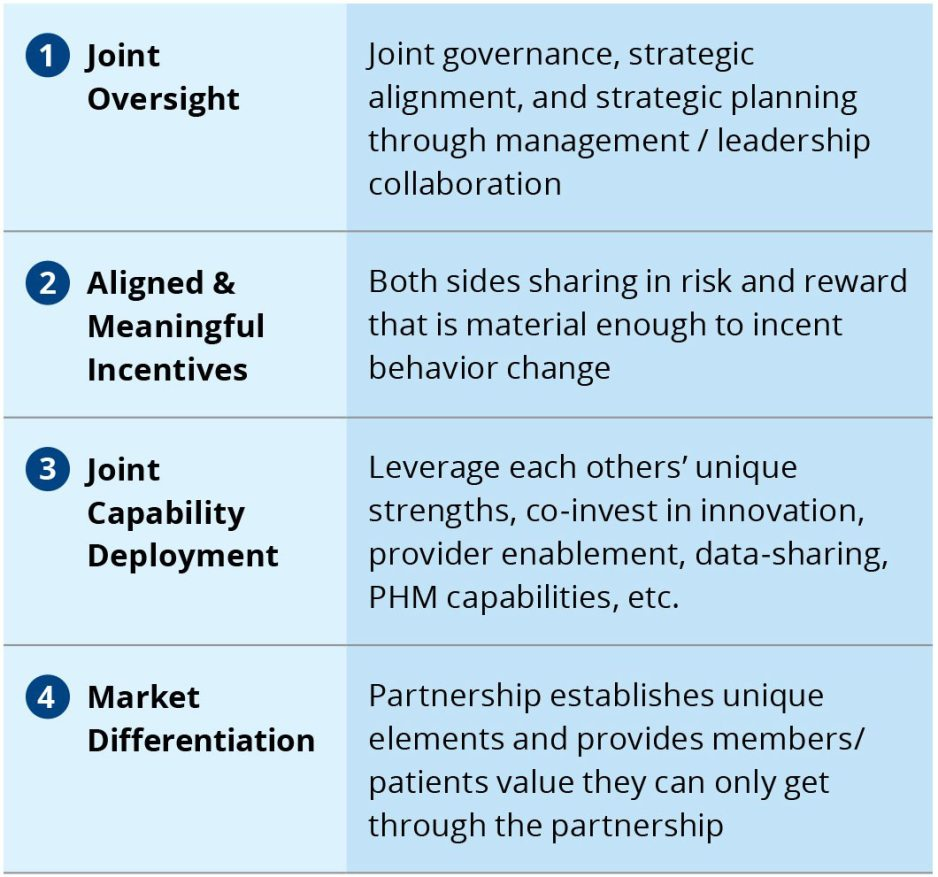
Successful VBC arrangements share several core tenets, grounded in the need for close collaboration between participating parties (Figure 2).

FIGURE 2: Core Tenets of Successful Payer-Provider Value-Based Care Models

However, VBC arrangements are not the only option. Value-centric collaborations can take on a wide range of forms, depending on the amount of risk providers are willing to assume and the partnerships’ risk-related capabilities. The full continuum of value-centric collaborations runs the gamut from shared savings contracts with no downside risk for providers to full vertical integration into a single organization (Figure 3).

FIGURE 3: Understanding the Continuum of Value-Based Care Arrangements

Looking Into the Crystal Ball: Three Future State Scenarios

As the MA market confronts new headwinds after years of growth and favorable attention, we anticipate three possible future state scenarios. These possibilities can be applied to both the outlook nationally, as well as the actions of payers and providers within specific markets.

Scenario 1: A renewal of growth

In this scenario, better sense prevails, and plans and providers collaborate to address the core issues facing the program. A pause/adjustment in the market is followed by a period of renewed growth. From a national standpoint, this scenario is contingent on neutral to favorable regulatory treatment.

Scenario 2: Uneasy stabilization

In this scenario, contention is partially resolved through some degree of collaboration between payers and providers. This scenario is also dependent on neutral to favorable regulatory treatment.

Scenario 3: Implosion

In this scenario, high levels of contention continue, and more providers go out of network. Middle-income Medicare members opt out of MA and go back to traditional Medicare when feasible. This scenario accounts for heightened regulatory pressure on risk adjustment and utilization management practices, which further pressures margins.

Conclusion

Despite MA’s recent, publicly documented challenges, the program now accounts for more than half of all Medicare beneficiaries—a patient population that every healthcare organization must engage in some form or fashion.

As providers and payers decide how to approach the program—and each other—amid uncertainty and contention, the path forward can appear unclear. However, healthcare leaders seeking to emerge from the current environment of MA contention have an opportunity to shape the future of MA and will play a major role determining which of the three scenarios outlined in this article comes to fruition.

Ultimately, organizations must be able to develop a business model that both delivers quality care and manageable per capita costs—and critically, find ways to work through today’s pressing concerns with other MA stakeholders and partners.