Although the nation reached a grim and long-dreaded milestone on Monday, surpassing 500,000 lives lost to COVID—more than were killed in two World Wars and the Vietnam conflict combined—the news this week was mostly good, as key indicators of the pandemic’s severity continued to rapidly improve.
Over the past two weeks, hospitalizations for COVID were down 30 percent, deaths were down 22 percent, and new cases declined by 32 percent—the lowest levels since late October. This week’s numbers declined somewhat more slowly than last week’s, leading Dr. Rachel Walensky, director of the Centers for Disease Control and Prevention, to caution people against letting their guard down just yet: “Things are tenuous. Now is not the time to relax restrictions.” Of particular concern are new variants of the coronavirus that have emerged in numerous states, including one in New York and another in California, that may be more contagious than the original virus.
The best news of the week was surely a report from the Food and Drug Administration (FDA) evaluating the new, single-shot COVID vaccine from Johnson & Johnson (J&J), showing it to be highly effective at preventing severe disease, hospitalization, and death caused by COVID, including variants. On Friday, a panel of outside experts met to assess whether to approve the J&J vaccine for emergency use, which would make it the third in the nation’s arsenal of COVID vaccines. If approved, the vaccine will be rolled out next week, according to the White House, with up to 4M doses available immediately.
The sooner the better: new data show that since vaccinations began in late December, new cases among nursing home residents have fallen more than 80 percent—a hopeful glimpse at the future that lies ahead for the general population once vaccines become widely available.
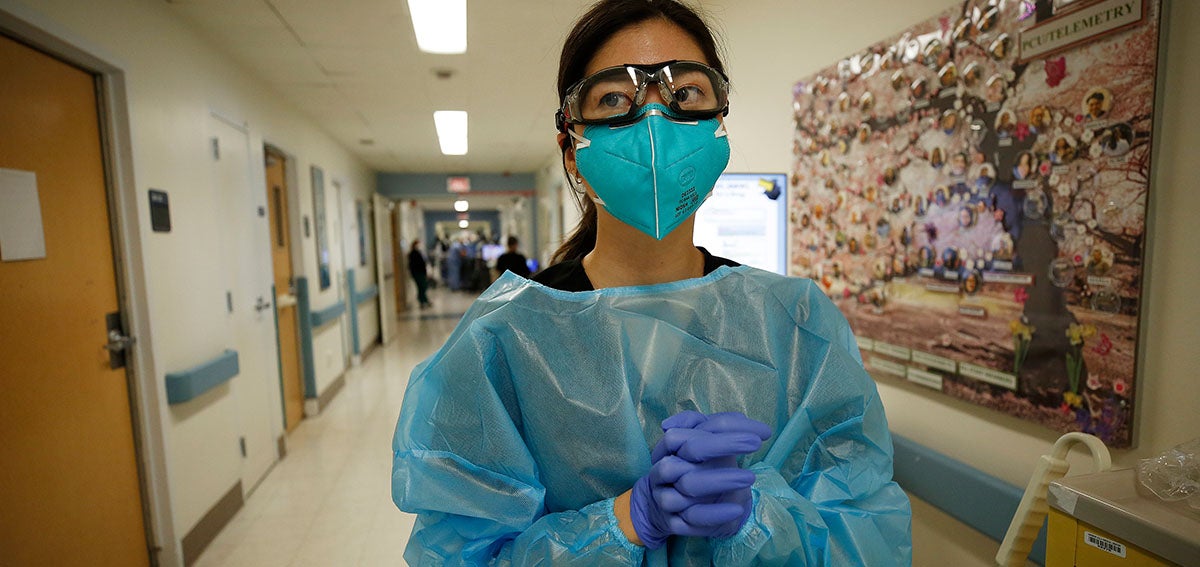
Dr. Christine Choi, 32, a medical resident at Harbor-UCLA Medical Center in Torrance, prepares to enter an isolation area for COVID-19 inpatients. Health care providers must face daily patient death and suffering.
Soon after the COVID-19 pandemic began last spring, Christine Choi, DO, a second-year medical resident at Harbor-UCLA Medical Center, volunteered to enter COVID-19 patient rooms. Since then, she has worked countless nights in the intensive care unit in full protective gear, often tasked with giving the sickest patients and their families the grim choice between intubation or near-certain death.
“I’m offering this guy two terrible options, and that’s how I feel about work: I can’t fix this for you and it sucks, and I’m sorry that the choices I’m giving you are both terrible,” Choi told the Los Angeles Times’ Soumya Karlamangla about one patient encounter.
While Choi exhibits an “almost startlingly positive attitude” in her work, it’s no match for the psychological burdens placed on her shoulders by the global pandemic, Karlamangla wrote. When an older female COVID-19 patient died in the hospital recently, her husband — in the same hospital with the same diagnosis — soon began struggling to breathe. Sensing that he had little time left, Choi held a mobile phone at his bedside so that each of his children could come on screen to tell him they loved him. “I was just bawling in my [personal protective equipment],” Choi said. “The sound of the family members crying — I probably will never forget that,” she said.
It was not the first time the young doctor helped family members say goodbye to a loved one, and it would not be the last. Health care providers like Choi have had to work through unimaginable tragedies and unprecedented circumstances because of COVID-19, with little time to dedicate to their own mental health or well-being.
It has been nearly a year since the US reported what was believed at the time to be its first coronavirus death in Washington State. Since then, the pandemic death toll has mushroomed to nearly 500,000 nationwide, including 49,000 Californians. These numbers are shocking, and yet they do not capture the immeasurable emotional weight that falls on the health care providers with the most intimate view of COVID-19’s deadly progression.“The horror of the pandemic has unfolded largely outside public view and inside hospitals, piling a disproportionate share of the trauma on the people whose work takes them inside their walls,” Karlamangla wrote.
Experts are deeply concerned about the psychological and physical burdens that providers must bear, and the fact that there is still no end in sight. “At least with a natural disaster, it happens, people get scattered all over the place, property gets damaged or flooded, but then we begin to rebuild,” Lawrence Palinkas, PhD, MA, a medical anthropologist at USC, told Karlamangla. “We’re not there yet, and we don’t know when that will actually occur.”
Sixty-eight percent of providers said they feel emotionally drained from their work, 59% feel burned out, 57% feel overworked, and 50% feel frustrated. The poll asked providers who say they feel burned out what contributes most to that viewpoint. One doctor from the Central Valley wrote:
“Short staffed due to people out with COVID. I’m seeing three times as many patients, with no time to chart or catch up. Little appreciation or contact from my bosses. I have never had an N95 [mask]. The emotional toll this pandemic is taking. Being sick myself and spreading it to my wife and young kids. Still not fully recovered but needing to be at work due to physician shortages. Lack of professional growth, and a sense of lack of appreciation at work and feeling overworked. The sadness of the COVID-related deaths and the stories that go along with the disease. That’s a lot of stuff to unpack.”
The pandemic has been especially challenging for female health providers, who compose 77% of health care workers with direct patient contact. “The pandemic exacerbated gender inequities in formal and informal work, and in the distribution of home responsibilities, and increased the risk of unemployment and domestic violence,” an international group of experts wrote in the Lancet. “While trying to fulfill their professional responsibilities, women had to meet their families’ needs, including childcare, home schooling, care for older people, and home care.”
For one female doctor from the Bay Area who responded to the CHCF survey, the extra burdens of the pandemic have been unrelenting: “Having to work more, lack of safe, affordable, available childcare while I’m working. As a single mother, working 15 hours straight, then having to care for my daughter when I get home. Just exhausted with no days off. So many Zoom meetings all day long. Miss my family and friends.”
It is unclear how the pandemic will affect the health care workforce in the long term. For now, the damage “can be measured in part by a surge of early retirements and the desperation of community hospitals struggling to hire enough workers to keep their emergency rooms running,” Andrew Jacobs reported in the New York Times.
One of the early retirements Jacobs cited was Sheetal Khedkar Rao, MD, a 42-year-old internist in suburban Chicago. Last October, she decided to stop practicing medicineafter “the emotional burden and moral injury became too much to bear,” she said. Two of the main factors driving her decision were a 30% pay cut to compensate for the decline in revenue from primary care visits and the need to spend more time at home after her two preteen children switched to remote learning.
“Everyone says doctors are heroes and they put us on a pedestal, but we also have kids and aging parents to worry about,” Rao said.
Working Through Unremitting Sickness and Death
In addition to the psychological burden, health care providers must cope with a harsh physical toll. People of color account for most COVID-19 cases and deaths among health care workers, according to a KFF issue brief. Some studies show that health care workers of color “are more likely to report reuse of or inadequate access to [personal protective equipment] and to work in clinical settings with greater exposure to patients with COVID-19.”
“Lost on the Frontline,” a collaboration of Kaiser Health News and the Guardian, has counted more than 3,400 deaths among US health care workers from COVID-19. Eighty-six percent of the workers who died were under age 60, and nurses accounted for roughly one-third of the deaths.
“Lost on the Frontline” provides the most comprehensive picture available of health care worker deaths, because the US still lacks a uniform system to collect COVID-19 morbidity and mortality data among health care workers. A year into the project, the federal government has decided to take action. Officials at the US Department of Health and Human Services cited the project when asking the National Academies of Sciences, Engineering, and Medicine for a rapid expert consultation to understand the causes of deaths among health care workers during the pandemic.
The National Academies’ report, published December 10, recommends the “adoption and use of a uniform national framework for collecting, recording, and reporting mortality and morbidity data” along with the development of national reporting standards for a core set of morbidity impacts, including mental well-being and psychological effects related to working through public health crises. Some health care experts said the data gathering could be modeled on the federal government’s World Trade Center Health Program, which provides no-cost medical monitoring and treatment for workers who responded to the 9/11 terrorist attacks 20 years ago.
“We have a great obligation to people who put their lives on the line for the nation,” Victor J. Dzau, MD, president of the National Academy of Medicine, told Jacobs.
In the seven states hit hardestby the pandemic, more than 1 in every 500 residents have died from the coronavirus.
Why it matters:The staggering death toll speaks to America’s failure to control the virus.
Details:In New Jersey, which has the highest death rate in the nation, 1 out of every 406 residents has died from the virus. In neighboring New York, 1 out of every 437 people has died.
In Mississippi, 1 out of every 477 people has died. And in South Dakota, which was slammed in the fall, 1 of every 489 people has died.
States in the middle of the pack have seen a death rate of around 1 in 800 dead.
California, which has generally suffered severe regional outbreaks that don’t span the entire state, has a death rate of 1 in 899.
Vermont had the lowest death rate, at 1 of every 3,436 residents.
The bottom line:Americans will keep dying as vaccinations ramp up, and more transmissible variants of the coronavirus could cause the outbreak to get worse before it gets better.
Experts also say it’s time to start preparing for the next pandemic — which could be deadlier.
Anti-inflammatory oral drug colchicine improved COVID-19 outcomes for patients with relatively mild cases, according to certain topline results from the COLCORONA trial announced in a brief press release.
Overall, the drug used for gout and rheumatic diseases reduced risk of death or hospitalizations by 21% versus placebo, which “approached statistical significance.”
However, there was a significant effect among the 4,159 of 4,488 patients who had their diagnosis of COVID-19 confirmed by a positive PCR test:
25% fewer hospitalizations
50% less need for mechanical ventilation
44% fewer deaths
If full data confirm the topline claims — the press release offered no other details, and did not mention plans for publication or conference presentation — colchicine would become the first oral drug proven to benefit non-hospitalized patients with COVID-19.
“Our research shows the efficacy of colchicine treatment in preventing the ‘cytokine storm’ phenomenon and reducing the complications associated with COVID-19,” principal investigator Jean-Claude Tardif, MD, of the Montreal Heart Institute, said in the press release. He predicted its use “could have a significant impact on public health and potentially prevent COVID-19 complications for millions of patients.”
Currently, the “tiny list of outpatient therapies that work” for COVID-19 includes convalescent plasma and monoclonal antibodies, which “are logistically challenging (require infusions, must be started very early after symptom onset),” tweeted Ilan Schwartz, MD, PhD, an infectious diseases researcher at the University of Alberta in Edmonton.
The COLCORONA findings were “very encouraging,” tweeted Martin Landray, MB ChB, PhD, of the Big Data Institute at the University of Oxford in England. His group’s RECOVERY trial has already randomized more than 6,500 hospitalized patients to colchicine versus usual care as one of the arms of the platform trial, though he did not offer any findings from that study.
“Different stage of disease so remains an important question,” he tweeted. “Maybe old drugs can learn new tricks!” Landray added, pointing to dexamethasone.
A small open-label, randomized trial from Greece had also shown less clinical status deterioration in hospitalized patients on colchicine.
“I think this is an exciting time. Many groups have been pursuing lots of different questions related to COVID and its complications,” commented Richard Kovacs, MD, immediate past-president of the American College of Cardiology. “We’re now beginning to see the fruit of those studies.”
The COLCORONA announcement came late Friday, following closely on the heels of the topline results from the ACTIVE-4a, REMAP-CAP, and ATTACC trials showing a significant morbidity and mortality advantage to therapeutic-dose anticoagulation in non-ICU patients in the hospital for COVID-19.
COLCORONA was conducted remotely, without in-person contact, with participants across Canada, the U.S., Europe, South America, and South Africa. It randomized participants double-blind to colchicine 0.5 mg or a matching placebo twice daily for the first 3 days and then once daily for the last 27 days.
Participants were ages 40 and older, not hospitalized at the time of enrollment, and had at least one risk factor for COVID-19 complications: age 70-plus, obesity, diabetes, uncontrolled hypertension, known asthma or chronic obstructive pulmonary disease, known heart failure, known coronary disease, fever of ≥38.4°C (101.12°F) within the last 48 hours, dyspnea at presentation, or certain blood cell abnormalities.
It had been planned as a 6,000-patient trial, but whether it was stopped for efficacy at a preplanned interim analysis or for some other reason was not spelled out in the press release. Whether the PCR-positive subgroup was preplanned also wasn’t clear. Key details such as confidence intervals, adverse effects, and subgroup results were omitted as well.
While a full manuscript is reportedly underway, “we don’t know enough to bring this into practice yet,” argued Kovacs.
Some physicians also warned about the potential for misuse of the findings and attendant risks.
Dhruv Nayyar, MD, of the University of Toronto, tweeted that he has already had “patients inquiring why we are not starting colchicine for them. Science by press release puts us in a difficult position while providing care. I just want to see the data.”
Angela Rasmussen, MD, a virologist with the Georgetown Center for Global Health Science and Security’s Viral Emergence Research Initiative in Washington, agreed, tweeting:“When HCQ [hydroxychloroquine] was promoted without solid data, there was at least one death from an overdose. We don’t need people self-medicating with colchicine.”
As was the case with hydroxychloroquine before the papers proved little efficacy in COVID-19, Kovacs told MedPage Today: “We always get concerned when these drugs are repurposed that we might see an unintended run on the drug and lessen the supply.”
Citing the well-known diarrheal side effect of colchicine, infectious diseases specialist Edsel Salvana, MD, of the University of Pittsburgh and University of the Philippines in Manila, tweeted a plea for use only in the trial-proven patient population with confirmed COVID-19 — not prophylaxis.
The dose used was on par with that used in cardiovascular prevention and other indications, so the diarrhea incidence would probably follow the roughly 10% rate seen in the COLCOT trial, Kovacs suggested.
In the clinic, too, there are some cautions. As Elin Roddy, MD, a respiratory physician at Shrewsbury and Telford Hospital NHS Trust in England, tweeted: “Lots of drug interactions with colchicine potentially — statins, macrolides, diltiazem — we have literally been running up to the ward to cross off clarithromycin if RECOVERY randomises to colchicine.”
The former White House coronavirus response coordinator told CBS News’s “Face The Nation” that she saw Trump presenting graphs about the coronavirus that she did not help make. Someone inside or outside of the administration, she said, “was creating a parallel set of data and graphics that were shown to the president.”
Birx also said that there were people in the White House who believed the coronavirus was a hoax and that she was one of only two people in the White House who routinely wore masks.
Birx was often caught between criticism from Trump, who at one point called her “pathetic” on Twitter when she contradicted his more optimistic predictions for the virus, and critics in the scientific community who thought she did not do enough to combat false information about the virus from Trump, The Post’s Meryl Kornfield reports.
“Colleagues of mine that I’d known for decades — decades — in that one experience, because I was in the White House, decided that I had become this political person, even though they had known me forever,” she told CBS. “I had to ask myself every morning, ‘Is there something that I think I can do that would be helpful in responding to this pandemic?’ And it’s something I asked myself every night.”
Anthony Fauci,director of the National Institute of Allergy and Infectious Diseases,told the New York Times that Trump repeatedly tried to minimize the severity of the virus and would often chide him for not being positive enough in his statements about the virus.
Fauci also described facing death threats as he was increasingly vilified by the president’s supporters.“One day I got a letter in the mail, I opened it up and a puff of powder came all over my face and my chest,” he said. The powder turned out to be benign.
Anthony Fauci on Friday said that a lack of facts “likely did” cost lives over the last year in the nation’s efforts to fight the coronavirus pandemic.
In an appearance on CNN, the nation’s leading infectious diseases expert was directly asked whether a “lack of candor or facts” contributed to the number of lives lost during the coronavirus pandemic over the past year.
“You know it very likely did,” Fauci said. “You know I don’t want that … to be a sound bite, but I think if you just look at that,you can see that when you’re starting to go down paths that are not based on any science at all, that is not helpful at all, and particularly when you’re in a situation of almost being in a crisis with the number of cases and hospitalizations and deaths that we have.”
“When you start talking about things that make no sense medically and no sense scientifically, that clearly is not helpful,” he continued.
President Biden on Thursday unveiled a new national coronavirus strategy that is, in part, aimed at “restoring trust in the American people.”
When asked why that was important, Fauci recognized that the past year of dealing with the pandemic had been filled with divisiveness.
“There’s no secret. We’ve had a lot of divisiveness, we’ve had facts that were very, very clear that were questioned. People were not trusting what health officials were saying, there was great divisiveness, masks became a political issue,” Fauci said.
“So what the president was saying right from the get-go was, ‘Let’s reset this. Let everybody get on the same page, trust each other, let the science speak.’”
Fauci, who was thrust into the national spotlight last year as part of former President Trump‘s coronavirus task force, often found himself at odds with the former president. Trump frequently downplayed the severity of the virus and clashed publicly with Fauci.
Speaking during a White House press briefing on Thursday, Fauci said it was “liberating” to be working in the Biden administration.
There have been more than 24,600,000 coronavirus infections in the U.S. since the pandemic began, according to a count from Johns Hopkins University. More than 410,000 people have died.






 HENRY KOTULA