100 million doses in 100 days: How Biden’s coronavirus vaccine push compares with those of other countries

https://www.washingtonpost.com/world/2021/01/23/international-comparison-biden-coronavirus-vaccine-plan/

A key part of President Biden’s new coronavirus strategy is a push to administer 100 million doses in 100 days, or a lofty sounding 1 million immunizations a day.

That goal, part of a comprehensive national plan launched this week, has raised questions about how quickly the United States can, and should aim to, deliver vaccines to its population.

The strategy document calls the 1 million shots per day pace “aggressive,” an effort that will “take every American doing their part.” But critics have pointed out that it does not constitute a major leap from the current rate, which has already neared or even surpassed the target. Many wonder why the country cannot move more swiftly.

It remains possible that the United States could pick up its pace as vaccine supply increases and logistics improve. But in international context 1 million doses a day does not seem slow.

Though differences in population, logistical capacity and data transparency, along with different levels of vaccine vetting and effectiveness between vaccine types, make it hard to compare vaccination campaigns across countries, the United States is near the top of the pack, behind some of the fastest countries to vaccinate, including Israel and Britain, but ahead of most of the rest of the world.

The biggest factor shaping the rate of vaccination is global supply.

Though the development and emergency approval of coronavirus vaccines has unfolded at an unprecedented pace, drug companies are scrambling to make enough doses to meet demand. As some countries receive a high number of doses from among the limited total produced, others must wait their turn.

So far, a small number of relatively rich countries, including the United States, have snapped up the initial supply, relegating low- and middle-income countries to the back of the line — possibly for years. Some projections suggest poor countries will not have enough doses until 2023 or 2024.

Rich countries are set to fare better. The European Commission aims to vaccinate 70 percent of the adult population of the European Union by the summer, though details of that plan are not yet clear.

Anthony S. Fauci, adviser to President Biden and director of the National Institute of Allergy and Infectious Diseases, said this week that the United States could potentially reach “herd immunity” by fall 2021.

Will other large countries move faster than the United States?

Possibly, but it is hard to say.

Questions about manufacturing capacity, the potential approval of additional vaccines and the impact of the new U.K. variant make predictions tough. However, India offers an interesting point of comparison.

On Jan. 16, India launched a plan to vaccinate 300 million people by August.

The roughly 200 day push to deliver 600 million doses is more ambitious than the U.S. plan. However, India’s population is more than three times larger than that of the United States.

China promised to vaccinate some 50 million people against the coronavirus before the Lunar New Year holiday next month — a seemingly rapid pace. But a report in a news outlet controlled by the ruling Communist Party said the country had administered 15 million doses by Jan. 20.

There are also questions about whether Chinese-made vaccines are as effective as the Moderna, Pfizer and AstraZeneca formulations used elsewhere.

Days after Brazilian officials announced that a vaccine made by Chinese company Sinovac was 78 percent effective protecting against moderate and severe covid-19 cases, for instance, they were forced to clarify that the shot’s efficacy rate among all cases was only 50.4 percent.

Ultimately, the biggest difference between the U.S. vaccination push and the Chinese effort is need.

Though there are doubts about China’s figures, the country reports just above 4,600 coronavirus deaths to date — comparable to the 4,409 U.S. deaths on Inauguration Day alone.

Deborah Birx says Trump received a “parallel set of data” on the coronavirus

https://www.washingtonpost.com/politics/2021/01/25/health-202-hospitals-drag-feet-new-regulations-disclose-costs-medical-services/

The former White House coronavirus response coordinator told CBS News’s “Face The Nation” that she saw Trump presenting graphs about the coronavirus that she did not help make. Someone inside or outside of the administration, she said, “was creating a parallel set of data and graphics that were shown to the president.”

Birx also said that there were people in the White House who believed the coronavirus was a hoax and that she was one of only two people in the White House who routinely wore masks.

Birx was often caught between criticism from Trump, who at one point called her “pathetic” on Twitter when she contradicted his more optimistic predictions for the virus, and critics in the scientific community who thought she did not do enough to combat false information about the virus from TrumpThe Post’s Meryl Kornfield reports.

“Colleagues of mine that I’d known for decades — decades — in that one experience, because I was in the White House, decided that I had become this political person, even though they had known me forever,” she told CBS. “I had to ask myself every morning, ‘Is there something that I think I can do that would be helpful in responding to this pandemic?’ And it’s something I asked myself every night.”

Anthony Fauci, director of the National Institute of Allergy and Infectious Diseases, told the New York Times that Trump repeatedly tried to minimize the severity of the virus and would often chide him for not being positive enough in his statements about the virus. 

Fauci also described facing death threats as he was increasingly vilified by the president’s supporters. “One day I got a letter in the mail, I opened it up and a puff of powder came all over my face and my chest,” he said. The powder turned out to be benign.

Fauci: Lack of facts ‘likely did’ cost lives in coronavirus fight

Fauci: Lack of facts 'likely did' cost lives in coronavirus fight | TheHill

Anthony Fauci on Friday said that a lack of facts “likely did” cost lives over the last year in the nation’s efforts to fight the coronavirus pandemic.

In an appearance on CNN, the nation’s leading infectious diseases expert was directly asked whether a “lack of candor or facts” contributed to the number of lives lost during the coronavirus pandemic over the past year.

“You know it very likely did,” Fauci said. “You know I don’t want that … to be a sound bite, but I think if you just look at that, you can see that when you’re starting to go down paths that are not based on any science at all, that is not helpful at all, and particularly when you’re in a situation of almost being in a crisis with the number of cases and hospitalizations and deaths that we have.”

“When you start talking about things that make no sense medically and no sense scientifically, that clearly is not helpful,” he continued.

President Biden on Thursday unveiled a new national coronavirus strategy that is, in part, aimed at “restoring trust in the American people.”

When asked why that was important, Fauci recognized that the past year of dealing with the pandemic had been filled with divisiveness.

“There’s no secret. We’ve had a lot of divisiveness, we’ve had facts that were very, very clear that were questioned. People were not trusting what health officials were saying, there was great divisiveness, masks became a political issue,” Fauci said.

“So what the president was saying right from the get-go was, ‘Let’s reset this. Let everybody get on the same page, trust each other, let the science speak.’”

Fauci, who was thrust into the national spotlight last year as part of former President Trump‘s coronavirus task force, often found himself at odds with the former president. Trump frequently downplayed the severity of the virus and clashed publicly with Fauci.

Speaking during a White House press briefing on Thursday, Fauci said it was “liberating” to be working in the Biden administration.

There have been more than 24,600,000 coronavirus infections in the U.S. since the pandemic began, according to a count from Johns Hopkins University. More than 410,000 people have died.

Cartoon – History Repeating Itself (Covid-19)

Editorial Cartoon: COVID-19 returns | Opinion | dailyastorian.com

Cartoon – Coronavirus Death Toll

Coronavirus cartoons: Trump's ratings jump amid big job losses

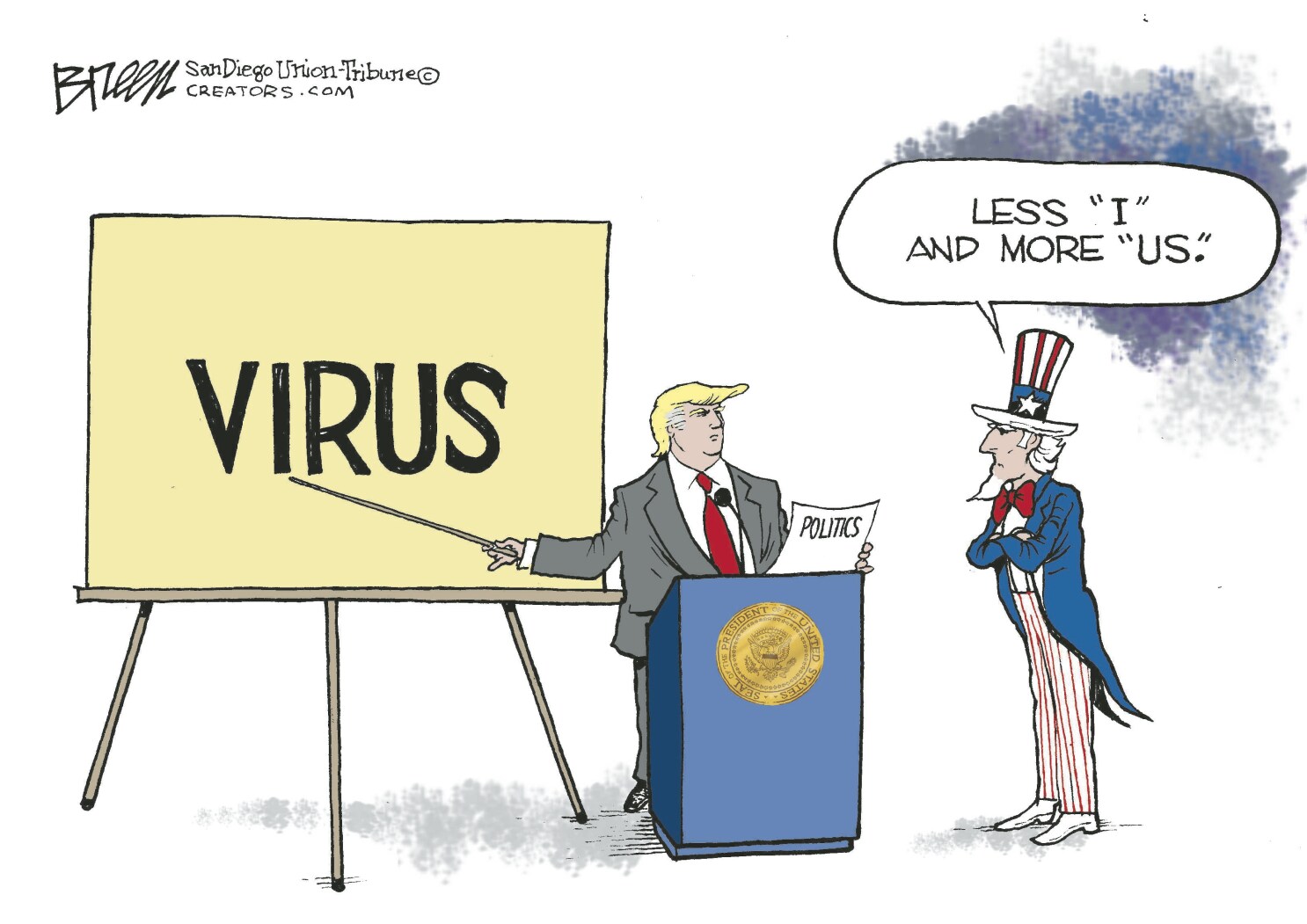
Cartoon – Less “I” and more “US.”

Trump's coronavirus press conference less than inspiring - The San Diego  Union-Tribune

The new administration unveils a national COVID strategy

https://mailchi.mp/128c649c0cb4/the-weekly-gist-january-22-2021?e=d1e747d2d8

Biden unveils national COVID-19 strategy | NHK WORLD-JAPAN News

As one of his first official actions upon taking office Wednesday, President Biden signed an executive order implementing a federal mask mandate, requiring masks to be worn by all federal employees and on all federal properties, as well as on all forms of interstate transportation. Yesterday Biden followed that action by officially naming his COVID response team, and issuing a detailed national plan for dealing with the pandemic. Describing the plan as a “full-scale wartime effort”, Biden highlighted the key components of the plan in an appearance with Dr. Anthony Fauci and COVID response coordinator Jeffrey Zients.

The plan instructs federal agencies to invoke the Defense Production Act to ensure adequate supplies of critical equipment, including masks, testing equipment, and vaccine-related supplies; calls for new national guidelines to help employers make workplaces safe for workers to return to their jobs, and to make schools safe for students to return; and promises to fully fund the states’ mobilization of the National Guard to assist in the vaccine rollout.

Also included in the plan is a new Pandemic Testing Board, charged with ramping up multiple forms of COVID testing; more investment in data gathering and reporting on the impact of the pandemic; and the establishment of a health equity task force, to ensure that vulnerable populations are an area of priority in pandemic response.
 
But Biden can only do so much by executive order. Funding for much of his ambitious COVID plan will require quick legislative action by Congress, meaning that the administration will either need to garner bipartisan support for its proposed American Rescue Plan legislation, or use the Senate’s budget reconciliation process to pass the bill with a simple majority (with Vice President Harris casting the tie-breaking vote). Even that may prove challenging, given skepticism among Republican (and some moderate Democratic) senators about the $1.9T price tag for the legislation. 

We’d anticipate intense bargaining over the relief package—with broad agreement over the approximately $415B in spending on direct COVID response, but more haggling over the size of the economic stimulus component, including the promised $1,400 per person in direct financial assistance, expanded unemployment insurance, and raising the federal minimum wage to $15 per hour.

Some of the broader economic measures, along with the rest of Biden’s healthcare agenda and his larger proposals to invest in rebuilding critical infrastructure, may have to wait for future legislation, as the administration prioritizes COVID relief as its first—and most important—order of business.

US passes 400,000 coronavirus deaths

https://thehill.com/policy/healthcare/534765-us-passes-400000-coronavirus-deaths?rnd=1611069180

COVID update: US passes 400,000 deaths; Rebekah Jones arrested

The United States on Tuesday passed 400,000 deaths from COVID-19, a stunning total that is only climbing as the crisis deepens. 

The country is now averaging more than 3,000 coronavirus deaths every day, according to Johns Hopkins University data, more than the number of people killed in the Sept. 11, 2001, terror attacks, and the daily death toll has been rising. The effects of a surge in gatherings and travel over the holidays are now coming into focus. 

The grim milestone of 400,000 deaths came on the last full day in office for President Trump, who has long rejected criticism of his handling of the pandemic.

The situation threatens to get even worse as a new, more contagious variant of the virus becomes more prevalent. The Centers for Disease Control and Prevention (CDC) warned last week that one of the new variants, first discovered in the United Kingdom, could be the predominant strain in the U.S. by March. 

Vaccines offer hope, but it is crucial for the inoculation campaign to progress as quickly as possible to get as many people protected before the new variant takes greater hold. 

The U.S. vaccination campaign has started slowly, though there are signs it is beginning to pick up some speed. President-elect Joe Biden has pledged a more aggressive federal role in the vaccination effort, including using the National Guard and the Federal Emergency Management Agency to set up more vaccination sites.

In the short term, however, the country is in for a bleak period. 

Biden’s incoming CDC director, Rochelle Walensky, said Sunday on CBS’s “Face the Nation” that she expects 500,000 COVID-19 deaths by the middle of February. 

“I think we still have some dark weeks ahead,” she said. 

The country passed 300,000 deaths in mid-December.

At the end of March, as the crisis was beginning, Trump said that if deaths are limited to between 100,000 and 200,000 “we all, together, have done a very good job.” The country has long ago exceeded those numbers. 

The U.S. has by far the most COVID-19 deaths of any country in the world. Brazil follows with around 210,000, and India and Mexico are around 150,000, according to Johns Hopkins University. 

More than 124,000 people are in the hospital with coronavirus in the U.S., according to the COVID Tracking Project, though the number is starting to decline somewhat from a peak of over 130,000 about a week ago. 

The spread of the more contagious variant, however, threatens to send that number spiking again.

Whatever Affects One Directly, Affects All Indirectly

Apple once more dedicates homepage to celebrating Martin Luther King Jr Day  - 9to5Mac

The United States could hit half a million covid-19 deaths by mid-February

“It took 12 weeks for the death toll to rise from 200,000 to 300,000. The death toll has leaped from 300,000 to almost 400,000 in less than five weeks,” The Post’s  Marc Fisher, Lori Rozsa, Mark Kreidler and Annie Gowen report. 

Yet despite the massive death toll and the changes to daily life caused by the pandemic, the individual deaths are largely invisible.  

“Coronavirus victims who die in the hospital often spend their final days cut off from family and friends, their only human contact coming from medical personnel hidden behind layers of protective gear. Even those who die at home often decline in quarantine, keeping a lonely vigil over their body’s fight,” my colleagues write.

The numbers are expected to quickly rise. Rochelle Walensky, the incoming director of the Centers for Disease Control and Prevention, told “Face The Nation” on Sunday that she anticipated half a million deaths by mid-February.

“That doesn’t speak to the tens of thousands of people who are living with a yet- uncharacterized syndrome after they’ve recovered. We still yet haven’t yet seen the ramifications from holiday travel, holiday gathering in terms of high rates of hospitalizations,” Walensky added.