Hundreds of nurses at University Hospitals are facing a decrease in pay as the Cleveland-based health system pivots from its COVID-19 pandemic model, cleveland.com reported.
A spokesperson told Becker’s the pay adjustment is effective June 16 and applies to 350 Enterprise Staffing Services nurses.
“UH’s Enterprise Staffing Services is an in-house staffing agency formed in response to the once-in-a-lifetime global health pandemic that stretched our resources and workforce to the extreme,” a UH statement shared with Becker’s said. “During the pandemic, hospitals across the country (including UH) increased their use of agency nurses to fill gaps in staffing with government funding assistance, with agency costing up to twice as much or more than our hospital-based full-time nurses.
“Nurses are the heartbeat of our health system and we will never be able to thank them enough for their commitment and dedication to our patients during the pandemic. Unfortunately, the pandemic care model is not sustainable in today’s environment.”
The statement said those affected by the pay adjustment, representing 1% of the health system’s workforce, will still be paid about twice the national average.
Pay for staffing services nurses on night shift will decrease from $75 to $65 an hour, a 13% cut, UH said, according to cleveland.com, which obtained a health system memo related to the change. Pay for staffing services nurses on day shift will decrease 8%, from $60 to $55 an hour.
Pay for a new staffing services job without benefits will be $75 per hour for night shift, and $65 per hour for day shift, UH said in the memo, which also encouraged staffing services nurses to apply for other health system roles, according to cleveland.com.
“As we continue to exit from our pandemic model, external nursing staffing agencies and internal hospital nurse staffing agencies nationwide are adjusting pay accordingly,”
UH’s statement said. “We have provided cutting-edge, compassionate care to our neighbors in Northeast Ohio since 1866. We’re taking the appropriate steps to ensure we can continue fulfilling our mission for future generations.”
Across the hospital industry, heavy reliance on contract labor in 2021 and 2022 caused a significant challenge for profitability.
However, a chief financial officer recently posited that his system’s large contract labor load has had unexpected benefits.
“Other hospitals [in our market] thought we were crazy to keep staffing with high contract rates until recently,” he shared. “But by keeping the agency nurses around a little longer, we were able to avert raising base salaries quite as much, and are in a better place today now that the labor market has softened.” It’s a story we’ve heard several times now.
While market rates for nursing and other clinical labor have undoubtedly been rebased, salary increases are sticky—it’s hard to adjust wages downward when the labor market loosens.
Systems who were able to avert large wage increases by increasing bonuses and other non-salary benefits, or forestalled permanent hiring at higher salaries by extending contract labor, now find themselves with more flexibility and potentially lower staffing costs in the long-term.
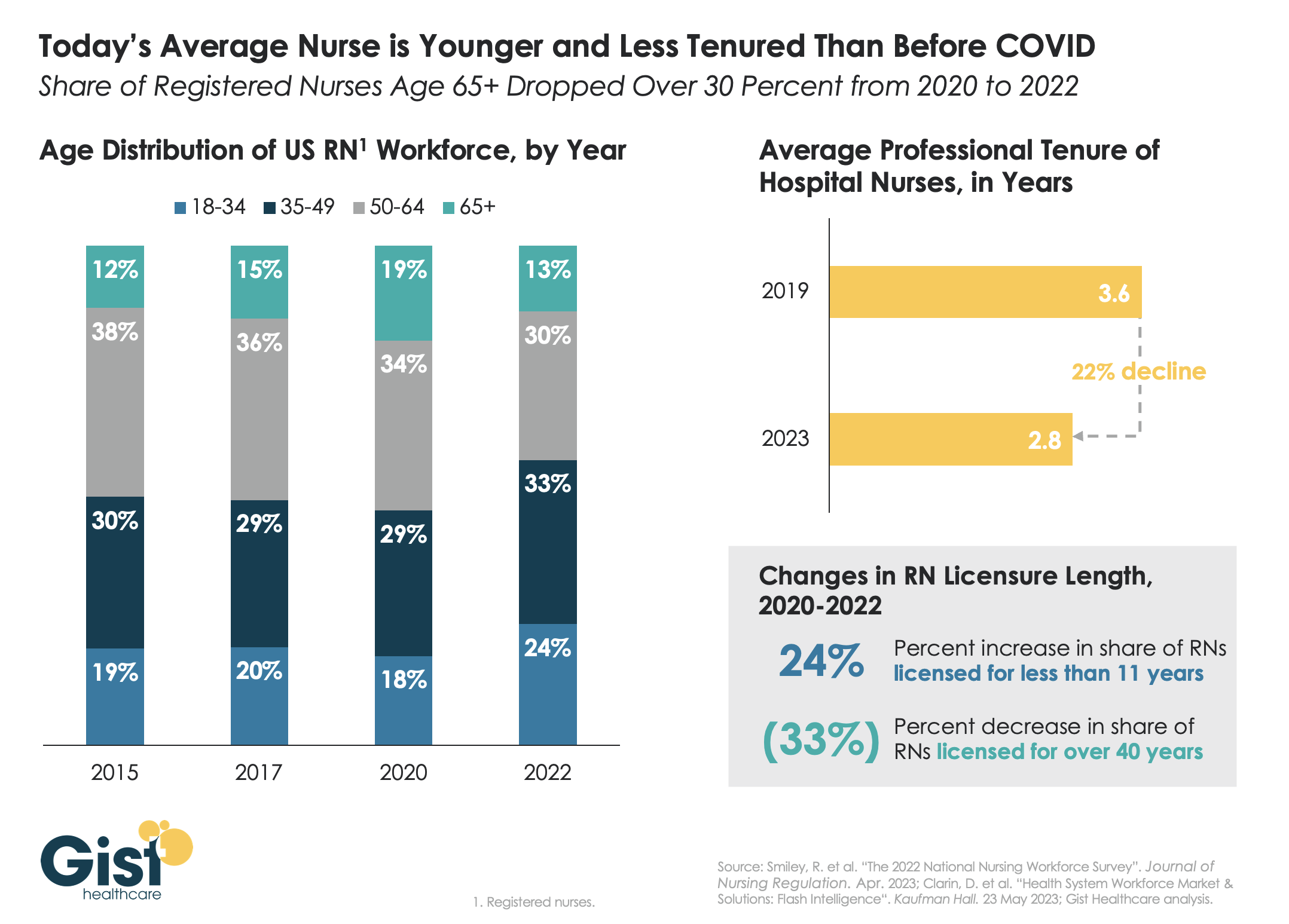
Last week we discussed how hospitals are still struggling to retain talent. This week’s graphic offers one explanation for this trend:
a significant share of older nurses, who continued to work during the height of the pandemic, have now exited the workforce, and health systems are even more reliant on younger nurses.
Between 2020 and 2022, the number of nurses ages 65 and older decreased by 200K, resulting in a reduction of that age cohort from 19 percent to 13 percent of the total nursing workforce. While the total number of nurses in the workforce still increased, the younger nurses filling these roles are both earlier in their nursing careers (thus less experienced), and more likely to change jobs.
Case in point:
From 2019 to 2023, the average tenure of a hospital nurse dropped by 22 percent. The wave of Baby Boomer nurse retirements has also resulted in a 33 percent decrease from 2020 to 2022 in the number of registered nurses who have been licensed for over 40 years.
Given these shifts, hospitals must adjust their current recruitment, retention, training, and mentorship initiatives to match the needs of younger, early-career nurses.
Of all the pandemic’s impacts still felt today, disruptions to the healthcare workforce and rising labor costs may be most impactful to current health system operations.
Over the next three editions of the Weekly Gist, we’ll be exploring the lingering effects of this workforce crisis, with a focus on nurse staffing and recruitment.
While wage increases helped reduce hospital registered nurse (RN) turnover rates from 27 percent in 2021 to 23 percent in 2022, nurses—along with hospital employees in general—are still changing jobs at higher rates than before the pandemic.
Over half of all hospitals still face nurse vacancy rates above 15 percent, a slight improvement from 2022 but still far more than before the pandemic.
While the worst of nursing turnover appears to have passed, the “rebasing” of wages (for nursing, 27 percent higher compared to 2019) will provide ongoing pressure to strained hospital margins.
Mountain View, Calif.-based El Camino Health ended the first quarter with an impressive operating margin of 10.2 percent when many health systems saw their margins hover above zero or fall into the red. The system’s revenue for the quarter totaled $131,290.
For the nine months ended March 31, the two-hospital system posted an operating gain of $141.4 million on revenue of just over $1 billion.
However, like most health systems, El Camino’s expenses are substantially higher than the same period last year, increasing 10.6 percent year over year for the nine months ending March 31, 2023, to $881.9 million.
The system is making a conscious effort to march down labor costs while also placing a significant emphasis on retention. In June, El Camino agreed a deal to increase pay for nurses by 16 percent over three years.
“Like nearly all hospitals, our nursing staff comprises the largest part of our workforce. With the recruitment of a single nurse estimated to be nearly $60,000, our primary strategy to reduce labor costs is to focus on decreasing turnover,” El Camino CEO Dan Woods told Becker’s.
“Our turnover rate for nurses is just about 8 percent while the turnover rate nationally is still running at 22 percent.”
In March, the system also received a credit rating upgrade from Moody’s, which noted the system’s “superlative cash metrics and operating performance.” Fitch Ratings also revised El Camino’s outlook to positive in February, noting that the system has a history of generating double-digit operating EBITDA margins, driven by a solid market position that features strong demographics and a very healthy payer mix.
More than a year after launching an in-house travel staffing agency, UPMC is adding a new regional approach to the effort.
Maribeth McLaughlin, MPM, BSN, RN, chief nursing executive for the Pittsburgh-based health system, told Becker’s the approach provides a new option for nurses and surgical technologists who desire to travel.
“Our overall travel program, when you travel for us, you travel across our hospitals in New York, Maryland and Pennsylvania,” she said. “And now we are launching a regional travel strategy where some staff can choose to travel only within certain regions.”
UPMC initially announced in December 2021 that it had created UPMC Travel Staffing, a new in-house travel staffing agency to address a nursing shortage and to attract and retain workers.
Through the agency, nurses and surgical technologists earn $85 an hour and $63 an hour, respectively, in addition to a $2,880 stipend at the beginning of each six-week assignment.
Ms. McLaughlin said the rate is lower — about $60 an hour — for those who opt for the regional approach.
As of June 1, UPMC has hired more than 700 staff into the in-house travel staffing agency, with 60 percent of those workers being external hires, according to Ms. McLaughlin. And there have been fewer workers leaving UPMC to go to other travel agencies.
“One of my goals since I’ve taken this role is to really look at building in as many flexible programs as I could for staff,” said Ms. McLaughlin, who has served in her current role since August 2022. “I think as we came out of the pandemic, it’s clear to me that work-life harmony means something different to staff today than it maybe meant when I was a young staff nurse years ago, and that we need to have as much flexibility and as many different programs as we can.”
She said UPMC Travel Staffing has delivered this flexibility and allowed the health system to cancel about 90 contracts with external travel agencies. Additionally, some external travelers have now moved into UPMC’s in-house agency. Ms. McLaughlin expects more to join the in-house agency now that UPMC has launched the regional approach.
“We’re launching a win-back program where we’re going out and trying to see some of the people who we know we lost and see if they’re interested in coming back closer to home and traveling closer to home,” she explained.
Still, she acknowledged some of the challenges along the way.
“Our IT department built us an app to be able to manage all of this because, as you can imagine, we have external travel, internal travelers, core staff and at times it could get a little confusing,” said Ms. McLaughlin. “So we’ve been able to build that to be able to figure out the best ways to assign the staff where the greatest needs are.”
Another challenge she noted is that shifts for workers from external travel agencies are often 12 weeks, while shifts with UPMC Travel Staffing are six weeks. She said this is a purposeful move because those in UPMC Travel Staffing receive benefits and are considered UPMC employees, rather than receiving an hourly rate.
“Overall, it’s been a really successful program for us because it’s allowed us to look at things in a different way,” said Ms. McLaughlin. “It’s a central function. It’s not something we did and farmed out to every hospital to administer themselves. We did it as a system and as a core, which I also think is important.”
Now, she said she’s excited about the new regional approach and the opportunities it presents for recruiting and retention.
“We’re growing our own students, we’re bringing in all these students, and we’re not saying, ‘You have to just work here.’ We’re saying, ‘You can work for us at UPMC, and here are all the options. You can even be a traveler with us,'” she said.
During the pandemic, many nurses left hospital staff jobs for more lucrative travel jobs. However, many of these nurses are returning to hospitals for full-time positions, especially as travel pay falls and organizations offer new staff benefits, Melanie Evans writes for the Wall Street Journal.
Hospitals see more nurses return to their positions
During the pandemic, many hospitals struggled with staffing shortages as many nurses left their positions as a result of burnout or for more high-paying travel opportunities. However, many nurses are now returning to staff positions, especially as travel pay declines.
According to Aya Healthcare CEO Alan Braynin, travel nurse pay is now down 28% compared to a year ago. Hospital openings for travel nurses were also down by 51% at the end of April compared to the same time last year.
At HCA Healthcare, the country’s largest publicly traded hospital chain, nurse hiring increased by 19% in the first three months of the year compared to the average across the last four quarters. In addition, turnover levels have almost declined to pre-pandemic levels, and HCA’s travel nurse costs have dropped by 21% in the first quarter of this year compared to 2022.
According to the organization, many nurses who initially left their hospitals during the pandemic are now coming back. Since 2022, around 20% of the 37,000 nurses hired at HCA hospitals previously worked for the company at some point between 2016 and 2022.
Similarly, Houston Methodist has rehired around 60 nurses who initially left during the pandemic. Roberta Schwartz, the chief innovation officer at the health system’s flagship hospital, said these returning nurses have helped the hospital make more beds available and keep up with an 8% increase in demand.
“The boomerang nurses have returned,” said Gail Vozzella, Houston Methodist’s chief nurse.
How hospitals are attracting boomerang nurses
To attract more nurses to staff positions, hospital officials said they are offering higher pay, as well as several new benefits, such as childcare, less demanding work positions, and more flexible schedules.
For example, Suzane Nguyen, who took a teaching job during the pandemic, rejoined Houston Methodist in June 2022 after she was offered a virtual job. In her new position, she collects patient information by video. “The stress doesn’t compare,” she said.
Similarly, Linda Allen, an ED nurse who left to work for a temporary agency during the pandemic, returned to Sentara Healthcare in 2022 after the hospital system increased its wages and offered new, more flexible schedules.
According to Terrie Edwards, Sentara’s regional VP, the organization has increased its nurse wages by around 21% in the last two years and now offers student debt relief up to $10,000, as well as adoption and infertility benefits.
Overall, these changes have helped Sentara hire around 400 boomerang nurses, which has reduced staff overtime and cut its travel nurse expenses in half.
“They really did step up,” said Allen, who became a full-time employee in September 2022 after initially working temporary 13-week contracts.
Outside of these benefits, some nurses are also just ready for more permanent positions after spending the pandemic working in several different hospitals. “There is something to be said for working in the same place every day, consistently,” said Alexis Brockting, an advanced practice nurse at Mercy Hospital South.
Addressing the education pipeline is one thing that legislators could focus on to improve nurse and physician shortages, medical school and health system leaders said.
As the healthcare industry continues to face pandemic-driven workforce challenges, lawmakers are exploring ways to boost the number of clinicians practicing in the U.S.
“A shortage of healthcare personnel was a problem before the pandemic and now it has gotten worse,” Chairman Sen. Bernie Sanders I-Vt., said during a Thursday Senate HELP committee hearing. “Health care jobs have gotten more challenging and, in some cases, more dangerous,” he said.
Hospitals are currently facing shortages of registered nurses as burnout and other factors drive them to other roles.
For example, 47-hospital system Ochsner Health in New Orleans has about 1,200 open nursing positions, Chief Academic Officer Leonardo Seoane said at Thursday’s hearing.
The workforce shortaged led Ochsner to close about 100 beds across its system during the past six months, leading to it use already-constrained emergency departments as holding bays for patients, he said.
Like other systems, labor costs have also been a concern due to a continued reliance on temporary staff to fill gaps. Ochsner’s non-agency labor costs grew just under 60% since 2019, while its costs for contract staff grew nearly 900%, he said.
“Our country is perilously short of nurses, and those we do have are often not working in the settings that could provide the most value,” Sarah Szanton, dean of Johns Hopkins School of Nursing said.
“This was true before the pandemic and has become more acute,” she said.
While many nurses left permanent roles for higher-paying contract positions during the pandemic, others have turned to jobs at outpatient clinics, coinciding with a shift toward non-hospital based care.
Registered nurse employment is nearly 5% above where it was in 2019, with nearly all that growth occurring outside of hospitals, Douglas Staiger, a professor of economics at Dartmouth College, found in his research and said at the hearing.
One major concern: Driving current and projected shortages in hospitals that lawmakers can address is the educational pipeline, medical school and health system leaders said.
Educational programs for nurses and physicians face site shortages and educators who are often allured by other higher-paying jobs in the industry.
Nursing educators in Vermont earn about $65,000 a year — about half of what nurses with similar degrees working in hospitals earn, Sanders said during the hearing. He asked members to consider expanding the Nurse Corps and nurse faculty loan repayments, among other programs.
Supporting partnerships between universities and hospitals to create more training opportunities is another way Congress can help, along with addressing high costs of tuition, James Herbert, president of University of New England, said during the hearing.
“Scholarship and loan repayment programs are critical to make healthcare education more accessible for those who would otherwise find it out of reach,” Herbert said.
That includes expanding and improving Medicare-funded physician residencies, he said.
Creating a more diverse workforce that looks more like the population it serves is another important task, and one lawmakers can address by supporting historically black colleges and universities.
Federal funding could help improve classrooms and other infrastructure at HBCUs “that have been egregiously are underfunded for decades,” in addition to expanding Medicare-funded residencies for hospitals that train a large number of graduates for HBCU medical schools, said James Hildreth Sr., president and CEO at Meharry Medical College in Nashville.
The American Hospital Association submitted a statement to the HELP subcommittee and said it also supports increasing the number of residency slots eligible for Medicare funds and rejecting cuts to curb long-term physician shortages.
Other AHA supported policies to address current and long-term workforce shortages include better funding for nursing schools and supporting expedited visas for foreign-trained nurses.
AHA also asked lawmakers to look into travel nurse staffing agencies, reviving requests it made last year alleging that staffing companies engaged in price gouging during the pandemic.
It covers 589,901 healthcare workers and 166,087 registered nurses from 272 facilities and 32 states. Participants were asked to report data on turnover, retention, vacancy rates, recruitment metrics and staffing strategies from January to December 2021.
The survey found a wide range of helpful figures for understanding the financial fallout of one of healthcare’s hardest labor disruptions:
The average hospital lost $7.1 million in 2021 to higher turnover rates.
The average hospital loses $5.2 to $9 million on RN turnover yearly.
The average turnover cost for a staff RN is $46,100, up more than 15 percent from the 2020 average.
The average hospital can save $262,300 per year for each percentage point it drops from its RN turnover rate.
To improve margins, hospitals need to control labor costs by decreasing dependence on travel and agency staff, but only 22.7 percent anticipate being able to do so.
For every 20 travel RNs eliminated, a hospital can save $4.2 million on average.
In the past 5 years, the average hospital turned over 100.5 percent of its workforce:
In 2021, hospitals set a goal of reducing turnover by 4.8 percent. Instead, it increased 6.4 percent and ranged from 5.1 percent to 40.8 percent. The current average hospital turnover rate nationally is 25.9 percent, according to the report.
While 72.6 percent of hospitals have a formal nurse retention strategy, less than half of those (44.5 percent) have a measurable goal.
Overall, 55.5 percent of hospitals do not have a measurable nurse retention goal.
Retirement is the number four reason staff RNs leave, and it is expected to remain a primary driver through 2030. More than half (52.8 percent) of hospitals today have a strategy to retain senior nurses. In 2018, only 21.6 percent had one.
Historically, RN turnover has trended below the hospital average across all staff. For the first time since conducting the survey, this is no longer true:
In the past five years, the average hospital turned over 95.7 percent of its RN workforce.
Close to a third (31.0 percent) of all newly hired RNs left within a year, with first year turnover accounting for 27.7 percent of all RN separations. Given the projected surge in retirements, expect to see the more tenured groups edge up creating an inverted bell curve.
Operating room RNs continue to be the toughest to recruit, while labor and delivery RNs are trending easier to recruit than in the year prior.
Hospitals are experiencing a dramatically higher RN vacancy rate (17 percent) compared to last year’s rate of 9.9 percent.
The vast majority (81.3 percent) reported a vacancy rate higher than 10 percent.
It’s been a difficult year for the hospital workforce, both here and around the world, as the effects of the pandemic, the economy, and the legacy of lean staffing models have combined to drive up vacancy rates and threaten the sustainability of hospital operations.
Everywhere we’ve gone in the past six months, workforce issues have overshadowed every other topic: how can hospitals attract and retain staff given the environment, how can they stabilize finances in the face of 15-20 percent increases in labor costs, how can they safeguard patient care with intense turbulence in the clinical workforce?
This week we heard yet another wrinkle to this problem, one that had not occurred to us but in retrospect is obvious. A system CFO was lamenting the fact that even with big salary increases, the hospital workforce remains unstable. “It’s like we’re not even getting credit for raising base salary 15 percent across the board and giving big retention bonuses.”
As to why—it’s a timing issue. Her system, like many, delivered pay raises back in the late winter and early spring, when staff were still recovering from the Omicron surge and the urgency of reducing reliance on expensive agency labor became clear. But economy-wide inflation had only then begun to spike, and has since continued to be stuck at high levels.
Staff don’t view the earlier salary increases as a response to inflation, but as predating it—and they’re asking for still more, to offset rising prices for food, transportation and housing. “I wish we’d waited to give the pay bump,” the CFO told us. “Even though our wage increases have outpaced inflation this year, the timing of events didn’t help us at all.”
With the hospitals operating near capacity, and a severe flu season impacting both patient volumes and staff availability, her sense is that the system is back to square one on staffing—and more difficult financial decisions lie ahead.






 HENRY KOTULA