When a Medicaid Card Isn’t Enough

tradeoffs.org/2022/05/17/medicaid-physician-access/

A certain segment of the health policy world spends a lot of time trying to get more states to expand Medicaid and reduce underinsurance.

But are we doing enough to make sure care is accessible once people enroll? One issue is access to physicians, who are less likely to treat patients on Medicaid than Medicare or private insurance because Medicaid payment rates are lower.

A new paper in Health Affairs by Avital Ludomirsky and colleagues looked at how well the networks of physicians supposedly participating in Medicaid reflect access to care. The researchers used claims data and provider directories from Medicaid managed care plans (the private insurers that most states contract with to run their Medicaid programs) in Kansas, Louisiana, Michigan and Tennessee from 2015 and 2017 to assess how the delivery of care to Medicaid patients was distributed among participating doctors. Their results were striking:

  • One-quarter of primary care physicians provided 86% of the care; one-quarter of specialists provided 75%.
  • One-third of both types of physicians saw fewer than 10 Medicaid patients per year, hardly contributing any “access” at all.
  • There was only one psychiatrist for every 8,834 Medicaid enrollees after excluding those seeing fewer than 10 Medicaid patients per year. This is especially concerning given that the COVID-19 pandemic has worsened mental health in the U.S., particularly among children

The authors note that their study only covers primary care and mental health providers in four states, so it is not necessarily generalizable to other states or specialties. But these results are still concerning.   

States have so-called network adequacy standards for their Medicaid managed care plans that are supposed to make sure there are enough providers. These standards typically rely on either a radius (a certain number of providers for a geographic area) or ratio (number of providers per enrollee), but the authors’ findings show these methods fall short if they are based on directories alone.

The authors specifically recommend states use claims-based assessments like the ones in the study and “secret shopper” programs — like this recently published one from Maryland by Abigail Burman and Simon Haeder — to better evaluate whether plans are offering adequate access to physicians. We absolutely need people to have coverage, but it needs to be more than just a card in their wallet.

Stanford physicians vote to join union

Resident and fellow physicians at Palo Alto, Calif.-based Stanford Health Care have voted in favor of representation by the Committee of Interns and Residents, according to a May 3 news release.

Of the nearly 1,050 ballots counted, 835 were in favor of representation, the National Labor Relations Board website showed. 

The vote comes after resident physicians led a protest in December 2020 against Stanford’s COVID-19 vaccination plan that excluded house staff from the initial round of shots. The health system immediately revised the plan to prioritize resident physicians.

In February, physicians also demanded the health system voluntarily recognize the Committee of Interns and Residents as their exclusive representative for collective bargaining.

Now the union said its members are looking forward to negotiations. 

“Our doctors are united by our desire to provide the best possible patient care and strong worker protections,” said Ben Solomon, MD, a pediatric resident physician, said in the release. “One thing the pandemic has made abundantly clear, in addition to the widespread equity issues in our healthcare system, is that our needs as physicians cannot be separated from those of our patients.”

The National Labor Relations Board must certify the election results before they are final. Stanford does not plan to challenge the results, the health system said in a statement shared with Becker’s on May 3.

“As we begin the collective bargaining process, our goal remains unchanged: providing our residents and fellows with a world-class training experience,” Stanford said. “We will bring this same focus to negotiations as we strive to support their development as physician leaders.”

The Committee of Interns and Residents is a local chapter of the Service Employees International Union. The union represents more than 20,000 resident physicians and fellows, including University of Massachusetts physicians in training, who unionized in March 2021. 

Physician departures from Mission Health continue years after HCA Healthcare takeover

Since the for-profit system acquired six-hospital, Asheville, NC-based Mission Health in February 2019, there has been a series of reports about cascading community impacts, including a large physician exodus from the system. Local news outlet Asheville Watchdog counts 223 doctors who are no longer included in the system’s online directory, which currently lists about 1,600 physicians; HCA has also reportedly reduced health system staff by over 12 percent since the acquisition. Former Mission doctors say that patient care at the system is suffering, and that HCA doesn’t place the same value on primary care that Mission Health physicians historically did.

The Gist: The cultural shift from 130 years as a nonprofit community fixture to for-profit health system subsidiary has been rocky for Mission. Even before the HCA deal had been finalized, Mission physicians expressed concerns about how the company would implement its lean staffing and operational “playbook”. These expected changes were surely compounded by COVID-related staffing challenges. 

Physician stakeholders who feel uncertain about the impact of an impending merger can sometimes use their voice to stymie health system combinations (see Beaumont Health’s failed merger with Advocate Aurora Health), but may also vote with their feet when dissatisfied with new ownership, leaving critical gaps in patient care

Private equity-backed buyouts have physicians concerned

The Federal Trade Commission and the Justice Department are seeking comments on ways merger guidelines should be updated, and physicians are raising concerns about private equity-backed buyouts of provider practices. 

The FTC and the Justice Department announced in January that they’re seeking to revamp merger guidelines for businesses. Comments on how to “modernize the merger guidelines to better detect and prevent anticompetitive deals,” can be submitted to the agencies through April 21. 

Comments are pouring in from physicians. Many of the comments are anonymous, but the commenters self-identify as physicians. 

The physicians’ top concern are private equity-backed buyouts, according to an analysis by Law360. They’re also concerned by the profit-first attitude of healthcare and consolidation in the industry, according to the report. 

The commenters raised many concerns with private equity groups, saying theyput profits over patients” and “stifle the voices of physicians.”

The comments are coming in as private equity firms continue to buy up physician practices. 

Private equity firms acquired 59 physician practices in 2013, and that number increased to 136 practices by 2016, according to a research letter published in JAMA

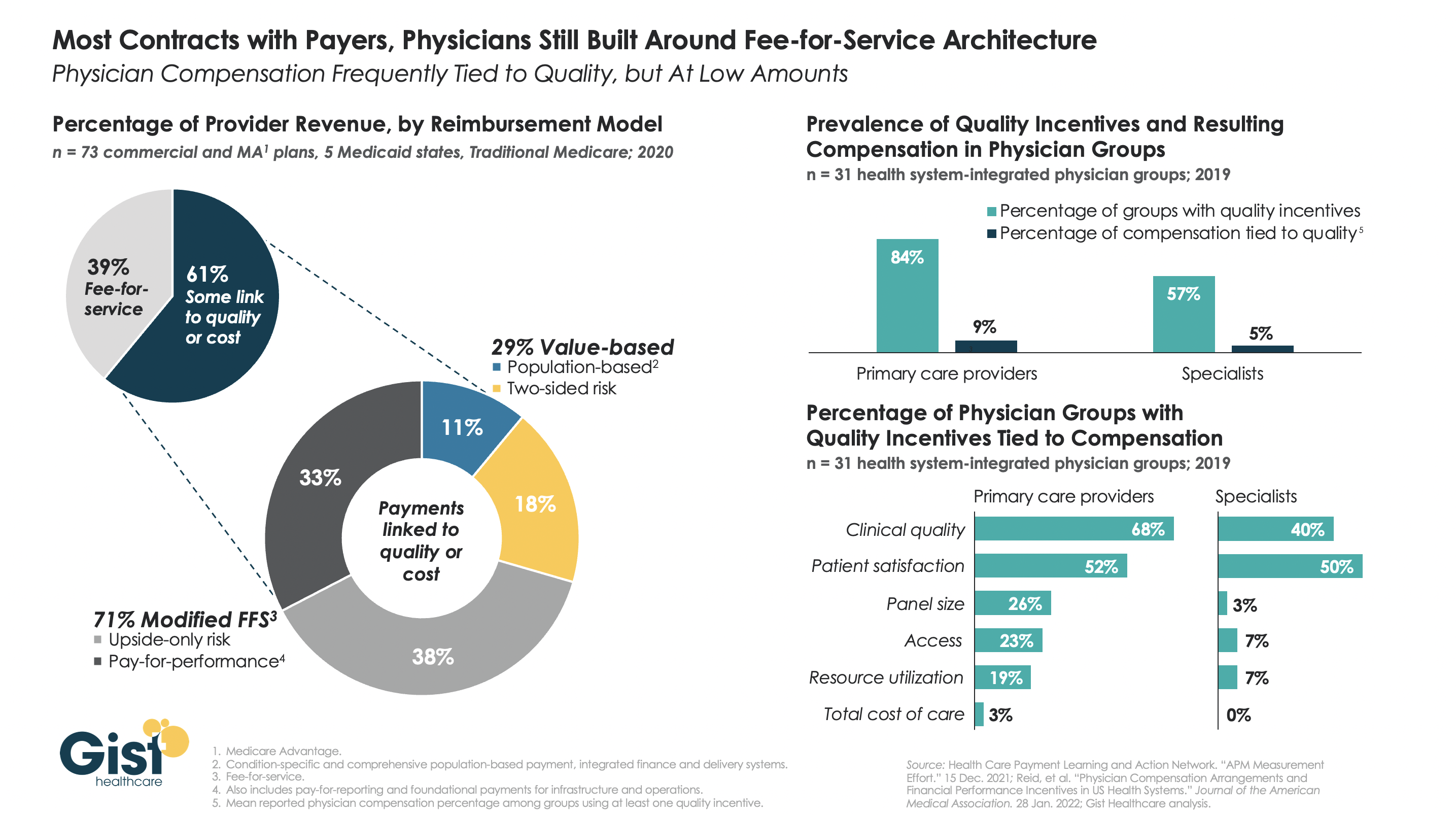
Payer contracts, physician pay still anchored in fee-for-service

The healthcare industry has made some strides in the “journey to value” across the last decade, but in reality, most health systems and physician groups are still very much entrenched in fee-for-service incentives.

While many health plans report that significant portions of their contract dollars are tied to cost and quality performance, what plans refer to as “value” isn’t necessarily “risk-based.” 

The left-hand side of the graphic below shows that, although a majority of payer contracts now include some link to quality or cost, over two-thirds of those lack any real downside risk for providers. 

Data on the right show a similar parallel in physician compensation. While the majority of physician groups have some quality incentives in their compensation models, less than a tenth of individual physician compensation is actually tied to quality performance. 

Though myriad stakeholders, from the federal government to individual health systems and physician groups, have collectively invested billions of dollars in migrating to value-based payment over the last decade, we are still far from seeing true, performance-based incentives translate into transformation up and down the healthcare value chain.  

Administration’s latest plans to manage COVID—including “test to treat”—now in question, as Congress strips funding

https://mailchi.mp/f6328d2acfe2/the-weekly-gist-the-grizzly-bear-conflict-manager-edition?e=d1e747d2d8

Congress cut billions of dollars in COVID-related funding from the broader government spending bill it just passed, jeopardizing President Biden’s plans for covering the costs of COVID testing and treatments, and making antiviral drugs available for free at pharmacies for those who test positive through the “test to treat” initiative.

However, a variety of other healthcare funding made it into the final package, including a five-month extension of COVID-era telehealth flexibilities for Medicare beneficiaries, and funds for pandemic preparedness. Congressional Democrats now plan to pass a separate COVID funding bill, although that effort will likely face stiff opposition from Senate Republicans.

The Gist: Removing COVID funding from the final spending package may signal the beginning of the end of federal pandemic relief spending, and could render the “test to treat” initiative, which has been praised by public health experts, dead on arrival. 

Pharmacists, who have taken on a larger role in patient care during the pandemic, assisting with testing and vaccination of millions of Americans, have pushed for the ability to prescribe new antiviral therapies, but the American Medical Association criticized the initiative, maintaining that physicians should control the prescribing. Although the drug interactions and side effects cited by the AMA are important to manage, pharmacy-based “test to treat” would reduce time to treatment for those with COVID, and provide a sustainable mechanism for managing future surges of the disease