Fifth Circuit Appeals Court Strikes Down the Affordable Care Act’s Individual Mandate

https://www.commonwealthfund.org/blog/2019/fifth-circuit-appeals-court-strikes-down-affordable-care-acts-individual-mandate

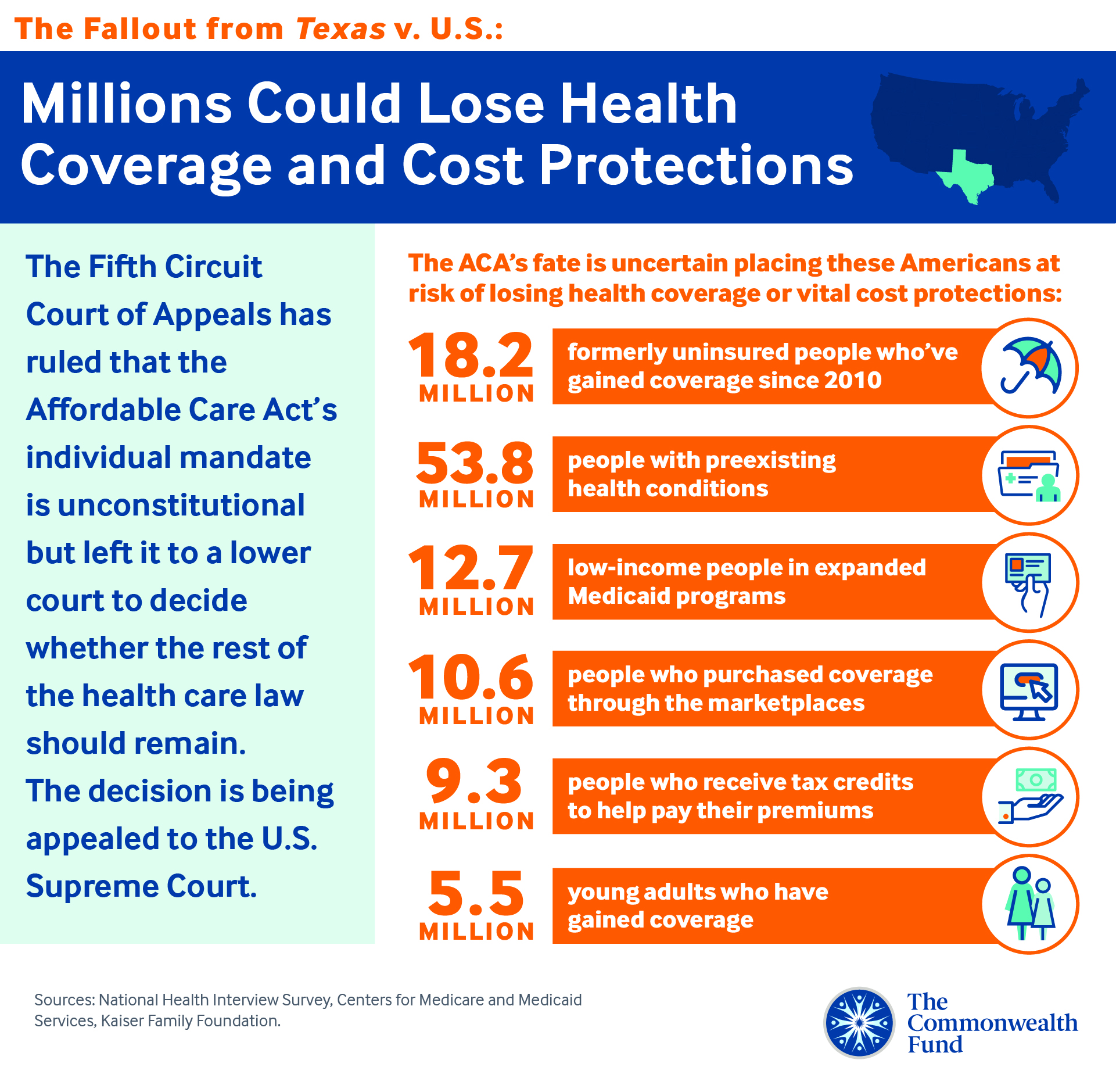
The Fallout from Texas v. U.S.:

Yesterday, a three-judge panel from the Fifth Circuit Court of Appeals struck down the Affordable Care Act (ACA)’s individual mandate. The judges agreed with a lower court decision issued in the case, Texas v. U.S., in December 2018 that the individual mandate is unconstitutional but, unlike the lower court, did not decide that the rest of the ACA is also unconstitutional. Instead, the judges remanded, or sent back, the decision to the same lower court judge to consider. California Attorney General Xavier Becerra, who is leading the 21 Democratic state attorneys general defending the law, along with the U.S. House of Representatives, immediately announced he would appeal the decision to the Supreme Court.

Whether the Supreme Court will decide to take the case now or wait for the decision of Judge O’Connor’s, of the lower court, is uncertain. If the Court decides to take the case now, they could expedite the briefing process and issue a decision in 2020. If it does not take the case now, a ruling will be delayed until after the 2020 presidential election.

No one knows how the Supreme Court will ultimately rule. But we do know that if the Court decides to strike down the ACA, the human toll will be immense and tragic. The law has granted unprecedented health security to millions:

  • 18.2 million formerly uninsured people have gained coverage since 2010
  • 53.8 million Americans with preexisting health conditions are now protected
  • 12.7 million low-income people are insured through expanded Medicaid
  • 10.6 million people have coverage through the ACA marketplaces, 9.3 million of whom receive tax credits to help them pay their premiums
  • 5.5 million young adults have gained coverage, many by staying on their parents’ plans
  • 45 million Medicare beneficiaries have much better drug coverage.

Such a decision will also trigger massive disruption throughout the U.S. health system. The health care industry represents nearly 20 percent of the nation’s economy; the ACA has touched every corner of it. The law restructured the individual and small-group health insurance markets, expanded and streamlined the Medicaid program, improved Medicare benefits, and reformed the way Medicare pays doctors, hospitals, and other providers. It was a catalyst for the movement toward value-based care and established a regulatory pathway for biosimilars — less expensive versions of biologic drugs. States have rewritten laws to incorporate the ACA’s provisions. Insurers, hospitals, physicians, and state and local governments have invested billions of dollars in adjusting to these changes.

The law’s popular preexisting health condition protections have made it possible for people with minor-to-serious health problems to apply for coverage in the same way healthier people have always done. These protections have given the estimated 53.8 million Americans with preexisting health conditions the peace of mind that they will never be denied health insurance because of their health.

More than 150 million people who get coverage through their employers now are eligible for free preventive care, and their children can stay on their policies to age 26.

The wide racial and income inequities in health insurance coverage that have been partly remedied by the ACA would return. Hospitals and providers, especially safety-net institutions, would struggle with mounting uncompensated care burdens and sicker and more costly patients who are not receiving the preventive care they need.

The ACA tore down financial barriers to health care for millions, many of whom were uninsured for most of their lives. It has demonstrably helped people get the health care they need in states across the country. Research indicates that Medicaid expansion has led to improved health status and lower mortality risk.

To date, neither the Trump administration, which has sided with the plaintiffs in the case, nor its Republican colleagues in Congress have offered a replacement plan in the event the law is struck down. The historic progress made by Americans, particularly those with middle and lower incomes and people of color, could unravel. Voters are already telling policymakers they are worried about their ability to afford health care. Yesterday’s decision and the uncertain path forward to the Supreme Court is certain to escalate those worries. With the nation entering the 2020 presidential election year, the Supreme Court may decide to take up the case this term.


Americans Still Favor Private Healthcare System

https://news.gallup.com/poll/268985/americans-favor-private-healthcare-system.aspx

Americans Still Favor Private Healthcare System

STORY HIGHLIGHTS

  • 54% prefer private system; 42% support government-run system
  • Two-thirds of Democrats favor a government-run system
  • Majority continue to see government responsibility for ensuring coverage

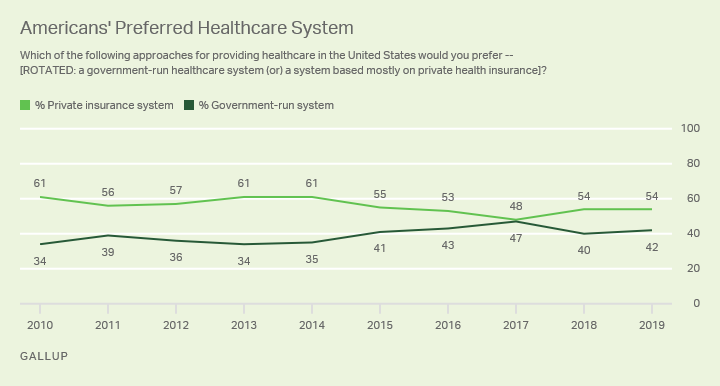
Americans continue to prefer a healthcare system based on private insurance (54%) over a government-run healthcare system (42%). Support for a government-run system averaged 36% from 2010 to 2014 but has been 40% or higher each of the past five years.

Line graph. Americans prefer a healthcare system based on private insurance to a government system by 54% to 42%.

These results are based on Gallup’s annual Health and Healthcare poll, conducted Nov. 1-14. Although more Americans have warmed to the idea of a greater government role in paying for healthcare, it remains the minority view in the U.S. This could create a challenge in a general election campaign for a Democratic presidential nominee advocating a “Medicare for All” or other healthcare plan that would greatly expand the government’s role in the healthcare system.

Democratic candidates’ plans for greater government involvement in healthcare are, however, consistent with the views of their party’s base. Since 2015, after most of the Affordable Care Act’s provisions had gone into effect, an average of 65% of Democrats have favored a government-run system.

Over the same period, Republicans have been overwhelmingly opposed to a government-run system, with an average of 13% preferring that approach while 84% have wanted to retain a private system.

Independents have been closely divided in recent years, but in 2019 tilt more toward a private (50%) than a government-run (45%) system.

Compared with the five-year period spanning the ACA’s passage and implementation from 2010 to 2014, support for a government-run system has increased among all party groups, with larger increases among independents (10 percentage points) and Democrats (seven points) than among Republicans (four points).


Changes in Preferences for Private vs. Government-Run Healthcare System, by Political Party
Figures are the average percentage holding each view in the five-year period
2010-2014 2015-2019
% %
Democrats
System based on private insurance 36 31
Government-run system 58 65
Independents
System based on private insurance 58 49
Government-run system 36 46
Republicans
System based on private insurance 88 84
Government-run system 9 13
GALLUP

Majority in U.S. Say Government Has Responsibility to Ensure Healthcare

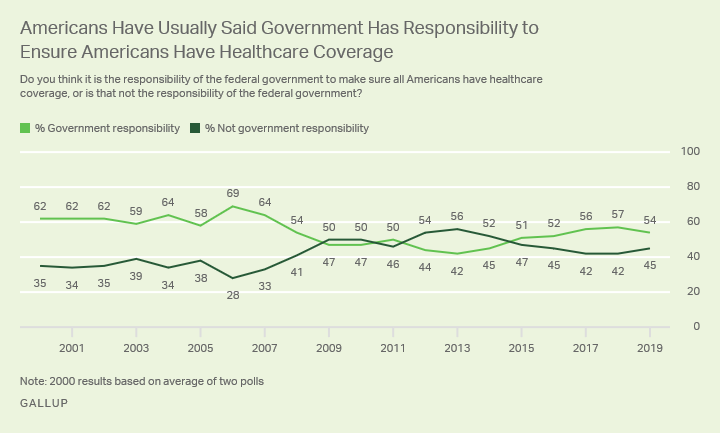
While Americans tend not to favor government-run healthcare, they do believe the federal government has a responsibility to ensure that all Americans have healthcare coverage. In the current survey, 54% hold this view, while 45% say it is not the government’s responsibility.

Recent support for the government having responsibility for ensuring healthcare coverage is not as high as it was from 2001 to 2007, when more than six in 10 Americans commonly expressed that opinion.

By contrast, from 2009 to 2014 — when the Obama administration and congressional Democrats developed, passed and implemented the Affordable Care Act — fewer Americans thought the government should ensure everyone has healthcare coverage. During that period, between 42% and 50% thought the government had that responsibility, the lowest measures in Gallup’s trend.

Line graph. Americans believe the federal government has a responsibility to ensure all in the U.S. have healthcare coverage.

Between 2009 and 2014, the percentages of Republicans and independents who thought the government should be responsible for ensuring healthcare coverage dropped at least 20 points, with a smaller eight-point drop among Democrats.

Democrats’ views are now back to where they were before 2009, while independents and especially Republicans have yet to return to prior levels, though independents are back above the majority level.

Changes in Belief That the Federal Government Has a Responsibility to Ensure All Americans Have Healthcare Coverage, by Political Party
Figures are the average percentage in each period
2001-2008 2009-2014 2015-2019
% % %
Democrats 80 72 80
Independents 64 44 56
Republicans 38 16 21
U.S. adults 62 46 54
GALLUP

Bottom Line

Americans have complex views on healthcare, with a majority saying the government should make sure everyone has coverage — but not necessarily pay for it through a government-run system. The Affordable Care Act was essentially an attempt to bridge these preferences by making coverage available to all through government-backed health insurance exchanges, but allowing those with insurance through an employer or other means to keep it.

Still, the law itself has been controversial, and Americans are currently as likely to disapprove of it as to approve. As such, it is fair to question to what extent Americans would embrace Democratic attempts to move to a healthcare system that goes further than the ACA does, or to support further Republican attempts to dismantle the law.

Healthcare is an issue that directly affects all Americans. Republican and Democratic political leaders have very different ideas about what healthcare policy should be. Additionally, the Democratic presidential campaign has revealed that even candidates in the same party can disagree on the best ways to address the U.S. healthcare system. With little consensus on the best way to approach healthcare policy, it promises to remain a key issue in U.S. politics and elections for the foreseeable future.


43% of U.S. Households Report Preexisting Conditions

https://news.gallup.com/poll/269003/households-report-preexisting-conditions.aspx

43% of U.S. Households Report Preexisting Conditions

STORY HIGHLIGHTS

  • 15% say they themselves have a preexisting health condition
  • 9% say they and someone else in their household have preexisting conditions
  • 19% say a family member has a preexisting condition

About one in four Americans (24%) report that they personally (15%) or they and a member of their household (9%) “have a long-term medical condition, illness or disease that would be considered a ‘preexisting’ condition by a health insurance company.” Factoring in the additional 19% who say another family member has such an illness or disease, the total percentage of U.S. households in which at least one member reports having a preexisting condition is 43%.

Americans’ Reports of Preexisting Medical Conditions in Their Household, 2018-2019
Do you, personally, or does another member of your family living with you, have a long-term medical condition, illness or disease that would be considered a “pre-existing condition” by a health insurance company?
Nov 1-11, 2018 Nov 1-14, 2019
% %
Respondent 16 15
Respondent and a family member 11 9
Family member 17 19
No one in family 54 57
GALLUP

These data are from Gallup’s annual Health and Healthcare survey, conducted Nov. 1-14, and are based on respondents’ self-reports. The survey does not probe about the nature of a respondent’s preexisting condition. Definitions of such conditions vary because individual insurance companies primarily determine what qualifies as a preexisting condition and what does not. They can include cancer or heart disease, but also asthma, high blood pressure or obesity.

Protecting individuals with preexisting conditions from being denied coverage by their insurers was a key tenet in Democrats’ campaign for and passage of the Affordable Care Act in 2010. It became a powerful election-year issue in the 2018 midterms for Democrats after President Donald Trump and Republicans in Congress tried to repeal the law. Gallup has found that Americans who report having a preexisting condition are somewhat more approving of the ACA than are those who do not report having such a condition.

Age Is the Biggest Differentiator in Reported Preexisting Conditions

Across key demographic groups, age stands out as the biggest factor in self-reports of preexisting conditions; the older individual Americans are, the more likely they are to report having one. About one in three adults aged 65 and older (33%) and 50 to 64 (31%) report having a preexisting condition — a rate about twice as high as what young adults aged 18 to 29 report (16%).

Aggregated data from Gallup’s 2018 and 2019 measures reveal other key differences across subgroups:

  • About a third of U.S. adults who are overweight report having a preexisting condition (32%) — much higher than the 21% among those whose self-reported weight is normal or underweight.
  • U.S. whites (29%) are more likely to report having such an illness or disease than are nonwhites (20%).
  • Women (29%) report having a preexisting condition at a higher rate than do men (21%).
  • U.S. adults living in low- (26%) and middle-income households (29%) are more likely to report having a preexisting condition than are those in upper-income households (21%).
Incidence of Preexisting Medical Conditions, Based on Self-Reported Data, by Subgroup
Do you, personally, or does another member of your family living with you, have a long-term medical condition, illness or disease that would be considered a “pre-existing condition” by a health insurance company?
Respondent personally Respondent or family member
% %
65+ years old 33 50
Overweight 32 50
50-64 years old 31 49
Democrat 31 50
Women 29 49
White 29 46
Middle household income ($40,000-$99,999/year) 29 45
Lower household income (less than $40,000/year) 26 43
Independent 24 42
30-49 years old 23 40
Republican 22 40
Men 21 38
Upper household income ($100,000 or more/year) 21 45
Normal weight/Underweight 21 39
Nonwhite 20 38
18-29 years old 16 38
Data aggregated from 2018 and 2019 polls
GALLUP

Across political party groups, Democrats (31%) are more likely to report having a preexisting condition than are independents (24%) and Republicans (22%). A Gallup analysis finds that across age and weight groups, Democrats are more likely than Republicans to report having a preexisting condition. This might suggest that some respondents are answering the question through a political lens — with Democrats more sensitive to the issue of preexisting conditions and therefore more likely to report having one, and Republicans more inclined to downplay the issue and less likely to report having such a condition themselves.

Bottom Line

As many Americans shop for healthcare plans in the current ACA open enrollment period, a sizable percentage of them will need to navigate a market that includes plans that may not provide them with coverage for preexisting conditions. The Trump administration is encouraging consumers currently on the ACA individual market to seek out short-term private plans that in many cases do not protect those with preexisting conditions. These new, non-ACA plans are now available during the ACA’s seventh annual open enrollment period after the administration loosened restrictions on them last year in an effort to offer more affordable alternatives to ACA plans.

The ACA’s provision on preexisting conditions has survived many challenges. Public officials of both major political parties have expressed commitment to the issue and have offered various plans to protect Americans with preexisting conditions from being denied coverage. But Americans have been lukewarm about the law that made the largest breakthrough on the issue — though it is a bit more popular among those who report having a preexisting condition themselves.


More Americans Delaying Medical Treatment Due to Cost

https://news.gallup.com/poll/269138/americans-delaying-medical-treatment-due-cost.aspx?fbclid=IwAR1p3J0ocF_YjiG8qFqOO7fVGqF-v1v6K0vtJjaKlhviLyUbpLFBa2ZJONY

Image result for More Americans Delaying Medical Treatment Due to Cost

STORY HIGHLIGHTS

  • A third of U.S. adults say their family couldn’t afford care in past year
  • One in four say care was deferred for a serious medical condition
  • Lower-income adults and Democrats most likely to report delayed care

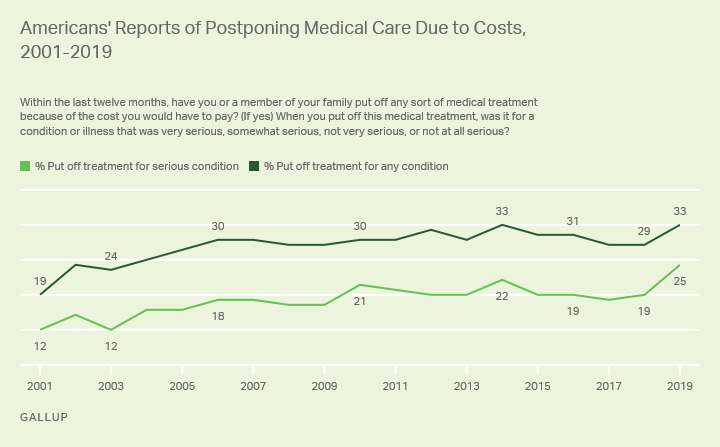
A record 25% of Americans say they or a family member put off treatment for a serious medical condition in the past year because of the cost, up from 19% a year ago and the highest in Gallup’s trend. Another 8% said they or a family member put off treatment for a less serious condition, bringing the total percentage of households delaying care due to costs to 33%, tying the high from 2014.

Gallup first asked this question in 1991, at which time 22% reported that they or a family member delayed care for any kind of condition, including 11% for a serious condition. The figures were similar in the next update in 2001, and Gallup has since asked this question annually as part of its Health and Healthcare poll. This year’s survey was conducted Nov. 1-14.

Americans’ reports of family members delaying any sort of medical treatment for cost reasons were lower in the early to mid-2000s when closer to a quarter reported the problem. Since 2006, the rate has averaged 30%.

The pattern is similar for the subset of Americans postponing medical treatment for a serious condition. The rate rose from 12% in 2001 to an average of 19% since 2006. However, the current 25% is the highest yet, exceeding the prior high-point of 22% recorded in 2014.

Income Gap Widens for Cost-Related Delays for Serious Conditions

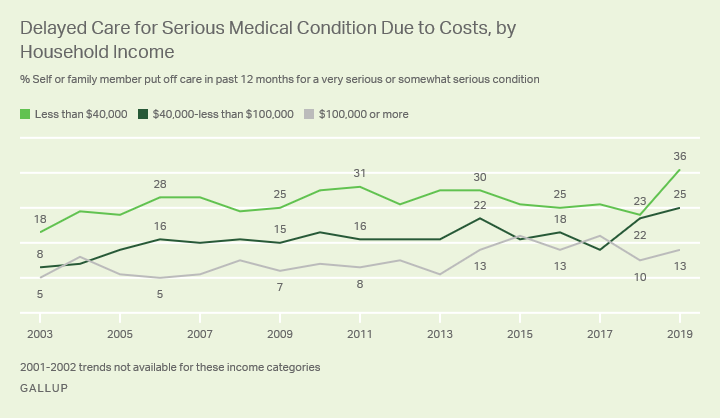
Reports of delaying treatment for a serious condition jumped 13 percentage points in the past year to 36% among adults in households earning less than $40,000 per year while it was essentially flat (up a non statistically significant three points) among those in middle-income and higher-income households.

As a result of the spike in lower-income households this year, the gap between the top and bottom income groups for failure to seek treatment for a serious medical condition widened to 23 percentage points in 2019. The income gap had averaged 17 points in the early years of Barack Obama’s presidency, but narrowed to an average 11 points in the first few years after implementation of the ACA, from 2015 to 2018.

Line graph, 2003-2019. U.S. adults saying family put off medical care for serious condition due to costs, by household income.

Delayed Care Up Most Among Those With Pre-Existing Conditions

Reports of delaying care for a serious condition due to costs are also up 13 points compared with last year among Americans who report they or another household member has a “pre-existing condition.”

At the same time, there has been virtually no change in the percentage of adults without pre-existing conditions in the household who delayed care for a serious health issue in the past year, currently 12% versus 11% in 2018.

Changes in health insurance coverage don’t appear to be the cause of the increase in delayed care as the percentage uninsured is 11% in the poll, within the 9% to 11% range seen each year since 2015. Also, the percentage delaying care has increased a similar proportion among those covered by private health insurance or Medicare/Medicaid as well as among the uninsured.

Recent Reports of Delayed Care May Have a Partisan Component

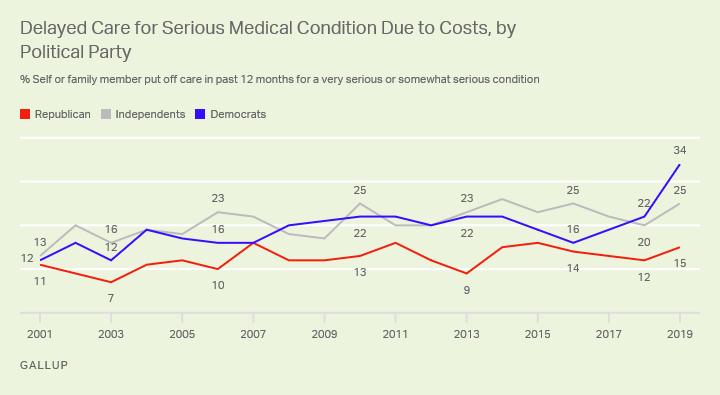
A cautionary note in the new findings is that most of the recent increase in reports that family members are delaying treatment for serious conditions has occurred among self-identified Democrats. This is up 12 points since 2018 among Democrats, compared with three- and five-point increases among Republicans and independents, respectively.

This ties in with Democrats’ higher likelihood than Republicans of reporting that they or a household family member has a pre-existing medical condition.

Whether these gaps are indicative of real differences in the severity of medical and financial problems faced by Democrats compared with Republicans or Democrats’ greater propensity to perceive problems in these areas isn’t entirely clear. But it’s notable that the partisan gap on putting off care for serious medical treatment is currently the widest it’s been in two decades.

Line graph, 2003-2019. U.S. adults saying family put off medical care for serious condition due to costs, by party ID.

Implications

Since 2001, Gallup has tracked a near 50% increase in the percentage of Americans saying that they or a family member chose not to get medical care because of the costs they would have to pay. Such delays in medical treatment, whether for injuries, illnesses or chronic conditions, can have significant implications for the economy and healthcare system, but also the political climate.

One indicator of the stress that delayed care can put on the healthcare system is the use of emergency departments. According to the American Hospital Association, patient visits to emergency departments in community hospitals increased 19% between 2001 and 2016 and has likely climbed to over 20% by today. While that may reflect many factors, including the aging of the population and the number of Americans living in close proximity to hospitals, it may also be indicative of a greater need for emergency care due to lack of routine care.

While most of the increase Gallup sees in delayed treatment occurred over a decade ago, the sharp increase in the past year, particularly among Democrats, suggests that healthcare costs could be a more potent political issue than previously seen. Presidential candidates who acknowledge the problem and propose solutions to address it may find a receptive ear among voters.

From an economic perspective, delayed care can have a range of negative effects, including reduced workplace productivity in the short-term, and increased healthcare costs and in the long-term — costs that ultimately burden the federal budget which has ripple effects on the economy.


Here come the prediabetics

https://mailchi.mp/1d8c22341262/the-weekly-gist-the-spotify-anxiety-edition?e=d1e747d2d8

Image result for Here come the prediabetics

Alarming statistics appeared this week in the journal JAMA Pediatrics, based on an analysis conducted by researchers at the Centers for Disease Control and Prevention (CDC) that showed that 20 percent of adolescents (ages 12-18) and 25 percent of young adults (ages 19-34) in the US are now prediabetic. These young people are at substantially increased risk for developing type 2 diabetes, as well as related cardiovascular diseases, as they grow older.

The numbers are a staggering picture of what confronts the American healthcare system as the millennial generation (whose median age is now 30) and the younger “Gen-Z” generation (born after 1997) move closer to their prime care consumption years. These age cohorts are likely to be much more medically complex, and will drive even higher healthcare costs, than previous generations—especially since both of the younger generations are larger than those that preceded them. But the statistics also raise important health policy questions.

To what extent should we “medicalize” prediabetes? In other words, should we begin to flag and treat prediabetes, which is more of a predisposition than an actual medical condition, with medications and interventions? Surely the reimbursement system will create a powerful temptation to do exactly that—at exorbitant cost. Or will we instead focus efforts on “reversing” prediabetes, with more robust attempts to encourage lifestyle changes (diet, exercise) and drive environmental changes (neighborhood walkability, availability and affordability of healthy foods)?

And there’s an information privacy issue looming as well—how will “prediabetics” be flagged, and could prediabetes be viewed as a “pre-existing condition” that might be used in coverage (and even employment) decisions should the regulatory environment change? As much as we focus today on the healthcare impact of the aging Baby Boom generation, we need to get out ahead of some of the issues we’re certain to face as our younger citizens grow older (and sicker).


People hate shopping for health insurance

https://www.axios.com/newsletters/axios-vitals-02263384-8aa6-44eb-b170-b01d408fc1c7.html?utm_source=newsletter&utm_medium=email&utm_campaign=newsletter_axiosvitals&stream=top

Illustration of a plastic bag with "NO THANK YOU" printed multiple times on it alongside a health plus.

Americans rarely switch to new health plans when the annual insurance-shopping season comes around, even if they could have gotten a better deal, Axios’ Bob Herman reports.

The bottom line: People loathe shopping for health plans, and many are bad at it, for one major reason: “It’s just too hard,” Tricia Neuman, a Medicare expert at the Kaiser Family Foundation, told Bob last year.

Reality check: During any insurance program’s annual enrollment period, most people end up staying with the status quo, if it’s an option, instead of picking a new plan.

  • Fewer than one out of 10 seniors voluntarily switch from one private Medicare Advantage plan to another, according to new research from the Kaiser Family Foundation.
  • The same holds true for Medicare’s private prescription drug plans.
  • Most employers don’t usually change insurance carriers, often out of fear of angering workers, and keep plan options limited.
  • Employees, after several reminders from HR, usually default to what they had.
  • Fewer than half of people in the Affordable Care Act’s marketplaces actively re-enroll in new plans, even though the market was designed for comparison shopping.
  • Medicaid enrollees in some states have no say in the private plans they get.

Between the lines: Buying health insurance — $20,000 decision for the average family — is more complicated than buying furniture.

  • With consumer products, you pretty much know what you’re getting. With health insurance, you’re making an educated guess of how much health care you’ll use, hoping you’ll need none of it.
  • Health insurance terms and policies also are confusing, which turns people off from the shopping process.

The big picture: Shopping for insurance is difficult enough for most people. Shopping for actual doctors, tests and services is even more difficult and less widespread, and likely won’t change if prices are unlocked.


Hospitals and health systems: 6 trends and issues

https://www.beckershospitalreview.com/strategy/hospitals-and-health-systems-6-trends-and-issues.html

Image result for healthcare trends and issues

This article discusses the current state and issues of hospitals and health systems for several different areas. First, this discusses types of hospitals and health systems. Second, it addresses what’s working and what’s not for health systems. Third, this discusses the mix of access, quality and cost as well as the shortages of different kinds of providers fourth. Fifth, this discusses policy issues and political issues. Sixth, we address threats and challenges.

1. 5,200+ acute-care hospitals. Currently, there are approximately 5,200 acute-care hospitals in the country. This number changes a little each year, with more closures than openings.

We view the landscape as one with seven core types of health systems. 

First, there’s what we think of as the very elite health systems, which are often academic medical centers. This usually includes the top 20 to 30 systems as ranked by U.S. News & World Report. These are typically great research institutions that provide great care in some of the most critical, life-threatening areas. This category may include hospitals like NewYork-Presbyterian, UChicago Medicine, Cleveland Clinic, Mayo Clinic, Northwestern Medicine and a number of other institutions that typically comprise the top 20 to 30 in the U.S. News & World Report’s Best Hospitals.

Second are regionally dominant systems. These systems are so important to a given area that they are often the focus point of care in said area. There are also situations where it’s very hard for payers and patients to go around these institutions — even if they wanted to. This might be an institution like Carilion Clinic or Sentara Healthcare in Virginia, Northwell in New York, Ochsner in Louisiana or NorthShore University Health System in the north suburbs of Chicago. It may be Advocate Aurora Health in the Chicagoland area and Eastern Wisconsin, Hartford HealthCare in Connecticut, Intermountain Healthcare in Utah and Idaho, and a number of institutions regionally strong in their areas.

A third type of system is the community hospital, typically the single- or two-hospital system. This could be rural, urban or suburban. Here, this may be a health system that has served as the core of primary care — and at one time tertiary care — for a community, but more and more has to have a certain reason for being, something that its really great at to remain relevant and open.

A fourth type of hospital is what we think of as a specialty hospital, usually built around a certain specialty like pediatrics, behavioral health, oncology or some other area. It is a hospital that has a specific focus and is just great at what it does, much like Hospital for Special Surgery in New York, which U.S. News & World Report has ranked as the No. 1 hospital in the country for orthopedics for the past 10 years.

National chains of hospitals and health systems make up the fifth type of system. This can be for-profit or nonprofit, and they come in a couple different varieties. First, they can pursue a strategy of being in lots of different markets, but regionally dominant in the markets they’re in. This has typically been the strategy for success. Second, they can pursue the strategy of having the most hospitals possible. This has typically not been a strategy for success. Market strength or market dominance and excellence in certain areas is far more important than having lots of different hospitals.

The sixth type of hospital that we think of as Kaiser Permanente. Here, we put Oakland, Calif.-based Kaiser Permanente in its own category. It is a regionally dominant system in certain parts, but more importantly it is vertically integrated with its own insurance plan. This has allowed Kaiser to do things in the cost savings areas and the efficiency area that many other systems have not been able to do. We have also found over the last decade that it is much harder for other systems to replicate what Kaiser has done, in terms of fully integrating insurance, than expected.

The seventh category of hospital we think of as the safety-net hospital. The safety-net hospital can really be in any of the above categories. We largely think of safety-net hospitals as those that are serving a huge percentage of Medicare and Medicaid patients. The safety-net hospital is a very important part of the fabric of American healthcare and the delivery system, and at the same time they often struggle to ensure they have the finances to make the system go.

2. What has worked the last 10 years? The three types of categories that have really worked the past 10 years are as follows.

First, one prescription for success has been to be regionally dominant. Whether a Novant Health or an Atrium Health, both based in North Carolina, or a system like Advocate Aurora in Wisconsin or ProMedica in Ohio, being regionally strong has been a prescription for success. It allows one to stack resources, invest in talent, invest in systems and get better and better.

The second prescription for success the last decade and for a long time is being an elite health system. As much as the world changes, these elite systems — whether Stanford Medicine, Mayo Clinic, Cleveland Clinic or UCLA Health — continue to be sought out for care and continue to recruit great physicians, researchers and providers. This may also include being elite in certain areas like Rush University Medical Center in Chicago in orthopedics, MD Anderson in oncology or a number of other actors that are elite.

The third type of category that has worked is clearly the Kaiser Permanente category. This is a situation where Kaiser is almost its own vehicle, led famously by the late Bernard J. Tyson. Over the years, Kaiser grew into being a great integrated system and was able to do things on the value-based side and make major investments to address social determinants of health that really no one else was able to do.

3. Access, quality and cost. There is constant discussion of access, quality and cost. As we look as things evolve, we see things as follows.

On the quality side, the American healthcare system seems to do a pretty good job of delivering pretty good care to a huge percentage of people. In essence, compared to other countries, the U.S. is providing care to more than 325 million people. While imperfect, it is pretty good. There are pockets of care in other countries that are certainly better and more advanced than it is here, but often in pockets versus an entire system.

In terms of access, the American healthcare system seems to be challenged in numerous ways. As shortages evolve, particularly among specialties and subspecialties, it is harder and harder to find access to the right type of provider when one needs that provider. Access can also be a challenge in many different ways for poor communities in our country and, of course, there is no quality without access.

A third issue in terms of the American healthcare system is cost. As costs continue to grow at a percentage higher than inflation, particular pockets of costs remain very challenging, specifically on the pharmaceutical side, technology side and labor side.

4. Shortages of doctors and allied health professionals. As we look at access challenges in the country, there is a perspective that it is very hard to solve without the minting of a great deal more of physicians and allied health professionals. Even as the ways care is delivered evolve, the physician shortage remains. We will see a shortage of up to nearly 122,000 physicians by 2032 as the population grows and ages and demand continues to grow faster than supply, the Association of American Medical Colleges.

There are different structural elements in place that make it hard to add on providers at a fast clip. For example, medical school, residency and fellowship take many years. In efforts to modernize medical education, there is a question as to whether that much education is needed. The American Medical Association is one body that is working with major institutions for accelerated programs, like a six-year model at University of California, Davis School of Medicine. The school offers a six-year path to practice — three years each of medical school and residency — in partnership with Kaiser Permanente Northern California.

As we look at our society, we probably need more incentive for people to go to medical school and graduate with medical degrees than are currently in place. The more one tries to attack some of benefits of being a physician, the harder it is to encourage the next generation to become physicians. In response, we do see a growing number of medical schools being opened, including those at Kaiser Permanente and Hackensack Meridian. We think this is absolutely critical. It is also critical that we develop more and more allied health professionals and those allied health professionals are largely able to practice at the top of their license.

Finally, there is this concept in medical school and in premed of “weed out” classes. We believe this is somewhat overdone and overemphasized, and many bright, talented people are weeded out that would be perfectly great physicians. As one resident at Stanford University School of Medicine put it, “Today we ‘weed out’ potentially wonderful doctors through a demoralizing maze of basic sciences that more often resembles the Hunger Games than a sensible recruitment process.”

5. Political polarization. In healthcare, and the hospital sector specifically, we see a great deal of political polarization. There are largely three different types of systems that people think about in terms of reform.

First, there is the “Medicare for All” perspective. While this would provide adequate “access” at a certain level for everybody in terms of health insurance coverage, there is concern from providers that reimbursement would be so low it would not encourage people to pursue medicine, thus flattening or denting the supply of physicians needed to provide the care that is needed.

Second, there is the concept of the “free market.” Here, the concept of a total free market and free market alternatives is somewhat illusory. In reality nearly 30 to 50 percent of most providers’ revenue comes from Medicare and Medicaid. Thus, you are never really dealing with a free market in healthcare. There are free market incentives — like health savings plans and transparency — that can help, but one is not in total dealing with a free market.

Third, is the concept of a public option. One way to think about a public option is to think about it as akin to the post office. One can either go to the post office to mail something via the United States Postal Service, or one could use UPS or Federal Express. The idea of a public option is that you would not have to buy insurance from an insurance company. Rather, you could buy into the Medicare program through a public option. Washington signed a public option into law this past summer and will launch it in 2021, becoming the first state to test the policy.

Whatever the answer is for healthcare reform, it is clear that the general public prefers two things. First, they like the concept that you should be able to buy insurance regardless of whether or not you have a pre-existing condition. Second, a large percentage of the public seems to prefer that there be some sort of public option to access care.

6. Threats and challenges. Some the challenges healthcare systems face today are as follows.

First, the strength of payers and the power they hold, especially as they diversify and broaden their scope of business. Under the UnitedHealth Group umbrella, for instance, is Optum, the Advisory Board and Equian, among other arms. In 2018, Cigna acquired Express Scripts, CVS Health combined with Aetna, and Humana and private equity firms acquired Kindred Healthcare. Highmark, one of the largest insurers in the country, acquired the West Penn Allegheny Health System years ago. Each of these forays into technology, consulting, payment, pharmacy benefit management, post-acute care and provider spaces make health insurers more prevalent in the industry.

A second great concern is the growing number of access points that are providing threats to health systems and their margins and revenues. This may be things like the CVS’, Walgreens and Walmarts of the world, which are expanding the medical services and health hubs in their stores to provide consumers with an alternative access point for chronic conditions and routine care. This fall, Walmart even revealed plans to build its own healthcare workforce.

Third, powerful payers are developing provider networks and providing alternatives to health systems and their delivery systems. Blue Cross Blue Shield Association, for instance, will launch a national provider network in 2021 that spans across 55 markets to help large employers better control medical costs.

Fourth is the total costs of bricks and mortar and labor that hospitals and health systems carry.

Fifth is the development of new types of insurance programs by companies like Haven, which is JPMorgan, Berkshire Hathaway and Amazon’s effort to serve their combined 1.2 million employees. Currently, commercial insurance and payments from employed people ultimately subsidize what hospitals and health systems receive from Medicare and Medicaid. Thus, if these efforts like Haven are successful at peeling off good-paying patients, this will have a big negative impact on hospitals and health systems.  


Critics say ‘junk plans’ are being pushed on ACA exchanges

https://www.washingtonpost.com/health/2019/11/20/critics-say-junk-plans-are-being-pushed-aca-exchanges/

Image result for junk health plans

The Trump administration has encouraged consumers to use private brokers, who often make more money if they sell the less robust plans.

The Trump administration is encouraging consumers on the Obamacare individual market to seek help from private brokers, who are permitted to sell short-term health plans that critics deride as “junk” because they don’t protect people with preexisting conditions, or cover costly services such as hospital care, in many cases.

Consumers looking at their health insurance options on the website for the federal marketplace, called healthcare.gov, may be redirected to other enrollment sites, some of which allow consumers to click a tab entitled “short-term plans” and see a list of those plans, often with significantly cheaper premiums. Short-term plans were once barred from the exchanges because they were considered inadequate coverage and do not meet the insurance requirements laid out under the Affordable Care Act. If consumers select a short-term plan, they are directed to call a phone number to finish signing up, according to screenshots provided to The Post.

Critics say that both the sale of short-term plans through private brokers and consumers’ ability to select such plans are the latest examples of Trump administration efforts to weaken the ACA after failing to repeal and replace the law in Congress. The president has repeatedly contended that short-term plans provide “relief” from expensive individual market insurance plans that are unaffordable to many consumers. The rule allowing the sale of such plans was finalized late last year, just weeks before open enrollment, so this is the first year they are widely available.

In addition to these efforts, the administration is also seeking to void the law in court, siding with a group of Republican state attorneys general who argue it is unconstitutional since Congress zeroed out the penalty for not having insurance in its 2017 tax overhaul legislationA trial court in Texas ruled the entire law invalid late last year, and an opinion is expected at any time from the U.S. Court of Appeals for the 5th Circuit. The law is likely to end up in front of the Supreme Court for a third time, possibly amid the 2020 presidential election.

Under the ACA, all health insurance plans have to cover 10 essential health benefits, including maternity and newborn care, prescription drugs, emergency room services and mental health. Short-term health plans do not have to cover those services, can discriminate against those with preexisting conditions and set caps on how much they are willing to pay, which is prohibited for Obamacare plans.

Brokers often make higher commissions on short-term plans, health policy experts said, which gives them an incentive to sell them. They are supposed to present ACA-compliant plans to consumers, but are allowed to provide other options, including short-term plans. Some brokers make clear that such plans are not as comprehensive as ACA plans, but experiences differ.

“The whole business model is signing people up for coverage and getting a cut of what they sell, and the place they’re going to make their money is selling these short-term plans,” said Nicholas Bagley, a professor of law at the University of Michigan and proponent of the ACA. Consumers “don’t fully understand the lack of protections if they go over some annual or lifetime [insurance] limit. These plans don’t cover preexisting conditions.”

The administration’s use of outside brokers has prompted nearly two dozen Senate Democrats, including Democratic presidential candidates Elizabeth Warren, Kamala D. Harris and Amy Klobuchar, to send a letter to CMS on Wednesday expressing their concern over the promotion of short-term health plans.

“We are concerned that [CMS] is not only failing to conduct sufficient oversight to protect customers, but is actively emailing consumers to encourage them to obtain coverage through third-party agents and brokers instead of the HealthCare.gov website,” the senators wrote in a letter. Democratic New Hampshire Senator Jeanne Shaheen orchestrated the effort.

Such plans were previously available for periods of three months or less and could not be renewed, but the administration late last year finalized a rule that allowed for the plans’ availability for up to 12 months, with the option to renew them for up to three years. A federal judge sided with the administration in a court challenge to their expanded availability and upheld the rule in July. Consumers still cannot use government subsidies to purchase short-term plans, however.

“For most of the people buying on the exchanges, this would be worse than what they’ve been buying, especially because the majority of people who buy on exchanges get help with their premiums,” said Allison Hoffman, a law professor at the University of Pennsylvania Law School.

The Centers for Medicare and Medicaid Services has sent at least five emails so far to individual market consumers encouraging them to use outside brokers, including through a service called Help on Demand, to sign up for health insurance, according to emails obtained by The Post from a recipient of ACA market emails. The agents and brokers must be registered with the federal exchanges, CMS said in a statement, and they help consumers sign up for individual market plans.

“While agents and brokers are required to provide assistance with Exchange, Medicaid and CHIP coverage and are directed to enroll consumers in such coverage options whenever possible, they are not prohibited from sharing information on other coverage options, such as those offered off-Exchange,” a CMS spokeswoman said.

Some critics of the policy say the expanded sale of short-term plans may be one of the factors depressing enrollment in Obamacare plans, which dropped 13 percent in the first three weeks of the sign-up period, compared to the same period last year, according to federal data released Wednesday. During the 2019 open enrollment, 1,924,476 people signed up for individual market plans in the first two weeks of enrollment, compared to 1,669,401 for 2020. Open enrollment ends on Dec. 15.

CMS said it has used Help on Demand for three years, but the agency has increasingly encouraged consumers to seek their advice through emails directing them to the service’s website.

The Trump administration has drastically cut federal funding for “navigators” — grass roots organizations that help people sign up for ACA plans, including those who may not otherwise know they are eligible for coverage. .

Premiums for the most common type of Obamacare plan dropped by 4 percent for 2020, CMS said last month, and the vast majority of consumers on the individual market qualify for government tax subsidies that help cover the cost of their insurance. However, consumers complain about high deductibles and premiums in individual market plans.


Health insurers eat higher medical costs

https://www.axios.com/newsletters/axios-vitals-b6a8b813-d93a-43d6-9080-bc9ee9606440.html?utm_source=newsletter&utm_medium=email&utm_campaign=newsletter_axiosvitals&stream=top

Image result for 2. Health insurers eat higher medical costs

Almost all of the major health insurance companies are spending more on medical care this year than they have in the past, Axios’ Bob Herman reports.

The big picture: Rising prices and more services for some sicker patients are among the many reasons why this is happening. That uptick in spending has freaked out Wall Street, even though insurers are still quite profitable.

Driving the news: Almost all of the eight major publicly traded insurers have shown their medical loss ratio — the percentage of premium revenues they’re spending on medical claims — is rising this year.

  • UnitedHealth Group, the largest insurer in the country, said its loss ratio was 82.4% in the third quarter this year compared with 81% in the same period a year ago.
  • But these companies are handling billions of premium dollars, so any increase in medical claims equates to hundreds of millions of dollars in additional spending, which they don’t want.

Between the lines: Medical loss ratios are often higher for health plans that cover more older adults, the disabled and the poor, because those groups typically need more care or are in the hospital more frequently.

But costs have been climbing in some commercial markets, too.

  • Anthem executives admitted on their earnings call that the company is dumping some employers with workers who had medical needs and costs that were too high.
  • CVS Health, which now owns Aetna, previously said some middle-market clients had employees that it thought were getting too many services and drugs.
  • CVS “intensified our medical management in those geographies,” an executive said on the earnings call.

The bottom line: Health insurance companies closely track their medical loss ratios and aim to hit those targets most often by charging higher premiums, denying care, forcing people to use lower-priced providers or declining to cover people they deem to be too expensive.