Administration’s talking health care again, with 2020 in mind

https://www.politico.com/news/2020/07/26/trumps-health-care-again-with-2020-election-381473?utm_source=ActiveCampaign&utm_medium=email&utm_content=Republicans+Roll+Out+%241+Trillion+Coronavirus+Relief+Plan&utm_campaign=TFT+Newsletter+07272020

Tell us: How has Trump handled healthcare in his first 100 days ...

Polls show voters say Joe Biden would handle the issue better. And Trump is running short on options to make concrete changes before November.

President Donald Trump is suddenly talking about health care again.

He signed several executive orders on drug pricing on Friday. He vowed to unveil some new health plan by the end of next week, although he hasn’t provided specifics or an explanation of how he’ll do it. His aides are touting a speech in which Trump will lay out his health care vision. White House counselor to the president Kellyanne Conway has been calling Trump “the health care president.”

Yet it’s unlikely to amount to much in terms of policy ahead of the election. There’s almost no chance Congress will enact any legislation on the issue before November and policy specialists say the executive orders in question will make changes only at the margins — if they make any changes at all. Trump has also previously vowed to roll out a grand health care plan without following through.

That leaves Trump with mostly rhetorical options — even if he insists otherwise — cognizant that voters consistently rank health care as a top priority and say Joe Biden, Trump’s presumptive 2020 rival, would handle the issue better than the president. Meanwhile, Trump is running for reelection having not replaced Obamacare or presented an alternative — all while urging the Supreme Court to overturn the decade-old health law. And millions of Americans are currently losing their health insurance as the coronavirus-gripped economy sputters.

“I think politically, the main objective will be to have something he can call a plan, but it will be smaller than a plan. Just something that he can talk about,” said Drew Altman, president and CEO of the Kaiser Family Foundation, a nonpartisan health policy organization. “But it’s almost inconceivable that anything can be delivered legislatively before the election.”

Trump has long stumped on his pledges to kill Obamacare, the law his predecessor implemented that expanded Americans’ access to health insurance, set baseline standards for coverage, introduced penalties for not having insurance and guaranteed coverage for preexisting conditions. But conservatives say the law introduced too many mandates and drove up costs.

But after winning election in 2016, Trump failed to overturn the law in Congress — or even offer an agreed upon alternative to the law — despite holding the majority in both chambers on Capitol Hill. Democrats then retook the House in the 2018 midterms, essentially ending any chances the law, formally known as the Affordable Care Act, would be repealed.

Even some conservatives said the ongoing failure to present a concrete replacement plan is helping the Democrats politically.

Republicans, said Joe Antos, a health expert at the conservative American Enterprise Institute, “spent basically 2010 to today arguing that the ACA is no good. After 10 years, clearly there are some problems with starting all over again. I haven’t detected very strong interest, at least among elected officials, in revisiting that.”

But the coronavirus pandemic has added pressure to address health care costs, and Trump has lagged behind Biden on his handling of the issue in polls. Fifty seven percent of registered voters recently polled by Quinnipiac said Biden would do a better job on health care than Trump, while only 35 percent approved of Trump’s handling of health care as president. And on the issue of affordability, a CNBC poll found 55 percent of battleground voters favored Biden and the Democrats, compared with 45 percent who preferred Trump and the Republicans.

“At this point, there are two huge issues, jobs and the economy, and health care, i.e., the coronavirus. If anything that’s simply been magnified,” said David Winston, a Republican pollster and strategist. “Given the fact that it’s one of the top issues, it’s not like there’s a choice but to talk about it. If candidates aren’t making statements and proposing solutions around that, it’s a requirement. Both candidates have to address it.”

Biden has campaigned on expanding Obamacare while also promising to implement a “public option” similar to Medicare, which is government-run health insurance for seniors. On drug pricing, he and Trump embrace some of the same ideas, like allowing the safe importation of drugs from other countries where they are cheaper. Biden also supports direct Medicare negotiation of drug prices, a Democratic priority that Trump supported during the 2016 campaign before reversing course.

“Donald Trump has spent his entire presidency working to take health care away from tens of millions of Americans and gut coverage for preexisting conditions,” said Andrew Bates, a Biden campaign spokesman. “If the Trump campaign wants to continue their pattern of highlighting the worst possible contrasts for Donald Trump, we certainly won’t stop them.”

The Trump administration insists it can point to several health care victories during Trump’s term.

Trump frequently notes the removal of the penalty for Americans who do not purchase insurance as a major victory, falsely claiming it is equivalent to overturning Obamacare.

Trump also signed an executive order last year to fight kidney disease to encourage home dialysis and increase the amount of kidney transplants, and he expanded telehealth medicine during the pandemic.

More recently, the U.S. Court of Appeals for the District of Columbia upheld a Trump administration rule expanding the availability of short-term health plans, which Trump has touted as an alternative to Obamacare but Democrats deride as “junk.” The plans are typically cheaper than Obamacare coverage because they don’t provide the same level of benefits or consumer protections for preexisting conditions.

A federal judge in June similarly upheld another Trump administration rule requiring hospitals to disclose the prices they have negotiated with insurers. Price transparency in the health care system has long been a significant issue, with Americans rarely having clarity over how much their treatments will cost ahead of time. Trump called the win “bigger than health care itself,” in an apparent reference to Obamacare. It’s unclear whether transparency will force down health care prices, and hospitals opposing the rule have appealed the judge’s decision.

And on Friday at the White House, Trump held an event to sign four executive orders aimed at slashing drug pricing. The move aimed to tackle a largely unfulfilled signature campaign promise — that he would stop pharmaceutical companies from “getting away with murder.”

“We are ending the sellouts, betrayals and broken promises from Washington,” Trump said Friday.“You have a lot of broken promises from Washington.”

But the orders appeared largely symbolic for now, as they were not immediately enforceable, contained notable caveats and may not be completed before the election anyway. For instance, an order requiring drugmakers to pass along any discounts directly to seniors requires the health secretary to confirm the plan won’t result in higher premiums or drive up federal spending. But the White House had shelved that plan last summer over worries the move might hike seniors’ Medicare premiums ahead of the election and cost taxpayers $180 billion over the next decade.

Conway disputed that Trump had not made progress on issues like drug pricing.

“President Trump is directing the development of therapeutics and vaccines, has delivered lower prescription drug costs, increased transparency in pricing for consumers and is committed to covering preexisting conditions and offering higher quality health care with lower costs and more choices,” she said.

Yet a number of Trump’s other health care initiatives have faced hurdles — especially amid the coronavirus pandemic.

The opioid crisis, which the president had touted as a top priority and campaigned on in 2016, is getting worse. Drug overdose deaths hit a record high in 2019 and federal and state data shows they are skyrocketing in 2020.

“The overdose epidemic will not take a back seat simply because Covid-19 has hit us hard, and that needs to be reflected in policy,” said Andrew Kessler, founder and principal of Slingshot Solutions, a behavioral health consulting firm.

The president’s plan to end HIV by 2030 has similarly receded during the pandemic. And Trump’s proposal on improving kidney care — an issue that affects roughly 15 percent of American adults — is still in its early stages and will not be finalized until next year.



Taking a look at the Biden healthcare plan

https://mailchi.mp/325cd862d7a7/the-weekly-gist-march-13-2020?e=d1e747d2d8


Now that the Democratic primary campaign has produced a clear front runner, it’s worth examining Joe Biden’s healthcare plan, which aims to expand the Affordable Care Act (ACA) by increasing access and affordability. As the graphic above highlights, former Vice President Biden has a broad—if at this point, still fairly high-level—proposal that includes a Medicare-like public option along with a variety of other ACA tweaks that aim to offer consumers more options and lower their healthcare costs.

These include allowing individuals in states without Medicaid expansion to join the pubic option premium-free, providing unlimited subsidy eligibility, and limiting drug price increases to the level of consumer inflation.

An independent analysis projects Biden’s plan would cost $2.25T and add an additional $800B to the deficit over 10 years. While large at first blush, these costs pale in comparison to Sen. Bernie Sanders’ Medicare for All plan, which would add a projected $12.95T to the deficit over the same period.

Of course, there are still many unanswered questions in Biden’s proposal, including how much consumers would pay under the public option, how much the public option plan would reimburse providers as a percentage of Medicare, and how the public option would impact competition among private insurers.

A public option offered at a significant discount has the potential to drive private plans out of business, which some project could eventually result in Medicare for All as an ultimate consequence. The devil will, as always, be in the details.


Two candidates remain: Mr. Medicare for All and Mr. Public Option

https://mailchi.mp/9e118141a707/the-weekly-gist-march-6-2020?e=d1e747d2d8

Image result for Medicare for All and Public Option

The past week in Presidential politics has been momentous—but not clarifying—for determining both the eventual Democratic nominee and the healthcare platform of the party. Between the first ballots cast in South Carolina and the last votes counted in California, the field of viable candidates for the nomination has been winnowed to two: Vermont Sen. Bernie Sanders and former Vice President Joe Biden. The coming weeks will feature a knock-down, drag-out fight for delegates in the run-up to what is likely to be a contested convention in Milwaukee in mid-July, pitting Biden’s “establishment” wing of the party against Sanders’ “progressive” wing.

On the healthcare front, that means a continued debate between defenders of the Affordable Care Act (ACA), who want to extend coverage, as Biden does, using a government-run “public option” plan, and supporters of single-payer, “Medicare for All” (M4A) coveragewhich Sanders advocates. That’s the same argument Democrats have been having since the campaign started, and while healthcare remains the top issue of concern for primary voters, polls indicate that both plans are popular with the electorate.

We continue to believe that the public option plan is a far more likely outcome than M4A, but only if the Democrats win control of the Senate—a prospect which appears more possible given billionaire Mike Bloomberg’s post-Super Tuesday endorsement of Biden, and plans to devote his substantial campaign resources to support Democratic candidates across the ballot. Some of that money will surely be spent in Montana, where Gov. Steve Bullock is poised to announce plans to run against incumbent Sen. Steve Daines (R-MT), in a critical race that could be the most expensive Senate contest in history.

And for an indication of how the politics of a public option would play out, look no further than Colorado, where the Democratic legislature moved forward with its version of the plan this week, over the objections of the hospital and insurance lobbies.

Finally, looming over the general election campaign will be the pivotal Texas vs. California case, which the Supreme Court agreed to take up in this fall’s term. That case will ensure that healthcare will remain the centerpiece of American political debates regardless of who leads the Democratic ticket. Buckle up.


Learning to live on Medicare margins

https://mailchi.mp/0ee433170414/the-weekly-gist-february-14-2020?e=d1e747d2d8

Image result for Learning to live on Medicare margins

“If Democrats take back the Senate and win the White House, there’s a good chance they’ll implement some version of a public option or Medicare buy-in, and that would be devastating for the fragile economics of our health system.” That was the message delivered by the CEO of a system we were visiting recently, in her report to the board of directors.

That kind of alarmist message might seem career-limiting, but given the way the politics of healthcare are playing out at both the national and state levels (see Colorado and Washington State), it’s past time for executives to get beyond the rhetoric and begin to prepare for the real financial consequences of public option proposals.

That’s what this CEO had done—what followed the dire warning was a detailed analysis (which we helped assemble) of what would happen in various scenarios—what if one percent of our revenue shifted from commercial rates (around 250 percent of Medicare) to possible public option rates (somewhere between 140 and 180 percent of Medicare)? That’s a knowable number, and you can begin to make assumptions about how much business would shift under different scenarios, and how quickly.

The reality for health systems is that most of the margin comes from the 55-to-65-year-old population—who use more healthcare services but whose care is reimbursed at commercial rates. That cohort cross-subsidizes much of the rest of a typical hospital’s business.

The presentation to the board laid those economic realities out in concise detail—and provided a bracing wake-up call that the system needs to be prepared to live on a different level of margin than they enjoyed in the past.

That means radical cost controls, sharp reductions in “system bloat”, and a laser-like focus on shifting care to lower-cost settings. For years, hospital leaders have tossed around the notion that “we have to learn to live on Medicare margins”.

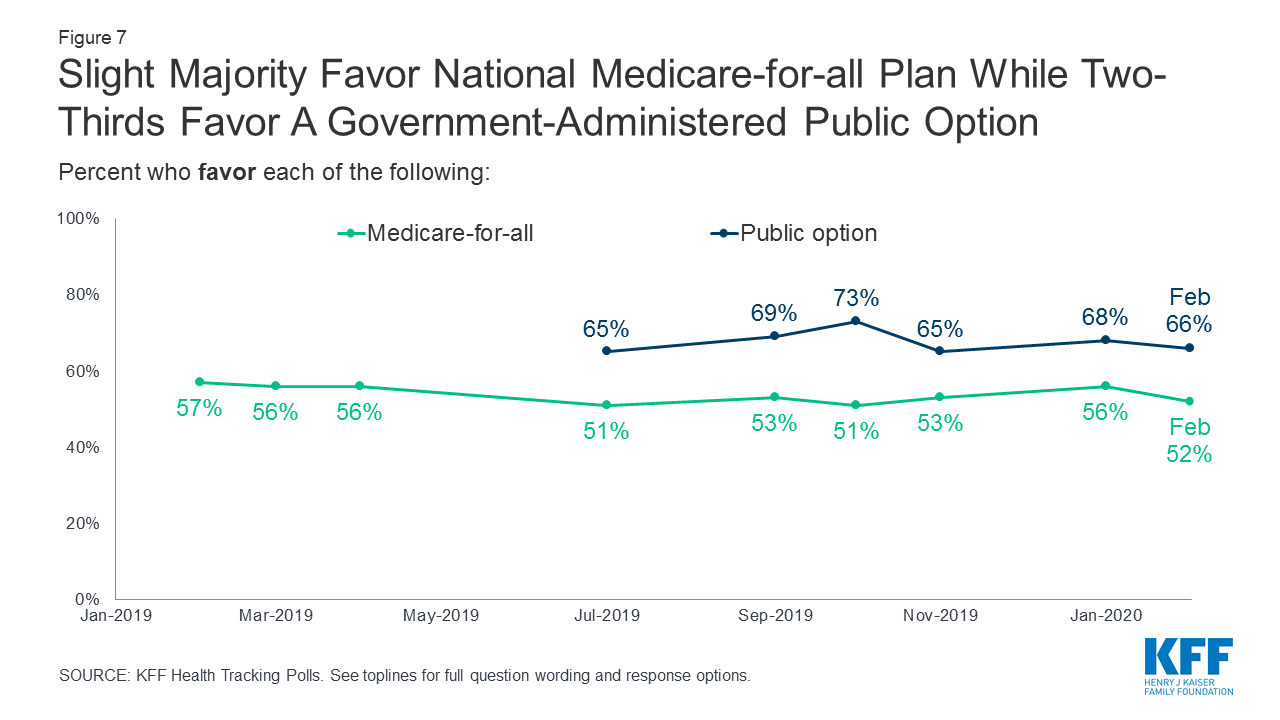
Given the rising popularity of public option policies (67 percent of Americans support the idea according to a recent poll, as do 42 percent of Republicans), that lesson may need to be learned sooner rather than later.


Health care is Iowa’s only winner right now

https://www.axios.com/newsletters/axios-vitals-ded63eb6-2431-48d0-a186-2f3b52417f2f.html?utm_source=newsletter&utm_medium=email&utm_campaign=newsletter_axiosvitals&stream=top

Image result for health policy"

Iowa Democrats reported last night that their biggest priorities were beating President Trump and health care — but the meltdown of their election reporting systems left their presidential choices unresolved.

Why it matters: We’ve been writing for months that Democrats have a major choice ahead, either picking an advocate of Medicare for All — and siding with the plan that’s less popular with the rest of the country — or a public option advocate.

  • The Iowa debacle means the path the party will take won’t be clear for a while longer.

By the numbers: Several polls — including ones by NBC News, the National Exit Poll and AP Votecast — found that around four in 10 caucus voters said health care was their top issue.

  • Previous polling has found that Medicare for All is less popular overall than a public option, but both were popular among Democratic caucus-goers last night.
  • Seven in 10 said they back a single-payer plan, and almost nine in 10 said they support a public option, per AP Votecast, which was conducted by NORC at the University of Chicago for The Associated Press and Fox News.

Yes, but: Caucus-goers said they prefer a Democratic candidate who can beat Trump over one that agrees with them on issues, CNN reports.

The big picture: Republicans are more than happy to talk about Medicare for All — and its subsequent tax increases and expanded government role in health care — instead of protecting and building on the Affordable Care Act.

  • Whereas the former gives them an opportunity to go on offense, the latter puts the GOP on defense against its 2017 repeal-and-replace efforts and ongoing lawsuit that would strike down the whole health care law, including its protections for pre-existing conditions.


The U.S. Spends $2,500 Per Person on Health Care Administrative Costs. Canada Spends $550. Here’s Why

https://time.com/5759972/health-care-administrative-costs/

Image result for The U.S. Spends $2,500 Per Person on Health Care Administrative Costs. Canada Spends $550. Here's Why

Whether it’s interpreting medical bills, struggling to get hospital records, or fighting with an insurance provider, Americans are accustomed to battling bureaucracy to access their health care. But patients’ time and effort are not the only price of this complexity. Administrative costs now make up about 34% of total health care expenditures in the United States—twice the percentage Canada spends, according to a new study published Monday in Annals of Internal Medicine.

These costs have increased over the last two decades, mostly due to the growth of private insurers’ overhead. The researchers examined 2017 costs and found that if the U.S. were to cut its administrative spending to match Canadian levels, the country could have saved more than $600 billion in just that one year.

“The difference [in administrative costs] between Canada and the U.S. is enough to not only cover all the uninsured but also to eliminate all the copayments and deductibles, and to amp up home care for the elderly and disabled,” says Dr. David Himmelstein, a professor at the CUNY School of Public Health at Hunter College and co-author of the study. “And frankly to have money left over.”

Closing the Health Care Gap : Ashley Judd, Dr. Raj Panjabi (moderated by Haley Sweetland Edwards)
Share

Play Video

Research has long shown that the U.S., which uses a disparate system of private providers and insurers, has higher administrative costs than other developed countries that use single-payer systems. But the Annals study puts a finer point on it: as the first major effort to calculate administrative costs across the U.S. health system in nearly two decades, the researchers found that the gap between the U.S. and Canada has widened significantly.

The U.S. now spends nearly five times more per person on health care administration than Canada does. The U.S. administrative costs came out to $812 billion in 2017, or $2,497 per person in the U.S. compared with $551 per person in Canada, according to the Annals study.

Along with Himmelstein, co-authors Steffie Woolhandler and Terry Campbell examined administrative costs for insurance companies and government agencies that administer healthcare, as well as costs in four settings: hospitals, nursing homes, home care agencies and hospices and physician practices. For each category, the researchers determined which costs were administrative and conducted analyses to adjust comparisons between relative costs in the U.S. and Canada.

Insurers’ overhead, the largest category, totaled $275.4 billion in the U.S. in 2017, or 7.9% of all national health expenditures, compared with $5.36 billion in Canada, or 2.8% of national health expenditures. The American number included $45 billion in government spending to administer health care programs and $229.5 billion in private insurers’ overhead and profits, which covers employer plans and managed care plans funded by Medicare and Medicaid.

This insurance overhead accounted for most of the total increase in administrative spending in the U.S. since 1999, according to the study. While the share of Americans covered by commercial insurance plans has not changed much, private insurers have expanded their role as subcontractors handling what are known as “managed care” plans for Medicaid and Medicare. The study notes that most Medicaid recipients are now on private managed care plans and about one third of Medicare enrollees now have Medicare Advantage plans. Both of these types of plans have higher overhead costs than the publicly administered alternatives.

“We were struck, and frankly hadn’t expected it until we delved into the data, by the huge increase in insurance overhead,” Himmelstein told TIME.

Other reports, including one by the Center for American Progress published last April, have identified ways to reduce administrative costs without moving the U.S. to a single-payer health care system. But Himmelstein says his study shows that a public option that preserves private insurance wouldn’t provide the same savings as a traditional single-payer system. “We could streamline the bureaucracy to some extent with other approaches, but you can’t get nearly the magnitude of savings that we could get with a single payer,” Himmelstein says, adding, “If the Medicare public option includes the Medicare Advantage plans, it’s actually conceivable that the public option would increase the bureaucratic costs.”

Most of the public option plans proposed by Democratic presidential candidates are not detailed enough to determine exact costs, Himmelstein says. But overall, he believes they won’t result in significant cost savings.

In addition to their research, Himmelstein and Woolhandler have been longtime advocates for single-payer health care. They co-founded the group Physicians for a National Health Program, which advocates for a single-payer system. They also conducted the initial health administrative costs study on 1999 data and have published other studies comparing hospital administrative costs in the U.S. and other countries.

Himmelstein says his team’s estimates of total U.S. administrative costs in the Annals study are likely conservative. When estimating physicians’ administrative costs, the researchers relied on a 2011 study of time spent by physicians and their staffs interacting with insurers. And he notes that while 2017 data was often the latest available when they were conducting this study, 2018 health spending numbers have since come out showing further increases in insurance overhead.

“We can afford universal coverage with a single payer plan, not just universal coverage but first dollar coverage for everybody in our country if we adopted a single-payer Medicare for all approach,” Himmelstein says. “If you’re going to cover everybody without getting those savings you’re going to have to spend more or you’re going to have to have big co-payments and deductibles that deter people from getting the care that they actually need.”


Hospitals and health systems: 6 trends and issues

https://www.beckershospitalreview.com/strategy/hospitals-and-health-systems-6-trends-and-issues.html

Image result for healthcare trends and issues

This article discusses the current state and issues of hospitals and health systems for several different areas. First, this discusses types of hospitals and health systems. Second, it addresses what’s working and what’s not for health systems. Third, this discusses the mix of access, quality and cost as well as the shortages of different kinds of providers fourth. Fifth, this discusses policy issues and political issues. Sixth, we address threats and challenges.

1. 5,200+ acute-care hospitals. Currently, there are approximately 5,200 acute-care hospitals in the country. This number changes a little each year, with more closures than openings.

We view the landscape as one with seven core types of health systems. 

First, there’s what we think of as the very elite health systems, which are often academic medical centers. This usually includes the top 20 to 30 systems as ranked by U.S. News & World Report. These are typically great research institutions that provide great care in some of the most critical, life-threatening areas. This category may include hospitals like NewYork-Presbyterian, UChicago Medicine, Cleveland Clinic, Mayo Clinic, Northwestern Medicine and a number of other institutions that typically comprise the top 20 to 30 in the U.S. News & World Report’s Best Hospitals.

Second are regionally dominant systems. These systems are so important to a given area that they are often the focus point of care in said area. There are also situations where it’s very hard for payers and patients to go around these institutions — even if they wanted to. This might be an institution like Carilion Clinic or Sentara Healthcare in Virginia, Northwell in New York, Ochsner in Louisiana or NorthShore University Health System in the north suburbs of Chicago. It may be Advocate Aurora Health in the Chicagoland area and Eastern Wisconsin, Hartford HealthCare in Connecticut, Intermountain Healthcare in Utah and Idaho, and a number of institutions regionally strong in their areas.

A third type of system is the community hospital, typically the single- or two-hospital system. This could be rural, urban or suburban. Here, this may be a health system that has served as the core of primary care — and at one time tertiary care — for a community, but more and more has to have a certain reason for being, something that its really great at to remain relevant and open.

A fourth type of hospital is what we think of as a specialty hospital, usually built around a certain specialty like pediatrics, behavioral health, oncology or some other area. It is a hospital that has a specific focus and is just great at what it does, much like Hospital for Special Surgery in New York, which U.S. News & World Report has ranked as the No. 1 hospital in the country for orthopedics for the past 10 years.

National chains of hospitals and health systems make up the fifth type of system. This can be for-profit or nonprofit, and they come in a couple different varieties. First, they can pursue a strategy of being in lots of different markets, but regionally dominant in the markets they’re in. This has typically been the strategy for success. Second, they can pursue the strategy of having the most hospitals possible. This has typically not been a strategy for success. Market strength or market dominance and excellence in certain areas is far more important than having lots of different hospitals.

The sixth type of hospital that we think of as Kaiser Permanente. Here, we put Oakland, Calif.-based Kaiser Permanente in its own category. It is a regionally dominant system in certain parts, but more importantly it is vertically integrated with its own insurance plan. This has allowed Kaiser to do things in the cost savings areas and the efficiency area that many other systems have not been able to do. We have also found over the last decade that it is much harder for other systems to replicate what Kaiser has done, in terms of fully integrating insurance, than expected.

The seventh category of hospital we think of as the safety-net hospital. The safety-net hospital can really be in any of the above categories. We largely think of safety-net hospitals as those that are serving a huge percentage of Medicare and Medicaid patients. The safety-net hospital is a very important part of the fabric of American healthcare and the delivery system, and at the same time they often struggle to ensure they have the finances to make the system go.

2. What has worked the last 10 years? The three types of categories that have really worked the past 10 years are as follows.

First, one prescription for success has been to be regionally dominant. Whether a Novant Health or an Atrium Health, both based in North Carolina, or a system like Advocate Aurora in Wisconsin or ProMedica in Ohio, being regionally strong has been a prescription for success. It allows one to stack resources, invest in talent, invest in systems and get better and better.

The second prescription for success the last decade and for a long time is being an elite health system. As much as the world changes, these elite systems — whether Stanford Medicine, Mayo Clinic, Cleveland Clinic or UCLA Health — continue to be sought out for care and continue to recruit great physicians, researchers and providers. This may also include being elite in certain areas like Rush University Medical Center in Chicago in orthopedics, MD Anderson in oncology or a number of other actors that are elite.

The third type of category that has worked is clearly the Kaiser Permanente category. This is a situation where Kaiser is almost its own vehicle, led famously by the late Bernard J. Tyson. Over the years, Kaiser grew into being a great integrated system and was able to do things on the value-based side and make major investments to address social determinants of health that really no one else was able to do.

3. Access, quality and cost. There is constant discussion of access, quality and cost. As we look as things evolve, we see things as follows.

On the quality side, the American healthcare system seems to do a pretty good job of delivering pretty good care to a huge percentage of people. In essence, compared to other countries, the U.S. is providing care to more than 325 million people. While imperfect, it is pretty good. There are pockets of care in other countries that are certainly better and more advanced than it is here, but often in pockets versus an entire system.

In terms of access, the American healthcare system seems to be challenged in numerous ways. As shortages evolve, particularly among specialties and subspecialties, it is harder and harder to find access to the right type of provider when one needs that provider. Access can also be a challenge in many different ways for poor communities in our country and, of course, there is no quality without access.

A third issue in terms of the American healthcare system is cost. As costs continue to grow at a percentage higher than inflation, particular pockets of costs remain very challenging, specifically on the pharmaceutical side, technology side and labor side.

4. Shortages of doctors and allied health professionals. As we look at access challenges in the country, there is a perspective that it is very hard to solve without the minting of a great deal more of physicians and allied health professionals. Even as the ways care is delivered evolve, the physician shortage remains. We will see a shortage of up to nearly 122,000 physicians by 2032 as the population grows and ages and demand continues to grow faster than supply, the Association of American Medical Colleges.

There are different structural elements in place that make it hard to add on providers at a fast clip. For example, medical school, residency and fellowship take many years. In efforts to modernize medical education, there is a question as to whether that much education is needed. The American Medical Association is one body that is working with major institutions for accelerated programs, like a six-year model at University of California, Davis School of Medicine. The school offers a six-year path to practice — three years each of medical school and residency — in partnership with Kaiser Permanente Northern California.

As we look at our society, we probably need more incentive for people to go to medical school and graduate with medical degrees than are currently in place. The more one tries to attack some of benefits of being a physician, the harder it is to encourage the next generation to become physicians. In response, we do see a growing number of medical schools being opened, including those at Kaiser Permanente and Hackensack Meridian. We think this is absolutely critical. It is also critical that we develop more and more allied health professionals and those allied health professionals are largely able to practice at the top of their license.

Finally, there is this concept in medical school and in premed of “weed out” classes. We believe this is somewhat overdone and overemphasized, and many bright, talented people are weeded out that would be perfectly great physicians. As one resident at Stanford University School of Medicine put it, “Today we ‘weed out’ potentially wonderful doctors through a demoralizing maze of basic sciences that more often resembles the Hunger Games than a sensible recruitment process.”

5. Political polarization. In healthcare, and the hospital sector specifically, we see a great deal of political polarization. There are largely three different types of systems that people think about in terms of reform.

First, there is the “Medicare for All” perspective. While this would provide adequate “access” at a certain level for everybody in terms of health insurance coverage, there is concern from providers that reimbursement would be so low it would not encourage people to pursue medicine, thus flattening or denting the supply of physicians needed to provide the care that is needed.

Second, there is the concept of the “free market.” Here, the concept of a total free market and free market alternatives is somewhat illusory. In reality nearly 30 to 50 percent of most providers’ revenue comes from Medicare and Medicaid. Thus, you are never really dealing with a free market in healthcare. There are free market incentives — like health savings plans and transparency — that can help, but one is not in total dealing with a free market.

Third, is the concept of a public option. One way to think about a public option is to think about it as akin to the post office. One can either go to the post office to mail something via the United States Postal Service, or one could use UPS or Federal Express. The idea of a public option is that you would not have to buy insurance from an insurance company. Rather, you could buy into the Medicare program through a public option. Washington signed a public option into law this past summer and will launch it in 2021, becoming the first state to test the policy.

Whatever the answer is for healthcare reform, it is clear that the general public prefers two things. First, they like the concept that you should be able to buy insurance regardless of whether or not you have a pre-existing condition. Second, a large percentage of the public seems to prefer that there be some sort of public option to access care.

6. Threats and challenges. Some the challenges healthcare systems face today are as follows.

First, the strength of payers and the power they hold, especially as they diversify and broaden their scope of business. Under the UnitedHealth Group umbrella, for instance, is Optum, the Advisory Board and Equian, among other arms. In 2018, Cigna acquired Express Scripts, CVS Health combined with Aetna, and Humana and private equity firms acquired Kindred Healthcare. Highmark, one of the largest insurers in the country, acquired the West Penn Allegheny Health System years ago. Each of these forays into technology, consulting, payment, pharmacy benefit management, post-acute care and provider spaces make health insurers more prevalent in the industry.

A second great concern is the growing number of access points that are providing threats to health systems and their margins and revenues. This may be things like the CVS’, Walgreens and Walmarts of the world, which are expanding the medical services and health hubs in their stores to provide consumers with an alternative access point for chronic conditions and routine care. This fall, Walmart even revealed plans to build its own healthcare workforce.

Third, powerful payers are developing provider networks and providing alternatives to health systems and their delivery systems. Blue Cross Blue Shield Association, for instance, will launch a national provider network in 2021 that spans across 55 markets to help large employers better control medical costs.

Fourth is the total costs of bricks and mortar and labor that hospitals and health systems carry.

Fifth is the development of new types of insurance programs by companies like Haven, which is JPMorgan, Berkshire Hathaway and Amazon’s effort to serve their combined 1.2 million employees. Currently, commercial insurance and payments from employed people ultimately subsidize what hospitals and health systems receive from Medicare and Medicaid. Thus, if these efforts like Haven are successful at peeling off good-paying patients, this will have a big negative impact on hospitals and health systems.  


Warren’s path to Medicare for All is rocky

https://www.axios.com/newsletters/axios-vitals-e30baa47-bebc-4081-81a6-cb96115c5e55.html

Illustration of Elizabeth Warren holding out a health plus.

Sen. Elizabeth Warren’s two-part plan to pass a public option as a transition into “Medicare for All” — and then full-blown “Medicare for All” a few years later — has revealed the difficulty of appealing to both the pragmatic and progressive wings of the party.

The big picture: Warren’s already being criticized by progressives for not being a “Medicare for All” purist, and because of the realities of governing, they may have a point: Passing two major health reforms in one term is unheard of.

  • “In my first week as president, we will introduce Medicare for All legislation,” Sen. Bernie Sanders tweeted on Friday.

Details: Warren’s transition plan — which she said she’ll try to pass within her first 100 days in office — would allow anyone over 50 to enroll in an “improved Medicare program,” and “every person in America” could get coverage through a “Medicare for All option.”

  • Coverage under the public option would immediately be free for children under 18 and families making 200% of the federal poverty level or less. Over time, it’d become free for everyone.
  • Then, by no later than her third year in office, Warren would push Congress to pass full-blown “Medicare for All.”

Reality check: The political capital that it’d take to pass Warren’s public option, even through a special procedure called “budget reconciliation” that’d allow her to bypass GOP opposition, would be enormous.

What they’re saying: “Passing one major piece of health care legislation with a knock down, drag out fight, followed by another one three years later, sounds pretty difficult,” said the Kaiser Family Foundation’s Larry Levitt.

  • A more likely scenario is that a public option would pass, and be given time to work. Depending on how that debate went, Medicare for [A]ll could be a rallying cry for a reelection campaign.”


Hillary Clinton: Warren’s ‘Medicare for All’ plan would never get enacted

Hillary Clinton: Warren’s ‘Medicare for All’ plan would never get enacted

Image result for Medicare for All

Hillary Clinton said Wednesday that she does not think Sen. Elizabeth Warren’s (D-Mass.) “Medicare for All” plan could ever get enacted and that she backs a public option instead. 

“You just don’t think that that plan would ever get enacted?” interviewer Andrew Ross Sorkin asked Clinton at The New York Times DealBook Conference.

“No, I don’t. I don’t, but the goal is the right goal,” the former secretary of State responded.

“I believe the smarter approach is to build on what we have. A public option is something I’ve been in favor of for a very long time,” Clinton said. “I don’t believe we should be in the midst of a big disruption while we are trying to get to 100 percent coverage and deal with costs.”

Amid the raging health care debate among the Democratic presidential candidates, Clinton, the party’s 2016 nominee, appears to line up more with former Vice President Joe Biden and South Bend, Ind., Mayor Pete Buttigieg, who are pushing for an optional government insurance plan, rather than Warren and Sen. Bernie Sanders (I-Vt.), who are pushing government insurance for all.

Clinton, though, tried to shift the debate back to highlighting the contrast between Democrats and Republicans, pointing to the fact that the GOP is trying to repeal the Affordable Care Act, including backing a lawsuit currently in the courts to overturn the entire law. 

“Yeah, we’re having a debate on our side of the political ledger, but it’s a debate about the right issue, how do we get to health care coverage for everybody that we can afford?” Clinton said, noting the GOP is “in court right now to strike the entire law down.”


Other countries show Medicare for All doesn’t have to mean getting rid of private insurance

https://www.cnn.com/2019/10/15/politics/private-health-insurance-medicare-for-all-international-comparison/index.html?utm_source=The+Fiscal+Times&utm_campaign=27ee43ca78-EMAIL_CAMPAIGN_2019_10_16_09_52&utm_medium=email&utm_term=0_714147a9cf-27ee43ca78-390702969

Image result for Other countries show Medicare for All doesn't have to mean getting rid of private insurance

Bernie Sanders often points to Canada and Europe as models for universal health care coverage.

But the Vermont independent senator’s “Medicare for All” plan differs substantially from the insurance systems that exist up north and across the pond. Canadians and most European countries have private insurance industries alongside their government programs.
One of the most controversial provisions of Sanders’ Medicare for All proposal is that it essentially eliminates private insurance — allowing the industry to only offer benefits for services that are not covered by the federal program, such as cosmetic surgery. More than 150 million Americans buy private policies through their employers, and tens of millions more purchase private insurance through Medicare Advantage or on the individual market exchanges.
Sanders has made Medicare for All a centerpiece of his 2020 presidential campaign. Rivals ranging from President Donald Trump to former Vice President Joe Biden, who is also seeking the Democratic nomination, have gone the other way and argue that Americans should not be forced to give up policies they like. Sanders has defended his stance, slamming the private insurance industry for putting profits over patients.
But public and private insurance co-exist in Canada and many European countries. These developed nations require that everyone have coverage — with private insurance typically providing additional benefits, helping to pay out-of-pocket costs or allowing faster and broader access to medical providers. In some nations, such as the Netherlands and Switzerland, residents satisfy their coverage mandate with policies from private carriers.
In many developed nations outside of the US, residents expect a lot from their health systems but they are conscious of the cost, said Chris James, an economist specializing in health care for the Organisation for Economic Co-operation and Development, a consortium of 36 developed countries.
“It becomes a tricky political balance between those competing sets of demands,” James said. “They want more generous public provisions but they don’t want to pay too much more tax.”
How health care coverage works in other countries varies widely.
Canada, for instance, has a regionally administered public health insurance program, which is paid for by provincial and federal tax revenue, according to a 2017 report from The Commonwealth Fund. Patients don’t pay for hospital care and doctors’ visits. However, the universal program, known as Canadian Medicare, doesn’t cover outpatient prescription drugs, rehabilitation, home care, dental benefits, vision care and some other services. Some two-thirds of Canadians are covered by private plans, often through their employers, to cover these treatments. The insurers are mostly for profit.
England, meanwhile, has the very comprehensive National Health Service, paid for by taxes. Services are generally free, though there are some copayments for prescription drugs and some services, including dental care for most adults. Still, about 11% of residents sign up for private health insurance plans, which provide faster access to care, particularly elective hospital procedures, according to The Commonwealth Fund.
“They use it to jump the queue,” said Robin Osborn, senior adviser with The Commonwealth Fund.
The system is very different in other countries, however.
In the Netherlands, residents are required to buy private insurance, which is heavily regulated and paid for by payroll taxes paid by employers, premiums paid by enrollees, annual deductibles, copayments and general taxes. Lower-income folks receive government subsidies to help them afford the cost, James said. Some 84% of the Dutch also buy additional private coverage to pay for dental care, eyeglasses, physical therapy and other services, mostly from non-profit insurers, according to The Commonwealth Fund.
Germans are also mandated to have coverage. They can choose from more than 100 non-profit “sickness funds,” which covers a wide array of services, including drugs, physical therapy and dental work. Most are funded through payroll contributions that are split between workers and companies. About 11% of residents, mainly younger workers with higher incomes, opt out of this program and buy private coverage, which may offer a wider range of services with lower premiums, according to The Commonwealth Fund. Some of the private insurers are non-profit, while most are for profit.
Denmark, meanwhile, has a national health care system paid for mainly by income taxes, but 42% of residents buy additional coverage to help pay for prescription drugs, dental care and physical therapy, mainly from the non-profit Danmark, according to The Commonwealth Fund. Additionally, 30% have supplemental policies from for-profit insurers to give them expanded access to private providers.
“These systems each have carved out a role for private insurance,” Osborn said. “The universal coverage provides a comprehensive package of benefits that is generous. The private insurance, depending on the system, often enables people to get care that is either faster, has a slightly higher level of amenities or additional benefits.”
The Sanders campaign says that private insurers in other countries are very different from the American companies Sanders is fighting against.
“For the most part, for-profit, private insurance companies do not play a large role in other countries’ health care systems and, to the extent that they do play a role, they are tightly managed and kept in line by the government,” said Warren Gunnels, senior adviser to the campaign.