Cartoon – Flattening the I.Q. Curve

Editorial cartoons

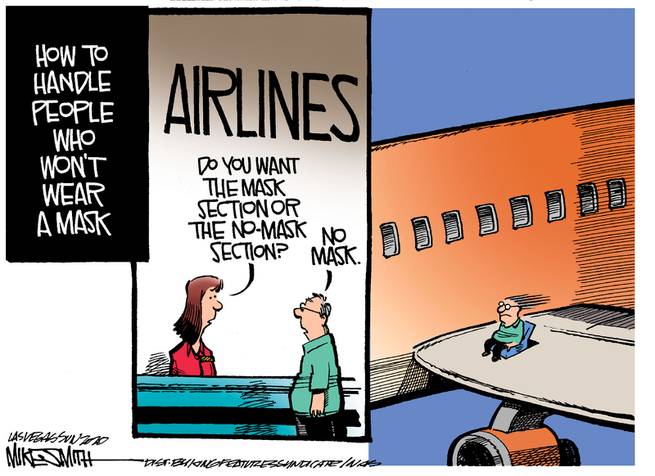
Cartoon – How to handle people who won’t wear a mask

Mike Smith Cartoon: 051420 smith cartoon masks -

Trump says Covid-19 is ‘dying out.’ Experts fear his dismissiveness could prolong the crisis

Trump says Covid-19 is ‘dying out.’ Experts fear his dismissiveness could prolong the crisis

The Trump Administration Paid Millions for Test Tubes — and Got ...

The White House is taking a new position on the coronavirus pandemic: a daily count of 750 deaths is a testament to the federal government’s successful pandemic response.

On Wednesday, when U.S. health officials reported nearly 27,000 new Covid-19 cases, President Trump said in a television interview that the virus was “dying out.” He brushed off concerns about an upcoming rally in Tulsa, Okla., because the number of cases there is “very miniscule,” despite the state’s surging infection rate. In a Wall Street Journal interview Wednesday, Trump argued coronavirus testing was “overrated” because it reveals large numbers of new Covid-19 cases, which in turn “makes us look bad,” and suggested that some Americans who wear masks do so not only to guard against the virus, but perhaps to display their anti-Trump animus.

But a range of public health experts told STAT that this messaging not only diverts attention from a pandemic that has already caused 120,000 U.S. deaths, but has more practical implications: It could make it difficult for local governments to enlist the public in the mitigation measures necessary to reduce the continued spread of the virus.

“The science behind how people process public warnings in a crisis supports this: You have to have people speaking with one voice,” said Monica Schoch-Spana, a medical anthropologist at the Johns Hopkins Center for Health Security. “You need a chorus.”

Conflicting directives can make it more difficult for recommendations coming from state and local leaders to have an impact, said Sara Bleich, a professor of public health policy at Harvard’s T.H. Chan School of Public Health.

“It sends a mixed message, which is confusing, particularly because while many people will get infected, most will not get severely sick, so it’s easy to say this won’t happen to me,” she said. “And it’s that sort of attitude that will keep us in this situation for a very long time.”

While the president has for weeks, if not months, underplayed the pandemic, his sharp and repeated remarks this week represent a remarkable attempt from the leader of American government to effectively declare the U.S. Covid-19 epidemic over.

The president’s rhetoric comes at a time that his coronavirus task force, which once conducted daily briefings, has not addressed the public since May. The president’s resumption of campaign rallies flouts federal guidance that encourages mask use (Trump’s campaign will hand out masks and hand sanitizer at the rally, but has not said it will require attendees to use them) and discourages large indoor gatherings. And the president has repeatedly claimed, misleadingly, that persistently high U.S. case totals are simply the result of increased testing.

Health experts say that political leaders preaching caution and modeling proper behavior — such as wearing a mask and demonstrating proper hand hygiene — can send a powerful signal to people that these steps can not only protect them, but their communities. They say that, essentially, national and state leaders need to walk the walk in a situation when individual behavior, like staying home when sick and cooperating with contact tracing, can make a large impact in curbing contagion.

Trump’s counterproductive behavior, Schoch-Spana said, extends far beyond the consistently dismissive tone he has taken toward the health risks of Covid-19. With few exceptions, the president has refused to wear a mask in public, and has insisted on continuing in-person briefings and White House events that effectively defy federal health guidance about gathering indoors in large groups.

“It’s not just words, it’s actions,” she said. “So when you have the nation’s top executive refusing to wear a mask, holding meetings where people are shoulder to shoulder, where he’s signing executive orders — that is also a form of communication.”

Experts also say continued federal commitments to combating the virus are crucial as the public grows tired of abatement measures. Instead, Trump has only elevated his monthslong campaign of downplaying the virus.

And Vice President Mike Pence, in a Wall Street Journal op-ed, framed the declines in cases and deaths since April as “testament to the leadership of President Trump” — even as hundreds of Americans are still dying every day and cases are not dropping further.

Rep. Donna Shalala (D-Fla.), who served as health secretary during the Clinton administration, said she hoped Americans would listen to public health guidance from local officials, not Trump and Pence.

“The president of the United States is dangerous to the health of the people of my district, because he’s giving out misinformation and false hope,” she said. “For those that believe him, they’re putting themselves and their families at risk.”

Public health experts have raised a number of issues with the administration’s messaging.

For one, a plateau of cases and deaths should not be celebrated, they say. While some countries in Europe and Asia have not only flattened their curve but driven them down, that hasn’t happened in the United States. Daily cases and deaths dipped from the peak in April, but have averaged about 20,000 and 800, respectively, for weeks.

Beyond those numbers representing real people getting sick and dying, there are other problems with sustained high levels of spread. The more cases there are, the more difficult it is for the surveillance system, including contact tracing, to keep up. It’s also more likely that some of the cases will spiral into explosive spread; 20,000 cases can turn into 40,000 a lot faster than one case can turn into 20,000.

Plus, a failure to suppress spread now could lead to more prolonged disruptions to daily life. If transmission rates come fall are still what they are now in certain communities, that makes it harder to reopen schools, for example.

Experts also point to evidence suggesting that the daily case and death numbers won’t stay flat for long. While new cases in the Northeast and Midwest are declining, a number of states in the West and South — Arizona, Texas, Florida, California, and Oregon among them — have reported record number of new cases this week. What worries public health officials is that, without measures to stem those increases, those outbreaks could keep growing. Those thousands of new cases also signal that, in a week or two, some portion of those people will show up in the hospital, and, about a week after that, a number of them will be dead, even as clinicians have learned more about treating severe Covid-19.

Some states in the South and West are already reporting record hospitalizations from Covid-19.

The White House’s shrug has been echoed by some governors, who insist, like Pence and Trump, that increased testing explains away the rise in cases. That is certainly one reason; testing has become more widespread, so states are capturing a more accurate reading of their true case burden.

But experts say increased testing can only account for some of the data states are reporting. Other metrics — including rising hospitalizations, filling ICUs, and the increasing rate of tests that are positive for the virus — signal broader spread.

Until Wednesday, leaders of Texas and Arizona also bristled at efforts from city and county officials to institute mask requirements, but acceded to growing pressure even as they have not ordered statewide mandates.

Cameron Wolfe, an infectious disease expert at Duke University, said he was seeing a growing “fatigue” among the public to keep up with precautionary steps like physical distancing and mask wearing. People letting down their guard was coinciding with an increase of cases in states, including North Carolina.

He said medical experts and health workers needed to model proper behavior to show others that the coronavirus epidemic was still something that required action. But, he added, “that also comes from political leaders buying into this.”

Federal and state authorities, he said, need to be “taking this to heart. That has not yet happened. That needs to change if we’re going to get people to buy into this.”


Mask-wearing becomes political even as some governors ease resistance

Mask-wearing becomes political even as some governors ease resistance

More US states mandate wearing masks | The Canberra Times ...

Some state and local leaders are softening their resistance to issuing public masking requirements as emerging research shows face coverings can slow the spread of COVID-19, even as others are doubling down on their opposition.

The debate over whether to require face coverings in public has become increasingly politicized in recent weeks, even as COVID-19 cases have increased in the Sun Belt and some other parts of the country as lockdowns across the country have greatly eased.

Governors in southern, conservative states have been reluctant to issue statewide mandates on public mask-wearing, and in some cases have prevented local governments from taking stronger actions. 

“We want to make sure that individual liberty is not infringed upon by government and hence government cannot require individuals to wear a mask,” Texas Gov. Greg Abbott (R) said Wednesday in an interview with Waco television station KWTX.

Abbott, who frequently recommends mask-wearing, has resisted calls from local leaders to require it, and has also prohibited them from enforcing local orders with civil or criminal penalties on individuals.

However, two Texas counties on Wednesday announced businesses must impose a mask rule on staff and customers or face fines of up to $1,000, which Abbott said would be allowed under his executive order.

“Businesses … they’ve always had the opportunity and the ability, just like they can require people to wear shoes and shirts, these businesses can require people to wear face masks if they come into their businesses. Now local officials are just now realizing that that was authorized,” he said.

Texas has experienced a rapid increase in COVID-19 cases that experts say is likely related to the state’s decision to lift lockdown measures ahead of Memorial Day. The state reported 3,129 new COVID-19 cases Wednesday, its largest single-day increase. Nearly 2,800 people were hospitalized with COVID-19 as of Wednesday, a new high for the state.

In Arizona, which has also seen a surge in cases, Gov. Doug Ducey (R) on Wednesday again resisted calls to issue a statewide masking requirement, but in a reversal, said he would allow local governments to take their own actions. Larger cities including Phoenix and Tucson plan to do so.

“Every Arizonan should wear a face mask,” he said at a Wednesday press conference. “This is an issue of personal responsibility, and we’re asking Arizonans to make responsible decisions to protect the most vulnerable in our communities.” 

While a number of coastal states and cities led by Democrats have strict mask requirements when in public settings such as grocery stores, where staying six feet away from others may not be possible, some Republicans appear to see it as a restriction on freedom and have emphasized individual responsibility.

Trump has almost exclusively declined to wear a mask, and has criticized his political rival Joe Biden, the Democratic candidate for president, for wearing one. 

“I see Biden. It’s like his whole face is covered,” Trump said in an interview published Thursday in The Wall Street Journal. “It’s like he put a knapsack over his face. He probably likes it that way. He feels good that way because he does. He seems to feel good in a mask, you know, feels better than he does without the mask, which is a strange situation.”

The debate of whether to wear masks has sparked division on Capitol Hill, where two Republicans this week refused to follow a new directive from House Speaker Nancy Pelosi (D-Calif.) 

“I consider masks much more effective at spreading panic and much less effective at stopping a virus,” said Rep. Tom McClintock (R-Calif.), during a hearing yesterday. He later put on a mask. 

Polls have shown Democrats are more likely to wear masks in public than Republicans; a Gallup poll conducted in April found 75 percent of Democrats have worn a mask in public, compared to half of Republicans.

However, emerging evidence shows face coverings can slow the transmission of COVID-19. A study published in Health Affairs this week found that mandated use of face masks in public was associated with a reduction in the daily COVID-19 growth rate in 15 states and Washington, D.C., compared to states that did not have such requirements.

Governors of other states experiencing outbreaks, including Henry McMaster (R) of South Carolina, have recommended but don’t require people to wear face masks in public. City council members in Columbia, S.C., however, are reportedly considering a requirement for the state’s largest city.

Alabama Gov. Kay Ivey (R) hasn’t issued a statewide mask requirement for the public, but employees of certain businesses are required to wear them while working.

In Montgomery, Ala., which has the largest COVID-19 outbreak in the state, Mayor Steven Reed (D) issued an executive order Wednesday requiring face coverings be worn in public after a similar ordinance failed to pass the city’s council.

Florida Gov. Ron DeSantis (R) has also resisted a statewide mask requirement, though localities can require their use in public. On Tuesday, he encouraged people to wear masks when social distancing isn’t possible but said it would not be a requirement.

“In terms of forcing that under penalty of criminal law, we’re not going to be doing that. I think it would be applied unevenly and I just don’t think it would end up working,” DeSantis said at a press conference.

The state is also seeing an increase in cases, which DeSantis ties to increased testing. However, public health experts note that the percentage of tests coming back positive is also increasing, a sign of ongoing community transmission. 

In Nebraska, where the rate of COVID-19 transmission has been declining, Gov. Pete Ricketts (R) encourages the use of masks in public but has threatened to withhold federal relief funding from localities that require their use in government buildings.

“The governor encourages people to wear a mask but does not believe that failure to wear a mask should be the basis for denying taxpayers’ services,” spokesman Taylor Gage told the Omaha World-Herald.

Not all Republican governors have resisted masking mandates. Maryland Gov. Larry Hogan and Massachusetts Gov. Charlie Baker were early to issue wide-ranging mask requirements in their states.

Meanwhile, Democratic governors are mandating mask requirements or say they are seriously considering it. 

As cases continue to climb in North Carolina, Gov. Roy Cooper (D) said this state leaders are considering making mask-wearing in public settings mandatory but has not done so yet.

Oregon Gov. Kate Brown (D) announced Wednesday that people living in seven of the state’s counties will have to wear masks in public beginning June 24 as the state sees an increase in cases.

Democratic governors of states hit hard early in the pandemic including New York, Washington and New Jersey have required the use of face coverings in public for several weeks.

California Gov. Gavin Newsom (D) issued a statewide mask order Thursday amid an increase in COVID-19 cases in his state.

“Science shows that face coverings and masks work,” Newsom said Thursday. “They are critical to keeping those who are around you safe, keeping businesses open and restarting our economy.” 


In countries keeping the coronavirus at bay, experts watch U.S. case numbers with alarm

https://www.washingtonpost.com/world/2020/06/19/countries-keeping-coronavirus-bay-experts-watch-us-case-numbers-with-alarm/?utm_campaign=wp_post_most&utm_medium=email&utm_source=newsletter&wpisrc=nl_most

Experts abroad watch U.S. coronavirus case numbers with alarm ...

As coronavirus cases surge in states across the South and West of the United States, health experts in countries with falling case numbers are watching with a growing sense of alarm and disbelief, with many wondering why virus-stricken U.S. states continue to reopen and why the advice of scientists is often ignored.

“It really does feel like the U.S. has given up,” said Siouxsie Wiles, an infectious-diseases specialist at the University of Auckland in New Zealand — a country that has confirmed only three new cases over the last three weeks and where citizens have now largely returned to their pre-coronavirus routines.

“I can’t imagine what it must be like having to go to work knowing it’s unsafe,” Wiles said of the U.S.-wide economic reopening. “It’s hard to see how this ends. There are just going to be more and more people infected, and more and more deaths. It’s heartbreaking.”

China’s actions over the past week stand in stark contrast to those of the United States. In the wake of a new cluster of more than 150 new cases that emerged in Beijing, authorities sealed off neighborhoods, launched a mass testing campaign and imposed travel restrictions.

Meanwhile, President Trump maintains that the United States will not shut down a second time, although a surge in cases has convinced governors in some states, including Arizona, to walk back their opposition to mandatory face coverings in public.

Commentators and experts in Europe, where cases have continued to decline, voiced concerns over the state of the U.S. response. A headline on the website of Germany’s public broadcaster read: “Has the U.S. given up its fight against coronavirus?” Switzerland’s conservative Neue Zürcher Zeitung newspaper concluded, “U.S. increasingly accepts rising covid-19 numbers.”

“The only thing one can say with certainty: There’s nothing surprising about this development,” a journalist wrote in the paper, referring to crowded U.S. beaches and pools during Memorial Day weekend in May.

Some European health experts fear that the rising U.S. caseloads are rooted in a White House response that has at times deviated from the conclusions of leading scientists.

“Many scientists appeared to have reached an adequate assessment of the situation early on [in the United States], but this didn’t translate into a political action plan,” said Thomas Gerlinger, a professor of health sciences at the University of Bielefeld in Germany. For instance, it took a long time for the United States to ramp up testing capacity.

Whereas the U.S. response to the crisis has at times appeared disconnected from American scientists’ publicly available findings, U.S. researchers’ conclusions informed the actions of foreign governments.

“A large portion of [Germany’s] measures that proved effective was based on studies by leading U.S. research institutes,” said Karl Lauterbach, a Harvard-educated epidemiologist who is a member of the German parliament for the Social Democrats, who are part of the coalition government. Lauterbach advised the German parliament and the government during the pandemic.

Despite its far older population, Germany has confirmed fewer than 9,000 coronavirus-linked deaths, compared to almost 120,000 in the United States. (Germany has about one-fourth of the United States’ population.)

Lauterbach cited in particular the work of Marc Lipsitch, a professor of epidemiology at Harvard University, whose research with colleagues recently suggested that forms of social distancing may have to remain in place into 2022. Lipsitch’s work, Lauterbach said, helped him to convince German Vice Chancellor Olaf Scholz that the pandemic will be “the new normal” for the time being, and it impacted German officials’ thinking on how long their strategy should be in place.

Regarding the effectiveness of face masks, Lauterbach added, “we almost entirely relied on U.S. studies.” Germany was among the first major European countries to make face masks mandatory on public transport and in supermarkets.

Lipsitch said Thursday that he was not previously aware of the impact of his research on German decision-making, but added that he has spoken to representatives of several other foreign governments in recent weeks, including Israeli Prime Minister Benjamin Netanyahu and officials or advisers from Canada, New Zealand and South Korea.

Even though Lipsitch cautioned it was impossible for him to say how or if his conversations influenced foreign governments’ thinking, he credited the overall European response as “science-based and a sincere effort to find out what experts in the field believe is a range of possible scenarios and consequences of decisions.”

Lipsitch said he presented some of his research to a White House group in the early stages of the U.S. outbreak but said the Trump administration’s response to the pandemic did not reflect his conclusions. “I think they have cherry-picked models that at each point looked the most rosy, and fundamentally not engaged with the magnitude of the problem,” he said.

The White House has defended its approach as science-based. After a study by Imperial College London predicted 510,000 deaths in Britain and 2.2 million in the United States if the pandemic remained fully uncontrolled, for instance, the Trump administration indicated that it was taking the research into account.

“If we didn’t act quickly and smartly, we would have had, in my opinion and in the opinion of others, anywhere from 10 to 20 and maybe even 25 times the number of deaths,” Trump said two months later,

But European researchers dispute that the U.S. government’s reliance on scientists to inform decision-making comes anywhere near the degree to which many European policymakers have relied on researchers.

After consulting U.S. research and German studies, for instance, German leaders agreed to make reopening dependent on case numbers, meaning restrictions snap back or reopening gets put on hold if the case numbers in a given region exceed a certain threshold.

Meanwhile, several U.S. states have reopened despite rising case numbers.

“I don’t understand that logic,” said Reinhard Busse, a health management professor a the Technical University of Berlin.

Lauterbach said that while most Germans disapproved of Trump before the pandemic, even his staunchest critics in Germany were surprised by how even respected U.S. institutions including the Centers for Disease Control and Prevention (CDC) struggled to respond to the crisis.

The CDC, for instance, initially botched the rollout of test kits in the early stages of the outbreak.

“Like many other aspects of our country, the CDC’s ability to function well is being severely handicapped by the interference coming from the White House,” said Harvard epidemiologist Lipsitch. “All of us in public health very much hope that this is not a permanent condition of the CDC.”

Some observers fear the damage will be difficult to reverse. “I’ve always thought of the CDC as a reliable and trusted source of information,” said Wiles, the New Zealand specialist. “Not anymore.”


Cartoon – Coronavirus Leadership

Hake's - JACK DAVIS ARTWORK ON NETWORK PROMO BUTTON FOR "CHICO AND ...

Coronavirus Layoffs Keep Coming as Jobless Claims Top 45 Million

http://www.thefiscaltimes.com

About 1.5 million people filed for state unemployment benefits last week, the Department of Labor announced Thursday, bringing the 13-week total for first-time claims to more than 45 million. Another 760,000 filed new claims for Pandemic Unemployment Assistance, a temporary program for workers such as independent contractors who ordinarily do not qualify for unemployment payments.

While new jobless claims continue to decline, falling for the 11th straight week, the numbers remain startlingly high relative to previous recessions, and some economists have expressed concerns that the labor market is not healing as rapidly as they had hoped.

“It’s not clear why claims are still so high,” said Ian Shepherdson, chief economist at Pantheon Macroeconomics, in a note to clients. “[I]s it the initial shock still working its way up through businesses away from the consumer-facing jobs lost in the first wave, or is it businesses which thought they could survive now throwing in the towel, or both? Either way, these are disappointing numbers and serve to emphasize that a full recovery is going to take a long time.”


Visualizing the Growth of COVID-19 in the U.S., Organized by State Peak Date

Visualizing the Growth of COVID-19 in the U.S., Organized by State Peak Date

Visualizing the Growth of COVID-19 in the U.S., Organized by State Peak Date

The exponential nature of viral spread means that pandemics are fast-moving and dynamic.

Combine this with the high interconnectedness of modern life—even when social distancing and lockdowns are applied—and pandemics can evolve quickly. In just a few weeks, previous hotspots can cool down, while new high risk areas can crop up seemingly out of nowhere.

In the United States, like many other places in the world, the virus is hitting regions differently, and this landscape is constantly changing over time.

COVID-19 Growth, by State

Today’s first visualization above comes to us from Reddit user bgregory98, and it uses data from the New York Times to plot confirmed active COVID-19 cases by state.

States are organized by the date that weekly average cases peaked, from top to bottom. Data is normalized and is current until June 16th, and states are colored based on regional definitions (i.e. Northeast, Midwest, West, South) as defined by the U.S. Census Bureau.

As you can see, when looking purely at active cases, the situation has evolved considerably from a geographical perspective.

Early on, COVID-19 cases were more concentrated in coastal population centers, especially in the Northeast. New York, New Jersey, and Massachusetts, the three hardest hit states per capita so far, saw cases peak in April.

However, a look at the bottom half of the visualization shows that generally, states in the South and West are starting to heat up with cases. Recent daily numbers confirm this, with California, Texas, Florida, Arizona, and North Carolina all gaining more than 1,000 new cases on June 17th.

Growth by State, Part Deux

The following visualization by Reddit user jawsem17 is designed using a similar concept, and is current as of June 17th.

This version uses the same data set from the New York Times. However, it also includes deaths as a metric, showing a comparison of peak deaths to peak cases for each state.

Visualizing the Growth of COVID-19 by Peak Cases and Peak Deaths

Although one would expect peak deaths to follow peak cases, this is not always the case.

Peak deaths in Nevada, for example, occurred on April 24th, but peak cases have been in the last week. This same peculiar pattern can be seen in a variety of states, from California to Oklahoma.

Mapped: The Evolution of COVID-19 in the U.S.

As the pandemic spreads and the situation has evolved, the mean center of weekly COVID-19 cases has been moving in a southwest direction.

The following map, which also comes from Reddit user bgregory98, averages the center coordinates of all counties weighted by how many new confirmed cases they have had over the past week:

Mean Cases Map

Originating in Ohio, the mean center of cases was initially heavily skewed by cases in the New York metro area. Since then, the mean center of cases has shifted and has now journeyed slightly past the mean center of U.S. population, located in Missouri.

This is partially a regression to the mean, but it is also driven by growing case counts in aforementioned states in the southern and western parts of the country.

Mapped: Peak County Totals

Finally, the progression of COVID-19 within the U.S. can be mapped in another useful way, revealing a geographical perspective to the virus’ spread.

These maps from Winston Saunders show places where current disease levels are below their previous peaks (blue), and where current COVID-19 cases are at highs (red) as of June 18:

Cases Below Previous Peaks

Cases at Peak Levels

This again shows the shift from the Northeast and Midwest parts of the country towards the West and South regions.

As always, the path of the virus’ spread will continue to change and evolve, and the picture could again look quite different in just a few weeks time.


LA healthcare leaders urge reopening coronavirus surge hospital

LA healthcare leaders urge reopening coronavirus surge hospital

LA healthcare leaders urge reopening coronavirus surge hospital ...

With recent flare-up in neighboring counties, L.A.-area hospital leaders want the county to work with the state to keep surge hospitals open.

Healthcare officials on Tuesday called for Los Angeles County leaders to work with the state to reopen its “surge” hospital and recommended that another in Long Beach swing open its doors, citing the need to fully reopen medical centers while also dealing with an expected surge in coronavirus cases.

The state-funded Los Angeles Surge Hospital, which opened on April 13 at the former site of the St. Vincent Medical Center amid heightened concern about having enough beds to deal with Covid-19 patients, has closed.

But Dr. Hector Flores, an Adventist Health White Memorial physician, told the county’s Board of Supervisors and his fellow members on the county’s Economic Resiliency Task Force that county officials should work to bring it back online. He also recommended that Long Beach Community Hospital — which has long been on the cusp of reopening — become a surge hospital.

The context in June is different, however, than it was in March and April, when public health officials were intensely concerned that the county’s hospital capacity would be overwhelmed by a never-before-seen virus that was spreading and killing exponentially.

Along with many other businesses, hospitals, too, shut down many services in an effort to grow bed capacity for COVID-19 patients. But those services were essential for many hospitals’ bottom line — everything from elective procedures to vital surgeries. Couple that with patients who were delaying or outright canceling vital non-coronavirus visits, and in the first 90 days of the pandemic in L.A. County, hospitals — typically among the largest employers — were shedding jobs and occupancy (which fell to about 40% collectively, according to Flores).

“Hospitals are like hotels. If they are not fully occupied they are losing money,” said Flores, who heads a working group on the county’s task force.

Ultimately, the industry took an estimated $15 billion hit, he said, and only now, in the past two weeks is it starting to recover as health orders are eased and 15,000 doctors and medical support staffs make their way back to their once-shuttered practices.

Flores, and his committee of healthcare leaders have been devising a framework for recovery in the healthcare sector of the county’s economy. They want to maintain those jobs in the $100-billion-a-year healthcare industry.

It’s a larger goal among county leaders, who started the resiliency task force to figure out how several of the region’s economic sectors can recover after being shut down for months.

But there’s a looming concern: A second wave of the virus.

Flores said recent coronavirus spikes in Orange and Ventura counties — which saw large crowds gathering at beaches over the Memorial Day holiday — are giving him pause.

And that’s prompted Flores and others to call for the county to work with state officials to reopen and keep surge hospitals open. The move would help regular hospitals keep their non-COVID business going but allow for more capacity, if needed.

As it stands, non-COVID patients are coming back. Hospitals over the last two to three weeks have gone from 40% to 85% occupancy rates.

“What that tells us is that if there is a surge there won’t be the same capacity that we had for the first 90 days (of the pandemic),” he said. “We’re concerned about the uptick we see in Ventura and Orange County, since on Memorial Day weekend they opened beaches, hiking trails and parks. Sadly, many people took advantage of that open environment without protection of masks and often congregating in clusters. We’re also waiting to see the impact of the protests in two weeks.”

State and local officials have repeatedly said that public health data will guide local decisions, and have held out the possibility that public health orders could be re-tightened.

During Tuesday’s meeting, Supervisor Sheila Kuehl questioned whether Flores meant the county should keep surge hospitals “available” or actually open them.

Flores said as hospitals reopen and perform essential surgeries, they need “safe units” where patients can recover from an operation without the threat of being infected by the virus. And to do that, they need more space, he said.

“As we see a smaller number of beds available in hospitals, we are eventually going to rely on surge hospitals … because we anticipate there is quite likely going to be another surge if the patterns we see in Ventura and Orange counties come to play in Los Angeles,” Flores said.

The shuttered St. Vincent’s hospital, on a 10-acre campus in the Westlake District near Downtown Los Angeles, seemed essential when it was pressed into duty on April 13 after being closed in January. It quickly became part of the state’s plan to outfit roughly 50,000 more hospital beds to handle a surge of infected patients.

Ultimately, though, that surge never came. The hospital treated 65 people at a cost to taxpayers of nearly $15 million, the Southern California News Group reported.

It may very well stay that way. A spokesperson for the hospital said Tuesday that the hospital is “officially closed at the present time, there are no plans to reopen.”

Long Beach Community Hospital, too, was eyed. City leaders and officials from Molina, Wu, Network, Inc. — the hospital’s new operator — scurried to reopen it in the early COVID-19 days.

MWN said in late March that the facility was “days away” from opening, as Long Beach looked for capacity.  That never came. Plus, the U.S. Navy hospital ship Mercy, which arrived in Los Angeles in late March to help treat non-coronavirus patients, returned to San Diego after treating just 77 patients.

Meanwhile, regular hospitals were scambling to find room for the expected surge of COVID patients. But between that and the March “Safer-at-Home” order, hospitals suffered the unintended consequence of furlough and layoffs related to a shortage of “non-essential” medical work.

The county’s Department of Health Services says the decision to reopen the St. Vincent’s property lies with the state, which in consultation with Dignity Health and Kaiser, closed down operations as its contract was due to run out by the end of June.

Could it come back online?

“The opinion of the County is that a) currently we project having sufficient overall beds in the county to meet demand (with the exception of ICU which can be resolved by flexing bed types within existing hospitals) and b) surging our existing hospitals,” according to a statement.

Officials say adding beds at existing hospitals is a “better approach” because it makes use of the existing infrastructure. County health services officials add that all hospitals have the ability “to surge patients at least 20% above their normal capacity.”

As for Long Beach Community Hospital, health officials noted that it has not yet been approved to operate by licensing through the state.

“We would welcome LBCH coming on line as an additional acute care hospital, but need for them to meet state licensing criteria,” according to the statement.

L.A. County Public Health officials predict that with no change in the transmission rate of the disease, the demand for hospital beds will remain relatively stable, with some slight “up-trending” because of the easing of health-order restrictions.

If transmission increases by half above current levels, a June 10 county Department of Health Services projection concluded that nearly 70% of the county’s population will catch the virus by Dec. 1.

Hospitalizations across the county were down to 1,285 as of Monday from a peak of nearly 2,000 in late April. While the numbers have been down considerably, some hospitals have experienced a slight uptick in recent days. Whether that increase is the result of an oncoming surge has yet to be seen, according to Molly Lawson, spokeswoman for Centinela Hospital Medical Center in Inglewood.

“It’s really too early to tell,” Lawson said. “This week we had anticipated seeing the community impact of some of the protests and marches and all the activities happening of late.”

Centinela Hospital, which according to Lawson had one of the higher levels of hospitalization rates, treated about 70 COVID-19 patients in late April and early May. Patients occupied two full units, Lawson said. As of Tuesday, the hospital had 17 patients, just half a unit.

At Torrance Memorial Medical Center, which saw a peak of about 55 patients just as “Safer-at-Home” orders went into effect in late March, the hospital has been treating 15 to 21 patients for the past several weeks, according to spokeswoman Sandy Rodriguez. The lowest number of COVID-19 patients the hospital had admitted was 11.

“We have seen some intermittent increases, but no surge,” Rodriguez said.


Dr. Fauci Sends Warning About The Football Season

https://thespun.com/nfl/nfc-east/dallas-cowboys/fauci-warning-football-season-college-nfl-bubble-nba-orlando?utm_source=ConstantContact&utm_medium=Email&utm_campaign=CFB051am

Fauci: It Would Be Hard To Play Football This Season Without A ...

Both college football and the NFL are currently prepared to move forward with their fall seasons, despite the ongoing public health crisis. Dr. Anthony Fauci has called into question whether that will be possible.

The NBA is pushing towards a July restart effectively in a “bubble” down at Disney property in Orlando. With 22 teams and fewer than 20 players on each, with support staff and others, the number of people in Orlando is large but manageable. Football presents much bigger problems.

Right now, the NFL and college football are set to play out schedules at home stadiums, whether or not fans can attend. Dr. Fauci says he thinks the NBA approach can work, but he has significant questions about how football will get underway.

“Unless players are essentially in a bubble, insulated from the community and they are tested nearly every day, it would be very hard to see how football is able to be played this fall,” Dr. Fauci said during a CNN appearance with Dr. Sanjay Gupta.

“If there is a second wave, which is certainly a possibility and which would be complicated by the predictable flu season, football may not happen this year,” Dr. Fauci added.

A second wave would definitely be a complicating factor, considering the first wave hasn’t really ended. While cases have been on a decline nationally, that is most due to a dip in the places where the virus was bad from the start, like New York.

At the same time, 22 states are currently peaking, including some major football hotbeds like Florida, South Carolina, and Texas after early reopening. The first wave in the country hasn’t ended, it has just started to hit new areas hard in recent weeks.

It would be nearly impossible for college football to implement some kind of bubble, and with the sheer size of NFL teams, and all 32 teams involved, it is unclear whether an NBA-style plan could work for the league. Football is definitely not out of the woods yet.