Benjamin Franklin’s fight against a deadly virus: Colonial America was divided over smallpox inoculation, but he championed science to skeptics

Benjamin Franklin's fight against a deadly virus: Colonial America was divided  over smallpox inoculation, but he championed science to skeptics

Exactly 300 years ago, in 1721, Benjamin Franklin and his fellow American colonists faced a deadly smallpox outbreak. Their varying responses constitute an eerily prescient object lesson for today’s world, similarly devastated by a virus and divided over vaccination three centuries later.

As a microbiologist and a Franklin scholar, we see some parallels between then and now that could help governments, journalists and the rest of us cope with the coronavirus pandemic and future threats.

Smallpox strikes Boston

Smallpox was nothing new in 1721. Known to have affected people for at least 3,000 years, it ran rampant in Boston, eventually striking more than half the city’s population. The virus killed about 1 in 13 residents – but the death toll was probably more, since the lack of sophisticated epidemiology made it impossible to identify the cause of all deaths.

What was new, at least to Boston, was a simple procedure that could protect people from the disease. It was known as “variolation” or “inoculation,” and involved deliberately exposing someone to the smallpox “matter” from a victim’s scabs or pus, injecting the material into the skin using a needle. This approach typically caused a mild disease and induced a state of “immunity” against smallpox.

Even today, the exact mechanism is poorly understood and not much research on variolation has been done. Inoculation through the skin seems to activate an immune response that leads to milder symptoms and less transmission, possibly because of the route of infection and the lower dose. Since it relies on activating the immune response with live smallpox variola virus, inoculation is different from the modern vaccination that eradicated smallpox using the much less harmful but related vaccinia virus.

The inoculation treatment, which originated in Asia and Africa, came to be known in Boston thanks to a man named Onesimus. By 1721, Onesimus was enslaved, owned by the most influential man in all of Boston, the Rev. Cotton Mather.

etching of an 18th century man in white wig
Cotton Mather heard about variolation from an enslaved West African man in his household named Onesimus. Bettman via Getty Images

Known primarily as a Congregational minister, Mather was also a scientist with a special interest in biology. He paid attention when Onesimus told him “he had undergone an operation, which had given him something of the smallpox and would forever preserve him from it; adding that it was often used” in West Africa, where he was from.

Inspired by this information from Onesimus, Mather teamed up with a Boston physician, Zabdiel Boylston, to conduct a scientific study of inoculation’s effectiveness worthy of 21st-century praise. They found that of the approximately 300 people Boylston had inoculated, 2% had died, compared with almost 15% of those who contracted smallpox from nature.

The findings seemed clear: Inoculation could help in the fight against smallpox. Science won out in this clergyman’s mind. But others were not convinced.

Stirring up controversy

A local newspaper editor named James Franklin had his own affliction – namely an insatiable hunger for controversy. Franklin, who was no fan of Mather, set about attacking inoculation in his newspaper, The New-England Courant.
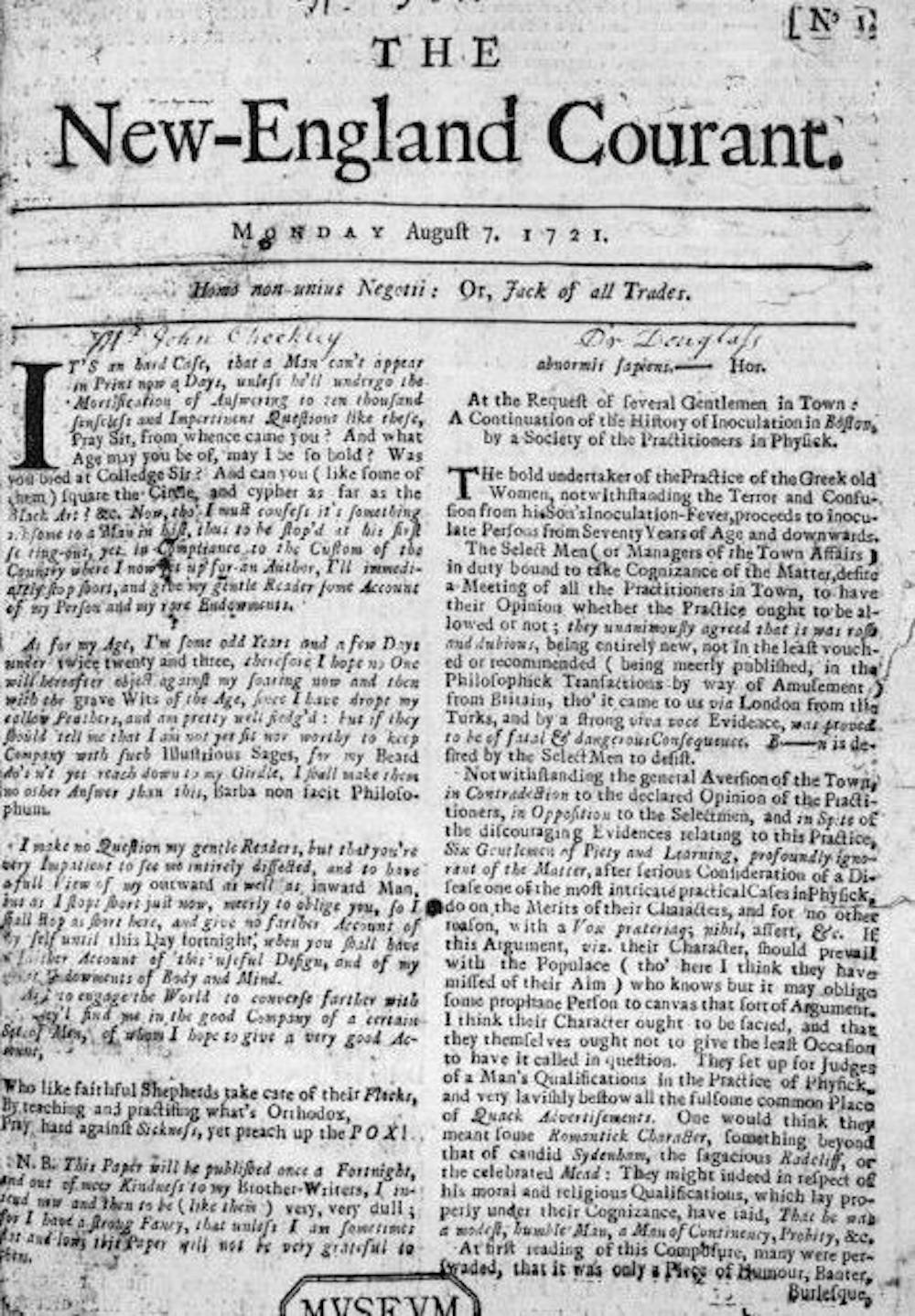
frontpage of a 1721 newspaper
From its first edition, The New-England Courant covered inoculation. Wikimedia Commons

One article from August 1721 tried to guilt readers into resisting inoculation. If someone gets inoculated and then spreads the disease to someone else, who in turn dies of it, the article asked, “at whose hands shall their Blood be required?” The same article went on to say that “Epidemeal Distempers” such as smallpox come “as Judgments from an angry and displeased God.”

In contrast to Mather and Boylston’s research, the Courant’s articles were designed not to discover, but to sow doubt and distrust. The argument that inoculation might help to spread the disease posits something that was theoretically possible – at least if simple precautions were not taken – but it seems beside the point. If inoculation worked, wouldn’t it be worth this small risk, especially since widespread inoculations would dramatically decrease the likelihood that one person would infect another?

Franklin, the Courant’s editor, had a kid brother apprenticed to him at the time – a teenager by the name of Benjamin.

Historians don’t know which side the younger Franklin took in 1721 – or whether he took a side at all – but his subsequent approach to inoculation years later has lessons for the world’s current encounter with a deadly virus and a divided response to a vaccine.

Independent thought

You might expect that James’ little brother would have been inclined to oppose inoculation as well. After all, thinking like family members and others you identify with is a common human tendency.

That he was capable of overcoming this inclination shows Benjamin Franklin’s capacity for independent thought, an asset that would serve him well throughout his life as a writer, scientist and statesman. While sticking with social expectations confers certain advantages in certain settings, being able to shake off these norms when they are dangerous is also valuable. We believe the most successful people are the ones who, like Franklin, have the intellectual flexibility to choose between adherence and independence.

Truth, not victory
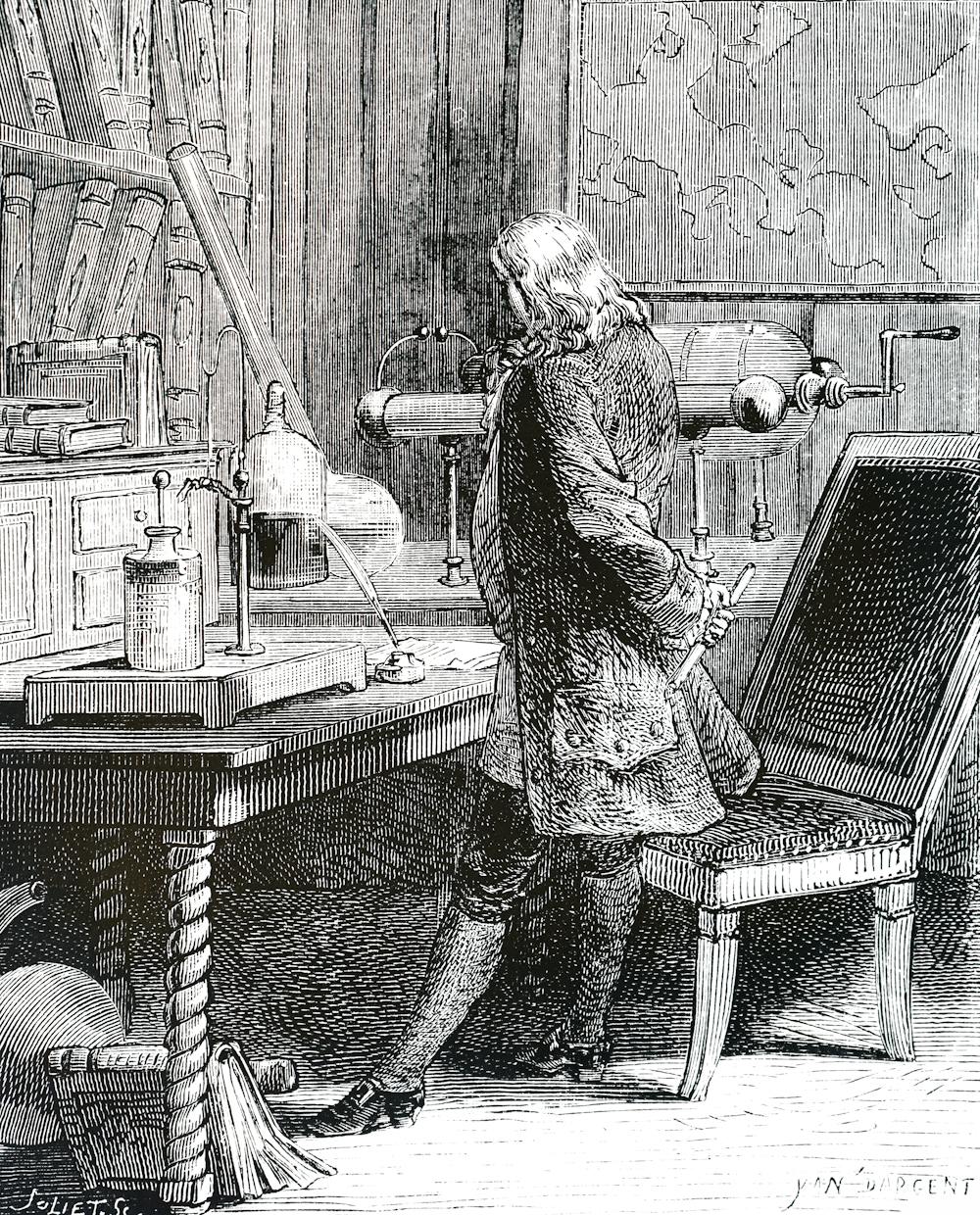
etching of Franklin standing at a table in a lab
Franklin matured into a well-known scientist and statesman, with many successes aided by his open mind. Universal History Archive/Universal Images Group via Getty Images

What happened next shows that Franklin, unlike his brother – and plenty of pundits and politicians in the 21st century – was more interested in discovering the truth than in proving he was right.

Perhaps the inoculation controversy of 1721 had helped him to understand an unfortunate phenomenon that continues to plague the U.S. in 2021: When people take sides, progress suffersTribes, whether long-standing or newly formed around an issue, can devote their energies to demonizing the other side and rallying their own. Instead of attacking the problem, they attack each other.

Franklin, in fact, became convinced that inoculation was a sound approach to preventing smallpox. Years later he intended to have his son Francis inoculated after recovering from a case of diarrhea. But before inoculation took place, the 4-year-old boy contracted smallpox and died in 1736. Citing a rumor that Francis had died because of inoculation and noting that such a rumor might deter parents from exposing their children to this procedure, Franklin made a point of setting the record straight, explaining that the child had “receiv’d the Distemper in the common Way of Infection.”

Writing his autobiography in 1771, Franklin reflected on the tragedy and used it to advocate for inoculation. He explained that he “regretted bitterly and still regret” not inoculating the boy, adding, “This I mention for the sake of parents who omit that operation, on the supposition that they should never forgive themselves if a child died under it; my example showing that the regret may be the same either way, and that, therefore, the safer should be chosen.”

A scientific perspective

A final lesson from 1721 has to do with the importance of a truly scientific perspective, one that embraces science, facts and objectivity.
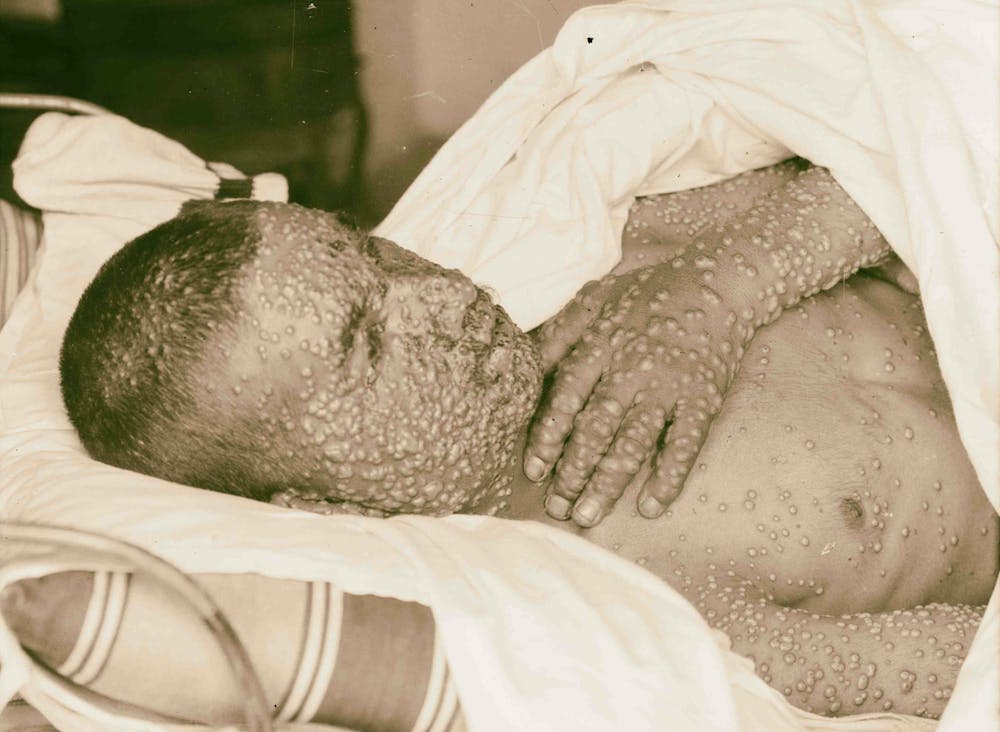
19th-century photo of a smallpox patient
Smallpox was characterized by fever and aches and pustules all over the body. Before eradication, the virus killed about 30% of those it infected, according to the U.S. Centers for Disease Control and Prevention. Sepia Times/Universal Images Group via Getty Images

Inoculation was a relatively new procedure for Bostonians in 1721, and this lifesaving method was not without deadly risks. To address this paradox, several physicians meticulously collected data and compared the number of those who died because of natural smallpox with deaths after smallpox inoculation. Boylston essentially carried out what today’s researchers would call a clinical study on the efficacy of inoculation. Knowing he needed to demonstrate the usefulness of inoculation in a diverse population, he reported in a short book how he inoculated nearly 300 individuals and carefully noted their symptoms and conditions over days and weeks.

The recent emergency-use authorization of mRNA-based and viral-vector vaccines for COVID-19 has produced a vast array of hoaxes, false claims and conspiracy theories, especially in various social media. Like 18th-century inoculations, these vaccines represent new scientific approaches to vaccination, but ones that are based on decades of scientific research and clinical studies.

We suspect that if he were alive today, Benjamin Franklin would want his example to guide modern scientists, politicians, journalists and everyone else making personal health decisions. Like Mather and Boylston, Franklin was a scientist with a respect for evidence and ultimately for truth.

When it comes to a deadly virus and a divided response to a preventive treatment, Franklin was clear what he would do. It doesn’t take a visionary like Franklin to accept the evidence of medical science today.

Cartoon – Never Reaching Herd Immunity

Herd immunity hard to achieve if you've heard wrong info

Cartoon – Worried about Tracking

Tracking vaccine? | EDITORIAL CARTOON - Baltimore Sun

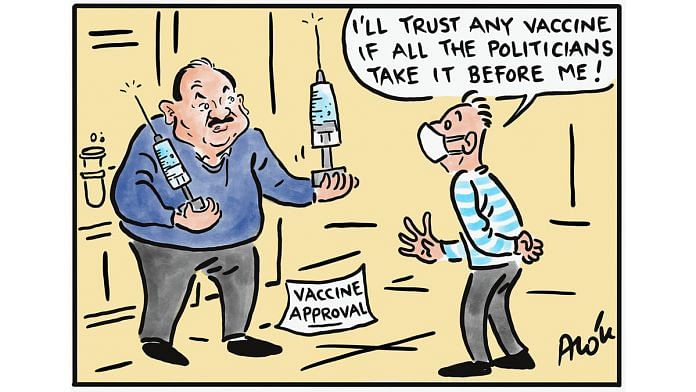
Cartoon – Vaccine Hesitancy

Tackling India's vaccine hesitancy, and Modi's 'world topper' trophy

Fauci vs. Rogan: White House works to stomp out misinformation

Fauci vs. Rogan: White House works to stomp out misinformation

Fauci vs. Rogan: White House works to stomp out misinformation | TheHill

The Biden administration is working to stamp out misinformation that might dissuade people from getting coronavirus shots, a crucial task as the nation shifts into the next, more difficult phase of its vaccination campaign.

The White House announced Friday that 100 million Americans are now fully vaccinated against COVID-19, but the nationwide rollout is plateauing as fewer people sign up for shots. 

Administration officials and health experts know the difficulty ahead in getting vaccines into as many people as possible, and are trying to eliminate the barriers to doing so.

Authorities need to dispel the legitimate concerns that make people hesitant, while also stopping waves of misinformation.

This past week, top infectious diseases expert Anthony Fauci corrected Joe Rogan, a popular podcast host who himself later acknowledged his lack of medical knowledge, after Rogan said young healthy people don’t need to be vaccinated.

“You’re talking about yourself in a vacuum,” Fauci said of the podcast host. “You’re worried about yourself getting infected and the likelihood that you’re not going to get any symptoms. But you can get infected, and will get infected, if you put yourself at risk.”

White House communications director Kate Bedingfield also joined in the criticism.

“Did Joe Rogan become a medical doctor while we weren’t looking? I’m not sure that taking scientific and medical advice from Joe Rogan is perhaps the most productive way for people to get their information,” she told CNN.

Rogan’s comments were trending on Twitter for two days before he attempted to walk them back.

“I’m not a doctor, I’m a f—ing moron, and I’m a cage fighting commentator … I’m not a respected source of information, even for me,” he said.

Public health experts said Rogan’s comments were irresponsible, and potentially dangerous because they could perpetuate hesitancy.

“You have a responsibility as an adult, you have a responsibility as a community leader, your responsibility as a communicator to get it right,” said Georges Benjamin, executive director of the American Public Health Association. 

While Rogan is not a political figure, he has one of the most popular podcasts in the world, and an enormous platform. 

Rogan hosts the most popular podcast on Spotify. Rogan said in 2019 that his podcast was being downloaded 190 million times per month.

People are not getting all their information from Rogan, but when his comments clash with what public health experts say, that is problematic.

“It’s not so much that Joe Rogan’s a comedian, he’s very popular with people sort of leaning on the conservative side, especially young people. And that’s the group that we have to reach, especially young men,” said Peter Hotez, a leading coronavirus vaccinologist and dean of Baylor University’s National School of Tropical Medicine.

Hotez, who has appeared on Rogan’s show in the past, said he thinks the host was just misinformed. Hotez said he has reached out, and wants to help Rogan have a more productive discussion about why it’s so important for everyone to be vaccinated against the coronavirus.

Polls show vaccine hesitancy is declining, but the holdouts are not monolithic, and experts believe trusted messengers will be needed. 

“I just think they have to speak the facts. You speak the facts, and anytime you discover the facts that are incorrect, you try to correct them,” said Benjamin. “And … I don’t think you demonize the individual, nor do I think you try to pin motive to it, because you don’t know what the motive is.”

Some people are most worried about side effects, some are concerned about the safety of the vaccines and some people don’t think COVID-19 is a problem at all. There are also likely some people who will never be convinced, and try to sow confusion and distrust. 

Biden administration officials are aware of the harmful impact of misinformation, but know they are walking a fine line between people who legitimately want more information and those who just want chaos.

“We know that people have questions for multiple reasons. Sometimes because there’s misinformation that they’ve encountered, sometimes because they’ve had a bad experience with the healthcare system and they’re wondering who to trust, and some people have just heard lots of different news as we continue to get updates on the vaccine, and they want to hear from someone they trust,” Surgeon General Vivek Murthy said during a White House briefing. 

For the White House, using medical experts like Fauci to correct obvious misinformation is part of the strategy to boost vaccine confidence.

“Our approach is to provide, and flood the zone with accurate information,” White House press secretary Jen Psaki said Friday. “Obviously that includes combating misinformation when it comes across.”

The administration has also invested $3 billion to support local health department programs and community-based organizations intended to increase vaccine access, acceptance and uptake. 

Still, experts said different messengers are needed, especially when trying to reach conservatives who may now view Fauci as a polarizing political figure.

“There needs to be a better organized effort by the administration to really understand how to reach groups that are identified in polls as saying they won’t get vaccinated,” Hotez said. “We need to figure out how to do the right kind of outreach with the conservative groups, and we’ve got to do something about” the damage caused by members of the conservative media.

In a recent CBS-YouGov poll, 30 percent of Republicans said they would not get the vaccine and another 19 percent said they only “maybe” would do so. 

The underlying mistrust comes after a year in which Trump and his allies played down the severity of a virus that has killed more than half a million Americans already. 

A national poll and focus group conducted by GOP pollster Frank Luntz showed Republicans who voted for President Trump will be far more influenced by their doctors and family members than any politician. 

To that end, a group of Republican lawmakers who are also physicians released a video urging people to get the COVID-19 vaccine.

The video, led by Sen. Roger Marshall (R-Kan.), features some of the lawmakers wearing white coats with stethoscopes around their necks speaking into the camera.

Cartoon – No Vaccine for Stupidity

Facebook Cracks Down on UK and Romanian Fake Accounts, Anti-Vaccine Posts |  National News | US News

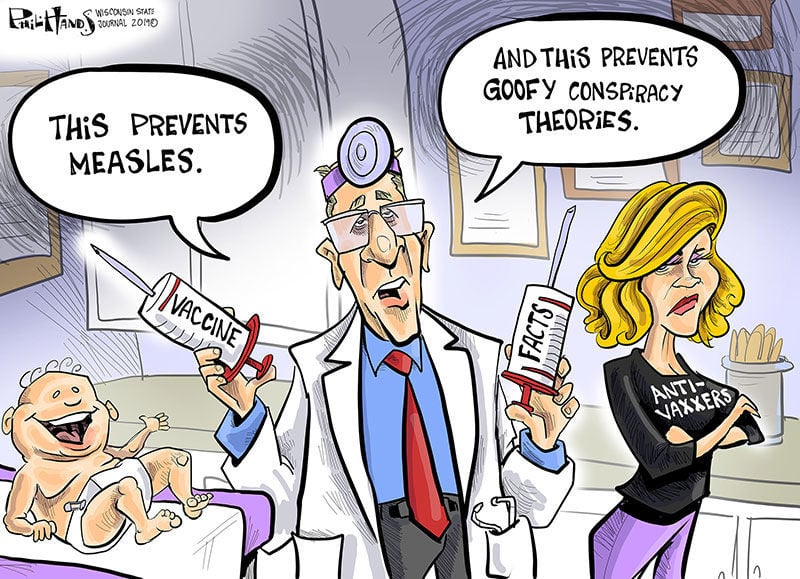
Cartoon – One Vaccine Prevents Disease & Another Conspiracy Theories

Hands on Wisconsin: Facts are the vaccine for conspiracies | Opinion |  Cartoon | madison.com

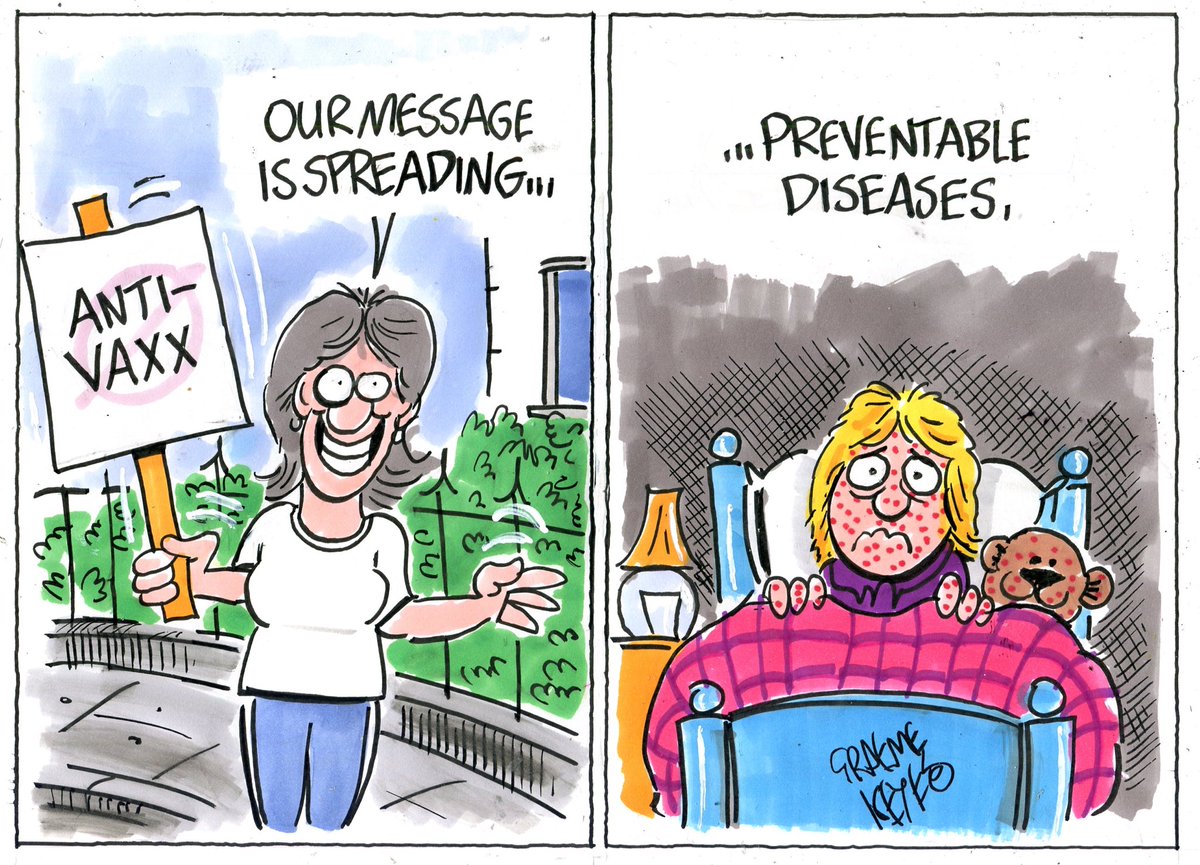
Cartoon – Anti Vaxx Message is Spreading

Political Cartoon on Twitter: "Graeme Keyes on Doctors worried as anti- vaccination messages escalate from social media misinformation to personal  threats - political cartoon gallery in London https://t.co/dePcTdnXF6…  https://t.co/UH1eOU4nPh"

Cartoon – A Shot of Common Sense

Vaccines must NOT be Feared” – STEM: From Roots to Fruits

CDC director walks tightrope on pandemic messaging

CDC director walks tightrope on pandemic messaging

Images: Tightrope walk across the Grand Canyon

Centers for Disease Control and Prevention (CDC) Director Rochelle Walensky finds herself in a delicate position as she seeks to balance the optimism of increasing vaccinations with the reality that the U.S. is still very much in the grip of a deadly pandemic.

Walensky started the CDC job with a reputation as a savvy communicator, tasked with salvaging the reputation of an agency that took a beating under the Trump administration.

“When I first started at CDC about two months ago, I made a promise to you: I would tell you the truth, even if it was not the news we wanted to hear,” Walensky told reporters recently.

Walensky’s expertise is in HIV research, like her predecessor Robert Redfield, and before being appointed to lead the CDC, she was head of infectious diseases at Massachusetts General Hospital.

While former colleagues say Walensky is the perfect fit for the CDC post, her skills are now being put to the test as she faces criticism for being both too negative and too hopeful.

“She is quite a compelling and clear communicator, but it’s a challenging set of messages to try and get out there,” said Chris Beyrer, a professor of epidemiology at Johns Hopkins Bloomberg School of Public Health.

Public health messaging during a global pandemic is complicated enough, but experts say this particular moment is especially difficult.

After weeks of decline and then stagnation, the rate of coronavirus infections has once again started to climb across much of the country. Cases are up about 12 percent nationally compared with the previous week, averaging around 62,000 cases per day, according to the CDC.

At the same time, nearly 100 million Americans have received at least one dose of a coronavirus vaccine. Many states are expanding vaccine eligibility, in some instances to all adults, and federal health officials say there will be enough supply for everyone to be vaccinated by the end of May.

Walensky tried to emphasize both aspects this week when she issued an emotional appeal to the public.

“We have so much to look forward to, so much promise and potential of where we are, and so much reason for hope. But right now I’m scared,” Walensky said, adding that she had a “sense of impending doom” if people continued to ignore public health precautions.

Yet almost in the next breath, she talked about a “tremendously encouraging” new study showing that vaccinated people were 90 percent protected from infection, meaning they pose an extremely low risk of spreading the virus.

While that may come across as mixed messaging, experts say it accurately reflects not only where things stand right now but also how the country has been reacting to the virus for the past year.

“Whiplash is a true reflection of how we’re all experiencing the epidemic and the response to it. So I’d rather she be honest about that and others be honest about that than give people something that they want … to make them feel better,” said Judith Auerbach, a professor in the University of California San Francisco School of Medicine.

Auerbach, who previously worked with Walensky on HIV research, praised the director’s openness, which she said had been missing from agency leadership during the Trump administration.

“She’s being really honest about her own emotions. That’s hard for a fed to do and get away with,” Auerbach said. “The science that says we all still need to be, in fact, quite scared because we’re in this race between the vaccines … versus the emergence of these variants, and she felt it at a visceral level, and she conveyed that in a way that I thought was quite telling.”

Glen Nowak, director of the Center for Health and Risk Communication at the University of Georgia and a former CDC media relations director, said Walensky’s candor helps establish credibility.

“She has embraced the fact that credibility comes from being transparent and honest and genuine about your fears and your concerns,” Nowak said.

The CDC declined to make Walensky available for an interview, but in a statement to The Hill, an agency spokesman said every communication reflects the latest science and epidemiology.

“At times, moments must balance hope that we will move out of the pandemic with the reality that we are not out of it yet,” the spokesman said.

“We acknowledge the challenge of conveying such hope and promise that vaccines offer with the reality that cases and deaths are rising. While we are sending the critical message that people cannot and should not let up on their prevention measures, we do remain very optimistic about what the future of a fully vaccinated public will offer,” the spokesman added.

On Friday, Walensky again came under criticism for her messaging. In updated guidance, the CDC said it is safe for people who have been fully vaccinated to travel.

But Walensky struck a cautionary tone by saying the CDC still recommends anyone, vaccinated or not, avoid nonessential travel because infection numbers are so high.

“We know that right now we have a surging number of cases,” Walensky said during a White House briefing. “I would advocate against general travel overall. Our guidance is silent on recommending or not recommending fully vaccinated people travel. Our guidance speaks to the safety of doing so.”

Nowak said part of what makes public health messaging so difficult is the fact that science doesn’t always deal in absolutes and that the public overall doesn’t do well with nuance.

“Often people don’t want to listen to the nuance; they want advice and guidance to be stable. They get frustrated with the changes or when it seems to be contradictory. They also get frustrated if it doesn’t match their everyday living experiences,” Nowak said.

With the travel guidance, Walensky attempted to spell out the balance she was trying to strike and asked the public for patience and understanding.

“I want to acknowledge today that providing guidance in the midst of a changing pandemic and its changing science is complex,” Walensky said.

“The science shows us that getting fully vaccinated allows you to do more things safely, and it’s important for us to provide that guidance, even in the context of rising cases. At the same time, we must balance the science with the fact that most Americans are not yet fully vaccinated, which is likely contributing to our rising cases,” she said.

Jen Kates, director for global health and HIV policy at the Kaiser Family Foundation, who has known Walensky for decades, said she thinks the CDC director is aware that she can’t escape criticism, especially when so many people have pandemic fatigue.

If the CDC is too strict and refuses to endorse relatively normal behavior, especially after people get vaccinated, it could risk others refusing to get the shot, Kates said.

But if the agency paints too rosy a picture, more people could act like the pandemic is over and risk further spread of the virus.

“It behooves public officials to always be cognizant that their words are being listened to and can be taken out of context or may be hard for people to grasp,” Kates said. “So I think Dr. Walensky is a great communicator, but that doesn’t mean that this is always easy to do and the balance is always straightforward.”