President Trump said Friday the U.S. would halt its funding of the World Health Organization and pull out of the agency, accusing it of protecting China as the coronavirus pandemic took off. The move has alarmed health experts, who say the decision will undermine efforts to improve the health of people around the world.
In an address in the Rose Garden, Trump said the WHO had not made reforms that he said would have helped the global health agency stop the coronavirus from spreading around the world.
“We will be today terminating our relationship with the World Health Organization and redirecting those funds to other worldwide and deserving urgent global public health needs,” Trump said. “The world needs answers from China on the virus.”
It’s not immediately clear whether the president can fully withdraw U.S. funding for the WHO without an act of Congress, which typically controls all federal government spending. Democratic lawmakers have argued that doing so would be illegal, and House Speaker Nancy Pelosi threatened last month that such a move would be “swiftly challenged.”
The United States has provided roughly 15% of the WHO’s total funding over its current two-year budget period.
The WHO has repeatedly said it was committed to a review of its response, but after the pandemic had ebbed. Last month, Robert Redfield, the director of the Centers for Disease Control and Prevention, also said the “postmortem” on the pandemic should wait until the emergency was over.
As the Trump administration’s response to pandemic has come under greater scrutiny, with testing problems and a lack of coordination in deploying necessary supplies, Trump has sought to cast further blame on China and the WHO for failing to snuff out the spread when the virus was centered in China.
During his remarks, Trump alleged, without evidence, that China pressured WHO to mislead the world about the virus. Experts say that if the U.S. leaves the WHO, the influence of China will only grow.
“The world is now suffering as a result of the malfeasance of the Chinese government,” Trump said. “China’s coverup of the Wuhan virus allowed the disease to spread all over the world, instigating a global pandemic that has cost more than 100,000 American lives, and over a million lives worldwide.” (That last claim is not true; globally, there have been about 360,000 confirmed deaths from Covid-19, the disease caused by the coronavirus.)
When Trump earlier this month threatened to yank U.S. funding in a letter, Tedros Adhanom Ghebreyesus, the WHO director-general, would only say during a media briefing that the agency was reviewing it. But he and other officials stressed that the agency had a small budget — about $2.3 billion every year — relative to the impact the agency had and what it was expected to do.
Mike Ryan, head of the WHO’s emergencies program, said the U.S. funding provided the largest proportion of that program’s budget.
“So my concerns today are both for our program and … working on how we improve our funding base for WHO’s core budget,” Ryan said. “Replacing those life-saving funds for front-line health services to some of the most difficult places in the world — we’ll obviously have to work with other partners to ensure those funds can still flow. So this is going to have major implications for delivering essential health services to some of the most vulnerable people in the world and we trust that other donors will if necessary step in to fill that gap.”
But a Vox analysis suggests that most states haven’t made the preparations needed to contain future waves of the pandemic — putting themselves at risk for a rise in Covid-19 cases and deaths should they continue to reopen.
Experts told me states need three things to be ready to reopen.State leaders, from the governor to the legislature to health departments, need to ensure the SARS-CoV-2 virus is no longer spreading unabated. They need the testing capacity to track and isolate the sick and their contacts. And they need the hospital capacity to handle a potential surge in Covid-19 cases.
More specifically, states should meet at least five basic criteria. They should see a two-week drop in coronavirus cases, indicating that the virus is actually abating. They should have fewer than four daily new cases per 100,000 people per day — to show that cases aren’t just dropping, but also below dangerous levels. They need at least 150 new tests per 100,000 people per day, letting them quickly track and contain outbreaks. They need an overall positive rate for tests below 5 percent — another critical indicator for testing capacity. And states should have more than 40 percent of their ICU beds free to actually treat an influx of people stricken with Covid-19 should it be necessary.
These metrics line up with experts’ recommendations, as well as the various policy plans put out by both independent groups and government officials to deal with the coronavirus.
Meeting these metrics doesn’t mean that a state is ready to reopen its economy — a process that describes a wide range of local and state actions. And failing them doesn’t mean a state is in immediate danger of a coronavirus outbreak if it starts to reopen; with Covid-19, there’s always an element of luck and other factors.
But with these metrics, states can gauge if they have repressed the coronavirus while building the capacity to contain future outbreaks should they come. In other words, the benchmarks show how ready states are for the next phase of the fight.
So far, most states are not there. As of May 27, just three states — Alaska, Kentucky, and New York — met four or five of the goals, which demonstrates strong progress. Thirty states hit two or three of the benchmarks. The other 17, along with Washington, DC, achieved zero or one.
Even the states that have made the most progress aren’t necessarily ready to safely reopen. There’s a big difference between Alaska — which has not suffered from a high number of coronavirus cases — and New York, and no expert would say that all of New York is ready to get back to normal.
Nor do the metrics cover everything that states should do before they can reopen. They don’t show, for example, if states have the capacity to do contact tracing, in which people who came into contact with someone who’s sick with Covid-19 are tracked down by “disease detectives” and quarantined. Contact tracing is key to containing an epidemic, but states don’t track how many contact tracers they’ve hired in a standardized, readily available way.
They also don’t have ready data for health care workers’ access to personal protective equipment, such as masks and gloves — a critical measure of the health care system’s readiness that is difficult to track.
But the map gives an idea of how much progress states have made toward containing the coronavirus and keeping it contained.
States will have to follow these kinds of metrics as they reopen. If the numbers — especially coronavirus cases — go in the wrong direction again, experts said governments should be ready to bring back restrictions. If states move too quickly to reopen or respond too slowly to a turn for the worse, they could see a renewed surge in Covid-19 cases.
“Planning for reclosing is part of planning for reopening,” Mark McClellan, a health policy expert at Duke, told me. “There will be outbreaks, and there will be needs for pauses and going back — hopefully not too much if we do this carefully.”
So this will be a work in progress, at least until we get a Covid-19 vaccine or the pandemic otherwise ends, whether by natural or human means. But the metrics can at least help give states an idea of how far along they are in finally starting to open back up.
Goal 1: A sustained two-week drop in coronavirus cases
What’s the goal? A 10 percent drop in daily new coronavirus cases compared to two weeks ago and a 5 percent drop in cases compared to one week ago, based on data from the New York Times.
Which states meet the goal? Colorado, Connecticut, Delaware, Hawaii, Indiana, Kansas, Kentucky, Massachusetts, Michigan, Missouri, Nebraska, New Jersey, New York, Oregon, Pennsylvania, Rhode Island, and Texas — 17 states in all. Washington, DC, did as well.
Why is this important? Guidance from the White House and several independent groups emphasize that states need to see coronavirus cases drop consistently over two weeks before they can say they’re ready to begin reopening. After all, nothing shows you’re out of an outbreak like a sustained reduction in infections.
“The first and foremost [metric] is you want to have a continued decrease in cases,” Saskia Popescu, an infectious disease epidemiologist, told me. “It’s a huge piece.”
A simple reduction in cases compared to two weeks prior isn’t enough; it has to be a significant drop, and it has to be sustained over the two weeks. So for Vox’s map, states need at least a 10 percent drop in daily new cases compared to two weeks prior and at least a 5 percent drop compared to one week prior.
Reported cases can be a reflection of testing capacity: More testing will pick up more cases, and less testing will pick up fewer. So it’s important that the decrease occur while testing is either growing or already sufficient. And since states have recently boosted their testing abilities, increases in Covid-19 cases can also reflect improvements in testing.
Even after meeting this benchmark, continued caution is warranted. If a state meets the goal of a reduction in cases compared to one and two weeks ago but cases seemed to go up in recent days, then perhaps it’s not time to reopen just yet. “You have to use common sense,” Cyrus Shahpar, a director at the public health policy group Resolve to Save Lives, told me.
For states with small outbreaks, this goal is infeasible. Montana has seen around one to two new Covid-19 cases a day for several weeks. Getting that down to zero would be nice, but the current level of daily new cases isn’t a big threat to the whole state. That’s one reason Vox’s map lets states meet four or five of the five goals — in case they miss one goal that doesn’t make sense for them but hit others.
Still, the two-week reduction in cases is the most cited by experts and proposals to ease social distancing.
Goal 2: A low number of daily new Covid-19 cases
What’s the goal? Fewer than four daily new coronavirus cases per 100,000 people per day, based on data from the New York Times and Census Bureau.
Which states meet the goal? Alaska, Florida, Hawaii, Idaho, Kentucky, Maine, Michigan, Missouri, Montana, Oklahoma, Oregon, South Carolina, Texas, Vermont, Washington, West Virginia, and Wyoming — 17 states.
Why is this important? One of the best ways to know you’re getting away from a disease outbreak is to no longer see a high number of daily new infections. While there’s no universally accepted number, experts said that four daily new coronavirus cases per 100,000 people is a decent ceiling.
“If I go from one to two to three [coronavirus cases a day], it’s different than going from 1,000 to 2,000 to 3,000, even though the percent difference is the same,” Shahpar said. “That’s why you have to take into account the overall level, too.”
This number can balance out the shortcomings in other metrics on this list. For example, New York — which has suffered the worst coronavirus outbreak in the country — has seen its reported daily new coronavirus cases drop for weeks, meeting the goal of a sustained drop in cases. But since that’s coming down from a huge high, even a month of sustained decreases may not be enough. New York has to make sure it falls below a threshold of new cases, too.
At the same time, if your state is now below four daily new cases per 100,000 but it’s seen a recent uptick in cases, that’s a reason for caution. New York, after all, saw just a handful of confirmed coronavirus cases before an exponential explosion of the disease took the state to thousands of new cases a day.
But if your state is below the threshold, it’s in a pretty solid place relative to most other states.
Which states meet the goal? Alaska, Connecticut, Delaware, Georgia, Illinois, Louisiana, Nevada, New Jersey, New Mexico, New York, North Dakota, and Rhode Island — for a total of 12 states.
Why is this important? Since the beginning of the coronavirus pandemic, experts have argued that the US needs the capacity for about 500,000 Covid-19 tests a day. Controlling for population, that adds up to about 150 new tests per 100,000 people per day.
Testing is crucial to getting the coronavirus outbreak under control. When paired withcontact tracing, testing lets officials track the scale of the outbreak, isolate the sick, quarantine those the sick came into contact with, and deploy community-wide efforts as necessary. Testing and tracing are how other countries, like South Korea and Germany, have managed to control their outbreaks and started to reopen their economies.
The idea, experts said, is to have enough surveillance to detect embers before they turn into full wildfires.
“States should be shoring up their testing capacity not just for what it looks like right now while everyone’s in their homes, but as people start to move more,” Jen Kates, the director of global health and HIV policy at the Kaiser Family Foundation, told me. “As people start doing more movement, you’ll have to test more, because people are going to come into contact with each other more.”
This goal is supposed to be for diagnostic tests, not antibody tests. Diagnostic tests gauge whether a person has the virus in their system and is, therefore, sick right at the moment of the test. Antibody tests check if someone ever developed antibodies to the virus to see if they had ever been sick in the past. Since diagnostic tests give a more recent gauge of the level of infection, they’re seen as much more reliable for evaluating the current state of the Covid-19 outbreak in a state.
But some states have included antibody tests in their overall counts. Experts said states shouldn’t do this. But since the data they report and the Covid Tracking Project collects is the best testing data we have, it’s hard to tease out how much antibody tests are skewing the total.
In particular, Georgia’s data suggested it met the goal of 150 daily tests per 100,000 people, but the state only started separating antibody tests from its total after the data was collected. Without the antibody tests, Georgia very likely wouldn’t meet the goal.
Some states’ numbers, like Missouri’s, also may appear significantly worse than they should due to recent efforts to decouple diagnostic testing data from antibody testing data, which can temporarily warp the overall test count.
“The virus isn’t going to care whether they were manipulating the numbers or not in order to look more favorable; it’s going to continue to spread,” Crystal Watson, a senior scholar at the Johns Hopkins Center for Health Security, told me. “It’s better to really understand what’s going on and report that accurately.”
For states honestly reporting these numbers, though, they’re a critical measure of their ability to detect, control, and contain coronavirus outbreaks.
Goal 4: A low test-positive rate
What’s the goal? Below 5 percent of coronavirus tests coming back positive over the past week, based on data from the Covid Tracking Project.
Which states meet the goal? Alaska, California, Florida, Georgia, Hawaii, Kentucky, Louisiana, Maine, Michigan, Montana, Nevada, New Hampshire, New Mexico, New York, North Dakota, Oklahoma, Oregon, South Carolina, Tennessee, Vermont, Washington, West Virginia, and Wyoming — for a total of 23 states.
Why is this important? The positive or positivity rate, which tracks how many tests come back positive for Covid-19, is another way to measure testing capacity.
Generally, a higher positive rate suggests there’s not enough testing happening. An area with adequate testing should be testing lots and lots of people, many of whom don’t have the disease or don’t show severe symptoms. The positive testing rate in South Korea, for example, is below 2 percent. High positive rates indicate only people with obvious symptoms are getting tested, so there’s not quite enough testing to match the scope of an outbreak.
The positive rate data is subject to the same limitations as the overall testing data from the Covid Tracking Project. So if a state includes antibody tests in its test count, it could skew the positive rate to look better than it is. States only risk hurting themselves if they do this.
Which states meet the goal? Alaska, Arizona, Arkansas, California, Connecticut, Delaware, Idaho, Illinois, Indiana, Iowa, Kansas, Kentucky, Minnesota, Missouri, Montana, New Hampshire, New Jersey, New Mexico, New York, North Dakota, Ohio, Oklahoma, Pennsylvania, South Dakota, Utah, Vermont, Virginia, Washington, Wisconsin, and Wyoming — for a total of 30 states.
Why is this important? If a pandemic hits, the health care system needs to be ready to treat the most severe cases and potentially save lives. That’s the key goal of “flattening the curve” and “raising the line,” in which social distancing helps reduce the spread of the disease so the health care system can maintain and grow its capacity to treat an influx of Covid-19 patients.
“There’s this idea that in six weeks we can open more things,” Amesh Adalja, a senior scholar at the Johns Hopkins Center for Health Security, told me. “But the virus is still there. It’s all about making sure that the case count isn’t too immense for our hospital system to deal with.”
The aim is to avoid the nightmare scenario that Italy went through when it had more Covid-19 cases than its health care system could handle, leading to hospitals turning away even dangerously ill patients.
To gauge this, experts recommended looking at ICU capacity, with states aiming to have less than 60 percent occupancy in their ICUs.
A big limitation in the metric: It’s based on data collected by the Centers for Disease Control and Prevention of only some hospitals in each state. So it might not be fully representative of hospital capacity throughout an entire state. But it’s the best current data available, and it suggests that the majority of states meet that standard.
That’s extremely good news. It shows that America really has flattened the curve, at least for now. But it’s done that so far through extreme social distancing. If the next step is to keep the curve flattened while easing restrictions, that will require meeting the other metrics on this list.
Hitting the benchmarks is the beginning, not the end
Vox’s map is just one way of tracking success against the coronavirus. Other groups have come up with their own measures, including Covid Act Now, Covid Exit Strategy, and Test and Trace. Vox’s model uses more up-to-date data than some of these other examples, while focusing not just on the state of the pandemic but states’ readiness to contain Covid-19 outbreaks in the future.
Very few states hit all the marks recommended by experts. But even those that do shouldn’t consider the pandemic over. They should continue to improve — for example, getting the positive rate below even 1 percent, as in New Zealand — and look at even more granular metrics, such as at the city or county level.
Meeting the benchmarks, however, indicates a state is better equipped to contain future coronavirus outbreaks as it eases previous restrictions.
Experts emphasized that states have to keep hitting all these goals week after week and day after day — Covid-19 cases must remain low, testing ability needs to stay high, and hospital capacity should be good enough for an influx of patients — until the pandemic is truly over, whether thanks to a vaccine or other means. Otherwise, a future wave of coronavirus cases, as seen in past pandemics, could kill many more people.
“You need to have all the metrics met,” Popescu said. “This needs to be a very incremental, slow process to ensure success.”
And if the numbers do start trending in the wrong direction, states should be ready to shut down at least some parts of the economy again. Maybe not as much as before, as we learn which places are truly at risk of increasing spread. But experts caution that future shutdowns will likely be necessary to some extent.
“I do worry we’re going to see surges of cases and hot spots,” Watson said. “We do need to keep pushing on building those capacities. … Otherwise, we’re just rolling the dice on the spread of the virus. It’s better if we have more control of the spread.”
That’s another reason these metrics, along with broader coronavirus surveillance, are so important: They not only help show how far along states are in dealing with their current Covid-19 outbreaks, but will help track progress to stop and prevent future crises as well.
Each person who has died of COVID-19 was somebody’s everything. Even as we mourn for those we knew, cry for those we loved and consider those who have died uncounted, the full tragedy of the pandemic hinges on one question: How do we stop the next 100,000?
The United States has now recorded 100,000 deaths due to the coronavirus.
It’s a moment to collectively grieve and reflect.
Even as we mourn for those we knew, cry for those we loved and consider also those who have died uncounted, I hope that we can also resolve to learn more, test better, hold our leaders accountable and better protect our citizens so we do not have to reach another grim milestone.
Through public records requests and other reporting, ProPublica has found example after example of delays, mistakes and missed opportunities. The CDC took weeks to fix its faulty test. In Seattle, 33,000 fans attended a soccer match, even after the top local health official said he wanted to end mass gatherings. Houston went ahead with a livestock show and rodeo that typically draws 2.5 million people, until evidence of community spread shut it down after eight days. Nebraska kept a meatpacking plant open that health officials wanted to shut down, and cases from the plant subsequently skyrocketed. And in New York, the epicenter of the pandemic, political infighting between Gov. Andrew Cuomo and Mayor Bill de Blasio hampered communication and slowed decision making at a time when speed was critical to stop the virus’ exponential spread.
COVID-19 has also laid bare many long-standing inequities and failings in America’s health care system. It is devastating, but not surprising, to learn that many of those who have been most harmed by the virus are also Americans who have long suffered from historical social injustices that left them particularly susceptible to the disease.
This massive loss of life wasn’t inevitable. It wasn’t simply unfortunate and regrettable. Even without a vaccine or cure, better mitigation measures could have prevented infections from happening in the first place; more testing capacity could have allowed patients to be identified and treated earlier.
The COVID-19 pandemic is not over, far from it.
At this moment, the questions we need to ask are: How do we prevent the next 100,000 deaths from happening? How do we better protect our most vulnerable in the coming months? Even while we mourn, how can we take action, so we do not repeat this horror all over again?
Here’s what we’ve learned so far.
Though we’ve long known about infection control problems in nursing homes, COVID-19 got in and ran roughshod.
From the first weeks of the coronavirus outbreak in the United States, when the virus tore through the Life Care Center in Kirkland, Washington, nursing homes and long-term care facilities have emerged as one of the deadliest settings. As of May 21, there have been around 35,000 deaths of staff and residents in nursing homes and long-term care facilities, according to the nonprofit Kaiser Family Foundation.
Yet the facilities have continued to struggle with basic infection control. Federal inspectors have found homes with insufficient staff and a lack of personal protective equipment. Others have failed to maintain social distancing among residents, according to inspection reports ProPublica reviewed. Desperate family members have had to become detectives and activists, one even going as far as staging a midnight rescue of her loved one as the virus spread through a Queens, New York, assisted living facility.
What now? The risk to the elderly will not decrease as time goes by — more than any other population, they will need the highest levels of protection until the pandemic is over. The CEO of the industry’s trade group told my colleague Charles Ornstein: “Just like hospitals, we have called for help. In our case, nobody has listened.” More can be done to protect our nursing home and long term care population. This means regular testing of both staff and residents, adequate protective gear and a realistic way to isolate residents who test positive.
Racial disparities in health care are pervasive in medicine, as they have been in COVID-19 deaths.
African Americans have contracted and died of the coronavirus at higher rates across the country. This is due to myriad factors, including more limited access to medical care as well as environmental, economic and political factors that put them at higher risk of chronic conditions. When ProPublica examined the first 100 recorded victims of the coronavirus in Chicago, we found that 70 were black. African Americans make up 30% of the city’s population.
What now? States should make sure that safety-net hospitals, which serve a large portion of low-income and uninsured patients regardless of their ability to pay, and hospitals in neighborhoods that serve predominantly black communities, are well-supplied and sufficiently staffed during the crisis. More can also be done to encourage African American patients to not delay seeking care, even when they have “innocent symptoms” like a cough or low-grade fever, especially when they suffer other health conditions like diabetes.
Racial disparities go beyond medicine, to other aspects of the pandemic. Data shows that black people are already being disproportionately arrested for social distancing violations, a measure that can undercut public health efforts and further raise the risk of infection, especially when enforcement includes time in a crowded jail.
Essential workers had little choice but to work during COVID-19, but adequate safeguards weren’t put in place to protect them.
We’ve known from the beginning there are some measures that help protect us from the virus, such as physical distancing. Yet millions of Americans haven’t been able to heed that advice, and have had no choice but to risk their health daily as they’ve gone to work shoulder-to-shoulder in meat-packing plants, rung up groceries while being forbidden to wear gloves, or delivered the mail. Those who are undocumented live with the additional fear of being caught by immigration authorities if they go to a hospital for testing or treatment.
What now? Research has shown that there’s a much higher risk of transmission in enclosed spaces than outdoors, so providing good ventilation, adequate physical distancing, and protective gear as appropriate for workers in indoor spaces is critical for safety. We also now know that patients are likely most infectious right before or at the time when symptoms start appearing, so if workplaces are generous about their sick leave policies, workers can err on the side of caution if they do feel unwell, and not have to choose between their livelihoods and their health. It’s also important to have adequate testing capacity, so infections can be caught before they turn into a large outbreak.
Frontline health care workers were not given adequate PPE and were sometimes fired for speaking up about it.
While health workers have not, thankfully, been dying at conspicuously higher rates, they continue to be susceptible to the virus due to their work. The national scramble for ventilators and personal protective equipment has exposed the just-in-time nature of hospitals’ inventories: Nurses across the country have had to work with expired N95 masks, or no masks at all. Health workers have been suspended, or put on unpaid leave, because they didn’t see eye to eye with their administrators on the amount of protective gear they needed to keep themselves safe while caring for patients.
First responders — EMTs, firefighters and paramedics — are often forgotten when it comes to funding, even though they are the first point of contact with sick patients. The lack of a coherent system nationwide meant that some first responders felt prepared, while others were begging for masks at local hospitals.
What now? As states reopen, it will be important to closely track hospital capacity, and if cases rise and threaten their medical systems’ ability to care for patients, governments will need to be ready to pause or even dial back reopening measures. It should go without saying that adequate protective gear is a must. I also hope that hospital administrators are thinking about mental health care for their staffs. Doctors and nurses have told us of the immense strain of caring for patients whom they don’t know how to save, while also worrying about getting sick themselves, or carrying the virus home to their loved ones. Even “heroes” need supplies and support.
What we still have to learn:
There continue to be questions on which data is lacking, such as the effects of the coronavirus on pregnant women. Without evidence-based research, pregnant women have been left to make decisions on their own, sometimes trying to limit their exposure against their employer’s wishes.
Similarly, there’s a paucity of data on children’s risk level and their role in transmission. While we can confidently say that it’s rare for children to get very ill if they do get infected, there’s not as much information on whether children are as infectious as adults. Answering that question would not just help parents make decisions (Can I let my kid go to day care when we live with Grandma?) but also help officials make evidence-based decisions on how and when to reopen schools.
There’s some research I don’t want to rush. Experts say the bar for evidence should be extremely high when it comes to a vaccine’s safety and benefit. It makes sense that we might be willing to use a therapeutic with less evidence on critically ill patients, knowing that without any intervention, they would soon die. A vaccine, however, is intended to be given to vast numbers of healthy people. So yes, we have to move urgently, but we must still take the time to gather robust data.
Our nation’s leaders have many choices to make in the coming weeks and months. I hope they will heed the advice of scientists, doctors and public health officials, and prioritize the protection of everyone from essential workers to people in prisons and homeless shelters who does not have the privilege of staying home for the duration of the pandemic.
The coronavirus is a wily adversary. We may ultimately defeat it with a vaccine or effective therapeutics. But what we’ve learned from the first 100,000 deaths is that we can save lives with the oldest mitigation tactics in the public health arsenal — and that being slow to act comes with a terrible cost.
I refuse to succumb to fatalism, to just accepting the ever higher death toll as inevitable. I want us to make it harder for this virus to take each precious life from us. And I believe we can.
The Trump administration is facing intense criticism for the lack of a national plan to handle the coronavirus pandemic as some states begin to reopen.
Public health experts, business leaders and current administration officials say the scattershot approach puts states at risk and leaves the U.S. vulnerable to a potentially open-ended wave of infections this fall.
The White House has in recent days sought to cast itself as in control of the pandemic response, with President Trump touring a distribution center to tout the availability of personal protective equipment and press secretary Kayleigh McEnany detailing for the first time that the administration did have its own pandemic preparedness plan.
Still, the White House lacks a national testing strategy that experts say will be key to preventing future outbreaks and has largely left states to their own devices on how to loosen restrictions meant to slow the spread of the virus. Trump this week even suggested widespread testing may be “overrated” as he encouraged states to reopen businesses.
The Centers for Disease Control and Prevention (CDC) on Thursday night issued long-awaited guidance intended to aid restaurants, bars and workplaces as they allow employees and customers to return, but they appeared watered down compared to previously leaked versions.
Some experts said the lack of clear federal guidance on reopening could hamper the economic recovery.
“A necessary condition for a healthy economy is a healthy population. This kind of piecemeal reopening with everyone using different criteria for opening, we’re taking a big risk,” said Mark Zandi, chief economist at Moody’s Analytics.
The lack of coherent direction from the White House was driven home this week by damaging testimony by a former top U.S. vaccine official who claims he was ousted from his post improperly.
“We don’t have a single point of leadership right now for this response, and we don’t have a master plan for this response. So those two things are absolutely critical,” said Rick Bright, who led the Biomedical Advanced Research and Development Authority until he was demoted in late April.
The U.S. faces the “darkest winter in modern history” if it does not develop a more coordinated national response, Bright said. “Our window of opportunity is closing.”
From the start, the White House has let states chart their own responses to the pandemic.
The administration did not issue a nationwide stay-at-home order, resulting in a hodgepodge of state orders at different times, with varying levels of restrictions.
Facing a widespread shortage, states were left to procure their own personal protective equipment, ventilators and testing supplies. Trump resisted using federal authority to force companies to manufacture and sell equipment to the U.S. government.
Without clear federal guidance, state officials were competing against each other and the federal government, turning the medical supply chain into a free-for-all as they sought scarce and expensive supplies from private vendors on the commercial market.
“The fact that we had questions about our ability to have enough mechanical ventilators, and you had states basically bidding against each other, trying to secure personal protective equipment … it shouldn’t be happening during a pandemic,” said Amesh Adalja, a senior scholar at the Johns Hopkins University Center for Health Security.
Internally, the administration struggled to mount a unified front as various agencies jockeyed for control. Multiple agencies have been providing contradictory instructions.
At first, Department of Health and Human Services (HHS) Secretary Alex Azar led the White House coronavirus task force.
Roughly a month, later he was replaced by Vice President Pence. The Federal Emergency Management Agency (FEMA) was later tasked with leading the response to get supplies to states, while senior White House adviser Jared Kushner led what has been dubbed a “shadow task force” to engage the private sector. Now, FEMA is reportedly winding down its role, and turning its mission back over to HHS.
The CDC has been largely absent throughout the pandemic. Director Robert Redfield has drawn the ire of President Trump as well as outside experts, and he has been seen infrequently at White House briefings.
“I think seeing the nation’s public health agency hobbled at a time like this and looking over its shoulder at its political bosses is something I hoped I would never see, and I’ve been working with the CDC for over 30 years,” said Lawrence Gostin, a professor of public health at Georgetown University.
“I think that people will die because the public health agency has lost its visibility and its credibility and that it’s being politically interfered with,” he added.
The administration recently has taken some steps to improve on the initial response to the pandemic.
Ventilator production has increased, and the U.S. is no longer seeing a shortage of the devices.
Testing has improved dramatically as well, though experts think the U.S. needs to be testing thousands of more people per day before the country can reopen.
The administration also unveiled plans to expand the Strategic National Stockpile’s supply of gowns, respirators, testing supplies and other equipment, after running out of supplies early in the pandemic.
Adalja said the administration’s positive steps are coming way too late.
“It’s May 15, we should have been in this position January 15,” he said.
McEnany on Friday for the first time detailed the White House’s preparedness plan that replaced the Obama-era pandemic playbook, an acknowledgement that Trump’s predecessor did leave a road map, despite claims to the contrary from some of the president’s allies.
She did not give many specifics on the previously unknown plan. Instead, McEnany declared the Trump administration’s handling of the virus had been “one of the best responses we’ve seen in our country’s history.”
Yet as states look to reopen businesses and get people back to work, the White House is taking a back seat as governors set their own guidelines for easing stay-at-home orders and restrictions on social activities.
The White House in April issued a three-step plan for states to reopen their economies, but it has largely been ignored by states and by the president.
Dozens of governors have begun easing restrictions on businesses and social activities without meeting the White House guidelines. Trump has been urging them to move even faster, backing anti-lockdown protesters in Michigan, Virginia, Minnesota and Pennsylvania.
Even scaled-down guidance from federal agencies is critical for providing a road map for state and local leaders, and for businesses considering how best to resume operations, said Neil Bradley, chief policy officer with the U.S. Chamber of Commerce.
“We need guidance because it helps instill confidence about the right types of approaches to take, but when you begin to move away from guidance and into either regulations or very strict approach, then that’s increasingly going to be unworkable in lots of different locations,” Bradley said.
As the nation begins to reopen amid the coronavirus pandemic, some people are looking to the skies — and experts don’t necessarily like what they see, arguing there are not enough safeguards in place to protect passengers and crew.
While air travel has fallen sharply due to the virus, the airports are open and planes are flying both domestically and internationally. The Centers for Disease Control and Prevention has issued travel guidelines encouraging air passengers to wear face coverings, “keep 6 feet of physical distance from others” and only board planes for essential travel. However, these guidelines are merely suggestions.
There is no requirement for masks, and there have been multiple reports of crowded conditions in airports and on planes, which have left passengers alarmed. The Transportation Security Administration, which screens passengers and luggage at airports, has also experienced over 560 confirmed cases of COVID-19, the disease caused by the coronavirus, and six deaths from the illness.
Despite these concerns, there are currently no coronavirus screening procedures for domestic air travelers, and a congressional investigation has also raised questions about the level of screening being conducted for international passengers. Speaking in the Oval Office on April 28, President Trump told reporters his administration is working on implementing a procedure for temperature checks and COVID-19 tests for air travelers.
“We’re also setting up a system where we do some testing, and we’re working with the airlines on that,” Trump said.
According to a May 6 government document reviewed by Yahoo News, the CDC was “developing a tool for predicting risk of importation of COVID-19 among international travelers” and meeting with the White House National Security Council “to discuss strategies for screening arriving international passengers from countries with substantial COVID-19 transmission.”
However, there have been reports of discord between the CDC and the White House. On May 9, USA Today reported CDC officials were overruled by the White House after they raised concerns about a potential plan to establish temperature checks at the airports. While some COVID-19 patients do have high fevers, many do not and others are entirely asymptomatic.
USA Today’s report included an email Dr. Martin Cetron, the CDC’s director of global mitigation and quarantine, sent to officials with the Department of Homeland Security criticizing the temperature checks as “a poorly designed control and detention strategy.”
Cetron, the CDC and DHS did not respond to requests for comment. The White House did not respond to questions about the reported disagreements from the CDC or whether the Trump administration believes temperature checks are an adequate screening measure for airports.
Rep. Raja Krishnamoorthi, the chairman of the House oversight subcommittee on economic and consumer policy, has investigated coronavirus screening procedures at airports. Earlier this week, the Illinois Democrat told Yahoo News he was concerned by the report that the White House is pursuing a temperature screening plan over the objections of CDC officials.
“The White House has been ignoring and sidelining America’s public health experts at the CDC, instead relying on nonexpert political appointees to make public health decisions,” Krishnamoorthi said. “I am troubled by reports that officials at the Centers for Disease Control and Prevention could raise this public health concern and be essentially overruled by presidential aides. The desire to lure Americans back into traveling by making them feel like they are safe cannot outweigh the need to actually keep this country safe.”
Krishnamoorthi has previously raised concerns about what he described as “lax” screening procedures for international travelers coming into the United States from coronavirus hot spots in March as the pandemic exploded around the globe. Trump has repeatedly pointed to restrictions he imposed on travelers from China — where the virus originated — on Jan. 31 as evidence of his strong efforts to curb its spread in the United States.
However, the restrictions on China contained exemptions that allowed over 400,000 people to subsequently travel from that country to the United States. And on May 7, Krishnamoorthi’s subcommittee released the results of an investigation that focused on two other early coronavirus hot spots — Italy and South Korea. Krishnamoorthi said he believes Trump has focused on “rhetoric and bluster rather than actually effective screenings.”
“Just from what we found with Italy and South Korea, there was no border closing. There was no screening. Unfortunately, the lack of screening probably had some very serious consequences at a time when cases were exponentially rising in the United States.”
Krishnamoorthi’s investigation, which included extensive briefings from officials, found that the White House National Security Council’s Policy Coordination Committees decided in March to rely on South Korean and Italian officials to screen passengers in those countries who were headed to the United States. The probe further found the U.S. had “limited” oversight for those screenings in Italy and that only 69 passengers were prevented from coming to the U.S. from those two countries in March. Once they arrived, the investigation found passengers entering from the two countries did not receive additional health screenings.
“Potentially thousands and thousands of people came across without screenings” from what were two of the leading coronavirus hot spots at the time, Krishnamoorthi told Yahoo News. “It doesn’t take a lot to believe that folks came over and seeded further outbreaks here in this country.”
Jonathan Ullyot, a spokesperson for the White House National Security Council, responded to questions about Krishnamoorthi’s investigation with a statement touting the government’s steps to screen international arrivals earlier this year.
“The reality is that the United States government took early and decisive action to mitigate the risk from global hot spots, including China, Iran, South Korea, and the Schengen area of Europe,” Ullyot wrote. “After restricting travel from China on January 31 … the security directive put forth by the administration required enhanced medical screenings for all passengers before they departed on flights to the United States from Northern Italy and South Korea.”
According to Ullyot, the screenings in Italy and South Korea “included checking the passenger’s temperature, visual observations to detect signs of illness, and questionnaires.” While Ullyot did not dispute Krishnamoorthi’s contention that the U.S. relied on officials in those countries to conduct the screenings and that few passengers were denied boarding, he said “U.S. mission staff visited airports” in both countries to “observe these screening procedures.”
A senior Trump administration official, who requested not to be named, said all international arrivals to the United States are subject to Customs and Border Protection (CBP) screenings that are following CDC guidelines. The official explained that those guidelines require CBP officers to refer travelers “to the CDC, DHS contract medical screeners, or local health authorities for health screening” if they are exhibiting symptoms or have traveled from countries that have experienced major outbreaks.
According to the official, the CBP has “established processes to identify travelers who have traveled to the United States directly or indirectly from areas that are experiencing COVID-19 outbreaks.”
Domestic air passengers, however, are treated differently.
“With regard to domestic travel, there’s not more screening beyond what TSA normally does,” Krishnamoorthi said.
He said that lack of screening for domestic travelers is particularly worrisome as areas of the country are beginning to lift lockdown restrictions. He suggested this could lead to a situation where business people “go back and start traveling” and then “transport these cases everywhere.”
“We have to look at the science of it more closely, and we have to develop a more precise way of screening,” Krishnamoorthi said.
Randy Babbitt, a former administrator of the Federal Aviation Administration, said the lack of new screening procedures is not as much of a problem right now since “nobody’s flying.” However, he said it will become a pressing issue as the country reopens and airports become more crowded.
“People are going to start flying and as it ramps back up, that becomes a different question,” Babbitt told Yahoo News.
Babbitt further explained that one difficulty with establishing comprehensive procedures for airports is that so many different government agencies are involved in air travel. However, he pointed to proposals generated by Stonebriar Strategy Group Thought Leadership Initiative, a nonprofit consultancy, as a realistic potential road map.
Howard Thrall, the president and senior partner of the group, said the organization is comprised of multiple retired consultants and executives who have worked in the industry. According to Thrall, a veteran executive who has worked for multiple aviation and aerospace companies, the group came together because they were “totally amazed” a coronavirus airport screening system has not yet been established.
“This is really a pro bono exercise for a bunch of old graybeards,” Thrall said.
The Stonebriar Strategy Group’s proposal calls for screening perimeters to be established outside airports, where rapid COVID-19 tests, questionnaires and temperature checks could be administered to travelers and workers. Setting up a screening perimeter would mean that even if passengers ended up in close proximity during boarding or on planes, they could have a higher degree of confidence those around them were not contagious.
Along with addressing safety concerns, Thrall said implementing these screenings could help the economy since aviation is a substantial part of the nation’s gross domestic product and boosting consumer confidence is crucial to returning the industry to normal levels. He pointed to the aftermath of the Sept. 11 attacks, when the TSA was formed and security screening procedures were transformed, as evidence that airport procedures can quickly be revamped.
The Stonebriar Strategy Group’s detailed proposal estimated it would cost approximately $6.8 million per airport, per year, to establish coronavirus screening perimeters. With approximately 5,000 public airports in the country, that would mean a total cost of about $34 billion.
However, Thrall argued that cost is realistic relative to the urgent need and the trillions of dollars the government is spending to address the coronavirus.
“That’s why we wrote it up. It wasn’t happening and it could happen. This is not a big deal,” Thrall said. “I mean, it’s not going to be free by any means, but this is very, very manageable.”
Rick Bright, the ousted director of a crucial federal office charged with developing countermeasures to infectious diseases, testified before Congress on Thursday that the US will face an even worse crisis without additional preparations to curb the coronavirus pandemic.
“Our window of opportunity is closing,” Bright said. “Without better planning, 2020 could be the darkest winter in modern history.”
Bright criticized the Trump administration for failing to implement a “standard, centralized, coordinated plan” to combat the virus and questioned its timeline for a vaccine. His testimony came a week after filing a whistleblower complaint alleging he was fired from his job leading the Biomedical Advanced Research and Development Authority for opposing the use of a drug frequently touted by President Donald Trump as a potential coronavirus treatment.
About an hour before Bright’s hearing, Trump tweeted that he had “never met” or “even heard of” Bright, but considers the NIH senior adviser a “disgruntled employee, not liked or respected by people I spoke to and who, with his attitude, should no longer be working for our government!”
Before the House Committee on Energy and Commerce’s health subcommittee, Bright urged the Trump administration to consider a number of actions, including increasing production of essential equipment and establishing both a national test strategy and a national standard of procurement of supplies. He calls on top officials to “lead” through example and wear face coverings and social distance.
Bright claimed that the administration missed “early warning signals” to prevent the spread of the virus. He said that he would “never forget” an email from Mike Bowen, the hearing’s other witness and the vice president of the medical supply company Prestige Ameritech, indicating that the US supply of N95, the respirator masks used by health care professionals, was at a perilous level.
“He said, ‘We’re in deep shit,'” testified Bright. “‘The world is.'”
Bright said he “pushed” that warning “to the highest levels” he could at Health and Human Services but received “no response.”
“From that moment, I knew that we were going to have a crisis for health care workers because we were not taking action,” said Bright. “We were already behind the ball.”
In his written statement, Bright blamed the leadership of HHS for being “dismissive” of his “dire predictions.” Bright wrote that he knew the US had a “critical shortage of necessary supplies” and personal protective equipment during the first three months of the year and prodded HHS to boost production of masks, respirators, syringes and swabs to no avail. He alleged that he faced “hostility and marginalization” from HHS officials after he briefed White House trade adviser Peter Navarro and members of Congress “who better understood the urgency to act.”
And he charged that he was removed from his post at BARDA and transferred to “a more limited and less impactful position” at NIH after he “resisted efforts to promote” the “unproven” drug chloroquine.
A Department of Health and Human Services spokesperson responded that it was “a personnel matter that is currently under review” but said it “strongly disagrees with the allegations and characterizations.”
Bright is seeking to be reinstated to his position as the head of BARDA. The Office of Special Counsel, which is reviewing Bright’s complaint, has determined that was a “substantial likelihood of wrongdoing” in removing him from his post, according to Bright’s attorneys.
Rep. Anna Eshoo, a California Democrat and the panel’s chairwoman, said Bright “was the right person, with the right judgment, at the right time.”
“We can’t have a system where the government fires those who get it right and reward those who get it completely wrong,” added Eshoo.
In his testimony, Bright also cast doubt on the Trump administration’s goal of manufacturing a vaccine in 12 to 18 months as overly optimistic, calling it “an aggressive schedule” and noting that it usually takes up to 10 years to make a vaccine.
“My concern is if we rush too quickly, and consider cutting out critical steps, we may not have a full assessment of the safety of that vaccine,” Bright said. “So, it’s still going to take some time.”
Some Republicans on the subcommittee said that the hearing shouldn’t have been held at all.
Rep. Michael Burgess of Texas, the top Republican on the panel, said “every whistleblower needs to be heard,” but added the hearing was “premature” and a “disservice” to the Special Counsel’s investigation since Bright’s complaint was filed only a week ago.
And Republican Rep. Richard Hudson of North Carolina claimed that the hearing was not about the whistleblower complaint but “undermining the Administration during a national and global crisis.”
Thursday’s subcommittee meeting comes two days after a blockbuster hearing in the Senate that featured Dr. Anthony Fauci, who leads the National Institute of Allergy and Infectious Diseases. Fauci said that access to a vaccine in time for the fall school year would be “a bit of a bridge too far” and warning against some schools opening too soon, which Trump later called “not an acceptable answer.”
Fauci testified from his modified quarantine at home since he had made contact with a White House staffer who tested positive. But Bright appeared masked and in-person for his hearing on Capitol Hill, as did the lawmakers who questioned him. Many members of the House have steered clear of Capitol Hill since the onset of the outbreak, although they are expected to return on Friday to vote on a multi-trillion dollar Democratic bill responding to the crisis.
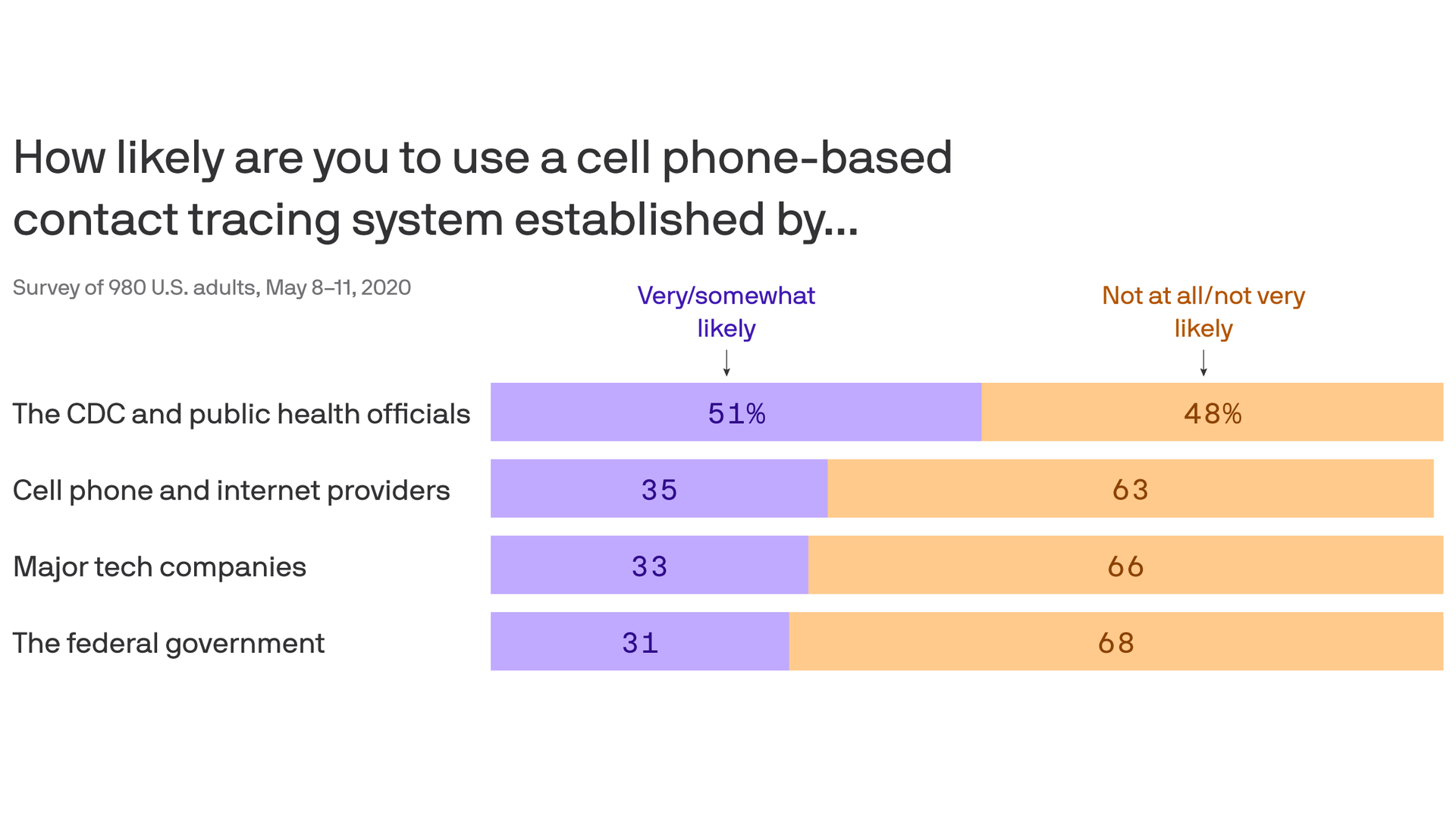
In a best-case scenario, just half of Americans would participate in a voluntary coronavirus “contact tracing” program tracked with cell phones, according to the latest installment of the Axios-Ipsos Coronavirus Index.
Why it matters: A strong contact tracing program — identifying people who have the virus and isolating those who have come into contact with them — is the key to letting other people get back to their lives, according to public health experts.
The findings underscore deep resistance to turning over sensitive health information, and mistrust about how it could be used.
The only way to get even half of Americans to participate would be for public health officials to run the program, not the White House or tech or phone companies.
What they’re saying: “The whole concept of American democracy is about local control and civil liberties, individual liberties,” said Cliff Young, president of Ipsos U.S. Public Affairs.
“At the end of the day, I think there will be an American solution to contact tracing,” but if the survey results are any guide, “it’s not going to be a centralized authority saying, ‘And now we’re going to have contact tracing.'”
These findings come as tech companies develop software to try to halt the spread, and public health officials train thousands to conduct the tracing.
The big picture: Even as the death toll rises and infections breach the White House firewall, Week 9 of our national survey also finds more people itching to return to work as they used to know it — and bending guidelines to see family and friends.
64% say returning to their pre-coronavirus lives would be a large or moderate risk. Just 30% say that’s worth the risk right now.
But four in 10 say they think returning to their normal place of employment would post only a small risk, or no risk.
63% consider airplane travel or mass transit to be a large risk, down from 73% a month ago.
Nine in 10 say they’re still practicing social distancing, but just 36% say they’re self quarantining, down from a peak of 55% in Week 4.
32% say they’ve visited family or friends in the past week, the highest share in seven weeks.
These shifts in behavior come even as growing shares of Americans know people in their own communities who have tested positive and the number of confirmed cases in the U.S. has topped 1.3 million, with roughly 80,000 deaths.
About a third know someone who has tested positive — and of those, nearly half say they know a person in their own community who has tested positive.
“People are getting antsy,” Young said. “They know there’s this risk, but … people’s mental health and social health are challenged and they’re just feeling restless.”
“You can only keep cooped up for so long.”
Between the lines: Most don’t see the virus as an immediate existential threat to themselves. This week, we asked whether people had prepared or updated their wills or living wills since the pandemic began. More than nine in 10 said no.
For contact tracing involving cell phone tracking, Democrats surveyed are more open than Republicans to the notion of opt-in reporting.
68% of Democrats say they’d participate if the Centers for Disease Control and Prevention (CDC) was in charge, compared with 58% of independents and 32% of Republicans.
Those numbers plunged if the federal government more broadly were in charge, but Democrats remained the most likely to participate — 39% compared with 34% of independents and 23% of Republicans.
That’s despite the fact that Democrats are less trusting than others of the Trump administration to protect their families.
Men are slightly more likely than women to trust tech companies with the information.
Be smart: Some reporting initiatives may need to be mandatory or person-to-person to get high enough levels of participation to be worthwhile.
Ubiquity of social media has made it easier to spread or even create COVID-19 falsehoods, making the work of public health officials harder.
This is part of our Coronavirus Update series in which Harvard specialists in epidemiology, infectious disease, economics, politics, and other disciplines offer insights into what the latest developments in the COVID-19 outbreak may bring.
When a disease outbreak grabs the public’s attention, formal recommendations from medical experts are often muffled by a barrage of half-baked advice, sketchy remedies, and misguided theories that circulate as anxious people rush to understand a new health risk.
The current crisis is no exception. The sudden onset of a new, highly contagious coronavirus has unleashed what U.N. Secretary-General António Guterres last week called a “pandemic of misinformation,” a phenomenon that has not gone unnoticed as nearly two-thirds of Americans said they have seen news and information about the disease that seemed completely made up, according to a recent Pew Research Center study.
What distinguishes the proliferation of bad information surrounding the current crisis, though, is social media. Kasisomayajula “Vish” Viswanath, Lee Kum Kee Professor of Health Communication at the Harvard T.H. Chan School of Public Health, said the popularity and ubiquity of the various platforms means the public is no longer merely passively consuming inaccuracies and falsehoods. It’s disseminating and even creating them, which is a “very different” dynamic than what took place during prior pandemics MERS and H1N1.
The sheer volume of COVID-19 misinformation and disinformation online is “crowding out” the accurate public health guidance, “making our work a bit more difficult,” he said.
“Misinformation could be an honest mistake or the intentions are not to blatantly mislead people,” like advising others to eat garlic or gargle with salt water as protection against COVID-19, he said. Disinformation campaigns, usually propagated for political gain by state actors, party operatives, or activists, deliberately spread falsehoods or create fake content, like a video purporting to show the Chinese government executing residents in Wuhan with COVID-19 or “Plandemic,” a film claiming the pandemic is a ruse to coerce mass vaccinations, which most major social media platforms recently banned.
In order to be effective, especially during a crisis, public health communicators have to be seen as credible, transparent, and trustworthy. And there, officials are falling short, said Viswanath.
“People are hungry for information, hungry for certitude, and when there is a lack of consensus-oriented information and when everything is being contested in public, that creates confusion among people,” he said.
“When the president says disinfectants … or anti-malaria drugs are one way to treat COVID-19, and other people say, ‘No, that’s not the case,’ the public is hard-pressed to start wondering, ‘If the authorities cannot agree, cannot make up their minds, why should I trust anybody?’”
Mainstream media coverage has added to the problem, analysts say. At many major news outlets, reporters and editors with no medical or public health training were reassigned to cover the unfolding pandemic and are scrambling to get up to speed with complex scientific terminology, methodologies, and research, and then identify, as well as vet, a roster of credible sources. Because many are not yet knowledgeable enough to report critically and authoritatively on the science, they can sometimes lean too heavily on traditional journalism values like balance, novelty, and conflict. In doing so, they lift up outlier and inaccurate counterarguments and hypotheses, unnecessarily muddying the water.
“People are hungry for information, hungry for certitude, and when there is a lack of consensus-oriented information and when everything is being contested in public, that creates confusion among people.”
— Kasisomayajula Viswanath
“What I have found is a remarkable degree of consensus among people who understand the science of this disease around what the fundamental issues are and then disagreements about trade-offs and policies,” said Jha, who is a frequent commentator on news programs. “The idea of covering the science in a two-sided way on areas where there really isn’t any disagreement has struck me as very, very odd, and it keeps coming up over and over again.”
Then there is the problem of political bias. This has been especially true at right-leaning media outlets, which have largely repeated news angles and viewpoints promoted by the White House and the president on the progress of the pandemic and the efficacy of the administration’s response, boosting unproven COVID-19 treatments and exaggerating the availability of testing and safety equipment and prospects for speedy vaccine development.
Tara Setmayer, a spring 2020 Resident Fellow at the Institute of Politics and former Republican Party communications director, said what’s coming from Fox News and other pro-Trump media goes well beyond misinformation. Whether downplaying the views of government experts on COVID-19’s lethality, blaming China or philanthropist Bill Gates for its spread, or cheering shutdown protests funded by Republican political groups, it’s all part of “an active disinformation campaign,” she said, aimed at deflecting the president’s responsibility as he wages a reelection campaign.
But turning around those who buy into false information is not as simple as piercing epistemic bubbles with facts, said Christopher Robichaud, senior lecturer in ethics and public policy at Harvard Kennedy School (HKS) who teaches the Gen Ed course “Ignorance, Lies, Hogwash and Humbug: The Value of Truth and Knowledge in Democracies.”
Over time, bubble dwellers can become cocooned in a media echo chamber that not only feeds faulty information to audiences, but anticipates criticisms in order to “prebut” potential counterarguments that audience members may encounter from outsiders, much the way cult leaders do.
“It’s not enough to introduce new pieces of evidence. You have to break through their strategies to diminish that counterevidence, and that’s a much harder thing to do than merely exposing people to different perspectives,” he said.
While Facebook, Twitter, and YouTube have all recently ramped up efforts to take down COVID-19 misinformation following public outcry, social media platforms “fall short” when it comes to curbing the flow, said Joan Donovan, who leads the Technology and Social Change Project at HKS.
Since the national shift to remote work, many social media firms are relying more heavily on artificial intelligence to patrol misinformation on their platforms, instead of human moderators, who tend to be more effective, said Donovan. So many users suddenly searching and posting about one specific topic can “signal jam search algorithms, which cannot tell the difference usually between truth and lies.”
These firms are reluctant to spark a regulatory backlash by policing their platforms too tightly and angering one or both political parties.
“So they are careful to take action on content that is deemed immediately harmful (like posts that say to drink chemicals), but are reticent to enforce moderation on calls for people to break the stay-at-home orders,” said Donovan.
Viswanath said public health officials cannot, and should not, chase down and debunk every bit of misinformation or conspiracy theory, lest the attention lends them some credence. The public needs to more closely scrutinize and be “much more skeptical” about what they’re reading and hearing, particularly online, and not try to keep up with the very latest COVID-19 research. “You don’t need to know everything,” he said.
Putting the onus entirely on the public, however, is “unfair and it won’t work,” said Viswanath. Institutions, like social media platforms, have to take more responsibility for what’s out there.
Public health organizations should be running effective communication surveillance of social media to monitor which rumors, ideas, and issues most worry the public, what is understood and misunderstood about various diseases and treatments, and what myths are circulating or being actively promoted in the community. And they need to have a strategy in place to counter what they’re picking up. “You cannot control this, but you can at least manage some of this,” Viswanath said.
Though some COVID-19 misinformation and conspiracy theories are outlandish or even dangerously inaccurate, Robichaud said it’s a mistake to dismiss those who believe them as people who don’t care about the truth.
Many cognitive biases get in the way of even the best truth-seeking strategies, so perhaps we could all benefit from a little more intellectual humility in this time of such great uncertainty, he said.
“Most of us are, at best, experts in a tiny, tiny area. But we don’t navigate the world as if that were true. We navigate the world as if we’re experts about a whole bunch of things that we’re not,” he said. “A little intellectual humility can go a long way. And I say that as a professor: It’s true of us, and it’s also true of the public at large.”
Solutions for COVID-19 are being developed at the same time as knowledge about the disease evolves, a serious challenge for doctors treating patients and for researchers trying to create vaccines and treatments.
Why it matters: What was first thought of as a respiratory infection now appears much more complex, making efforts to tackle the disease more complicated.
“We’re laying the track as the train is moving and the train is coming very fast,” says Mark Poznansky, director of the Vaccine & Immunotherapy Center at Massachusetts General Hospital. “That is an extraordinary place to be at the global level.”
What’s happening: When the world first encountered COVID-19 four months ago, it was deemed a respiratory infection that hammers the lungs. That’s still the case but in recent weeks, clinicians have been reporting wide-ranging manifestations of the disease in some people.
Some of this could be that, with enough cases, there are outliers and anomalies. But that underscores that doctors and researchers are learning as they go.
Details: Renal failure, sepsis, damaged blood vessels, skin lesions, stroke, gastrointestinal problems and blood clots in the lungs and kidneys are being seen in some COVID-19 patients.
20% of hospitalized patients in one study in Wuhan, China had heart damage.
31% of people with the disease studied in a Danish ICU had blood clots.
“It comes across more as a systemic disease exhibited initially as a respiratory disease,” says Poznansky. It’s unclear whether the cause is the virus itself, the immune system’s response to it, or the treatment received.
That has implications for developing vaccines. The goal is to prevent infection but not exacerbate the immune effects in response to the virus.
“Is [a vaccine] protective or not in a context where we don’t know what exactly defines a protective immune response to COVID-19?” asks Poznansky.
The evolving understanding underscores the need to have multiple vaccines in development. (The current count is 123, per the Milken Institute’s tracker.)
What to watch: The changing percent of the disease will feature in regulatory discussions.
“This is the question companies will be discussing with regulators: which surrogate endpoints are acceptable as a proxy for going all the way to the worst possible outcomes in a patient?” says Phyllis Arthur, vice president of infectious diseases and diagnostics policy at biotech trade organization BIO.
The bottom line: Pandemics bring a potent mix of uncertainty and urgency to science that experts say requires both nimbleness and rigor to navigate.
“This is what a pandemic is like. It’s uncomfortable,” says Arthur. “You need to move swiftly and do good, solid, evidence-based, risk-benefit ratio assessments and understand what you know and don’t know, and make evidence based policy decisions knowing you don’t have perfect information.”


/cdn.vox-cdn.com/uploads/chorus_image/image/66858616/GettyImages_1220891781.0.jpg)
:no_upscale()/cdn.vox-cdn.com/uploads/chorus_asset/file/20005583/coronavirus_reopen_map.png)
:no_upscale()/cdn.vox-cdn.com/uploads/chorus_asset/file/20007678/coronavirus_cases_map.png)
:no_upscale()/cdn.vox-cdn.com/uploads/chorus_asset/file/20005708/coronavirus_cases_per_capita_map.png)
:no_upscale()/cdn.vox-cdn.com/uploads/chorus_asset/file/20005705/coronavirus_test_map.png)
:no_upscale()/cdn.vox-cdn.com/uploads/chorus_asset/file/20005702/coronavirus_positive_rate_map.png)
:no_upscale()/cdn.vox-cdn.com/uploads/chorus_asset/file/20005695/coronavirus_icu_maps.png)





 HENRY KOTULA