CFOs need to prep for healthcare’s lagging inflation

Healthcare costs are expected to jump 6.0% next year. CFOs must prepare accordingly, advises WTW’s Tim Stawicki.

CFOs need to be prepared for a “higher tail” of medical inflation — even if general inflation eases in the near future, Tim Stawicki, chief actuary, North America health & benefits of Willis Towers Watson (WTW) told CFO Dive.

With the Consumer Price Index (CPI)  rising to 8.5% in July and the recent rise in the core Producer Price Index (PPI), the Federal Reserve will probably look to hike interest rates even farther. 

“CFOS need to be prepared for the case that if general inflation eases, there may be two or three more years where they need to think about how they are managing the costs of health care plans,” he said in an interview. 

Inflation, which can more immediately impact consumer prices, works somewhat differently when it comes to costs of medical care. “Employers are paying healthcare costs based on contracts that their insurer has with providers, which are multiple years in length. So if a deal with the hospital or contract does not come up until 2023, then that provider has the opportunity to renegotiate higher prices for three years,” said Stawicki. 

The recent Best Practices in Healthcare Survey by WTW consisting of 455 U.S. employers found that employers project their healthcare costs will jump 6.0% next year compared with an average 5.0% increase expected by the end of this year.

Further, employers see little relief in sight — seven in 10 (71%) expect moderate to significant increases in costs over the next three years. Additionally, over half of respondents (54%) expect their costs will be over budget this year.

Balancing talent retention and healthcare costs

Talent retention has also remained an entrenched challenge for CFOs over recent months and continues to be top of mind. 

Given inflationary pressures and a potential looming recession, employers are having trouble finding the workers they need to run their businesses. A rise in healthcare benefit costs will make this all the more challenging, said Stawicki. “Employers are looking around and saying ‘I need to find talent to help me run my business and I can’t do that if I have an ineffective program in healthcare benefits,’” he said. 

There is a direct link between business outcomes and in particular employee productivity and employees’ ability to manage their health and financial environment, according to WTW’s Global Benefits Attitude Survey. “Losing the ability to offer programs and benefits that meet employee needs is impacting business,” said Stawicki.

It comes down to finding the balance between cost management in an environment where talent is hard to come by, he said. In order for CFOs to be successful in financing benefit programs they need to look at finding ways to partner with their counterparts in human resources, said Stawicki. 

Sixty-seven percent of employers said that managing company costs was a top priority in the company’s August Best Practices in Healthcare Survey, versus the 42% who said that achieving affordability for employees was a top priority. In the near future, CFOs need to establish a relationship with HR counterparts that can facilitate “ways to manage company costs without shifting it to employees,” said Stawicki. 

Ultimately, company costs remain paramount for employers but running a successful business will also require keeping employee affordability top of mind.


CFOs continue talent retention battle

Dive Brief:

  • CFOs looking to attract and retain the right kind of talent amidst inflationary pressures, rising interest rates and other economic tensions need to “double down on recognition and meaningful work for employees,” said Jessica Bier, managing director of Deloitte Consulting, in an interview. 
  • In order to attract and retain viable talent to keep business afloat, 71% of CFOs indicated that a flexible workplace environment was their approach, 63% said clarity around career development and growth opportunities and 62% pointed to increased salaries, per the second wave of data in the Q3 CFO Signals report.
  • The report also revealed that CFOs who took steps to alter, reduce or streamline the type of work their finance organizations performed saw several benefits throughout the enterprise — 78% said one benefit was more time spent on higher-value activities and 71% indicated greater use of technology was another. Contrastingly, only 20% saw talent retention as a benefit, and even less (10%) saw higher quality talent as one.

Dive Insight:

The managers and workforce of financial departments are looking for five main things, said Bier, per the report — those being work environment flexibility, career growth and development, salaries, meaningful work and recognition, she said.

“As we think about the workforce experience, every CFO is also the chief talent officer,” Bier said. “Your HR business partner can support you but at the end of the day the way your managers work and the way you connect people to the work that they’re doing — that’s the CFO’s job to set that tone.”

In today’s macroeconomic environment, with inflation at its highest point in nearly four decades, meeting the expectations and needs of finance employees is all the more expensive, and important. 

One misconception, Bier said, is that a recession means workers will be happy just to have a job. “The people in the workforce who are the ones you want to keep, are the ones who are always going to have options,” she said. 

Talent retention continues to be a multifaceted challenge for CFOs and remains top of mind. Over half of CFOs (54%) cited hiring and retaining staff as the most difficult task over the next 12 months, according to a July Gartner study.

Why 67% of nurses want to quit—and what would make them stay

As RNs struggle to work through staffing shortages, their job satisfaction has sharply declined, with 67% saying they plan to leave their jobs within the next few years, according to a survey from the American Association of Critical-Care Nurses (AACN) published in Critical Care Nurse.

RNs cite poor work environments

For the survey, AACN collected responses from 9,862 nurses, 9,335 of which met the study criteria of being currently practicing RNs, in October 2021. The mean age was 46.5 years, and the mean years of experience was 17.8 years.

Of the participants, 78.3% worked in direct care, and 19.4% worked in a Beacon unit, meaning that their unit had been recognized by an AACN Beacon Award for Excellence. Half of the participants said they spent 50% or less of their time caring for Covid-19 patients, while the other half said they spent 50% or more.

To measure the health of a work environment, AACN looked at six standards:

  • Skilled communication
  • True collaboration
  • Effective decision-making
  • Meaningful recognition
  • Authentic leadership
  • Appropriate staffing

Overall, AACN found that nurses’ perceptions of quality on these six measures had declined across the board since the organization’s 2018 survey.

In particular, appropriate staffing was the lowest rated of all the standards at 2.33 out of 4, which is the lowest rating the standard has received since AACN first began the survey in 2006. Only 24% of RNs said their units had the right number of nurses with the right knowledge and skills more than 75% of the time—down from 39% who said the same in 2018.

In addition, there was a significant decline in how RNs rated the quality of care in their organizations and their units. Only 16% rated their organizations’ quality of care as excellent (compared to 24% in 2018), and 30% rated their units’ quality of care as excellent (compared to 44% in 2018). Over 50% of nurses said quality of care in their organization or unit has gotten somewhat or much worse over the last year.

Many nurses also reported difficulties with their physical and psychological well-being in the survey. For example, less than 50% of RNs said they felt their organization values their health and safety, a significant decline from 68% who said the same in 2018.

In addition, 40% of participants reported that they were not emotionally healthy. The percentage of RNs who reported experiencing moral distress also doubled from 11% in 2018 to 22% in 2021.

A significant portion of RNs also reported experiencing verbal abuse, physical abuse, sexual harassment, or discrimination over the past year. Of the 7,399 RNs who answered this question, 72% said they had experienced at least one negative incident, with verbal abuse being the most common at 65%, followed by physical abuse at 28%.

RN job satisfaction

Only 40% of RNs said they were “very satisfied” with their job, down from 62% who said the same in 2018. Further, a significant number of RNs in the survey reported planning to leave their jobs within the next few years.

Overall, 67% of RNs said they planned to leave their current position within the next three years, compared to 54% in 2018. Of this group, 36% said they planned to leave within the next year, with 20% planning to leave within the next six months.

According to the respondents, the top factors that could lead them to reconsider their decision to leave their job were a higher salary and more benefits (63%), better staffing (57%), and more respect from administration (50%).

“Without improvements in the work environment, the results of this study indicate that nurses will continue to exit the workforce in search of more meaningful, rewarding, and sustainable work,” the survey’s authors wrote. “It is time for bold action, and this study shows the way.” (Firth, MedPage Today, 8/3; Ulrich et al., Critical Care Nurse, 8/1)

Hard truths on the current and future state of the nursing workforce

image

Concerns about an imbalance in supply and demand in the nursing workforce have been around for years. The number of nursing professionals nationally may be healthy, but many nurses are not in the local areas, sites of care, or roles where they’re needed most. And many of today’s nurses don’t have the specialized skills they need, widening the existing gap between nurse experience and job complexity.

As a result, gaping holes in staffing rosters, prolonged vacancies, unstable turnover rates, and unchecked use of premium labor are now common.

Health care leaders need to confront today’s challenges in the nursing workforce differently than past cyclical shortages. In this report, we present six hard truths about the nursing workforce. Then, we detail tactics for how leaders can successfully address these challenges—stabilizing the nursing workforce in the short term and preparing it for the future.

Read More

Companies expand CFOs’ role to retain them amid high demand

The pressure is on for boards to hold onto chief financial officers as firms face the prospect of an economic slowdown and intense competition for talent.

Demand for finance chiefs continues to be high in U.S. businesses, according to a July 4 report from The Wall Street Journal. Data from Russell Reynolds Associates indicates that CFO turnover at companies in the S&P 500 rose to 18 percent in 2021, compared to 15 percent in 2020 and 14 percent in 2019. 

Some new strategies call for broadening CFO responsibilities or elevating their positions altogether to retain top executives, according to Joel von Ranson, head of recruitment firm Spencer Stuart’s global functional practices. 

“Companies create these broader roles and titles to engage and recognize and motivate the very best of the best,” Mr. von Ranson said. 

CFOs at companies in the S&P 500 and Fortune 500 average about five years in their job, according to executive search firm Crist Kolder Associates. Expanding the CFO role allows organizations to create opportunities to retain key talent past the five-year mark. 

In 2021, just under 8 percent of chief executive officers at companies in the S&P 500 and Fortune 500 came from the CFO seat. 

Stay Vigilant, CFOs: Your Compensation Strategy Matters More Than Ever

https://www.forbes.com/sites/paulmcdonald/2022/06/15/stay-vigilant-cfos-your-compensation-strategy-matters-more-than-ever/?sh=697b638f18f7

There’s been some speculation in the news lately that wage growth in the United States might be topping out. This could be the case for some employers, especially smaller companies that don’t have much more give in their current staffing budget. However, don’t think for a moment that compensation is suddenly losing its power as a tool to help secure top talent in a market where unemployment is low, the quits rate is high, and there are nearly twice as many open jobs as there are available workers.

The suggestion that employers are becoming more conservative in their salary offers also might be hopeful thinking for those trying to control rising inflation. Federal Reserve Chair Jerome Powell, for example, recently referred to the labor market as “unsustainably hot.”

While some big companies may be considering cooling down on hiring, some are paying higher wages to median-salaried employees than they did before the pandemic. (Significantly so, in some cases — think six figures.) And although the U.S. economy has seen some job-shedding in recent months, layoffs overall are at their lowest level on record.

The takeaway for chief financial officers (CFOs) is that you can’t afford to sit back and wait on wages. You can never really be sure when or if it will “top out,” especially in this unusual economy and candidate-driven hiring market. Your business needs to be prepared to provide standout compensation packages to hire stellar candidates — and keep your best people, too.

Compensation remains the not-so-secret weapon for besting competitors targeting the same talent, including the high performers who are already part of your organization. The trick is to use compensation as an offensive strategy that gives you more control. Following are three ways to help your organization make that pivot:

1. Review Current Employees’ Compensation Levels Now

While its name has been overexposed in the media, the Great Resignation is real and still in motion. Some are even referring to the phenomenon now as the “Forever Resignation”— a cycle of voluntary turnover that may never end. Buzzy labels aside, the pandemic has fundamentally changed the way people look at work, and what it means to them. They aren’t as willing to put up with things they don’t like about their job — like a low rate of pay. They know they have options, and they will seek them out.

Nearly two-thirds of U.S. workers who left their jobs in 2021 cited insufficient compensation as a reason for quitting, according to a Pew Research Center survey. To avoid turning your company’s valued staff into part of the “Class of 2022,” don’t wait for them to ask for a raise. Make sure to review their current compensation and if needed, bump it up, or extend another financial perk, like a spot bonus or paid time off.

And, if you find that employees are beating you to the punch, encourage an open discussion about pay. For example, if this person’s job responsibilities recently expanded or they’ve gained new skills, an immediate raise (or the promise of one soon) may be in order. If the employee is just feeling the crunch from inflation, offering a flexible work arrangement to reduce the burden of a costly commute might be an alternative solution for in-office workers.

2. Designate an Expert to Oversee the Compensation Process

In addition to taking stock of staff compensation levels as soon as possible, consider putting a formal process in place to ensure these levels will be monitored and adjusted proactively.

Compensation analysis will require, among other things, keeping tabs on the latest salary research and market trends, analyzing and updating job descriptions, and setting pay ranges and communicating them to staff. Look for someone in your human resources organization who could take the lead on managing this critical process. Because the market has changed so fast, it’s critical to keep continual tabs on what’s happening with pay rates and hiring dynamics for your company’s most mission-critical roles.

3. Watch Out for Pay Compression

The need to pay higher salaries to top candidates is in many cases resulting in new hires earning more than existing staff. Even small differences in pay between employees who are performing the same job, regardless of their skills or experience, can turn into big staffing headaches — namely, turnover. Feelings of resentment and disengagement can especially rise in the workforce when new hires with less experience are paid the same as, or more than, tenured employees in the same positions, or when individual contributors are paid more than their managers.

Inflation, competition for in-demand talent and the company’s failure to keep up with current market rates for compensation can all lead to pay compression. Conducting regular pay audits as described above and quickly bringing up the base salary of underpaid employees are solutions for resolving and, ideally, preventing, pay compression.

When raises aren’t an option, consider offering compelling non-monetary perks such as upskilling opportunities, better benefits, health and wellness programs, a more welcoming corporate culture, or all of the above.

That said, you can be sure that, no matter what, leading employers will continue to pay salaries that will attract the top talent they need to drive innovation and stay competitive.

Younger hospital nurses leaving the profession altogether

https://mailchi.mp/3390763e65bb/the-weekly-gist-june-24-2022?e=d1e747d2d8

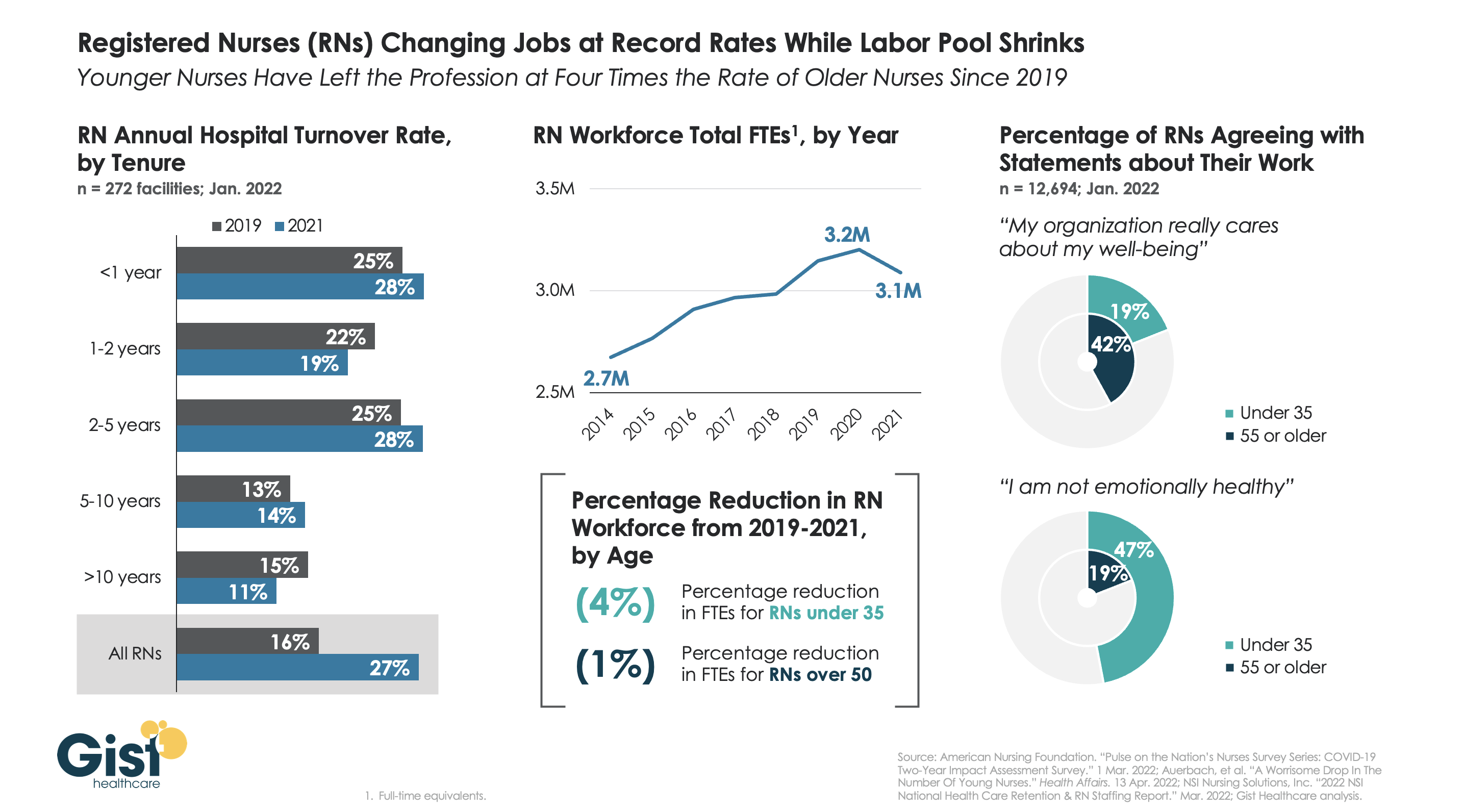
The prevailing opinion earlier this year was that the hospital registered nurse (RN) shortage was being driven by older nurses retiring early or leaving hospital employment for less-demanding care settings during the pandemic. However, recent data shown in the graphic below paint a different picture. 

Hospital RNs with over ten years of tenure actually turned over at lower rates in 2021, compared to 2019. Meanwhile, the turnover rate for nurses with less tenure (who are typically younger) increased in 2021. While less-tenured nurses have always turned over at higher rates, we are seeing a new uptick in younger RNs leaving the profession

The size of the total RN workforce decreased by 1.8 percent between 2019 and 2021and the decline was twice as steep for hospital-employed RNs. Younger RNs disproportionately drove this decline: nurses under age 35 left the nursing workforce at four times the rate of those over age 50. 

A recent survey suggests younger RNs are less likely to feel their well-being is supported by their organization, and more likely to define themselves as “emotionally unhealthy.” To keep younger nurses in the profession, hospitals must increase the support available to them. Investments might include expanding preceptorship and mentorship programs, many of which were cut during the pandemic, and increasing behavioral health support and job flexibility.  

Hospitals face increasing competition for lower-wage workers 

https://mailchi.mp/8e26a23da845/the-weekly-gist-june-17th-2022?e=d1e747d2d8

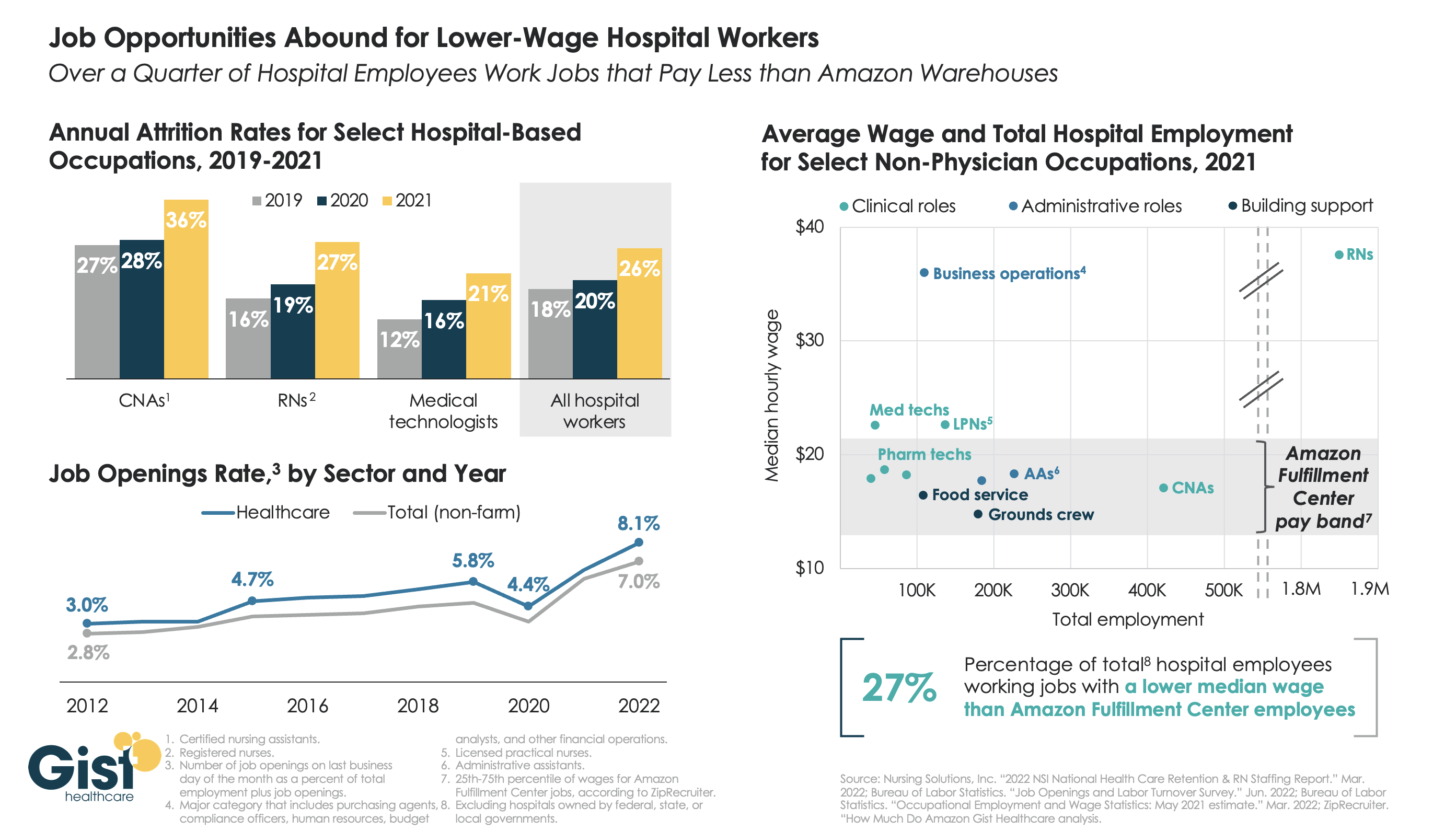
Although the nursing shortage has attracted much attention in recent months, the healthcare workforce crisis is hitting at all levels of the labor force. As the graphic above shows, the attrition rate for all hospital workers in 2021 was eight percentage points higher than in 2019. 

Among clinicians and allied health professionals, certified nursing assistants (CNAs) have the highest turnover levels. Given the demands of the job and relatively low pay, CNA openings have been consistently difficult to fill. But it’s become even harder to hire for the role in today’s labor market as job openings near an all-time high. 

Although labor force participation rates have rebounded to 2019 levels, pandemic-induced economic shifts have led to a boom in lower-wage jobs. In 2021 alone, Amazon opened over 250 new fulfillment centers and other delivery-related work sites. The company is competing directly with hospitals and nursing facilities for the same pool of workers at many of these new sites.

In fact, our analysis shows that more than a quarter of hospital employees currently work in jobs with a lower median wage than Amazon warehouses. Health systems have historically relied on rich benefits packages and strong career ladder opportunities to attract lower-wage employees, but that’s no longer enough—Amazon and other companies have ramped up their benefits, such that they now meet, or even surpass, what many hospitals are providing. 

The time has come for health systems to reevaluate their position in local labor markets, and better define and promote their employee value proposition. 

What the “org chart” can reveal about physician culture 

https://mailchi.mp/ce4d4e40f714/the-weekly-gist-june-10-2022?e=d1e747d2d8

A consultant colleague recently recounted a call from a health system looking for support in physician alignment. He mused, “It’s never a good sign when I hear that the medical group reports to the system CFO [chief financial officer].” We agree. It’s not that CFOs are necessarily bad managers of physician networks, or aren’t collaborative with doctors—as you’d expect from any group of leaders, there are CFOs who excel at these capabilities, and ones that don’t. 

The reporting relationship reveals less about the individual executive, and more about how the system views its medical group: less as a strategic partner, and more as “an asset to feed the [hospital] mothership.” Or worse, as a high-cost asset that is underperforming, with the CFO brought in as a “fixer”, taking over management of the physician group to “stop the bleed.”

Ideally the medical group would be led by a senior physician leader, often with the title of chief clinical officer or chief physician executive, who has oversight of all of the system’s physician network relationships, and can coordinate work across all these entities, sitting at the highest level of the executive team, reporting to the CEO. Of course, these kinds of physician leaders—with executive presence, management acumen, respected by physician and executive peers—can be difficult to find. 

Having a respected physician leader at the helm is even more important in a time of crisis, whether they lead alone or are paired with the CFO or another executive. Systems should have a plan to build the leadership talent needed to guide doctors through the coming clinical, generational, and strategic shifts in practice. 

Cartoon – Our Most Valuable Asset

Hospitals feel the brain drain

Hospitals are feeling an enduring consequence of experienced employees’ early retirements and resignations: collective knowledge loss. 

“Even when missing people can be replaced, missing knowledge cannot,” Ed Yong wrote for The Atlantic May 18. 

Beyond hospitals’ challenges in recruiting and retaining employees are the stubborn and sometimes subtle problems resulting from decreasing median tenure within their organizations. The ripple effects of losing older, seasoned employees to resignations or early retirements can be harder to quantify, but are nonetheless felt by colleagues who stay, newcomers to the organization, and patients and their families.  

Team tenure is a significant determinant to the cost and quality of hospital care. For example, a one-year increase in the average tenure of registered nurses on a hospital unit was associated with a 1.3 percent decrease in length of stay, a 2014 study from researchers at Columbia University School of Nursing and Columbia Business School found. 

“I don’t think the public really understands how great the loss of this generational knowledge is,” Kelley Cabrera, a nurse based in New York, told Mr. Yong. She described the six-week orientation for her current job, led by some people who had been in the ER for less than a year, as “shockingly short.” 

“When inexperienced recruits are trained by inexperienced staff, the knowledge deficit deepens, and not just in terms of medical procedures,” Mr. Yong wrote. “The system has also lost indispensable social savvy — how to question an inappropriate decision, or recognize when you’re out of your depth — that acts as a safeguard against medical mistakes. And with established teams now ruptured by resignations, many healthcare workers no longer know — or trust — the people at their side.”

National data on average tenure in healthcare has not yet caught up to compare with pre-pandemic longevity numbers. The median years of tenure with current employers for healthcare practitioners and technical occupations was 4.7 years in 2020, according to the most recent data from the U.S. Bureau of Labor Statistics, ticking up to five years for workers in hospitals.

The benefits of lengthy tenures are felt at the front lines as well as hospitals’ most senior levels. Marc Boom, MD, CEO of Houston Methodist, told Becker’s this year the cumulative tenure of the health system’s executive team was a game changer throughout the pandemic. At the start of the pandemic, Dr. Boom had been CEO for more than eight years and at the institution for almost 22. The executive team of nine leaders, including him, collectively shared more than 150 years of tenure with Houston Methodist. The team had worked together without any changes for about seven years, when the most recent person joined. 

This longevity lends itself to major systemwide decisions almost feeling instinctive due to their familiarity working together. “I had a team that was very tenured,” Dr. Boom said. “To work with people who you’ve known for a long period of time — you know the ins and outs, the strengths and weaknesses. You have almost an understood language. You can talk in five-word sentences, move on and everyone goes and does their thing. There are a lot of advantages to that.”