The US healthcare sector added 64K jobs in February, an increase from recent months, but the gains were concentrated in provider offices and home health companies. Hospitals and nursing facilities, which have both struggled with widespread staffing shortages, saw more anemic job growth. In particular, nursing homes have lost 15 percent of their workforce, remaining significantly understaffed even though resident occupancy rates still lag pre-pandemic levels. This week, nursing home groups pushed back against President Biden’s call for minimum staffing levels, calling them unrealistic without federal funding.
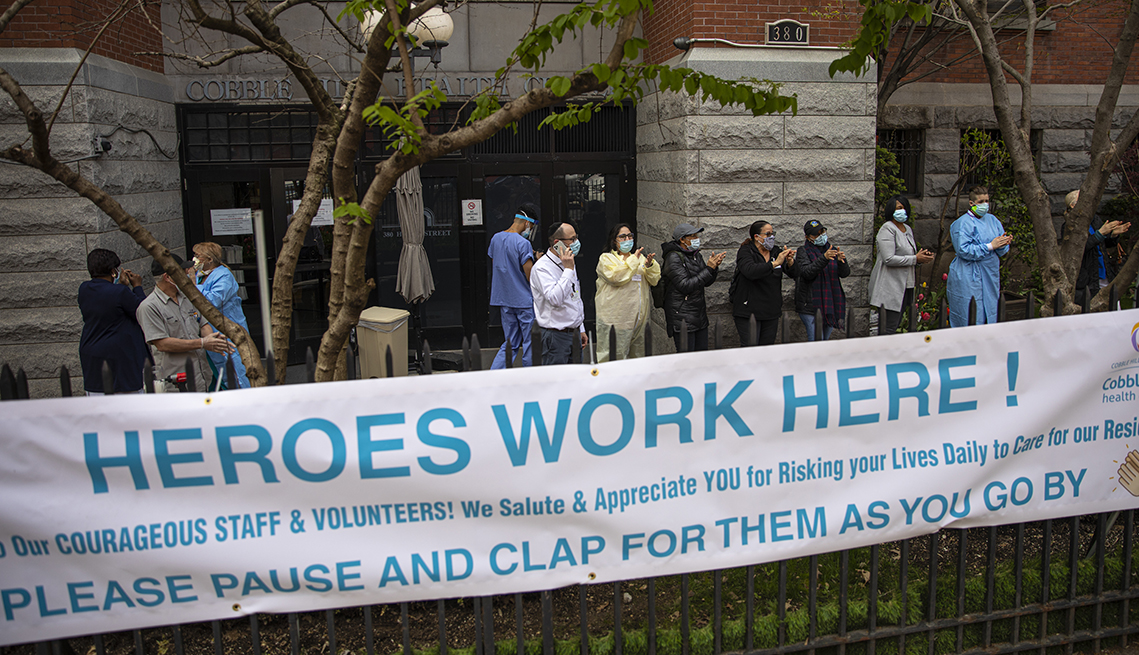
The Gist: Hospital and nursing facility workers have taken on some of the most taxing and dangerous jobs during the pandemic, caring for the sickest patients while personally risking COVID infection.
Healthcare workers are increasingly opting for safer, less intense jobs in outpatient care settings like physician offices, or are exiting direct patient care entirely. Even as the pandemic subsides, recruitment and retention of nurses and other caregivers will be of paramount importance, given rising vacancy rates and unabating staff shortages.
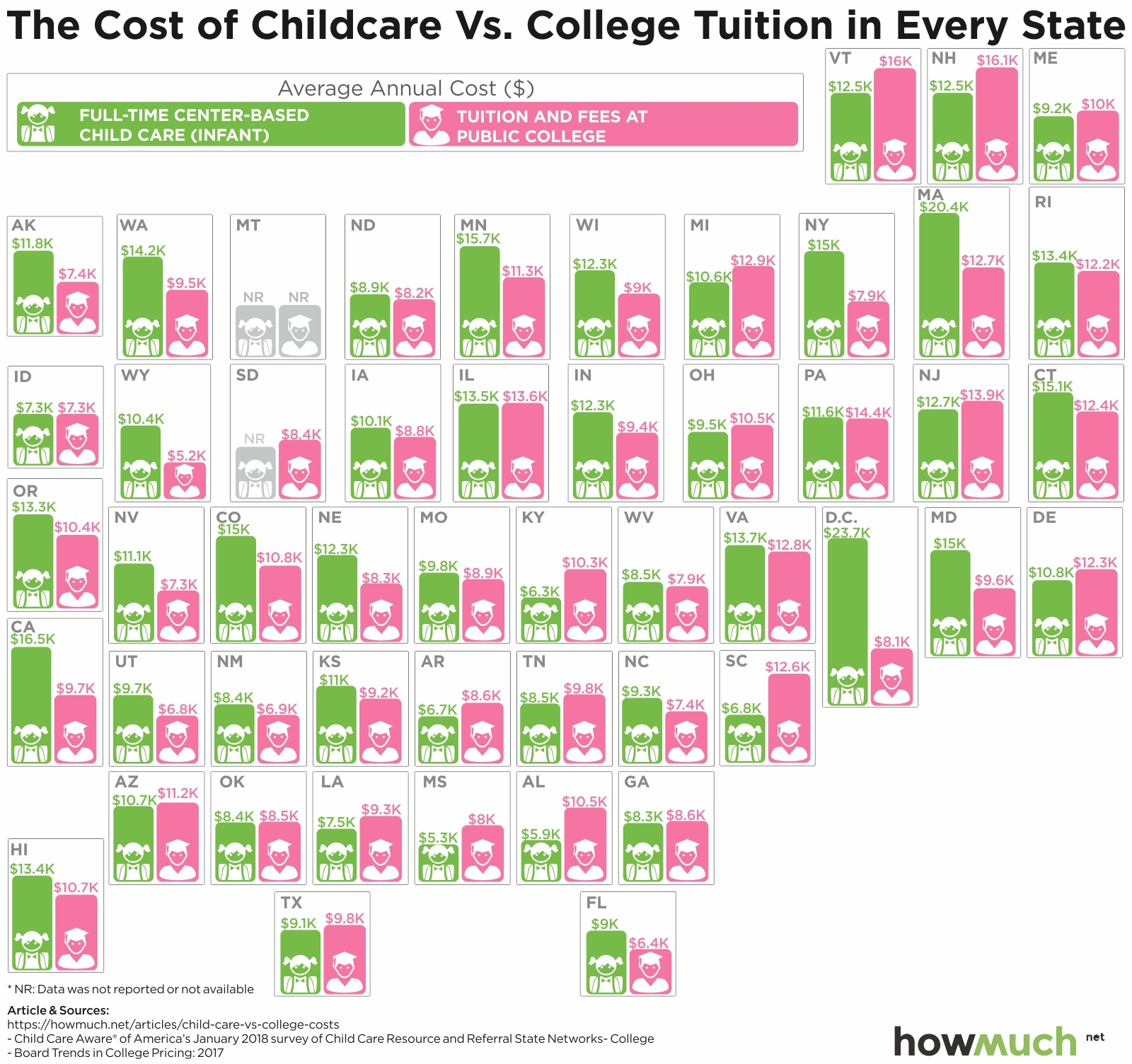
The annual expense of child care for an infant exceeds the annual cost of in-state tuition at a public four-year university in 34 states, according to the most recent data from the Economic Policy Institute.
At this point in the pandemic, healthcare is among the top three industries when it comes to people quitting or changing jobs. The quality and cost of child care is top of mind for healthcare decision-makers given its strength as a determining factor to push people from the U.S. labor force. Mothers continue to shoulder the majority of family caregiving responsibilities, making child care a heavier tip of the scale for healthcare, where women make up the majority of the front-line workforce (66 percent) and managers (59 percent), according to research from McKinsey.
Infant care expenses exceed college tuition in 34 states and Washington, D.C. Below is each state ranked by how much infant care costs exceed or compare to the cost of tuition at a four-year public university, along with the median family income in each state and infant care as a share of income.
Despite the gains, employment in healthcare is down by about 378,000 jobs (2.3%) from where it was in February 2020.
After a rough end to 2021 in terms of job losses,healthcare appears to be on the rebound – for now. The latest jobs report from the U.S. Bureau of Labor Statistics showed hospitals gaining jobs in January, though the industry is still below the levels seen before the COVID-19 pandemic.
In total, the healthcare sector saw a gain of 18,000 jobs last month. It lost 3,100 jobs in December; the prior month, November 2021, was the last time the sector saw job gains, when it posted a net gain of 2,100.
Hospitals made up for some, but not all, of the job losses seen during the tail end of 2021. They gained 3,400 jobs in January, after losing 5,100 jobs in December and 3,900 in November.
The last time hospitals gained jobs was in October, when 1,100 were added. Hospitals lost 8,100 jobs in September.
The biggest increase was in ambulatory healthcare services, which gained 14,700 jobs during the month. Physicians’ offices added 9,700 jobs. Nursing and residential-care facilities lost about 100 jobs in January.
Despite the gains, employment in healthcare is down by about 378,000 jobs (2.3%) from where it was in February 2020, at the dawn of the pandemic, according to BLS.
The broader U.S. economy added 467,000 jobs in January, after gaining 199,000 jobs in December, while the unemployment rate held fairly steady at about 4%.
WHAT’S THE IMPACT?
In a preview of the jobs report by economic research firm Glassdoor, researchers predicted that job losses in healthcare and leisure and hospitality would drag down overall payroll employment. Other coronavirus-sensitive sectors, such as retail and education, were also impacted, though seasonal factors helped mute job losses in those sectors.
Over the course of the pandemic, new COVID-19 cases have been somewhat predictive of job market data, but current record levels represent a situation without precedent, and there are few good comparisons, Glassdoor found. Since September 2020, each new 1,000 daily cases has been correlated with 4,000 fewer job gains, but the level of cases seen in January is unlike any other previous point in the pandemic, leading to uncertainty heading into the BLS jobs report.
The Bureau of Labor Statistics’ preliminary benchmark estimates forecast a modest downward revision in payroll employment of 166,000 for March 2021.
THE LARGER TREND
The Great Resignation hit the healthcare sector hard in November. BLS released job numbers in January showing that healthcare is among the top three industries cited in a 3% rise in the monthly “quits rate,” matching a high from September. The number of quits surged to 4.53 million for the month.
The numbers coincide with an already-strapped healthcare staffing market. Shortages and burnout among healthcare staff are a pervasive issue.
Multiple factors are contributing to labor pressures, including staff burnout stemming from the enduring pandemic and an overall shortage of qualified help, which has resulted in higher costs to hire temporary staff, as well as wage inflation.
Further, a Fitch Ratings report in November noted that lack of staff is forcing some in-patient behavioral health and senior housing operators to lower admission rates.
The U.S. economy added 467,000 jobs in January as the omicron variant spiked to record heights, with the labor market performing better than many expected two years after the pandemic began.
The unemployment rate ticked up slightly to 4 percent, from 3.9 percent the month before.
The monthly report, released by the Department of Labor, stems from a survey taken in mid-January, around the time the omicron variant was beginning to peak, with close to 1 million new confirmed cases each day. The rapid spread during that period upended many parts of the economy, closing schools, day cares, and a number of businesses, forcing parents to scramble.
But the labor market, according to the new data, performed very well during that stretch.
In addition to the robust January, the Department of Labor also revised upward the figure for December’s jobs report, to 510,000 from 199,000, and November, to 647,000 from 249,000. That means that there were some 700,000 more jobs added at the end of last year than previously estimated — showing a labor market with momentum heading into the new year.
The data sets show a labor market that continues to recover at a strong pace from the pandemic’s worst disruption in March and April of 2020.
New outbreaks and variants have sent shockwaves through the economy since then, but the labor market has continued to return, with companies working to add jobs and wages steadily rising.
The industries experiencing growth in January were lead by the leisure and hospitality sector, which added 151,000 jobs on the month, mostly in restaurants and bars. Professional and business services added 86,000 jobs. Retailers added 61,000 jobs in January, which is typically an off month. Transportation and warehousing added 54,000 jobs.
The labor market’s participation rate, a critical measurement that has never fully recovered from losses during the pandemic’s earliest days, also went up significantly, to 62.2 percent from 61.9 percent. That shows more people are reentering the labor force, looking for work.
Average hourly earnings increased by 23 cents on the month to $31.63, up 5.7 percent over the last year. However, those gains for many people have largely been wiped out by rising prices from inflation.
January is traditionally a weak month for employment when retail and other industries shed jobs after the holiday season. Economists say that seasonal adjustments made to the survey’s data to account for this have the potential to distort the survey in the other direction, given that the holiday shopping boom appeared to take place earlier this year than typical.
As such, predictions for job growth for the month had been all over the map. Analysts surveyed by Dow Jones predicted an average of about 150,000 jobs added for the month, in what would be the lowest amount added in a year. Some economists predicted job losses, of up to 400,000.
Last year was a strong year for growth in the labor market, with the country adding an average of more than 550,000 jobs a month — regaining some 6.5 million jobs lost in the pandemic’s earlier days, after the Department revised its numbers. The country has about 2.9 million fewer jobs than it had before the pandemic, according to the figures released Friday.
“Omicron is going to make it look like things dropped off a cliff in January, but overall they did not,” said Drew Matus, chief market strategist for MetLife Investment Management.
Some economists like Matus say that the prospects for such rapid regrowth are more complicated this year, with the fiscal measures that boosted the economy during the pandemic’s first two years, like generous government aid, and record low interest rates from federal bankers, having largely expired, and the country’s confidence in a virus-free future dented after the winter wave.
Since the rollout of vaccines last year, there have been hopes that a return to a more typical rhythm of life could encourage some of the roughly two million people who have left the labor force during the pandemic to seek work anew, but thus far, continued threats from variants — and uncertainty after more closures of schools, daycares, and office — have prevented this from materializing in a substantial way.
There are signs that the omicron exacted a toll on the economy during its peak.
Weekly unemployment claims swelled mid-month to its highest level since October, though the numbers have come down in the two weeks since. Other statistical markers like passenger traffic at airports, hotel revenues, and dining reservations also took a hit during the month.
Recent months continue to be marked by incredible churn in the labor market, as record numbers of workers are switching jobs. In December, some 4.3 million people quit or changed jobs — a number which was down from an all-time high in November but still at elevated. Employers continue to report near record numbers of job openings: the Bureau of Labor Statistics said they reported some 10.9 million openings last month.
Beaufort (S.C.) Memorial Hospital has created a homebuyer assistance program to help staff purchase a home or refinance mortgages, with up to $10,000 in assistance.
To be eligible for the program, employees must be full time, have worked at the hospital for at least six months, attend a homebuyer education workshop and meet household income requirements, among other criteria, according to a Jan. 10 news release from the hospital.
Additionally, properties must be within a 15-mile radius of a designated Beaufort Memorial campus, be the buyer’s primary residence and have monthly mortgage payments of no more than 33 percent of monthly income.
Recipients can use the funds for down payments and closing costs, the release said.
The hospital is partnering with development financial institution CommunityWorks for the program.
“We know that homeownership provides stability, security and a means to building financial health and wealth for future generations,” Beaufort Memorial President and CEO Russell Baxley said. “We also recognize that a major obstacle can be coming up with the money needed for a down payment or closing costs. This assistance program will help our employees bridge that financial gap.”
Companies that fail to adjust to labor shortages and satisfy the growing demands of workers will likely falter as they lose the battle for talent, BlackRock CEO Larry Fink said in a letter to CEOs.
“No relationship has been changed more by the pandemic than the one between employers and employees,” Fink said, noting that “employees across the globe are looking for more from their employer — including more flexibility and more meaningful work.” Fink, while leading the world’s largest asset manager, has sought for a decade to influence corporate behavior through an annual CEO letter.
“As companies rebuild themselves coming out of the pandemic, CEOs face a profoundly different paradigm than we used to,” Fink said. Companies can no longer overlook employee mental health, insist that staff work in the office five days per week and provide modest wage increases for low- and middle-income workers.
Dive Insight:
CFOs considering an increase in prices and employee wages need to balance the imperative to sustain profits with pressures from the worst inflation and labor shortages in decades.
The persistence of COVID-19 has slowed the labor market’s post-lockdown recovery and churned up company payrolls. Fink noted that in November the quits rate, or the number of workers who left their jobs as a percent of total employment, rose to 3%, a record high first breached in September.
CFOs aiming to attract and retain employees with wage increases must take into account a 7% jump in the consumer price index (CPI) during the 12 months through December — the biggest surge since 1982.
“Workers demanding more from their employers is an essential feature of effective capitalism,” Fink said. Describing “a new world of work,” he said, “companies not adjusting to this new reality and responding to workers do so at their own peril.
“Turnover drives up expenses, drives down productivity and erodes culture and corporate memory,” Fink said. BlackRock manages more than $10 trillion in assets for institutional and retail investors.
In order to satisfy workers, CEOs must look beyond pay and workplace flexibility, Fink said. The coronavirus “shone a light on issues like racial equality, childcare and mental health — and revealed the gap between generational expectations at work.”
Fink also reiterated his support for “stakeholder capitalism,” saying that “a company must create value for and be valued by its full range of stakeholders in order to deliver long-term value for its shareholders.”
“Stakeholder capitalism is not about politics. It is not a social or ideological agenda. It is not ‘woke,’” he said. “It is capitalism driven by mutually beneficial relationships between you and the employees, customers, suppliers and communities your company relies on to prosper.”
Most stakeholders expect companies to help “decarbonize” the global economy, Fink said, predicting that so-called sustainable investment will surge well beyond the $4 trillion total.
BlackRock has asked companies to set short-, medium- and long-term targets for greenhouse gas reductions which “are critical to the long-term economic interests of your shareholders,” he said.
At the same time, “divesting from entire sectors — or simply passing carbon-intensive assets from public markets to private markets — will not get the world to net zero,” Fink said, adding that “BlackRock does not pursue divestment from oil and gas companies as a policy.”
Fink’s annual letter drew fire from environmentalists.
The letter “is just another rehashing of the same vague rhetoric, without any meaningful new commitment to actually help lead the necessary transition to a climate-safe future,” Ben Cushing, the Sierra Club’s fossil-free finance campaign manager, said in a statement.
We’ve been having “year ahead” discussions with our health system members over the past few weeks, although it’s been difficult for some to carve out time for planning in the midst of the Omicron surge.
One common theme is that, from a financial perspective, 2022 is expected to be a more difficult year. For many systems, despite the trying COVID situation, the past two years have been financial record-setters. In 2020, systems benefited from a massive infusion of COVID relief funding from the government, and in 2021, they continued to enjoy enhanced reimbursement due to COVID, plus had a resurgence of volume as patients sought care that was previously postponed.
2022 looks to be a more “normal” year—meaning a return to the financial pressures of pre-pandemic times. Those include mounting price compression from payers, an accelerating shift of care from inpatient to outpatient settings, and increasing competition for patients from disruptors and others. At the same time, patient acuity will continue to rise, with patients presenting sicker and with more comorbidities. The cost of caring for those patients will escalate, as the workforce shortage drives labor costs higher and supply chain woes persist.
We’d anticipate a year or more of belt-tightening among many health systems, as they adjust to the post-pandemic environment.






 HENRY KOTULA