This week, California Governor Gavin Newsom announced the state has struck a 10-year, $50M partnership with nonprofit drugmaker Civica Rx to produce three versions of generic insulin.
These are intended to be made available nationwide for list prices of no more than $30 a vial.
Production is slated to begin in late 2023 at Civica’s Petersburg, VA plant, and Food and Drug Administration approval will be required. This deal advances California’s CalRx initiative to produce and distribute generic drugs at low costs; according to a Newsom administration official, the low-cost insulin will be available to state residents through mail-order and retail pharmacies. This is the first state-level partnership for Civica, a health system collaborative whose members now cover a third of all US hospital capacity.
The Gist:Since Congress capped insulin copays for Medicare beneficiaries at $35 per month, there’s been a remarkable sea change in the pricing of the drug. Last week, Sanofi joined Eli Lilly and Novo Nordisk, the three of which together control 90 percent of the US insulin market, in dramatically reducing insulin list prices and capping out-of-pocket costs (including for the uninsured), bringing them in line with the costs now paid by Medicare beneficiaries.
Given that most Americans needing insulin are already covered by these policies, the impact of California’s initiative may be muted. However, it sets an important precedent for state partnership in pharmaceutical productionthat will surely expand to other drugs (Newsom stated generic naloxone could be next)—and works to position Newsom as an advocate for lower drug costs, should he seek higher office.
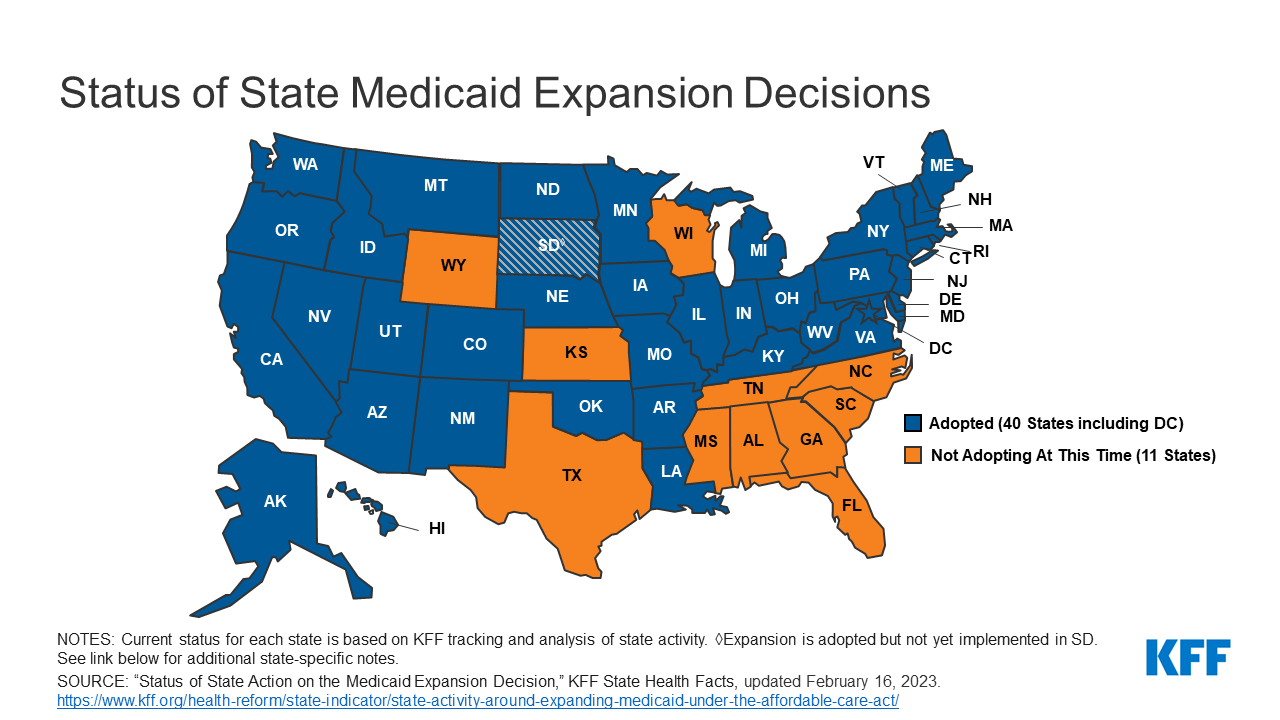
On Thursday, legislators in North Carolina’s Republican-led General Assembly passed a bill to expand Medicaid eligibility to more than 600K low-income residents. The bill is expected to be signed into law by Democratic Governor Roy Cooper, with expanded coverage beginning in 2024. The Tar Heel State is poised to become the 40th state to expand Medicaid through the Affordable Care Act, although it must still appropriate funding in upcoming budget negotiations. The North Carolina Healthcare Association, which represents the state’s health systems, helped get the deal over the line by supporting language that repeals state certificate of need (CON) review in certain instances, including ambulatory surgical centers (ASCs), behavioral health and substance treatment beds, and capital technology replacements costing below $3M.
The Gist: North Carolina legislators have been attempting to expand Medicaid since 2019. It’s notable that the state’s hospitals viewed thebenefits of broader public insurance to be worth the elimination of CON rules restricting development of ambulatory surgery centers, which will surely increase competition from new insurer- and private equity-backed facilities.
North Carolina will become the fourth state to expand Medicaid using additional incentives from the American Rescue Plan, and there’s a chance Kansas will be next, given the recent push by Democratic Governor Laura Kelly.
Prospects for Medicaid expansion in the remaining nine states seem slim at best.
The payer services market is expected to grow by double digits annually over the next several years, according to a new analysis.
These services, which include data analytics, digital health and care management, are in growing demand, according to analysts at Markets and Markets, which conducts market research. The report said the sector was worth about $69.9 billion in 2022. That’s expected to increase by an 11.1% compound annual growth rate, reaching $118.2 billion by 2027, according to the analysis.
The projected growth is backed by increasing health insurance enrollment, rising fraud, federal mandates and increasing rates of chronic illness. However, multiple factors could constrain the market, too, the analysts said: cultural and language barriers, the risk of data breaches and the high costs related to outsourcing this work.
In addition to supporting payers, the services provided in this space can help providers keep up with the evolving expectations of patients, Markets and Markets said in a press release.
“As the industry continues to evolve, providers will need to focus on leveraging technology, as well as improving customer service, to remain competitive,” according to the release. “In addition, they must ensure compliance with various healthcare regulations and be prepared to comply with the changing demands of the healthcare industry.”
The report analyzed these services in three categories—business process outsourcing (BPO), information technology outsourcing (ITO) and knowledge process outsourcing—as well as compared the likely performance of private and public payers. As of 2021, BPO services made up the largest share of the broader health payer services market, according to the analysts, as they can drive lower costs, boost efficiency and allow companies to focus on their core operations.
However, the analysts project that ITO services will see the highest growth over the next five years, driven by greater integration between healthcare and technology as well as the adoption of electronic health records.
Private payers also account for the largest share of this market and are expected to grow at a faster rate than their public payer counterparts due to increasing competition between insurers.
North American firms accounted for the largest market share in the payer services space, though the analysts expect that companies based in the Asia-Pacific market will grow the most over the next several years.
“Factors such as increasing adoption of advanced technologies, increasing pressure to reduce healthcare costs, growing prevalence of chronic disease, presence of large and growing patient population in this region, availability of skilled labor at low costs, high growth opportunities and growing focus of established players on emerging [Asia Pacific] countries are driving the market growth in this region,” they said in the report.
A health insurer launched a pilot program that takes aim at food insecurity in addressing the healthcare needs of beneficiaries—the first time that’s ever happened, according to those who spearheaded the effort.
Kaiser Permanente and Geisinger Health Plan have also used a food-as-medicine approach in attempting to improve health outcomes, but here’s the difference: They are integrated health systems that own their own hospitals and physician practices, while Blue Cross and Blue Shield of North Carolina is not.
Blue Cross NC unveiled data published in NEJM Catalyst about its proof-of-concept pilot program that involved delivering food to individuals in Affordable Care Act plans who suffer from Type 2 diabetes as well as connecting them with health advisers. Despite the success of the effort, the findings included many caveats that suggest that it could be some time before the pilot program evolves and lands a spot on the insurer’s roster of benefits packages.
Still, the authors called it a good first step that underscores great potential.
They also noted that “payers are in a unique position to integrate food-as-medicine interventions into more sustainable financial models. As a payer, the business case needs to be made for offering products and services that address the food and nutritional needs of its members.”
More than 600,000 North Carolina residents struggle to put food on the table, with the state ranking as the tenth hungriest in the country. The pilot’s results come at a time when the expansion of food-aid programs because of the COVID-19 pandemic has run out and inflation is driving up the price of groceries.
Blue Cross NC’s program was launched in December 2020, and invitations to eligible beneficiaries were sent out in January 2021. The insurer hired the digital health coaching vendor Pack Health, a division of Quest Diagnostics, to help administer the program.
A typical box of food could include salmon, carrots, beans, rice, pasta, sauce, applesauce, milk and crushed tomatoes. Deliveries included easy-to-make recipes, according to the study.
Blue Cross NC researchers compared the results of surveys at three and six months to baseline metrics. The surveys measured physical and mental health, body mass index, hemoglobin A1c levels, self-reported food security and member satisfaction.
They also looked at medical expenses for the 555 “completes,” those who finished the program, and the 327 “partials.” Completes received 12 boxes of food and six months of coaching. Partials received six to 11 boxes of food and three to five months of coaching but dropped out of the program.
Most participants (81%) were satisfied with the frequency of food delivery as well as the amount of food delivered (82%).
Food insecurity for the completes dipped from 38% to 20%, BMI (35 kg/m2 to 33 kg/m2) and obesity (72% to 61%). Completes saw an increase in individuals who reached the U.S. average for physical health measures (51% to 65%) and mental health measures (70% to 80%).
In addition, completes saw a $139 reduction per member per month in total medical costs and an increase of $8 per member per month in pharmacy costs, which the researchers interpreted as evidence of greater medication adherence.
Partials, meanwhile, saw a decrease of $10 per member per month in pharmacy costs, but an increase in all other cost types.
“The relative number of partials responding to the 3- and 6-month surveys was low; therefore, we do not discuss the 6-month results of this group, nor do we attempt to draw meaningful conclusions regarding differences across participation groups,” the study said.
Nonetheless, researchers estimate that if the program becomes available to all eligible beneficiaries, it could cut medical expenses by as much as $8.5 million to $13.1 million a year.
“These findings highlight that an upfront investment by an insurer can help improve health outcomes,” according to a Blue Cross NC spokesperson. “The food delivery and health coaching pilot program is one of a series focused on long-term strategies for eliminating health disparities, strengthening communities and making health care more affordable, accessible and easier to navigate for all North Carolinians.”
In April 2021, the health plan unveiled partnerships with state organizations including Benefits Data Trust, Manna Food Bank, Food Bank of Central & Eastern North Carolina and Second Harvest Food Bank of Northwest NC that focused on trying to boost enrollment in the Supplemental Nutrition Assistance Program.
“With an initial focus on food security, the insurer is advancing its work to promote health equity with new prevention programs and value-added services,” Blue Cross NC said in a statement at the time. “Beyond just offering these services for members, the insurer is also measuring their impact. This research will identify which steps will be effective long-term strategies for eliminating health disparities, strengthening communities, developing impactful member products, and reducing health care costs for North Carolinians.”
Researchers also note that the results from its food delivery and health coaching program published in NEJM Catalyst are far from conclusive, and further study needs to be done.
“Because all program participants received health coaching, the design makes it impossible to disentangle the effects of the food delivery component from those of the health coaching,” the study states. “Interaction with the [health adviser] was regular, with program participants and [health advisers] communicating at least once per week by telephone and six to seven times per week via text message.”
In addition, researchers want to evaluate whether the gains seen in a six-month period could be sustained over the long haul and what effect greater member participation might have on the program’s sustainability.
“Analyses are planned to evaluate the long-term impact of the … program,” the study states.
Sacramento, California-based Sutter Health crossed the finish line strong but ultimately wrapped up 2022 with a $249 million net loss, a substantial decline from the $1.1 billion profit of 2021.
A $628 million dip in investment income, a $578 million decrease in net unrealized gains and losses on investments and the $208 million disaffiliation of Samuel Merritt University all contributed to the nonprofit’s year-over-year decline.
Still, the tally is a $289 million improvement over the $538 million net loss the system had reported at the year’s nine-month mark.
The loss was also blunted by a 12-month operating income of $278 million—a bump over the $199 million operating income of 2021 and a feather in Sutter’s cap at a time when several other major nonprofit systems are reporting hundreds of millions in operating losses.
“Our operating financial performance has put Sutter in a position to reinvest more within the system, which can help support even higher quality, equitable healthcare for patients throughout California,” CEO and President Warner Thomas said in a press release.
Sutter’s total operating revenues rose 3.9% year over year to $14.8 billion in 2022. This was just ahead of the 3.3% increase to $14.5 billion in total operating expenses. The system wrote in a release that “like other healthcare organizations around the country,” it was not immune from inflationary pressures on expenses like wages and benefits or supplies.
However, the strong results of its 2021 financial recovery initiative and patient volumes “returning to near-2019 levels by year’s end” give Sutter “a stable base to invest in the future,” the system said.
Renton, Wash.-based Providence had its second downgrade in less than a week amid higher expenses that helped lead to steeper-than-expected losses and an expectation of a multiyear recovery.
The rating downgrade from “A+” to “A” applies to the system’s long-term rating as well as to various bonds it holds, S&P Global said March 21. The outlook is negative.
“The negative outlook reflects our view of the steep operating losses that management must address over the next year to put the organization on a path to better cash flow and break-even margins,” S&P said.
The rating downgrade follows a similar move by Fitch March 17.
Positive fundamentals such as its diversified services and robust strategic plan, as well as its leading market positions in all seven of its regionally centered markets, stands Providence in good stead, S&P added.
Providence, a 51-hospital system, recently reported a fiscal 2022 operating loss of $1.7 billion.
The Medicare Advisory Payment Commission recommends a higher-than-current-law fee-for-service payment update in 2024 for acute care hospitals and positive payment updates for clinicians paid under the physician fee schedule. It recommends reductions in base payment rates for skilled nursing facilities, home health agencies and inpatient rehabilitation facilities.
MedPAC gave Congress recommendations on payment rates in both traditional fee-for-service and Medicare Advantage for 2024, satisfying a legislative mandate comparing per enrollee spending in both programs.
MedPAC estimates that Medicare spends 6% more for MA enrollees than it would spend if those enrollees remained in fee-for-service Medicare.
In their March 2023 Report to the Congress: Medicare Payment Policy, commissioners said they were acutely aware of how providers’ financial status and patterns of Medicare spending varied in 2020 and 2021 due to COVID-19 and were also aware of higher and more volatile cost increases.
However, they’re statutorily charged to evaluate available data to assess whether Medicare payments are sufficient to support the efficient delivery of care and ensure access to care for Medicare’s beneficiaries, commissioners said.
FEE-FOR-SERVICE RATE RECOMMENDATIONS
MedPAC’s payment update recommendations are based on an assessment of payment adequacy, beneficiaries’ access to and use of care, the quality of the care, the supply of providers, and their access to capital, the report said. As well as higher payments for acute care hospitals and clinicians, MedPAC recommends positive rates for outpatient dialysis facilities.
It recommends providing additional resources to acute care hospitals and clinicians who furnish care to Medicare beneficiaries with low incomes. It also recommends a positive payment update in 2024 for hospice providers concurrent with wage adjusting and reducing the hospice aggregate Medicare payment cap by 20%.
It recommends negative updates, which are reductions in base payment rates, for skilled nursing facilities, home health agencies and inpatient rehabilitation facilities.
Acute care
For acute care hospitals paid under the inpatient prospective payment system, commissioners recommend adding $2 billion to current disproportionate share and uncompensated care payments and distributing the entire amount using a commission-developed “Medicare SafetyNet Index” to direct funding to those hospitals that provide care to large shares of low-income Medicare beneficiaries.
This recommendation got pushback from America’s Essential Hospitals.
“We appreciate the Medicare Payment Advisory Commission’s desire to define safety net hospitals for targeted support, but the commission’s Medicare safety net index (MSNI) could have the perverse effect of shifting resources away from hospitals that need support the most,” said SVP of Policy and Advocacy Beth Feldpush. “The MSNI methodology fails to account for all the nation’s safety net hospitals by overlooking uncompensated care and care provided to non-Medicare, low-income patients – especially Medicaid beneficiaries. Any practical definition of a safety net provider must consider the care of Medicaid and uninsured patients, yet the MSNI misses on both counts.”
Feldpush urged policymakers to develop a federal designation of safety net hospitals and to reject the MSNI.
“Further, policymaking for these hospitals should supplement, rather than redistribute, existing Medicare DSH funding, which reflects a congressionally sanctioned, well-established methodology,” she said.
Physicians and clinicians
For clinicians, the commission recommends that Medicare make targeted add-on payments of 15% to primary care clinicians and 5% to all other clinicians for physician fee schedule services provided to low-income Medicare beneficiaries.
The American Medical Association commended MedPAC, but also said that an update tied to just 50% of the Medicare Economic Index would cause physician payment to chronically fall even further behind increases in the cost of providing care. AMA president Dr. Jack Resneck Jr. urged Congress to pass legislation providing for an annual inflation-based payment update.
MedPAC has long championed a physician payment update tied to the Medicare Economic Index, Resneck said. Physicians have faced the cost of inflation, the COVID-19 pandemic and growing expenses to run medical practices, jeopardizing access to care, particularly in rural and underserved areas.
“Not only have Medicare payments failed to respond adequately, but physicians saw a 2% payment reduction for 2023, creating an additional challenge at a perilous moment,” Resneck said. “As one of the only Medicare providers without an inflationary payment update, physicians have waited a long time for this change. When adjusted for inflation, Medicare physician payment has effectively declined 26% from 2001 to 2023. These increasingly thin or negative operating margins disproportionately affect small, independent, and rural physician practices, as well as those treating low-income or other historically minoritized or marginalized patient communities. Our workforce is at risk just when the health of the nation depends on preserving access to care.”
The AMA and 134 other health organizations wrote to congressional leaders urging for a full inflation-based update to the Medicare Physician Fee Schedule.
MGMA’s SVP of Government Affairs Anders Gilberg said, “Today’s MedPAC report recommends Congress provide an inflationary update to the Medicare base payment rate for physician and other health professional services of 50% of the Medicare Economic Index (MEI), an estimated annual increase of 1.45% for 2024. In the best of times such a nominal increase would not cover annual medical practice cost increases. In the current inflationary environment, it is grossly insufficient.”
MGMA urged Congress to pass legislation to provide an annual inflationary update based on the full MEI.
Ambulatory surgical centers and long-term care hospitals
Previously, the commission considered an annual update recommendation for ambulatory surgical centers (ASCs). However, because Medicare does not require ASCs to submit data on the cost of treating beneficiaries, the commissioners said they had no new significant data to inform an ASC update recommendation for 2024.
Commissioners also previously considered an annual update recommendation for long-term care hospitals (LTCHs). But as the number of cases that qualify for payment under Medicare’s prospective payment system for LTCHs has fallen, they said they have become increasingly concerned about small sample sizes in the analyses of this sector.
“As a result, we will no longer provide an annual payment adequacy analysis for LTCHs but will continue to monitor that sector and provide periodic status reports,” they said in the report.
MEDICARE ADVANTAGE
Commissioners said that overall, indicators point to an increasingly robust MA program. In 2022, the MA program included over 5,200 plan options, enrolled about 29 million Medicare beneficiaries (49% of eligible beneficiaries), and paid MA plans $403 billion (not including Part D drug plan payments).
In 2023, the average Medicare beneficiary has a choice of 41 plans offered by an average of eight organizations. Further, the level of rebates that fund extra benefits reached a record high of about $2,350 per enrollee, on average.
Medicare payments for these extra benefits – which are not covered for beneficiaries in FFS – have more than doubled since 2018. For 2023, the average MA plan bid to provide Medicare Part A and Part B benefits was 17% less than FFS Medicare would be projected to spend for those enrollees.
However, the benefits from MA’s lower cost relative to FFS spending are shared exclusively by the companies sponsoring MA plans and MA enrollees (in the form of extra benefits). The taxpayers and FFS Medicare beneficiaries (who help fund the MA program through Part B premiums) do not realize any savings from MA plan efficiencies.
Medicare should not continue to overpay MA plans, MedPAC said. Over the past few years, the commission has made recommendations to address coding intensity, replace the quality bonus program and establish more equitable benchmarks, which are used to set plan payments, the report said. All of these would stem Medicare’s excess payments to MA plans, helping to preserve Medicare’s solvency and sustainability while maintaining beneficiary access to MA plans and the extra benefits they can provide.
PART D
Medicare’s cost-based reinsurance continues to be the largest and fastest growing component of Part D spending, totaling $52.4 billion, or about 55% of the total, according to the report.
As a result, the financial risk that plans bear, as well as their incentives to control costs, has declined markedly. The value of the average basic benefit that is paid to plans through the capitated direct subsidy has plummeted in recent years.
In 2023, direct subsidy payments averaged less than $2 per member per month, compared with payments of nearly $94 per member, per month, for reinsurance. To help address these issues, in 2020 the commission recommended substantial changes to Part D’s benefit design to limit enrollee out-of-pocket spending; realign plan and manufacturer incentives to help restore the role of risk-based, capitated payments; and eliminate features of the current program that distort market incentives.
In 2022, Congress passed the Inflation Reduction Act, which included numerous policies related to prescription drugs. One such provision is a redesign of the Part D benefit with many similarities to the commission’s recommended changes.
The changes adopted in the IRA will be implemented over the next several years, and are likely to alter the drug-pricing landscape, commissioners said.










 HENRY KOTULA