


Cartoon – Plan B


In healthcare, as in life, people devote a lot of time and attention to the way things should be. They’d be better off focusing on what actually could be.
As an example, 57% to 70% of American voters believe our nation “should” adopt a single-payer healthcare system like Medicare For All. Likewise, public health advocates insist that more of the nation’s $4 trillion healthcare budget “should” be spent on combating the social determinants of health: things like housing insecurity, low-wage jobs and other socioeconomic stresses. Neither of these ideas will happen, nor will dozens of positive healthcare solutions that “should” happen.
When the things that should happen don’t, there’s always a reason. In healthcare, the biggest roadblock to change is what I call the conglomerate of monopolies, which includes hospitals, drug companies, private-equity-staked physicians and commercial health insurers. These powerful entities exert monopolistic control over the delivery and financing of the country’s medical care. And they remain fiercely opposed to any change in healthcare that would limit their influence or income.
This article concludes my five-part series on medical monopolies with an explanation of why (a) “should” won’t happen in healthcare but (b) industrywide disruption will.
With the U.S. Senate split 51-49 and with virtually no chance of either party securing the 60 votes needed to avoid a filibuster, Congress will, at most, tinker with the medical system. That means no Medicare For All and no radical redistribution of healthcare funds.
Even if elected officials started down the path of major reform, healthcare’s incumbents would lobby, threaten to withhold campaign contributions (which have exceeded $700 million annually for the past three years) and swat down any legislative effort that might harm their interests.
In American politics, money talks. That won’t change soon, even if voters believe it should.
Private payers wield significant power and influence of their own. In fact, the Fortune 500 represents two-thirds of the U.S. GDP, generating more than $16 trillion in revenue. And they provide health insurance to more than half the American population.
With all that clout, you’d think business executives would demand more from healthcare’s conglomerate of monopolies. You might assume they’d want to push back against the prevailing “fee for service” payment model, replacing it with a form of reimbursement that rewards doctors and hospitals for the quality (not quantity) of care they provide. You’d think they would insist that employees get their care through technologically advanced, multispecialty medical groups, which deliver superior outcomes when compared to solo physician practices.
Instead, companies take a more passive position. In fact, employers are willing to shoulder 5% to 6% increases in insurance premiums each year (double their average rate of revenue growth) without putting up much or any resistance.
One reason they tolerate hefty rate hikes—rather than battling insurers, hospitals and doctors— involves a surprising truth about insurance premiums. Business leaders have figured out how to transfer much of their added premium costs to employees in the form of high-deductible health plans. A high deductible plan forces the beneficiary to pay “first dollar” for their medical care, which significantly reduces the premium cost paid by the employer.
Businesses also realize that high deductibles will only financially burden employees who experience an unexpected, catastrophic illness or accident. Meaning, most workers won’t feel the sting in a typical year. As for employees with ongoing, expensive medical problems, employers typically don’t mind watching them walk out the door over high out-of-pocket costs. Their departures only reduce the company’s medical spend in future years.
Finally, businesses know that employee medical costs are tax deductible, which cushions the impact of premium increases. So, what starts as a 6% annual increase ends up costing employees 3%, the government 1% and businesses only 2%. In today’s strong labor market, which boasts the lowest unemployment rate in 54 years, businesses are reluctant to demand changes from healthcare’s biggest players—regardless of whether they should.
If there were a job opening for “Leader of the American Healthcare Revolution,” the applicant pool would be shallow.
Elected officials would shy away, fearing the loss of campaign contributions. Businesses and top executives would pass on the opportunity, preferring to shift insurance costs to employees and the government. Patients would feel overwhelmed by the task and the power of the incumbents. Doctors, nurses and hospitals—despite their frustrations with the current system—would want to take small steps, fearful of the conglomerate of monopolies and the risks of disruptive change.
To revolutionize American medicine, a leader must possess three characteristics:
Whoever leads the way won’t make these investments because it “should happen.” They will take the chance because the upside is dramatically better than sitting on the sidelines.
Amazon, CVS, Walmart and other retail giants are the only entities that fit the revolutionary criteria above. In healthcare’s game of monopoly, they’re the ones willing to take high-stakes risks and capable of disrupting the industry.
For years, these retailers have been acquiring the necessary game pieces (including pharmacy services, health-insurance capabilities and innovative care-delivery organizations) to someday take over American healthcare.
CVS Health owns health insurer Aetna. It bought value-based care company Signify Health for $8 billion, along with national primary care provider OakStreet Health for $10.6 billion. Walmart recently entered into a 10-year partnership with the nation’s largest insurance company, UnitedHealth, gaining access to its 60,000 employed physicians. Walmart then acquired LHC, a massive home-health provider. Finally, Amazon recently purchased primary-care provider One Medical for $3.9 billion and maintains close ties with nearly all of the country’s self-funded businesses.
Harvard business professor Clay Christensen noted that disruptive change almost always comes from outsiders. That’s because incumbents cling to overly expensive and inefficient systems. The same holds true in American healthcare.
The retail giants can see that healthcare is exorbitantly priced, uncoordinated, inconvenient and technologically devoid. And they recognize the hundreds of billions of dollars of revenue and they could earn by offering a consumer-focused, highly efficient alternative.
Initially, I believe the retail giants will take a two-pronged approach. They’ll (a) continue to promote fee-for-service medical services through their pharmacies and retail clinics (in-store and virtual) while (b) embracing every opportunity to grow their market share in Medicare Advantage, the capitated option for people over age 65.
And within Medicare Advantage, they’ll look for ways to leverage sophisticated IT systems and economies of scale, thus providing care that is better coordinated, technologically supported and lower cost than what’s available now.
Rather than including all community doctors in their network, they’ll rely on their own clinicians, augmented by a limited cohort of the highest-performing medical groups in the area. And rather than including every hospital as an inpatient option, they’ll contract with highly respected centers of excellence for procedures like heart surgery, neurosurgery, total-joint replacement and transplants, trading high volume for low prices.
Over time, they’ll reach out to self-funded businesses to offer proven, superior clinical outcomes, plus guaranteed, lower total costs. Then they’ll make a capitated model their preferred insurance plan for all companies and individuals. Along the way, they’ll apply consumer-driven medical technologies, including next generations of ChatGPT, to empower patients, provide continuous care for people with chronic diseases and ensure the medical care provided is safe and most efficacious.
Tommy Lasorda, the long-time manager of the Los Angeles Dodgers, once remarked, “There are three types of people. Those who watch what happens, those that make it happen and those who wonder what just happened.”
Lasorda’s quip describes healthcare today. The incumbents are watching closely but failing to see the big picture as retailer acquire medical groups and home health capabilities. The retail giants are making big moves, assembling the pieces needed to completely transform American medicine as we think of it today. Finally, tens of thousands of clinicians and thousands of hospital administrators are either ignoring or underestimating the retail giants. And, when they get left behind, they’ll wonder: What just happened?
The conglomerate of monopolies rule medicine today. Amazon, CVS and Walmart believe they should rule. And if I had to bet on who will win, I’d put my money on the retail giants.

Contrary to widespread reports of staffing shortages, healthcare employment reached pre-pandemic levels with the addition of 44,200 jobs in February, according to a recent report from Altarum.
A recent survey of hospital CEOs found that healthcare staffing was their top concern. Nurses nationwide have reported unsafe staffing levels, leading health systems to restructure and lawmakers to consider safe-staffing laws.
Yet, healthcare currently has 1.3 percent more jobs than it did in February 2020, according to the monthly Health Sector Economic Indicators brief from Altarum. The nonprofit, healthcare-focused research and consulting organization analyzes available data on spending, prices, employment and utilization to craft the monthly report.
The data holds that this isn’t a new occurence. The sector has been adding — on average — 49,100 jobs per month for the past year, according to the brief. In February, hospitals led that growth, tapping 19,400 workers. Nursing and residential care facilities added 13,700 jobs, and ambulatory care settings added 11,100.
However, as healthcare employment rises, its wage growth continues to decline and now lags behind economywide growth. Healthcare wage growth has been declining since mid-2022; in January, pay grew 4.2 percent year over year, while total private sector wage growth grew 4.4 percent.
This statistic also defies industry narratives, as recent labor negotiations between unions and health systems have scored big raises for workers and clinicians.

MedPAC’s recommendation that acute care hospitals don’t need a significant increase in 2024 Medicare rates is “totally insufficient and out of touch with reality,” according to the American Hospital Association.
“This view is one-sided, inaccurate and misleading,” Ashley Thompson, AHA’s senior vice president of public policy analysis and development, wrote in a March 23 blog post. “After years of once-in-a-lifetime events in the form of a global pandemic and record inflation, hospitals across the country are struggling to continue to fulfill their mission to care for their patients and communities.”
In its annual March report to Congress, MedPAC recommended an update to hospital payment rates of “current law plus 1 percent,” which the AHA says is not enough for many hospitals to keep their doors open.
The commission found that most indicators of sufficient Medicare rates for providers were positive or improved in 2021, though it acknowledged that hospitals saw more volatile cost increases in 2022 compared to years prior. Hospital margins were also lower last year than in 2021, according to preliminary data, driven in part by providers facing higher than expected costs and capacity and staffing challenges.
The report also said that its 2024 payment recommendations “may not be sufficient” to sustain some safety-net hospitals with a low number of commercially insured patients, and proposed $2 billion in add-on payments.
Across the U.S., a total of 631 rural hospitals — or about 30 percent of all rural hospitals — are at risk of closing in the immediate or near future.
MedPAC’s recommendations for 2024 differ from how some health economists have recently described hospitals’ finances. In January, hospitals had a median operating margin of -1 percent according to Kaufman Hall, a finding that arrived on the heels of 2022 being named the worst financial year for hospitals since the start of the COVID-19 pandemic.
“It is also important to realize that MedPAC’s report and data has limitations,” Ms. Thompson wrote, referring to a misalignment in the calendar year MedPAC chose to analyze and how hospitals can differ in how they report their individual financial earnings.
MedPAC said its report reflects 2021 data, preliminary data from 2022, and projections for 2023, along with recent inflation rates.
“…cost reports are filed for hospitals’ own specific fiscal years, and because surges, relief payments, and eventual expense increases happened at different times for different hospitals, these calculated margins don’t necessarily provide a fully accurate picture of the financial reality in 2021,” Ms. Thompson wrote.
The AHA stressed that hospitals’ finances in 2023 face much different challenges compared to 2021, when the industry was more supported by strong investment returns and federal pandemic relief.
“The fact that massive numbers of hospitals are not currently closing due to financial pressures should be seen as positive for patients and communities,” Ms. Thompson said. “Instead, some observers seem to be disappointed that more hospitals are not failing financially.”
A detailed response from the AHA to the MedPAC report is available here.

A number of hospitals and health systems are trimming their workforces or jobs due to financial and operational challenges.
Below are workforce reduction efforts or job eliminations that were announced within the past six months and/or take effect later this year.
Editor’s Note: This webpage was updated March 27 and will continue to be updated.
1. Bellevue, Wash.-based Overlake Medical Center and Clinics has laid off administrative staff, the health system confirmed to the Puget Sound Business Journal. The layoffs, which occurred earlier this year, included 30 workers across Overlake’s human resources, information technology and finance departments, a spokesperson said, according to the publication. This represents about 6 percent of the organization’s administrative workforce. Overlake’s website says it employs more than 3,000 people total.
2. Columbia-based University of Missouri Health Care is eliminating five hospital leadership positions across the organization, spokesperson Eric Maze confirmed to Becker’s March 20. Mr. Maze did not specify which roles are being eliminated saying that the organization won’t address individual personnel actions. According to MU Health Care, the move is a result of restructuring “to better support patients and the future healthcare needs of Missourians.”
3. Greensboro, N.C.-based Cone Health eliminated 68 senior-level jobs. The job eliminations occurred Feb. 21, Cone Health COO Mandy Eaton told The Alamance News. Of the 68 positions eliminated, 21 were filled. Affected employees were offered severance packages.
4. The newly merged Greensburg, Pa.-based organization made up of Excela Health and Butler Health System eliminated 13 filled managerial jobs. The affected employees and positions are from across both sides of the new organization, Tom Chakurda, spokesperson for the Excela-Butler enterprise, confirmed to Becker’s. The positions were in various support functions unrelated to direct patient care.
5. Crozer Health, a four-hospital system based in Upland, Pa., is laying off roughly 215 employees amid financial challenges. The system announced the layoffs March 15 as part of its “operational restructuring plan” that “focuses on removing duplication in administrative oversight and discontinuing underutilized services.” Affected employees represent about 4 percent of the organization’s workforce.
6. Philadelphia-based Penn Medicine is eliminating administrative positions. The change is part of a reorganization plan to save the health system $40 million annually, the Philadelphia Business Journal reported March 13. Kevin Mahoney, CEO of the University of Pennsylvania Health System, told Penn Medicine’s 49,000 employees last week that changes include the elimination of a “small number of administrative positions which no longer align with our key objectives,” according to the publication. The memo did not indicate the exact number of positions that were eliminated.
7. Sovah Health, part of Brentwood, Tenn.-based Lifepoint Health, has eliminated the COO positions at its Danville and Martinsville, Va., campuses. The responsibilities of both COO roles will now be spread across members of the existing administrative team.
8. Valley Health, a six-hospital health system based in Winchester, Va., eliminated 31 administrative positions. The job cuts are part of the consolidation of the organization’s leadership team and administrative roles.
9. Marshfield (Wis.) Clinic Health System will lay off 346 employees, representing less than 3 percent of its employee base.
10. St. Mark’s Medical Center in La Grange, Texas, is cutting nearly 50 percent of its staff and various services amid financial challenges.
11. Roseville, Calif.-based Adventist Health plans to go from seven networks of care to five systemwide to reduce costs and strengthen operations. The reorganization will result in job cuts, including reducing administration by more than $100 million.
12. Arcata, Calif.-based Mad River Community Hospital is cutting 27 jobs as it suspends home health services.
13.. Hutchinson (Kan.) Regional Medical Center laid off 85 employees, a move tied to challenges in today’s healthcare environment.
14. Oklahoma City-based OU Health is eliminated about 100 positions as part of an organizational redesign to complete the integration from its 2021 merger.
15. Memorial Sloan Kettering Cancer Center announced it would lay off to reduce costs amid widespread hospital financial challenges. The layoffs are spread across 14 sites in New York City, and equate to about 1.8 percent of Memorial Sloan’s 22,500 workforce.
16. St. Louis-based Ascension completed layoffs in Texas, the health system confirmed in January. A statement shared with Becker’s says the layoffs primarily affected nonclinical support roles. The health system declined to specify to Becker’s the number of employees or positions affected.
17. Lebanon, N.H.-based Dartmouth Health is freezing hiring and reviewing all vacant jobs at its flagship hospital and clinics in an effort to close a $120 million budget gap.
18. Chillicothe, Ohio-based Adena Health System announced it would eliminate 69 positions — 1.6 percent of its workforce — and send 340 revenue cycle department employees to Ensemble Health Partners’ payroll in a move aimed to help the health system’s financial stability.
19. Ascension St. Vincent’s Riverside in Jacksonville, Fla., will end maternity care at the hospital, affecting 68 jobs, according to a Workforce Adjustment and Retraining Notification filed with the state Jan. 17. The move will affect 62 registered nurses as well as six other positions.
20. Visalia, Calif.-based Kaweah Health aims to eliminate 94 positions through early January as part of a new strategy to reduce labor costs. The job cuts come in addition to previously announced workforce reductions; the health system already eliminated 90 unfilled positions and lowered its workforce by 106 employees.
21. Oklahoma City-based Integris Health is eliminating 200 jobs to curb expenses. The eliminations include 140 caregiver roles and 60 vacant jobs.
22. Toledo, Ohio-based ProMedica plans to lay off 262 employees, a move tied to its exit from a skilled-nursing facility joint venture late last year. The layoffs will take effect between March 10 and April 1.
23. Employees at Las Vegas-based Desert Springs Hospital Medical Center were notified of layoffs coming to the facility, which will transition to a freestanding emergency department. There are 970 employees affected. Desert Springs is part of the Valley Health System, a system owned and operated by King of Prussia, Pa.-based Universal Health Services.
24. Philadelphia-based Jefferson Health plans to go from five divisions to three in an effort to flatten management and become more efficient. The reorganization will result in an unspecified number of job cuts, primarily among executives.
25. Pikeville (Ky.) Medical Center will lay off 112 employees by year’s end as it outsources its environmental services department. The 112 layoffs are effective Jan. 1, 2023, with the affected employees’ last day of work expected to be Dec. 31.
26. Southern Illinois Healthcare, a four-hospital system based in Carbondale, announced it would eliminate or restructure 76 jobs in management and leadership. The 76 positions fall under senior leadership, management and corporate services. Included in that figure are 33 vacant positions, which will not be filled. No positions in patient care are affected.
27. Citing a need to further reduce overhead expenses and support additional investments in patient care and wages, Traverse City, Mich.-based Munson Health is eliminating 31 positions and leaving another 20 jobs unfilled. All affected positions are in corporate services or management. The layoffs represent less than 1 percent of the health system’s workforce of nearly 8,000.
28. West Reading, Pa.-based Tower Health on Nov. 16 laid off 52 corporate employees as the health system shrinks from six hospitals to four. The layoffs, which are expected to save $15 million a year, account for 13 percent of Tower Health’s corporate management staff.
29. Sioux Falls, S.D.-based Sanford Health announced layoffs affecting an undisclosed number of staff in October, a decision its CEO said was made “to streamline leadership structure and simplify operations” in certain areas. The layoffs primarily affect nonclinical areas.
30. St. Vincent Charity Medical Center in Cleveland closed its inpatient and emergency room care Nov. 11, four days before originally planned — and laid off 978 workers in doing so. After the transition, the Sisters of Charity Health System will offer outpatient behavioral health, urgent care and primary care.
https://mailchi.mp/6f4bb5a2183a/the-weekly-gist-march-24-2023?e=d1e747d2d8

The concept of the “medical mall” is not new. Health systems and physician groups have long looked to build larger outpatient facilities that include several physician specialties, diagnostics, and outpatient procedure all under one roof—sometimes even converting defunct shopping malls. But recently some providers have questioned whether this “one stop shop” approach is delivering the value expected.
One CFO shared, the cost to build and operate these large facilities can be daunting: “we had two of these in our capital plan, but the real estate and construction costs are enormous. Given where margins are this year, we just couldn’t justify them.”
Others have also questioned whether their medical malls provide the value they anticipated. Another leader noted that “it seemed to make sense to put 15 primary care docs under one roof, which let us co-locate a host of other services. But patients told us they’d rather have primary care close to home. And a more distributed ‘low-key’ footprint might have been cheaper.” He also mentioned their operations fell short of the vision: “just because we have primary care and CT under one roof, doesn’t mean we can get a patient on the scanner right after their appointment.”
A physician group with two medical malls found that while they expected the vision to appeal to busy, commercially-insured patients, “it turned out that people with transportation issues or a lot of chronic conditions were the ones who chose to go there…it ended up being primarily a public-pay population, and we can’t support the cost.”
Consumers have rejected shopping malls for more distributed and technology-driven retail options. Given the cost of the medical mall, it’s worth considering whether they’ll apply the same logic to healthcare.
https://mailchi.mp/6f4bb5a2183a/the-weekly-gist-march-24-2023?e=d1e747d2d8

In the last edition of the Weekly Gist, we illustrated how non-hospital physician employment spiked during the pandemic. Diving deeper into the same report from consulting firm Avalere Health and the nonprofit Physicians Advocacy Institute, the graphic above looks at the specialties that currently have the greatest number of physicians employed by hospitals and corporate entities (which include insurers, private equity, and non-provider umbrella organizations), and those that remain the most independent.
To date, there has been little overlap in the fields most heavily targeted for employment by hospitals and corporate entities. Hospitals have largely employed doctors critical for key service lines, like cancer and cardiology, as well as hospitalists and other doctors central to day-to-day hospital operations.
In contrast, corporate entities have made the greatest strides in specialties with lucrative outpatient procedural business, like nephrology (dialysis) and orthopedics (ambulatory surgery), as well as specialties like allergy-immunology, that can bring profitable pharmaceutical revenue.
Meanwhile, only a few specialties remain majority independent. Historically independent fields like psychiatry and oral surgery saw the number of independent practitioners fall over 25 percent during the pandemic.
While hospitals will remain the dominant physician employer in the near term, corporate employment is growing unabated, as payers and investors, unrestrained by fair market value requirements, can offer top dollar prices to practices.
https://mailchi.mp/6f4bb5a2183a/the-weekly-gist-march-24-2023?e=d1e747d2d8
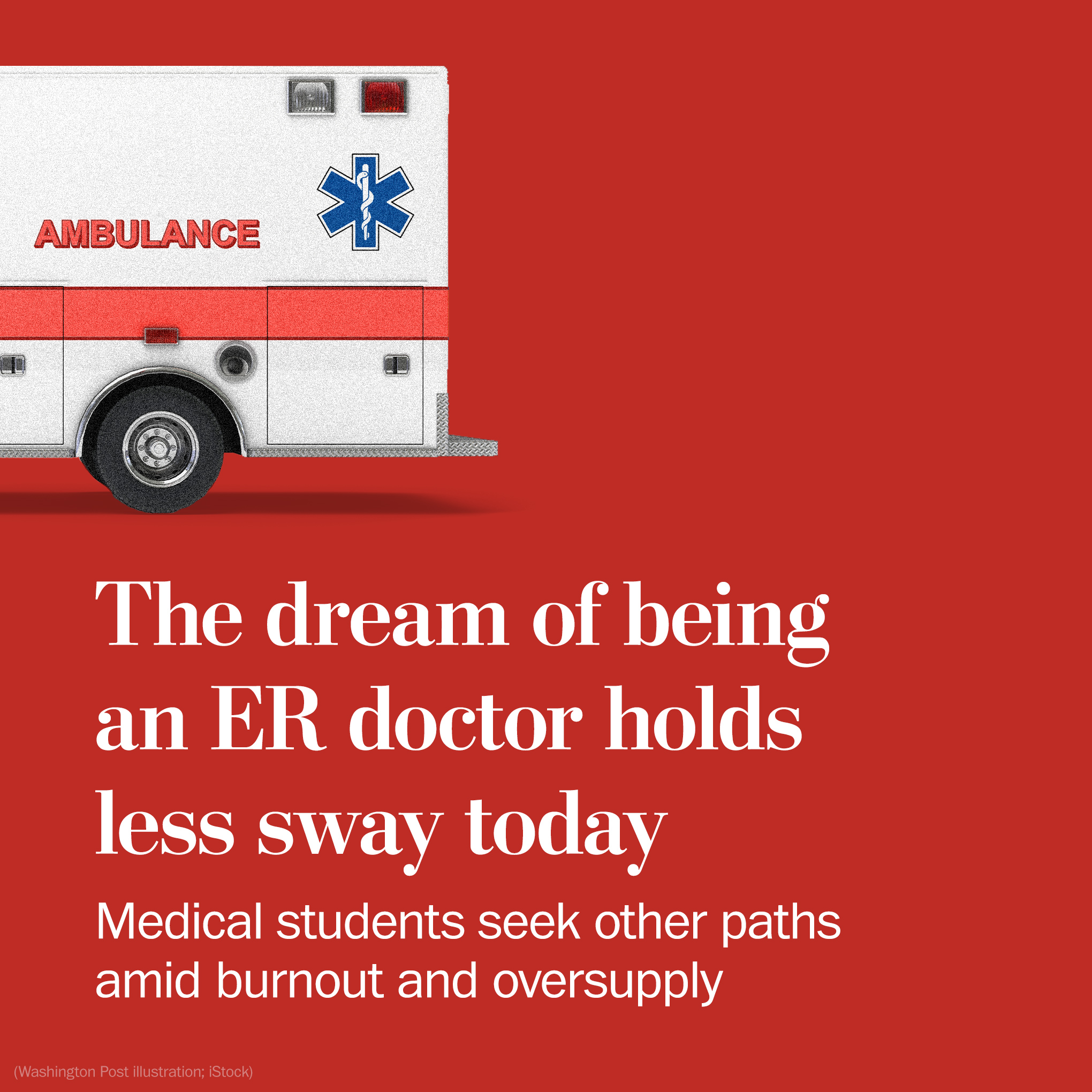
With recent residency match data showing a 26 percent drop in applications to emergency medicine training programs since 2021, this article in the Washington Post grapples with why the once sought-after profession is now struggling with recruitment.
Some point to high rates of pandemic burnout and the unappealing nature of the work: emergency departments (EDs) are increasingly overcrowded, understaffed, and violent—turning ED docs into “the cops of medicine,” as one ED residency program leader put it. Others suggest that residents are simply following the money elsewhere, discouraged by reports of an impending oversupply of ED physicians in coming years.
The Gist: The days of the television drama ER, which inspired a generation of would-be doctors to pursue emergency medicine, are gone—most medical students graduating today weren’t even born when the show first aired in 1994. The article fails to note the changes in EDs brought on by investor-backed staffing companies, which now staff anywhere from an estimated quarter to half of the nation’s EDs.
They’re accused of cutting costs by hiring fewer ED docs, as well as funding more ED residency spots in an attempt to flood the market and drive down their future labor costs even further. In the wake of COVID, emergency physicians find themselves in EDs largely staffed by advanced practice providers.
While in the near-term hospitals will surely face challenges in staffing these critical roles, shortages may drive momentum to refine and expand technology- and team-based care models.
https://mailchi.mp/6f4bb5a2183a/the-weekly-gist-march-24-2023?e=d1e747d2d8

On Wednesday, the Health Resources and Services Administration (HRSA), a division of the Department of Health and Human Services, announced plans to modernize the US organ transplant system. For 40 years, the United Network for Organ Sharing (UNOS) has held an exclusive contract to facilitate the retrieval, matching, and distribution of all transplanted organs, handling a record 43K transplants last year.
Starting this fall, HRSA will split out contracts and open the bidding process up to competition, hoping to increase efficiency, accountability, and transparency. While the Biden administration has asked Congress to double the funding appropriated to HRSA for the transplant system, it has the authority to institute many of these changes without Congressional action.
The Gist: The US organ transplant system has long received criticism from patients and providers.With over 100K Americans currently on organ transplant waiting lists, and 6K dying annually while waiting (a group that is disproportionately Black and Latino), there’s vast room for improvement.
The government’s efforts to increase competition to solve operational and distribution challenges is overdue, but other aspects of the transplant process, including performance evaluation, deserve reassessment as well. For example, providers are scored on the survival rates of patients who receive transplants, but not those who die on waiting lists. Thus, they are disincentivized to operate on higher-risk patients or utilize organs that are potentially transplantable but have imperfections.
Hospitals and transplant specialists must take an active role in ensuring the overhauled process provides comprehensive reform, driven by the best interests of patients.
 HENRY KOTULA