

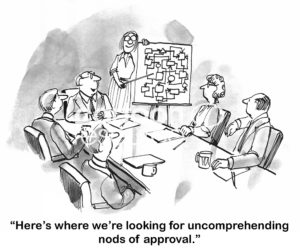
Cartoon – Uncomprehending Nods of Approval

https://mailchi.mp/59374d8d7306/the-weekly-gist-january-13-2023?e=d1e747d2d8

On Monday, San Francisco-based Carbon Health—a virtual-first primary and urgent care company with 125 clinics across 13 states—announced a partnership with CVS Health, which includes a $100M investment, as well as plans to pilot its operating model in select CVS stores. The announcement came just days after Carbon reported its second round of layoffs in the past year, as it scales back on less profitable business segments to focus on expanding its primary care model.
The Gist: It’s been over a year since CVS CEO Karen Lynch said the company was moving with “speed and urgency” to construct a physician-staffed primary care model. Last fall it purchased in-home health evaluation company Signify Health for $8B, after rumors that it had been close to acquiring One Medical.
Between its convenient retail footprint, insurance arm, and Signify’s risk-assessment tools, a nationwide primary care physician network is the last puzzle piece CVS needs to field a comprehensive and formidable primary care strategy.
While it’s currently rumored to be evaluating a $10B acquisition of Oak Street Health, this partnership with Carbon Health is a better bet to deliver value quickly, as CVS should be able to more easily integrate and leverage Carbon’s retail health expertise across its growing care delivery platform.
https://mailchi.mp/59374d8d7306/the-weekly-gist-january-13-2023?e=d1e747d2d8

Late last week, Salt Lake City, Utah-based Intermountain Healthcare and University of Colorado-affiliated UCHealth, based in Aurora, CO, shared that they are jointly developing a clinically integrated network (CIN). It will initially comprise 700 primary care physicians working at UCHealth’s 12 hospitals and hundreds of clinics, but may expand in the future. The CIN will leverage Intermountain’s value-based care expertise and its SelectHealth insurance plans. The two health systems will remain independent and operate the CIN as a separate company.
The Gist: This partnership continues Intermountain’s expansion into Colorado, after it finalized its merger with SCL Health in April of last year.
It’s a smart way for Intermountain to strengthen its foothold in the state, especially as further health system acquisitions in the Denver area may raise antitrust concerns.
Intermountain will be able to tap into a larger network of physician relationships that it can use to bolster its health plan, with significantly lower infrastructure costs compared to employment.
These types of partnership strategies may also be bed-warming for deeper relationships, with the opportunity to demonstrate value before a full-on merger.
https://mailchi.mp/59374d8d7306/the-weekly-gist-january-13-2023?e=d1e747d2d8

Published this week in the New England Journal of Medicine, this concerning study found that seven percent of all inpatient hospital admissions feature at least one preventable adverse event, and that nearly a quarter of all adverse events are preventable, with drug administration errors the most frequent. While the complexities behind studying adverse events make it difficult to measure progress over time, the authors assert that these episodes are still far too common, and advocate for establishing standard approaches to measure the frequency of adverse events more reliably.
The Gist: Health systems had been making at least some progress in their decades-long effort to reduce adverse events before COVID turned the industry upside down, drawing clinical leaders’ focus to the crisis and upending industry benchmarks.
Today’s short-staffed, traveler-dependent labor force presents yet another challenge to hospitals aiming to achieve quality benchmarks. COVID has also accelerated the outpatient shift, heightening the importance of tracking quality metrics in non-hospital settings.
As more complex procedures are performed in ambulatory surgery centers, and more hospital care is administered at home, there’s also a concern that hospital-based quality measures are not telling the whole story on the state of patient safety.
A rethinking of quality metrics and processes to measure and prevent adverse events across the continuum is long overdue.
https://mailchi.mp/59374d8d7306/the-weekly-gist-january-13-2023?e=d1e747d2d8

In our decades of working in healthcare, we’ve never seen a time when payer-provider negotiations have been more tense. Emboldened insurers, having seen strong growth during the pandemic, are entering contract negotiations with an aggressive posture.
“They weren’t even willing to discuss a rate increase,” one CFO shared as he described his health system’s recent negotiations with a large national insurer. “The plan’s opening salvo was a fifteen percent rate cut!”
Health systems are feeling lucky to get even a two or three percent rate bump, well short of the historical average of seven percent—and far short of what would be needed to account for skyrocketing labor, supply, and drug costs. According to executives we work with, efforts to describe the current labor crisis and resulting cost impacts with payers are largely falling on deaf ears.
This scenario is playing out in markets across the country, with more insurers and health systems announcing that they are “terming” their contract, publicly stating they will cut ties should the stalemate in negotiations persist.
Speaking off the record, a system executive shared how this played out for them. With negotiations at an impasse, a large insurer began the process of notifying beneficiaries that the system would soon be out-of-network, and patients would be reassigned to new primary care providers. The health plan assumed that the other systems in the market would see this as a growth opportunity—and was shocked when they discovered that other providers were already operating at capacity, unable to accommodate additional patients from the “terminated” system.
Mounting concerns about access brought the plan back to the table. Even in the best of times, a major insurer cutting ties with a health system is extremely disruptive for consumers, who must shift their care to new providers or pay out-of-network rates. But given current capacity challenges in hospitals nationwide, major network disruptions can be even more dire for patients—and may force payers and providers to walk back from the brink of contract termination.
https://mailchi.mp/59374d8d7306/the-weekly-gist-january-13-2023?e=d1e747d2d8
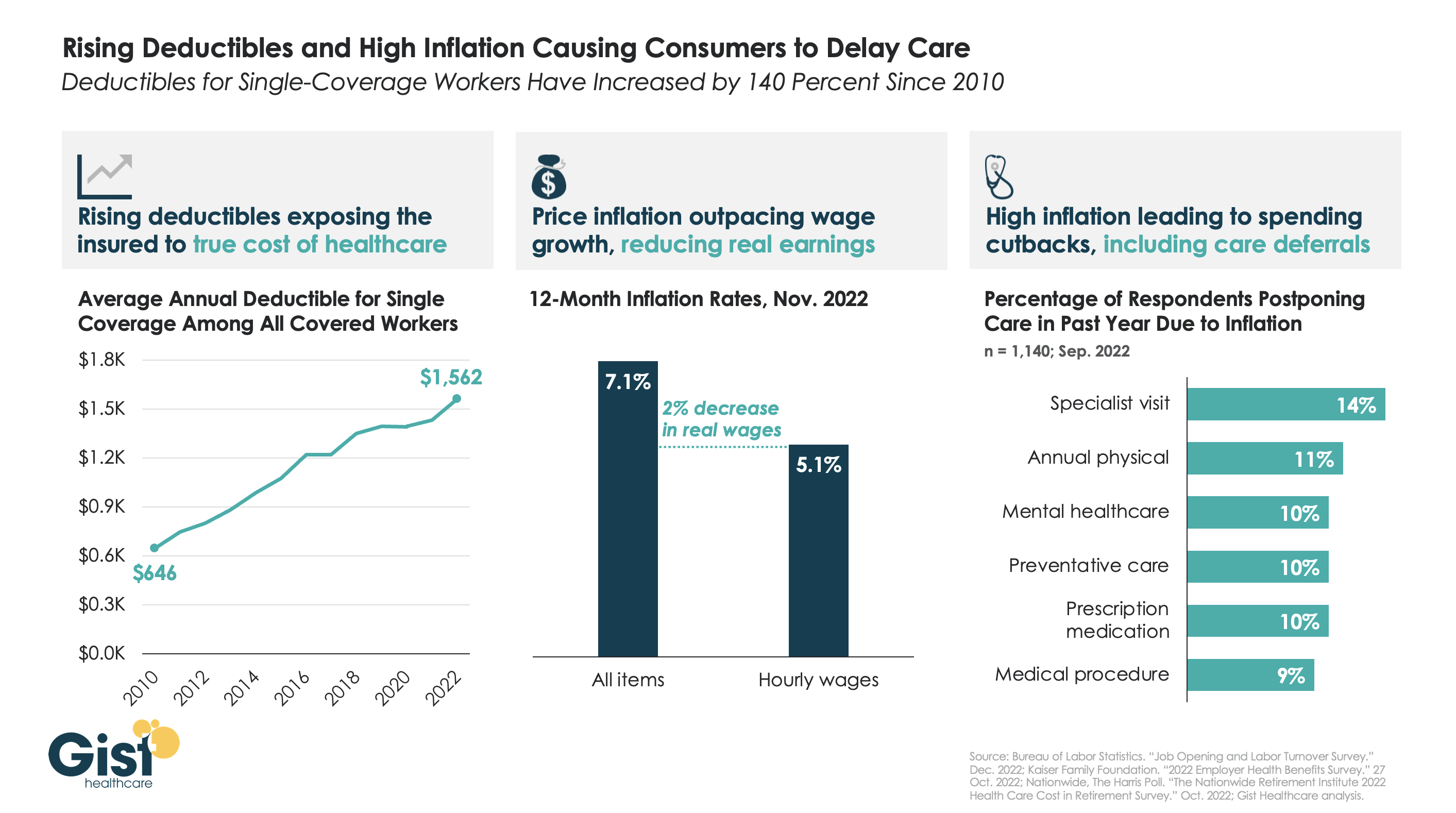
After COVID fears and shutdowns led consumers to delay care early in the pandemic, persistently high inflation over the past year has further suppressed volumes.
As the graphic above illustrates, the average deductible for individual coverage has grown by over 140 percent since 2010, exposing consumers to an increasing portion of healthcare costs, and prompting economists to reevaluate the adage that healthcare is “recession-proof”.
This year, that trend collided with an inflation spike that outpaced wage gains by two percent. Faced with diminished purchasing power, households are making budget tradeoffs which explicitly pit healthcare against other essential household needs.
For some, this cost-cutting impulse even extends to preventative screenings—required to be covered without cost-sharing—when consumers’ financial concerns drive them to avoid healthcare altogether.
While the latest inflation report suggests price increases are moderating, fears of a broader recession persist, making it critical for health systems and physicians to communicate with patients, encouraging them to continue to access preventive care, educating them about lower cost care options, and helping them prioritize treatment that should not be put off.
https://mailchi.mp/59374d8d7306/the-weekly-gist-january-13-2023?e=d1e747d2d8

Last Thursday, the Federal Trade Commission (FTC) released a proposed rule that would ban employers from imposing noncompete agreements on their employees. Noncompetes affect roughly 20 percent of the American workforce, and healthcare providers would be particularly impacted by this change, as far greater shares of physicians—at least 45 percent of primary care physicians, according to one oft-cited study—are bound by such agreements.
The rulemaking process is expected to be contentious, as the US Chamber of Commerce has declared the proposal “blatantly unlawful”. While it is unclear whether the rule would apply to not-for-profit entities, the American Hospital Association has released a statement siding with the Chamber of Commerce and urging that the issue continue to be left to states to determine.
The Gist: Should this sweeping rule go into effect, it would significantly shift bargaining power in the healthcare sector in favor of doctors, allowing them the opportunity to move away from their current employers while retaining local patient relationships.
The competitive landscape for physician talent would change dramatically, particularly for revenue-driving specialists, who would have far greater flexibility to move from one organization to another, and to push aggressively for higher compensation and other benefits.
Given that the FTC cited suppressed competition in healthcare as an outcome of current noncomplete agreements, the burden will be on organizations that employ physicians—including health systems and insurers, as well as private equity-backed corporate entities—to prove that physician noncompetes are essential to their operations and do not raise prices, as the FTC has suggested.

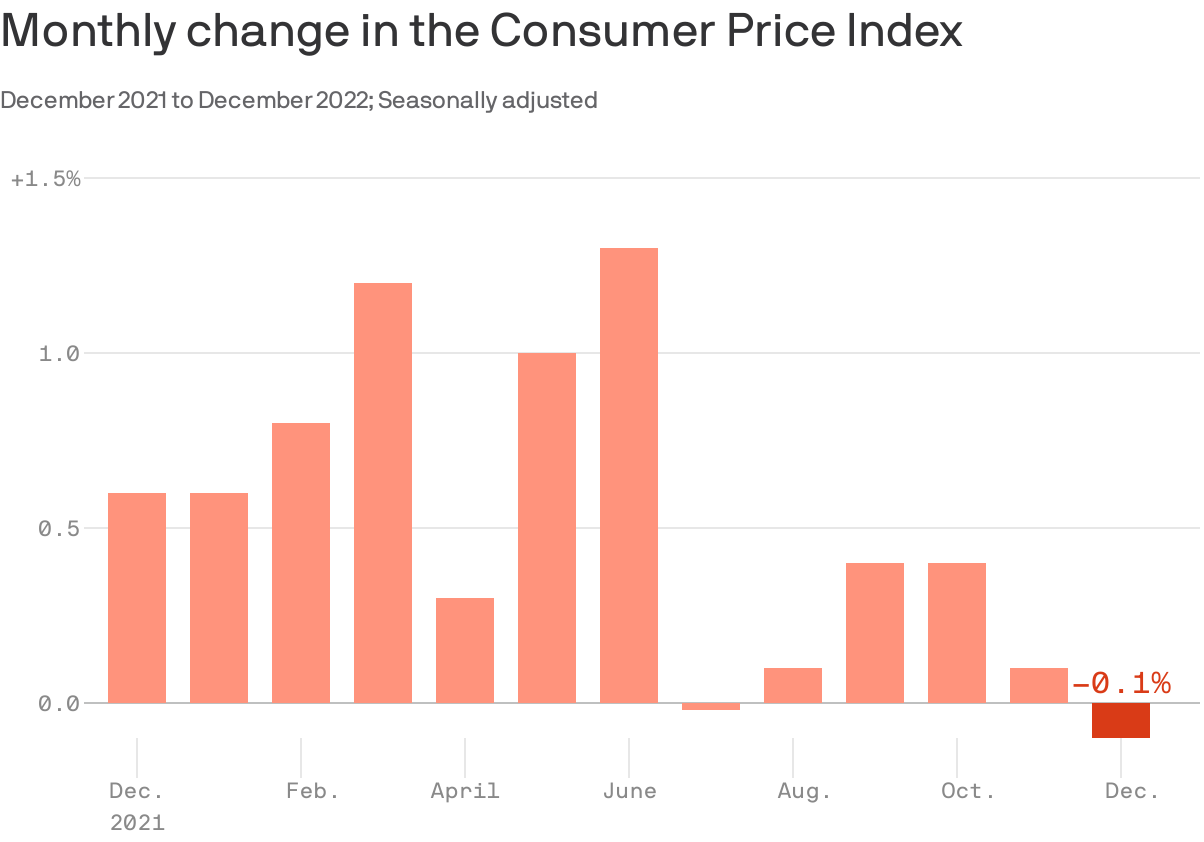
It may be time to update your inflation narrative.
The ultra-hot readings that defined the first half of 2022 appear to be firmly in the rearview mirror, improving the odds that price pressures can dissipate further without excessive economic pain.
Why it matters:
The nation’s inflation problem isn’t over, but so far inflation is slowing while the job market is still healthy, an enviable combination.
By the numbers:
In the final three months of 2022, core inflation (which excludes food and fuel costs) came in at an annualized 3.1% — higher than the Fed aims for, but hardly crisis levels. In the second quarter of the year, that number was 7.9%.
State of play:
Grocery prices rose 1.1% in the final three months of the year, an uncomfortably high rate, but not as extreme as the rates seen earlier in 2022.
What to watch:
That’s not to say there aren’t risks ahead. The war in Ukraine is ongoing, and another energy price shock could occur.
The bottom line:
Inflation will still be a worry in 2023, but much less so than it seemed a few months ago.
 HENRY KOTULA