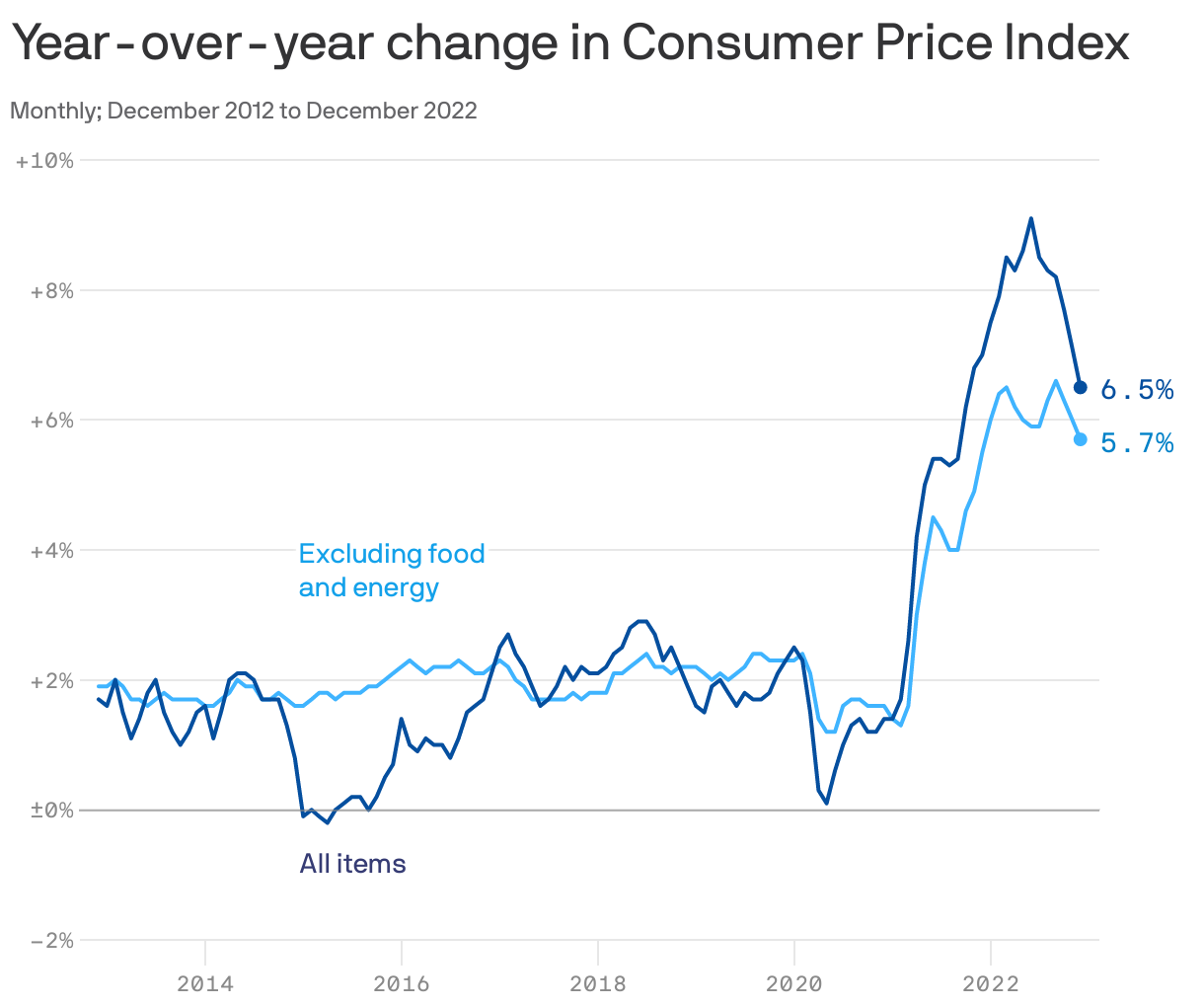
U.S. consumers got a reprieve from soaring costs in December: the Consumer Price Index declined on a monthly basis, the first drop since last summer as falling prices for items including gasoline and used carsdragged the overall index down.
By the numbers:
The index, which captures price changes across a basket of consumer goods and services, fell 0.1%, following an increase by the same amount in November. Over the past 12 months ending in December, the index is up 6.5%, falling from 7.1% through November.
Core CPI, which excludes food and fuel costs, rose by0.3% last month. Over the last 12 months through December, the index rose 5.7%. In November, those figures were 0.2% and 6%, respectively.
Why it matters:
The hot inflation that persisted through much of last year continues to show signs of receding — offering at least some relief for shoppers, the White House and the Federal Reserve, though some underlying inflation pressure remains.
Where it stands:
The data caps a year in which consumer prices rose rapidly, though the pace of cost increases began to slow in the final months of the year.
As consumers shifted spending and supply chains began to heal, price increases for a range of goods have cooled or, in some cases, costs have fallen outright.
Between the lines:
The Federal Reserve, which has been raising interest rates aggressively to tame inflation, is watching the services sector closely, where inflation can be more challenging to stamp out.
A sub-index measuring price moves within the services category (excluding housing) accelerated by 0.4%, after two straight months of cooler readings
Still, in the 12 months through December, this sub-index is up 7.4%(compared to 7.3% in November).
Big questions tend to have no easy answers. Fortunately, few people would say they went into healthcare for its ease.
The following questions about hospitals’ culture, leadership, survival and opportunity come with a trillion-dollar price tag given the importance of hospitals and health systems in the $4.3 trillion U.S. healthcare industry.
1. How will leaders insist on quality first in a world where it’s increasingly harder to keep trains on time?
Hospitals and health systems have had no shortage of operational challenges since the COVID-19 pandemic began. These organizations at any given time have been or still are short professionals, personal protective equipment, beds, cribs, blood, helium, contrast dye, infant formula, IV tubing, amoxicillin and more than 100 other drugs. After years of working in these conditions, it is understandable why healthcare professionals may think with a scarcity mindset.
This is something strong leaders recognize and will work to shake in 2023, given the known-knowns about the psychology of scarcity. When people feel they lack something, they lose cognitive abilities elsewhere and tend to overvalue immediate benefits at the expense of future ones. Should supply problems persist for two to three more years, hospitals and health systems may near a dangerous intersection where scarcity mindset becomes scarcity culture, hurting patient safety and experience, care quality and outcomes, and employee morale and well-being as a result.
The year ahead will be a great test and an opportunity for leaders to unapologetically prioritize quality within every meeting, rounding session, budgetary decision, huddle and town hall, and then follow through with actions aligned with quality-first thinking and commentary. Working toward a long-term vision and upholding excellence in the quality of healthcare delivery can be difficult when short-term solutions are available. But leaders who prioritize quality throughout 2023 will shape and improve culture.
2. Who or what will bring medicine past the scope-of-practice fights and turf wars that have persisted for decades?
It is naive to think these tensions will dissolve completely, but it would be encouraging if in 2023 the industry could begin moving past the all-too-familiar stalemates and fears of “scope creep,” in which physicians oppose expanded scope of practice for non-physician medical professionals.
Many professions have political squabbles and sticking points that are less palpable to outsiders. Scope-of-practice discord may fall in that category — unless you are in medicine or close to people in the field, it can easily go undetected. But just as it is naive to think physicians and advanced practice providers will reach immediate harmony, so too is it naive to think that aware Americans who watch nightly news segments about healthcare’s labor crisis and face an average wait of 26 days for a medical appointment will have much sympathy for physicians’ staunch resistance to change.
The U.S. could see an estimated shortage of between 37,800 and 124,000 physicians by 2034, according to the Association of American Medical Colleges. Ideally, 2023 is the year in which stakeholders begin to move past the usual tactics, arguments and protectionist thinking and move toward pragmaticism about physician-led care teams that empower advanced practice providers to care for patients to the extent of the education and training they have. The leaders or organizations who move the needle on this stand to make a name for themselves and earn a chapter or two in the story of American healthcare.
3. Which employers will win and which will lose in lowering the cost of healthcare?
Employers have long been incentivized to do two things: keep their workers healthy and spend less money doing it. News of companies’ healthcare ventures can be seen as cutting edge, making it easy to forget the origins of integrated health systems like Oakland, Calif.-based Kaiser Permanente, which dates back to one young surgeon establishing a 12-bed hospital in the height of the Great Depression to treat sick and injured workers building the Colorado River Aqueduct.
Many large companies have tried and failed, quite publicly, to improve healthcare outcomes while lowering costs. Will 2023 be the year in which at least one Fortune 500 company does not only announce intent to transform workforce healthcare, but instead point to proven results that could make for a scalable strategy?
Walmart is doing interesting things. JPMorgan seems to have learned a good deal from the demise of Haven, with Morgan Health now making some important moves. And just as important are the large companies paying attention on the sidelines to learn from others’ mistakes. Health systems with high-performing care teams and little variation in care stand to gain a competitive advantage if they draw employers’ attention for the right reasons.
4. Who or what will stabilize at-risk hospitals?
More than 600 rural hospitals — nearly 30 percent of all rural hospitals in the country — are at risk of closing in the near future. Just as concerning is the growing number of inner-city hospitals at increased risk of closure. Both can leave millions in less-affluent communities with reduced access to nearby emergency and critical care facilities. Although hospital closures are not a new problem, 2022 further crystalized a problem no one is eager to confront.
One way for at-risk hospitals to survive is via mergers and acquisitions, but the Federal Trade Commission is making buying a tougher hurdle to clear for health systems. The COVID-19 public health emergency began to seem like a makeshift hospital subsidy when it was extended after President Joe Biden declared the pandemic over, inviting questions about the need for permanent aid, reimbursement models and flexibilities from the government to hospitals. Recently, a group of lawmakers turned to an agency not usually seen as a watchdog for hospital solvency — HHS — to ask if anything was being done in response to hospital closures or to thwart them.
Maintaining hospital access in rural and urban settings is a top priority, and the lack of interest and creativity to maintain it is strikingly stark. As a realistic expectation for 2023, it would be encouraging to at least have an injection of energy, innovation and mission-first thinking toward a problem that grows like a snowball, seemingly bigger, faster and more insurmountable year after year.
Look at what Mark Cuban was able to accomplish within one year to democratize prescription drug pricing. Remember how humble and small the origins of that effort were. Recall how he — albeit being a billionaire — has put profit secondary to social mission. There’s no one savior that will curb hospital closures in the U.S., but it would be a good thing if 2023 brought more leadership in problem-solving and matching a big problem with big energy and ideas.
5. Which hospital and health system CEOs will successfully redefine the role?
Many of the largest and most prominent health systems in the country saw CEO turnover over the past two years. With that, health systems lost decades of collective industry and institutional knowledge. Their tenure spanned across numerous milestones and headwinds, including input and compliance with the Affordable Care Act, the move from paper to digital records, and major mergers and labor strikes. The retiring CEOs had been top decision-makers as their organizations met the demands of COVID-19 and its consequences. They set the tone and had final say in how forcefully their institutions condemned racism and what actions they took to address health inequities.
To assume the role of health system CEO now comes with a different job description than it did when outgoing leaders assumed their posts. Many Americans may carry on daily life with little awareness as to who is at the top of their local hospital or health system. The pandemic challenged that status quo, throwing hospital leaders into the limelight as many Americans sought leadership, expertise and local voices to make sense of what could easily feel unsensible. The public saw hospital CEOs’ faces, heard their voices and read their words more within the past two years than ever.
In 2023, newly named CEOs and incoming leaders will assume greater responsibility in addition to a fragile workforce that may be more susceptible to any slight change in communication, transparency or security. They will need to avoid white-collar ivory towers, and earn reputations as leaders who show up for their people in real, meaningful ways. Healthcare leaders who distance themselves from their workforce will only let the realistic, genuine servant leaders outshine them. In 2023, watch for the latter, emulate them and help up-and-comers get as much exposure to them as possible.
The percentage of healthcare organizations with an internal minimum wage of $15 or higher increased significantly over the last year, according to the “2022 Health Care Staff Compensation Survey” from SullivanCotter.
In 2021, less than 30 percent of healthcare organizations had an internal minimum wage of $15 per hour or more; this year, nearly 70 percent do. Some health systems are increasing the internal minimum wage to stay competitive amid staffing shortages and rising inflation. Others are increasing hourly rates as a result of union negotiations.
Health systems reported large increases in overall staff salaries, wages and benefits this year, and many expect to see increases in 2023 as well.
Here is how the internal minimum wage rates changed over the last year:
1. Less than $10 per hour 2021: 2.9 percent 2022: 2.2 percent
2. $10 per hour 2021: 14.7 percent 2022: 5 percent
3. $11 per hour 2021: 13.7 percent 2022: 3.9 percent
4. $12 per hour 2021: 12.7 percent 2022: 7.8 percent
5. $13 per hour 2021: 12.7 percent 2022: 6.1 percent
6. $14 per hour 2021: 14.7 percent 2022: 5.6 percent
7. $15 per hour 2021: 26.5 percent 2022: 53.9 percent
8. More than $15 per hour 2021: 2 percent 2022: 15.6 percent
Here are 30 health systems with strong operational metrics and solid financial positions in 2022, according to reports from Fitch Ratings and Moody’s Investors Service.
1. Advocate Aurora Health has an “AA” rating and a stable outlook with Fitch. The health system, dually headquartered in Milwaukee and Downers Grove, Ill., has a strong financial profile and a leading market position over a broad service area in Illinois and Wisconsin, Fitch said. The health system’s fundamental operating platform is strong, the credit rating agency said.
2. Atlantic Health System has an “Aa3” rating and stable outlook with Moody’s. The Morristown, N.J.-based health system has strong operating performance and liquidity metrics, Moody’s said. The credit rating agency expects Atlantic Health System to sustain strong performance to support capital spending.
3. Banner Health has an “AA-” rating and stable outlook with Fitch. The Phoenix-based health system’s core hospital delivery system and growth of its insurance division combine to make it a successful, highly integrated delivery system, Fitch said. The credit rating agency said it expects Banner to maintain operating EBITDA margins of about 8 percent on an annual basis, reflecting the growing revenues from the system’s insurance division and large employed physician base.
4. BayCare has an “AA” rating and stable outlook with Fitch. The 14-hospital system based in Clearwater, Fla., has excellent liquidity and operating metrics, which are supported by its leading market position in a four-county area, Fitch said. The credit rating agency expects strong revenue growth and cost management to sustain BayCare’s operating performance.
5. Bon Secours Mercy Health has an “AA-” rating and stable outlook with Fitch. The Cincinnati-based health system has a broad geographic footprint as one of the five largest Catholic health systems in the U.S., a good payer mix and a leading or near-leading market share in eight of its 11 markets in the U.S., Fitch said.
6. Bryan Health has an “AA-” rating and stable outlook with Fitch. The Lincoln, Neb.-based health system has a leading and growing market position, very strong cash flow and a strong financial position, Fitch said. The credit rating agency said Bryan Health has been resilient through the COVID-19 pandemic and is well-positioned to accommodate additional strategic investments.
7. CaroMont Health has an “AA-” rating and stable outlook with Fitch. The Gastonia, N.C.-based system has a leading market position in a growing services area and a track record of good cash flow, Fitch said.
8. Christiana Care Health System has an “Aa2” rating and stable outlook with Moody’s. The Newark, Del.-based system has a unique position as the state’s largest teaching hospital and extensive clinical depth that affords strong regional and statewide market capture, and it is expected to return to near pre-pandemic level margins over the medium-term, Moody’s said.
9. Cone Health has an “AA” rating and stable outlook with Fitch. The Greensboro, N.C.-based health system has a leading market share and a favorable payer mix, Fitch said. The health system’s broad operating platform and strategic capital investments should enable it to return to stronger operating results, the credit rating agency said.
10. Deaconess Health System has an “AA” rating and stable outlook with Fitch. The Evansville, Ind.-based system has a leading market position in its primary service area and a favorable payer mix, Fitch said. The ratings agency said it expects Deaconess’ operating EBITDA margins to improve and stabilize around 10 percent by 2023, reflecting strong volumes and focus on operating efficiencies.
11. El Camino Health has an “AA-” rating and stable outlook with Fitch. El Camino Health, which includes hospital campuses in Los Gatos, Calif., and Mountain View, Calif., has a solid market share in a competitive market and a stable payer mix, Fitch said. The credit rating agency said El Camino Health’s balance sheet provides moderate financial flexibility.
12. Gundersen Health System has an “AA-” rating and stable outlook with Fitch. The La Crosse, Wis.-based health system has strong balance sheet metrics, a leading market position and an expanding operating platform in its service area, Fitch said. The credit rating agency expects the health system to return to strong operating performance as it emerges from disruption related to the COVID-19 pandemic.
13. Hackensack Meridian Health has an “AA-” rating and stable outlook with Fitch. The Edison, N.J.-based health system has shown consistent year-over-year increases in market share and has a solid liquidity position, Fitch said.
14. Inova Health System has an “Aa2” rating and stable outlook with Moody’s. The Falls Church, Va.-based health system has a consistently strong operating cash flow margin and ample balance sheet resources, Moody’s said. Inova’s financial excellence will remain undergirded by its favorable regulatory and economic environment, the credit rating agency said.
15. Intermountain Healthcare has an “Aa1” rating and stable outlook with Moody’s. The Salt Lake City-based health system has exceptional credit quality, which will continue to benefit from its leading market position in Utah, Moody’s said. The credit rating agency said the health system’s merger with Broomfield, Colo.-based SCL Health will also give Intermountain greater geographic reach.
16. Mass General Brigham has an “Aa3” rating and stable outlook with Moody’s. The Boston-based health system has an excellent clinical reputation, good financial performance and strong balance sheet metrics, Moody’s said. The credit rating agency said it expects Mass General Brigham to maintain a strong market position and stable financial performance.
17. Mayo Clinic has an “Aa2” rating and stable outlook with Moody’s. The credit rating agency said Mayo Clinic’s strong market position and patient demand will drive favorable financial results. The Rochester, Minn.-based health system “will continue to leverage its excellent reputation and patient demand to continue generating favorable operating performance while maintaining strong balance sheet ratios,” Moody’s said.
18. MemorialCare has an “AA-” rating and stable outlook with Fitch. The Fountain Valley, Calif.-based health system has excellent leverage metrics and a strong financial profile, Fitch said. The credit rating agency said it expects the system’s leverage metrics to remain strong over the next several years.
19. Methodist Health System has an “Aa3” rating and stable outlook with Moody’s. The Dallas-based system has strong operating performance, and investments in facilities have allowed it to continue to capture more market share in the fast-growing Dallas-Fort Worth, Texas, area, Moody’s said. The credit rating agency said it expects Methodist Health System’s strong operating performance and favorable liquidity to continue.
20. OhioHealth has an “AA+” rating and stable outlook with Fitch. The Columbus, Ohio-based system has an exceptionally strong credit profile, broad regional operating platform and leading market position in both its competitive two-county primary service area and broader 47-county total service area, Fitch said.
21. Parkview Health has an “Aa3” rating and stable outlook with Moody’s. The Fort Wayne, Ind.-based system has a leading market position with expansive tertiary and quaternary clinical services in Northeastern Indiana and Northwestern Ohio, Moody’s said.
22. Presbyterian Healthcare Services has an “Aa3” rating and stable outlook with Moody’s and an “AA” rating and stable outlook with Fitch. The Albuquerque, N.M.-based system is the largest in the state, and it has strong revenue growth and a healthy balance sheet, Moody’s said. The credit rating agency said it expects the health system’s balance sheet and debt metrics to remain strong.
23. Rady Children’s Hospital has an “AA” rating and stable outlook with Fitch. The San Diego-based hospital has a very strong balance sheet position and operating performance, and it is also a leading provider of pediatric services in the growing city and tri-county service area, Fitch said.
24. Rush Health has an “AA-” rating and stable outlook with Fitch. The Chicago-based health system has a strong financial profile and a broad reach for high-acuity services as a leading academic medical center, Fitch said. The credit rating agency expects Rush’s services to remain profitable over time.
25. Stanford (Calif.) Health Care has an “AA” rating and stable outlook with Fitch. The health system has extensive clinical reach in a competitive market and its financial profile is improving, Fitch said. The health system’s EBITDA margins rebounded in fiscal year 2021 and are expected to remain strong going forward, the crediting rating agency said.
26. ThedaCare has an “AA-” rating and stable outlook with Fitch. The Neenah, Wis.-based system has a focused strategy, strong financial profile and robust market share, Fitch said.
27. Trinity Health has an “AA-” rating and stable outlook with Fitch. The Livonia, Mich.-based system’s large size and market presence in multiple states disperses risk and the long-term ratings incorporate the expectation that Trinity will return to sustained stronger operating EBITDA margins.
28. UnityPoint Health has an “AA-” rating and stable outlook with Fitch. The Des Moines, Iowa-based health system has strong leverage metrics and cash position, Fitch said. The credit rating agency expects the health system’s balance sheet and debt service coverage metrics to remain robust.
29. University of Chicago Medical Center has an “AA-” rating and stable outlook with Fitch. The credit rating agency said it expects University of Chicago Medical Center’s capital-related ratios to remain strong, in part because of its broad reach of high-acuity services.
30. Yale New Haven (Conn.) Health has an “AA-” rating and stable outlook with Fitch. The health system’s turnaround efforts, brand recognition and market presence will help it return to strong operating results, Fitch said.
Hospitals experienced a slight boost to operating margins in November, but not enough to restore the median negative margins that persisted for 2022 to date.
Kaufman Hall’s December “National Flash Hospital Report“ — based on data from more than 900 hospitals — found hospitals’ median operating margin was -0.2 percent through November, a slight improvement from the median of -0.3 percent recorded a month prior.
A 1 percent decline in expenses from October to November drove the eleventh-hour improvement to margins and tipped the scales on hospitals’ relatively flat revenue. Additionally, hospitals saw labor expenses decrease 2 percent in November, potentially driven by less reliance on contract labor.
The median -0.2 percent margin recorded in November 2022 marks a 44 percent decline for margins in 22 year-to-date compared to 2021 year-to-date. Kaufman Hall’s index shows hospitals’ median monthly margins have been in the red throughout 2022, starting with the -3.4 percent recorded in January, driven by the omicron surge. November is tied with September as hospitals’ best month of the year, with both sharing a median margin of -0.2 percent.
Outpatient care marks one of the brighter spots for hospitals’ finances, with outpatient revenue up 10 percent year-over-year while inpatient revenue was flat over the same time period.
“The November data, while mildly improved compared to October, solidifies what has been a difficult year for hospitals amidst labor shortages, supply chain issues and rising interest rates,” Erik Swanson, senior vice president of data and analytics with Kaufman Hall, said. “Hospital leaders should continue to develop their outpatient care capabilities amid ongoing industry uncertainty and transformation.”
The December issue of Health Affairs included an intriguing study that sought to explain the recent trend toward more high-intensity billing in emergency departments (EDs). Using ED visit data for “treat-and-release” visits (i.e. ED patients who were not admitted to the hospital), the study found that visits deemed high-intensity, as defined by certain high-complexity or critical care billing codes, rose from around 5 percent of visits in 2006 to 19 percent in 2019.
The authors conclude that while about half of this increase can be explained by changes in patient case mix and available care services that were visible in claims data, the other half is due to the adoption of sophisticated revenue cycle management programs, and industry-wide changes to billing practices that include upcoding.
The Gist: At first blush, an increase in high-intensity ED billing may not be a bad thing, if it means that greater numbers of people with low-acuity needs are going to urgent care centers, and avoiding EDs for needs that can be managed elsewhere. But the study finds thattreat-and-release rates are going up for high-intensity patients.
Though the authors list many potential reasons for this—including the changed role of the ED as a diagnostic referral center used by primary care physicians for quick workups of complex patients, the growing number of multimorbid seniors, and value-based care’s pressure to reduce hospital admission rates in favor of more resource-intensive ED visits—we have a strong suspicion that good old-fashioned upcoding also plays a role, especially as the percentage of emergency medicine practices managed by private equity companies increased from four percent to over eleven percent across the same time period as the study.
Under new guidance released by the Food and Drug Administration (FDA) on Tuesday, retail pharmacies can now dispense mifepristone, the first in a two-drug sequence for medication abortions. This move follows a December 2021 change that allows mail-order pharmacies to ship prescribed mifepristone, which previously could only be dispensed in-person by approved clinics. The medication will still require a prescription, and will remain highly restricted, or even illegal, in states that have implemented strict abortion bans.
Pharmacies opting to dispense the drug will face requirements that go beyond other medications, such as keeping the identity of the prescribing provider anonymous. Retail pharmacy chains CVS and Walgreens each announced plans to become certified to dispense mifepristone in locations where it is legal.
The Gist:Abortion pills, currently used in used in more than half of pregnancy terminations, are becoming more sought-after in the wake of last year’s Supreme Court ruling overturning the federal right to abortion. This FDA action is the latest move by the Biden administration to expand access to abortion—though its impact will be felt unevenly across states, even with the Department of Justice stating the Postal Service can legally deliver the medications anywhere in the US.
Surging from less than 5 percent of cases in the first week of December, XBB.1.5 now makes up over 40 percent of all COVID infections in the US. The new variant appears to demonstrate a high level of immune evasion, and is around 40 percent more contagious than the next most virulent strain, though illnesses caused by XBB.1.5 do not seem to be more severe. Weekly rates for new COVID-related hospital admissions are now higher than at any point since February 2022, despite case counts remaining lower than the peak of the summer wave in July 2022 (although it is likely that the vast majority of cases are now identified through home testing, and not reported, making the data unreliable).
The Gist: While the new variant seems to be less likely to create a COVID spike of the magnitude we experienced last winter, hospitalizations rising faster than case counts bears watching. That’s especially true given the current staffing situation in most hospitals, which makes each COVID admission and each caregiver call-out for illness a cause for concern.
Only 15 percent of eligible Americans have received the most recent bivalent booster, leaving the population more vulnerable to this and future variants. Plus, additional funding to support the fight against COVID does not seem to be forthcoming from the new Congress. Beset with surges of COVID, flu, and RSV admissions, hospitals must hope that the end of the holiday season brings some relief.
At a recent health system retreat, the CFO shared data describing a trend we’ve observed at a number of systems: for the past few months, emergency department (ED) volumes have been up, but the percentage of patients admitted through the ED is precipitously down.
The CFO walked to through a run of data to diagnose possible causes of this “uncoupling” of ED visits and inpatient admissions. Overall, the severity of patients coming to the ED was higher compared to 2019, so it didn’t appear that the ED was being flooded with low-level cases that didn’t merit admission. Apart from the recent spike in respiratory illness brought on by the “tripledemic” of flu, COVID and RSV, there wasn’t a noteworthy change in case mix, or the types of patients and conditions being evaluated in the emergency room. (Fewer COVID patients were admitted compared to 2021, but that wasn’t enough to account for the decline.) The physicians staffing the ED hadn’t changed, so a shift in practice patterns was also unlikely.
A physician leader attending the retreat spoke up from the audience: “I can diagnose this for you. I work in the ED, and the problem is we can’t move them. Patients are sitting in the ED, in hallways, in observation, sometimes for days, because we can’t get a bed on the floor. The whole time we are treating them, and many of them get better, and we’re able to discharge them before a bed frees up.”
With nursing shortages and other staffing challenges, many hospitals have been unable to run at full capacity even if the demand for beds is there. So total admissions may be down, even if the hospital feels like it’s bursting at the seams.
The current staffing crisis not only presents a business challenge, but also adversely impacts patient experience, and makes it more difficult to deliver the highest quality care. A good reminder of the complexity of hospital operations, where strain in one part of the system will quickly impact the performance of other parts of the care delivery continuum.
While healthcare wasn’t a top priority for lawmakers hammering out the Omnibus bill aimed at keeping the government open through next September, the graphic above outlines the bill’s three greatest areas of impact for providers.
The package reduces the planned 4.5 percent 2023 physician fee schedule cut to two percent, while also extending value-based care bonuses in alternative payment models (albeit at 3.5 percent, instead of five percent). It also delays the $38B Medicare spending cut required by the PAYGO sequester, pushing that cut out two years.
On the telehealth front, the bill extends Medicare’s pandemic-era virtual care flexibilities through 2024, including the “hospital at home” waiver. It also sets April 1, 2023 as the start date of a one-year window for states to reassess Medicaid enrollment,decoupling the start of eligibility redeterminations from the end of the federal COVID public health emergency. Medicaid enrollment grew by 25 percent over the course of the pandemic, but around two-thirds of new enrollees may lose eligibility after redeterminations.
Overall, the legislation is a mixed bag for providers.The uninsured population is expected to grow, at least in the short term. Physician groups had hopes for a complete reprieve from Medicare pay cuts, and the fact that they didn’t get it may signalgrowing Congressional hesitancy to intervene with the Medicare physician fee schedule in the future. But the telehealth extensions may encourage other wider adoption of reimbursement by private insurers, bolstering providers’ long-term virtual care investments.











 HENRY KOTULA