


Cartoon – Good Listener

At a certain point, it was no longer a matter of if the United States would reach the gruesome milestone of 1 in 500 people dying of covid-19, but a matter of when. A year? Maybe 15 months? The answer: 19 months.
Given the mortality rate from covid and our nation’s population size, “we’re kind of where we predicted we would be with completely uncontrolled spread of infection,” said Jeffrey D. Klausner, clinical professor of medicine, population and public health sciences at the University of Southern California’s Keck School of Medicine. “Remember at the very beginning, which we don’t hear about anymore, it was all about flatten the curve.”

The idea, he said, was to prevent “the humanitarian disaster” that occurred in New York City, where ambulance sirens were a constant as hospitals were overwhelmed and mortuaries needed mobile units to handle the additional dead.
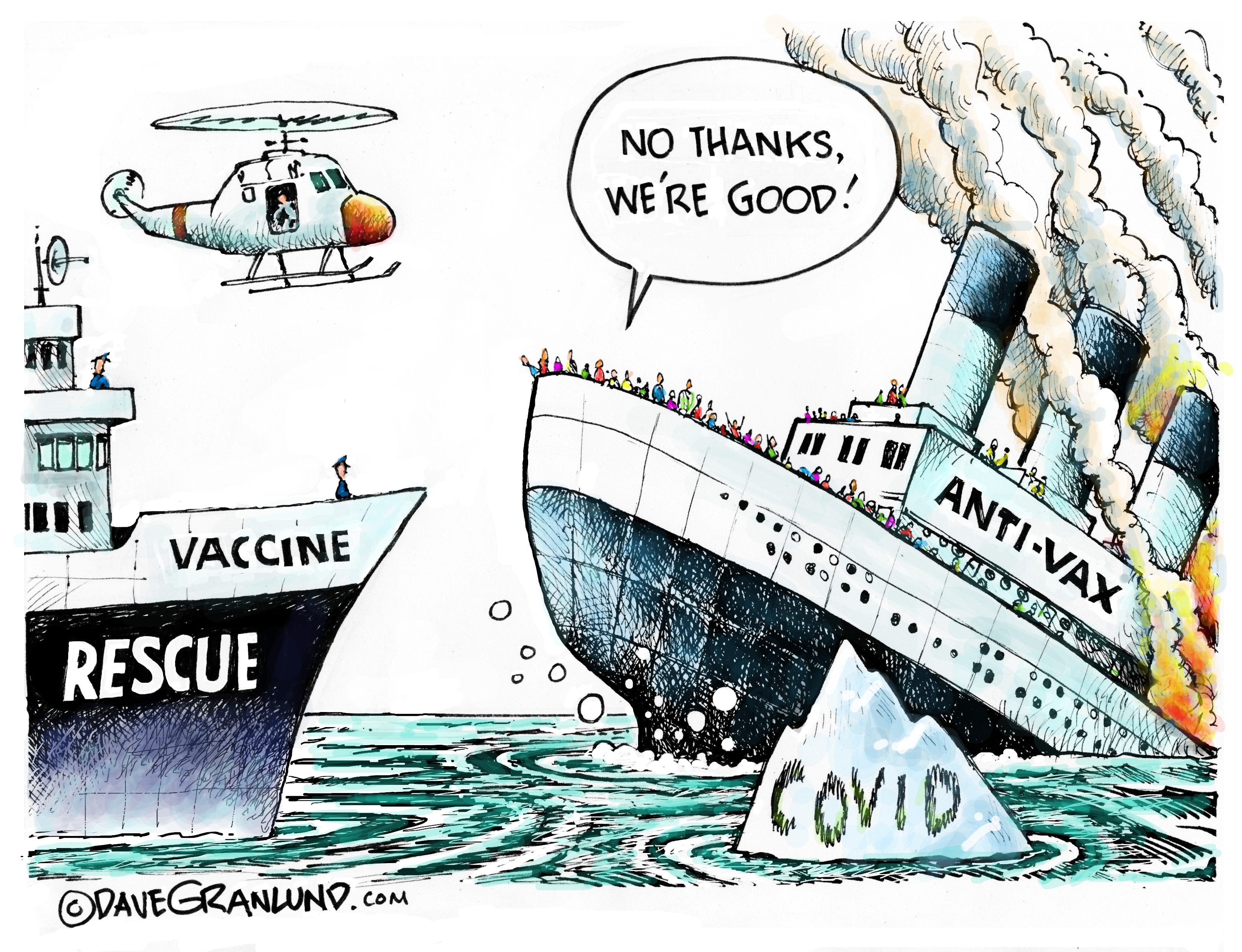
The goal of testing, mask-wearing, keeping six feet apart and limiting gatherings was to slow the spread of the highly infectious virus until a vaccine could stamp it out. The vaccines came but not enough people have been immunized, and the triumph of science waned as mass death and disease remain. The result: As the nation’s covid death toll exceeded 663,000 this week, it meant roughly 1 in every 500 Americans had succumbed to the disease caused by the coronavirus.
While covid’s death toll overwhelms the imagination, even more stunning is the deadly efficiency with which it has targeted Black, Latino, and American Indian and Alaska Native people in their 30s, 40s and 50s.
Death at a younger age represents more lost years of life. Lost potential. Lost scholarship. Lost mentorship. Lost earnings. Lost love.
Neighborhoods decimated. Families destroyed.

“So often when we think about the majority of the country who have lost people to covid-19, we think about the elders that have been lost, not necessarily younger people,” said Abigail Echo-Hawk, executive vice president at the Seattle Indian Health Board and director of the Urban Indian Health Institute. “Unfortunately, this is not my reality nor that of the Native community. I lost cousins and fathers and tribal leaders. People that were so integral to building up our community, which has already been struggling for centuries against all these things that created the perfect environment for covid-19 to kill us.”
Six of Echo-Hawk’s friends and relatives — all under 55 — have died of covid.
“This is trauma. This is generational impact that we must have an intentional focus on. The scars are there,” said Marcella Nunez-Smith, chair of President Biden’s COVID-19 Health Equity Task Force and associate dean for health equity research at Yale University. “We can’t think that we’re going to test and vaccinate our way out of this deep pain and hurt.”
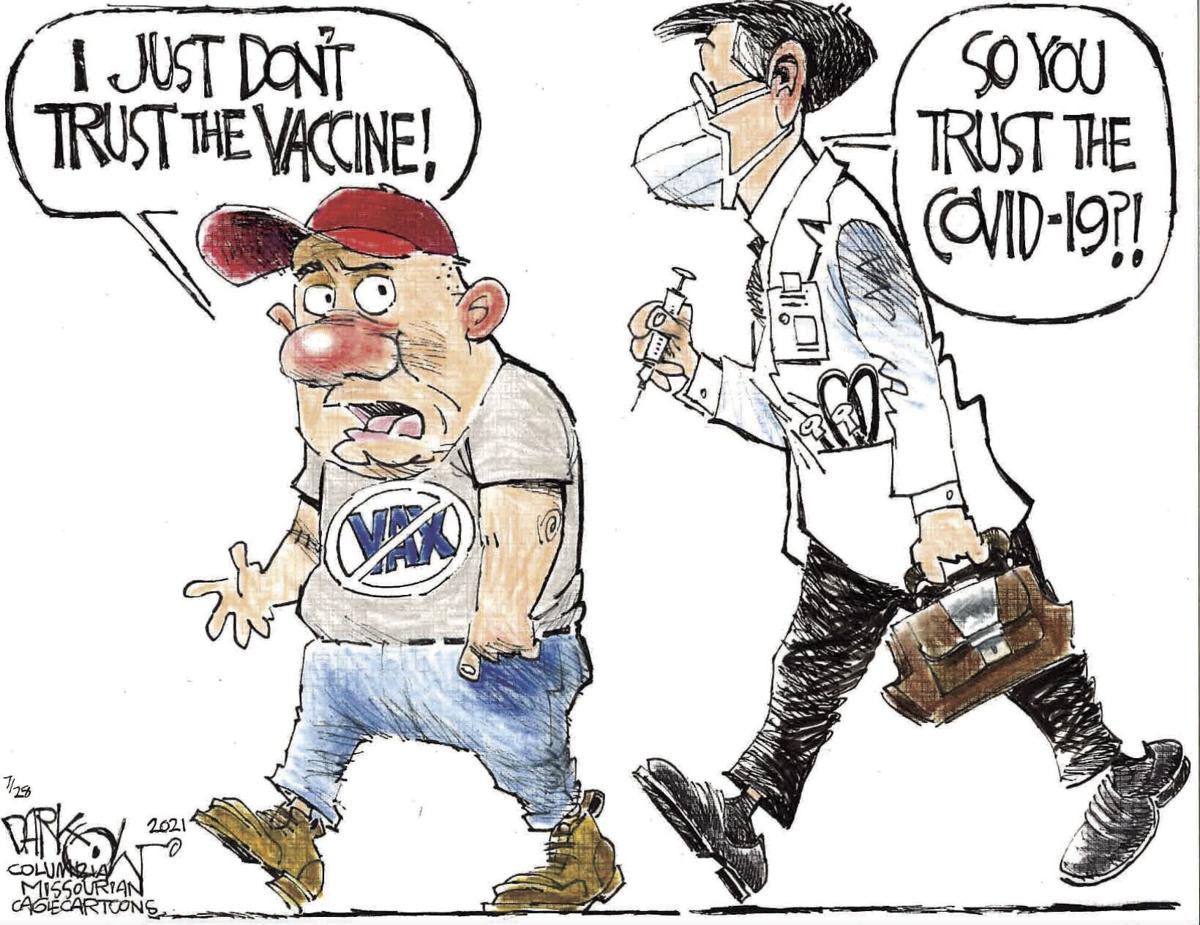
The pandemic has brought into stark relief centuries of entwining social, environmental, economic and political factors that erode the health and shorten the lives of people of color, putting them at higher risk of the chronic conditions that leave immune systems vulnerable to the coronavirus. Many of those same factors fuel the misinformation, mistrust and fear that leave too many unprotected.
Take the suggestion that people talk to their doctor about which symptoms warrant testing or a trip to the hospital as well as the safety of vaccines. Seems simple. It’s not.
Many people don’t have a physician they see regularly due in part to significant provider shortages in communities of color. If they do have a doctor, it can cost too much money for a visit even if insured. There are language barriers for those who don’t speak English fluently and fear of deportation among undocumented immigrants.

“Some of the issues at hand are structural issues, things that are built into the fabric of society,” said Enrique W. Neblett Jr., a University of Michigan professor who studies racism and health.
Essential workers who cannot avoid the virus in their jobs because they do not have the luxury of working from home. People living in multigenerational homes with several adult wage-earners, sharing housing because their pay is so low. Even the fight to be counted among the covid casualties — some states and hospitals, Echo-Hawk said, don’t have “even a box to check to say you are American Indian or Alaskan Native.”
It can be difficult to tackle the structural issues influencing the unequal burden of the pandemic while dealing with the day-to-day stress and worry it ignites, which, Neblett said, is why attention must focus on both long-term solutions and “what do we do now? It’s not just that simple as, ‘Oh, you just put on your mask, and we’ll all be good.’ It’s more complicated than that.”
The exacting toll of the last year and a half — covid’s stranglehold on communities of color and George Floyd’s murder — forced the country to interrogate the genealogy of American racism and its effect on health and well-being.
“This is an instance where we finally named it and talked about structural racism as a contributing factor in ways that we haven’t with other health disorders,” Neblett said.
But the nation’s attention span can be short. Polls show there was a sharp rise in concern about discrimination against Black Americans by police following Floyd’s murder, including among White Americans. That concern has eroded some since 2020, though it does remain higher than years past.
“This mistaken understanding that people have, almost this sort of impatience like, ‘Oh, we see racism. Let’s just fix that,’ that’s the thing that gives me hives,” Nunez-Smith said. “This is about generational investments and fundamental changes in ways of being. We didn’t get here overnight.”

https://www.nationalgeographic.com/science/article/the-mu-variant-is-on-the-rise-scientists-weigh-in-on-how-much-to-worry?cmpid=org=ngp::mc=crm-email::src=ngp::cmp=editorial::add=SpecialEdition_20210910::rid=C1D3D2601560EDF454552B245D039020
Laboratory studies suggest this variant may be better at avoiding the immune system but lags Delta when it comes to transmission and infecting cells.
One of the newest variants of COVID-19, known as Mu, has spread to 42 countries, but early studies suggest that it is less easily transmitted than the dangerous Delta variant, which has triggered a resurgence of the pandemic in the U.S. and many other countries.
Mu quickly became the dominant strain in Colombia, where it was first detected in January, but in the U.S., where the Delta virus is dominant, it has not spread significantly. After reaching a peak at the end of June, the prevalence of the Mu variant in the U.S. has steadily declined.
Scientists believe that the new variant cannot compete with the Delta variant, which is highly contagious. “Whether it could have gone higher or not if there was no Delta, that’s hard to really say,” says Alex Bolze, a geneticist at the genomics company Helix.
In Colombia, however, the Mu variant is responsible for more than a third of the COVID-19 cases. There have been 11 noteworthy variants to date, which the World Health Organization has named for the letters of the Greek alphabet. The newest variant, Mu, is the 12th. WHO has labeled this latest version of SARS-CoV-2 a Variant of Interest, a step below a Variant of Concern.
Delta and three other variants have drawn the highest level of concern. But a Variant of Interest, like Mu still raises worries. Mu has many known mutations that can help the virus escape immunity from vaccines or previous infection.
Still, the good news is that Mu is unlikely to replace Delta in places like the U.S. where it is already predominant, says Tom Wenseleers, evolutionary biologist and biostatistician at the Catholic University of Leuven in Belgium, who previously estimated the transmissibility and impact of Alpha variant in England.
Most genetic sequences reveal that Mu has eight mutations in its spike protein, many of which are also present in variants of concern: Alpha, Beta, Gamma, and Delta.
Some of Mu’s mutations, like E484K and N501Y, help other variants evade antibodies from mRNA vaccines. In the Beta and Gamma variants, the E484K mutation made the variants more resistant to a single dose of mRNA vaccines.
A study, not yet peer reviewed, has shown that the P681H mutation helps transmission of the Alpha variant—it may do the same for Mu.
Mu also harbors novel mutations that haven’t been seen in variants before, so their consequences are not fully understood. Mutation at the 346 position disrupts interaction of antibodies with the spike protein, which, scientists say, might make it easier for the virus to escape.
A study using epidemiological models, not yet peer reviewed, estimates that Mu is up to twice more transmissible than the original SARS-CoV-2 and caused the wave of COVID-19 deaths in Bogotá, Colombia in May, 2021. This study also suggests that immunity from a previous infection by the ancestral virus was 37 percent less effective in protecting against Mu.
“Right now, we do not have [enough] available evidence that may suggest that indeed this new variant Mu is associated with a significant [..] change in COVID,” says Alfonso Rodriguez-Morales, the President of the Colombian Association of Infectious Diseases.
But some clues are emerging that Mu can weaken protection from antibodies generated by existing vaccines. Lab-made virus mimicking the Mu variant were less affected by antibodies from people who had recovered from COVID-19 or were vaccinated with Pfizer’s Comiranty. In this study, not yet peer reviewed, Mu was the most vaccine resistant of all currently recognized variants.
In another lab-based study, antibodies from patients immunized with Pfizer’s vaccine were less effective at neutralizing Mu compared to other variants.
“[Mu] variant has a constellation of mutations that suggests that it would evade certain antibodies—not only monoclonal antibodies, but vaccine and convalescent serum-induced antibodies—but there isn’t a lot of clinical data to suggest that. It is mostly laboratory […] data,” said Anthony Fauci, director of the National Institute of Allergy and Infectious Diseases, at a White House press briefing on September 2.
The COVID-19 vaccines—Pfizer, Astra Zeneca, Johnson & Johnson, and Sinovac, all of which are available in Colombia—still seem to offer good protection against Mu, according to Rodriguez-Morales.
The Mu variant rapidly expanded across South America, but it is difficult to know for sure how far Mu has spread, according to Paúl Cárdenas, microbiologist at Universidad San Francisco de Quito in Ecuador.
“[Latin American countries] have provided very low numbers of sequences, compared with the numbers of cases that we have,” says Cárdenas. South American countries have sequenced just 0.07 percent of their total SARS-CoV-2 positive cases, although 25 percent of global infections have occurred in the region. This contrasts with 1.5 percent of all positive cases sequenced in the U.S. and 9.3 percent of all positive cases sequenced in the U.K.
“We are not necessarily looking at the reality of the distribution of the variants [in Latin America], because of the limitations in performing genome sequencing,” says Rodriguez-Morales.
That said, except in Columbia where Mu has been spreading since late February, the variant is becoming relatively less frequent globally, including in the rest of South America.
“Additional evidence on Mu is scarce, similar to Lambda and other regionally prevalent variants, because of limited capacity for follow-up studies, and because these variants have not yet been a significant threat in high-income countries like Delta is,” says Pablo Tsukayama, a microbiologist at Universidad Peruana Cayetano Heredia in Lima, Peru. He hopes the WHO’s designation of Mu as a variant of interest will change that.

The Democrats’ reconciliation bill includes several major health care pieces backed by different lawmakers and advocates, setting up a precarious game of policy Jenga if the massive measure needs to be scaled back.
Between the lines: Health care may be a priority for Democrats. But that doesn’t mean each member values every issue equally.
Why it matters: As the party continues to hash out the overall price tag of its giant reconciliation bill, it’s worth gaming out which policies are on the chopping block — and which could potentially take the entire reconciliation bill down with them.
There are clear winners of each pillar of Democrat’s health plan:
Yes, but: Each of these groups face real problems with health care access and affordability. But when there’s a limited amount of money on the table — which there is — even sympathetic groups can get left in the dust.
Each policy measure, however, also has powerful political advocates. And when Democrats have a razor-thin margin in both the House and the Senate, every member has a lot of power.
The bottom line: “From a political perspective, none of these health care proposals seem very expendable,” said KFF’s Larry Levitt.
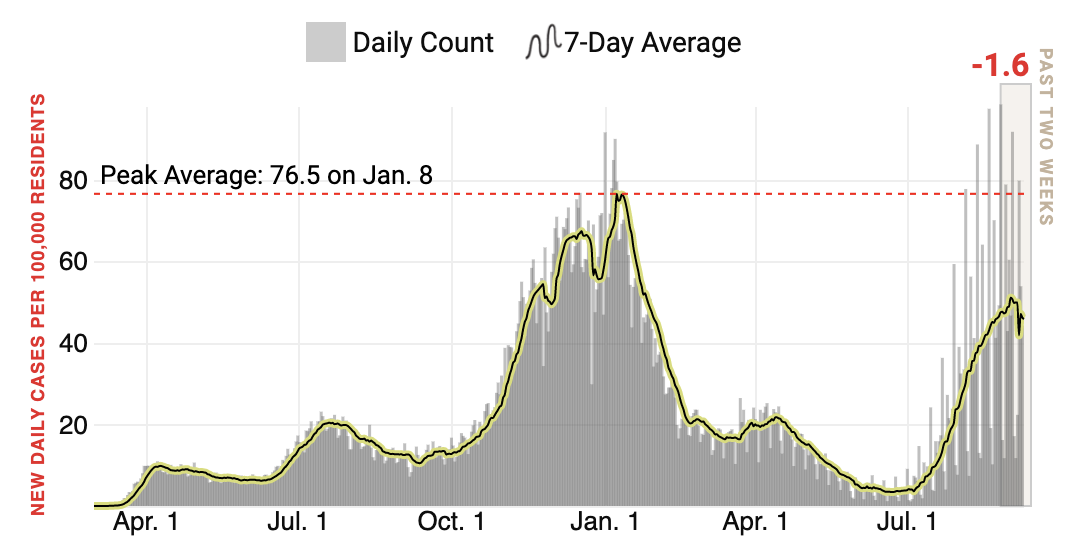
It may feel like eons ago, but try to recall summer 2020: While there were coronavirus surges in some parts of the country, national case rates were low. In some areas, the virus almost faded away entirely. But of course, the respite didn’t last. Cases began rising again in the fall of 2020, peaking at an average of more than 250,000 per day in January 2021.
The U.S. may be in for something even worse this year, my colleague Chris Wilson warns.
After a heartbreakingly bad summer, the virus’ spread appears to be ebbing, Chris writes. As of today, the U.S. is reporting about 145,000 diagnoses per day—too high for comfort, but at least a modest downward trend from over 160,000 daily cases at the end of August. In many hotspot states, diagnoses are significantly lower than they were a month or two ago.
But kids are now returning to school, cooler weather will force social gatherings indoors and holiday travel season will soon be upon us. With the highly contagious Delta variant now the dominant strain and millions of Americans still unvaccinated, we may be heading for a repeat of last year.
Of course, the situation isn’t exactly the same. More than half the population (and counting) is fully vaccinated, and many other people have at least some level of natural immunity after surviving an infection. That will certainly help keep cases down, but it may not be enough. As Chris points out, seven U.S. states set new daily case records this summer, even with vaccines widely available. As long as there are millions of unvaccinated people in the U.S., the virus will find a way to spread—particularly when it’s as contagious as the Delta variant.
So what can you do? At the risk of sounding like a broken record, the advice is the same as ever: get vaccinated if you haven’t, get your kids vaccinated if they’re old enough, wear masks if you gather with people indoors and stay home if you feel unwell.
President Joe Biden’s announcement Thursday that broadly expanded mandatory COVID-19 vaccinations or at least compulsory weekly testing is a sign, possibly, that the administration sees the writing on the wall. Even with tentative but promising signs that the fourth wave of surging cases in COVID-19 in the United States, dating back to the first days of summer, was waning, without drastic measures, the fifth will be catastrophically worse.
The new requirements are estimated to affect about 100 million people, including most federal workers and a substantial number of private sector employees—many of whom are already vaccinated. This would largely affect working-age residents (age 18-64), who currently number above 200 million, of whom 59.8% are vaccinated, according to TIME’s analysis of daily figures from the U.S. Centers for Disease Control and Prevention. That leaves more than 80 million who remain unvaccinated, though the White House orders will only cover a fraction of them.
The question is now: What happens this fall and winter, when children are at school and Americans once again travel for the holidays? In spite of desperate warnings from the CDC that people stay home for last year’s holiday, they largely did not, which led to the third spike in cases, which reached heights that dwarfed the first two. That doesn’t bode well for Christmas 2021, especially given that, in this current, fourth wave, seven states have already surpassed their previous peaks in cases (with another four doing nearly as poorly):
Within the next several days, we may see a modest surge from travel over the Labor Day weekend, but the real test will come in about two months—still all too soon. The holidays always sneak up on us. Under one possibility, many millions of Americans may be bolstered by a booster shot of the COVID-19 vaccine, though this will be scant protection for those who have yet to receive a first.
Evidence that surging cases could inspire more unvaccinated Americans to change their mind was initially encouraging, but did not extend indefinitely. Should the fourth wave recede considerably, it may take a fifth to convince a significantly greater number.


 HENRY KOTULA