Getting Distracted by the Politics of Healthcare

Image result for strategy

A number of interactions over the past two weeks have convinced me that the political debate over M4A in Congress, amplified by Presidential candidates jockeying for favor with primary voters, is beginning to seriously spook executives across healthcare.

At a health system board meeting in the Southwest last week, a number of physician leaders and board members had questions about the possible timing and dimensions of a shift to “single payer”, clearly convinced that M4A is an inevitability if Democrats take over in 2020. And two separate inbound calls this week, one from the CEO of a regional health system, and the other from a health plan executive, were both sparked by the hearings on M4A in Congress.

Again, the implicit assumption in their questions about timing and impact was the same: M4A, or something like it, is sure to happen if the 2020 elections favors Democrats. My response to all of them: keep an eye on the politics, but don’t get overly distracted. There’s little chance that “single payer” healthcare will come to the US—industry lobbies are simply too powerful to let that happen.

Even if Democrats do win the Senate and the White House in 2020, they’ll have to “govern to the center” to hold onto their majorities, and any major policy shifts will have to be negotiated across the various interests involved. Most likely: measures to strengthen provisions of the ACA, and perhaps a “public option” in the ACA exchanges.

As to Medicare expansion, I believe the most we’d see in a Democratic administration would be a compromise allowing 55- to 65-year-olds to buy into Medicare Advantage plans.

But for now, M4A’s biggest risk to hospitals and doctors is that it becomes a paralyzing distraction, keeping provider organizations from making the strategic and operational changes needed to re-orient care delivery around value.

Regardless of the politics, a focus on delivering value to the consumers of care will prove to be a no-regrets position for providers.

Democrats Draw up their Healthcare Battle Lines

Image result for battle lines

Now that former Vice President Joe Biden has thrown his hat in the ring for the 2020 Presidential race, the healthcare policy differences between moderate and progressive factions of the Democratic party are becoming clearer. On Monday, Biden revealed the broad outlines of his healthcare platform, coming out in favor of a “public option” that would allow Americans to buy into the Medicare program, but would leave the existing employer-sponsored insurance framework largely intact. “If the insurance company isn’t doing right by you, you should have another choice,” Biden said in a campaign rally in Pittsburgh. Although his campaign did not announce details of the proposal, Biden seems to support the idea of offering a Medicare plan to employers and individuals through the Affordable Care Act (ACA) marketplaces.

As the frontrunner in the primary race, Biden’s support for this more moderate approach to coverage expansion will surely make him the favored candidate of healthcare industry interests, who have come out swinging hard against “Medicare for All” (M4A) proposals.

But his position earned him a swipe from progressive candidate Sen. Bernie Sanders (I-VT), who’s running second among Democrats in early polling. “It doesn’t go anywhere near far enough,” said Sanders of Biden’s proposal, “it will be expensive, [and] it will not cover a whole lot of people.” Sanders instead favors eliminating private insurance altogether and moving quickly toward a single-payer system built around universal Medicare coverage.

As the Presidential race takes shape, expect candidates to orient around one of these two poles: Biden’s moderate approach (O’Rourke, Buttigieg, Klobuchar); and Sanders’s more aggressive position (Warren, Harris, Booker).

Either position will present a stark contrast in the general election, as the Trump administration looks to reinvigorate the effort to strike down the ACA entirely. The 2020 elections are shaping up to be a pivotal moment for healthcare.

Trump Administration Files Formal Request to Strike Down All of Obamacare

The Trump administration formally declared its opposition to the entire Affordable Care Act on Wednesday, arguing in a federal appeals court filing that the signature Obama-era legislation was unconstitutional and should be struck down.

Such a decision could end health insurance for some 21 million Americans and affect many millions more who benefit from the law’s protections for people with pre-existing medical conditions and required coverage for pregnancy, prescription drugs and mental health.

In filing the brief, the administration abandoned an earlier position — that some portions of the law, including the provision allowing states to expand their Medicaid programs, should stand. The switch, which the administration disclosed in late March, has confounded many people in Washington, even within the Republican Party, who came to realize that health insurance and a commitment to protecting the A.C.A. were among the main issues that propelled Democrats to a majority in the House of Representatives last fall.

The filing was made in a case challenging the law brought by Ken Paxton, the attorney general of Texas, and 17 other Republican-led states. In December, a federal judge from the Northern District of Texas, Reed O’Connor, ruled that the law was unconstitutional.

A group of 21 Democratic-led states, headed by California, immediately appealed, and the case is now before the Fifth Circuit Court of Appeals in New Orleans. The House of Representatives has joined the case as well to defend the law.

Democrats wasted no time responding to the filing Wednesday. Xavier Becerra, the attorney general of California, a Democrat, said: “The Trump administration chose to abandon ship in defending our national health care law and the hundreds of millions of Americans who depend on it for their medical care. Our legal coalition will vigorously defend the law and the Americans President Trump has abandoned.”

The government’s brief did not shed light on why it had altered its earlier position, referring only to “further consideration and review of the district court’s opinion.”

Oral arguments in the appeals court are expected in July, with a possible decision by the end of the year, as the 2020 presidential campaign gets going in earnest. Whichever side loses is expected to appeal to the Supreme Court.

The Justice Department’s request to expedite oral arguments, granted last month, suggests that the administration is eager for a final ruling. In its application, it said that “prompt resolution of this case will help reduce uncertainty in the health care sector, and other areas affected by the Affordable Care Act.”

Democrats, seizing on the health law’s popularity and its decisive role in their winning the House last fall, are already using the case as a cudgel against President Trump as his re-election campaign gets started. The law’s guarantee of coverage for people with pre-existing medical conditions, in particular, remains very popular with voters in both parties as well as independents.

But Mr. Trump has appeared undaunted, tweeting in April that “Republicans will always support Pre-Existing Conditions” and that a replacement plan “will be on full display during the Election as a much better & less expensive alternative to Obamacare.”

Instead of providing specifics, though, Mr. Trump, members of his administration and other Republicans have focused on attacking the Medicare for All plans that some Democratic presidential candidates have sponsored or endorsed as a dangerous far-left idea that would, as Mr. Trump tweeted, cause millions of Americans “to lose their beloved private health insurance.”

As the administration and Texas noted in their briefs, Judge O’Connor’s ruling turned on the law’s requirement that most people have health coverage or be subject to a tax penalty.

But in the 2017 tax legislation, Congress reduced that penalty to zero, effectively eliminating it. Judge O’Connor, the plaintiff states, and now the Trump administration reasoned that, like a house of cards, when the tax penalty fell, the so-called individual mandate became unconstitutional and unenforceable. Therefore, the entire law had to fall as well.

Mr. Paxton, the Texas attorney general, whose office also filed a brief on Wednesday, said: “Congress meant for the individual mandate to be the centerpiece of Obamacare. Without the constitutional justification for the centerpiece, the law must go down.”

Whether that position will survive judicial scrutiny is another question. Nicholas Bagley, who teaches health law at the University of Michigan Law School, noted that only two lawyers signed the brief. That is highly unusual in a case with such a high profile, he said.

“This is a testament to the outrageousness of the Justice Department position, that no reasonable argument could be made in the statute’s defense,” Mr. Bagley said. “It is a truly indefensible position. This is just partisan hardball.”

Many legal scholars have also said that even before appellate judges wade into the more obscure pools of legal reasoning, they could reach a decision by addressing the question of congressional intent. If Congress had meant the erasure of the tax penalty to wipe out the entire act, such an argument goes, it would have said so.

If the Fifth Circuit overturns the O’Connor decision, there is no guarantee that the Supreme Court would take an appeal. The court has ruled on two earlier A.C.A. challenges, finding in favor of the act, although narrowing it.

Of course, the composition of the Supreme Court has since changed.


Health Insurance Enrollment Trends for Year-End 2018

https://www.markfarrah.com/mfa-briefs/health-insurance-enrollment-trends-for-year-end-2018/

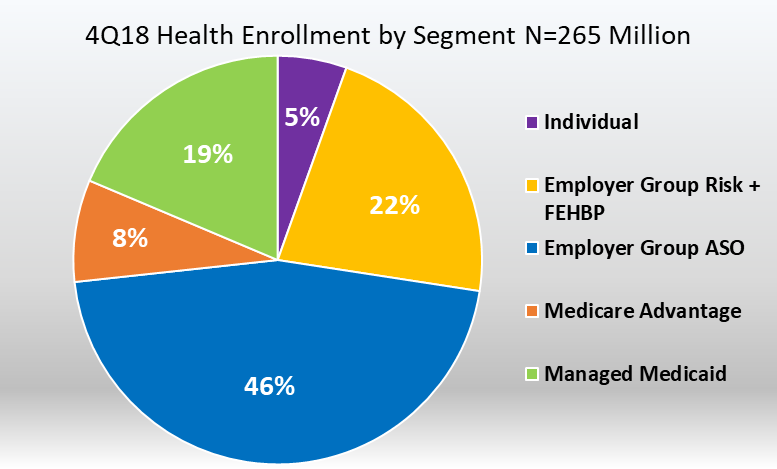
Mark Farrah Associates (MFA) assessed the latest year-over-year enrollment trends, comparing fourth quarter 2017 with fourth quarter 2018 segment membership based on data filed in statutory financial reports from the NAIC (National Association of Insurance Commissioners) and the CA DMHC (California Department of Managed Health Care).  As of December 31, 2018, almost 265.2 million people received medical coverage from U.S. health insurers.  This number is down from 265.6 million, or approximately 428,000 members, from a year ago. Year-end enrollment trends indicate membership gains for Medicare Advantage (MA) and Employer Group administrative services only (ASO) business while the managed Medicaid market, Individual, and Employer Group Risk segments experienced year-over-year declines.

Segment by Segment Enrollment Trends

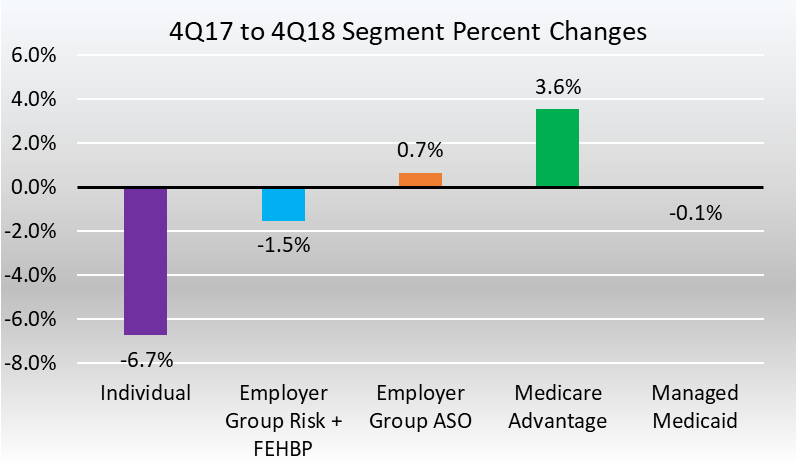
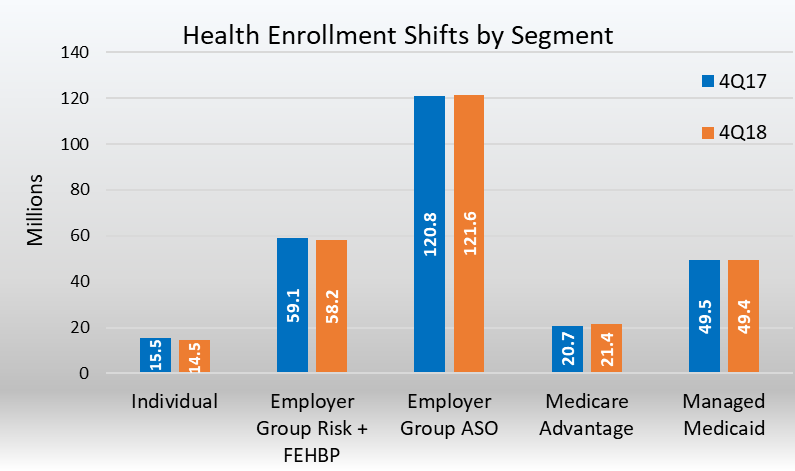
As of December 31, 2018, the Individual segment lost over 1.0 million members year-over-year (YOY) and the Employer Group Risk segment, including Federal Employees Health Benefit Plans (FEHBP) business, experienced a decline of approximately 897,000 members. The Employer Group ASO segment persisted as the largest source of coverage in the industry, enrolling nearly 121.6 million people. Medicare Advantage experienced moderate growth in membership as over 736,000 more seniors chose an MA plan YOY.  Managed Medicaid saw a slight decrease YOY, by more than 36,000 members.  A more in-depth look at each segment follows.

  • The Individual segment experienced a significant decline of 6.7% from 15.5 million in December 2017 to 14.5 million in December 2018. Some factors that have led to a decrease in the individual market include increased costs for providers, increased premiums for members, and the repeal of the Affordable Care Act’s (ACAs) individual mandate.
  • Managed Medicaid membership marginally declined by 0.1%, or approximately 36,000 enrollees between December 31, 2017 and December 31, 2018.  Despite the decline in membership, Medicaid continues to be the largest government-sponsored health program in the United States, measured by enrollment.
  • Medicare Advantage (MA) enrollment increased from 20.7 million as of December 31, 2017 to 21.4 million at year-end 2018 according to plan-reported statutory reports. The MA segment remained the segment leader in terms of percentage increases – consistently growing YOY.


  • Employer Group Risk membership, including Federal Employees Health Benefit Plans (FEHBP) membership, experienced a 1.5% decline between 4Q17 and 4Q18. This equates to a segment decrease of over 897,000 as more employers continue to shift towards self-funded (ASO) insurance for their employees.
  • Employer group ASO (administrative services only for self-funded business) membership grew by over 814,000 members from December 2017 to December 2018.  YOY, the increase was 0.7%, nearly offsetting the decrease in the Employer Group Risk decline at a one-to-one ratio.  MFA identified 121.6 million ASO covered lives, which encompassed 46% of total health enrollment by segment for 4Q18.

Conclusion

As of December 31, 2018, almost 265.2 million people received medical coverage from U.S. health insurers, down approximately 428,000 members from a year ago. Year-end enrollment trends indicate membership declines for a majority of the health care segments. Health care will continue to be subjected to regulatory and political pressure as the upcoming presidential election approaches.

The Individual market continues to be the most volatile health care segment. Repealing the ACA remains a controversial topic that is gaining steam as 2020 swiftly approaches. While there has yet to be a popular front runner in terms of a conservative replacement plan, Medicare for All is a progressive replacement plan that aims for public sector health insurance.  In addition, managed Medicaid has expanded under the ACA but recently work requirements have gained popularity. Managed Medicaid work requirement waivers have already been approved or are currently pending in 15 states. Currently, 37 states including the District of Columbia have chosen to expand their Medicaid programs. Although Montana is counted in the 37 expanded states, a bill is currently being discussed that would extend the current expansion cutoff date past June 30, 2019.


About the Data

The data used in this analysis brief was obtained from Mark Farrah Associates’ Health Coverage Portal™ database. It is important to note that MFA estimated fourth quarter 2018 enrollment for a small number of health plans that are required to report quarterly enrollment but hadn’t yet filed.  Employer group ASO figures may be estimated by Mark Farrah Associates using credible company and industry resources.  Individual, Non-Group membership reported by some carriers may include CHIP (Children’s Health Insurance Program).

These adjustments may have resulted in moderate understatement or overstatement of enrollment changes by segment. Findings reflect enrollment reported by carriers with business in the U.S. and U.S. territories.  Data sources include NAIC (National Association of Insurance Commissioners) and the CA DMHC (California Department of Managed Health Care).  As always, MFA will continue to report on important plan performance and competitive shifts across all segments.


About Mark Farrah Associates (MFA)

Mark Farrah Associates (MFA) is a leading data aggregator and publisher providing health plan market data and analysis tools for the healthcare industry.  Our product portfolio includes Health Coverage Portal™, County Health Coverage™, Medicare Business Online™, Medicare Benefits Analyzer™, and Health Plans USA™.  For more information about these products, refer to the informational videos and brochures available under the Our Products section of the website or call 724-338-4100.

Healthcare Business Strategy is a FREE monthly brief that presents analysis of important issues and developments affecting healthcare business today.  If you would like to be added to our email distribution list, please submit your email to the “Subscribe to MFA Briefs” section at the bottom of this page. 

Request Information

Thank you for your interest. Please send us your email and we will contact you
within 1-2 business days.
SEND


Trump administration appeals association health plan ruling

https://www.fiercehealthcare.com/payer/dept-labor-defends-rights-small-businesses-to-expanded-health-plans?mkt_tok=eyJpIjoiTXpCbFpXWXpPR1JtTTJSayIsInQiOiIyUWdwd0NuaU9YSUFYcmg1UnlDUm84Tk4yXC8weWpLOG5hT0lXWHJSRjIzMllDUFZmU05XSFpKWmRrQ3R0NjhPV3VSbk5KTFVYbEdPMXZmMHF1Q0JRbCtRNzZzSWFPV1Y2N1hnMmpRVlNtS1wvNmRZSE1YREZnbUNLM3ZnMXE2ejhBIn0%3D&mrkid=959610

Gavel court room lawsuit judge

The Trump administration will appeal a judge’s ruling that struck down much of its rule expanding association health plans (AHPs).

The rule made it easier for an association of employers to establish an employee welfare plan—regulated under the Employee Retirement Income Security Act (ERISA) and the Affordable Care Act—as a single employer plan. In other words, small employers can work together with others in their industry or geographic area to purchase a larger health plan.

The Department of Labor filed a notice of appeal (PDF) Friday.

Eleven states and the District of Columbia filed a lawsuit saying that the definition of “employer” in ERISA was not reasonable. A federal district court agreed and set aside regulations for qualifying associations, saying that the Labor Department failed to put a limit on the types of associations that can qualify to sponsor an AHP.

“This appeal is welcomed by associations across the country who have invested their time, money and reputation to launch health plans under the 2018 regulation,” Kev Coleman, president and founder of AssociationHealthPlans.com, said in a statement. “This regulation marked a watershed in health policy inasmuch as it corrected a basic unfairness existing in health coverage costs between small companies and large companies.”

Critics, meanwhile, argue the plans offer skimpy coverage that can leave consumers at risk.

Currently, there are an estimated 30,000 small-business employees and their dependents using these plans. According to a 2019 healthcare survey by AssociationHealthPlans.com, four out of five respondents supported small businesses working together to offer large company health insurance plans.

In Congress, Sens. Chuck Grassley, R-Iowa, and Joni Ernst, R-Iowa, joined Sen. Mike Enzi, R-Wyoming, in introducing legislation to prevent small business employees from losing their healthcare coverage. The legislation would ensure a pathway for small businesses to offer AHPs under the Labor Department’s final rule.


Ballad Health Relies on Partnerships to Excel With Difficult Payer Mix

https://www.healthleadersmedia.com/finance/ballad-health-relies-partnerships-excel-difficult-payer-mix?spMailingID=15495934&spUserID=MTg2ODM1MDE3NTU1S0&spJobID=1621203648&spReportId=MTYyMTIwMzY0OAS2

Ballad CFO Lynn Krutak said the health system faces significant financial challenges but has the discipline and leadership to navigate obstacles ahead.


KEY TAKEAWAYS

CFO Lynn Krutak said the system’s most significant challenge is its payer mix.

Luckily, she says, Virginia’s decision to expand Medicaid will help somewhat in terms of recouping from years of cuts.

Ballad Health also has a $308 million, 10-year spending plan in the works.

Last year, Mountain States Health Alliance (MSHA) and Wellmont Health System, merged to form Ballad Health. The fact that the two rural systems merged was not typical because it formed under a certificate of public advantage (COPA).

This legal agreement governs the merger through joint oversight from both the state of Tennessee and Virginia and also includes “enforceable commitments” to invest in population health, expand patient access, and boost research and education opportunities.

According to the Millbak Memorial Fund, the COPA acts as a “state-monitored monopoly—or a public utility model of healthcare delivery.”

Related: Ballad Health Launches Changes Across Newly Merged Hospital Network

Lynn Krutak, who served as CFO for both MSHA and its corporate parent Blue Ridge Medical Management, was elevated as CFO at Ballad Health. In an interview with HealthLeaders, Krutak emphasized how she implemented effective cost-cutting strategies within a challenging payer mix and low-wage index area.

This transcript has been lightly edited for brevity and clarity.

HealthLeaders: Can you describe the challenges and opportunities for Ballad Health in its provider market?

Krutak: The majority of our hospitals are either in southwest Virginia or northeast Tennessee, so we have high-use rates. From the payer standpoint, as more people move into managed Medicare and managed Medicaid, we know those use rates are going to fall.

Our population growth is flat to even declining; a lot of our counties in southwest Virginia are coal counties that have been hit hard by the [employment] reductions. So, with the use-rates decline, population decline, and the reimbursement decline that we’re all faced with, we know that there are going to be issues going forward.

As far as our payer mix, we’re heavily governmental. Over 70% of our payer mix is Medicare, Medicaid, or self-pay. We can continue to see the payer mix decline as well. We are also faced with high-deductible health plans out there now, with the patient portion of those deductibles being so high our bad debt has increased over 30%.

Fortunately, Virginia has implemented a Medicaid expansion program, so we will get some relief. However, we’ve had years of ACA cuts and this is a small portion. With the cuts that we’ve had versus what we’re going to gain back from Medicaid expansion, we’ll still be in the red.

Our wage index with Medicare is another hurdle we have. We are in the fourth-lowest wage index area in the country; we’re getting about half of what other [systems] are getting. We’ve done a good job of controlling our costs because we have to.

We’re excited about the potential with some of the things that we’re going to be able to do as a merged organization. We have $308 million in spending commitments over the next 10 years, but we have about twice as much in estimated savings. We’ve been able to achieve a lot of that already and we’re working hard on our continued integration.

This merger’s unique and what we’re going to be able to do is take costs out of the system, as far as redundant and duplicative costs go, and then reinvest them back.

HL: Can you describe some initiatives Ballad is looking to pursue in the next few years?

Krutak: As far as the labor costs, we’ve done a great job controlling our labor by not using contract labor for nursing. During the nursing shortage, other systems were using contract labor, it was something that MSHA did not have to do.

We have East Tennessee State University right in our backyard in Johnson City, where we work with them to develop nursing programs and offer scholarships to students in return for a work commitment.

Of the investments through COPA, where we have committed $308 million over a 10-year period, [is] $75 million is going to common health issues facing children. We’ve made a commitment to bring on specialists—specifically pediatrics—and be able to keep these patients and their families in the region and not have to send them elsewhere.

We’ve also committed $140 million to mental health, addiction, or rural health [initiatives] with $85 million going to behavioral health. That’s an issue for our service area in northeast Tennessee and southwest Virginia.

Finally, we have $8 million set for clinical effectiveness and patient engagement mainly related to health information exchange. Wellmont was on Epic, MSHA was on Cerner, so we agreed to convert the whole system to Epic, which will happen in April 2020.

HL: How is Ballad best positioned to navigate the direction healthcare is going while still providing the best quality service to its patients?

Krutak: We’ve been working with our state representatives to craft a fair wage index bill, where Ballad would get some relief and revamp how those calculations are done. In other words, you would not be penalized if you do a good job controlling your costs.

Our CEO, Alan Levine was secretary of health in Florida and secretary of health in Louisiana. We have Tony Keck, who is the executive vice president of our development, innovation, and population health improvement, who was secretary of health in South Carolina. We have a lot of insight on the [governmental] side of things from them.

We’re positioning ourselves to take costs out of the system but also to switch over from fee-for-service plans to looking at risk-based contracts. How do we get paid more for showing better patient outcomes? We’re looking over the next five years to transition into more of that than your traditional payments.

HL: What advice would you give to CFOs from rural systems to make the most of what are sometimes challenging financial situations?

Krutak: As a result of the merger, I’m relieved that we’re going to be able to have these savings to reinvest in rural areas. The largest issue we face with the payer mix shift is that it’s hard to get physicians in rural areas.

My advice to them is just make sure that you are controlling your costs as much as you possibly can and look to partner with other systems that may be near you that could provide physician-sharing arrangements.

For the reimbursement side, it’s always actively looking at how you’re being paid and what you’re being paid. Work with your government officials and partner with your hospital associations, to say, ‘Hey, if we’re going to continue to keep these rural hospitals and provide access, then there’s going to have to be changes as far as how that reimbursement is calculated and how those facilities are compensated.’

On the cost side, make sure that that you’ve situated yourself appropriately and then as things transition to outpatient, be sure the investments that you’re making are being made in the right places.


Red states’ Medicaid gamble: Paying more to cover fewer people

https://www.axios.com/republicans-medicaid-affordable-care-act-expensive-d7057a8e-0a55-4f0d-906e-e42aa3f00ba9.html?utm_source=newsletter&utm_medium=email&utm_campaign=newsletter_axiosvitals&stream=top

Illustration of a price tag hanging from an IV stand

Red states are getting creative as they look for new ways to limit the growth of Medicaid. But in the process those states are taking legal, political and practical risks that could ultimately leave them paying far more, to cover far fewer people.

Why it matters: Medicaid and the Children’s Health Insurance Program cover more than 72 million Americans, thanks in part to the Affordable Care Act’s Medicaid expansion. Rolling back the program is a high priority for the Trump administration, and it needs states’ help to get there.

The big picture: The Centers for Medicare & Medicaid Services, under the leadership of Administrator Seema Verma, has made clear that it wants to say “yes” to new limits on Medicaid eligibility, and has invited states to ask for those limits.

  • But CMS hasn’t actually said “yes” yet to some of the most significant limits states have asked for.
  • In the meantime, states are left either with vague ambitions they’re not sure how to implement, or with risky plans that put their own budgets on the line.

What we’re watching: State-level Republicans are waiting for CMS to resolve two related issues: how much federal funding their versions of Medicaid can receive, and the extent to which they’re able to cap enrollment in the program.

  • “These issues are going to continue to be intertwined,” said Joan Alker, the executive director of Georgetown University’s Center for Children and Families.

Verma has reportedly told state officials that she wants to use her regulatory power to convert Medicaid funding into a system of block grants — which would be an enormous rightward shift and probably a big cut in total funding.

  • CMS probably cannot do that on its own, experts said, but it could achieve something similar by approving caps on either enrollment or spending.

Where it stands: GOP lawmakers in a handful of states are looking to Utah, which has bet big on Verma’s authority, for signals about what’s possible.

  • Utah voters approved the full ACA expansion last year, but the state legislature overruled them to pass a more limited version.
  • By foregoing the full expansion, Utah passed up enhanced federal funding. It’s still asking for that extra money — a request CMS has never previously approved.
  • Utah will also ask CMS to impose a per-person cap on Medicaid spending — a steep cut that was part of congressional Republicans’ failed repeal-and-replace bill, and which may strain CMS’ legal authority.
  • If Utah doesn’t get those two requests, its backup plan is simply to adopt the full expansion.

What’s next: Utah is not the only red state leaning into Verma’s agenda, but it’s further out on a limb than any other.

  • Idaho, like Utah, overruled its voters to pass a narrower Medicaid bill. But it preserved an option for people to buy into the ACA’s expansion.
  • Alaska Gov. Mike Dunleavy has said he wants to take Verma up on her offer of block grants; so have legislators in Tennessee and Georgia. But in the absence of any detail about what that means, or what CMS will approve, that’s all pretty vague right now.

If CMS does move forward on any of this, it could face the same threat of lawsuits that have stymied its first big Medicaid overhaul — work requirements.

  • Those rules are on ice in two states because a judge said they contravene Medicaid’s statutory structure and goals. The same argument could await a partial expansion or tough spending caps.

“There’s a clear agenda here to get a handful of states to take up these waivers, which fundamentally undermine the central tenets of the Medicaid program — which [are] that it is a guarantee of coverage, and a guarantee of federal funding,” Alker said.


Las Vegas hospital doesn’t contract with any payers

https://www.beckershospitalreview.com/payer-issues/las-vegas-hospital-doesn-t-contract-with-any-payers.html?origin=cfoe&utm_source=cfoe

Image result for elite medical center las vegas

Elite Medical Center, a Las Vegas-based acute care hospital that some experts say is operating similarly to a 24/7 freestanding emergency room, doesn’t contract with any payers, according to the Milbank News.

EMC is a state-licensed hospital. It is an unaccredited hospital that has no agreements with insurers, meaning patients have to pay out-of-network prices for care. Under state law, EMC isn’t required to be accredited by CMS or accept public or private insurance.

On EMC’s website, the medical center states, “This facility is not a participating provider in any health benefit plan provider network. However, under the [ACA], your health insurance company is required to process your emergency visit at in-network benefit levels. The physician providing medical care at this facility may bill separately from the facility for the medical care provided to you.”

While Nevada doesn’t provide licenses for freestanding ERs — though hospitals can open satellite ERs at other locations — EMC obtained a state license to operate as a hospital. As a result, it has to be able to admit patients for 48 hours.

Bill Welch, president and CEO of the Nevada Hospital Association, told Milbank News: “We think that Elite Medical Center, if they want to operate as a hospital in the state, that they should operate as a CMS-certified center and they should be accredited and Medicare participating. Without those things, we’re concerned.”

EMC CEO Butch Frazier defended the hospital in an emailed statement to the publication, saying it often has higher online patient ratings than University Medical Center in Las Vegas.

“EMC tries hard to make sure that the ultimate charges paid by the patients and by the insurers to EMC are in line with what they are paying for the same services at other hospitals in the area,” Mr. Frazier said. He added that EMC is seeking CMS accreditation.


Considering “Single Payer” Proposals in the U.S.: Lessons from Abroad

https://www.commonwealthfund.org/publications/2019/apr/considering-single-payer-proposals-lessons-from-abroad

Flags and sky 21x9

ABSTRACT

  • Issue: When discussing universal health insurance coverage in the United States, policymakers often draw a contrast between the U.S. and high-income nations that have achieved universal coverage. Some will refer to these countries having “single payer” systems, often implying they are all alike. Yet such a label can be misleading, as considerable differences exist among universal health care systems.
  • Goal: To compare universal coverage systems across three areas: distribution of responsibilities and resources between levels of government; breadth of benefits covered and extent of cost-sharing in public insurance; and role of private insurance.
  • Methods: Data from the Organisation for Economic Co-operation and Development, the Commonwealth Fund, and other sources are used to compare 12 high-income countries.
  • Key Findings and Conclusion: Countries differ in the extent to which financial and regulatory control over the system rests with the national government or is devolved to regional or local government. They also differ in scope of benefits and degree of cost-sharing required at the point of service. Finally, while virtually all systems incorporate private insurance, its importance varies considerably from country to country. A more nuanced understanding of the variations in other countries’ systems could provide U.S. policymakers with more options for moving forward.

Background

Despite the gains in health insurance coverage made under the Affordable Care Act, the United States remains the only high-income nation without universal health coverage. Coverage is universal, according to the World Health Organization, when “all people have access to needed health services (including prevention, promotion, treatment, rehabilitation, and palliation) of sufficient quality to be effective while also ensuring that the use of these services does not expose the user to financial hardship.”1

Several recent legislative attempts have sought to establish a universal health care system in the U.S. At the federal level, the most prominent of these is Senator Bernie Sanders’ (I–Vt.) Medicare for All proposal (S. 1804, 115th Congress, 2017), which would establish a federal single-payer health insurance program. Along similar lines, various proposals, such as the Medicare-X Choice Act from Senators Michael Bennet (D–Colo.) and Tim Kaine (D–Va.), have called for the expansion of existing public programs as a step toward a universal, public insurance program (S. 1970, 115th Congress, 2017).

At the state level, legislators in many states, including Michigan (House Bill 6285),2 Minnesota (Minnesota Health Plan),3 and New York (Bill A04738A)4 have also advanced legislation to move toward a single-payer health care system. Medicare for All, which enjoys majority support in 42 states, is viewed by many as a litmus test for Democratic presidential hopefuls.5 In recent polling, a majority of Americans supported a Medicare for All plan.6

Medicare for All and similar single-payer plans generally share many common features. They envision a system in which the federal government would raise and allocate most of the funding for health care; the scope of benefits would be quite broad; the role of private insurance would be limited and highly regulated; and cost-sharing would be minimal. Proponents of single-payer health reform often point to the lower costs and broader coverage enjoyed by those covered under universal health care systems around the world as evidence that such systems work.

Other countries’ health insurance systems do share the same broad goals as those of single-payer advocates: to achieve universal coverage while improving the quality of care, improving health equity, and lowering overall health system costs. However, there is considerable variation among universal coverage systems around the world, and most differ in important respects from the systems envisioned by U.S. lawmakers who have introduced federal and state single-payer bills. American advocates for single-payer insurance may benefit from considering the wide range of designs other nations use to achieve universal coverage.

This issue brief uses data from the Organisation for Economic Co-operation and Development (OECD), the Commonwealth Fund, and other sources to compare key features of universal health care systems in 12 high-income countries: Australia, Canada, Denmark, England, France, Germany, the Netherlands, Norway, Singapore, Sweden, Switzerland, and Taiwan.

We focus on three major areas of variation between these countries that are relevant to U.S. policymakers: the distribution of responsibilities and resources between various levels of government; the breadth of benefits covered and the degree of cost-sharing under public insurance; and the role of private health insurance. There are many other areas of variation among the health care systems of other high-income countries with universal coverage — such as in hospital ownership, new technology adoption, system financing, and global budgeting — that are beyond the scope of this discussion.


COMMUNITY HEALTH CENTERS MORE FINANCIALLY STABLE UNDER MEDICAID EXPANSION

https://www.healthleadersmedia.com/finance/community-health-centers-more-financially-stable-under-medicaid-expansion?source=EHLM8&effort=B&utm_source=HealthLeaders&utm_medium=email&utm_campaign=MeritWelcomeB&emailid=&utm_source=silverpop&utm_medium=email&utm_campaign=Warming-Merit-Finance-040319%20(1)&spMailingID=15443417&spUserID=Mzc4MjM1NTY0ODgyS0&spJobID=1620654151&spReportId=MTYyMDY1NDE1MQS2

Facilities are faring better in states that expanded Medicaid, according to a new Commonwealth Fund report.


KEY TAKEAWAYS

A year after facing a federal funding cliff, CHCs in expansion states are thriving. 

CHCs provide care to 27 million patients each year, according to the Health Resources and Services Administration.

The financial stability of CHCs, which serve medically vulnerable communities, is a benefit for health systems.

Community health centers (CHC) operating in states that expanded Medicaid under the ACA are 28% more likely to report improvements to their financial stability, according to a Commonwealth Fund report released Thursday morning.

CHCs in Medicaid expansion states reported were more likely to report improvements in their ability to provide affordable care to patients, 76%, than their counterparts in non-expansion states, 52%.

More than 60% of CHCs in expansion states reported improved ability to fund service or site expansions and upgrades for facilities, while only 46% of CHCs in non-expansion states said the same.

These facilities reported higher levels of unfilled job openings for mental health professional and social workers, while also implying a greater openness to operating under a value-based payment model.

The success and viability of CHCs are essential for larger health systems, according to Melinda K. Abrams, M.S., vice president and director of the Commonwealth Fund’s Health Care Delivery System Reform program, adding that CHCs act as a strong foundation for providing primary care to medically vulnerable populations in rural communities.

Abrams said that by making sure patients are insured and receiving care up front, rather than delaying treatment and exacerbating their condition, they are less likely to end up in a hospital emergency room and contribute to a rise in uncompensated care for hospitals.

She also told HealthLeaders that populations with higher enrollment rates make it easier for CHCs to innovate, invest in technology, hire new staff, train existing the workforce, and adopt new models of care.

“[Medicaid expansion] makes it a lot easier to provide high-quality comprehensive care when [a CHC’s] patients have health insurance,” Abrams said. “In this particular instance, it’s a lot easier to innovate and have financial stability when you have more paying patients, which means that it is easier if you are [a CHC] in a state that has expanded Medicaid.”

The Commonwealth Fund report provides a welcome note of positivity for CHCs, which serve vulnerable populations primarily composed by the uninsured, but have faced funding challenges in the past.

During the budget battles that produced multiple government shutdowns throughout the early portion of 2018, advocates wondered anxiously whether Congress would provide long term funding to the nearly 1,400 CHCs operating at nearly 12,000 service delivery sites across the country.

According to the Health Resources and Services Administration, CHCs provide care to more than 27 million patients annually.

The Community Health Center Fund (CHCF), created in 2010 as a result of the ACA, is the largest source of comprehensive primary care for medically underserved communities, according to the Kaiser Family Foundation.

However, Abrams said that Medicaid expansion has also been a beneficial tool for CHCs, as they have begun to see more insured patients while also benefiting from Medicaid reimbursements, even though they are low compared to other reimbursement rates.

CHCs in states that expanded Medicaid have been able to grow the services that are offered while assisting in the ongoing fight against the opioid epidemic, according to the Commonwealth Fund report.

Abrams said that one downside to the growing success of CHCs have been the unfilled positions, mostly for mental health providers, that are falling behind rising demand levels, though she added that this finding is not surprising.

“I think it’s in part because the supply of the workforce is lagging a little bit behind the demand,” Abrams said. “There’s no reason to think that over time that this gap wouldn’t be closed. But we did find that as a challenge, that [CHCs] have a lot of positions open [yet] they’re hiring. A number of these CHCs are in economically depressed areas, so the good news is that there are some jobs available.”

CHCs are much more likely to participate in value-based payment models as a result of Medicaid expansion, with Abrams explaining that changes in payments and delivery models are common during insurance expansions.

She sees the continued progress made on the value-based front by CHCs as a way to “promote better healthcare and save money” over time.