


:focal(1987x783:1988x784)/https://public-media.si-cdn.com/filer/17/00/1700b1d9-5c50-4f0e-beae-693f1147ff19/children_going_to_a_clinic_for_a_health_check_to_prevent_the_wellcome_l0029944.jpg)
At the end of the 19th century, one in seven people around the world had died of tuberculosis, and the disease ranked as the third leading cause of death in the United States. While physicians had begun to accept German physician Robert Koch’s scientific confirmation that TB was caused by bacteria, this understanding was slow to catch on among the general public, and most people gave little attention to the behaviors that contributed to disease transmission. They didn’t understand that things they did could make them sick. In his book, Pulmonary Tuberculosis: Its Modern Prophylaxis and the Treatment in Special Institutions and at Home, S. Adolphus Knopf, an early TB specialist who practiced medicine in New York, wrote that he had once observed several of his patients sipping from the same glass as other passengers on a train, even as “they coughed and expectorated a good deal.” It was common for family members, or even strangers, to share a drinking cup.
With Knopf’s guidance, in the 1890s the New York City Health Department launched a massive campaign to educate the public and reduce transmission. The “War on Tuberculosis” public health campaign discouraged cup-sharing and prompted states to ban spitting inside public buildings and transit and on sidewalks and other outdoor spaces—instead encouraging the use of special spittoons, to be carefully cleaned on a regular basis. Before long, spitting in public spaces came to be considered uncouth, and swigging from shared bottles was frowned upon as well. These changes in public behavior helped successfully reduce the prevalence of tuberculosis.
In the 19th century, city streets in the U.S. overflowed with filth. People tossed their discarded newspapers, food scraps, and other trash out their windows onto the streets below. The plentiful horses pulling streetcars and delivery carts contributed to the squalor, as each one dropped over a quart of urine and pounds of manure every day. When a horse died, it became a different kind of hazard. In “Portrait of an Unhealthy City,” Columbia University professor David Rosner writes that since horses are so heavy, when one died in New York City, “its carcass would be left to rot until it had disintegrated enough for someone to pick up the pieces. Children would play with dead horses lying on the streets.” More than 15,000 horse carcasses were collected and removed from New York streets in 1880. Human waste was a problem, too. Many people emptied chamber pots out their windows. Those in tenement housing did not have their own facilities, but had 25 to 30 people sharing a single outhouse. These privies frequently overflowed until workers known as “night soil men” arrived to haul away the dripping barrels of feces, only to dump them into the nearby harbor.
As civic and health leaders began to understand that the frequent outbreaks of tuberculosis, typhoid and cholera that ravaged their cities were connected to the garbage, cities began setting up organized systems for disposing of human urine and feces. Improvements in technology helped the process along. Officials began introducing sand filtration and chlorination systems to clean up municipal water supplies. Indoor toilets were slow to catch on, due to cost, issues with controlling the stench, and the need for a plumbing system. Following Thomas Crapper’s improved model in 1891, water closets became popular, first among the wealthy, and then among the middle-class. Plumbing and sewage systems, paired with tenement house reform, helped remove excrement from the public streets.
Disease radically improved aspects of American culture, too. As physicians came to believe that good ventilation and fresh air could combat illness, builders started adding porches and windows to houses. Real estate investors used the trend to market migration to the West, prompting Eastern physicians to convince consumptives and their families to move thousands of miles from crowded, muggy Eastern cities to the dry air and sunshine in places like Los Angeles and Colorado Springs. The ploy was so influential that in 1872, approximately one-third of Colorado’s population had tuberculosis, having moved to the territory seeking better health.
Some of this sentiment continues today. While we know that sunshine doesn’t kill bacteria, good ventilation and time spent outside does benefit children and adults by promoting physical activity and improving spirits—and access to outdoor spaces and parks still entices homebuyers. This fresh-air “cure” also eventually incited the study of climate as a formal science, as people began to chart temperature, barometric pressure and other weather patterns in hopes of identifying the “ideal” conditions for treating disease.
Epidemics of the past established an ethos of altruism in the U.S. During the 1793 yellow fever epidemic, Philadelphians selflessly stepped up to save their city. With no formal crisis plan, Mayor Matthew Clarkson turned to volunteers collect clothing, food and monetary donations; to pitch a makeshift hospital; and to build a home for 191 children temporarily or permanently orphaned by the epidemic. Members of the Free African Society, an institution run by and for the city’s black population, were particularly altruistic, providing two-thirds of the hospital staff, transporting and burying the dead and performing numerous other medical tasks.
A 20th-century diphtheria outbreak in a small region in the Alaska Territory inspired a national rally of support—and created the Iditarod, the famous dog sled race. When cases of “the children’s disease” began to mount in Nome, Alaska, in January 1925, the town was in trouble. Diphtheria bacteria produces a toxin, making it especially deadly, unless the antitoxin serum is administered. This serum had been readily available for decades, but Nome’s supply had run short, and the town was inaccessible by road or sea in the winter. Leaping into action, 20 of the area’s finest dogsled teams and mushers carried a supply of the serum all the way from Fairbanks—674 miles—in record time, facing temperatures of more than 60 degrees below zero. Their delivery on February 2nd, plus a second shipment a week later, successfully halted the epidemic, saving Nome’s children from suffocation. Newspapers across the country covered the rescue. It was also memorialized in movies (including the animated Balto), with a Central Park statue—and, most notably, with the annual Iditarod race. The significant challenges of delivery by dogsled also sparked investigation into the possibilities of medical transport by airplane, which takes place all the time in remote areas today but was still in its infancy at the time.
Diseases fueled the growth of fundraising strategies. The polio epidemic of 1952 sickened more than 57,000 people across the United States, causing 21,269 cases of paralysis. The situation became so dire that at one point, the Sister Kenny Institute in Minneapolis, a premier polio treatment facility, temporarily ran out of cribs for babies with the disease. In response, the National Foundation of Infantile Paralysis (NFIP), which had been founded in 1938 by President Franklin D. Roosevelt and later came to be known as the March of Dimes, distributed around $25 million through its local chapters. It provided iron lungs, rocking chairs, beds and other equipment to medical facilities, and assigned physicians, nurses, physical therapists, and medical social workers where they were needed. The March of Dimes success has served as the gold standard in public health education and fundraising since its heyday in the 1940s and 1950s.
Public health emergencies have inspired innovations in education. Starting in 1910, Thomas Edison’s lab, which had invented one of the first motion picture devices in the 1890s, partnered with anti-TB activists to produce short films on tuberculosis prevention and transmission—some of the first educational movies. Screened in public places in rural areas, the TB movies were also the first films—of any type—that viewers had ever seen. The anti-tuberculosis crusade was also a model for later NFIP efforts to combat polio that relentlessly put that disease at the front of public agenda until an effective vaccination was developed and implemented, and set a standard for future public health campaigns.
Past epidemics fueled the growth of civic debate and journalism in the U.S., too. As far back as colonial times, newspapers built their audiences by providing an outlet for debate on controversial issues, including disease. Founders of the New England Courant—the first paper in Colonial America to print the voices and perspectives of the colonists—launched their paper as a vehicle to oppose smallpox inoculation during the 1721 Boston epidemic. As smallpox ravaged the city, a Boston doctor named Zabdiel Boylston began using inoculation, a practice in which people are intentionally infected with a disease, to produce milder cases and reduce mortality risk. Backed by those opposed to the practice, James Franklin started the Courant to serve as a tool to fight it. Inoculation’s success was demonstrated in 1721 and later smallpox epidemics, eventually convincing even staunch opponents of its value—but by inspiring an outlet to air their concerns, the anti-inoculation camp had made an important contribution to public discourse.
Since colonial times, newspapers, pamphlets, and a host of other outlets have continued to thrive and evolve during outbreaks—updating the public on believed transmission and remedies, announcing store closing and quarantine restrictions, advertising outbreak-related job openings (florists, nurses, grave diggers, coffin makers, to name a few), and serving as spaces for public debate. The cycle continues today, as media powers and regular citizens flock to social media to discuss COVID-19—disseminating information, speculating on its origins, expressing fear of its unknowns.

As certain states have continued to lag behind others in issuing stay-at-home orders, the White House has also resisted a more drastic step: demanding that states get with the program.
Vice President Pence made it clear Wednesday that President Trump has decided he doesn’t want to tell states what to do. “At the president’s direction, the White House coronavirus task force will continue to take the posture that we will defer to state and local health authorities on any measures that they deem appropriate,” Pence said.
Pressed again on Thursday after Georgia Gov. Brian Kemp (R) finally got on board with a stay-at-home order, Trump again signaled that the task force won’t seek to compel states. “I think it’s about 85 percent of the states have got the stay at home,” Trump said. “Brian’s a great governor; it’s his decision.”
The thing is, though, Trump is wrong. Eighty-five percent of states are not on board. A New York Times compilation shows that 12 states still have not taken this step. Localities within some of those state have, and the vast majority of the United States is under such orders, population-wise, but this is still not a blanket policy being applied across the country.
And for the first time, Anthony S. Fauci is signaling his frustration with that. After the White House had for days played off this question, the director of the National Institute of Allergy and Infectious Diseases appeared on CNN on Thursday night and for the first time made his position on that issue clear.
“If you look at what’s going on in this country, I just don’t understand why we’re not doing that,” he told Anderson Cooper. “We really should be.”
The question was about a federal mandate and not whether states should take this step themselves, and Fauci was careful to recognize valid questions about states’ rights. But he was also clear that he thinks this should be a nationwide policy, one way or another.
“I think so, Anderson,” Fauci added at another point. “I don’t understand why that’s not happening.”
Part of the reason it’s not happening is that this request has not been enunciated by the president like it was by Fauci on Thursday night. Florida Gov. Ron DeSantis (R) said earlier this week that he was waiting for Trump to tell him what to do. DeSantis eventually succumbed to the pressure himself, but in making his announcement, he cited Trump’s tone about the severity of the issue.
In other words, what the president says matters. And just like Florida and Georgia, all of the 12 remaining holdout states are run by Republican governors. Trump’s say-so would likely carry significant weight with them.
But Trump isn’t just declining to lean on them; he also continues to cling to the idea that certain areas of the country can treat the outbreak differently because they aren’t yet as hard-hit. Asked Wednesday why he wasn’t telling every state to do this, Trump said it was “because states are different.”
“There are some states that don’t have much of a problem,” Trump said. “There is some — well, they don’t have the problem. They don’t have thousands of people that are positive or thousands of people that even think they might have it, or hundreds of people in some cases.”
Trump added: “You have to give a little bit of flexibility. We have a state in the Midwest or if Alaska, as an example, doesn’t have a problem, it’s awfully tough to say close it down.”
About 24 hours later, Fauci offered a diametrically opposed view on this question, saying that every state should have a stay-at-home order. The statement both reinforced that there are certain disconnects between the president and his top health officials and added to pressure on everyone to fall in line.
Plenty of governors have resisted this step, only to succumb to the realities in their states. Fauci is essentially asking: Why are you waiting to be the next one?

I don’t have time for a fully formed post or column on this, but I want to make note of a few ways in which the COVID-19 pandemic is intersecting with drivers of health (which include social determinants and health system factors). The following list is not necessarily exhaustive and my focus is on the U.S.
Fundamentally, it’s interesting how much we are reliant on collective resources — government through policy and shared health care infrastructure. The best thing we can do for ourselves individually is to engage in safe behaviors. But we also need collective action for our future well being. Yes/and, not either/or.

HP has unveiled advanced security for businesses and their remote workforces and disclosed an extensive guide to disinfecting your laptop and other computer equipment.
The new offerings include HP Pro Security Edition, HP Proactive Security, and HP Sure Click Enterprise. These are aimed at the security threats that evolve and disrupt business every day.
With the recent surge of remote workers — due to work-from-home rules forced upon us by COVID-19 — HP said we must all be aware of the increased risks of working from home. Over 80% of home office routers have been found to be vulnerable to potential cyberattacks.
Emails also pose a significant risk to organizations, with over 90% of PC infections originating from attachments and 96% of security breaches not discovered until months later. There are 5 billion new threats per month, based on HP’s estimates.
“Our HP Pro Security Edition takes Sure Sense and Sure Click and bundles [them] with our system,” said Andy Rhodes, global head of commercial PCs, in a press briefing. “Endpoints are still an enormous risk — 90% of infections originate with emails. Every user is at risk here.”
HP Pro Security for small businesses.

With public health concerns over COVID-19 spreading worldwide, HP wants customers to have the information they need to effectively clean HP devices and maintain a healthy work environment.
The Centers for Disease Control and Prevention (CDC) recommends cleaning surfaces, followed by disinfection, as a best practice for the prevention of COVID-19 and other viral respiratory illnesses in households and community settings.
In fact, HP has issued its own whitepaper for cleaning your devices.
“We get asked [about] this every day,” said Rhodes. “If you use the wrong disinfectant, you can actually damage the product.”
A CDC-recommended disinfectant that is also within HP’s cleaning guidelines is an alcohol solution consisting of 70% isopropyl alcohol and 30% water.
The steps below use the CDC-recommended alcohol solution to clean high-touch, external surfaces on HP products:

New data provided to Axios spells out just how outsized a role immigrants play on the high- and low-skilled ends of the economy keeping Americans alive and fed during the coronavirus crisis, Axios’ Stef Kight reports.
By the numbers: Immigrants make up an estimated 17% of the overall U.S. workforce. But the analysis by New American Economy (NAE) shows they’re more than one in four doctors, nearly half the nation’s taxi drivers and chauffeurs and a clear majority of farm workers.
Be smart: The share of immigrants in some health care roles are higher in states that have been hit hardest by the virus.
Between the lines: A large percentage of farm workers, who help maintain food supplies, are unauthorized immigrants, as the New York Times reported.
https://www.axios.com/coronavirus-rich-drawbridges-7567f493-1bed-494e-926c-be897823a706.html
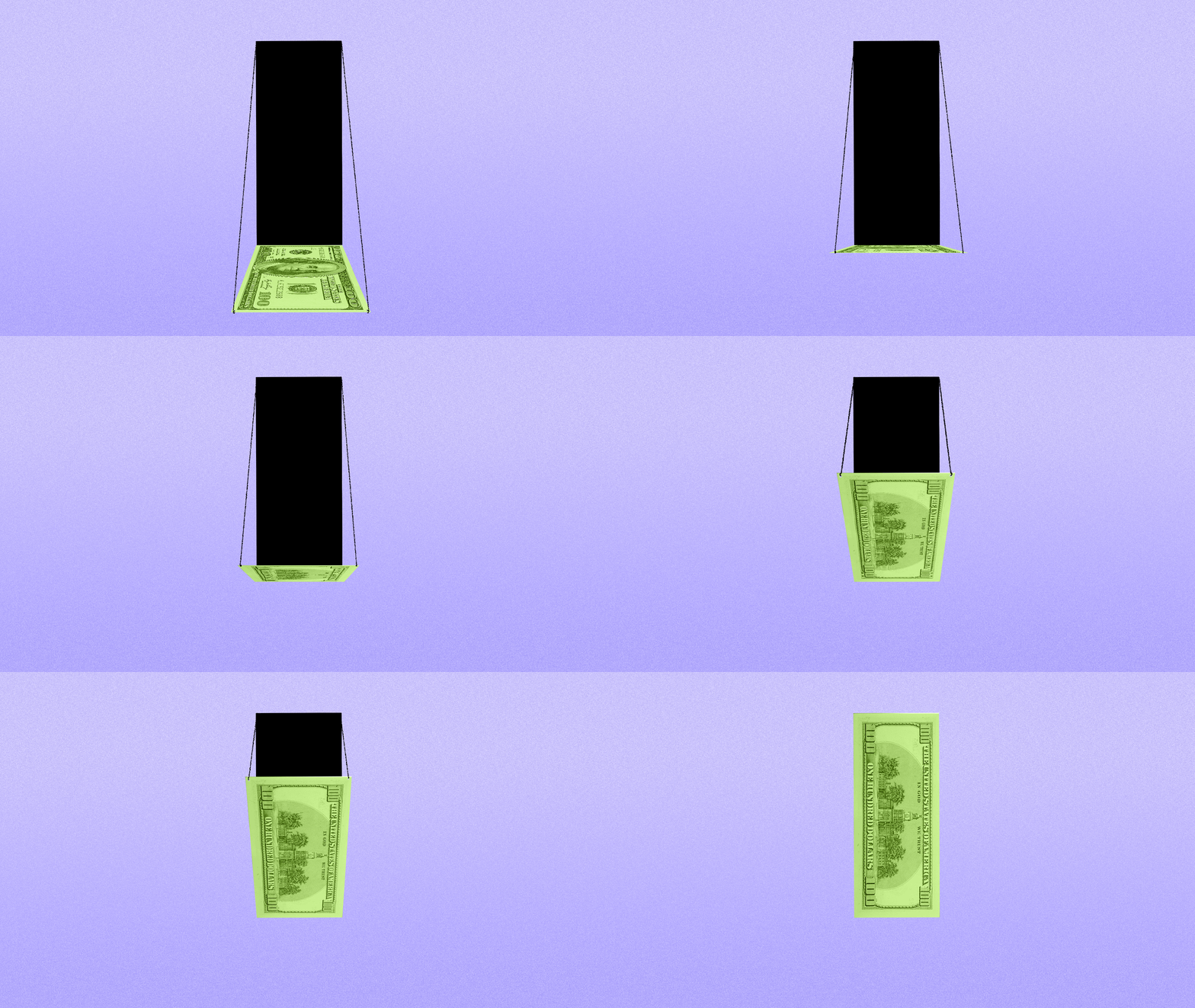
From hastily-chartered superyachts to fortresslike country estates, the wealthiest Americans have found places to ride out the pandemic far away from the masses.
Why it matters: The contrast between the rich vs. poor experience of coronavirus exposes class differences — in housing, access to health care, etc. — that are less obvious in normal times.
Where it stands: Even as elected officials tell us that the novel coronavirus does not discriminate — New York Gov. Andrew Cuomo called it “the great equalizer” — it’s still true that the moneyed classes are walling themselves off and, on the whole, suffering less.
Headlines that tell the story:
What they’re saying: “There is an undercurrent of unequal sacrifice,” Chuck Collins, a senior scholar at the progressive Institute for Policy Studies, tells Axios.
Seasonal vacation resorts don’t have the doctors, hospital beds and other resources to care for throngs of sick people — prompting calls for the moneyed interlopers (renters and owners alike) to go home.
While the wealthy were among the first in the U.S. to contract the virus (as they’re more apt to travel abroad), the brunt of the pandemic has hurt the working poor.
People who live in poverty are more likely to have underlying illnesses that make them more susceptible to coronavirus — asthma, heart disease, hypertension, diabetes.
A tale of two pandemics: As soon as NYC schools closed, real estate agents were flooded with calls from people begging to rent houses in the Hamptons — where a single summer’s lease can easily cost $100,000 — immediately and sight unseen.
To drive there, the renters would have had to pass through Queens — the city’s hardest-hit borough — where “apocalyptic” conditions at a 545-bed public hospital in Elmhurst have turned the neighborhood into a poster child for the virus’ wrath.
The Memo: Scale of economic crisis sends shudders through nation

New data released Thursday revealed the scale of the economic devastation wrought by the coronavirus crisis — and experts say there is no end in sight.
More than 6.6 million new unemployment claims were filed during the week ending March 28, according to the Department of Labor. The figure was double that of the previous week, which had itself been by far the highest since records began.
The stark reality is that roughly 10 million people have been dumped from their jobs in two weeks. A previously robust economy has been scythed down by the virus. A nation that had been enjoying its lowest unemployment rate for decades is now virtually certain to see jobless totals surpass those of the Great Recession a decade ago.
“The present economic situation is awful,” said Jason Furman, a Harvard University professor who served as chairman of President Obama’s Council of Economic Advisers. “The data is just telling us what we can see with our own eyes — there is very little business happening.”
Economists who had already been deeply worried about the immediate outlook are now wondering if their earlier projections were in fact too rosy.
“In our earlier scenario, we had expected 6.5 million job losses by May,” said Beth Ann Bovino, the chief U.S. economist at Standard & Poor’s. That figure will be exceeded, she now believes, given that there were “more lockdowns, more business closures and more businesses just trying to keep themselves alive” by laying off workers.
Heidi Shierholz, senior economist and director of policy at the Economic Policy Institute, said that even the 10 million figure for new unemployment claims was “likely a massive undercount” of actual losses because, during that period, self-employed people and workers in the so-called “gig economy” were generally not eligible to apply. This is changing as a consequence of the package recently passed by Congress that extends eligibility for unemployment benefits, as well as providing other aid for businesses and individuals.
“Our estimate is that by the end of June, 20 million people will have lost their jobs — and I am wondering if even that is optimistic,” Shierholz said.
The political ramifications of such a huge economic shock are unknowable.
President Trump had been looking forward to using the economy as his strongest card as he seeks a second term in November. That card has been shredded.
Trump has promised repeatedly during his White House briefings on the crisis that the nation can bounce back very fast once the public health dangers have receded.
Trump’s approval ratings have also ticked up modestly since the crisis began in many polls. He may be benefitting from the traditional “rallying around the flag” effect that has occurred in previous moments of crisis.
President George W. Bush, for example, hit 90 percent approval in a Gallup poll — the highest result for any president in the polling organization’s history — right after the terrorist attacks of Sept. 11, 2001.
In a statement on Thursday, probable Democratic nominee Joe Biden hit Trump for “failing to prepare our nation” for the ramifications of the coronavirus crisis. Biden called on Trump to allow open enrollment in the Affordable Care Act and also jabbed at Treasury Secretary Steven Mnuchin for having referred to previous unemployment figures as “not relevant.”
In response, Trump campaign communications director Tim Murtaugh blasted back at Biden for “ineffectively sniping from the sidelines, stumbling through television interviews, and hoping for relevance and political gain.”
Economic experts caution that Trump’s promises of a v-shaped recovery, in which the nation jolts itself back into strong economic shape quickly, are almost certainly unrealistic. It will not be a matter of the nation simply rolling the shutters back up and returning to business as usual.
“The economy is not symmetrical,” said Furman. “It is easier to separate someone from a job than to connect someone to a job. In recessions, the unemployment rate can go up very quickly and it comes down very slowly. The worry is that this will be like that.”
Several economic experts who spoke with The Hill made similar points, unprompted, as to the ways the federal government could ease the crisis.
One refrain was that huge assistance needs to be made available to states. States are generally required to balance their budgets. In a situation like the current one, where their tax revenue is cratering, this means they are obligated to severely cut spending — something that most economists believe would deepen and prolong the recession.
Another theme was the need to tie together financial assistance for businesses and the retention of employees.
The recently passed stimulus package makes some effort to do that, particularly in the case of small businesses. The Paycheck Protection Program extends loans to small businesses based upon eight weeks of payroll costs plus an additional 25 percent of the total.
The payroll portion of the loans would be forgiven — rendering them in effect a grant, not a loan — so long as the workforce was maintained at existing levels.
Economic experts praise the principle but worry that the total amount of money in the pot for these loans — $349 billion — may not be enough.
“The small business subsidies will be critical,” said Steven Hamilton, an assistant professor of economics at The George Washington University. “The government needs to get the word out on those, and Congress will likely need to pass an expansion both to adequately fund the existing scheme and to make the scheme more generous to businesses to keep them from laying off workers.”
The public seems to share the view that the aid package, which also includes checks of up to $1,200 for individuals, is a move in the right direction — but unlikely to suffice.
A CBS News poll released late Thursday afternoon indicated 81 percent of Americans support the recent legislation but 57 percent also say it likely won’t be enough.
The same trepidation is shared by the experts, given the unprecedented nature of the coronavirus and the economic crisis it has created.
“It’s like nothing we have ever seen before,” said Shierholz.
 HENRY KOTULA