

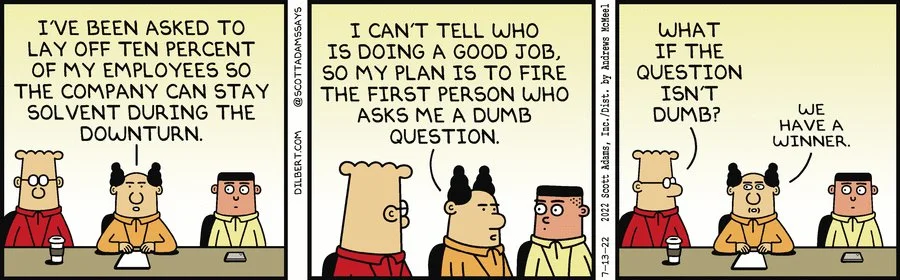
Cartoon – Managing the Downturn


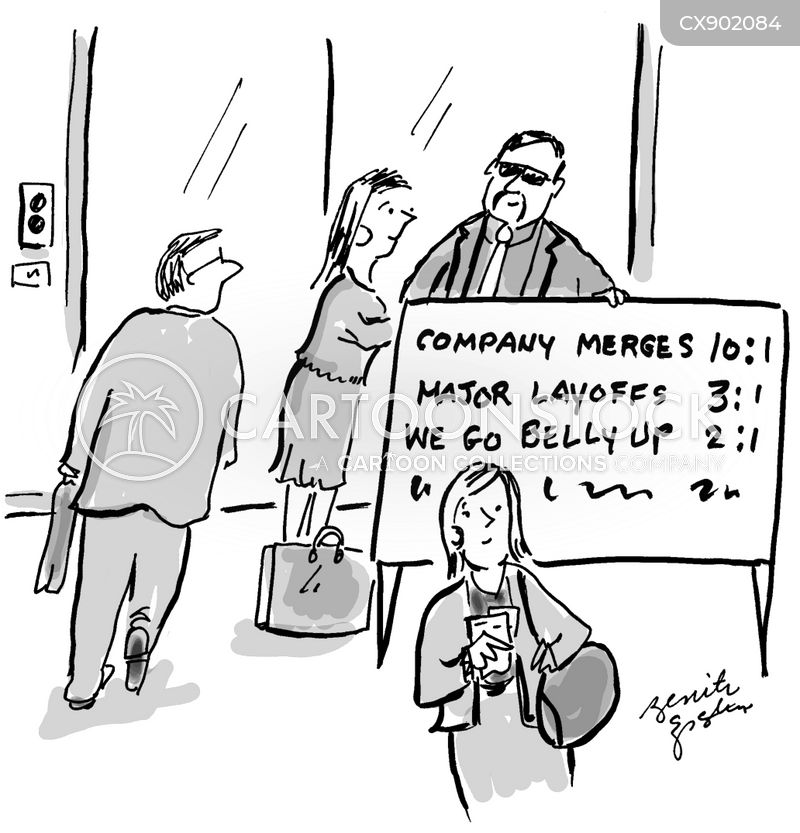


The jobs of young professionals in several white-collar industries are particularly vulnerable as companies scale back hiring plans, pull job listings and lay off workers.
Sixty-five percent of employers see a recession coming and many are taking steps to prepare, according to a survey by Principal Financial Group. If there is a recession, white-collar industries are likely the most vulnerable, said William Lee, PhD, chief economist at the Milken Institute, according to Bloomberg.
“The entry-level white-collar guy is going to have to watch out. That’s going to be the surprise in this downturn,” Dr. Lee said, according to Newsweek.
A Challenger, Gray and Christmas survey revealed companies are preparing for a recession by reducing business travel, laying off staff and implementing hiring freezes.
Many industries, including technology, banking and business services, have staffing numbers that are far above pre-pandemic levels, and the layoffs have already begun, according to Bloomberg. Social media platform Snap, Netflix and Re/Max Holdings are a few of the companies that have recently announced staff reductions.
Read the full Bloomberg article here.
Read the full Newsweek article here.

Envision will see weak liquidity over the following 12 to 18 months, and its $1.4B cash reserve will likely run dry by the end of next year.
Physician staffing company Envision Healthcare is struggling financially, and these struggles are reflected in a Moody’s Investors Service credit rating downgrade, which took into account ongoing labor pressures and a decline in volumes linked to the COVID-19 pandemic.
According to Moody’s, Envision will see weak liquidity over the following 12 to 18 months, and its $1.4 billion cash reserve will likely run dry by the end of next year. Moody’s said bankruptcy or restructuring is likely in the cards, and its Corporate Family Rating (CFR) has been downgraded from C to Caa3.
The rating action follows a series of transactions including restructuring of Envision’s senior secured credit facilities, and issuing a new revolving credit facility in July 2022 and other debt in April 2022 at its subsidiary, AmSurg. Moody’s deemed Envision’s transactions to be a distressed exchange, as the loans were exchanged at a price below par. That’s a default under Moody’s definition.
Envision’s capital structure is unsustainable, the rating agency said. Recovery rates for much of the company’s debt will be low. Moody’s expects operating performance will continue to deteriorate due to ongoing labor pressures within the industry, as well as rising interest rates that will cause interest expense to nearly double.
The refinancing has not materially reduced debt, and while the maturities have been extended, Envision remains at risk of being unable to service its debt.
WHAT’S THE IMPACT
There are some factors in play that mitigate some of the risks. Envision has considerable scale and market position as one of the largest physician staffing outsourcers in the country, said Moody’s. The company has strong product diversification within its physician staffing and ambulatory surgery center segments.
However, continuing business pressures and increased interest expense will cause Envision’s free cash flow to be significantly negative in 2022 and beyond.
When assigning the new ratings, Moody’s considered the expected loss on the Envision debt, which the Rating Agency expects will be significant. Moody’s noted that to the extent that there is asset recovery on the Envision business, the share of proceeds to the term loans will be applied to the Envision senior secured first out term loan before the other debt. But it’s expected that there will be material losses.
The outlook is stable for both Envision and the AmSurg subsidiary. Moody’s expects the company to remain distressed and there is a heightened risk of default given the weak liquidity and risks surrounding the ongoing sustainability of the business.
THE LARGER TREND
Envision operates an extensive emergency department, hospital, anesthesiology, radiology and neonatology physician outsourcing segment. The company also operates more than 250 ambulatory surgery centers in 34 states, and is owned by private equity firm KKR. Revenues for the period ending June 30 were about $7 billion.
Although it’s unlikely in the near term, a substantial improvement in Envision’s liquidity position – including refinancing of the existing debt – would be needed to support an upgrade. Envision would also need an improvement in its operating performance, Moody’s said.
Earlier this month, Envision filed a lawsuit against UnitedHealthcare over the insurer’s denied claims, sparking a countersuit from UHC, which claimed Envision fraudulently upcoded claims for services provided to UHC members.
UHC removed Envision from its network last year, claiming the firm’s costs did not reflect fair market rates. According to Envision’s lawsuit, UHC denied about 18% of submitted commercial claims – a number that swelled to 48% of all claims after Envision’s removal from UHC networks, the firm said. And for the highest-acuity claims, Envision is accusing UHC of denying 60% of those claims.
Meanwhile, in June, physicians at Corona Regional Medical Center and Temecula Valley Hospital in California threatened to leave the hospitals if for-profit owner Universal Health Services changes the staffing management firm to Envision, according to an emergency room doctor who heads the hospitals’ current staffing firm, Emergent Medical Associates (EMA).
Physicians objected to Envision citing concerns of lower pay and staffing levels leading to lower quality of care.
https://mailchi.mp/e60a8f8b8fee/the-weekly-gist-september-23-2022?e=d1e747d2d8

Cross-subsidy economics are increasingly challenged for America’s hospitals. Aging Baby Boomers are moving from commercial insurance to Medicare, decreasing the share of patients with lucrative private coverage, and insurers are increasingly reticent to provide the rate increases providers need to make up for the worsening mix.
At a recent executive retreat, one health system debated the best strategies to increase their capture of commercial volume. Most of the conversation focused on traditional market-based tactics to increase access and awareness in fast-growing, higher income areas of their service region.
For instance, the system’s chief marketing officer was pushing to increase advertising in the rapidly expanding suburbs, and advocated building ambulatory surgery centers in a wealthy area of town with a boom of new home construction.
The chief strategy officer shared a different perspective, supporting an employer-focused strategy. His logic: “In most businesses, the CEO and the janitor have the same benefit plans. If we only focus on the wealthy parts of town, we’re missing a big portion of the workers with good insurance.” He advocated for a new round of direct-to-employer contracting outreach, hoping to steer workers to high-value primary and specialty care solutions.
In reality, any system looking to move commercial share will need to do both—but even the best playbook for building commercial volume is unlikely to close the growing cross-subsidy gap. To maintain profitability in the long term, health systems must reduce costs for managing Medicare patients by delivering lower-cost care in lower-cost settings, with lower-cost staff.
https://mailchi.mp/e60a8f8b8fee/the-weekly-gist-september-23-2022?e=d1e747d2d8

COVID fueled a record year for digital healthcare venture funding in 2021, which included 85 digital health startups achieving “unicorn” status with $1B+ valuations. But 2022 has been marked by cooling expectations amid inflation concerns and recession fears.
In the graphic above, we’ve tracked the stock market performances of six recent healthcare IPOs across their opening, peak, and latest months. While not all of them are pure digital health plays, each of these companies promotes its digital solutions or tech-enabled patient platforms as key parts of their value propositions.
Since going public, each company has lost between 50 and 90 percent of its initial value, more than double the S&P 500’s roughly 20 percent drop from its January 2022 peak to today’s level. The bear market has influenced the venture funding world as well, as H1 2022 fundraising totals for digital health have dropped from last year’s record-setting pace, though they may still surpass 2020 levels by year end.
After the initial fervor, this market correction among “healthtech” companies is not surprising, and acquisitions—like Amazon’s purchase of One Medical—are likely to continue, as long as these market trends hold.
The questions every investor should now be asking: does this start-up have a viable path to profitability in the US healthcare market, and does it deliver meaningful value to consumers?
https://mailchi.mp/e60a8f8b8fee/the-weekly-gist-september-23-2022?e=d1e747d2d8

A recent STAT News article highlights a concerning new trend in direct-to-consumer pharmaceutical marketing, enabled by access to virtual care. Pitched as a tool for patient empowerment, pharmaceutical companies are now offering consumers immediate treatment for a variety of health conditions at the click of a button that says, “Talk to a doctor now.”
Over 90 percent of eligible patients receive a prescription for the drug they “clicked” on, after connecting with a virtual care provider on a third-party telehealth platform. Not only does this practice give drug companies direct access to prospective patients, but it also delivers lucrative data on patient age, zip code, and medication history that can be used to target marketing efforts.
The Gist: Articles like this remind us why the US is one of only two countries in the world that allows direct-to-consumer marketing of prescription drugs (the other, interestingly, is New Zealand).
As the number of Americans with a primary care provider continues to decline, this kind of Amazon-style, easy-button drug shopping experience will be increasingly appealing to many consumers. But wherever innovation outpaces regulation, situations in which for-profit companies prioritize profits over providing the best care for patients are sure to occur.
While we support the idea of greater consumer empowerment in healthcare, we worry that this highly fragmented approach to consumer-driven health can result in abuse and patient harm.
 HENRY KOTULA