Monthly Archives: November 2022
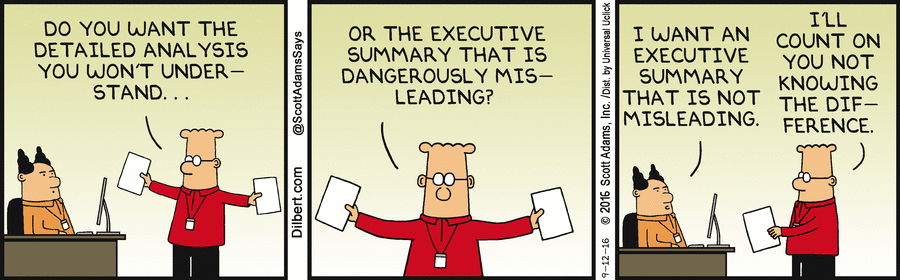
Cartoon – Beware of the Executive Summary
Cartoon – Demonizing Our Critics
GOP floats Medicare changes while ducking details
https://www.axios.com/2022/11/03/gop-floats-medicare-reform

Some House Republicans aren’t waiting for the election to think about overhauling Medicare. But it’s hard to tell if there are specifics behind the talking point.
Why it matters: Past GOP attempts to cut Medicare landed with a thud, and Democrats in recent weeks have been hammering on the message that Republicans are intent on gutting the program.
- The critical moment could be next year’s talks on the debt ceiling, if Republicans flip one or both houses of Congress.
What they’re saying: “If we’re going raise the debt ceiling, we can’t just raise it without focusing on some way to address the debt and the deficit,” Rep. Bruce Westerman (R-Ark.), a member of the House GOP’s health care task force, told Axios, adding Medicare should be made “sustainable over time.”
- “We’re going to have a lot of hearings on this,” Rep. Jason Smith (R-Mo.), the current top Republican on the Budget Committee who wants to move up to chairman of Ways and Means, told Axios. “I’m not going to get into the inner details.”
- “Everything is on the table, we haven’t really nailed down any specific policies one way or the other,” Rep. Buddy Carter (R-Ga.), who is running to chair the House Budget panel. “I think it could be wrapped up with that [debt ceiling talks], that’s shaping up to be pretty dynamic.”
Yes, but: Not all Republicans are eager to kick off their time in the majority with another grinding health care fight against a Democratic president. Health policy experts are also skeptical of how realistic Medicare reform may be, recalling failed GOP agendas from the pre-Trump years.
- Senate GOP Leader Mitch McConnell (R-Ky.) earlier this year rebuked a plan from Sen. Rick Scott (R-Fla.) that would sunset all federal legislation every five years — including entitlement programs. McConnell told reporters a plan that “sunsets Social Security and Medicare within five years … will not be part of the Republican Senate majority agenda.”
- House GOP Leader Kevin McCarthy (R-Calif.) raised eyebrows when he told Punchbowl News last month that he wouldn’t “predetermine” if Medicare and Social Security would be involved in talks on raising the debt ceiling. McCarthy later tried to clarify in a CNBC interview that “I never mentioned Social Security or Medicare.”
- Joseph Antos, a senior fellow and health care scholar at the American Enterprise Institute, puts the odds of Medicare reform as “pretty unlikely,” adding, “I don’t see any major changes happening over the next two years, and I think Republicans might wait to see what Medicare policies the Republican presidential candidate will push.”
The big picture: While a GOP Medicare push is not certain, Democrats are seizing on the possibility.
- “They’re coming after your Social Security and Medicare in a big way,” President Biden said Tuesday in a speech in Florida, saying Republicans would create “chaos” by risking government default over demands to raise the debt limit next year.
Between the lines: Republicans are not being specific about the changes they would push. But there’s a limited universe of possibilities.
- The proposed budget of the Republican Study Committee, an influential group of House Republicans, includes proposals like raising the Medicare eligibility age to 67 to align with Social Security, and converting Medicare to a “premium support” system where seniors received a subsidy they could use on private plans competing against traditional Medicare.
- Tricia Neuman, a Medicare expert at the Kaiser Family Foundation, said such a policy would have “uneven” results, where “some could save money but others might have to pay a whole lot more.”
- Other GOP-backed Medicare changes are less partisan, like “site neutral” reforms to pay hospital outpatient departments the same rates as doctors’ offices, though hospitals oppose those measures.
- The Committee for a Responsible Federal Budget, recently issued a fiscal blueprint to reduce the budget deficit, which included reforms such as changing Medicare provider payments, benefit design and payroll taxes, but included nothing about changing eligibility requirements.
The bottom line: Republicans point to the Medicare trust fund’s projected insolvency date in 2028 to argue change is needed to make the program sustainable. But any change is hard, and cuts that hit beneficiaries are not the only way to seek savings.

- “McCarthy won’t shoot down talk of addressing debt because it matters to him and his caucus, and you can’t do debt without entitlement reform, but he knows at this point there’s no interest from Democrats, and any entitlement reform will require serious political capital from Ds and Rs,” said a former GOP leadership aide. “The last time those conversations happened in a meaningful way was in 2011.”
For hospitals, ‘difficult decisions’ loom after 9 months of negative margins

The third quarter brought little relief to hospitals in what is shaping up to be one of their worst financial years.
Kaufman Hall’s October National Hospital Flash Report — based on data from more than 900 hospitals — found slightly lower hospital expenses in September did not outweigh lower revenue across the board, with decreases in discharges, inpatient minutes and operating minutes.
The median year-to-date operating margin index for hospitals was -0.1 percent in September, marking a ninth straight month of negative operating margins and a dimmer outlook for their climb back into the black by year’s end.
Kaufman Hall noted that expense pressures and volume and revenue declines could force hospitals to make “difficult decisions” about service reductions and cuts.
“Health systems are starting to get a clear picture of what service lines have a positive effect on their margins and which ones are weighing them down,” said Matthew Bates, managing director and Physician Enterprise service line lead with Kaufman Hall. “Without a positive margin there is no mission. Health systems must think carefully and strategically about what areas of care they invest in for the future.”
Health systems suffer while payer profits soar

Large health systems are reporting big losses this year while insurers continue to turn billion-dollar profits.
Humana reported $1.2 billion in third quarter profits, a slight drop from the same period last year. The company has focused on regaining Medicare Advantage market share and increased quarterly revenues 10.2 percent year over year.
Cigna’s third quarter profits jumped 70 percent year over year, hitting $2.8 billion. The company reported $45.3 billion in third quarter revenues and raised its annual earnings outlook based on the results. The company now projects $179 billion for full year 2022 adjusted revenue.
CVS Health also beat investor expectations in the third quarter and raised its earnings outlook. The company’s third quarter revenue jumped almost 10 percent year over year to $81.2 billion, although it reported $3.4 billion in losses after agreeing to pay into a $5 billion global opioid lawsuit settlement over 10 years.
At the same time, health systems are reporting multimillion and even billion-dollar losses. Chicago-based CommonSpirit Health reported $1.3 billion operating loss for the 12-months end on June 30. Ascension, based in St. Louis, also reported a $1.8 billion loss for the fiscal year’s end in June.
Community Health System reported a $42 million net loss for the third quarter in October and both Dallas-based Tenet Healthcare and Nashville, Tenn.-based HCA Healthcare reported more than 50 percent drops in quarterly net income from 2021 to 2022.
The profitability mismatch between the nation’s largest payers and health systems of all sizes will be front and center during contract negotiations in the coming year. There have already been high profile contract impasses between insurers and large systems, with some leading to contract termination.

Thought of the Day: On Loyalty
An overhaul for Medicare’s pay transformation program

The Biden administration is trying to jump start a Medicare program that pays health providers based on patient outcomes rather than by how many services they perform.
Why it matters: The alternative payment effort was created through the Affordable Care Act, but participation has plateaued since 2018 amid waning interest from providers.
Driving the news: The Biden administration finalized an overhaul of the initiative, known as the Medicare Shared Savings Program, on Tuesday. Changes include offering groups of providers in rural and other underserved areas upfront payments to help them start out in the program.
- The rule includes other provisions to make it less financial risky for provider groups to join, and makes it easier for participants to earn money back from the government year after year — a central perk of joining the program.
Zoom out: Medicare traditionally pays on a “fee-for-service” basis pegged to the number of patients seen and volume of procedures performed.
- But one of the main funding sources for Medicare is set to run dry in 2028 if the federal government doesn’t make changes. Advocates say the solution at least partially lies in value-based care programs, like the Shared Savings Program.
- Under the program, doctors, hospitals and other providers join form groups known as accountable care organizations. ACOs take responsibility for the care of a set of traditional Medicare patients.
- If ACOs reduce total care costs for their members, they can get back a portion of that savings from the government. ACOs at more advanced stages of the program must pay the government back if total patient spending crosses a threshold.
By the numbers: ACOs have saved the federal government more than $17 billion since 2012, according to the National Association of Accountable Care Organizations.
- In 2022, 483 ACOs participated in the program and took care of more than 11 million Medicare enrollees. But that’s down from 517 ACOs participating in 2020.
- CMS set a goal last year to bring all 63 million-plus Medicare beneficiaries into a value-based care model by 2030. ACOs are a key player in achieving the goal.
Go deeper: Providers and value-based care advocates are also pushing Congress to extend a 5% pay bump for providers that participate in advanced alternative payment models, including some tracks of the Medicare Shared Savings Program. The bonus expires Dec. 31.
- “If the bonus is not continued, it will soften or dampen the momentum toward alternative payment models, because it would create this mentality, or the view, that we’re not serious about that transformation,” said Mara McDermott, vice president at McDermott+Consulting and executive director of the Value Based Care Coalition.
- Losing the bonus would also make it harder to recruit new providers into alternative payment models, she added.
- The American Medical Association and five other health care groups launched a separate coalition Tuesday to rally around an extension of the 5% bonus.
- “Patients and the healthcare system in the United States quite literally cannot afford to return to the days before Medicare incentivized healthcare providers for generating good results,” Clif Gaus, CEO of the National Association of ACOs, said in a news release about the coalition.
Also notable: The rule finalized Tuesday outlines physician payment rates for 2023. Interventional radiologists and vascular surgeons will see the largest Medicare cuts among physician specialties next year, though the final cuts are slightly lower than what CMS proposed in July.
- Congress could stave off the cuts when they come back to Washington later this month.
- “The Medicare payment schedule released today puts Congress on notice that a nearly 4.5 percent across-the-board reduction in payment rates is an ominous reality unless lawmakers act before Jan. 1,” American Medical Association President Jack Resneck said in a statement.
- CMS finalized a slew of other policy proposals Tuesday, including provisions to reduce barriers to behavioral health care.
Gaming out the winners and losers of health care inflation

Employers, patients or taxpayers could be on the hook for hundreds of billions of dollars in additional health spending if providers and insurers successfully shift those inflation-driven costs, according to a recent McKinsey analysis.
Why it matters: The health care sector’s profits are severely at risk, per the analysis. But key players could yet dodge the bullet coming their way.
By the numbers: The analysis predicts a $370 billion increase in U.S. health expenses by 2027, thanks to rising labor and supply costs.
- McKinsey also surveyed health care leaders, who reported an expected drop in margins between 25 and 75%. This “could necessitate drastic responses,” per the analysis.
Between the lines: These rising costs will initially be borne by providers. It will likely take years for them to shift costs to commercial insurers or the government through contract negotiations or changes to federal reimbursement.
- Insurers will attempt to pass along their increased costs to employers, who will then have to decide whether to pass along the costs to workers.
Yes, but: “Rate increases are unlikely to offer a way out,” the authors warn.
- “While they may seem like the easiest path, payers recognize that price increases beyond historical levels are unsustainable; therefore, other actions will be needed. The actual financers of healthcare — employers, government, and consumers — can’t afford more than historical levels of increase, if that.”
The next health care wars are about costs

All signs point to a crushing surge in health care costs for patients and employers next year — and that means health care industry groups are about to brawl over who pays the price.
Why it matters: The surge could build pressure on Congress to stop ignoring the underlying costs that make care increasingly unaffordable for everyday Americans — and make billions for health care companies.
[This special report kicks off a series to introduce our new, Congress-focused Axios Pro: Health Care, coming Nov. 14.]
- This year’s Democratic legislation allowing Medicare to negotiate drug prices was a rare case of addressing costs amid intense drug industry lobbying against it. Even so, it was a watered down version of the original proposal.
- But the drug industry isn’t alone in its willingness to fight to maintain the status quo, and that fight frequently pits one industry group against another.
Where it stands: Even insured Americans are struggling to afford their care, the inevitable result of years of cost-shifting by employers and insurers onto patients through higher premiums, deductibles and other out-of-pocket costs.
- But employers are now struggling to attract and retain workers, and forcing their employees to shoulder even more costs seems like a less viable option.
- Tougher economic times make patients more cost-sensitive, putting families in a bind if they get sick.
- Rising medical debt, increased price transparency and questionable debt collection practices have rubbed some of the good-guy sheen off of hospitals and providers.
- All of this is coming to a boiling point. The question isn’t whether, but when.
Yes, but: Don’t underestimate Washington’s ability to have a completely underwhelming response to the problem, or one that just kicks the can down the road — or to just not respond at all.
Between the lines: If you look closely, the usual partisan battle lines are changing.
- The GOP’s criticism of Democrats’ drug pricing law is nothing like the party’s outcry over the Affordable Care Act, and no one seriously thinks the party will make a real attempt to repeal it.
- One of the most meaningful health reforms passed in recent years was a bipartisan ban on surprise billing, which may provide a more modern template for health care policy fights.
- Surprise medical bills divided lawmakers into two teams, but it wasn’t Democrats vs. Republicans; it was those who supported the insurer-backed reform plan vs. the hospital and provider-backed one. This fight continues today — in court.
The bottom line: Someone is going to have to pay for the coming cost surge, whether that’s patients, taxpayers, employers or the health care companies profiting off of the system. Each industry group is fighting like hell to make sure it isn’t them.