


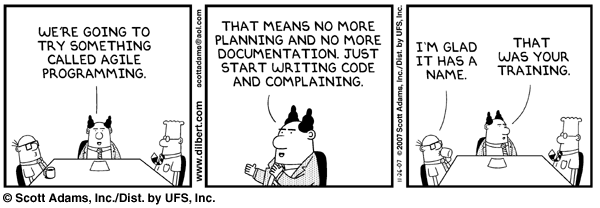
Cartoon – Project Status Reporting


Despite the Covid-19 death count in the United States rapidly accelerating, a startlingly high percentage of health care professionals and frontline workers throughout the country—who have been prioritized as early receipts of the coronavirus vaccine—are reportedly hesitant or outright refusing to take it, despite clear scientific evidence that the vaccines are safe and effective.
Earlier this week, Ohio Gov. Mike DeWine said he was “troubled” by the relatively low numbers of nursing home workers who have elected to take the vaccine, with DeWine stating that approximately 60% of nursing home staff declined the shot.
Dr. Joseph Varon, chief of critical care at Houston’s United Memorial Medical Center, told NPR in December more than half of the nurses in his unit informed him they would not get the vaccine.
Roughly 55 percent of surveyed New York Fire Department firefighters said they would not get the coronavirus vaccine, the Firefighters Association president said last month.
The Los Angeles Times reported Thursday that hospital and public officials in Riverside, Calif., have been forced to figure out how best to allocate unused doses after an estimated 50% of frontline workers in the county refused the vaccine.
Fewer than half of the hospital workers at St. Elizabeth Community Hospital in Tehama County, Calif., were willing to be vaccinated, and around 20% to 40% of L.A. County’s frontline workers have reportedly declined an opportunity to take the vaccine.
Dr. Nikhila Juvvadi, the chief clinical officer at Chicago’s Loretto Hospital, said that a survey was administered in December, and 40% of the hospital staff said they would not get vaccinated.
A recent survey by the Kaiser Family Foundation found that 29% of healthcare workers were hesitant to receive the vaccine, citing concerns related to potential side effects and a lack of faith in the government to ensure the vaccines were safe. Frontline workers in the United States are disproportionately Black and Hispanic. The pandemic has taken an “outsized toll” on this segment of the population, which has reportedly accounted for roughly 65% of fatalities in cases in which there are race and ethnicity data. A study published by the journal The Lancet over the summer found “healthcare workers of color were more than twice as likely as their white counterparts” to test positive for the coronavirus. According to a Pew Research Center poll published in December, vaccine skepticism is highest among Black Americans, as less than 43% said they would definitely/probably get a Covid-19 vaccine. Dr. Juvvadi told NPR that “there’s no transparency between pharmaceutical companies or research companies — or the government sometimes — on how many people from” Black and Latino communities were involved in the research of the vaccine. Dr. Varon said that “the fact that [President] Trump is in charge of accelerating the process bothers” those individuals who refuse to be immunized, adding “they all think it’s meant to harm specific sectors of the population.” In an op-ed published in the New York Times earlier this week, emergency physicians Benjamin Thomas and Monique Smith wrote that “vaccine reluctance is a direct consequence of the medical system’s mistreatment of Black people” and past atrocities, such as the unethical surgeries performed by J. Marion Sims and the Tuskegee Syphilis Study, best exemplifies “the culture of medical exploitation, abuse and neglect of Black Americans.”
“I’ve heard Tuskegee more times than I can count in the past month — and, you know, it’s a valid, valid concern,” said Dr. Juvvadi.
Dr. Anthony Fauci, the director of the National Institute of Allergy and Infectious Diseases, said in a Friday interview that it’s “quite possible” the Covid-19 vaccine could be required for international travel and to attend school at some point in the future.
40 million. In early December, government officials said they planned to have 40 million doses available by the end of 2020, which would be enough to fully vaccinate 20 million Americans. However, according to the Centers for Disease Control and Prevention, less than 3 million Americans have received the first dose of the vaccine, with 14 million doses have been distributed.

England will enter a national lockdown until at least mid-February to stem the spread of the coronavirus, Prime Minister Boris Johnson announced Monday, as the so-called U.K. variant continues to spread throughout the country.
Coronavirus is again surging in the U.K. because of a new, more transmissible mutation of Covid-19 called B.1.1.7.
The lockdown will close all non-essential businesses and restaurants will be required to limit service to takeout orders.
Schools will be closed to all students except for the children of essential workers.
Johnson’s announcement comes after Scotland imposed a similar lockdown earlier Monday.
This is a developing story.

KEY POINTS
Haven, the joint venture formed by three of America’s most powerful companies to lower costs and improve outcomes in health care, is disbanding after three years, CNBC has learned exclusively.
The company began informing employees Monday that it will shut down by the end of next month, according to people with direct knowledge of the matter.
Many of the Boston-based firm’s 57 workers are expected to be placed at Amazon, Berkshire Hathaway or JPMorgan Chase as the firms each individually push forward in their efforts, and the three companies are still expected to collaborate informally on health-care projects, the people said.
The announcement three years ago that the CEOs of Amazon, Berkshire Hathaway and JPMorgan Chase had teamed up to tackle one of the biggest problems facing corporate America – high and rising costs for employee health care – sent shock waves throughout the world of medicine. Shares of health-care companies tumbled on fears about how the combined might of leaders in technology and finance could wring costs out of the system.
The move to shutter Haven may be a sign of how difficult it is to radically improve American health care, a complicated and entrenched system of doctors, insurers, drugmakers and middlemen that costs the country $3.5 trillion every year. Last year, Berkshire CEO Warren Buffett seemed to indicate as much, saying that were was no guarantee that Haven would succeed in improving health care.
Shares of UnitedHealth Group, Humana and CVS Health each climbed more than 2% after the Haven news broke.
One key issue facing Haven was that while the firm came up with ideas, each of the three founding companies executed their own projects separately with their own employees, obviating the need for the joint venture to begin with, according to the people, who declined to be identified speaking about the matter.
Coming just three years after the initial rush of fanfare about the possibilities for what Haven could accomplish, its closure is a disappointment to some. But insiders claim that it will allow the founding companies to implement ideas from the project on their own, tailoring them to the specific needs of their employees, who are mostly concentrated in different cities.
The move comes after Haven’s CEO, Dr. Atul Gawande, stepped down from day-to-day management of the nonprofit in May, a change that sparked a search for his successor.
Brooke Thurston, a spokeswoman for Haven, confirmed the company’s plans to close and gave this statement:
″The Haven team made good progress exploring a wide range of healthcare solutions, as well as piloting new ways to make primary care easier to access, insurance benefits simpler to understand and easier to use, and prescription drugs more affordable,” Thurston said in an email.
“Moving forward, Amazon, Berkshire Hathaway, and JPMorgan Chase & Co. will leverage these insights and continue to collaborate informally to design programs tailored to address the specific needs of our individual employee populations and locations,” she said.
https://www.healthcaredive.com/news/we-feel-bullish-payers-look-ahead-to-2021/585211/

Top executives at some of the biggest commercial insurers outlined their shifting strategies and what markets are growth opportunities in light of the recession at Morgan Stanley’s annual conference.
Top executives at some of the biggest commercial insurers provided a peak behind their curtains at Morgan Stanley’s annual investor conference this week, discussing the pace of utilization recovery and how they’re approaching rate setting and risk going into next year
Though there’s significant uncertainty around the future of the insurance industry, many remarks can be summed up in a line from Cigna CEO David Cordani: “We feel bullish on 2021.”
And despite the major role of government in regulating healthcare, most officials seemed agnostic on the presidential election looming in less than two months.
Payers are reporting skyrocketing profits amid the COVID-19 pandemic as patients deferred care in droves in the second quarter, sparking a congressional investigation into business practices. Use of healthcare services continues to recover from a nadir in March and April, and that recovery has continued into the third quarter, payer executives said. But the pace has differed by segment.
At the start of the pandemic, Humana saw beneficiary use drop to about 30% of pre-COVID-19 levels until mid-May, when it slowly started to tick back up. The Louisville, Kentucky-based insurer’s utilization is now still “a little below par,” but well above that depression and meeting internal expectations, CEO Bruce Broussard said.
CVS Health-owned Aetna has seen its commercial business come back faster than Medicare, CFO Eva Boratto said. Primary care and labs have seen a quicker rebound, but it’s been slower in inpatient and ambulatory.
Centene CEO Michael Neidorff predicts utilization will be between 65% to 80% of normal by the end of the year, but remains cautious due to the shifting nature of the pandemic, and how it could coincide with a potentially nasty flu season.
“We don’t know what other peaks we’re going to see,” Neidorff said.
Unsurprisingly, COVID-19 is also shaping major payer’s go-to-market approaches and how they’re thinking about 2021 bids.
Humana, for example, studied both historical data prior to COVID-19 and did scenario planning around what the pandemic could do to factors like utilization, testing and treatment if it continued throughout the year. Eventually, the payer decided to base bid assumptions off trending historical information forward, according to Broussard.
“We were very oriented to pricing that was more conservative as we thought about the approach,” he said.
It appears Centene, contrastingly, is using 2020 data to risk score. When asked how the payer is approaching rate setting, Neidorff said: “We’re dealing with this year. And we’re saying that any concessions this year should not necessarily carry into next year, which is an entirely different year.”
Employers and plans nationwide are struggling with this issue. Only about 60% of employers are using 2020 claims to set rates for next year, while another 26% are calculating expected medical costs based on data from 2019, and 9% are using data from the first two months of 2020 alone, according to Credit Suisse.
The pandemic has also shifted insurers’ broader strategic priorities in 2021 and beyond, especially by hammering home the need for diversified revenue streams to keep afloat, top execs said.
“We’re in 37 states. If you have a stock that’s not performing well in your portfolio, you probably have some that are offsetting it,” Centene’s Neidorff said.
Humana has been investing in telesales, at-home and in-community offerings and digital capabilities, with an eye for growth. Broussard said Humana’s customers have been mostreactive to an omnichannel approach to care delivery.
For example, the payer is seeing home as an increasingly valid path for care a little more acute in service than in the past. As a result, Humana plans to continue investing in areas that dovetail with that trend, and those with biggest impact on downstream healthcare costs, including primary care, social determinants of health, behavioral health and pharmacy.
CVS has also accelerated development of its virtual care offering, eClinic, as a result of the pandemic and relaxed federal regulations. Visits are up 40% since the end of June, CEO Larry Merlo said, noting he believes the future of healthcare delivery is at the intersection between digital and physical.
Because of the pandemic, “we are seeing an accelerated shift to this multichannel, integrated approach,” Merlo said. “We did change some of our priorities, and accelerate some things that may have been further down the road.”
CVS is continuing to convert existing stores to health- and wellness-focused locations, called HealthHUBs, which devote a fifth of floor space to healthcare products and services. Currently, the Rhode Island-based giant has 275 HUBs up and running, despite pausing conversions for a time in March.
Cigna is also looking to drive revenue by moving beyond a payer’s traditional wheelhouse. On Wednesday, the insurer announced it was rebranding its health services division as Evernorth, in a next step for the Cigna-Express Scripts megamerger completed almost two years ago.
For its part, Centene is introducing more value-based contracts in 2021, after seeing providers it contracts with in alternative payment models are reporting stronger cash flow and patient relationships amid COVID-19 than those in fee-for-service relationships.
Going into next year, the payer is also focused on margin expansion, working with states to set rates and federal lobbying for friendly policies like an increased Medicaid match rate, Neidorff said.
The COVID-19 recession booted millions of Americans off employer-sponsored insurance, though the full scope of the insurance crisis isn’t yet clear. Cigna’s Cordani noted the disenrollment in the first half of the year in its commercial population was lower than expected, helped by the fact the payer is less active in sectors hit hardest by the pandemic like travel and leisure.
But disenrollment could still snowball in the second half of 2020. As a result, a number of major commercial payers are building out offerings in two coverage backstops in the market: Medicaid and the Affordable Care Act exchanges.
Broussard said Humana sees ample opportunity in Medicaid — including the dually eligible — but wants to be more surgical in expansion moving forward, especially as states look for a more contemporary delivery of services and engagement with clinical programs. Humana is going to look for tuck-in acquisitions.
“Is there a way to enter the market in a small way, and leverage our capabilities and grow from that?,” Broussard said.
Cordani agreed that budget-strapped states are looking for new ways to lower costs, but said “Medicaid has always been a lower priority growth platform” for Cigna. Instead, the insurer sees the safety net program as an opportunity for Evernorth in the near term, more than its government business.
Of the 1.1 million new members Centene added from March through August, the majority were in Medicaid, but a significant portion were in the ACA exchanges, Neidorff said. Capitalizing on that momentum, Centene — already the largest payer in the exchanges — is adding 2 new states to its footprint for 2021. “I think we’ll grow in marketplace, given the level of people and the subsidies they get,” Neidorff said. “I see it as a positive going forward.”
Humana, however, is leery on entering the exchange market, given political uncertainty around the upcoming 2020 presidential election, according to its top exec.
“The exchange market has stabilized in a lot of different ways, but still has elements where it tends to be a sicker, more transient population,” Broussard said. “We’d rather not be in the situation where we go in and have to pull out because of the political realm.”
Payers also continue to forecast strong growth in Medicare Advantage. Currently, about 34% of Medicare beneficiaries are in the privately run Medicare plans. It’s a popular program: The Congressional Budget Office predicts MA’s share of the overall Medicare population will swell to 47% by 2029.
CVS is currently on track for mid-single-digit growth next year, and sees Aetna’s continued growth in MA as one of the building blocks to continued earnings power, Boratto said.
Similarly, Cigna is well on track to meeting its goal of 10% to 15% annual organic growth in MA, Cordani said. Historically, Cigna has only been present in about 18% to 19% of the addressable government market, but is trying to eventually expand to 50%.
Unlike years past when some payers worried of Democratic plans for Medicare and other aspects of insurance, most executives seemed to shrugged off the coming presidential election.
President Donald Trump has made undermining the ACA one of the chief goals of his first term, while Democrat nominee former Vice President Joe Biden’s healthcare plan revolves around shoring up the decade-old law, enacting a public option and lowering Medicare’s age of eligibility.
But executives noted Trump’s tenure hasn’t necessarily been bad for them, and having Biden at the helm could provide some opportunity for savvy operators.
Humana could be particularly at risk going into a period of political uncertainty. The payer has a smaller portfolio and fewer assets than some of its bigger peers, Ricky Goldwasser, managing director at Morgan Stanley, said.
But Broussard said regardless of whether the inhabitant of the White House is blue or red, they’ll likely support value-based payment models — a key tenet of its strategy. Additionally, the seemingly-threatening Medicare buy-in option is “very similar to MA,” Broussard said. “We’d see that as the opportunity to expand our ability to bring our capabilities to maybe a younger population, but with a lot of the same elements.”
Some industry experts see the public option, which has bipartisan support among voters, as a potential benefit for companies with leading market share in MA, like UnitedHealth, Humana and Aetna.
“We’ve had public options and done well in public options. So history says that’s fine,” Centene’s Neidorff said. “I think Biden would not be a threat, but an opportunity. I think a Trump re-election would just be more of what we’ve seen. And we’ve done OK with that.”

The deal is designed to boost Centene’s ability to market a “whole health” approach for its members. The COVID-19 pandemic has underscored the need to care for more than just a member’s physical health by also caring for their mental health, the company said Monday.
“This has become even more evident in light of the pandemic which has driven a dramatic rise in behavioral health needs,” Centene CEO Michael Neidorff said in statement. Both boards unanimously approved the deal.
Magellan Health provides managed care and pharmacy services for an array of clients that include health plans, unions and third-party administrators. Centene has been a client of Magellan’s in years past.
Magellan leans on analytics and other technologies in an attempt to improve health outcomes and lower costs. In addition to behavioral health, Magellan focuses on high-cost or complex patients for its clients. In its presentation to investors on Monday, Centene said 71% of total healthcare costs in the U.S. are spent on complex patients, illustrating the need for the deal.
For its healthcare management services, Magellan typically enters into risk-based contracts with its clients where it assumes all or a substantial portion of the risk in exchange for a per member, per month fee. Or, Magellan will enter into an administrative services only agreement in which it reviews utilization and claims administration and manages provider networks, according to its latest 10-Q filing.
The deal is expected to close in the second half of the year pending regulatory approvals. CEO Ken Fasola and other Magellan executives will continue their leadership roles.
Last year, Centene completed its blockbuster acquisition of rival WellCare, a $17 billion deal that catapulted the company to the fourth-largest insurer by membership when including Aetna, which is now part of CVS Health. The deal also doubled Centene’s Medicare Advantage footprint. Centene’s core business is Medicaid managed care and it is the largest insurer on the Affordable Care Act exchanges.
Around half a million Americans are now getting a coronavirus vaccine shot every day. But that pace must accelerate considerably if the United States has any hope of quashing the virus in 2021.
Public health experts differ on how quickly that might happen — and when things might start to feel “normal” again around the country.
After all, we all want to know when we can go to concerts and ballgames again. Or even just go to the office. (Let’s start small.)
We asked two questions. The first has to do with when the United States will reach “herd immunity” — the point at which enough people are immune to a virus, either by recovering from it or getting vaccinated against it. Herd immunity generally kicks in when about 70 percent of people are immune, although experts differ on the precise threshold.
To reach herd immunity with the coronavirus, approximately 230 million Americans would need the vaccine. As of yesterday, just 4 million had gotten the first of two shots. Daily immunizations have increased considerably over the past few days, with about 500,000 people getting the shot each day, but experts say that number needs to at least double and ideally quadruple.
We also asked these experts when they personally expect their lives to return to normal.
Here are their responses, edited lightly for clarity and brevity.
Carlos del Rio, professor of medicine and global health at Emory University:
“At the current pace it will take a really long time. … I think if we can get our act together and start vaccinating 1 million people a day like President-elect Biden is promising, then we can get to 260 million people getting at least one dose … more or less or by late August or early September. If we really scale up and get to 3 million per day, then we can get to 260 million people in [less than] 100 days or three months. Can we do it? Yes! But it will require coordination, leadership and funding. So, as you see, my answer is: It depends.”
Eric Topol, director and founder of Scripps Research Translational Institute:
“I think by July, if we get 2 to 3 million people vaccinated per day, and even sooner, if we have a rapid neutralization antibody assay to be able to defer those who have had a prior infection and mounted a durable immune response. Yes, that is optimistic, but it can be done.”
Jay Bhattacharya, professor of medicine at Stanford University:
“There is a lot of disagreement in the scientific literature about the herd immunity threshold, which is certain to vary from place to place. I don’t think anyone responsible would confidently say what it is, and would never put forward a single number for the U.S. as a whole. Rather, the key question is how rapidly we inoculate people who have a high risk of mortality conditional on infection — most older folks and some late middle-aged folks with severe chronic conditions. Prioritizing them for vaccination will yield the greatest benefit in reducing covid-19-related mortality, regardless of when herd immunity is hit.”
Jesse Goodman, professor of medicine and infectious diseases at Georgetown University:
“I am not sure that in the near future we will reach a level of population immunity where the virus will be virtually shut down, as we are accustomed to with measles. Through immunity due to vaccination, combined, unfortunately, with infections in the unvaccinated, we should reach a state where the risk of exposure is reduced due to a mostly immune population. While cases will still occur, our health system will no longer be stressed and large outbreaks should be less common.
“I am hopeful we can get to such a situation in the last quarter of this year, provided vaccine production, access and acceptance go well and no mutant viruses arise that gain the ability to escape current vaccines.”
Kimberly Powers, associate professor of epidemiology at the University of North Carolina at Chapel Hill:
“That question is difficult to answer, as there is considerable uncertainty around the level of immunity we would need in the population to achieve herd immunity, along with the speed with which we can expect widespread vaccine uptake to occur.”
Leana Wen, public health professor at George Washington University and former Baltimore health commissioner:
“Right now, vaccine distribution is progressing at an unacceptably slow speed, and at this current rate, it will take years to reach herd immunity — if ever. If we are able to pick up speed by many times in January, there is still a chance we could substantially slow down the infection and perhaps approach herd immunity in 2021.”
Marc Lipsitch, professor of epidemiology at Harvard University:
“I think you mean ‘will enough Americans be vaccinated to reach the herd immunity threshold?’ My answer is possibly not because we don’t know if the vaccines protect enough against transmission for the threshold to be achievable, and because the new variant may increase that threshold substantially.”
Michael Osterholm, chairman of the Center for Infectious Disease Research and Policy at the University of Minnesota:
“There are three factors that will independently determine when enough Americans will either be protected from covid-19 via vaccination or development of antibody following actual infection.
“First, when will there be sufficient vaccine produced and distributed so everyone can receive their two doses? This includes vaccinating those who may have immune protection from actual infection but are vaccinated anyway to increase durable protection. Second, will enough people agree to be vaccinated? And finally, what is the durability of vaccine-induced protection over time?
“Each of these factors will play a role in achieving local, regional or national herd immunity protection. I feel confident we can achieve the first factor of sufficient vaccine by the late summer or early fall. But ultimately, the second two factors, how many will be vaccinated and how durable is immune protection will determine the answer to this question. I hope, when considering all three factors, it will be late summer or early fall, but we all realize hope is not a strategy.”
When do you expect your own daily life to feel similar to pre-pandemic times?
Carlos del Rio:
“I am hoping to be ‘close to normal’ by December 2021 more or less. However, as a physician seeing patients, I will probably continue to wearing a face mask and goggles for much longer.”
Eric Topol:
“In 2022.”
Jay Bhattacharya:
“Given the changes that the previous year has had on my professional and personal life, I do not expect my daily life to ever feel similar to pre-pandemic times. More broadly though and given the disappointingly slow roll out of the vaccine to the vulnerable in many states, I anticipate that American society will start to feel more like normal by April 2021.”
Jesse Goodman:
“Hopefully late this year, life should begin to feel similar to pre-pandemic times. However, it is likely that both great vigilance and some social distancing will still be needed, particularly if the population is not nearly all vaccinated. In addition, we may well require periodic immunization against the current and, possibly, other emerging coronavirus variants.”
Kimberly Powers:
“I expect daily life to feel more normal by sometime this summer, but I think it will be 2022 before some mitigation measures can be fully relaxed. And I expect that our society will feel ongoing consequences of this pandemic — physical, mental, emotional, and economic — for years to come.”
Leana Wen:
“I don’t know. I was much more optimistic a few weeks ago. But given the lag in vaccine rollout thus far and how under-resourced our public health systems are, I am concerned things for much of 2021 will feel more like 2020 than 2019.”
Marc Lipsitch:
“I think that sometime in the second half of the year there will be enough vaccination in the U.S. and some other countries that we will begin to treat covid-19 more like seasonal flu, which is deadly to large numbers of people but does not overwhelm health care and does not cause us to curtail normal social contact. This is because with enough vaccine in those at high risk of death and hospitalization, transmission may continue (at a reduced level thanks to some immunity in the population from prior infection and vaccine) but the outcomes will be less severe.”
Michael Osterholm:
“I’m not sure it ever will. We will not go back to a pre-covid-19 normal. We will instead exist in world with a new normal. And even that will in part be determined by the availability of adequate vaccine supply to cover everyone in high, middle and low income countries. I look forward to the day when my office hours are as they were pre-covid-19.”

Twenty states and dozens of localities increased their minimum wage on Friday, giving a financial boost to many frontline workers during the pandemic.
New Mexico will see the largest jump, adding $1.50 to its hourly minimum and bringing it up to $10.50. Arkansas, California, Illinois and New Jersey will each increase their minimum wages by $1.
Alaska, Maine and South Dakota will increase wages by just 15 cents an hour, while the rate in Minnesota will rise by half that, at 8 cents, to $10.08 an hour.
Additional increases are scheduled for elsewhere this year, with most changes taking effect on July 1.
Low-income earners, like much of the country’s workforce, have seen their wages remain relatively stagnant for decades when inflation is taken into account. Proponents say the new raises will help reduce poverty and offer much-needed pay hikes to some of the most vulnerable workers.
“Minimum wage increases income levels, reduces poverty, so I think it’s pretty clear that it improves conditions in the lower end of the wage distribution,” said Daniel Kuehn a research associate at The Urban Institute.
Localities are also boosting their minimum pay. Flagstaff, Ariz., will see wages rise from $13 an hour to $15, as will Burlingame, Calif.
In some municipalities, the increases are dependent on business size. Hayward, Calif., for example, will follow the same wage hike as Burlingame, but employers who 25 or fewer workers will need to raise wages from $12 an hour to $14.
Varying minimum wages across localities, Kuehn said, lets governments take into account different cost-of-living conditions.
“I think the ideal policy would include a lot of local variation, but that doesn’t mean a federal floor isn’t helpful,” he said.
The federal minimum wage has been stuck at $7.25 since 2009. In recent years, the goal of a $15 minimum wage has become a standard progressive policy.
House Democrats in July 2019 passed a bill that would gradually increase the federal minimum wage to $15 gradually through 2025, but the measure died in the GOP-controlled Senate.
“While families work hard to make ends meet, their cost of living has surged to unsustainable highs, inflation has eaten nearly 20 percent of their wages and the GOP’s special interested agenda has left them behind,” Speaker Nancy Pelosi (D-Calif.) said at the time.
“No one can live with dignity on a $7.25 an hour wage,” she added.
The issue is back in the political spotlight again with Tuesday’s runoff elections in Georgia that will determine which party controls the Senate for the next two years.
The Democratic challengers are arguing that the federal minimum wage will only increase if they win both races.
“If the federal minimum wage kept up with the cost of living, it would be even higher than $15,” Democratic candidate Jon Ossoff said last week. “The basic premise is that anybody in this country working a single full-time job should be bringing home enough money to sustain themselves and then some.”
But critics argue that minimum wage increases could slow job growth by raising labor costs for employers, an issue of particular concern during the fragile recovery from the coronavirus recession.
“A dramatic increase in the minimum wage even in good economic times has been shown to be harmful,” said Michael Saltsman, the managing director for the Employment Policy Institute, a think tank tied to the restaurant and hospitality industry.
“In the current climate, for many employers it could be the final nail in the coffin,” he added.
Saltsman argued that increasing anti-poverty programs such as the Earned Income Tax Credit are better policies than wage increases. The tax credit essentially operates as a government subsidy for low-wage work, shifting the onus of paying the extra wages from businesses to taxpayers.
Kuehn said there is little evidence to suggest that small and gradual increases of the minimum wage have significant effects on employment.
“The minimum wage increase levels we see get passed are not large enough to have significant employment effects,” he said.
But he concedes that it’s harder to predict the effects of a quick nationwide boost toward $15.
“I think it’s important to note that since we’ve never had a federal increase of that magnitude, there’s a lot we don’t know,” he said. “With something of that size, you would worry about low-wage places like Mississippi or Alabama.”
A report from the nonpartisan Congressional Budget Office in 2019 projected that a gradual increase to $15 through 2025 would mean “1.3 million workers who would otherwise be employed would be jobless in an average week in 2025.”
But it also specified a range of possible outcomes, including no job losses on the low end and as many as 3.7 million jobs lost on the high end.
The report found that 27 million people would see higher income, and that the poorest families would have wages rise as much as 5.2 percent.
Researchers such as Kuehn are adamant that businesses can handle increasing wages at moderate levels, even in the midst of a global health crisis.
“It certainly doesn’t make businesses’ lives easier, but businesses aren’t struggling right now because of wage costs,” he said.
“They’re hurting because of the pandemic.”

