

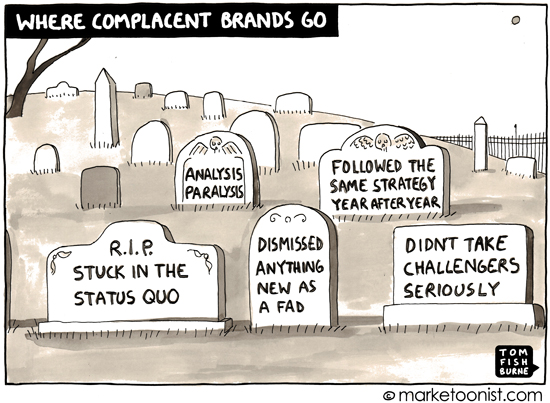
Cartoon – Where Complacent Brands Go

More Americans are dying at home than in hospitals for the first time in more than a half century, according to a new study in the New England Journal of Medicine.
Why it matters: “Americans have long said that they prefer to die at home, not in an institutional setting. Many are horrified by the prospect of expiring under florescent lights, hooked to ventilators, feeding tubes and other devices that only prolong the inevitable,” NYT writes.
By the numbers: In 2017, 29.8% of deaths by natural causes occurred in hospitals, and 30.7% were in people’s homes.
Go deeper: The looming crisis in long-term care

Starting this spring, five corporate giants — Anthem, Cigna, CVS Health, Humana and UnitedHealth Group — will control health insurance and pharmacy benefits for more than 125 million Americans.
Why it matters: Most of this happened through rapid consolidation, and now the pressure is on these companies to prove they can better control both medical and drug spending with everything under the same roof.
The 5 largest conglomerates combining health insurance and pharmacy benefits are on track this year to be bigger than the 5 preeminent tech companies.
The big picture: Anthem, Cigna, CVS Health, Humana and UnitedHealth Group cumulatively expect to collect almost $787 billion in 2019, compared with $783 billion of projected revenue for Facebook, Amazon, Apple, Netflix and Google.
https://www.chicagobusiness.com/health-care/big-hospital-combo-works

Crain’s has learned that at least four hospitals—Advocate Trinity Hospital, Mercy Hospital & Medical Center, South Shore Hospital and St. Bernard Hospital—are in talks with the state to create a single system with one leadership team that includes some combination of inpatient, outpatient and emergency care, as well as skilled nursing. Separately, a private health care consultancy has agreed to buy recently shuttered MetroSouth Medical Center as the first step in a hoped-for combination with other so-called safety-net hospitals.
Both proposals aim to bolster the precarious finances of hospitals that treat large numbers of uninsured and low-income patients on Medicaid. Consolidation could enable the institutions to generate economies of scale, improve bargaining power with insurers, eliminate redundant expenses and cut back duplicative or underutilized capabilities. Bringing the hospitals together also could lead to the centralization of certain services, forcing some patients to seek care farther from home.
South Shore and St. Bernard did not respond to requests for comment.
All four hospitals are operating in the red, with 2018 net losses ranging from $1.3 million at South Shore to $68.3 million at Mercy, according to data compiled by Modern Healthcare Metrics. The hospitals treat a large number of patients on Medicaid, which pays less than Medicare and commercial insurance. Meanwhile, they’re getting less money from various federal and state programs intended to offset the cost of treating patients who can’t pay for care.
St. Bernard CEO Charles Holland Jr. told Crain’s in July that without additional government funding, “we’re going to have to make some difficult decisions. . . .We just cannot continue to go on the way we are.”
Joining forces would enable the hospitals to pool the money they get from various state and federal programs to fund costly transformative initiatives.
The state-led initiative is being driven by the Illinois Department of Healthcare & Family Services, which oversees Medicaid.
“HFS has been and is routinely approached by numerous providers with a variety of ideas seeking to transform to better meet the needs of their communities,” the department said in an emailed statement. “Our department is currently in talks with multiple groups and would provide guidance to any group of providers that came to us with ideas for health care transformation to meet the needs of the community. HFS will also be monitoring closely and engaging directly with community leaders and members to ensure any changes result in expanded care that meets the needs of the communities these hospitals serve.”
Driving a separate, private initiative is Third Horizon Strategies, which has agreed to buy MetroSouth in Blue Island from Brentwood, Tenn.-based Quorum Health for a dollar.
Third Horizon CEO David Smith said he filed articles of incorporation Monday to create an entity called South Side Health, funded by private investors, and—he hopes—government dollars intended for hospital transformation.
“As we build out South Side Health, if other hospitals are successful (in coming together), it will be important to integrate into one system,” Smith said. “At the end of the day, there needs to be one integrated system on the South Side that acts as a financially self-sustaining utility whose sole function is to improve the health that community.”

Corona Calif.-based KPC Group missed the court-appointed deadline to purchase four hospitals from El Segundo, Calif.-based Verity Health, which entered Chapter 11 bankruptcy in August 2018.
KPC Group bid $610 million in January to purchase the four hospitals from Verity. Three months later, U.S. Bankruptcy Judge Ernest M. Robles approved the asset purchase agreement for KPC’s Strategic Global Management to acquire the hospitals. In late November, the judge ordered SGM to close the deal by Dec. 5.
After SGM failed to complete the purchase by the court-appointed deadline, Verity asked the court to issue an order requiring SGM’s principals to testify as to why the deal did not close and whether SGM has the financial ability to close the sale. Verity also asked the court to issue an order finding SGM in breach of the asset purchase agreement and allowing it to keep SGM’s $30 million deposit and proceed with other plans to sell the hospitals.
On Dec. 9, the court denied Verity’s request to force SGM’s executives to appear and testify in court.
“By failing to close, SGM risks the loss of its $30 million good-faith deposit as well as the possibility of damages for breach of contract in an amount of up to $60 million,” Judge Robles wrote in a Dec. 9 court filing. “Being compelled to offer testimony will not motivate SGM to close where the threat of the loss of up to $90 million has failed to accomplish that end.”
The judge assured Verity that it would have the chance to litigate the issues of whether SGM breached the asset purchase agreement and whether it’s entitled to keep the good-faith deposit.
Though neither party has terminated the sale process, the judge said Verity can “explore options for the alternative disposition of the hospitals” without violating the asset purchase agreement.
The next bankruptcy court hearing is slated for Dec. 30.

Centene, the nation’s largest Medicaid managed care provider, wants Congress to change the eligibility requirements around Medicaid, the government-sponsored safety net program that covers one in five low-income Americans.
Its proposal would ultimately push more people onto the Affordable Care Act exchanges by allowing states to adopt a partial Medicaid expansion, an idea typically embraced by red states.
CEO Michael Neidorff told Healthcare Dive the company has been quietly talking to lawmakers on both sides of the aisle on Capitol Hill about the plan, though he emphasized nothing of substance will happen until after the 2020 election.
Centene says its proposal is an attempt to strengthen the ACA markets by increasing the pool of people while enticing holdout states to partially expand their Medicaid programs.
“I think there’s a way to get it done,” Neidorff told Healthcare Dive. “We have a very powerful Washington office and they’ve been working with leadership and their staff.”
Centene filed lobbying forms totaling about $2 million in spending in the congressional lobbying database for 2019, as of Dec. 11. In 2018, the payer reported spending roughly $2.5 million.
However, policy experts caution that it would result in increased spending for the federal government and fewer protections for those enrolled in Medicaid who are then pushed into the exchanges.
It’s unclear how receptive Congress will be, but experts were skeptical of any consensus on the polarizing health law.
“It would be a very major change. I certainly don’t see that happening. It’s opening up the ACA and as we know from past history, it’s a battle royale when you go into the ACA,” Joan Alker, executive director and co-founder of the Center for Children and Families at Georgetown University, told Healthcare Dive.
Under the ACA, states can expand their Medicaid programs to cover all adults whose annual incomes does not exceed 138% of the federal poverty level, or $17,236 for an individual.
Centene’s proposal calls for lowering that income ceiling from 138% to 100%, or $12,490 for an individual.
That would shrink the pool of who is eligible for Medicaid and push those people into the exchanges. Neidorff said the move would grow the exchange pool and ultimately drive down prices. High costs have attracted criticism as they play a role in forcing those who are not subsidized to leave the market.

For Centene, it would be a notable shift because its core business has long been in Medicaid. The insurance exchanges only became a viable business beginning in 2013 with the advent of the ACA. It’s a nod to how important the exchange business has become for the payer.
Centene arguably stands to benefit the most as the nation’s largest insurer on the exchanges in terms of enrollment, plus the exchanges generate higher profit margins than its Medicaid book of business.
“You move those lives into exchange and your profitability is higher,” David Windley, an analyst with Jefferies, told Healthcare Dive.
In the states that have not expanded Medicaid, there are about 2 million people with incomes between 100% and 138% of the federal poverty level, according to the Kaiser Family Foundation.
Hospitals and providers are likely to favor the proposal because Medicaid plans tend to pay less than commercial ones. The idea could garner support from states with tight budgets as some, even Massachusetts, have already expressed a desire to adopt a partial expansion. (Both the Trump and Obama’s administrations have denied providing the enhanced match rate for states seeking partial expansions).
Still, there are potential drawbacks, according to analysts and policy experts. For example, the plan could potentially cost taxpayers more if there is a greater shift to the exchanges away from Medicaid coverage.
“Medicaid is broadly accepted as the cheapest coverage vehicle in the country,” Windley said, noting that the exchanges are typically a more expensive insurance product than Medicaid coverage.
Plus, because of the way the ACA was written, the federal government would be forced to pick up the entire tab of the subsidies for those between 100% and 138% of FPL.
“As a result, the states save money for every beneficiary whom they can move from Medicaid into their exchanges,” according to a previous paper in the New England Journal of Medicine.
However, policy experts warn the proposal may not be in the best interest of Medicaid members who would migrate to the exchanges.
These members are better off with Medicaid, Alker said.
“From a beneficiary perspective it’s problematic because there are no premiums in Medicaid for that group, 100-138 [FPL]. The cost sharing is very limited,” she said.
Plus, there are benefits in Medicaid members would no longer have access to if they move to the exchanges, Adrianna McIntyre, a health policy researcher at Harvard University, told Healthcare Dive, including non-emergency transportation and retroactive eligibility.
Centene argues many states have avoided expanding Medicaid because of cost concerns, which then leaves some residents without access to affordable care, particularly those in the coverage gap, or those with incomes below 100% of FPL.
If a partial option convinces some holdout states to expand “that’s a tradeoff some may be willing to make,” McIntyre said.
Some states that did expand are looking for ways to curb costs and have decided to implement work requirements, Neidorff noted. He believes the proposal is the answer to both these problems for states.
Centene’s plan comes as a slate of Democratic presidential contenders are calling for “Medicare for All,” a single-payer or public-option healthcare system.
Not surprisingly as such a plan would at a minimum sideline private plans and at the extreme eliminate private payers, Neidorff dismissed the idea.
He estimates his plan would cost $6 billion a year, which he characterized as “very affordable” when compared to a Medicare for All plan, which some studies estimate could cost as much as $32 trillion over 10 years.
Still, some policy experts say the change being proposed by Centene is a tall order.
Though the changes may seem small, the consequences of adopting a partial expansion are large, researchers wrote in a NEJM report: “The damage to Medicaid beneficiaries, the exchange population, and the federal budget could be serious.”
https://www.healthcaredive.com/news/provider-providence-st-joseph-health-dive-awards/566477/

The 51-hospital system, which traces its roots back to the 1850s, has maintained a stable ratings outlook amid industry headwinds and pursued tech partnerships this year to bolster its portfolio.
Providence St. Joseph Health, the fourth-largest U.S. nonprofit health system by number of hospitals, marked a busy 2019 with multiple efforts to dive into the tech sector and seek out partnerships to tackle the industry’s biggest challenges.
The Catholic system now operates 51 hospitals in eight states as the result of a July 2016 merger of Providence Health and Services and St. Joseph Health. While the organization is the dominant inpatient provider in all its markets, no single area accounts for more than 30% of its net operating revenue, showing good portfolio diversification, ratings agency have noted.
The system, which can trace its roots back to the 1850s when the Sisters of Providence set up hospitals, schools and orphanages throughout the Northwest, posted $24 billion in operating revenue last year. That metric has shown year-over-year increases since the $18 billion posted in 2014.
Providence CEO Rod Hochman told Healthcare Dive the health system hasn’t shied away from seeking partnerships as the industry swings toward value based care and other systemic changes.
“I think the message is: ‘You can’t do it alone,'” he said. “You can’t go out there and just do it yourself — you don’t have the scale to do it.”
In that vein, the system (which is formally rebranding to Providence over the next few years) was one of the founding members of generic drug company Civica Rx, which opened its headquarters and made its first delivery this year. That’s a coalition of hospitals working to make their own drugs, starting with antibiotics.
It’s also grouping up with One Medical to increase access to primary care and teaming with Cedars-Sinai to build a patient tower in southern California. And in February, the organization launched the population health management company Ayin Health Solutions to provide benefits management as well as risk evaluation and care coordination tools.
Providence has maintained a stable outlook from the three main ratings agencies even as other nonprofits struggled to stay above water. Kevin Holloran, senior director at Fitch Ratings, said the system has managed to think about margins the way a public company must while still adhering to the mission-driven thought process nonprofit organizations trumpet.
“Blending those two thoughts together sounds easy, but it’s not,” Holloran told Healthcare Dive. “It’s hard to do.”
Moody’s Investors Service issued a credit opinion recently on Providence, finding the system’s integrated structure that includes a health plan and 7,600 employed physicians creates “further cashflow diversification, and strengthens the organization’s competitive position.”
The analysts wrote they expect operating margins to continue to improve going into next year as it implements dozens of initiatives updating operating practices, cost structures and revenue systems. They note, however, the organization faces a challenge in transitioning disparate EHRs and its numerous joint ventures “may also entail a certain amount of execution and integration risk.”
Holloran pointed to two relatively recent hires as leading the way for Providence — both poaches from Microsoft. CFO Venkat Bhamidipati joined the organization two years ago and CIO B.J. Moore came on in January.
They migrated from the tech world to the traditionally loathe-to-change healthcare landscape, and have made a difference for Providence.
It puts the company in a strategic place for growth, Holloran said. “Now they’re sort of adding that missing piece, which is optimizing what they’ve got,” he said. “And a big piece of that is the technology, and they’re doing it in a unique and interesting way.”
This year, Providence acquired Lumedic, which uses blockchain tools for revenue cycle management, and Bluetree, an Epic consultancy. The health system also allows patients to schedule appointments through Amazon’s smart speaker Alexa.
In July, the health system announced an agreement with Microsoft to use the tech giant’s cloud and artificial intelligence tools in an effort to foster interoperability, improve outcomes and drive down costs.
The organization still has traditional struggles, however. Hochman, who is also the incoming chairman of the American Hospital Association, said the ongoing litigation surrounding the Affordable Care Act, coupled with payment changes and other CMS changes, creates a chaotic environment for providers.
“Every day they come up with something new, and it’s been the lack of predictability that’s been the biggest problem for us,” he said.
https://www.healthcaredive.com/news/health-insurers-stable-ma-seen-diminishing-in-2020-fitch/568859/

Even anticipating an increase in the growth of U.S. health expenditures, Fitch expects insurers to deliver solid operating results, including improved medical loss ratios, for 2020.
There is even a chance for insurers to garner positive ratings outlooks as many look to continue to execute on merger integration and deleveraging, according to Fitch.
Thanks in part to the return of the health insurance fee, Fitch expects medical loss ratios to drop to 82.5% in 2020. A decrease from the expected 83.9% for the full year of 2019 for the nation’s eight largest publicly traded insurers, which cover about 165 million people, according to Fitch.
MLR is an important measure, showing the amount an insurer spends on medical claims as a percentage of premiums. Lower MLRs leave more room for covering administration costs and garnering profit.
Even an upcoming election year and a slate of Democratic presidential hopefuls touting support to expand Medicare, the agency does not expect seismic changes to the system.
“Healthcare will certainly continue to be one of the most prevalent discussion topics among candidates for the U.S. presidency in 2020, but Fitch does not anticipate significant change in the structure of the U.S. healthcare system over the next couple of years,” the report said.
The agency also said it expects major mergers to slow significantly in 2020. The insurance sector has experienced significant M&A activity over the last few years, including CVS Health’s buy of Aetna and Cigna’s acquisition of Express Scripts. Centene is near closing on its purchase of rival WellCare.
Fitch expects consolidation activity next year to focus more on “modest build-out of care delivery opportunities in various regions or care management and technology initiatives.”
https://www.healthcaredive.com/news/nonprofit-hospitals-get-bump-in-moodys-ratings-for-2020/568739/

UPDATE: Dec. 11, 2019: Fitch Ratings also changed its sector outlook for the U.S. nonprofit health systems market to stable from negative for 2020 in a report released Tuesday.
High Medicare reimbursement rates should, along with slightly more favorable commercial reimbursements, drive sector revenue to jump 4% to 5%, Moody’s predicts. Medicare payment rates in 2020 are the most industry-friendly in a while, analysts say, at 3.1% for overall inpatient rates and 2.6% for outpatient.
Fitch Ratings, which also revised its sector outlook from negative to stable, noted balance sheet measures for the providers are now at levels not seen since before the Great Recession in 2007.
Expense management is also forecast to improve cash flow, though provider shortages will cause labor costs to grow.
A growth in the number of uninsured is projected to curb some of the gains expected under this positive forecast, however. The uninsured rate reached 13.7% at the end of 2018, ticking up from 12.2% in 2017 and a low of 10.6% in 2016, according to Gallup. Policy experts blame the elimination of the Affordable Care Act’s individual mandate, along with other Trump administration policies destabilizing the market.
Other regulatory waves could also impact hospital margins next year.
Cuts to Medicaid disproportionate share payments are likely to be postponed until late 2020 at least, which will help hospitals serving a large number of low-income patients. The $4 billion payment reduction was supposed to go into effect in 2014, but lawmakers have delayed the unpopular cuts annually since.
On Nov. 21, the Senate approved a continuing resolution to fund the federal government through Dec. 20. The CR once again pushed back the trims to the Medicaid payments.
A Trump administration policy requiring payers and providers to post secret negotiated rates online could help some hospitals and hurt others, with some health experts arguing it would stimulate competition through transparency and others warning it could cause prices across the board to rise.
Hospital lobbies filed a lawsuit Dec. 4 to stop the rule, arguing it violates the First Amendment and would put overly onerous administrative burdens on providers.
Cuts to the 340B Drug Discount program, meant to prop up hospitals with a large amount of uncompensated care, could also hurt the sector. The program generated an average savings of almost $12 million across all U.S. hospitals last year.
In May, a federal judge struck down planned HHS cuts to 340B, arguing the change was outside of the agency’s authority. However, CMS has said it plans to go through with the payment reductions in the final outpatient rule for 2020.
On the legislative side, the Republican state-led initiative to find the Affordable Care Act unconstitutional would shear an estimated 20 million Americans from coverage and raise premiums on millions more, hitting both hospitals and the consumer hard.
“The fate of the ACA will likely again rest with the Supreme Court,” Moody’s analysts said. “An adverse ruling there would have painful implications for hospitals if millions of individuals lose insurance,” and “coverage gains from Medicaid expansion would likely be lost.”

 HENRY KOTULA