The surge in coronavirus hospitalizations is severe

https://www.axios.com/newsletters/axios-vitals-b0ebd340-d76f-49c3-8f02-cb2896ae2e8d.html?utm_source=newsletter&utm_medium=email&utm_campaign=newsletter_axiosvitals&stream=top

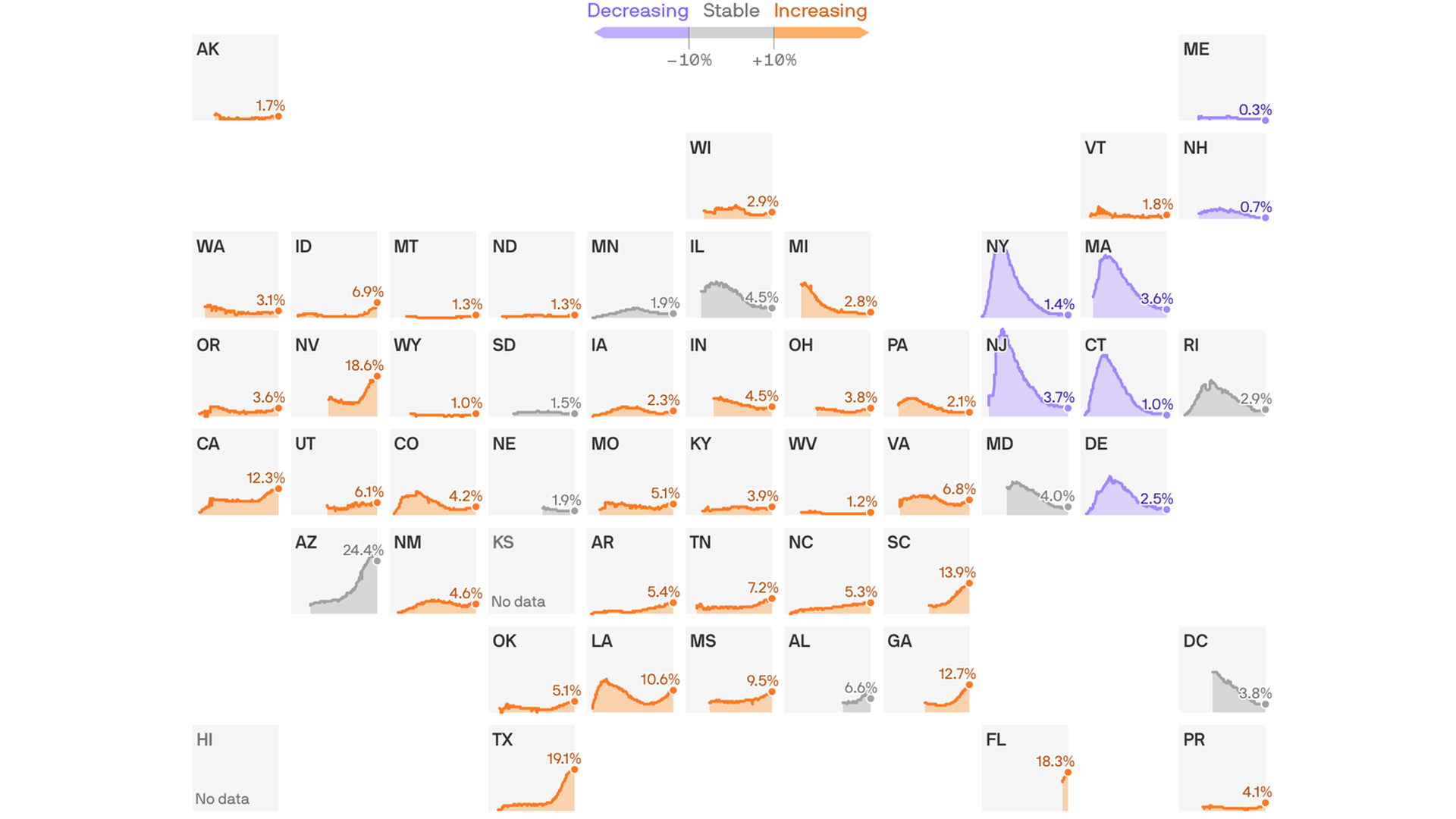
Share of hospital beds occupied
by COVID-19 hospitalizations

States shown from first date of reported data, from March 17 to July 19, 2020

  • In the last two weeks hospitalizations are:

The coronavirus surge is real, and it's everywhere - Axios


Coronavirus hospitalizations are skyrocketing, even beyond the high-profile hotspots of Arizona, Florida and Texas, Axios’ Bob Herman and Andrew Witherspoon report.

Why it matters: The U.S. made it through the spring without realizing one of experts’ worst fears — overwhelming hospitals’ capacity to treat infected people. But that fear is re-emerging as the virus spreads rapidly throughout almost every region of the country.

Where things stand: Arizona remains in the worst shape; 27.1% of all hospital beds in the state are occupied by COVID-19 patients as of July 15, according to an analysis combining data from the COVID Tracking Project and the Harvard Global Health Institute. Texas is second at 18.8%.

  • Nevada is the next worst, with COVID-19 patients taking up 18.7% of all hospital beds. That’s up significantly from 11.2% at the start of July.
  • Florida just started tallying current hospitalization data, showing more than 16% of all hospital beds occupied.

It gets worse: Many other states are showing significant upticks in coronavirus hospitalizations during the first half of July, including Alabama, California, Louisiana, Mississippi, South Carolina and Tennessee.

  • Many of these states, which reopened a lot of their economies in May, do not have mask mandates.

Between the lines: Intensive-care unit beds, reserved for the sickest patients, are completely full in parts of ArizonaFloridaMississippi and Texas.

  • Hospitals can convert other areas into ICUs, but that’s not all that useful if hospitals don’t have enough staff and supplies.

The bottom line: Cases have soared over the past 45 days, and hospitalizations naturally follow many of those cases.

  • Rising hospitalizations mean the outbreaks in many areas are not close to being controlled, and some percentage of those hospitalizations will end as deaths.


Coronavirus updates: U.S. infections top 76,000 in a day as virus’s spread continues unabated

https://www.washingtonpost.com/nation/2020/07/18/coronavirus-updates-us-infections-top-76000-day-virus-spread-continues-unabated/?utm_campaign=wp_main&utm_medium=social&utm_source=facebook&fbclid=IwAR3cnVHnhbmPw7a_og-oZc1Ocgfs-A_y4Qr6Ht8OKDkxpiWv7E7ydb67EqA

Coronavirus in the U.S.: Latest Map and Case Count - The New York ...

The United States on Friday set another record for daily coronavirus infections, with states reporting a combined 76,403 new confirmed cases — more than double the amount the country was reporting daily during the initial surge of cases in the spring.

Coronavirus-related deaths are rising, too, after declining nationally throughout May and June. The country reported 963 fatalities from the virus Friday, the most in a single day since June 3.

Here are some other significant developments:

  • A federal appeals court blocked a lower-court ruling that would have allowed the Republican Party of Texas to proceed with its planned in-person convention in downtown Houston. Mayor Sylvester Turner (D) said the event poses too great a health risk with infections in the area spiraling out of control. “In the middle of a pandemic, the doors remain locked,” Sylvester said of the appeals court’s decision.
  • The nine largest brick-and-mortar retail companies — including Walmart, Lowe’s and CVS — have adopted new policies requiring customers to wear masks inside U.S. stores.
  • President Trump affirmed in a Fox News interview he does not favor requiring face coverings nationwide. “I want people to have a certain freedom,” Trump told Chris Wallace in an interview set to air in full on Sunday.
  • California Gov. Gavin Newsom (D) on Friday announced new guidelines that will bar schools in 32 hotspot counties from reopening in the fall unless they meet strict standards for preventing the spread of the coronavirus. Iowa Gov. Kim Reynolds (R) said Friday the state’s schools must resume in-person instruction.

Infections and deaths are rising in states around the country, led by Texas, California, Florida, Georgia and Arizona. Texas on Friday reported a record 14,916 new cases and 174 new deaths related to the virus. Other states, including Ohio, Utah and the Carolinas, have reported single-day records in the past week.

The sharp increases have prompted many states to adopt new public health measures to prevent the virus spread. California ordered most of its schools to conduct remote instruction in the new academic year unless counties can meet strict benchmarks for reducing community transmission. More than half of all U.S. states have instituted some form of statewide mask requirements, including Alabama and Arkansas, where governors previously balked at mask mandates.


Covid-19 data is a public good. The US government must start treating it like one.

https://www.technologyreview.com/2020/07/17/1005391/covid-coronavirus-hospitalizations-data-access-cdc/

Data for the public good - O'Reilly Radar

The US has failed to prioritize a highly effective and economical intervention—providing quick and easy access to coronavirus data.

Earlier this week as a pandemic raged across the United States, residents were cut off from the only publicly available source of aggregated data on the nation’s intensive care and hospital bed capacity. When the Trump administration stripped the Centers for Disease Control and Prevention (CDC) of control over coronavirus data, it also took that information away from the public.


I run a nonpartisan project called covidexitstrategy.org, which tracks how well states are fighting this virus. Our team is made up of public health and crisis experts with previous experience in the Trump and Obama administrations. We grade states on such critical measures as disease spread, hospital load, and the robustness of their testing. 


Why does this work matter? In a crisis, data informs good decision-making. Along with businesses, federal, state, and local public health officials and other agencies rely on us to help them decide which interventions to deploy and when workplaces and public spaces can safely reopen. Almost a million people have used our dashboards, with thousands coming back more than 200 times each.

To create our dashboards, we rely on multiple sources. One is the National Healthcare Safety Network (NHSN), run by the CDC. Prior to July 14, hospitals reported the utilization and availability of intensive care and inpatient beds to the NHSN. This information, updated three times a week, was the only publicly available source of aggregated state-level hospital capacity data in the US.

With 31 states currently reporting increases in the number of hospitalized covid-19 patients, these utilization rates show how well their health systems will handle the surge of cases.


Having this information in real time is essential; the administration said the CDC’s system was insufficiently responsive and data collection needed to be streamlined. The US Department of Health and Human Services (HHS) directed hospitals (pdf) to report their data to a new system called HHS Protect.

Unfortunately, by redirecting hospitals to a new system, it left everyone else in the dark. On July 14, the CDC removed the most recent data from its website. As we made our nightly update, we found it was missing. After significant public pressure, the existing maps and data are back—but the agency has added a disclaimer that the data will not be updated going forward.


This is unacceptable. This critical indicator was being shared multiple times a week, and now updates have been halted. US residents need a federal commitment that this data will continue to be refreshed and shared.

The public is being told that a lot of effort is going into the new system. An HHS spokesman told CNBC that the new database will deliver “more powerful insights” on the coronavirus. But the switch has rightly been criticized because this new data source is not yet available to the public. Our concerns are amplified by the fact that responsibility for the data has shifted from a known entity in the CDC to a new, as-yet-unnamed team within HHS.

I was part of the team that helped fix Healthcare.gov after the failed launch in 2013. One thing I learned was that the people who make their careers in the federal government—and especially those working at the center of a crisis—are almost universally well intentioned. They seek to do the right thing for the public they serve.


In the same spirit, and to build trust with the American people, this is an opportunity for HHS to make the same data it’s sharing with federal and state agencies available to the public. The system that HHS is using helps inform the vital work of the White House Coronavirus Task Force. From leaked documents, we know that reports for the task force are painstakingly detailed. They include county-level maps, indicators on testing robustness, and specific recommendations. All of this information belongs in the public domain.

This is also an opportunity for HHS to make this data machine readable and thereby more accessible to data scientists and data journalists. The Open Government Data Act, signed into law by President Trump, treats data as a strategic asset and makes it open by default. This act builds upon the Open Data Executive Order, which recognized that the data sets collected by the government are paid for by taxpayers and must be made available to them. 

As a country, the United States has lagged behind in so many dimensions of response to this crisis, from the availability of PPE to testing to statewide mask orders. Its treatment of data has lagged as well. On March 7, as this crisis was unfolding, there was no national testing data. Alexis Madrigal, Jeff Hammerbacher, and a group of volunteers started the COVID Tracking Project to aggregate coronavirus information from all 50 state websites into a single Google spreadsheet. For two months, until the CDC began to share data through its own dashboard, this volunteer project was the sole national public source of information on cases and testing.

With more than 150 volunteers contributing to the effort, the COVID Tracking Project sets the bar for how to treat data as an asset. I serve on the advisory board and am awed by what this group has accomplished. With daily updates, an API, and multiple download formats, they’ve made their data extraordinarily useful. Where the CDC’s data is cited 30 times in Google Scholar and approximately 10,000 times in Google search results, the COVID Tracking Project data is cited 299 times in Google Scholar and roughly 2 million times in Google search results.


Sharing reliable data is one of the most economical and effective interventions the United States has to confront this pandemic. With the Coronavirus Task Force daily briefings a thing of the past, it’s more necessary than ever for all covid-related data to be shared with the public. The effort required to defeat the pandemic is not just a federal response. It is a federal, state, local, and community response. Everyone needs to work from the same trusted source of facts about the situation on the ground.

Data is not a partisan affair or a bureaucratic preserve. It is a public trust—and a public resource.


The Unchecked Rise in Cases Turns Deadly: This Week in COVID-19 Data, July 16

https://covidtracking.com/blog/weekly-update-unchecked-new-cases-turn-deadly

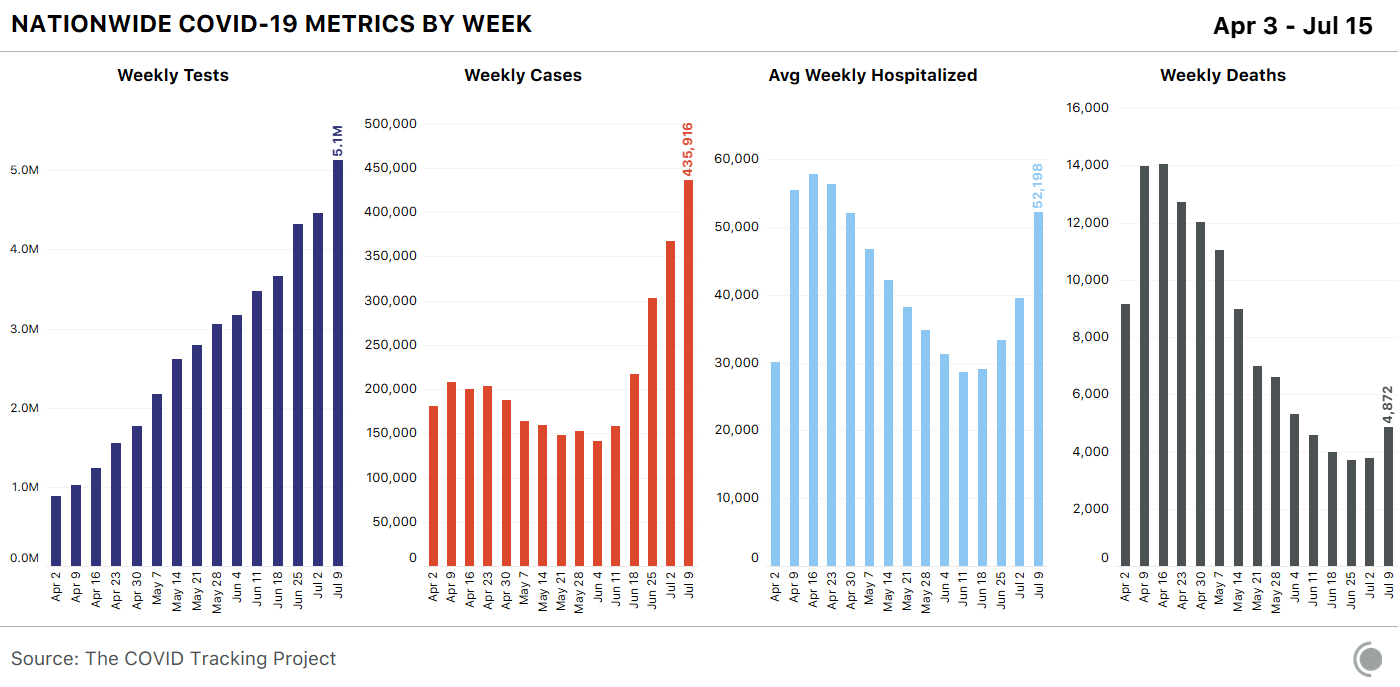
COVID-19 metrics by week, Apr 3 - Jul 15


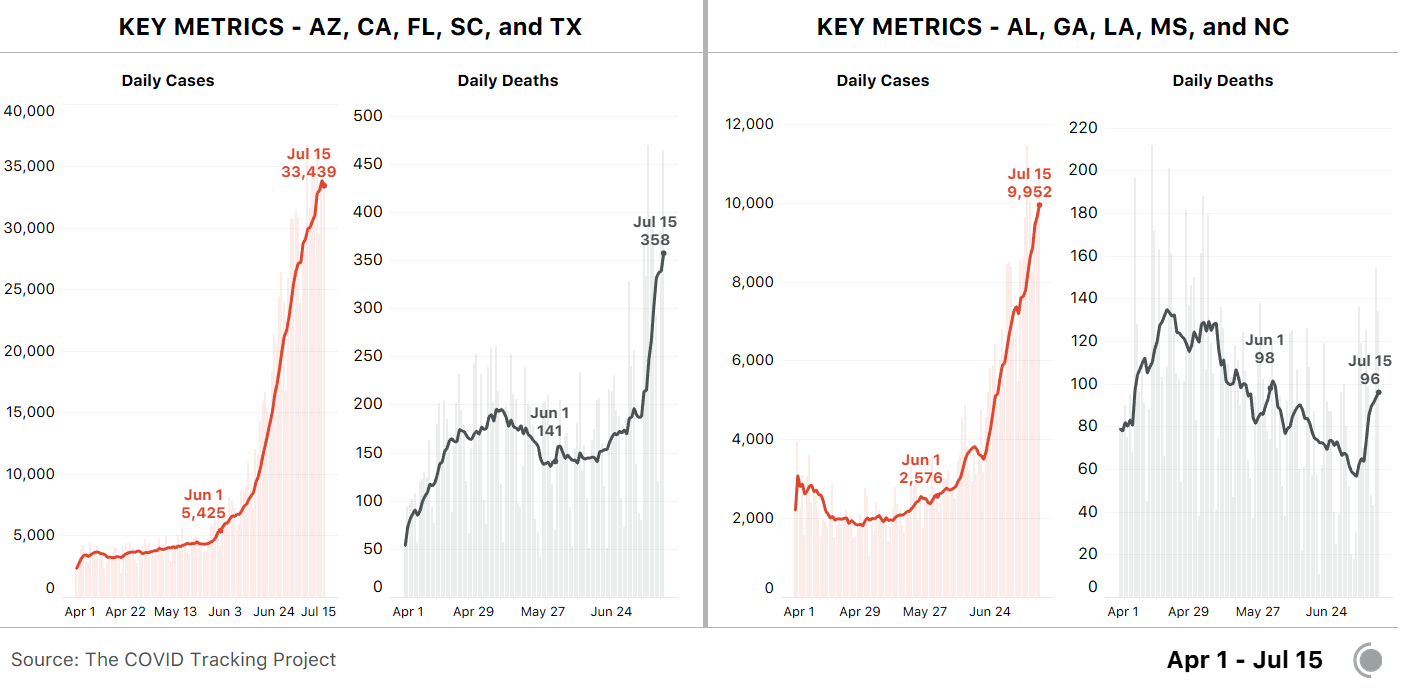
The US is approaching half a million new cases of COVID-19 each week. States with major outbreaks including Arizona, California, Florida, and Texas all saw record high weekly hospitalizations and deaths. Meanwhile, worsening outbreaks in many other states threaten to increase the pandemic’s death toll in the coming weeks.

This week, about 435,000 Americans were diagnosed with COVID-19. This is our fourth week of big increases in the number of new cases, and the results of this case surge are becoming clear. As of July 15, more than 56,000 people are currently in the hospital with COVID-19 in the United States. This week, states reported that 4,872 more people have died of COVID-19, an increase of nearly 29 percent from the previous week.


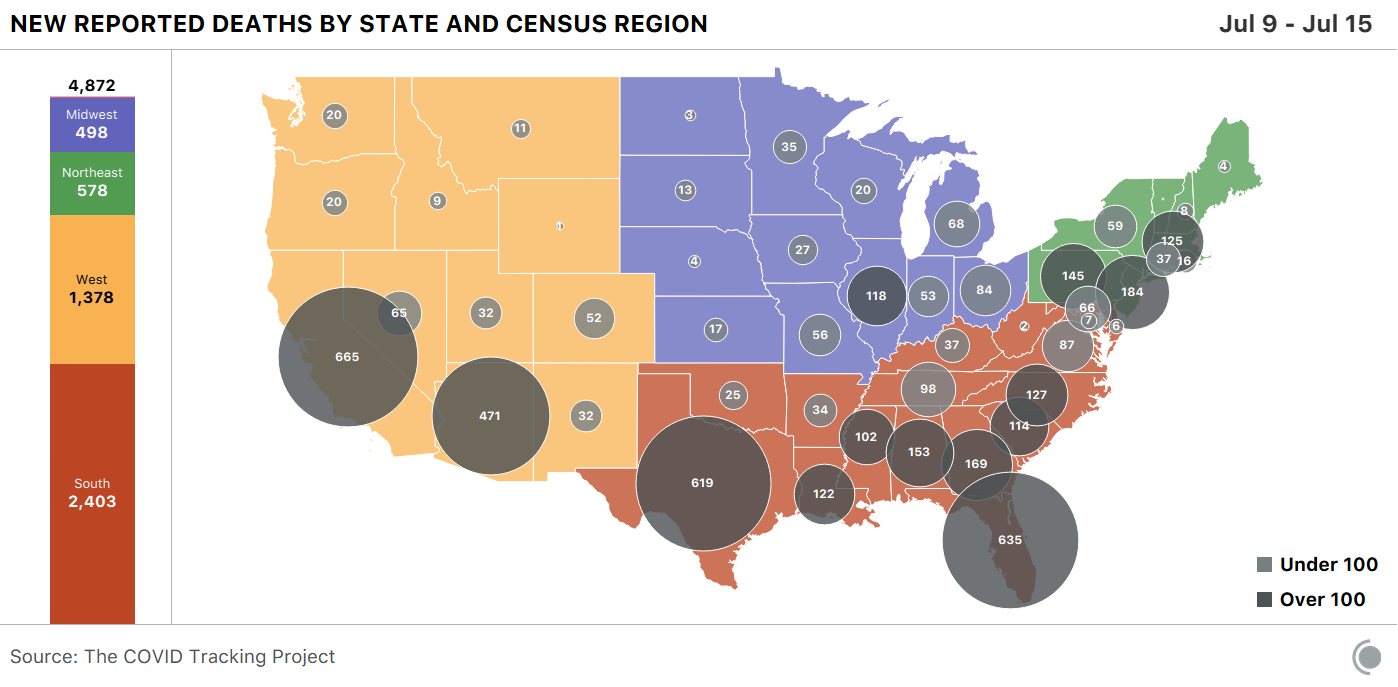
There are no surprises in these new death numbers: people are dying of COVID-19 in the same places where cases have been surging and COVID-19 hospital admissions have spiked. Fourteen states reported more than 100 COVID-19 deaths in the last week, and eight of those states were in the South, the region so far hit hardest in the second surge of cases. Slightly fewer than half the deaths were reported by the four states with the biggest outbreaks—ArizonaCaliforniaFlorida, and Texas—and most of the rest were distributed down the Eastern Seaboard and across the South.

New reported deaths by state and census region, Jul 9- Jul 15


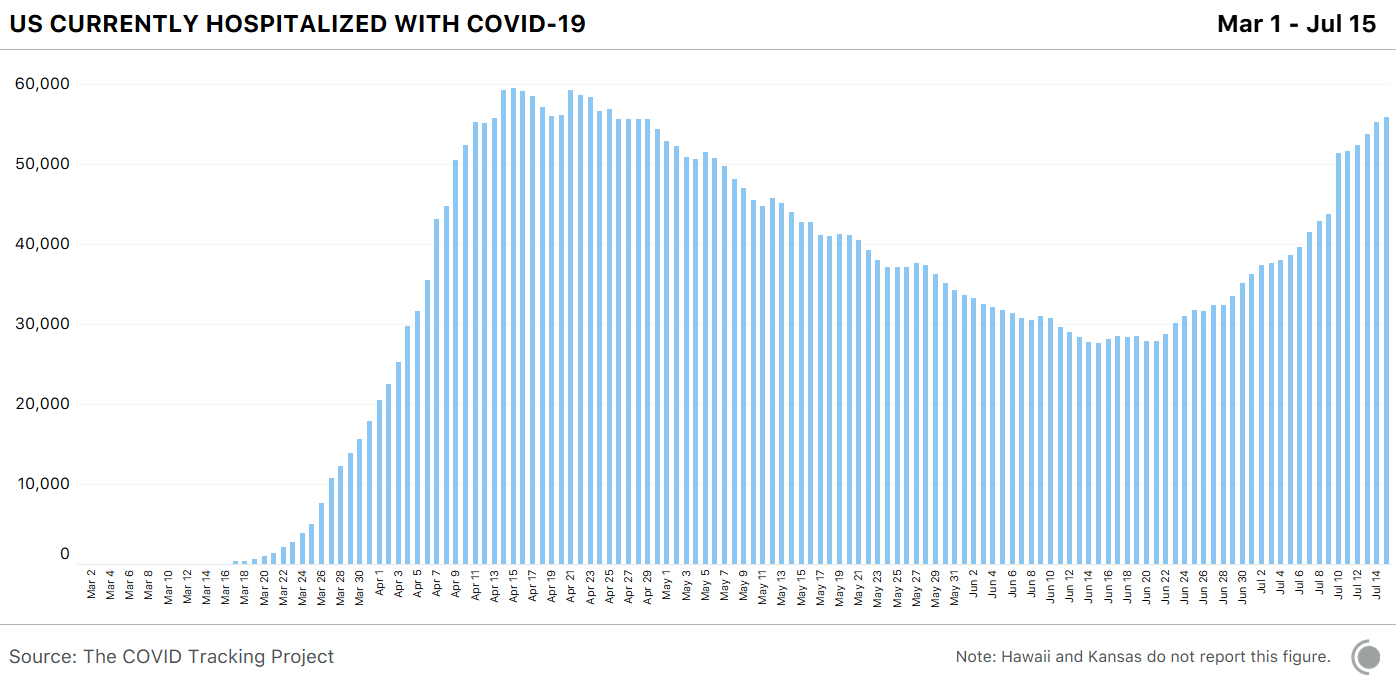
Our national view of how many people are currently hospitalized with COVID-19 is clearer now that Florida has finally released current hospitalization data. With hospitalizations from Florida’s outbreak accounted for, the national hospitalization figures are approaching their previous peak levels from April of this year.

Currently Hospitalized, March 1 - Jul 15

Hospital data has been in the news for other reasons as well. The US Department of Health and Human Services has directed hospitals to report COVID-19 data directly to HHSrather than to the Centers for Disease Control and Prevention. At The COVID Tracking Project, we compile all our data from official state and territorial sources—not from any federal agency. Nevertheless, we have already seen state-level hospital data go dark in at least one state, Idaho, as a result of the new HHS directive. We hope and expect that hospital reporting through many states will continue uninterrupted, and we’ll be reporting what we learn about states’ experience with the new directive.

Outside of the five states with the biggest outbreaks, several other states posted alarming data this week. In several states across the South, case growth is smaller in absolute terms, but the trends we see this week mirror those we saw in Arizona and Florida a few weeks ago. We hope not to see those trends continue and result in the huge case spikes—and subsequent large increases in hospitalizations and deaths—that we saw in the states worst hit in the pandemic’s second surge.

Key metrics comparison - top 5 states


Public health interventions in these states have varied widely this week. In AlabamaLouisiana, and Mississippi, new mask orders and other restrictions have gone into effect. North Carolina has been under a mask order since June 25, and has reported a less explosive rise in new case growth than the other four states we’re watching in this group of southern states. In Georgia, the governor has explicitly voided local mask orders in Georgia cities and counties.

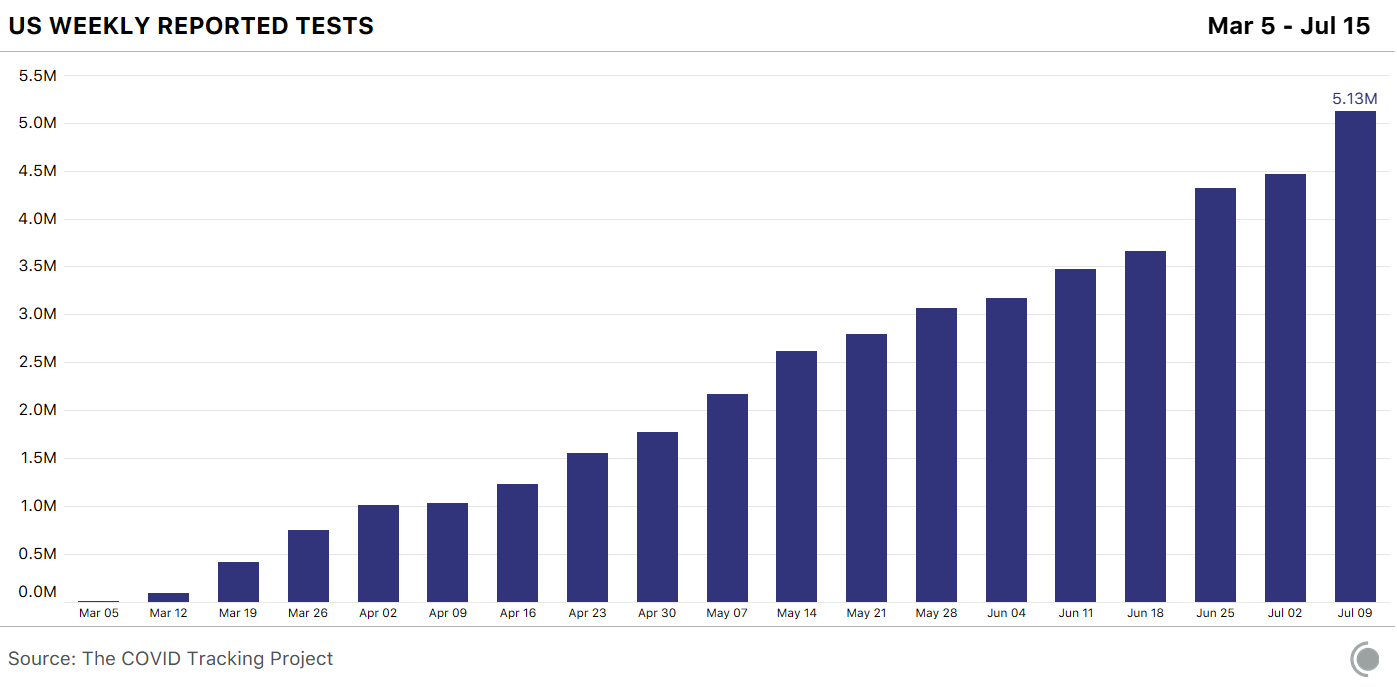
This week, US states and territories reported more than five million COVID-19 tests in a single week—a major achievement amid continuing testing shortages in many areas. For context, the Harvard Global Health Institute estimates that the United States will need to perform at least 8.4 million tests per week to slow the spread of the virus, and 30 million tests per week to suppress the pandemic.

Weekly reported tests, May 5 - Jul 15


You can learn all about our data compilation process, including an overview of our collection and publication process, our data sourcing policy, and exact definitions of the data points we track here on our website and in our API. To keep up to date on our work, follow us on Twitter and join our low-frequency email list.


The Covid Tracking Project – Rate of Positive Test in the US over Time

https://covidtracking.com/?fbclid=IwAR2MeUIGRc9ChxXNGonEAiSDczeKi3UPAle0zDaxNJXxayzUrF-H7CIG7iY

Chart from the Johns Hopkins COVID-19 Testing Insights Initiative depicting daily total tests and daily positive tests using COVID Tracking Project data. This visualization is not a dynamic representation of case data and will not update automatically


Appeals court rules HHS has authority to implement site-neutral payments, dealing blow to hospitals

https://www.fiercehealthcare.com/hospitals/appeals-court-rules-hhs-has-authority-to-implement-site-neutral-payments-dealing-blow-to?mkt_tok=eyJpIjoiWXpGa016azRZekJqTTJZeSIsInQiOiJ6ajZGSWlYUGh1TTZqTFBDMEgwaXk3ZFZZSCtBVkdUWHNhemZ0SDJZWnhJVHlHVUpjRTdFVUlpbVBSdng4dTFXUEhhOGV2S3lRcElVVWNuZWpqakdEZE1DRmhleHRzdlY4RDRxYkxtZUNYNVI3Rmg5Kys5SVd1aGdseUR6Y1hxSCJ9&mrkid=959610

Appeals court rules HHS has authority to implement site-neutral ...

A federal appeals court ruled the Department of Health and Human Services has the authority to cut Medicare payments to off-campus clinics to bring them in line with independent physician practices, reversing a lower court’s decision.

The ruling from the U.S. Court of Appeals for the District of Columbia delivered Friday strikes a major blow to the hospital industry which has been fighting HHS over the controversial rule.

The American Hospital Association (AHA) led a lawsuit against HHS arguing it did not have the statutory authority to cut payments to the off-campus, provider-based departments. HHS made the cuts in its annual hospital payments rule and the hospitals argued they were unlawful because the cuts were not budget-neutral, a requirement of the payment rule.

But the appeals court agreed with HHS that it had the authority to make the change in the payment rule because of how the law is structured.


U.S. blows past coronavirus record with more than 70,000 new cases in one day

https://www.washingtonpost.com/nation/2020/07/17/coronavirus-live-updates-us/?utm_campaign=wp_post_most&utm_medium=email&utm_source=newsletter&wpisrc=nl_most

FirstFT: Today's top stories | Financial Times

There was a time in the United States when 40,000 coronavirus cases in a day seemed like an alarming milestone. That was less than three weeks ago.

Now, the number of new infections reported each day is reaching dizzying new heights. On Thursday, the daily U.S. caseload topped 70,000 for the first time, according to data tracked by The Washington Post.

Record numbers of covid-19 fatalities were reported in Florida, Texas and South Carolina on Thursday, and officials throughout the Sun Belt are worried that hospitals could soon reach a breaking point.

Here are some significant developments:

  • Masks are now mandatory in more than half of U.S. states — with the governors of Arkansas and Colorado the latest to issue face-covering orders. Major retailers phased in new mask policies, and Maryland Gov. Larry Hogan (R), chairman of the National Governors Association, said that masks should be mandated in states across the country.
  • Larry Fink, the chief executive of investment firm BlackRock, said that if states moving forward with reopening plans required masks, the economy would recover much sooner.
  • Atlanta Mayor Keisha Lance Bottoms (D) blasted Georgia’s Republican governor, Brian Kemp (R), for suing to stop block her city’s mask ordinance, accusing him of “putting politics over people.”
  • An unpublished report from the White House Coronavirus Task Force suggests that nearly 20 hard-hit states should enact tougher public health measures.
  • Real-time coronavirus tracking data temporarily disappeared from the Centers for Disease Control and Prevention’s website, sparking an outcry.
  • President Trump faces rising disapproval and widespread distrust on coronavirusaccording to a new Post-ABC poll.
  • India on Friday surpassed 1 million confirmed coronavirus cases, becoming the third country to cross that threshold, behind the United States and Brazil..


Cartoon – Welcome to Dysfunctional Corp.

Cartoon – Welcome to Dysfunction Corp | HENRY KOTULA