Battle over COVID-19 school openings goes to the courts

Battle over COVID-19 school openings goes to the courts

Nearly 800 COVID-19 lawsuits have been filed, according to law firm's  tracker

Teachers unions are waging court fights across the country aimed at unwinding what they say are unsafe and politically motivated timetables for reopening schools that risk exposing personnel to the coronavirus pandemic.

State officials eager to ramp up brick-and-mortar operations are facing lawsuits from Florida to Texas to Iowa over reopening plans as well as access to the COVID-19 infection data needed to monitor the rate of spread within school communities. 

At the same time, lawsuits are flying from the opposition direction: Parents in several states, including New York, Massachusetts and Oregon, dissatisfied with web-based teaching alternatives, are suing to force state officials to reopen physical schools sooner as courts are increasingly called upon to referee the fight over education in the age of coronavirus.

“A legal storm is brewing as safety and social distancing requirements for a physical return to school begin to take shape around the country,” Maria Ferguson, executive director of the Center on Education Policy at George Washington University, wrote on the education website The 74.

As millions of students prepare for the first day of school — whether in-person, remote or a hybrid of the two — the fight over the reopening physical school buildings is likely to intensify.

The debate over in-person K-12 instruction planning is inseparably tied to the issues of child care needs and parents’ ability to return to the workforce to help revive the struggling economy, all of which is playing out against the backdrop of a fast-approaching November election in a country that has seen nearly 6 million cases and more than 181,000 deaths from COVID-19.

Perhaps the highest-profile legal battle is taking place in the courts of Florida, where Republican Gov. Ron DeSantis signed off last month on an emergency order over school reopenings.

Under the order, most Florida school districts would be required to hold in-person classes five days a week by the end of August or risk losing funding. President Trump, who counts DeSantis as a close ally, has also threatened to cut off federal funding for schools if they do not resume in-person learning this fall.

The Florida policy prompted a lawsuit from the Florida Education Association (FEA), a statewide teachers union, and several other plaintiffs in favor of a more cautious return to in-person teaching.

“Public schools are not designed for COVID safety, and indeed, the government has recognized that they are high-contact environments,” said Kendall Coffey, the lead plaintiff’s attorney in the Florida case, who likened prematurely opened schools to “disease factories” and called the Florida policy “financial bullying.”

There are any number of issues, in terms of hallway sizes, the flow of students in and out of classrooms, ventilation, even how many students go into the bathroom,” he told The Hill. “There are many elements that are virtually impossible to guarantee when you’re dealing with children in large amounts.”

On Aug. 24, a Florida judge ruled in favor of the union and temporarily halted the statewide order. In his decision, Judge Charles Dodson struck down the order’s unconstitutional provisions and blasted DeSantis for having “essentially ignored” the state’s constitutional requirement that schools be operated safely.

“The districts have no meaningful alternative,” wrote Dodson, of Leon County. “If an individual school district chooses safety, that is, delaying the start of schools until it individually determines it is safe to do so for its county, it risks losing state funding, even though every student is being taught.”

A Florida appeals court agreed to temporarily halt Judge Dodson’s order from taking effect while DeSantis appeals.

The state contends that the benefit of in-person instruction outweighs the health risks associated with reopening brick-and-mortar schools. Some Florida school officials have also declined to disclose incidents of positive COVID-19 cases to school communities, citing the need for patient privacy. 

Attorneys for Florida have also argued in hearings that courts should not substitute their judgment for that of policymakers who have balanced all the equities and decided a prompt in-person reopening is the best policy.

Randi Weingarten, president of the American Federation of Teachers (AFT), one of the largest teachers unions in the country, said Florida has its priorities backward.

“What their arguments show is that they don’t care about human life,” Weingarten told The Hill.

According to Weingarten, internal AFT polling in June showed that about 3 in 4 teachers said they would be comfortable returning to the classroom if guidelines from the Centers for Disease Control and Prevention (CDC) were implemented in schools.

But she predicts that attitudes among teachers have shifted dramatically in past months as the Trump administration has failed to adequately manage the virus to ensure schools can be reopened safely.

“We’re polling right now,” she said. “And my hunch is that just like the public polls, it’s totally flipped.”

The AFT is backing lawsuits in Florida, New Mexico and Texas. Before schools can reopen safely — for what Weingarten calls “the biggest move indoors that the nation has done since March” — the group says local positivity rates should be below 3 percent and schools should have visibility into daily transmission rates. 

The union is also pushing for protocols that involve testing, contact tracing and isolation and implement best practices from the CDC for things such as ventilation, cleaning, physical distancing, mask-wearing and other safeguards.

As teachers unions make their case in court, parents in at least five states have filed lawsuits of their own to accelerate school reopenings.

A nonprofit litigation group called the Center for American Liberty, co-founded by lawyer and GOP official Harmeet Dhillon, is backing one such suit in California. Democratic Gov. Gavin Newsom’s restrictions on in-person school openings in the Golden State will affect an estimated 80 percent of K-12 students.

“The effects of this ham-handed policy are as predictable as they are tragic,” the lawsuit filed in a federal court in California states. “Hundreds of thousands of students will essentially drop out of school, whether because they lack the technological resources to engage with ‘online learning’ or because their parents cannot assist them.”

The litigation raises concerns about everything from school closures exacerbating the achievement gap and disproportionately harming special needs students and those without convenient internet access to challenges over the constitutional validity of government health orders.

Weingarten, of AFT, said it’s important to remember that despite seemingly irreconcilable differences over the policy details, all parties want to see schools reopen as soon as it’s safe to do so.

“None of us believes that remote is a substitute,” she said. “It’s a supplement.”


Top U.S. Officials Told C.D.C. to Soften Coronavirus Testing Guidelines

The Centers for Disease Control and Prevention abruptly changed its recommendations, saying people without Covid-19 symptoms should not get tested.

 Trump administration officials on Wednesday defended a new recommendation that people without Covid-19 symptoms abstain from testing, even as scientists warned that the policy could hobble an already weak federal response as schools reopen and a potential autumn wave looms.

The day after the Centers for Disease Control and Prevention issued the revised guidance, there were conflicting reports on who was responsible. Two federal health officials said the shift came as a directive to the Atlanta-based C.D.C. from higher-ups in Washington at the White House and the Department of Health and Human Services.

Adm. Brett P. Giroir, the administration’s coronavirus testing czar, called it a “C.D.C. action,” written with input from the agency’s director, Dr. Robert R. Redfield. But he acknowledged that the revision came after a vigorous debate among members of the White House coronavirus task force — including its newest member, Dr. Scott W. Atlas, a frequent Fox News guest and a special adviser to President Trump.

“We all signed off on it, the docs, before it ever got to a place where the political leadership would have, you know, even seen it, and this document was approved by the task force by consensus,” Dr. Giroir said. “There was no weight on the scales by the president or the vice president or Secretary Azar,” he added, referring to Alex M. Azar II, the secretary of health and human services.

Regardless of who is responsible, the shift is highly significant, running counter to scientific evidence that people without symptoms could be the most prolific spreaders of the coronavirus. And it comes at a very precarious moment. Hundreds of thousands of college and K-12 students are heading back to campus, and broad testing regimens are central to many of their schools’ plans. Businesses are reopening, and scientists inside and outside the administration are growing concerned about political interference in scientific decisions.

Democratic governors who were weighing how to keep the virus contained as their economies and schools come to life said limiting testing for asymptomatic citizens would make the task impossible.

“The only plausible rationale,” Gov. Andrew M. Cuomo of New York told reporters in a conference call from Albany, N.Y., “is that they want fewer people taking tests, because as the president has said, if we don’t take tests, you won’t know the number of people who are Covid-positive.”

Over the weekend, the Food and Drug Administration, under pressure from Mr. Trump, gave emergency approval to expand the use of antibody-rich blood plasma to treat Covid-19 patients. The move came just days after scientists, including Dr. Anthony S. Fauci, the nation’s top infectious disease expert, and Dr. Francis S. Collins, the director of the National Institutes of Health, intervened to stop the practice because of lack of evidence that it worked.

The move echoed a decision by the Food and Drug Administration to grant an emergency use waiver for hydroxychloroquine, a malaria drug repeatedly sold by Mr. Trump as a treatment for Covid-19. The agency revoked the waiver in June, when clinical trials suggested the drug’s risks outweighed any possible benefits.

The testing shift, experts say, was a far more puzzling reversal. Dr. Giroir said the move was “discussed extensively by” members of the White House coronavirus task force, and he named Dr. Redfield, Dr. Atlas, Dr. Fauci and Dr. Stephen M. Hahn, the commissioner of food and drugs. Notably, he did not name Dr. Deborah L. Birx, the White House coronavirus response coordinator. But he said Dr. Fauci was among those who had “signed off.”

In a brief interview, Dr. Fauci said he had seen an early iteration of the guidelines and did not object. But the final debate over the revisions took place at a task force meeting on Thursday, when Dr. Fauci was having surgery under general anesthesia to remove a polyp on his vocal cord. In retrospect, he said, he now had “some concerns” about advising people against getting tested, because the virus could be spread through asymptomatic contact.

“My concern is that it will be misinterpreted,” Dr. Fauci said.

The newest version of the C.D.C. guidelines, posted on Monday, amended the agency’s guidance to say that people who had been in close contact with an infected individual — typically defined as being within six feet of a person with the coronavirus and for at least 15 minutes — “do not necessarily need a test” if they do not have symptoms.

Exceptions might be made for “vulnerable” individuals, the agency noted, or if health care providers or state or local public health officials recommended testing.

Dr. Giroir said the new recommendation matched existing guidance for hospital workers and others in frontline jobs who have “close exposures” to people infected with the coronavirus. Such workers are advised to take proper precautions, like wearing masks, socially distancing, washing their hands frequently and monitoring themselves for symptoms.

He argued that testing those exposed to the virus was of little utility, because tests capture only a single point in time, and that the results could give people a false sense of security.

“A negative test on Day 2 doesn’t mean you’re negative. So what is the value of that?” Dr. Giroir asked, adding, “It doesn’t mean on Day 4 you can go out and visit Grandma or on Day 6 go out without a mask on in school.”

The guidelines come amid growing concern that the C.D.C., the agency charged with tracking and fighting outbreaks of infectious disease, is being sidelined by its parent agency, the Department of Health and Human Services, and the White House. Under ordinary circumstances, administering public health advice to the nation would fall squarely within the C.D.C.’s portfolio.

Experts have called the revisions alarming and dangerous, noting that the United States needs more testing, not less. And they have expressed deep concern that the C.D.C. is posting guidelines that its own officials did not author. A former C.D.C. director, Dr. Thomas R. Frieden, railed against the move on Twitter on Wednesday:

Dr. Tom Frieden
@DrTomFrieden
Two unexplained, inexplicable, probably indefensible changes, likely imposed on CDC’s website. * Dammit, if you come from a place with lots of Covid, quarantine for 14 days * If you’re a contact, get tested. If +, we can trace your contacts and stop chains of spread. A sad day.

Later, in an interview, Dr. Frieden elaborated. He noted that the C.D.C. had recently dropped its recommendation that people quarantine for 14 days after traveling from an area with a high number of cases to one where the virus was less prevalent. And he reiterated that testing the contacts of those infected was an important means of curbing the spread of the virus.

“We don’t know the best protocol for testing of contacts: Should you test all contacts? That’s the kind of study that frankly needs to get done,” Dr. Frieden said. But absent the answer to that question, he added, “I certainly wouldn’t say, ‘Don’t test contacts.’”

Democrats, including Speaker Nancy Pelosi and two governors — Mr. Cuomo and Gavin Newsom of California — were outraged by the changes. Mr. Newsom said California would not follow the new guidelines, and Mr. Cuomo blamed Mr. Trump.

Representative Frank Pallone Jr. of New Jersey, a Democrat and the chairman of the House Energy and Commerce Committee, also chimed in on Twitter: “The Trump Admin has a lot of explaining to do. #COVID19 testing is essential to stopping the spread of the pandemic. I’m concerned that CDC is once again caving to political pressure. This simply cannot stand.”

Mr. Trump has suggested that the nation should do less testing, arguing that administering more tests was driving up case numbers and making the United States look bad. But experts say the true measure of the pandemic is not case numbers but test positivity rates — the percentage of tests coming back positive.

As Dr. Giroir denied that politics was involved, he encouraged the continued testing of asymptomatic people for surveillance purposes — to determine the prevalence of the virus in a given community — and said such “baseline surveillance testing” would still be appropriate in schools and on college campuses.

“We’re trying to do appropriate testing, not less testing,” he said.

Still, the revisions left many public health officials scratching their heads. They might have made sense when the United States was experiencing a shortage of tests, some experts said, but that no longer appears to be the case. Dr. Frieden, however, said it was possible the administration was trying to conserve testing in case of another surge.

“The problem is we have too many cases, so there is basically no way to keep up the testing if you have a huge outbreak,” he said.

Jennifer Nuzzo, an epidemiologist at Johns Hopkins Bloomberg School of Public Health, said she was “not as up in arms about the content of the guidelines” as she was about the idea that the C.D.C.’s own experts did not write them — and that C.D.C. officials were referring all questions about them to the health department in Washington.

“These guidelines are clearly controversial, and many are calling on C.D.C. to explain its rationale for them, but C.D.C. is unable to comment,” she said in an email. “This is really dangerous precedent, and I fear it will erode public trust in C.D.C.”


History tells us trying to stop diseases like COVID-19 at the border is a failed strategy

https://theconversation.com/history-tells-us-trying-to-stop-diseases-like-covid-19-at-the-border-is-a-failed-strategy-145016?utm_medium=email&utm_campaign=Latest%20from%20The%20Conversation%20for%20August%2028%202020%20-%201715916573&utm_content=Latest%20from%20The%20Conversation%20for%20August%2028%202020%20-%201715916573+Version+A+CID_8719e3ecf842bc9762e48ce42f2ba6ad&utm_source=campaign_monitor_us&utm_term=History%20tells%20us%20trying%20to%20stop%20diseases%20like%20COVID-19%20at%20the%20border%20is%20a%20failed%20strategy

History tells us trying to stop diseases like COVID-19 at the border is a failed  strategy

To explain why the coronavirus pandemic is much worse in the U.S. than anywhere else in the world, commentators have blamed the federal government’s mismanaged response and the lack of leadership from the Trump White House.

Others have pointed to our culture of individualism, the decentralized nature of our public health, and our polarized politics.

All valid explanations, but there’s another reason, much older, for the failed response: our approach to fighting infectious disease, inherited from the 19th century, has become overly focused on keeping disease out of the country through border controls.

As a professor of medical sociology, I’ve studied the response to infectious disease and public health policy. In my new book, “Diseased States,” I examine how the early experience of outbreaks in Britain and the United States shaped their current disease control systems. I believe that America’s preoccupation with border controls has hurt our nation’s ability to manage the devastation produced by a domestically occurring outbreak of disease.

Germ theory and the military

Though outbreaks of yellow fever, smallpox, and cholera occurred throughout the 19th century, the federal government didn’t take the fight against infectious disease seriously until the yellow fever outbreak of 1878. During that same year, President Rutherford B. Hayes signed the National Quarantine Act, the first federal disease control legislation.

By the early 20th century, a distinctly American approach to disease control had evolved: “New Public Health.” It was markedly different from the older European concept of public health, which emphasized sanitation and social conditions. Instead, U.S. health officials were fascinated by the newly popular “germ theory,” which theorized that microorganisms, too small to be seen by the naked eye, caused disease. The U.S. became focused on isolating the infectious. The typhoid carrier Mary Mallon, known as “Typhoid Mary,” was isolated on New York’s Brother Island for 23 years of her life.

Originally, the military managed disease control. After the yellow fever outbreak, the U.S. Marine Hospital Service (MHS) was charged with operating maritime quarantine stations countrywide. In 1912, the MHS became the U.S. Public Health Service; to this day, that includes the Public Health Service Commissioned Corps led by the surgeon general. Even the Centers for Disease Control and Prevention started as a military organization during World War II, as the Malaria Control in War Areas program. Connecting the military to disease control promoted the notion that an attack of infectious disease was like an invasion of a foreign enemy.

Germ theory and military management put the U.S. system of disease control down a path in which it prioritized border controls and quarantine throughout the 20th century. During the 1918 influenza pandemicNew York City held all incoming ships at quarantine stations and forcibly removed sick passengers into isolation to a local hospital. Other states followed suit. In Minnesota, the city of Minneapolis isolated all flu patients in a special ward of the city hospital and then denied them visitors. During the 1980s, the Immigration and Naturalization Service denied HIV-positive persons from entering the country and tested over three million potential immigrants for HIV.

Defending the nation from the external threat of disease generally meant stopping the potentially infectious from ever entering the country and isolating those who were able to gain entry.

Our mistakes

This continues to be our predominant strategy in the 21st century. One of President Trump’s first coronavirus actions was to enforce a travel ban on China and then to limit travel from Europe.

His actions were nothing new. In 2014, during the Ebola outbreakCaliforniaNew York and New Jersey created laws to forcibly quarantine health care workers returning from west Africa. New Jersey put this into practice when it isolated U.S. nurse Kaci Hickox after she returned from Sierra Leone, where she was treating Ebola patients.

In 2007, responding to pandemic influenza, the Department of Homeland Security and the CDC developed a “do not board” list to stop potentially infected people from traveling to the U.S.

When such actions stop outbreaks from occurring, they are obviously sound public policy. But when a global outbreak is so large that it’s impossible to keep out, then border controls and quarantine are no longer useful.

This is what has happened with the coronavirus. With today’s globalization, international travel, and an increasing number of pandemics, attempting to keep infectious disease from ever entering the country looks more and more like a futile effort.

Moreover, the U.S. preoccupation with border controls means we did not invest as much as we should have in limiting the internal spread of COVID-19. Unlike countries that mounted an effective response, the U.S. has lagged behind in testingcontact tracing, and the development of a robust health care system able to handle a surge of infected patients. The longstanding focus on stopping an outbreak from ever occurring left us more vulnerable when it inevitably did.

For decades, the U.S. has been underfunding public health. When “swine flu” struck the country in 2009, the CDC said 159 million doses of flu shots were needed to cover “high risk” groups, particularly health care workers and pregnant women. We only produced 32 million doses. And in a pronouncement that now looks prescient, a Robert Wood Johnson Foundation report said if the swine flu outbreak had been any worse, U.S. health departments would have been overwhelmed. By the time Ebola appeared in 2014, the situation was no better. Once again, multiple government reports slammed our response to the outbreak.

Many causes exist for the U.S.‘s failed response to this crisis. But part of the problem lies with our past battles with disease. By emphasizing border controls and quarantine, the U.S. has disregarded more practical strategies of disease control. We can’t change the past, but by learning from it, we can develop more effective ways of dealing with future outbreaks.


Six months ago, Trump said that coronavirus cases would soon go to zero. They … didn’t.

https://www.washingtonpost.com/politics/2020/08/26/six-months-ago-trump-said-that-coronavirus-cases-would-soon-go-zero-they-didnt/?utm_campaign=wp_main&utm_medium=social&utm_source=facebook&fbclid=IwAR2-yqYYel73YR3zJXfqtn25DXNEA8Yi1qc0L0RQ3PNP-NqUJ299PFNdeWc


But with new constraints on testing, Trump may get his wish eventually.

It was exactly six months ago Wednesday when the spread of the coronavirus in the United States had become too significant for President Trump to wave away. He and several members of the team planning the administration’s response held a news briefing designed to inform the public about the virus and, more important, to allay concerns.

This was the briefing in which Trump made one of his most wildly incorrect assertions about what the country could expect.

“The level that we’ve had in our country is very low,” Trump said, referring to new confirmed infections, “and those people are getting better, or we think that in almost all cases they’re better, or getting. We have a total of 15. We took in some from Japan — you heard about that — because they’re American citizens, and they’re in quarantine.”

That part was generally true. At the time, there had been only a smattering of confirmed cases, with the addition of passengers from the cruise ship Diamond Princess pushing the confirmed total to more than 50.

“So, again,” he added later, “when you have 15 people, and the 15 within a couple of days is going to be down to close to zero, that’s a pretty good job we’ve done.”

It was a brash prediction and seemingly an off-the-cuff one. Trump’s point was less about what was going to happen than arguing that his administration had done a good job. But by linking those two things, he made it simple for observers to use his assertion that the number of cases would fade as a baseline for measuring everything that followed.

Over time, more cases from the period before Feb. 26 would be discovered, including two early deaths in California from covid-19, the disease caused by the virus. There were actually almost 200 cases that would eventually be confirmed by the time Trump was saying the country would go from 15 to zero.

The experts standing behind Trump would have known that Trump’s claims were inaccurate. As the briefing was underway, The Washington Post reported a confirmed case of “community spread” — a documented infection that couldn’t be traced to international travel. In other words, it was uncontained: The virus was moving from person to person without impediment or detection.

Although about 200 cases in that period eventually would be confirmed, even that number was far lower than the reality. Researchers can use documented cases to estimate the number of cases that weren’t being detected and that also weren’t later confirmed through testing. For example, an estimate produced by data scientist Youyang Gu puts the likely number of new infections on Feb. 26 somewhere in the range of 13,000 to 25,000.

On that day alone.

Within a month, the country would go from Trump’s 15 cases to nearly 88,000 cases. By April 26, the total was nearly a million. By May 26, 1.7 million. The most recent total is north of 5.7 million.

That steady increase is in part a function of Trump repeating the same mistake over and over, portraying the pandemic as ending or functionally ended. As cases faded a bit in May and June, he pushed for a return to normal economic activity, triggering a new surge in confirmed cases. That second increase has been fading for about a month, happily, but the country is still adding 33 percent more confirmed new cases each day than it did at the peak in April.

That’s confirmed cases, a metric that relies on testing. Gu’s estimates of the actual spread of the virus put the country about 40 percent below the peak in daily new cases, which was reached in early July.

Trump, of course, blames testing for revealing the scale of the pandemic in the first place. He has a point, in a way: Had the United States never managed to solve its problems with testing, something that took weeks, there wouldn’t have been millions of confirmed cases. There would still have been millions of cases or, perhaps, tens of millions of cases. We just wouldn’t have known how many there were.

It has been about two months since Trump held a political rally in Tulsa, contributing to a new surge of cases in the city. There, he made a tongue-in-cheek reference to asking his team to slow down on testing, because it was pushing the number of confirmed cases higher. As they say, though, each joke contains a grain of truth, and it was clear that Trump, in fact, would be happy to see the number of tests drop so that the number of confirmed cases did as well.

Data compiled by the COVID Tracking Project show that he has gotten his wish, to a degree. Over the past month, the number of tests being completed each day in the United States has dropped by nearly one-fifth.

Part of this is a function of interference from natural disasters, with storms in Florida and fires in California limiting testing capacity. Part of it, too, is probably a function of the drop in the number of cases coming back positive. Fewer new cases means fewer people feeling sick and seeking tests to confirm an infection. The drop in the percent of tests coming back positive reinforces that trend.

But, increasingly, part of it will stem from the administration de-emphasizing testing. New guidance published by the Centers for Disease Control and Prevention suggested that those who had been in contact with an infected person no longer needed to be tested, particularly when asymptomatic.

This, too, has been something Trump has talked about a lot, complaining that people without symptoms were being tested and confirmed as positive — and added to the total number of infections.

“Many of those cases are young people that would heal in a day,” Trump said in an interview on July 19. “They have the sniffles and we put it down as a test.”

The reason it’s important to track asymptomatic cases, of course, is that those people can still infect others. To defeat the pandemic, we need to contain it, and the new CDC approach runs the significant risk of leaving large holes in that containment effort. But, with the presidential election only about 70 days away, it will mean fewer confirmed cases.

The irony of Trump’s complaints about the virus from the outset is that the United States’ confirmed infection totals already have been minimized because of limited testing. The reason Trump was able to claim that there were only 15 cases six months ago was that the administration had spent the month since the first confirmed case in the country unable to put together a robust testing regimen that would allow the virus to be constrained. South Korea, where such a regimen was quickly implemented, actually did see its virus numbers drop to near zero.

In other words, Trump’s prediction was not only wrong, it was wrong in large part because Trump’s team hadn’t done what would have been needed to make it come true. Trump portrays himself as an unwitting victim of the pandemic, but his comment six months ago Wednesday is a good reminder that he can put a lot of the blame for his position on himself.


Billions in Hospital Virus Aid Rested on Compliance With Private Vendor

Billions in Hospital Virus Aid Rested on Compliance With Private ...

The Department of Health and Human Services told hospitals in April that reporting to the vendor, TeleTracking Technologies, was a “prerequisite to payment.”

The Trump administration tied billions of dollars in badly needed coronavirus medical funding this spring to hospitals’ cooperation with a private vendor collecting data for a new Covid-19 database that bypassed the Centers for Disease Control and Prevention.

The highly unusual demand, aimed at hospitals in coronavirus hot spots using funds passed by Congress with no preconditions, alarmed some hospital administrators and even some federal health officials.

The office of the health secretary, Alex M. Azar II, laid out the requirement in an April 21 email obtained by The New York Times that instructed hospitals to make a one-time report of their Covid-19 admissions and intensive care unit beds to TeleTracking Technologies, a company in Pittsburgh whose $10.2 million, five-month government contract has drawn scrutiny on Capitol Hill.

“Please be aware that submitting this data will inform the decision-making on targeted Relief Fund payments and is a prerequisite to payment,” the message read.

The financial condition, which has not been previously reported, applied to money from a $100 billion “coronavirus provider relief fund” established by Congress as part of the $2.2 trillion Coronavirus Aid, Relief and Economic Security Act, or CARES Act, signed by President Trump on March 27. Two days later, the administration instructed hospitals to make daily reports to the C.D.C., only to change course.

“Another data reporting ask,” a regional official in the health department informed colleagues in an email exchange obtained by The Times, adding: “It comes with $$ incentive. We really need a consolidated message on the reporting/data requests, this is past ridiculous.”

A colleague replied, “Another wrinkle. What a mess.”

The disclosure of the demand in April is the most striking example to surface of the department’s efforts to expand the role of private companies in health data collection, a practice that critics say infringes on what has long been a central mission of the C.D.C. Last month, the federal health department moved beyond financial incentives and abruptly ordered hospitals to send daily coronavirus reports to TeleTracking, not the C.D.C., raising concerns about transparency and reliability of the data.

Officials at the Department of Health and Human Services say that the moves were necessary to improve and streamline data collection in a crisis, and that the one-time reports collected in April by TeleTracking were not available from any other source.

“The national health system has not been challenged in this way in any time in recent history,” Caitlin Oakley, a department spokeswoman, said in a statement, adding that TeleTracking offered a “standardized national hospital capacity tracking system which provided more real-time, better informed data to make decisions from.”

But critics remain alarmed.

“In the middle of a pandemic, the Trump administration is using funds meant to support hospitals as a tool to coerce them to use an unproven, untrusted and deeply flawed system that sidelines public health experts,” Senator Patty Murray of Washington, the ranking Democrat on the Senate Health Committee, said in a statement.

In a statement, TeleTracking said it has three decades of experience providing health care systems “with actionable data and unprecedented visibility to make better, faster decisions.”

Still, public health experts and hospital executives are puzzled as to why the health agency chose such a difficult time to employ an untested private vendor rather than improve the C.D.C.’s National Healthcare Safety Network, a decades-old disease tracking system that was deeply familiar to hospitals and state health departments.

The N.H.S.N., as it is known, had built up trust over decades of working with hospitals and state health departments. Administrators were reluctant to make the switch.

“People — especially in public health and clinical health — are very protective of their data, so that trust factor is certainly an issue,” said Patina Zarcone, the director of informatics for the Association of Public Health Laboratories. “The fear of having their data leaked or misused or used for a purpose that they weren’t aware of or agreed to — I think that’s the biggest rub.”

Ms. Oakley said the C.D.C.’s system was “not designed for use in a disaster response” and could not adapt quickly in a crisis. Allies of the C.D.C. say withholding taxpayer dollars from the CARES Act in lieu of cooperation was an inappropriate effort to push hospitals into a system they were reluctant to use.

“It’s an absolutely enormous lever,” said William Schaffner, an infectious disease expert at Vanderbilt University. “It’s a compulsion to oblige institutions to report to this TeleTracking system because they knew if it weren’t tied to money, it wouldn’t happen.”

The Pittsburgh company has no obvious ties to the Trump administration. Rather, the push appears to be part of a broader privatization. The Health and Human Services Department has also asked the Minnesota-based manufacturer 3M “to create, and continuously update, a nationwide clinical data set on Covid-19 treatment,” according to documents obtained by The Times.

The effort is separate from the TeleTracking data collection. Tim Post, a company spokesman, said that because 3M already operates hospital information systems, it is “uniquely positioned,” with the permission of its clients, to submit information to the health department to help officials study disease patterns and recommend treatment options.

Some experts say this kind of cooperation with the private sector is long overdue. But the push also appears to be driven at least in part by an intensifying rift between the C.D.C., based in Atlanta, and officials at the White House and Department of Health and Human Services, the parent agency of the disease control centers.

Dr. Deborah L. Birx, the White House coronavirus response coordinator, and Mark Meadows, the president’s chief of staff, have taken a dim view of the C.D.C. and believe its reporting systems were inadequate. In a recent interview, Michael Caputo, the spokesman for Mr. Azar, accused the C.D.C. of having “a tantrum.”

Accurate hospital data — including information about coronavirus caseloads, deaths, bed capacity and personal protective equipment — is essential to tracking the pandemic and guiding government decisions about how to distribute scarce resources, like ventilators and the drug remdesivir, the only approved treatment for hospitalized Covid-19 patients.

The health agency has set up a new database, H.H.S. Protect, to collect and analyze Covid-19 data from a range of sources. TeleTracking feeds hospital data to that system.

But the public rollout of H.H.S. Protect has been rocky. The nonpartisan Covid Tracking Project identified big disparities between hospital data reported by states and the federal government and deemed the federal data “unreliable.”

The tension dates to March, when the novel coronavirus was making its first surge in the United States

On March 29, Vice President Mike Pence, charged by Mr. Trump with overseeing the federal response, informed hospital administrators that the C.D.C. was setting up a “Covid-19 Module,” and asked them to file daily reports which, he said, were “necessary in monitoring the spread of severe Covid-19 illness and death as well as the impact to hospitals.”

But around that time, TeleTracking submitted a proposal for data collection to the Trump administration, through an initiative, ASPR Next, created to promote innovation. On April 10, TeleTracking was awarded its contract.

The health department’s spokeswoman said the intent was to complement the C.D.C., not compete with it. Like the C.D.C.’s network, TeleTracking’s system requires manual reporting on a daily basis. But in June, Ms. Murray demanded the administration provide more information about what she called a “multimillion-dollar contract” for a “duplicative health data system.”

Some hospital officials also objected to the change.

“We have been directing our hospitals to N.H.S.N.,” Jackie Gatz, a vice president of the Missouri Hospital Association, wrote to a regional health and human services official in an email obtained by The Times, “and now this email with a much greater carrot — CARES Act distributions — is routing them to TeleTracking.”

When the order was delivered, flaws had already emerged in the new system.

“H.H.S. has acknowledged long wait times for those calling for technical support, and indicated that TeleTracking recently added 100 staff to respond to call center requests,” the American Hospital Association wrote to its members in a “special bulletin” on April 23. “They also are directing hospitals to leave a message if they are unable to reach someone live.”

At the time, hospitals had the option of making their daily coronavirus reports to TeleTracking or the C.D.C. Few were using the new database.

In June, the administration again used a stick to demand that hospitals report to TeleTracking, this time in order to obtain remdesivir. By July, with Dr. Birx pushing to bolster hospital compliance, the administration instructed hospitals to stop filing daily reports to the C.D.C. and to send them to TeleTracking instead.

One official at a major academic hospital, who spoke on the condition of anonymity for fear of angering officials in Washington, said the switch left her “unable to sleep at night.”

“Ethically, it felt like they had taken a very trusted institution in the C.D.C. and all of that trust built up with many public health people,” she said, then “moved it onto a politically and financially motivated portion of this response.”

Health and human services officials say the government now has a much more complete picture of hospital bed capacity, with more than 90 percent of hospitals reporting. But Dr. Janis M. Orlowski, the chief health officer for the Association of American Medical Colleges, who worked with Dr. Birx and the administration to bolster hospital reporting, said that she was “stunned” by the switch and that the increase in reporting came because of efforts by her group and others, not the TeleTracking system.

Dr. Orlowski said the data and maps now published on the administration’s H.H.S. Protect data hub are “just not as sophisticated as the C.D.C.”

The switch also generated pushback inside the C.D.C., where officials have refused to analyze and publish TeleTracking data, saying they could not be assured of its quality and had continuing questions about its accuracy, according to a senior federal health official.

Administration officials say the C.D.C. is working with a little-known office in the executive branch — the United States Digital Service — to build a “modernized automation process” in which data will continue to flow directly to the Department of Health and Human Services. But the project is in its infancy, one senior federal health official said.

Critics say that if the department believed the C.D.C.’s health network had problems, those should have been fixed.

“We have a public health system that depends upon communication from hospitals to state health departments to the C.D.C.,” said Dr. Schaffner, the Vanderbilt University infectious disease expert. “It’s very well established. Can it be improved? Of course. But to cut out the public health infrastructure and report to a private firm essential public health data is misguided in the extreme.”


FDA chief apologizes for overstating plasma effect on virus

https://abcnews.go.com/Health/wireStory/fda-commissioner-overstated-effects-virus-therapy-72595122?fbclid=IwAR3Um3rVuom9rJNCOvccmmTBDOrrRePEu1BX1VgRvAzYbpL2NATGjY2-1IY

FDA chief apologizes for overstating plasma effect on virus

Food and Drug Administration Commissioner Stephen Hahn is apologizing for overstating the life-saving benefits of using convalescent plasma to treat COVID-19 patients.

Responding to an outcry from medical experts, Food and Drug Administration Commissioner Stephen Hahn on Tuesday apologized for overstating the life-saving benefits of treating COVID-19 patients with convalescent plasma.

Scientists and medical experts have been pushing back against the claims about the treatment since President Donald Trump’s announcement on Sunday that the FDA had decided to issue emergency authorization for convalescent plasma, taken from patients who have recovered from the coronavirus and rich in disease-fighting antibodies.

Trump hailed the decision as a historic breakthrough even though the treatment’s value has not been established. The announcement on the eve of Trump’s Republican National Convention raised suspicions that it was politically motivated to offset critics of the president’s handling of the pandemic.

Hahn had echoed Trump in saying that 35 more people out of 100 would survive the coronavirus if they were treated with the plasma. That claim vastly overstated preliminary findings of Mayo Clinic observations.

Hahn’s mea culpa comes at a critical moment for the FDA which, under intense pressure from the White House, is responsible for deciding whether upcoming vaccines are safe and effective in preventing COVID-19.

The 35% figure drew condemnation from other scientists and some former FDA officials, who called on Hahn to correct the record.

“I have been criticized for remarks I made Sunday night about the benefits of convalescent plasma. The criticism is entirely justified. What I should have said better is that the data show a relative risk reduction not an absolute risk reduction,” Hahn tweeted.

The FDA made the decision based on data the Mayo Clinic collected from hospitals around the country that were using plasma on patients in wildly varying ways — and there was no comparison group of untreated patients, meaning no conclusions can be drawn about overall survival. People who received plasma with the highest levels of antibodies fared better than those given plasma with fewer antibodies, and those treated sooner after diagnosis fared better than those treated later.

Hahn and other Trump administration officials presented the difference as an absolute survival benefit, rather than a relative difference between two treatment groups. Former FDA officials said the misstatement was inexcusable, particularly for a cancer specialist like Hahn.

“It’s extraordinary to me that a person involved in clinical trials could make that mistake,” said Dr. Peter Lurie, a former FDA official under the Obama administration who now leads the nonprofit Center for Science in the Public Interest. “It’s mind-boggling.”

The 35% benefit was repeated by Health and Human Services Secretary Alex Azar at Sunday’s briefing and promoted on Twitter by the FDA’s communication staff. The number did not appear in FDA’s official letter justifying the emergency authorization.

Hahn has been working to bolster confidence in the agency’s scientific process, stating in interviews and articles that the FDA will only approve a vaccine that meets preset standards for safety and efficacy.

Lawrence Gostin of Georgetown University said Hahn’s performance Sunday undermined those efforts.

“I think the integrity of the FDA took a hit, if I were Stephen Hahn I would not have appeared at such a political show,” said Gostin, a public health attorney.

Hahn pushed back Tuesday morning against suggestions that the plasma announcement was timed to boost Trump ahead of the Republican convention.

“The professionals and the scientists at FDA independently made this decision, and I completely support them,” Hahn said, appearing on “CBS This Morning.”

Trump has recently accused some FDA staff, without evidence, of deliberately holding up new treatments “for political reasons.” And Trump’s chief of staff, Mark Meadows, said over the weekend that FDA scientists “need to feel the heat.”

The administration has sunk vast resources into the race for a vaccine, and Trump aides have been hoping that swift progress could help the president ahead of November’s election.

At Sunday’s briefing Hahn did not correct Trump’s description of the regulatory move as a “breakthrough.” He also did not contradict Trump’s unsupported claim of a “deep state” effort at the agency working to slow down approvals.

Former FDA officials said the political pressure and attacks against the FDA carry enormous risk of undermining trust in the agency just when it’s needed most. A vaccine will only be effective against the virus if it is widely taken by the U.S. population.

“I think the constant pressure, the name-calling, the perception that decisions are made under pressure is damaging,” said Dr. Jesse Goodman of Georgetown University, who previously served as FDA’s chief scientist. “We need the American people to have full confidence that medicines and vaccines are safe.”

Convalescent plasma is a century-old approach to treating the flu, measles and other viruses. But the evidence so far has not been conclusive about whether it works, when to administer it and what dose is needed.

The FDA emergency authorization is expected to increase its availability to additional hospitals. But more than 70,000 Americans have already received the therapy under FDA’s “expanded access” program. That program tracks patients’ response, but cannot prove whether the plasma played a role in their recovery.

Some scientists worry the broadened FDA access to the treatment will make it harder to complete studies of whether the treatment actually works. Those studies require randomizing patients to either receive plasma or a dummy infusion.


Op-Ed: American Exceptionalism or American Insanity?

https://www.medpagetoday.com/infectiousdisease/covid19/88163?xid=nl_popmed_2020-08-20&eun=g885344d0r&utm_source=Sailthru&utm_medium=email&utm_campaign=PopMedicine_082020&utm_content=Final&utm_term=NL_Gen_Int_PopMedicine_Active

We don’t have all of the answers, but that’s not our biggest problem.

Thirty years ago, in preparation for hunting season, I went to a shooting range to practice with my bow. I felt fine. When I finished, I got in my truck and began to back out. When I pressed on the brake, I felt a sharp pain in my foot. My first instinct was to go over what I did walking back and forth to pull arrows from the target. Had I twisted my foot, did I trip on something? No, I had not injured my foot in any way.

When I got home, I took off my shoe and looked. My big toe was slightly swollen and slightly red. It looked like gout. I took ibuprofen. I was better by the next day. I never had another attack until this week.

I was at a friend’s house drinking wine. My knee suddenly began to hurt. I walk or jog 6-8 miles per day, so my first thought was that all the exercise was catching up to me. I took ibuprofen. It got better. But the next day my ankle suddenly became very painful; then my wrist hurt a bit. I remembered my experience with gout. I treated myself for gout, and got better.

I feel very fortunate to live in a time when gout can be easily treated. One hundred years ago, I would have been in big trouble. Which is not to say that I would not have taken medicine in an attempt to get relief. I would have tried a variety of products that claimed to help but did no good.

Today, we can treat so many illnesses that were brutal and deadly in the past. A long time ago, all children with type 1 diabetes died. Today, we have effective therapy — insulin. When I was a resident in the early 1980s, we had no specific way of treating a heart attack. Today, we can place a stent and reverse the pathological process.

In the past, something as simple as poison ivy could make a person’s life miserable. Today, we can knock it out in a short time. Modern medicine can do amazing things. To a large extent, it can do these amazing things because of effective biomedical science.

However, it can’t cure everything. Nor can it beat death. The amazing accomplishments of the medical profession in the last 100 years seem to have led some to believe, or want to believe, that doctors can solve all medical problems. This belief system came to bear with the COVID-19 pandemic.

Many expected the medical profession to step up and solve the problem. When it didn’t, disappointment arose. Then accusations began to fly. Some claimed that there were conspiracies involving Big Pharma and doctors. Others claimed there were cures that were being suppressed by the government.

Some doctors and scientists responded to this by trying to appease. They turned to in vitro data — such as the zinc/hydroxychloroquine (HCQ) interaction — to claim that zinc and HCQ would work wonders. When other doctors and scientists pointed out flaws in that data, they were attacked. It was another conspiracy. I even heard accusations that this was a plot by Bill Gates for population control.

Some doctors also turned to poor, anecdotal trials with HCQ that supposedly showed benefit in a few patients. This led quite a few to believe that HCQ was a wonder drug. Once the exaggerations about HCQ came out, it could no longer be found in pharmacies. The panic was just that strong.

Everyone seemed to get caught up in the panic mindset, and then work under the notion that a lack of clear medical success just can’t be possible in the 21st century. Many patients in intensive care units across the country were being put on HCQ, steroids, remdesivir, anti-IL-6 medication, vitamin C, and whatever else seemed like it might do something.

Many patients who were put on that medication cocktail died, because there was no legitimate science behind this approach — whether it helped was unclear.

However, over time, it became more clear that steroids helped. It became more clear that HCQ did not help. Such revelations led to more reasonable, though not entirely proven, therapeutic approaches. But because the less scientific approaches had so much hype in the beginning, and because the panic was so strong, getting away from them has been fraught with problems and accusations, and even physical threats.

Sadly, some of these accusations and threats were fueled by irresponsible doctors in academic medical centers. Misinformation was fed to the public, and the public, being not well-versed in biomedical research, latched onto the credentials of these doctors rather than seeing through their hysterical and misguided arguments about HCQ and such.

The internet and the free flow of information allows many who don’t really understand the ins and outs of biomedical research and clinical medicine to read something that sounds good and believe it because it satisfies psychological needs. This is a clear pattern of behavior when it comes to HCQ.

But it is not just irresponsible people in academic medical centers who contribute to this process. Doctors, many of whom post on medical blogs, accuse anyone who says we should slow down and evaluate our therapy of “wanting to do nothing” or “not caring about the thousands who are dying.” Even well-intentioned doctors get caught up in this need to seem like something is being done, and so they order all sorts of useless tests.

One such useless test being ordered more commonly in COVID patients is an MRI of the heart. One study in a few patients comes out that shows that COVID can affect the heart, and the next thing you know everybody with COVID needs a heart MRI. Whether the MRI is a reliable test for this is unclear. What we do with the information from the MRI is unclear. It just makes some doctors and some patients feel good to engage in such useless practices.

This pattern of behavior, the pattern of engaging in useless practices to give the appearance of care, is quite common in the profession of medicine. I find it interesting that it has not been challenged by progressives, like those so interested in the Green New Deal. The environmental harm done along these lines by misguided doctors might do as much or more environmental harm than fracking — but at least with fracking you get something to show for your efforts.

With out-of-control doctors, ordering useless tests, running MRI machines and CT scans, etc., day in and day out, without valid justifications, produces nothing useful — unless one believes that feeding hypochondriasis and feeding poor medical judgment is useful.

The profession of medicine accomplished great things in the 21st century. These great things came through American exceptionalism. They came through valid biomedical science. These amazing accomplishments led many to believe that the profession of medicine has all the answers.

But it doesn’t. The COVID pandemic has shown us that. I’m sorry that we can’t save everyone. It is tragic. But it will be more tragic if we let our limitations along these lines lead us into a dark place of anger, lack of reason, lack of valid science, and then on to invalid conspiracy theories.

American exceptionalism does not need to die because of COVID. Instead, what needs to die is a type of insanity that makes us think we have all the answers. What needs to die is a type of insanity that makes us think that if we don’t have all the answers, we have to turn to useless testing, unproven therapies, and futile care.

What needs to die is the turning to false prophets and conspiracy theories. The profession of medicine has proven that it can do a very good job combating illness.

Good doctors are trying hard to deal with and solve this pandemic. When a type of insanity gets in the way, it is a problem.

W. Robert Graham, MD, completed medical school and residency at UTHSC-Dallas (Parkland Hospital) and served as chief resident. Graham received a National Institutes of Health fellowship at the Salk Institute for oncogene research in 1985. He was a professor of medicine at Baylor College of Medicine from 1998 through 2016. In retirement, he enjoys writing and ranching.


School reopenings with COVID-19 offer preview of chaotic fall

https://thehill.com/policy/healthcare/public-global-health/512824-school-reopenings-with-covid-19-offer-preview-of

When Texas schools reopen, officials planning few required safety ...

Thousands of students and teachers across the country are quarantining just days into the new school year, highlighting the challenges of resuming in-person instruction during a pandemic.

While many schools aren’t scheduled to reopen until later this month or September, those that have are offering a preview of the chaos that awaits districts this fall, particularly in hot spots in the South and Midwest where the virus is spreading uncontrollably.

In Georgia’s Cherokee County School District, where students are not required to wear masks, nearly 2,200 students — mostly high schoolers — are quarantining after coming into contact with one of 116 students or 25 teachers and staff members with COVID-19. Another 53 teachers and staff members are also quarantining.

Those numbers are expected to increase with more test results. In the meantime, three of the district’s six high schools have moved classes online, at least until September.

Experts have warned for weeks that it will be extremely difficult to safely reopen schools in hot spots, but some districts are still charging ahead — some willingly, others after some prodding from state and national leaders.

The results, health officials say, are not surprising, though they are preventable.

“You go in, people get infected — boom, you close them down. So it’s better to ease in, perhaps with virtual, until you see what’s going on when you’re in a really hot zone,” Anthony Fauci said during a livestreamed event Tuesday, referring to schools that have already closed after reopening this year.

“When you’re in a red zone … you really better think twice before you do that because what might happen, is what you’ve seen,” Fauci added.

Schools in states like IndianaLouisianaOklahoma and Tennessee have shut down, at least temporarily, after finding COVID-19 in their hallways and classrooms.

The question of when and how to open schools has moved from a public health debate to a political one, with President Trump and his administration strongly advocating for full-time, in-person instruction, hoping in part that parents can then return to work and revamp an economy that’s been ravaged by the coronavirus recession.

Health experts and administration officials note that the consequences of missing in-person learning can be severe, especially for younger students. Finding a solution that minimizes harm to students while protecting public health has proven difficult.

Annette Anderson, a professor in the school of education at Johns Hopkins University, said there is no proven or agreed-upon approach to holding classes during a pandemic, no set protocols around when to return to in-person instruction or how to conduct testing and contact tracing.

“There’s a wild, wild west approach with all the different types of plans in reopening and because of that, a gold standard would just mean clarity around what schools should do. But we don’t have a tacit agreement about what that actually means,” she said.

Most states are deferring school opening decisions to local school districts. For example, while the Cherokee County School District is offering in-person learning five days a week, Atlanta Public Schools, just one county over, is beginning the year online.

Many school districts are opting for online instruction or pursuing hybrid models in which students alternate which days they are in class to limit the number of people in school buildings at one time.

Others, like some districts in Georgia, Arkansas, Florida and Texas, are moving full speed ahead with in-person learning, despite the challenges posed by cramped buildings and classrooms. Some of those districts also offer online options.

While in-person instruction might work for some states where transmission is relatively low, like New York, which gave districts the green light to fully reopen this year, it will be much harder in hot spots.

Fauci classified hot spots as areas with test positivity rates that exceed 10 percent.

While he didn’t specify any states, several across the country have positivity rates over 10 percent, according to figures compiled by Johns Hopkins University, and have districts pursuing in-person instruction. The list includes Florida, Georgia, Idaho, Iowa, Kansas, Mississippi and Texas.

“There’s one opportunity to do this well, because once you open you want the schools to stay open as much as possible, given how disruptive isolating schools and teachers can be,” said Thomas Tsai, assistant professor in the Department of Health Policy and Management at Harvard T.H. Chan School of Public Health.

He recommended schools consider shutting down if the virus appears to be widespread. If cases appear to be isolated to one cluster in a classroom, the rest of the school can probably remain open, while exposed students isolate at home.

That’s why it’s especially important for students to wear masks and keep their desks at least 6 feet apart, and avoid gatherings outside of classrooms, he said, otherwise the number of contacts per case can quickly grow, resulting in more students and teachers needing to be quarantined.

If there are clusters in multiple classrooms and hundreds of students and teachers need to quarantine, schools might need to consider shutting down, Tsai added.

The Centers for Disease Control and Prevention says in “most instances” a single case of COVID-19 should not warrant a school closure.

But if the spread of COVID-19 at a school is higher than within the community, or if the school is becoming the source of an outbreak, administrators should work with local health officials to determine whether temporary closures are needed.

Mississippi State Health Officer Thomas Dobbs said Monday that 245 teachers and 199 students have tested positive for the coronavirus in 71 of the state’s 82 counties. Almost 600 teachers and more than 2,000 students are now in quarantine, but none of the schools have closed.

Dobbs said many of the teachers and students likely contracted the virus outside of school but unknowingly “brought it with them” to class.

Classes are canceled indefinitely at a school district in Pinal County, Ariz., after more than 100 teachers and staff members refused to come to work, citing a concern with the spread of COVID-19 in the community.

The school district planned to resume in-person learning Monday, despite the county not meeting metrics recommended by the state’s health department for safely reopening, including a drop in the number of new cases, new COVID-19 hospitalizations and the percentage of people testing positive.

In Florida, 13 counties have reopened schools in the past week for in-person instruction; at least three districts have reported COVID-19 cases. In Martin County, more than 300 students and teachers are quarantining after coming into contact with infected classmates.

County officials said some parents are not keeping their kids at home while awaiting the results of COVID-19 tests. Instead, they’re waiting until the test is positive before notifying the school.

And in Florida’s Dade County, about 70 students and staff are quarantining after 11 people in the district tested positive. County officials have said that cases are to be expected and superintendents should call them before making any decisions about closures.

The confusion at all levels of government has frustrated both parents and school officials. In the lead-up to the new school year, Trump has offered mixed messages.

Last month, he said schools in hot spots might need to delay their reopening plans, but in August he renewed his push for a return to in-person instruction by tweeting: “OPEN THE SCHOOLS!!!”


Fearing a ‘Twindemic,’ Health Experts Push Urgently for Flu Shots

Fearing a 'Twindemic,' Health Experts Push Urgently for Flu Shots ...

There’s no vaccine for Covid-19, but there’s one for influenza. With the season’s first doses now shipping, officials are struggling over how to get people to take it.

As public health officials look to fall and winter, the specter of a new surge of Covid-19 gives them chills. But there is a scenario they dread even more: a severe flu season, resulting in a “twindemic.”

Even a mild flu season could stagger hospitals already coping with Covid-19 cases. And though officials don’t know yet what degree of severity to anticipate this year, they are worried large numbers of people could forgo flu shots, increasing the risk of widespread outbreaks.

The concern about a twindemic is so great that officials around the world are pushing the flu shot even before it becomes available in clinics and doctors’ offices. Dr. Robert Redfield, director of the U.S. Centers for Disease Control and Prevention has been talking it up, urging corporate leaders to figure out ways to inoculate employees. The C.D.C. usually purchases 500,000 doses for uninsured adults but this year ordered an additional 9.3 million doses.

Dr. Anthony Fauci, director of the National Institute of Allergy and Infectious Diseases, has been imploring people to get the flu shot, “so that you could at least blunt the effect of one of those two potential respiratory infections.”

In Britain, Prime Minister Boris Johnson has been waging his own pro flu-shot campaign. Last month, he labeled people who oppose flu vaccines “nuts” and announced the country’s largest ever rollout of the shots. In April, one of the few reasons Australia allowed citizens to break the country’s strict lockdown was to venture out for their flu shots.

The flu vaccine is rarely mandated in the U.S. except by some health care facilities and nursery schools, but this month the statewide University of California system announced that because of the pandemic, it is requiring all 230,000 employees and 280,000 students to get the flu vaccine by November 1.

A life-threatening respiratory illness that crowds emergency rooms and intensive care units, flu shares symptoms with Covid-19: fever, headache, cough, sore throat, muscle aches and fatigue. Flu can leave patients vulnerable to a harsher attack of Covid-19, doctors believe, and that coming down with both viruses at once could be disastrous.

The 2019-20 flu season in the United States was mild, according to the C.D.C. But a mild flu season still takes a toll. In preliminary estimates, the C.D.C. says that cases ranged from 39 million to 56 million, resulting in up to 740,000 hospitalizations and from 24,000 to 62,000 flu-related deaths.

According to the C.D.C., flu season occurs in the fall and winter, peaking from December to February, and so was nearing its end as the pandemic began to flare in the United States in March.

But now, fighting flu proactively during the continuing pandemic presents significant challenges: not only how to administer the shot safely and readily, but also how to prompt people to get a shot that a majority of Americans have typically distrusted, dismissed and skipped.

With many places where the flu shot is administered en masse now inaccessible — including offices and plants that offered it free to employees on site and school health clinics — officials have been reaching out to local health departments, health care providers and corporations to arrange distribution. From now through Oct. 31, publicity campaigns will blast through social media, billboards, television and radio. Because the shot will be more difficult to access this year, people are being told to get it as soon as possible, although immunity does wane. There will be flu shot tents with heaters in parking lots and pop-up clinics in empty school buildings.

Because of the efforts, vaccine makers are projecting that a record 98 million flu shots will be given this year in the United States, about 15 percent more than doses ordered last year. The Kaiser Permanente health care system will be flooding more than 12 million of its members with flu shot reminders via postcard, email, text and phone calls.

Pharmacies and even supermarkets are expected to play a bigger role than they have in previous years. As of this week, Walgreens and CVS will have flu shots available. Walgreens will be hosting additional off-site flu vaccine clinics in community centers and churches. To reduce contact time, CVS is allowing patients to fill out paperwork digitally.

In New York City, which averages about 2,000 flu-related deaths a year, the health department has been reaching out to hundreds of independent pharmacies to administer the shots, because they are often located in outer-borough neighborhoods where the coronavirus has been rampaging. The health department has a detailed online flu vaccine locator.

“Access is a problem for all adult vaccines,” said L. J. Tan, chief strategy officer for the Immunization Action Coalition, a nonprofit group that works to increase vaccination rates, who was an early promoter of the term twindemic. “Adults may think, If I can get the flu shot easily, I might consider it.”

But as difficult as getting the flu shot to people safely will be, perhaps harder still will be persuading them to actually get it. In the 2018-19 flu season in the United States, only 45.3 percent of adults over 18 got the vaccine, with rates for those ages 18 to 50 considerably lower.

Skepticism to this vaccine runs high, particularly in communities of color because of longstanding distrust and discrimination in public health.2017 study in the journal Vaccine noted that, compared with white people, “African Americans were more likely to report barriers to vaccination, were more hesitant about vaccines in general and the flu vaccine specifically, more likely to believe in conspiracy theories and use naturalism as an alternative to getting vaccinated.”

Across all demographic groups, perhaps the most striking reason given for avoiding the flu vaccine is that people do not see it as efficacious as, say, the measles vaccine.

Indeed, it is a good vaccine but not a great one. It must be repeated annually. Immunity takes up to two weeks to kick in. But its efficacy also depends on how accurately infectious disease centers worldwide forecast which strains are expected to circulate in the coming year. And then those strains can mutate.

Although the flu shot confers immunity at all ages over six months, it can be less complete in people over 65. Depending on many factors, the shot’s effectiveness in a given year can range from 40 to 60 percent.

“But a vaccine not given won’t protect anyone,” said Dr. Jane R. Zucker, assistant commissioner for the Bureau of Immunization at the New York City Health Department, which has been hosting webinars for providers about how to have conversations about the flu shot with hesitant patients.

As health officials note, should a vaccinated person contract the flu, the severity will almost certainly be reduced, hospitalization rarely necessary. Especially with Covid-19 raging, public officials reason, those odds look pretty good.

Another reason people give for not getting the shot is they think it makes them sick.

“People who say ‘I’ll never get it because it gives me the flu’ have not had the flu and don’t know what it is,” said Patsy Stinchfield, senior director of infection prevention at Children’s Minnesota.

“What you’re feeling is your body’s immune response to the virus’s antigens,” said Ms. Stinchfield, a member of the C.D.C.’s influenza work group. “You may feel flu-ish. And that’s a good thing. It’s your body’s way of saying, ‘I am ready for the flu, and I won’t get as sick if I get the real one.’”

Public campaigns will describe the shot as a critical weapon during the pandemic. “Hopefully people will say, ‘There’s no Covid vaccine so I can’t control that, but I do have access to the flu vaccine and I can get that,’” Ms. Stinchfield said. “It gives you a little power to protect yourself.”

Other campaigns will emphasize familial and community responsibility.

Usually, flu vaccine compliance rates among people ages 18 to 49 are low. Vermont’s, for example, is only about 27 percent.

Christine Finley, the state’s immunization program manager, believes that rates will improve because of the pandemic’s stay-at-home households. “People are more aware that the risks they take can negatively impact others,” she said. “They’re often taking care of young children and older parents.”

If any example could prove instructive about protective behavior and flu vaccines during the coronavirus epidemic, it could well be Australia.

Australia’s flu vaccine rate tends to be modest, but this year demand was high. The government’s rollout of the shot began earlier than usual for the June-through-August winter because the coronavirus pandemic was exploding. Though the government had also issued strict no-entry limits among many states and territories and bans on international travel, the flu shot was one of the few reasons people could emerge from lockdown.

The prevalent strain circulating in the country is Type A, the most common and virulent form of flu, said Dr. Kelly L. Moore, a public health expert at the Vanderbilt University School of Medicine.

According to the C.D.C., Type A is the most likely to circulate globally. It mutates readily, particularly as it jumps between animals and humans.

“There are two strains of Type A influenza in the vaccine,” Dr. Moore said, “and so the very best way to protect yourself is to get the shot.”

Reported cases of flu in Australia have dropped 99 percent compared with 2019.

Australia’s milder-than-usual flu season is likely the result of a number of factors — strong flu vaccination uptake, social distancing, but also severely decreased movement of people,” said Dr. Jonathan Anderson, a spokesman for Seqirus, a supplier of flu vaccine.

But though American public health authorities usually look to Australia’s flu season as a predictive, Australians say this year it’s not a reliable indicator.

“This situation is of no comfort as these measures do not apply to the United States where the populace has never been effectively physical distancing,” nor have the country’s entry restrictions been as onerous, said Dr. Paul Van Buynder, a public health professor at Griffith University in Queensland, Australia.

All that Americans can do is get vaccinated against flu, he added, because circulation of the coronavirus remains high.

“It is likely they will have a significant influenza season this northern winter,” he said.


Beware the office toilet

https://mailchi.mp/647832f9aa9e/the-weekly-gist-august-14-2020?e=d1e747d2d8

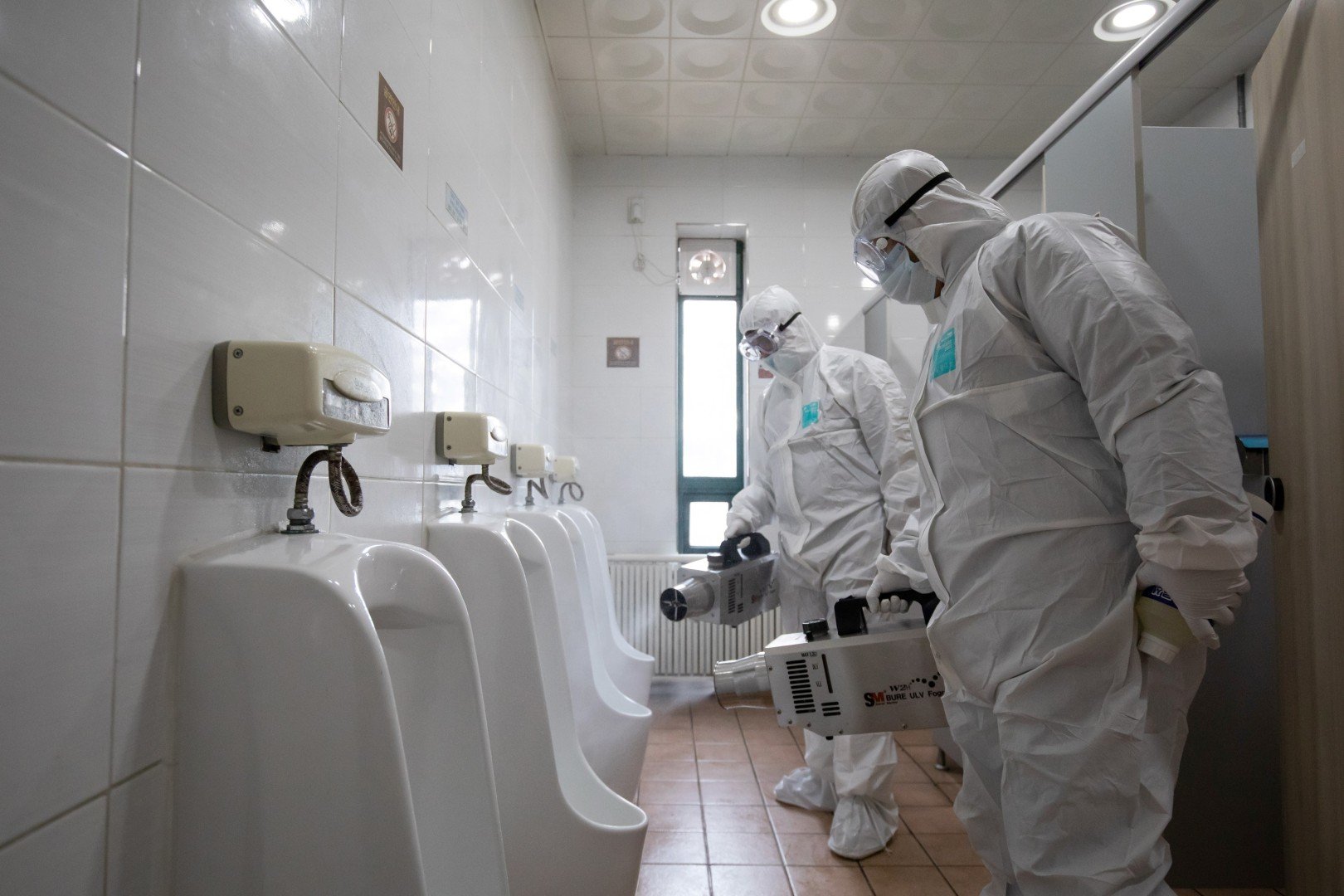
Coronavirus can be killed with disinfectant but beware high-touch ...

Returning to the office after months of lockdown may bring an unexpected risk for workers. According to the New York Times, the CDC recently closed some of its Atlanta offices after finding that its water sources contained Legionella, the bacteria that causes Legionnaire’s disease.

The bacteria can grow in stagnant water systems, including plumbing and air conditioning units. After a prolonged absence, inhaled vapors from flushing toilets, running taps or restarted air conditioners can carry Legionella into the lungs.

While older individuals with lung conditions are most vulnerable, Legionnaire’s pneumonia carries a 10 percent fatality rate—leading the CDC to publish reopening guidelines for building operators that include flushing long-dormant systems with heated water and additional disinfectant in advance of reopening, and the suggestion that at-risk individuals should wear an N95 respirator or facepiece when aerosol generation is likely. (Unsurprisingly, the guidelines have been criticized as overly vague and lacking prescriptive advice.)

As if we all didn’t have enough to worry about, don’t forget to bring a N95 mask for any bathroom breaks during your first day back at the office! (Or maybe just hold it.)