


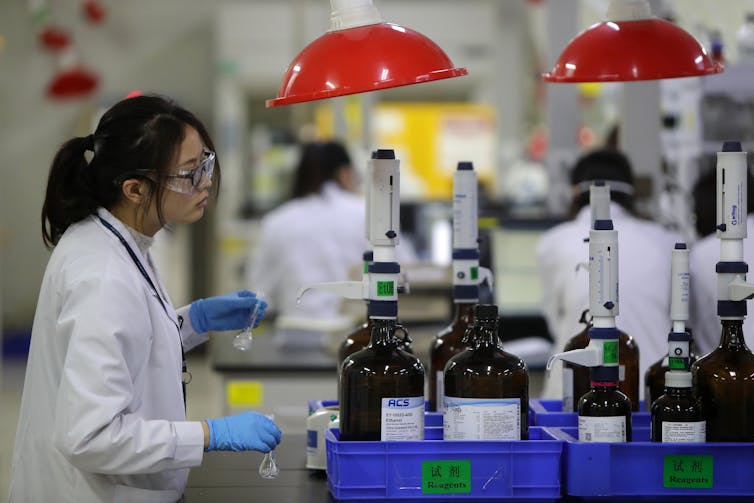
As the new coronavirus, called 2019-nCoV, spreads rapidly around the globe, the international community is scrambling to keep up. Scientists rush to develop a vaccine, policymakers debate the most effective containment methods, and health care systems strain to accommodate the growing number of sick and dying. Though it may sound like a scene from the 2011 movie “Contagion,” it is actually an unfolding reality.
In the midst of all of this, a potential crisis simmers in the shadows: The global dependence on China for the production of pharmaceuticals and medical equipment.
We represent an interdisciplinary group of scientists and policymakers at the Scowcroft Institute’s Pandemic and Biosecurity Policy Program based at the Bush School of Government at Texas A&M University who have been holding annual summits addressing pandemic-related issues for the past five years. One of our goals is to promote dialogue on potential risks related to pandemics and U.S. security, in this case the disruption of supply chains and availability of medical supplies and drugs.
Today, about 80% of pharmaceuticals sold in the U.S. are produced in China. This number, while concerning, hides an even greater problem: China is the largest and sometimes only global supplier for the active ingredient of some vital medications. The active ingredients for medicines that treat breast cancer and lung cancer and the antibiotic Vancomycin, which is a last resort antibiotic for some types of antimicrobial resistant infections, are made almost exclusively in China. Additionally, China controls such a large market portion of heparin, a blood thinner used in open-heart surgery, kidney dialysis and blood transfusions that the U.S. government was left with no choice but to continue buying from China even after a contamination scandal in 2007.
China is not only the dominant global supplier of pharmaceuticals, but it is also the largest supplier of medical devices in the U.S. These include things like MRI equipment, surgical gowns, and equipment that measures oxygen levels in the blood. Supplies of these essential products have not yet been severely disrupted by the coronavirus, but if China is no longer will or able to supply them to the U.S., thousands of Americans could die.
More concerning still are the limited options available to the U.S. and the rest of the globe to make up the shortfall. It could take years to develop the necessary infrastructure to reestablish U.S. manufacturing capacities and obtain Food and Drug Administration licensure to overcome the loss of the Chinese supply.
When a disease reaches epidemic levels, the first obligation for leaders in any country is to protect their own people. As this current crisis progresses, there may come a point when political leaders in China will face decisions on whether to prohibit the export of pharmaceuticals, medical devices and other vital medical components in order to treat or protect their own people. Such acts would be the logical outcome of an escalating situation. For the 2009 H1N1 pandemic response, for example, the U.S. was pushed to the back of the queue for vaccine deliveries even though we had existing contracts with a major vaccine manufacturer located in another country. Those vaccine deliveries were delayed.
While a total loss of active ingredient imports from China might seem far-fetched, we believe the increasing scale of the outbreak moves it closer to the realm of possibility.
About six weeks into international recognition of the epidemic in China, there are already shortages of vital personal protective equipment in both China and the U.S. UPS has transported more than 2 million masks and 11,000 gowns to Wuhan to help alleviate the shortage. But what happens when everyone runs out of protective equipment?
Wuhan is a significant player in the biotechnology and pharmaceutical industry, with multiple pharmaceutical companies located in the city. How many of these factories have closed as a result of the pandemic, and when will those that have closed open back up? Global supply chains could reach a crisis point if they are compromised because Hubei province, where Wuhan is located, is in quarantine and factories are shut down.
Additionally, Wuhan is the location of China’s first Biosafety Level (BSL) 4 laboratory, which was opened in 2017 to research SARS and other emerging diseases. It is the only lab in China that can safely handle the world’s most dangerous pathogens that pose a significant risk of transmission. Infection, death and quarantine in Wuhan and the surrounding Hubei province is restricting the ability of all types of commerce in the region. Meanwhile, the virus is already creating a significant supply chain imbalance within China. That means those medical supply companies will be under pressure to keep any products produced within the country for protection of their own health care workers, laboratory personnel and the general public.
The regulatory apparatus to insure that the Chinese manufactured pharmaceuticals being exported meet the highest standards of safety and quality control are weak or nonexistent, according to a congressional report last year. The pressure placed on supply chains by the outbreak could further exacerbate existing quality control challenges. In doing so, the virus has highlighted our reliance on China as a U.S. national security issue due to outsourcing our manufacturing capabilities and inability to ensure quality control.
As with all pandemics, the complexity of this outbreak demands international collaboration and transparency. At the same time, U.S. public health officials must acknowledge the country’s vulnerability due to our dependence on Chinese production of pharmaceuticals and medical equipment. The U.S. must develop a response plan for the inevitable shortages in the near-term and take necessary actions to reclaim control of our medical supply chain. Continuing to overlook this long-known vulnerability will only lead to catastrophe.

More than a dozen Americans who had tested positive for coronavirus and were flown home alongside others without the virus were transported despite objections from the Centers for Disease Control and Prevention (CDC), The Washington Post reported on Thursday.
The 14 Americans who tested positive were among more than 300 who arrived back in the United States earlier this week after being evacuated from the Diamond Princess cruise ship in Japan, which has been the center of scrutiny over a coronavirus outbreak on board.
When those individuals tested positive for the virus, U.S. officials had to make a choice as to whether to let them fly home alongside the other passengers.
The State Department and some Department of Health and Human Services (HHS) officials decided to allow it while the CDC objected, warning of the risk of the disease spreading on the plane, the Post reported.
The plane did have a plastic-lined enclosure that allowed the 14 people with the virus to be separated from the others, according to the newspaper.
The State Department and HHS explained the decision to allow the flights with sick passengers in a statement earlier this week, without mentioning the CDC objections.
The Post reported that the CDC asked to be taken off the press release.
“These individuals were moved in the most expeditious and safe manner to a specialized containment area on the evacuation aircraft to isolate them in accordance with standard protocols,” the departments said in the earlier statement.
“Every precaution to ensure proper isolation and community protection measures are being taken, driven by the most up-to-date risk assessments by U.S. health authorities,” they added.
All of the Americans evacuated from the cruise ship will be quarantined on military bases for 14 days to ensure they do not spread the disease to others.

Dozens of House Democrats wrote to President Trump Thursday to ask that he ensure any future coronavirus vaccines and treatments be “accessible, available and affordable.”
The Department of Health and Human Services (HHS) will help fund efforts by Janssen — a drug company owned by Johnson & Johnson — to create a coronavirus vaccine and treatment. HHS is also partnering with French drugmaker Sanofi to produce a potential coronavirus vaccine.
Rep. Jan Schakowsky (D-Ill.) led 45 House Democrats in warning that HHS should not give an exclusive license to any private manufacturer or risk making the vaccines or treatments unaffordable.
“Providing exclusive monopoly rights could result in an expensive medicine that is inaccessible, wasting public resources and putting public health at risk in the United States and around the globe,” the lawmakers wrote.
“If HHS or any other federal agency moves forward with such a proposal, we urge you to instead issue a limited license and implement requirements that a vaccine or treatment be made available at an affordable price.”
The efforts are in the early stages, and it could take years for a vaccine to be available to the public.
“Americans deserve to know that they will benefit from the fruits of their public investments,” the lawmakers wrote.
“That goal cannot be met if pharmaceutical corporations are given authority to set prices and determine distribution, putting profit-making interests ahead of public health priorities.”
But the concern from House Democrats comes as lawmakers increase their scrutiny of drugmakers over rising prescription costs.
“You have repeatedly called for action to lower drug prices and know that unjustifiably high drug prices are one of the most pressing public health concerns we face today,” the lawmakers wrote to Trump.
“We should not grant any manufacturer a blank check to monopolize a coronavirus vaccine or treatment developed with public, taxpayer support.”

The first travel-related case of the novel coronavirus has been detected in the U.S. in a man from Washington state, CDC officials said on Tuesday.
The man tested positive for the novel coronavirus via laboratory testing, CDC officials said. According to Washington health officials, he arrived without symptoms on an “indirect” flight into Seattle-Tacoma International Airport on Jan. 15, prior to implementation of the new screening procedures at other U.S. airports. Described as “an astute gentleman,” the passenger was aware of the virus and promptly shared information with his provider when his symptoms developed.
Currently, the patient is hospitalized “out of an abundance of caution,” but not because of severe illness. He reported he did not visit any of the implicated markets in the Wuhan area.
A statement released by the CDC details how the man sought care at a nearby medical facility, where health professionals suspected novel coronavirus, and based on the patient’s travel history and symptoms, sent specimens out for testing. CDC confirmed the diagnosis on Monday.
Washington health officials emphasized that this was one of the hospitals that had “done a drill” about this type of illness, including how to transport a patient in an ambulance and what type of isolation is needed. They said that the patient here is “isolated and poses low risk to staff or to the general public.”
Julie Fischer, PhD, of Georgetown University in Washington, D.C., told MedPage Today that this looks to be a similar pattern for human-to-human transmission as SARS, where currently most cases of this novel coronavirus “are probably close contacts,” including healthcare workers. Chinese health officials announced that 14 healthcare workers had been infected.
“This is a big heads up to the rest of the world to go ahead and start preparing your healthcare workers and make sure they have proper equipment,” she said. “It’s a reminder of what we already knew was a risk.”
Fischer said that in addition to taking precautions to avoid infection (such as personal protective equipment), clinicians should “pay attention to evolving guidance.”
The CDC had already decided to step up screening at two additional U.S. airports prior to this case being reported, with additional screening being added at both Hartsfield-Jackson Atlanta International Airport (ATL) and Chicago O’Hare International Airport (ORD) this week. In addition, passengers from Wuhan will be “funneled” into airports with enhanced screening measures, CDC officials said.
“The long incubation period [for the virus] also makes early detection much harder, especially as we do not know how many passengers have flown abroad and how many will do so in the coming weeks,” Stratfor Senior East Asia analyst Zhixing Zhang said in a statement.
Fischer added that screening will be especially challenging, given that this is in the middle of increased flu activity in the U.S. and that clinicians must rely on a “non-specific, place-based case definition” (based on travel) until new diagnostics emerge.
She emphasized the importance of “a good diagnostic test,” saying that only a handful of labs are capable of testing for the virus now. Once molecular testing is available, such as a polymerase chain reaction (PCR) test, the CDC will figure out how best to optimize it and share it more widely, Fischer said.
Indeed, CDC officials said that they are having “active conversations” about diagnostics, as well as research into vaccines.
Over the weekend, the case count for the novel coronavirus rose to over 300, with 6 deaths, according to news reports. The World Health Organization (WHO) is scheduled to meet on Wednesday about whether this virus constitutes an international health emergency.

‘Medicare for all’ debate sidesteps cost of current system.
The projected multitrillion-dollar cost of “Medicare for All” has pitted Democratic presidential candidates against each other as they argue about the feasibility of single-payer health care.
But the reality is the current health system may cost trillions more in the long run and be less effective in saving lives.
Spending on Medicare, Medicaid, private health insurance and out-of-pocket expenses is projected to hit $6 trillion a year — and $52 trillion over the next decade. At the same time, the number of people with insurance is dropping and Americans are dying younger.
Sen. Bernie Sanders and other single-payer advocates say Medicare for All would cost the government far less — between $20 trillion and $36 trillion over a decade — by slashing overhead, eliminating out-of-pocket costs and empowering federal officials to bargain directly with hospitals and drugmakers. But the streamlined system would have to care for millions of currently uninsured people at a significant cost to taxpayers, and experts disagree whether it would actually save money in the long run.
Centrist Democrats are pushing narrower plans that would, among other things, expand tax credits for people just above the Obamacare subsidy threshold. Virtually no one is arguing for maintaining the status quo, but that’s precisely what could happen given that congressional gridlock has stymied even popular, and bipartisan, causes like halting surprise medical bills.
“It’s really hard to see anything breaking through, especially when the industry interests and the money they’re willing to spend on lobbying and campaign contributions is just mind-boggling,” said Sabrina Corlette, a researcher at Georgetown University’s Center on Health Insurance Reforms. “And, without question, we are on an unsustainable trajectory.”
With Medicare for All and its price tag likely to come up in the next Democratic debate Jan. 14 in Iowa, here are five of the costliest consequences of inaction:
The Centers for Medicare and Medicaid Services estimates that nationwide health spending will hit $6 trillion a year by 2027 absent any changes in law. That would be nearly a fifth of the economy. In total, the United States is slated to spend about $52 trillion over the coming decade.
The cost drivers include hospitals, physician and clinical services and prescription drugs. Some local health systems have become monopolies that can largely set prices as they please — leading to higher premiums and more out-of-pocket spending for consumers.
“Even the biggest insurance plans are not big enough to bargain down the cost of services, and they don’t have an incentive to,” said Wendell Potter, a former Cigna executive-turned whistleblower and single-payer advocate.
An aging population is driving up Medicare spending, but the rising cost of private insurance is the biggest factor. A recent Kaiser Family Foundation analysis found per capita spending for private insurance grew by nearly 53 percent over the last decade, or more than double the hike in per capita Medicare spending.
The Census Bureau reported in September that the number of Americans without insurance grew by 2 million people since 2017 — the first increase in nearly a decade. Even with a healthy economy and low unemployment, more than 27 million people weren’t covered at any point last year. That could grow to 35 million by 2029, per the Congressional Budget Office, under current law.
The number of people enrolling in the Obamacare marketplace has declined, and more people are dropping employer-sponsored insurance due to cost and other concerns.
Part of this is President Donald Trump’s doing — the administration has slashed efforts to push Obamacare enrollment and rolled back the massive marketing effort that the Obama administration rolled out for years.
There are also more than 400,000 additional uninsured children than just two years ago — and 4 million in all — and states that haven’t expanded Medicaid are seeing the biggest spikes.
“What we also miss in the debate is the number of people temporarily uninsured, who miss open enrollment, who are between jobs, who fall through the cracks,” said Adam Gaffney, a Harvard Medical School researcher and the president of Physicians for a National Health Program. “I see people all the time in my practice in that situation who don’t fill prescriptions and experience serious complications.”
Going without insurance hits patients and health care providers: Average hospital spending on care for the uninsured was $13 million in 2018 up roughly 3 percent annually since 2016.
As the cost of health care has skyrocketed, insurance companies have squeezed patients, charging higher premiums, deductibles and co-pays, and creating narrow networks of providers and aggressively billing for out-of-network care.
Since 2009, the amount workers have had to pay for health insurance has increased 71 percent, while wages have only risen 26 percent over that time.
More than 80 percent of workers now have to pay a minimum amount out of pocket before insurance kicks in — and the amount of that deductible has doubled over the last 10 years, now standing at an average of $1,655, though many workers have to pay a lot more.
These costs are putting care out of reach for millions.
A new Gallup poll found that a full quarter of adults have put off treatment for a serious medical condition due to the cost — the highest since Gallup began asking the question three decades ago. A full third say they’ve delayed or deferred some kind of health care service over the past year. Another Gallup and West Help survey found that 34 million people know at least one friend or family member who died over the past five years after skipping treatment due to costs.
U.S. patients pay vastly more for prescription drugs than people in other developed countries and the disparity is set to grow. The United States spent $1,443 per person on prescription drugs in 2018, while other developed countries fell somewhere between $466 and $939.
In just five years, national spending on prescription drugs increased 25 percent, according to the Government Accountability Office, and CMS expects that increase to “accelerate” over the next several years.
Increasingly, patients are responding by forgoing their medications. Gallup found in November that nearly 23 percent of adults — roughly 58 million people — said they haven’t been able to “pay for needed medicine or drugs that a doctor prescribed” over the past year.
This widespread inability to take needed medication, a government-funded study found last year, is responsible for as much as 10 percent of hospital admissions. And the Centers for Disease Control and Prevention estimates that medication nonadherence accounts for somewhere between $100 and $300 billion in national health spending every year.
The cost of maintaining the status quo is evident not only in dollars but in human lives.
Life expectancy in the United States has declined over the last three years, even as other developed countries around the world saw improvements.
Though the United States spends nearly twice as much on health care as other high-income countries, there’s been a stark increase in mortality between the ages of 19 and 64, with drug overdoses, alcohol abuse, suicide and organ diseases driving the trend. It’s cut across race and gender with the worst effects felt in rural areas.
The opioid epidemic only accounts for a fraction of the problem. The National Research Council found that the United States has higher mortality rates from most major causes of death than 16 other high-income countries.
Researchers at USC estimate that if these trends continue, it would take the United States more than a century to reach the average life expectancy levels other countries hit in 2016.
https://mailchi.mp/1d8c22341262/the-weekly-gist-the-spotify-anxiety-edition?e=d1e747d2d8

Alarming statistics appeared this week in the journal JAMA Pediatrics, based on an analysis conducted by researchers at the Centers for Disease Control and Prevention (CDC) that showed that 20 percent of adolescents (ages 12-18) and 25 percent of young adults (ages 19-34) in the US are now prediabetic. These young people are at substantially increased risk for developing type 2 diabetes, as well as related cardiovascular diseases, as they grow older.
The numbers are a staggering picture of what confronts the American healthcare system as the millennial generation (whose median age is now 30) and the younger “Gen-Z” generation (born after 1997) move closer to their prime care consumption years. These age cohorts are likely to be much more medically complex, and will drive even higher healthcare costs, than previous generations—especially since both of the younger generations are larger than those that preceded them. But the statistics also raise important health policy questions.
To what extent should we “medicalize” prediabetes? In other words, should we begin to flag and treat prediabetes, which is more of a predisposition than an actual medical condition, with medications and interventions? Surely the reimbursement system will create a powerful temptation to do exactly that—at exorbitant cost. Or will we instead focus efforts on “reversing” prediabetes, with more robust attempts to encourage lifestyle changes (diet, exercise) and drive environmental changes (neighborhood walkability, availability and affordability of healthy foods)?
And there’s an information privacy issue looming as well—how will “prediabetics” be flagged, and could prediabetes be viewed as a “pre-existing condition” that might be used in coverage (and even employment) decisions should the regulatory environment change? As much as we focus today on the healthcare impact of the aging Baby Boom generation, we need to get out ahead of some of the issues we’re certain to face as our younger citizens grow older (and sicker).
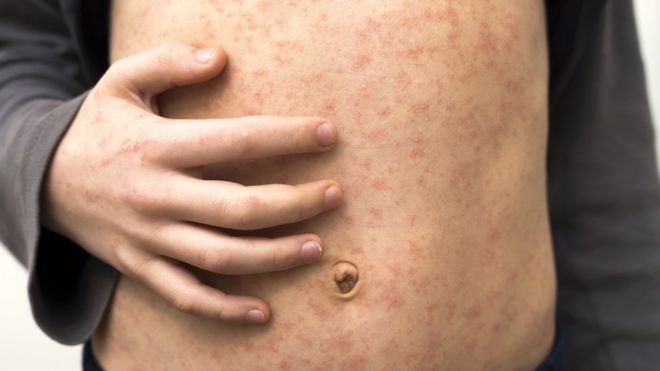
More than 140,000 people died from measles last year as the number of cases around the world surged once again, official estimates suggest.
Most of the lives cut short were children aged under five.
The situation has been described by health experts as staggering, an outrage, a tragedy and easily preventable with vaccines.
Huge progress has been made since the year 2000, but there is concern that incidence of measles is now edging up.
In 2018, the UK – along with Albania, the Czech Republic and Greece, lost their measles elimination status.
And 2019 could be even worse.
The US is reporting its highest number of cases for 25 years, while there are large outbreaks in the Democratic Republic of Congo, Madagascar and Ukraine.
The Pacific nation of Samoa has declared a state of emergency and unvaccinated families are hanging red flags outside their homes to help medical teams find them.
The global estimates are calculated by the World Health Organization (WHO) and the US Centers for Diseases Control and Prevention.
They show:
Measles cases do not go down every year – there was an increase between 2012 and 2013, for example.
However, there is greater concern now that progress is being undone as the number of children vaccinated stalls around the world.
“The fact that any child dies from a vaccine-preventable disease like measles is frankly an outrage and a collective failure to protect the world’s most vulnerable children,” said Dr Tedros Ghebreysus, director-general of the WHO.
Every single case of measles cannot be counted. In 2018, only 353,236 cases were officially recorded (out of the 7.8 million estimated).
So scientists perform complex maths for each country.
They take reported cases, the population size, deaths rates, the proportion of children vaccinated and more to eventually produce a global estimate.
Dr Minal Patel, who performed the number-crunching, told the BBC: “We’ve had a general trajectory downwards for deaths, which is great. Everyone involved in vaccination programmes should be very proud.
“But we’ve been stagnating in numbers of deaths for about the past seven years, and what’s really concerning is from last year we’ve gone up, and it looks like we’ve gone backwards.”
In short, not enough children are being vaccinated.
In order to stop measles spreading, 95% of children need to get the two doses of the vaccine.
But the figures have been stubbornly stuck for years at around 86% for the first jab, and 69% for the second.
Why enough children are not being vaccinated is more complicated – and the reasons are not the same in every country.
The biggest problem is access to vaccines, particular in poor countries.
The five worst-affected countries in 2018 were Democratic Republic of Congo, Liberia, Madagascar, Somalia and Ukraine.
The Ebola outbreak in Liberia (2014-16) and plague in Madagascar (2017) have taken a toll on their healthcare systems.
“Democratic Republic of Congo, Somalia and Ukraine, the other countries hardest-hit by measles, each face conflicts, with DRC additionally battling a serious Ebola outbreak and rampant distrust,” Prof Heidi Larson, from the London School of Hygiene & Tropical Medicine, explained.
The other issue is people who do have access to vaccines choosing not to immunise their children.
It looks likely.
The number of reported cases by mid-November this year was 413,000 compared with 353,000 for the whole of last year.
Henrietta Fore, Unicef’s executive director, said: “The unacceptable number of children killed last year by a wholly preventable disease is proof that measles anywhere is a threat to children everywhere.”
Dr Seth Berkley, chief executive of Gavi, the Vaccine Alliance, said: “It is a tragedy that the world is seeing a rapid increase in cases and deaths from a disease that is easily preventable with a vaccine.
“While hesitancy and complacency are challenges to overcome, the largest measles outbreaks have hit countries with weak routine immunisation and health systems.”
Prof Larson said: “These numbers are staggering. Measles, the most contagious of all vaccine-preventable diseases, is the tip of the iceberg of other vaccine-preventable disease threats and should be a wake-up call.”

We’ve been covering the news on recent vaping-related lung injuries, and a lot has happened since our last video. Time for an update!
 HENRY KOTULA