


Thought of the Day – I want this


The new year is always an ideal time for healthcare leaders to reflect on the state of our industry and their own organizations, as well as the challenges and opportunities ahead.
As the CEO of a large health system, I always like to reflect on one basic question at the end of each year: Are we staying true to our mission?
Certainly, maintaining an organization’s financial health must always be a priority but we should also never lose sight of our core purpose. In a business like ours that has confronted and endured a global pandemic and immense financial struggles over the past several years, I recognize it’s increasingly difficult to maintain our focus on mission while trying to find ways to pay for rising labor and supply costs, infrastructure improvements needed to remain competitive and other pressures on our day-to-day operations.
After all, the investments we need to make to promote community wellness, mental health, environmental sustainability and health equity receive little or no reimbursement, negatively impacting our financial bottom lines. During an era of unprecedented expansion of Medicaid and Medicare, we get less and less relief from commercial insurers, whose denial and delay tactics for reimbursing medical claims continue to erode the stability of many health systems and hospitals, especially those caring for low-income communities.
Despite those enormous pressures, it’s imperative that we continue to support underserved communities, military veterans struggling with post-traumatic stress, and intervention programs that help deter gun violence and addiction.
The list of other worthy investments goes on and on: charity care to uninsured or underinsured patients who can’t pay their medical bills, funding for emergency services that play such a critical role during public health emergencies, nutritional services for families struggling to put food on the table, programs that combat human trafficking and support women’s health, the LGBTQIA+ community and global health initiatives that aid Ukraine, the Middle East and other countries torn apart by war, famine and natural disasters.
We must also recognize the key role of healthcare providers as educators. School-based mental health programs are saving lives by identifying children exhibiting suicidal behaviors, anger management issues and other troublesome behaviors. School outreach efforts have the added benefit of helping health systems and hospitals address their own labor shortages by introducing young people to career paths that will help shape the future healthcare workforce.
Without a doubt, the “to-do” list of community health initiatives that support our mission is daunting. We can’t do it all alone, but as the largest employers in cities and towns across America, health systems and hospitals can serve as a catalyst to get all sectors of our society — government, businesses, schools, law enforcement, churches, social service groups and other community-based organizations — to recognize that “health” goes far beyond the delivery of medical care.
The health of individuals, families and communities hinges on the prevalence of good-paying jobs, decent and affordable housing, quality education, access to healthy foods, medical care, transportation, clean air and water, low prevalence of crime and illicit drugs, and numerous other variables that typically depend on the zip codes where we live. Those so-called social determinants of health are the driving factors that enable communities and the people who live there to either prosper or struggle, resulting in disparities that are the underlying cause of why so many cities and towns across the country fall into economic decay and become havens for crime and hotbeds for gun violence, which shamefully is now the leading cause of death for children and adolescents.
To revive these underserved communities, many of which are in our own backyards, we have to look at all of the socioeconomic issues they struggle with through the prism of health and use the collective resources of all stakeholders to bring about positive change.
Health is how we work together to build a sense of community. Having a healthy community also requires everyone doing what they can to tone down the political rhetoric and social media-fueled anger that is polarizing our society. Health is bringing back a sense of civility and respect in our public discourse, and promoting the values of honesty, decency and integrity.
As healthcare providers and respected business leaders, we should all make a New Year’s resolution to stay true to our mission and do what we can within our communities to bring oxygen to hope, optimism and a healthier future.

In nearly every facet of our lives, all of us are routinely put in the position of trying to settle disputes or disagreements, whether it be with our spouses or significant others, our children, our siblings, co-workers, neighbors, contractors — you name it. It’s part of everyday life. Conflicts arise and we figure out how to resolve them.
Unfortunately, in the politically toxic environment in which we now live, compromise is now perceived as a sign of weakness. Elected leaders are routinely criticized and attacked by fellow party members and their constituents for trying to find middle ground on any issue, particularly those rooted in ideology. The bipartisan agreement reached in Congress last week on gun safety was a rare and welcome exception.
While they hold starkly different positions and come from states that are thousands of miles apart geographically and politically, Senators Chris Murphy, D-Conn., an outspoken proponent of stronger gun safety laws, and John Cornyn, R-Texas, a staunch Second Amendment advocate, found a way to set aside their differences and reach compromise on the so-called Bipartisan Safer Communities Act that was approved by the Senate 65-33 and the House by a margin of 234-193. President Joe Biden signed the legislation into law June 25.
While the new law does not go nearly as far as Senator Murphy and most of his fellow Democrats wanted by, for instance, banning the sale of assault rifles or at least increasing the age to buy them, the willingness to finally get something done after 30 years of Congressional gridlock was a long-overdue victory for common sense.
Bipartisanship has also been evident in Congressional support for military funding for Ukraine and the 2021 Infrastructure Investment and Jobs Act, but little else.
Despite the glimmer of progress in our nation’s legislative branch of government, it appears that polarization now has a firm grip on our nation’s top court. In trying to find middle ground in deliberations on Roe v. Wade, U.S. Supreme Court Chief Justice John Roberts sought this compromise with his five fellow conservatives and three liberals on the bench: support Mississippi’s prohibition against abortion after 15 weeks, but preserve some semblance of reproductive rights for women by not overturning Roe v. Wade or the court’s 1992 ruling in Planned Parenthood v. Casey.
“The Court’s decision to overrule Roe and Casey is a serious jolt to the legal system — regardless of how you view those cases,” Roberts wrote. His incremental approach found no takers among his entrenched colleagues on either the right or the left. Hence, constitutional protections for abortions that had stood for nearly 50 years — and are supported by the vast majority of Americans — were stripped away in a 5-4 vote, leaving the power to individual states.
Unfortunately, bipartisanship can be equally elusive in state capitals around the country, which does not bode well for reproductive rights advocates in 21 states where abortion is now illegal or have “trigger bans” that will take effect within 30 days of the Supreme Court’s June 24 ruling.
Regardless of whether the issue is abortion or other divisive topics such as immigration, gun safety, voting rights, bail reform or LGBTQ rights, governors and state legislators of one controlling party or another routinely dig in and take intractable positions, leaving little or no room for negotiation.
We would all be well served to reintroduce ourselves to the art of compromise, for the good of our family relationships, for the good of our respective professions, for the good of our country and society in general, and even for the good of our own personal health as we consider whether to consume that extra helping of food or another cocktail.
Moderation is key in our lifestyle choices and it could also go a long way in trying to find middle ground with those who have differing opinions. If adversaries are truly motivated to do the right thing, not political gamesmanship, they should always choose their words carefully, listen with an open mind and always be open to making concessions. In short, we should all start by embracing civility.

Two members of Congress from Massachusetts have tested positive for the coronavirus, one after receiving both doses of the vaccine, a reminder that people can still be vulnerable to infection after being vaccinated, particularly in the two weeks after receiving the second dose.
Rep. Stephen F. Lynch (D-Mass.) tested positive for the virus on Friday afternoon after a staff member in his Boston office tested positive earlier in the week, his spokeswoman Molly Rose Tarpey said.
Lynch received a second dose of the Pfizer-BioNTech vaccine before the inauguration of President Biden on Jan. 20, but his office declined to specify the date it was administered. Lynch had tested negative for the virus before attending the inaugural ceremonies, Tarpey said.
“While Mr. Lynch remains asymptomatic and feels fine, he will self-quarantine and will vote by proxy in Congress during the coming week,” she said.
Tarpey added that Lynch “has followed CDC guidelines and continues to do so since he received the vaccine.”
Another Democrat from Massachusetts, Rep. Lori Trahan, announced Thursday that she had tested positive for the virus and was asymptomatic. Trahan, whose staff members have been working remotely, also said she planned to vote by proxy next week.
“I encourage everyone to continue taking this virus seriously and to follow the science and data-driven guidance to wear a mask, maintain a safe social distance from others, avoid large gatherings and stay home whenever possible,” Trahan said.
Trahan received her first shot of one of the vaccines last week, spokeswoman Francis Grubar told The Washington Post.
Occasional cases of people testing positive after receiving one or both doses are not unexpected, medical experts say. Clinical trial data published by Pfizer show that the vaccine is about 52 percent effective at preventing illness after the first shot, compared to 95 percent effectiveness seven days after the second dose.
A small number of patients can still become mildly sick even after they are fully vaccinated. But only one of the roughly 20,000 people who received both doses in the clinical trial developed severe covid-19, suggesting the vaccine is powerful protection against the most dangerous cases of the disease.
Members of Congress began getting vaccinated as early as Dec. 18, but Lynch at the time said he was “waiting for the vaccine to be first offered to health care personnel, first responders and vulnerable seniors” in his district, the Boston Herald reported. It is unclear when Lynch ultimately received his first dose of the vaccine; he would have received the second dose of the Pfizer-BioNTech vaccine about three to four weeks after the first.
Public health experts have emphasized that it usually takes one week after the second dose of the Pfizer-BioNTech vaccine to reach 95 percent efficacy and two weeks after the second dose of the Moderna vaccine to reach 94 percent efficacy.
“There’s no vaccine that I know that protects you the same day you get it,” Onyema Ogbuagu, the principal investigator for Pfizer’s vaccine trial at Yale University, told The Post’s Allyson Chiu. “On a population level, 95% efficacy still translates to 5/100, or 50/1,000, or 500/10,000 vaccinated persons still being vulnerable to symptomatic disease and maybe even more having asymptomatic carriage.”
At least 23.2 million people in the United States have received one or both doses of the vaccine. The Centers for Disease Control and Prevention recommends that vaccinated people continue to wear masks, socially distance, avoid poorly ventilated spaces and wash their hands frequently to prevent the spread of the virus.
“We also don’t yet know whether getting a covid-19 vaccine will prevent you from spreading the virus that causes covid-19 to other people, even if you don’t get sick yourself,” CDC guidelines state. “While experts learn more about the protection that covid-19 vaccines provide under real-life conditions, it will be important for everyone to continue using all the tools available to help stop this pandemic.”
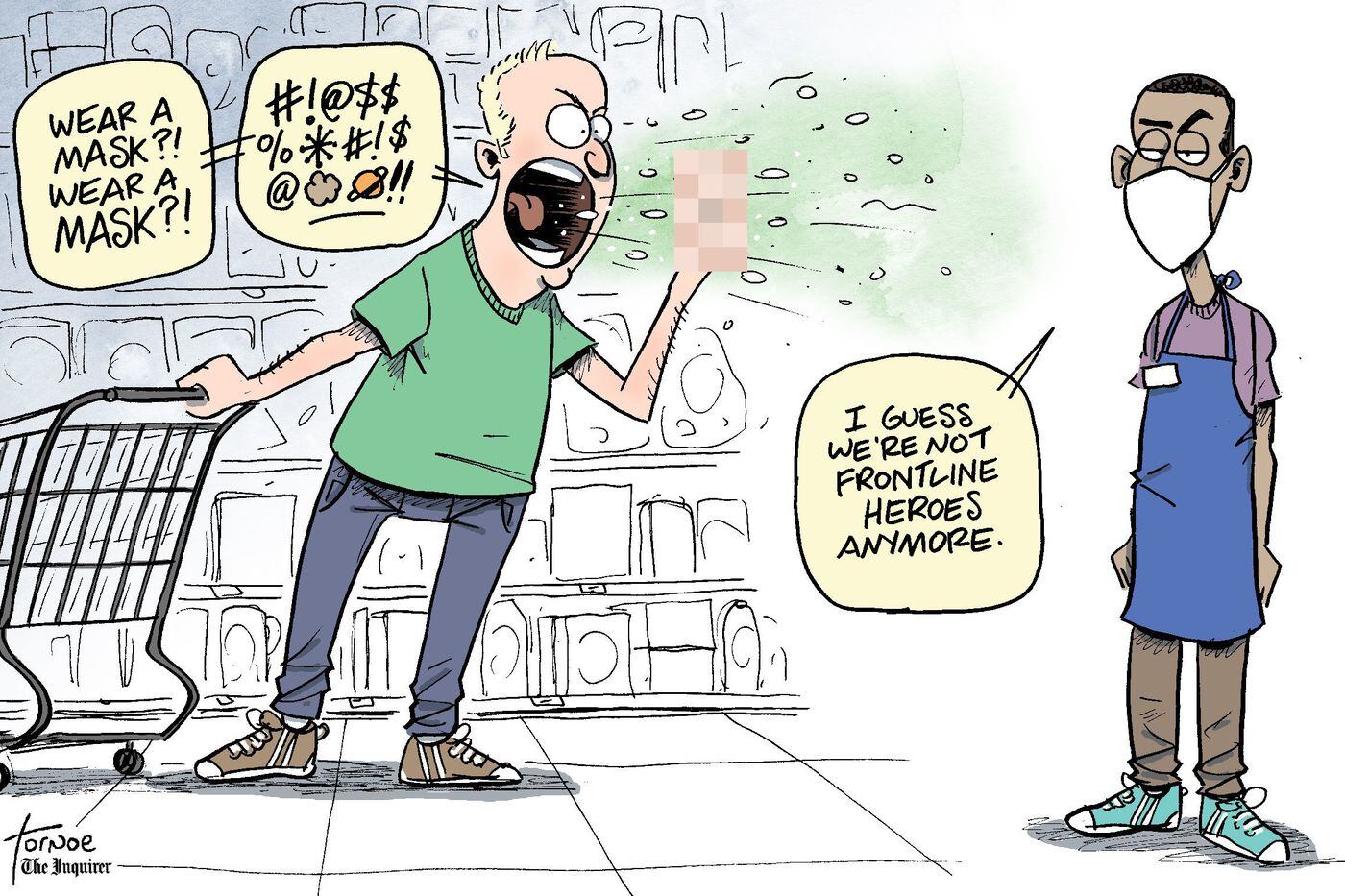
Mask-wearing in particular has become politicized, including in the hallways of Congress. After the Jan. 6 siege at the Capitol, several Democrats said they feared they had been exposed to the virus after sheltering with Republican lawmakers who refused to wear masks. In the following, at least three lawmakers tested positive for the virus.
On Friday, Rep. Cori Bush (D-Mo.) accused Rep. Marjorie Taylor Greene (R-Ga.) of berating her in the hallways after she told Greene to put on a mask. The incident, coupled with other hostile rhetoric and Greene’s refusal to abide by rules and protocols put in place because of the pandemic, prompted Bush to decide to move her office away from Greene’s for safety reasons, the Missouri lawmaker said.



 HENRY KOTULA