The emerging long-term complications of Covid-19, explained

https://www.vox.com/2020/5/8/21251899/coronavirus-long-term-effects-symptoms

Coronavirus long-term effects: Some Covid-19 survivors face lung ...

“It is a true roller coaster of symptoms and severities, with each new day offering many unknowns.”

At first, Lauren Nichols tried to explain away her symptoms. In early March, the healthy 32-year-old felt an intense burning sensation, like acid reflux, when she breathed. Embarrassed, she didn’t initially seek medical care. When her shortness of breath kept getting worse, her doctor tested her for Covid-19.

Her results came back positive. But for Nichols, that was just the beginning. Over the next eight weeks, she developed wide and varied symptoms, including extreme and chronic fatigue, diarrhea, nausea, tremors, headaches, difficulty concentrating, and short-term memory loss.

“The guidelines that were provided by the CDC [Centers for Disease Control and Prevention] were not appropriately capturing the symptoms that I was experiencing, which in turn meant that the medical community was unable to ‘validate’ my symptoms,” she says. “This became a vicious cycle of doubt, confusion, and loneliness.”

An estimated 40 to 45 percent of people with Covid-19 may be asymptomatic, and others will have a mild illness with no lasting symptoms. But Nichols is one of many Covid-19 patients who are finding their recovery takes far longer than the two weeks the World Health Organization says people with mild cases can expect. (The WHO says those with severe or critical cases can expect three to six weeks of recovery.)

Because Covid-19 is a new disease, there are no studies about its long-term trajectory for those with more severe symptoms; even the earliest patients to recover in China were only infected a few months ago. But doctors say the novel coronavirus can attach to human cells in many parts of the body and penetrate many major organs, including the heart, kidneys, brain, and even blood vessels.

“The difficulty is sorting out long-term consequences,” says Joseph Brennan, a cardiologist at the Yale School of Medicine. While some patients may fully recover, he and other experts worry others will suffer long-term damage, including lung scarring, heart damage, and neurological and mental health effects.

The UK National Health Service assumes that of Covid-19 patients who have required hospitalization, 45 percent will need ongoing medical care, 4 percent will require inpatient rehabilitation, and 1 percent will permanently require acute care. Other preliminary evidence, as well as historical research on other coronaviruses like severe acute respiratory syndrome (SARS) and Middle East respiratory syndrome (MERS), suggests that for some people, a full recovery might still be years off. For others, there may be no returning to normal.

There’s a lot we still don’t know, but here are a few of the most notable potential long-term impacts that are already showing up in some Covid-19 patients.


Lung scarring

Melanie Montano, 32, who tested positive for Covid-19 in March, says that more than seven weeks after she first got sick, she still experiences symptoms on and off, including burning in her lungs and a dry cough.

Brennan says symptoms like that occur because “this virus creates an incredibly aggressive immune response, so spaces [in the lungs] are filled with debris and pus, making your lungs less pliable.”

On CT scans, while normal lungs appear black, Covid-19 patients’ lungs frequently have lighter gray patches, called “ground-glass opacities” — which may not heal.

One study from China found that this ground-glass appearance showed up in scans of 77 percent of Covid-19 patients. In another study out of China, published in Radiology, 66 of 70 hospitalized patients had some amount of lung damage in CT scans, and more than half had the kind of lesions that are likely to develop into scars. (A third study from China suggests this is not just for critically ill patients; its authors found that of 58 asymptomatic patients, 95 percent also had evidence of these ground-glass opacities in their lungs. More than a quarter of these individuals went on to develop symptoms within a few days.)

“These kinds of tissue changes can cause permanent damage,” says Ali Gholamrezanezhad, a radiologist at the Keck School of Medicine at the University of Southern California.

Although it’s still too early to know if patients with ongoing lung symptoms like Montano will have permanent lung damage, doctors can learn more about what to expect from looking back to people who have recovered from SARS and MERS, other coronaviruses that resulted in similar lung tissue changes.

One small longitudinal study published in Nature followed 71 SARS patients from 2003 until 2018 and found that more than a third had reduced lung capacity. MERS is a little harder to extrapolate from, since fewer than 2,500 people were infected, and somewhere between 30 and 40 percent died. But one study found that about a third of 36 MERS survivors also had long-term lung damage.

Gholamrezanezhad has recently done a literature review of SARS and MERS and says that for this subset of people, “The pulmonary function never comes back; their ability to do normal activities never goes back to baseline.”

Additionally, Covid-19 scarring rates may end up being higher than SARS and MERS patients because those illnesses often attacked only one lung. But Covid-19 appears to often affect both lungs, which Gholamrezanezhad says escalates the risks of lung scarring.

He has already seen residual scarring in Covid-19 patients and is now designing a study to identify what factors might make some people at higher risk of permanent damage. He suspects having any type of underlying lung disease, like asthma, or other health conditions, like hypertension, might increase the risk of having longer-term lung issues. Additionally, “the older you are, probably the higher your chance of scarring,” he says.

For people with this kind of lung scarring, normal activities may become more challenging. “Routine things, like running up a flight of stairs, would leave these individuals gasping for air,” Brennan says.


Stroke, embolisms, and blood clotting

Many patients hospitalized for Covid-19 are experiencing unexpectedly high rates of blood clots, likely due to inflammatory responses to the infection. These can cause lung blockages, strokes, heart attacks, and other complications with serious, lasting effects.

Blood clots that form in or reach the brain can cause a stroke. Although strokes are more typically seen in older people, strokes are now being reported even in young Covid-19 patients. In Wuhan, China, about 5 percent of hospitalized Covid-19 patients had strokes, and a similar pattern was reported with SARS.

In younger people who have strokes, mortality rates are relatively low compared to those who are older, and many people recover. But studies show only between 42 and 53 percent are able to return to work.

Blood clots can also cut off circulation to part of the lungs, a condition known as a pulmonary embolism, which can be deadly. In France, two studies suggest that between 23 and 30 percent of people with severe Covid-19 are also having pulmonary embolisms.

One analysis found that after a pulmonary embolism, “symptoms and functional limitations are frequently reported by survivors.” These include fatigue, heart palpitations, shortness of breath, marked limitation of physical activity, and inability to do physical activity without discomfort.

Blood clots in other major organs can also cause serious problems. Renal failure has been a common challenge in many severe Covid-19 patients, and patients’ clotted blood has been clogging dialysis machines. Some of these acute kidney injuries may be permanent, requiring ongoing dialysis.

Clots outside organs can be serious, too. Deep vein thrombosis, for example, occurs when a blood clot forms in a vein, often the legs. Nick Cordero, a Tony-nominated Broadway and television actor, recently had to have his right leg amputated after Covid-related blood clots.

Abnormal blood clotting even seems to be happening in people after they’ve appeared to recover. One 32-year-old woman in Chicago, for example, had been discharged from the hospital for a week when she died suddenly with a severely swollen leg, a sign of deep vein thrombosis, according to local broadcaster WGN9. Or take Troy Randle, a 49-year-old cardiologist in New Jersey, who was declared safe to go back to work after recovering from Covid-19 when he developed a vicious headache. A CT scan confirmed he’d had a stroke.

Although there’s still a shortage of data, one study found that as many as 31 percent of ICU patients with Covid-19 infections had these kinds of clotting problems. In the meantime, the International Society on Thrombosis and Haemostasis has issued guidelines that recovered Covid-19 patients should continue taking anticoagulants even after being discharged from the hospital.


Heart damage

Being critically ill, especially with low oxygen levels, puts additional stress on the heart. But doctors now think that in Covid-19 patients, viral particles might also be specifically inflaming the heart muscle. (The heart has many ACE2 receptors, which scientists have identified as an entry point for the SARS-CoV-2 virus.)

“In China, doctors noted some people coming [in] with chest pain,” says Mitchell Elkind, president-elect of the American Heart Association and professor of neurology and epidemiology at Columbia University. “They had a heart attack, and then developed Covid symptoms or tested positive after.”

One study from Wuhan in January found 12 percent of Covid-19 patients had signs of cardiovascular damage. These patients had higher levels of troponin, a protein released in the blood by an injured heart muscle. Since then, other reports suggest the virus may directly cause acute myocarditis and heart failure. (Heart failure was also seen with MERS and is known to be correlated with even the seasonal flu.)

In March, another study looked at 416 hospitalized Covid-19 patients and found 19 percent showed signs of heart damage. University of Texas Health Science Center researchers warn that in survivors, Covid-19 may cause lingering cardiac damage, as well as making existing cardiovascular problems worse, further increasing the risk for heart attack and stroke.

A pulmonary critical care doctor at Mount Sinai Hospital in New York City, for example, recovered from Covid-19, only to learn she had developed cardiomyopathy, a condition in which your heart has trouble delivering blood around your body. Although previously healthy, when she returned to work, she told NBC, “I couldn’t run around like I always do.”

The specific consequences may vary depending on how the heart is affected. For example, Covid-19 has been linked to myocarditis, a condition where inflammation weakens the heart, creates scar tissue, and makes it work harder to circulate the body’s oxygen. The Myocarditis Foundation recommends these patients avoid cigarettes and alcohol, and stay away from rigorous exercise until approved by their doctor.


Neurocognitive and mental health impacts

Covid-19 also seems to affect the central nervous system, with potentially long-lasting consequences. In one study from China, more than a third of 214 people hospitalized with confirmed Covid-19 had neurological symptoms, including dizziness, headaches, impaired consciousness, vision, taste/smell impairment, and nerve pain while they were ill. These symptoms were more common in patients with severe cases, where the incidence increased to 46.5 percent. Another study in France found neurologic features in 58 of 64 critically ill Covid-19 patients.

As the pandemic goes on, Elkind says, “We need to be on the lookout for long-term neurocognitive problems.”

Looking back to SARS and MERS suggests that Covid-19 patients may have slightly delayed onset of neurological impacts. Andrew Josephson, a doctor at the University of California San Francisco, wrote in JAMA, “Although the SARS epidemic was limited to about 8,000 patients worldwide, there were some limited reports of neurologic complications of SARS that appeared in patients 2 to 3 weeks into the course of the illness.” These included muscular weakness, burning or prickling, and numbness, and the breakdown of muscle tissue into the blood. Neurological injuries, including impaired balance and coordination, confusion, and coma, were also found with MERS.

Long-term complications of Covid-19 — whether caused by the virus itself or the inflammation it triggers — could include decreased attention, concentration, and memory, as well as dysfunction in peripheral nerves, “the ones that go to your arms, legs, fingers, and toes,” Elkind says.

There are other cognitive implications for people who receive intensive treatment in hospitals. For example, delirium — an acutely disturbed state of mind that can result in confusion and seeing or hearing things that aren’t there — affects a third or more of ICU patients, and research suggests the presence of delirium during severe illness predicts future long-term cognitive decline.

Previous research on acute respiratory distress syndrome (ARDS) more generally may also provide clues to what neurological issues critically ill Covid-19 patients might see after leaving the hospital.

Research shows one in five ARDS survivors experiences long-term cognitive impairment, even five years after being discharged. Continuing impairments can include short-term memory problems and difficulty with learning and executive function. These can lead to challenges like difficulty working, impaired money management, or struggling to perform daily tasks.

ARDS survivors frequently have increased rates of depression and anxiety, and many experience post-traumatic stress. Although it’s still too early to have much data on Covid-19, during the SARS outbreak, former patients struggled with psychological distress and stress for at least a year after the outbreak.

“I felt imprisoned within my body, imprisoned within my home, and tremendously ignored and misunderstood by the general public, and even those closest to me,” Nichols says about her battle with Covid-19. “I feel incredibly alone.”

Jane, who prefers to use a pseudonym because she fears retribution at the hospital where she works, tested positive for Covid-19 more than a month ago. She’s still struggling with fevers, heart issues, and neurological issues, but the most difficult part, she says, is how tired she is of “being treated like I am a bomb that no one knows how to disarm.” Jane, a nurse who cared for AIDS patients during the ’90s, says, “This is exactly what those people went through. There is a terrible stigma.” In addition to the stigma, uncertainty has added to her mental health burden.

“People need to know this disease can linger and wreck your life and health,” she says. “And no one knows what to do for us.”


Childhood inflammation, male infertility, and other possible lasting effects

The novel coronavirus continues to frustrate scientists and patients alike with its mysteries. One of these is a small but growing number of children who recently began showing up at doctors’ offices in Britain, Italy, and Spain with strange symptoms, including a rash, a high fever, and heart inflammation.

On May 4, the New York City Health Department noted that at least 15 children with these symptoms had been hospitalized there, too. These cases present like a severe immune response called Kawasaki disease, where blood vessels can begin to leak, and fluid builds up in the lungs and other major organs. Although only some of these children have tested positive for Covid-19, Russell Viner, president of the Royal College of Pediatrics and Child Health, told the New York Times, “the working hypothesis is that it’s Covid-related.”

Children who survive Kawasaki-like conditions can suffer myocardial and vascular complications in adulthood. But it’s too early to know how Covid-related cases will develop. Many of the small number of reported cases appear to be responding well to treatment.

Other researchers are suggesting that Covid-19 may pose particular problems for men beyond their disproportionate mortality from the illness. The testicles contain a high number of ACE2 receptors, explained researcher Ali Raba, in a recent letter to the World Journal of Urology. “There is a theoretical possibility of testicular damage and subsequent infertility following COVID-19 infection,” he wrote.

Another study, looking at 38 patients in China who had been severely ill with Covid-19, found that during their illness, 15 had virus RNA in their semen samples, as did two of 23 recovering patients. (The presence of viral RNA doesn’t necessarily indicate infectious capacity.)

Another recent study also showed that in 81 men with Covid-19, male hormone ratios were off, which could signal trouble for fertility down the line. The authors called for more attention to be paid, particularly on “reproductive-aged men.” An April 20 paper published in Nature went so far as to suggest, “After recovery from COVID-19, young men who are interested in having children should receive a consultation regarding their fertility.”

And we are just at the beginning of figuring out what this complex infection means for other organ systems and their recovery. For example, a recent preprint from Chinese doctors looked at 34 Covid-19 survivors’ blood. While they saw a difference between severe and mild cases, the researchers found that regardless of the severity of the disease, after recovered patients were discharged from the hospital, many biological measures “failed to return to normal.” The most concerning measures suggested ongoing impaired liver function.


What all of this means for survivors and researchers

As all this preliminary research shows, we are still in the early days of understanding what this virus might mean for the growing number of Covid-19 survivors — what symptoms they might expect to have, how long it might take them to get back to feeling normal (if they ever will), and what other precautions they might need to be taking.

Many people aren’t even receiving adequate information about when it might be safe for them to stop self-isolating. Nichols and other survivors report feeling better one day and terrible the next.

But in the chaos Covid-19 has caused in the medical systems, survivors say it’s hard to get attention for their ongoing struggles. “The support and awareness is simply lacking,” Nichols says. “It is a true roller coaster of symptoms and severities, with each new day offering many unknowns: I may feel healthier one day but may feel utterly debilitated and in pain the next.”


Covid-19 cases are rising, but deaths are falling. What’s going on?

https://www.vox.com/2020/7/6/21314472/covid-19-coronavirus-us-cases-deaths-trends-wtf

Coronavirus cases are rising, but Covid-19 deaths are falling ...

By the time coronavirus deaths start rising again, it’s already too late.

There is something confounding about the US’s new coronavirus spikes: Cases are rising, but the country is seeing its lowest death counts since the pandemic first exploded.

The numbers are genuinely strange to the naked eye: On July 3, the US reported 56,567 new Covid-19 cases, a record high. On the same day, 589 new deaths were reported, continuing a long and gradual decline. We haven’t seen numbers that low since the end of March.

When laypeople observe those contradictory trends, they might naturally have a follow-up question: If deaths are not increasing along with cases, then why can’t we keep reopening? The lockdowns took an extraordinary toll of their own, after all, in money and mental health and some lives. If we could reopen the economy without the loss of life we saw in April and May, then why shouldn’t we?

I posed that very question to more than a dozen public health experts. All of them cautioned against complacency: This many cases mean many more deaths are probably in our future. And even if deaths don’t increase to the same levels seen in April and May, there are still some very serious possible health consequences if you contract Covid-19.

The novel coronavirus, SARS-Cov-2, is a maddeningly slow-moving pathogen — until it’s not. The sinking death rates reflect the state of the pandemic a month or more ago, experts say, when the original hot spots had been contained and other states had only just begun to open up restaurants and other businesses.

That means it could still be another few weeks before we really start to see the consequences, in lives lost, of the recent spikes in cases. And in the meantime, the virus is continuing to spread. By the time the death numbers show the crisis is here, it will already be too late. Difficult weeks will lie ahead.

Even if death rates stay low in the near term, that doesn’t mean the risk of Covid-19 has evaporated. Thousands of Americans being hospitalized in the past few weeks with a disease that makes it hard to breathe is not a time to declare victory. Young people, who account for a bigger share of the recent cases, aren’t at nearly as high a risk of dying from the virus, but some small number of them will still die and a larger number will end up in the hospital. Early research also suggests that people infected with the coronavirus experience lung damage and other long-term complications that could lead to health problems down the road, even if they don’t experience particularly bad symptoms during their illness.

And as long as the virus is spreading in the community, there is an increased risk that it will find its way to the more vulnerable populations.

“More infected people means faster spread throughout society,” Kumi Smith, who studies infectious diseases at the University of Minnesota, told me. “And the more this virus spreads the more likely it is to eventually reach and infect someone who may die or be severely harmed by it.”

This presents a communications challenge. Sadly, as Smith put it, “please abstain from things you like to benefit others in ways that you may not be able to see or feel” is not an easy message for people to accept after three-plus months in relative isolation.

But perhaps the bigger problem is the reluctance of our government to take the steps necessary to control the disease. Experts warned months ago that if states were too quick to relax their social distancing policies, without the necessary capacity for more testing or contact tracing, new outbreaks would flare up and be difficult to contain.

That’s exactly what happened — and now states are scrambling to reimpose some restrictions. Unless the US gets smarter about its coronavirus response, the country seems doomed to repeat this cycle over and over again.


Why Covid-19 deaths aren’t rising along with cases — yet

The contradiction between these two curves — case numbers sloping upward, death counts downward — is the primary reason some people are agitating to accelerate, not slow down, reopening in the face of these new coronavirus spikes.

The most important thing to understand is that this is actually to be expected. There is a long lag — as long as six weeks, experts told me — between when a person gets infected and when their death would be reported in the official tally.

“Why aren’t today’s deaths trending in the same way today’s cases are trending? That’s completely not the way to think about it,” Eleanor Murray, an epidemiologist at Boston University, told me. “Today’s cases represent infections that probably happened a week or two ago. Today’s deaths represent cases that were diagnosed possibly up to a month ago, so infections that were up to six weeks ago or more.”

“Some people do get infected and die quickly, but the majority of people who die, it takes a while,” Murray continued. “It’s not a matter of a one-week lag between cases and deaths. We expect something more on the order of a four-, five-, six-week lag.”

As Whet Moser wrote for the Covid Tracking Project last week, the recent spikes in case counts really took off around June 18 and 19. So we would not expect them to show up in the death data yet.

“Hospitalizations and deaths are both lagging indicators, because it takes time to progress through the course of illness,” Caitlin Rivers at the Johns Hopkins Center for Health Security told me late last week. “The recent surge started around two weeks ago, so it’s too soon to be confident that we won’t see an uptick in hospitalizations and deaths.”

The national numbers can also obscure local trends. According to the Covid Tracking Project, hospitalizations are spiking in the South and West, but, at the same time, they are dropping precipitously in the Northeast, the initial epicenter of the US outbreak.

And a similar regional shift in deaths may be underway, though it will take longer to reveal itself because the death numbers lag behind both cases and hospitalizations. But even now, Alabama, Arizona, Florida, Nevada, South Carolina, Tennessee, Texas, and Virginia have seen an uptick in their average daily deaths, according to Covid Exit Strategy, while Connecticut, Massachusetts, and New York have experienced a notable decline.

There are some reasons to be optimistic we will not see deaths accelerate to the same extent that cases are. For one, clinicians have identified treatments like remdesivir and dexamethasone that, respectively, appear to reduce people’s time in the hospital and their risk of dying if they are put on a ventilator.

The new infections are also, for now, skewing more toward younger people, who are at a much lower risk of dying of Covid-19 compared to older people. But that is not the case for complacency that it might superficially appear to be.


Younger people are less at risk from Covid-19 — but their risk isn’t zero

For starters, younger people can die of Covid-19. About 3,000 people under the age of 45 have died from the coronavirus, according to the CDC’s statistics (which notably have a lower overall death count than other independent sources that rely on state data). That is a small percentage of the 130,000 and counting overall Covid-19 deaths in the US. But it does happen.

Moreover, younger people can also develop serious enough symptoms that they end up having to be hospitalized with the disease. Again, their risk is meaningfully lower than that of older people, but that doesn’t mean it’s zero.

There can also be adverse outcomes that are not hospitalization or death. Illness is not a zero-sum game. A recent study published in Nature found that even asymptomatic Covid-19 patients showed abnormal lung scans. As Lois Parshley has documented for Vox, some people who recover from Covid-19 still report health problems for weeks after their initial sickness. Potential long-term issues include lung scarring, blood clotting and stroke, heart damage, and cognitive challenges.

In short, surviving Covid-19, even with relatively mild symptoms, does not mean a person simply reverts to normal. This is a new disease, and we are still learning the full extent of its effects on the human body.

But even if we recognize that young people face less of a threat directly from the coronavirus, there is still a big reason to worry if the virus is spreading in that population: It could very easily make the leap from less vulnerable people to those who are much more at risk of serious complications or death.


The coronavirus could easily jump from younger people to the more vulnerable

One response to the above set of facts might be: “Well, we should just isolate the old and the sick, while the rest of us go on with our lives.” That might sound good in theory (if you’re not older or immunocompromised yourself), but it is much more difficult in practice.

“The fact is that we live in communities that are all mixed up with each other. That’s the concern,” Natalie Dean, a biostatistics professor at the University of Florida, says. “It’s not like there’s some nice neat demarcation: you’re at high risk, you’re at low risk.”

The numbers in Florida are telling. At first, in late May and into early June, new infections accelerated among the under-45 cohort. But after a lag of a week or so, new cases also started to pick up among the over-45 (i.e., more at-risk) population.

“The rise in older adults is trailing behind, but it is starting to go up,” Dean said.

Anecdotally, nursing homes in Arizona and Texas — the two states with the most worrisome coronavirus trends right now — have seen outbreaks in recent weeks as community spread increases. The people who work in nursing homes, after all, are living out in the community where Covid-19 is spreading. And, because they are younger, they may not show symptoms while they are going to work and potentially exposing those patients.

As one expert pointed out to me, both Massachusetts and Norway have seen about 60 percent of their deaths come in long-term care facilities, even though the former has a much higher total fatality count than the latter. That would suggest we have yet to find a good strategy for keeping the coronavirus away from those specific populations.

“There is so far not much evidence that we know how to shield the most vulnerable when there is widespread community transmission,” Marc Lipsitch, a Harvard epidemiologist, told me.

That means the best recourse is trying to contain community spread, which keeps the overall case and death counts lower (as in Norway) and prevents the health care system from being overwhelmed.


Health systems haven’t been overwhelmed — but some hospitals in new hot spots are getting close

Arizona, Florida, and Texas still have 20 to 30 percent of their ICU and hospital beds available statewide, according to Covid Exit Strategy, even as case counts continue to rise. While some people use those numbers to argue that the health systems can handle an influx of Covid patients, the experts I spoke to warned that capacity can quickly evaporate.

“Let’s keep it that way, shall we?” William Hanage at Harvard said. “Hospitals are getting close to overwhelmed in some places, and that will be more places in future if action isn’t taken now. Also ‘not overwhelmed’ is a pretty low bar.”

Hospital capacity is another example of how the lags created by Covid-19 can lull us into a false sense of security until a crisis presents itself and suddenly it’s too late. Because it can take up to two weeks between infection and hospitalization, we are only now beginning to see the impact of these recent spikes.

And, to be clear, hospitalizations are on the rise across the new hot spots. The number of people currently hospitalized with Covid-19 in Texas is up from less than 1,800 on June 1 to nearly 8,000 on July 4. Hospitalizations in Arizona have nearly tripled since the beginning of June, up to more than 3,100 today.

And the state-level data doesn’t show local trends, which are what really matter when it comes to hospital capacity. Some of the hardest-hit cities in these states are feeling the strain, as Hanage pointed out. Hospitals in Houston have started transferring their Covid-19 patients to other cities, and they are implementing their surge capacity plans, anticipating a growing need because of the trendlines in the state.

Once a hospital’s capacity is reached, it’s already too late. They will have to endure several rough weeks after that breach, because the virus has continued to infect more people in the interim, some of whom will get very sick and require hospitalization when there isn’t any room available for them.

“We’re seeing some drastic measures being implemented right now in Texas and Arizona along those lines: using children’s hospitals for adults, going into crisis mode, etc.,” Tara Smith, who studies infectious diseases at Kent State University, told me. “So it shows how quickly all of that can turn around.”

And, on top of Covid-19, these health systems will continue to have the usual flow of emergencies from heart attacks, strokes, accidents, etc. That’s when experts start to worry people will die who wouldn’t otherwise have. That is what social distancing, by slowing the spread of the coronavirus, is supposed to prevent.


We don’t have to lock down forever — but we have to be smart and vigilant

Lockdowns are extraordinarily burdensome. Tens of millions of Americans have lost their jobs. Drug overdoses have spiked. There has been a worrying increase in heart-related deaths, which indicates people who otherwise would have sought medical treatment did not do so during the worst of the outbreak this spring.

But we cannot will the coronavirus out of existence. Experts warned months ago that if states reopened too early, cases would spike, which would strain health systems and put us at risk of losing more people to this virus. That appears to be what’s starting to happen. And it may get worse; if the summer heat has suppressed the virus to any degree, we could see another rebound in the fall and winter.

So we must strike a balance, between the needs of a human society and the reality that most of us are still susceptible to an entirely novel pathogen that is much deadlier and more contagious than the flu.

That means, for starters, being smarter about how we reopen than we have been so far. There is strong evidence that states were too cavalier about ending stay-at-home orders and reopening businesses, with just a handful meeting the metrics for reopening laid out by experts, as Vox’s German Lopez explained.

“What I’ve seen is that reopening is getting interpreted by many as reverting back to a Covid-free time where we could attend larger group gatherings, socialize regularly with many different people, or congregate without masks,” Kumi Smith in Minnesota said. “The virus hasn’t changed since March, so there’s no reasons why our precautions should either.”

To date, most states have opened up bars again and kept schools closed. Lopez made a persuasive case last week that we’ve got that backward. One of the most thorough studies so far on how lockdowns affected Covid-19’s spread found that closing restaurants and bars had a meaningful effect on the virus but closing schools did not.

That study also found that shelter-in-place orders had a sizable impact. While those measures may not be politically feasible anymore, individuals can still be cautious about going out — and when they do, they can stick to outdoor activities with a small number of people.

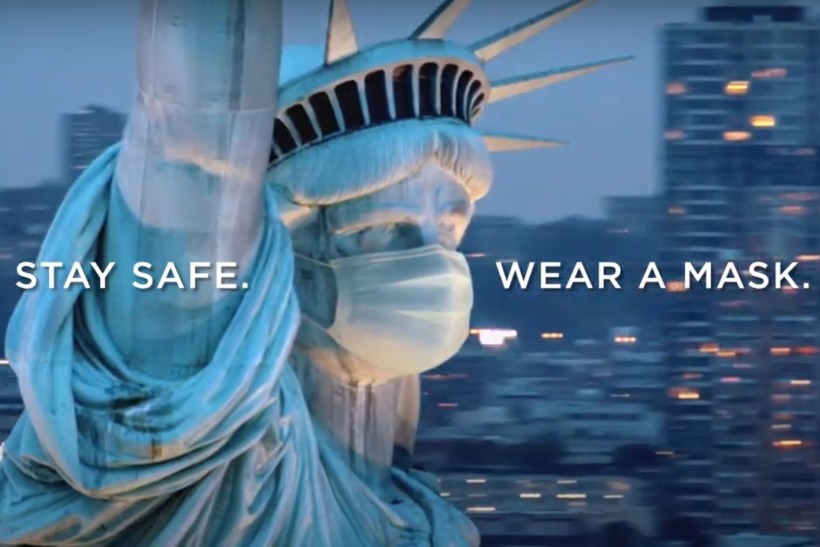
Masks are not a panacea either, but the evidence is convincingly piling up that they also help reduce the coronavirus’s spread. Whether a given state has a mandate to wear one or not, that is one small inconvenience to accept in order to get this outbreak back under control.

And, really, that is the point. While the current divergence between case and death counts can be confusing, the experts agree that Covid-19 still poses a significant risk to Americans — and it is a risk that goes beyond literal life and death. We know some of the steps that we, as individuals, can take to help slow the spread. And we need our governments, from Washington to the state capitals, to get smarter about reopening.

It will require collective action to stave off the coronavirus for good. Other countries have done it. But we have to act now, before we find out it’s already too late.


Slow the spread, save the economy—mask up

https://mailchi.mp/7d224399ddcb/the-weekly-gist-july-3-2020?e=d1e747d2d8

3 agency entries for New York governor's mask PSA | Campaign US

If Americans don’t believe public health officials or medical researchers, perhaps they’ll believe Wall Street. A new analysis released by the investment bank Goldman Sachs this week argues that implementing a national mask-wearing mandate is “worth” about 5 percent of US gross domestic product (GDP). Performing a regression analysis of reported masking behavior among residents of states with state-level mandates, as well as infection rates following the mandate implementation, Goldman’s analysts found that mask mandates result in a 25 percent reduction in the growth rate of infections, as well as a decline in COVID fatalities.

The analysis estimates that implementing a national mandate would increase the percentage of people who wear masks by 15 percentage points, with larger impact in states that currently have low levels of mask compliance. Goldman Sachs had previously constructed an “effective lockdown index”, estimating that the coronavirus pandemic subtracted 17 percent from US GDP between January and April.

Given spikes in COVID infections across Sun Belt states, the analysis found that avoiding potential lockdowns by instead implementing a mask mandate could avoid a further 5 percent decrease in GDP. Both the Centers for Disease Control (CDC) and the World Health Organization (WHO) recommend that the general public wear masks, and a growing body of scientific research indicates that masking significantly reduces the spread of COVID.

Now the bankers have weighed in. We don’t know who still needs to hear this, but please wear a mask when you’re out and about this holiday weekend. Please.


America celebrates a grim milestone

https://mailchi.mp/7d224399ddcb/the-weekly-gist-july-3-2020?e=d1e747d2d8

Epidemic vs. Pandemic, What Is the Difference Between an Epidemic ...


As the nation headed into the 4th of July weekend, the number of new COVID cases hit a string of daily highs, reaching a record high of more than 55,000 on Thursday. States across the South and Sunbelt, especially those that lifted stay-at-home orders early, saw the worst spikes.

Florida broke a new record with more than 10,000 cases on Thursday, and Georgia also experienced a new daily high. Hospitalizations continued to rise sharply in several states as well. Many hospitals reported a shift in COVID admissions toward younger, otherwise healthy adults, reports borne out by the lower death rate than that experienced in the initial surge of cases in the Northeast. (Advances in the management of severely ill COVID patients have also brought death rates down.)

In a Senate hearing on Tuesday, top White House health advisor Dr. Anthony Fauci said that the US was “not in total control” of the pandemic, and predicted that daily new case counts could top 100,000 if more stringent measures are not taken.

California, Florida, and other states took steps to roll back reopening efforts, and Texas Gov. Greg Abbott abruptly reversed direction and ordered a statewide mask mandate. Welcome news, but likely too late to prevent cities like Houston from exceeding available ICU capacity. Cases in the city have skyrocketed across the past month, with its positive test rate hitting 20 percent yesterday; its cancer and children’s hospitals began admitting COVID-positive adults to provide added capacity.

With celebrations scheduled across the nation this weekend, including another large event today at Mount Rushmore to be attended by President Trump, where masking and social distancing will be optional, it seems certain that we will continue to reap the whirlwind of careless behavior and hasty reopening for the rest of this month and beyond.

And looming in just six weeks—students return to schools and colleges.

US coronavirus update: 2.7M cases; 130K deaths; 33.5M tests conducted.


12 hospitals laying off workers in response to COVID-19

https://www.beckershospitalreview.com/finance/12-hospitals-laying-off-workers-in-response-to-covid-19.html?utm_medium=email

Facing a financial squeeze, hospitals nationwide are cutting jobs

To address the financial fallout from the COVID-19 pandemic, hospitals across the nation are looking to cut costs by implementing furloughs, layoffs or pay cuts. 

U.S. hospitals are expected to lose $323.1 billion this year due to the pandemic, according to a recent report from the American Hospital Association. The total includes $120.5 billion in financial losses that hospitals are projected to see from July through December, as well as $202.6 billion in losses that were projected between March and June. The losses were largely due to a lower patient volume after canceling elective procedures. 

Although Congress allocated $175 billion to help hospitals offset some of the revenue losses and expense increases to prepare for the pandemic, hospitals have said it is not enough.

Nearly 270 hospitals and health systems have furloughed workers in response to the pandemic and several others have implemented layoffs. 

Below are 12 hospitals and health systems that have announced layoffs since June 1:

1. Trinity Health furloughs, lays off another 1,000 workers
Trinity Health, a 92-hospital system based in Livonia, Mich., will lay off and reduce work schedules of 1,000 employees.

2. Ohio children’s hospital cuts jobs
Dayton (Ohio) Children’s Hospital said it has cut jobs to help offset financial losses due to the COVID-19 pandemic.

3. Munson Healthcare to cut 25 leadership positions
Traverse City, Mich.-based Munson Healthcare cut 25 leadership positions to help offset financial losses amid the COVID-19 pandemic.

4. Erlanger lays off 93 nonclinical employees
Chattanooga, Tenn.-based Erlanger Health System has cut 93 nonclinical positions to help offset financial damage from the COVID-19 pandemic. The layoffs come after the health system cut 11 leadership positions June 12, including the CEO of Erlanger Western Carolina Hospital in Murphy, N.C., and made staff and pay cuts in March.

5. Michigan Medicine to lay off 738 employees by end of June
Ann Arbor-based Michigan Medicine planned to eliminate 738 positions by the end of June amid financial challenges from the COVID-19 pandemic.

6. Pennsylvania health system cuts 10% of workforce amid pandemic losses
As part of a restructuring effort to cut pandemic-related losses, State College, Pa.-based Mount Nittany Health System plans to lay off 10 percent of its workforce, or about 250 employees.

7. TriHealth eliminates 440 positions to cut costs
Cincinnati-based TriHealth cut 440 positions as part of a plan to trim at least $140 million in expenditures this year.

8. Layoffs hit U of Kansas Health System
The University of Kansas Health System St. Francis Campus in Topeka laid off employees after previously implementing furloughs.

9. Tower Health to cut 1,000 jobs
Citing a $212 million loss in revenue through May due to the COVID-19 pandemic, West Reading, Pa.-based Tower Health plans to cut 1,000 jobs.

10. Colorado hospital cuts 22 positions
Parkview Medical Center in Pueblo, Colo., eliminated 22 positions in response to the COVID-19 pandemic.

11. Arkansas Children’s cuts 42 positions
Little Rock-based Arkansas Children’s Hospital said it is eliminating 42 jobs as part of cost-savings measures in response to the COVID-19 pandemic.

12. North Carolina health system cuts 10% of workforce, closes clinics
Citing a financial hit from the COVID-19 pandemic, Lumberton, N.C.-based Southeastern Health will permanently close several clinics, cut 10 percent of its workforce and reduce executive pay.


Flu vs. Covid-19 Death Rate, by age

No photo description available.


Hospitals in new COVID-19 hot spots face delicate balancing act with elective surgeries

https://www.fiercehealthcare.com/hospitals/hospitals-new-covid-19-hotspots-face-delicate-balancing-act-elective-surgeries?mkt_tok=eyJpIjoiT1RJMlpqWTNPREJtTmpGaSIsInQiOiJ0enNDdXU5R0ZEdUJmSE1GcXl5UHd4VjdcL1FQcWE3ckN2YmhLVUhnazNFNlhUOEdLQndTcnRnXC9TbWNzWDhZMW5KWEhtMUxJRDRFdG1uXC84NGVhTHZ5QklGK0Fyc2dadXVcL0phNWFaVGY1SGlVVzN6NFRxVlRLOE9mRmdHR2VmdDgifQ%3D%3D&mrkid=959610

Hospitals in new COVID-19 hot spots face delicate balancing act ...

Some hospital systems located in states that are seeing huge spikes of COVID-19 are continuing to perform elective procedures and developing strategies to avoid a total shutdown.

The experiences of hospitals in states such as Florida and Arizona could inform how systems will handle new surges of COVID-19 cases, especially if a second surge of the virus arrives in the fall. Hospitals have been reticent to shut down surgical procedures, which are pivotal to their bottom line and also impact patient care.

“We are not turning it all the way off,” said Marjorie Bessel, M.D., chief clinical officer for Banner Health, referring to elective procedures. “Our surgeries are needed and medically necessary and people need to have those surgeries done.”

The 28-hospital system has a large footprint in Arizona, which is experiencing a major spike in cases. Bessel said 45% of Arizona COVID-19 patients are in a Banner Health facility.

Like many states, Arizona’s governor required hospitals to shutter elective procedures to ensure there is enough capacity and personal protective equipment (PPE) for COVID-19 patients. The governor lifted the shutdown May 1, and Banner has slowly ramped up delayed or canceled elective procedures.

“We attempted to reduce the backlog of people who had been waiting or wait-listed,” Bessel told Fierce Healthcare. “We didn’t quite get back to full normal operations, but we got close.”

That progress has been hindered now as COVID-19 cases soar in the state.

But instead of doing a full shutdown, Banner is implementing a tiered and step-wise approach to surgeries.

“One of the things that we are going to try is to do surgeries for patients that don’t need an inpatient stay,” Bessel said. “We are gonna try that and see how that works for us.”

The system is also tightly monitoring the patients that need an intensive care unit stay after their surgery. Banner can transfer patients to other facilities to ensure it has enough capacity.

“We look at our [patient] census almost hourly throughout the day and the night and make these adjustments to best meet the needs of those in the community,” she said.

Tampa General Hospital in Florida resumed elective procedures back in early May and is still performing surgeries as COVID-19 cases rise. The hospital told Fierce Healthcare that it treats COVID-19 patients in a “negative-pressure unit that is separate from other areas of the hospital.”

The hospital has 81 of these rooms and 100 hospitals and has a surge plan to adjust capacity when necessary.

Another important factor for hospitals is to communicate with patients about what is going on. Tampa General, for instance, issued a release on when it is appropriate to go to the emergency room and outlined the procedures for screening patients of COVID-19 to assuage fears.

Hospitals’ own internal processes have also gotten better amid the COVID-19 pandemic.

“In the operating area, COVID-19 has made us more efficient,” said Michael Zinner, M.D., CEO of the Miami Cancer Institute, which is part of 11-hospital system Baptist Health South Florida. “It has taught us how to move things out of the general operating room into ambulatory and more efficient in the turnovers. It has taught us how to adapt.”

Some states could decide to shut down elective procedures again, which is a move Texas has decided to make in four counties in the state.

Getting and keeping enough PPE

One of the key reasons that states ordered hospitals to shut down surgeries was to preserve enough PPE for COVID-19 care.

But hospital systems say they are in a better place now in terms of PPE than they were at the onset of the pandemic, when a buying spree caused hospitals to fight among each other to get supplies.

“We are a heck of a lot better than we were two months ago,” Zinner said.

He added that Baptist Health even bought a stake in a domestic PPE manufacturer, a move Banner Health made as well.

“Besides the current spike, we were preparing for what we think will be a surge in the fall,” Zinner added.

Another important development for hospitals now is there are guidelines for how to reprocess PPE.

“We have found ways to reprocess some PPE safely so you can reuse it without losing efficacy and take it through a decontamination procedure,” said Michael Calderwood, M.D., an epidemiologist at Dartmouth-Hitchcock Medical Center in New Hampshire.

He pointed to using ultraviolet light and hydrogen peroxide as among methods facilities can use to reprocess their supplies.

The type of PPE that is used in surgeries is also sometimes different than the equipment used to treat COVID-19 patients, Bessel said.

“They use a procedural mask for most of the cases, while the masks in shortage has been the N-95 respirators,” she said.


U.S. coronavirus cases rise by nearly 50,000 in biggest one-day spike of pandemic

https://www.yahoo.com/news/u-coronavirus-cases-rise-nearly-013221004.html

Dr Fauci warns US could see 100,000 new coronavirus cases PER DAY ...

New U.S. COVID-19 cases rose by nearly 50,000 on Wednesday, according to a Reuters tally, marking the biggest one-day spike since the start of the pandemic.

The record follows a warning by the government’s top infectious diseases expert that the number could soon double to 100,000 cases a day if Americans do not come together to take steps necessary to halt the virus’ resurgent spread, such as wearing masks when unable to practice social distancing.

In the first week of June, the United States added about 22,000 new coronavirus cases each day. But as the month progressed, hotspots began to emerge across the Sun Belt. In the last seven days of June, daily new infections almost doubled to 42,000 nationally.

Brazil is the only other country to report more than 50,000 new cases in one day. The United States reported at least 49,286 cases on Tuesday.

More than half of new U.S. cases each day come from Arizona, California, Florida and Texas, home to 30% of the country’s population. All four states plus 10 others saw new cases more than double in June.

The daily increase in new cases could reach 100,000 unless a nationwide push was made to tamp down the fast-spreading virus, Dr. Anthony Fauci, head of the National Institute of Allergy and Infectious Diseases, told a U.S. Senate committee on Tuesday.

“We can’t just focus on those areas that are having the surge. It puts the entire country at risk,” Fauci said.

The rise in cases is not just the result of more testing. Hospitalizations are also skyrocketing.

Nationally, 7% of coronavirus diagnostic tests came back positive last week, up from 5% the prior week, according to a Reuters analysis. Arizona’s positivity test rate was 24% last week, Florida’s was 16%. Nevada, South Carolina and Texas were all 15%, according to the analysis.

(Open https://tmsnrt.rs/2WTOZDR in an external browser for a Reuters interactive)

Some of the recent increase traces back to Memorial Day holiday celebrations in late May. Health experts are worried about Independence Day celebrations this weekend, when Americans traditionally flock to beaches and campgrounds to watch fireworks displays.


Quick Visual Summary of Covid-19 in the United States

No photo description available.

Cases skyrocketing among communities of color

https://www.axios.com/newsletters/axios-vitals-e9aa531d-4ef5-46ec-aedb-56f2bc9a77c9.html?utm_source=newsletter&utm_medium=email&utm_campaign=newsletter_axiosvitals&stream=top

Coronavirus cases skyrocketing among communities of color - Axios

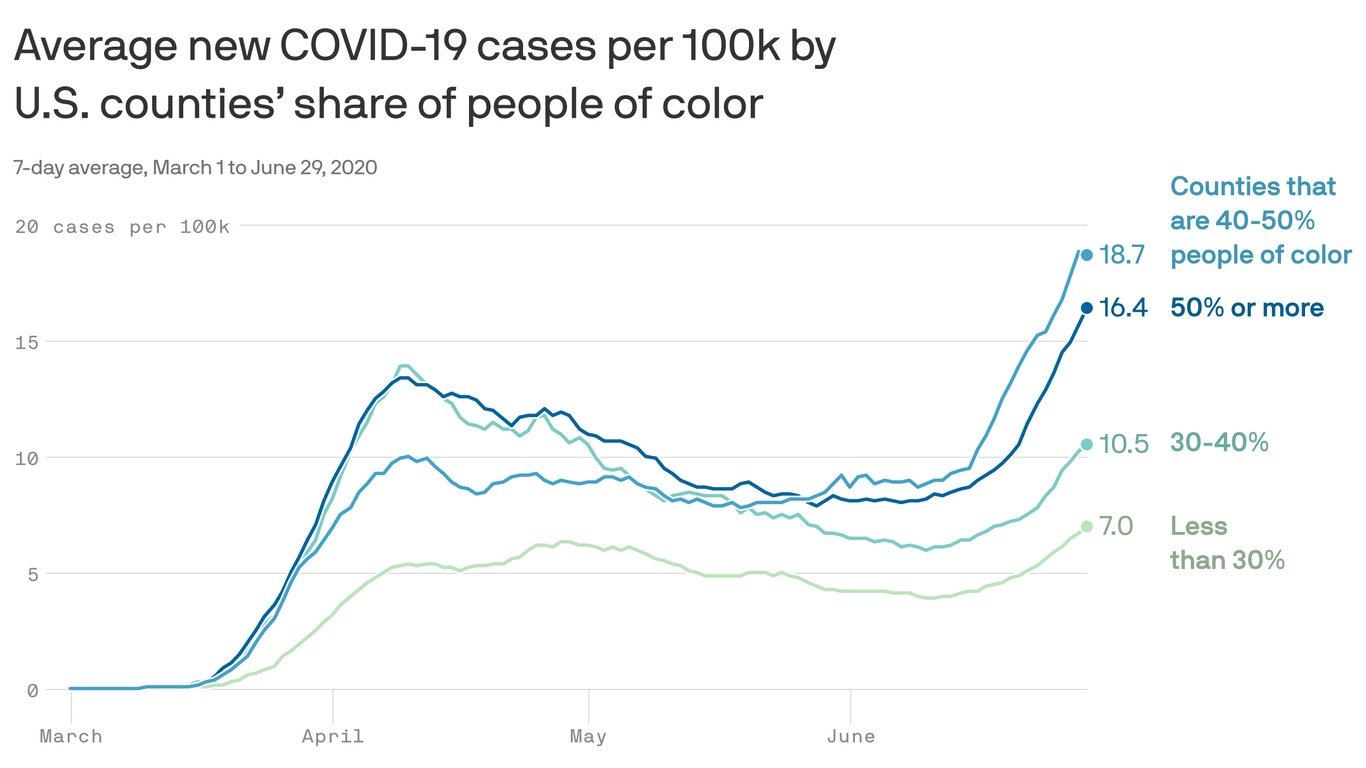
Counties populated by larger numbers of people of color tend to have more coronavirus cases than those with higher shares of white people.

What we’re watching: As the outbreak worsens throughout the South and the West, caseloads are growing fastest in counties with large communities of color.

The big picture: The southern and southwestern parts of the U.S. — the new epicenters of the outbreak — have higher Black and Latino or Hispanic populations to begin with.

  • People of color have seen disproportionate rates of infection, hospitalization and death throughout the pandemic.

Between the lines: These inequities stem from pre-existing racial disparities throughout society, and have been exacerbated by the U.S. coronavirus response.

  • Black and Hispanic or Latino communities have had less access to diagnostic testing, and people of color are also more likely to be essential workers. That means the virus is able to enter and spread throughout a community without adequate detection, often with disastrous results.

The bottom line: Until we plug the huge holes in the American coronavirus response — like inadequate testing and contact tracing and a lack of protection for essential workers — people of color will continue to bear the brunt of the pandemic.

Go deeper: People of color have less access to coronavirus testing