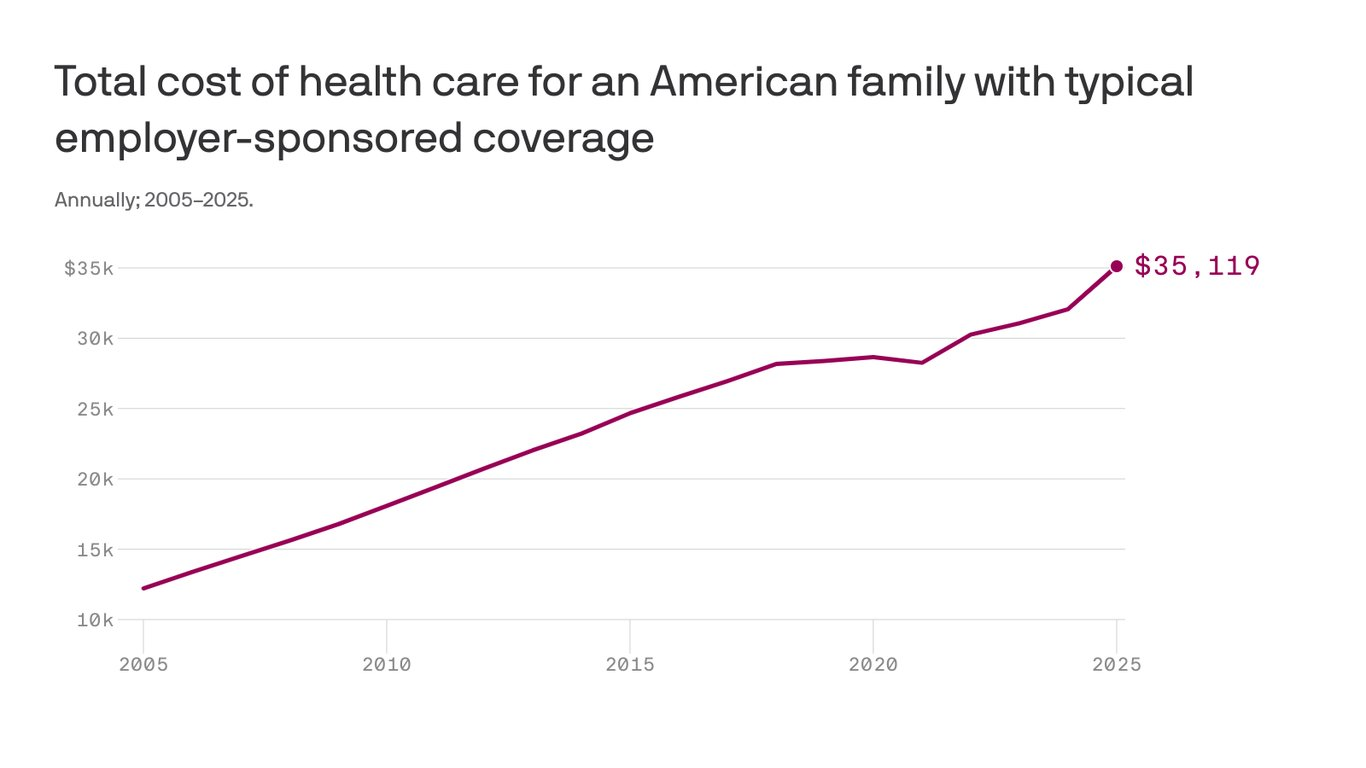
The cost to cover a family of four through workplace insurance now exceeds $35,000, nearly triple what it cost 20 years ago as annual growth in health costs have far outpaced wages.
The big picture:
Growing pharmacy and outpatient facility costs drove most of the increase, which includes employee and employer shares,according to the 2025 Milliman Medical Index.
Employers have been wary of passing health cost hikes to workers in a tight labor market, but the rising demand for costly care may force a reckoning.
State of play:
The $35,119 annual cost to cover a hypothetical family of four this year factors in drug costs, inpatient and outpatient care, and professional services, along with an “other” category that includes home health, ambulance transport, medical equipment and prosthetics.
A year of health care cost a family of four $12,214 in 2005, the year Milliman launched the index. The 20-year cumulative gain of 188% outpaced the 84% growth in wages over the same time.
Health costs have increased about 6% per year on average over the past two decades, according to Milliman, compared with an average inflation rate of 2.5% over that time.
Between the lines:
Employers in 2025 still shoulder 58% of employee health care costs, but their share has shrunk since 2005, when it was more than 60%.
Reality check:
Health care costs vary significantly by age, geography and pharmacy rebate arrangements.
Milliman calculates family cost based on a family with a 47-year-old male, 37-year-old female, and children ages 4 and under 1.
This was a “mathematically average” family in 2005, and Milliman continues to use that formula to keep data comparable year-to-year.
The firm has an online tool that allows readers to input other family configurations to see their estimated 2025 health care costs.
The analysis is based on Milliman’s proprietary research tools and analyzes commercialclaims data. The family cost figure reflects nationwide average negotiated provider fees and average PPO benefit levels.
The U.S. economy added 353,000 jobs in January, while the unemployment rate held at 3.7%, the Labor Department said Friday.
Why it matters:
The first look at the 2024 labor market shows it’s on fire — not slowing down as previously thought.
Details:
The January payroll figures show hiring picked up from the 333,000 added the prior month, which itself was revised higher by 117,000.
Job gains in November were revised slightly higher, too, by 9,000 to 182,000 jobs added.
What’s new:
The hiring boom last month came amid strong job gains in health care, retail and professional and business services, while mining and oil and gas extraction are among the sectors that shed jobs.
Meanwhile, the labor force participation rate — the share of workers with or looking for a job — was 62.5% in January.
Average hourly earnings, a measure of wage growth, soared by 0.6%. Over the past 12 month, average hourly earnings increased by 4.5%.
The big picture:
The data is the latest in recent weeks to show that the economy is revving up, with fading inflation and steady hiring — a welcome development for the Biden administration that is touting its economic agenda ahead of the 2024 election.
The intrigue:
The strong growth in both jobs and earnings will make the Federal Reserve reluctant to cut interest rates soon, out of fear that labor market strength could reverse progress on inflation.
Already this week, Fed chair Jerome Powell threw cold water on the idea of a March rate cut.
The bottom line:
Despite high profile layoffs at media and technology companies, the report shows that broader labor market is heating up.
On Wednesday, 75K Kaiser Permanente (KP) healthcare workers in five states and Washington, DC walked off the job as part of the largest healthcare strike in US history.
The striking workers are a diverse group, based mostly in California, that includes support staff, X-ray technicians, medical assistants, and pharmacy workers. They will continue their work stoppage until Saturday morning, though union leadership is threatening an even larger strike in November if a new contract agreement is not reached by then.
Their employment contract expired on September 30th, and while negotiations have progressed on issues like shift-payment differentials and employee training investments, union leaders and KP executives remain at odds over key wage increase demands, with the unions asking for a $25 national minimum wage, and KP proposing $21.
The company has sought to minimize disruptions to patient care during the strike, bringing in temporary labor to keep critical infrastructure open, but has told its members to expect some non-urgent procedures to be rescheduled, some clinic and pharmacy operating hours to be reduced, and call center wait times to be lengthy.
The Gist: Kaiser Permanente has enjoyed solid relations with its unions for decades, making this strike a significant break from precedent,fueled by post-pandemic burnout and staffing shortages.
While KP is keeping all essential services open, care disruptions are inevitable with around one third of its total workforce on strike.
The stakes of these labor negotiations extend far beyond just KP and its employees, as union success could inspire other unionized healthcare workers to adopt similar tactics and demands. (Case in point: Employees at eleven Tenet Healthcare facilities in California represented by SEIU-UHW, one of the unions representing striking KP workers, just voted to authorize their own strike.)
While happening alongside high-profile strikes in other industries, labor unrest is a troubling trend for health systems, whose margins remain well below historical levels amid persistently high labor and supply expenses.
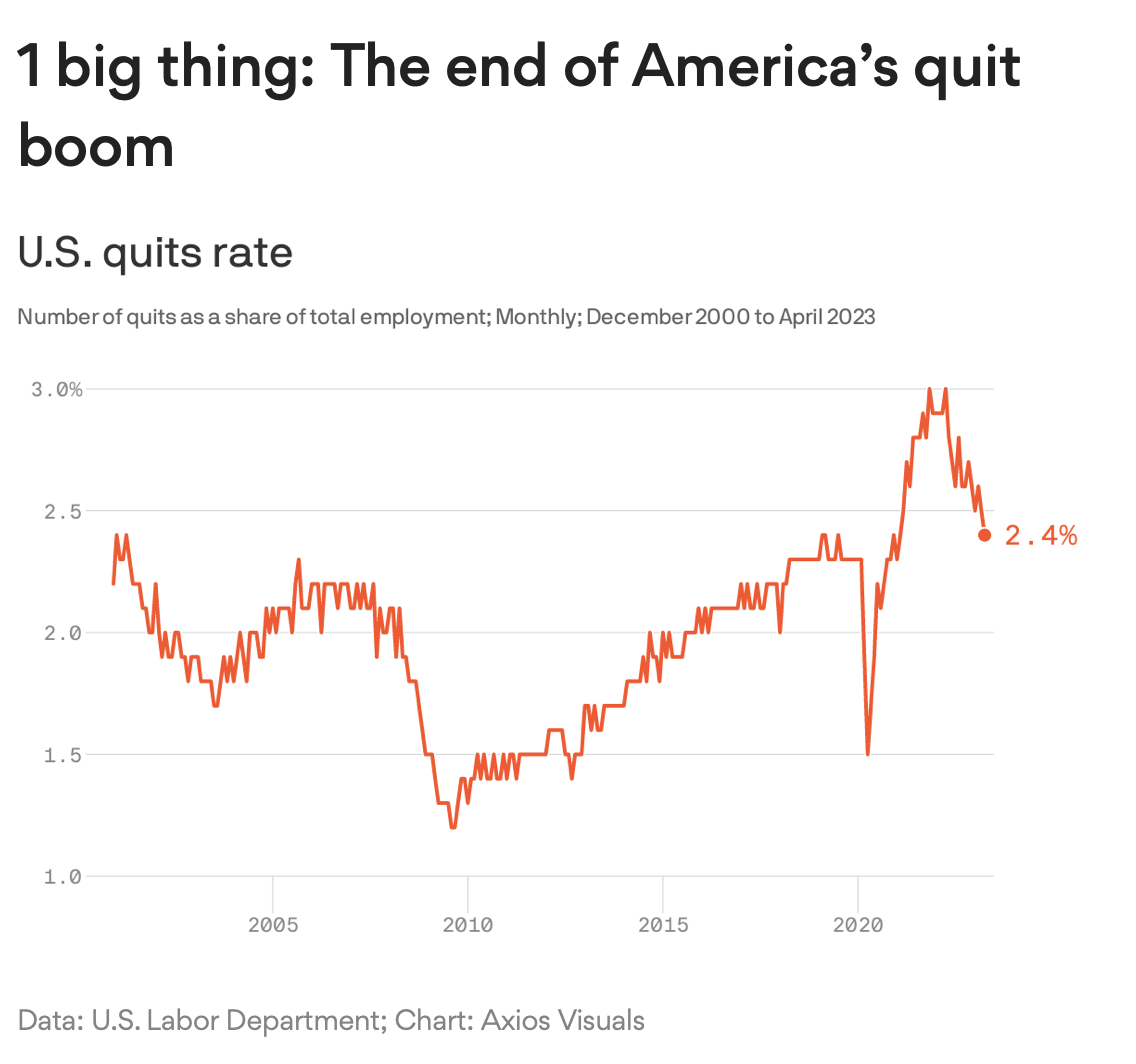
A phenomenon that defined the pandemic-era labor market is over: the Great Resignation — workers furiously quitting for new, likely higher paying jobs — is a thing of the past.
Why it matters:
The historic surge of quitters was a symptom of an on-fire labor market, where demand for workers far outstripped supply of them.
Now the job market may be entering a different era — one that more closely resembles pre-pandemic times.
By the numbers:
The quits rate fell to 2.4% in April, according to the Job Openings and Labor Turnover Survey, released this morning.
That is just a tick (0.1 percentage point) higher than the quits rate in February 2020 — and roughly in line with the average quits rate in 2019.
Even leisure and hospitality workers, once the poster child for the quits boom, are returning to pre-pandemic norms: the quits rate in this segment hit 4.6% in April — very close to the January 2020 rate of 4.4%, and well-below the peak 5.8% recorded last summer.
What they’re saying:
“We are pretty much back to a strong, robust labor market, but one that is no longer overheating,” says Julia Pollak, an economist at ZipRecruiter.
“One that isn’t plagued by widespread labor shortages that are wreaking havoc across the economy, and causing firms to offer off-cycle wage increases and dispense of all hiring requirements. The deck isn’t totally stacked in jobseekers‘ favor anymore.”
Flashback:
At the height of the Great Resignation, the overall quits rate most recently peaked at 3% in April 2022, when there were roughly 4.5 million quits in a single month.
Turnover of that magnitude had never been seen before — at least not since the Labor Department started collecting the data in 2000.
Workers were in such high demand that they felt confident enough to ditch current gigs for new (likely higher paying) ones.
The bottom line:
Americans who did job hop over the past few years have seen heftier pay gains. But that phenomenon, too, is fading — another sign of some heat coming off the labor market.
Job-changers saw annual pay grow more than 13% in April, according to payroll professor ADP — more than double the annual rate of job-stayers.
Still that was the slowest pace of growth since November 2021.
CFOs are planning to increase their compensation spend in 2023, with 86% of finance chiefs noting they plan to raise it by at least 3% year-over-year, according to a recent survey by Gartner.
CFOs are still facing a tight labor market in 2023. As CFOs weigh increased turnover and a more remote workforce, “they’re thinking through, how do they use compensation as a lever to engage and retain talent across their workforce,” said Alexander Bant, chief of research in the Gartner finance practice.
Only 5% of the 279 CFOs surveyed stated they planned to reduce their compensation spend in 2023, according to Gartner.
Dive Insight:
While CFOs typically budget more for compensation every year, ongoing inflationary pressures and a still-tight labor market puts compensation plans “front and center” in CFOs’ “ability to engage and retain top talent,” Bant said in an interview.
However, this does not mean finance chiefs will be budgeting for sweeping pay raises across their entire workforce — CFOs are “not trying to keep up with inflation across the board,” Bant said.
Rather, they are working with other members of the C-Suite such as the chief human resource officer and using tools like advanced analytics to single out and reward top performers which might be at more risk of departing for other opportunities, he said.
“CFOs are being more deliberate about how they allocate that money,” Bant said.
While the pace of wage growth slowed in the fourth quarter of 2022, according to recent data from the Labor Department, tamping down fears of a wage-price spiral, the war on talent remains a top worry for finance chiefs. Raising compensation can allow companies to be more competitive in the face of ongoing talent shortages, especially as workforce needs change.
For those companies which are moving employees back into the office, for example, raising compensation can help them to better compete against the remote or hybrid work opportunities which are becoming increasingly common, for example, Bant said.
Upping compensation can also help firms to find or hold onto employees with the key skills they need in areas such as digital transformation. Despite cost pressures, 43% of finance chiefs said they plan to increase their companies’ technology spend by 10%or more, according to the Gartner survey.
“What we’re hearing is, ’Yes, we are right-sizing parts of our organization and reducing head count in certain areas, but at the same time, we still have open roles and we’re still searching for talent in those areas that align to our digital transformation priorities,” Bant said of the search for technology talent.
Such skills still come at a premium, for that matter, despite the recent spat of layoffs across high-profile tech companies such as Google parent Alphabet, IBM and Microsoft. While these companies have reduced staff, they may not be letting go of employees with critical hardcore coding, data analytics or artificial intelligence related skills, Bant said.
“There is more talent available from technology companies, but that doesn’t mean that talent necessarily has the technical skills to drive the digital transformations that many CFOs and their leadership teams need,” he said.
It’s been a difficult year for the hospital workforce, both here and around the world, as the effects of the pandemic, the economy, and the legacy of lean staffing models have combined to drive up vacancy rates and threaten the sustainability of hospital operations.
Everywhere we’ve gone in the past six months, workforce issues have overshadowed every other topic: how can hospitals attract and retain staff given the environment, how can they stabilize finances in the face of 15-20 percent increases in labor costs, how can they safeguard patient care with intense turbulence in the clinical workforce?
This week we heard yet another wrinkle to this problem, one that had not occurred to us but in retrospect is obvious. A system CFO was lamenting the fact that even with big salary increases, the hospital workforce remains unstable. “It’s like we’re not even getting credit for raising base salary 15 percent across the board and giving big retention bonuses.”
As to why—it’s a timing issue. Her system, like many, delivered pay raises back in the late winter and early spring, when staff were still recovering from the Omicron surge and the urgency of reducing reliance on expensive agency labor became clear. But economy-wide inflation had only then begun to spike, and has since continued to be stuck at high levels.
Staff don’t view the earlier salary increases as a response to inflation, but as predating it—and they’re asking for still more, to offset rising prices for food, transportation and housing. “I wish we’d waited to give the pay bump,” the CFO told us. “Even though our wage increases have outpaced inflation this year, the timing of events didn’t help us at all.”
With the hospitals operating near capacity, and a severe flu season impacting both patient volumes and staff availability, her sense is that the system is back to square one on staffing—and more difficult financial decisions lie ahead.
Seeking stronger workplace protections, physician residents and fellows at both Stanford Health Care and the University of Southern California’s (USC) Keck School of Medicine have voted to join the Committee of Interns and Residents, a chapter of the Service Employees International Union (SEIU).
Despite being frontline healthcare workers, most Stanford residents were excluded from the first round of the health system’s COVID vaccine rollout in December 2020. The system ultimately revised its plan to include residents, but the delay damaged Stanford’s relationship with residents, adding momentum to the unionization movement. Meanwhile, Keck’s residents unanimously voted in favor of joining the union, aiming for higher compensation and greater workplace representation.
The Gist: While nurses and other healthcare workers in California, as in many other parts of the country, have been increasingly banding together for higher pay and better working conditions, physician residents and fellows contemplating unionization is a newer trend.
Physicians-in-training have historically accepted long work hours and low pay as a rite of passage, and have shied away from organizing. But pandemic working conditions, the growing trend of physician employment, and generational shifts in the physician workforce have changed the profession in a multitude of ways.
Health systems and training programs must actively engage in understanding and supporting the needs of younger doctors, who will soon comprise a majority of the physician workforce.
While healthcare workers battle burnout, hospitals have been ramping up wages and other benefits to recruit and retain workers. It has created a culture of competition among health systems as well as travel agencies that offer considerably higher pay.
But other healthcare organizations are not hospitals’ only competitors. Some hospitals, particularly those in rural areas, are struggling to match rising employee pay among nonindustry employers such as Target and Walmart.
“We monitor and we’ve been looking and we ask around in the community and we can ask who’s paying what,” Troy Bruntz, CEO of Community Hospital in McCook, Neb., told Becker’s. “So we know where Walmart is on different things, and we’re OK. But if Walmart tried to match what Target’s doing, that would not be good.”
At Target, the hourly starting wage now ranges from $15-$24. The organization is making a $300 million investment total to boost wages and benefits, including health plans. Starting pay is dependent on the job, the market and local wage data, according to NPR.
Walmart raised the hourly wages for 565,000 workers in 2021 by at least $1 an hour, The New York Times reported. The company’s average hourly wage is $16.40, with the lowest being $12 and the highest being $17.
Meanwhile, Costco raised its minimum wage to $17 an hour, according to NPR. The federal minimum wage is $7.25.
Estimated employment for healthcare practitioners and technical occupations is 8.8 million, according to the latest data released March 31 by the U.S. Bureau of Labor Statistics. This includes nurse practitioners, physicians, registered nurses, physician assistants and respiratory therapists, among others.
In sales and related occupations, estimated employment is 13.3 million, according to the bureau. This includes retail salespersons, cashiers and first-line supervisors of retail salespersons, among others.
While retail companies up their wages, at least one hospital CEO is monitoring the issue. Healthcare leaders weigh their options
Mr. Bruntz said rising wages among retailers is an issue his organization monitors. Although Target does not have a store in McCook, there is a Walmart, where pay is increasing.
“I was quoted a few months ago saying Walmart was approaching $15 an hour, and we can handle that,” Mr. Bruntz said. “But when it gets to $20 or $25, it’s going to be an issue.”
He also said he cannot solely increase the wages of the people making less than $15 or less than $25 because he has to be fair in terms of wages for different types of roles.
Specifically, he said he is concerned about what matching rising wages at retailers would mean for labor expenses, which make up about half of the hospital’s cost structure.
“I double that half, that’s 25 percent more expenses instantly,” Mr. Bruntz said. “And how is that going to ratchet to a bottom line anything less than a massive negative number? So it’s a huge problem.”
Clinical positions are not the only ones hospitals and health systems are struggling to fill; they are encountering similar difficulties with technicians and food service workers. Regarding these roles, competition from industries outside healthcare is particularly challenging.
This is an issue Patrice Weiss, MD, executive vice president and chief medical officer of Roanoke, Va.-based Carilion Clinic, addressed during a Becker’spanel discussion April 4. The organization saw workforce issues not just in its clinical staff, but among environmental services staff.
“When you look at what … even fast food restaurants were offering to pay per hour, well gosh, those hours are a whole lot better,” she said during the panel discussion. “There’s no exposure. You’re not walking into a building where there’s an infectious disease or patients with pandemics are being admitted.”
Amid workforce challenges, Community Hospital is elevating its recruitment and retention efforts.
Mr. Bruntz touted the hospital as a hard place to leave because of the culture while acknowledging the monetary efforts his organization is making to keep staff.
He said the hospital has a retention program where full-time employees get a bonus amount if they are at the employer on Dec. 31 and have been there at least since April 15. Part-time workers are also eligible for a bonus, though a lesser amount.
“It also encourages staff [who work on an as-needed basis] to go part-time or full-time, and [those who are] part-time to go full-time,” Mr. Bruntz said. “That’s another thing we’re doing is higher amounts for higher status to encourage that trend.”
Additionally, Community Hospital, which has 330 employees, offers a referral bonus to staff to encourage people they know to come work with them.
“We want staff to bring people they like. [We are] encouraging staff to be their own ambassadors for filling positions,” Mr. Bruntz said.
He said the hospital also will offer employees a sizable market wage adjustment not because of competition from Walmart but because of inflation.
Graham County Hospital in Hill City, Kan., is also affected by the tight labor market, although it has not experienced much competition with retail companies, CEO Melissa Atkins told Becker’s. However, the hospital is struggling with competition from other healthcare organizations, particularly when it comes to patient care departments and nursing. While many hospitals have struggled to retain employees from travel agencies, Graham County Hospital has mostly been able to avoid it.
“As the demand increases, so does the wage,” Ms. Atkins said. “In addition to other hospitals offering sign-on bonuses and increased wages, nurse agency companies are offering higher wages for traveling nurse aides and nurses. We are extremely fortunate in that we have not had to use agency nurses. Our current staff has stepped up and filled in the shortages [with additional incentive pay].”
To combat this trend, the hospital has increased hourly wages and shift differentials, as many healthcare organizations have done. It has also provided bonuses using COVID-19 relief funds.
Overall, Mr. Bruntz said he prefers “not to get into an arms race with wages” among nonindustry competitors.
“It’s not going to end well for anybody. We prefer not to use that,” he said. “At the same time, we’re trying to do as much as possible without being in a full arms race. But if Walmart started paying $25 for a door greeter and cashier, we would have to reassess.”









 HENRY KOTULA