Jobless Numbers Are ‘Eye-Watering’ but Understate the Crisis

How the coronavirus created a U.S. unemployment crisis — in 3 graphics

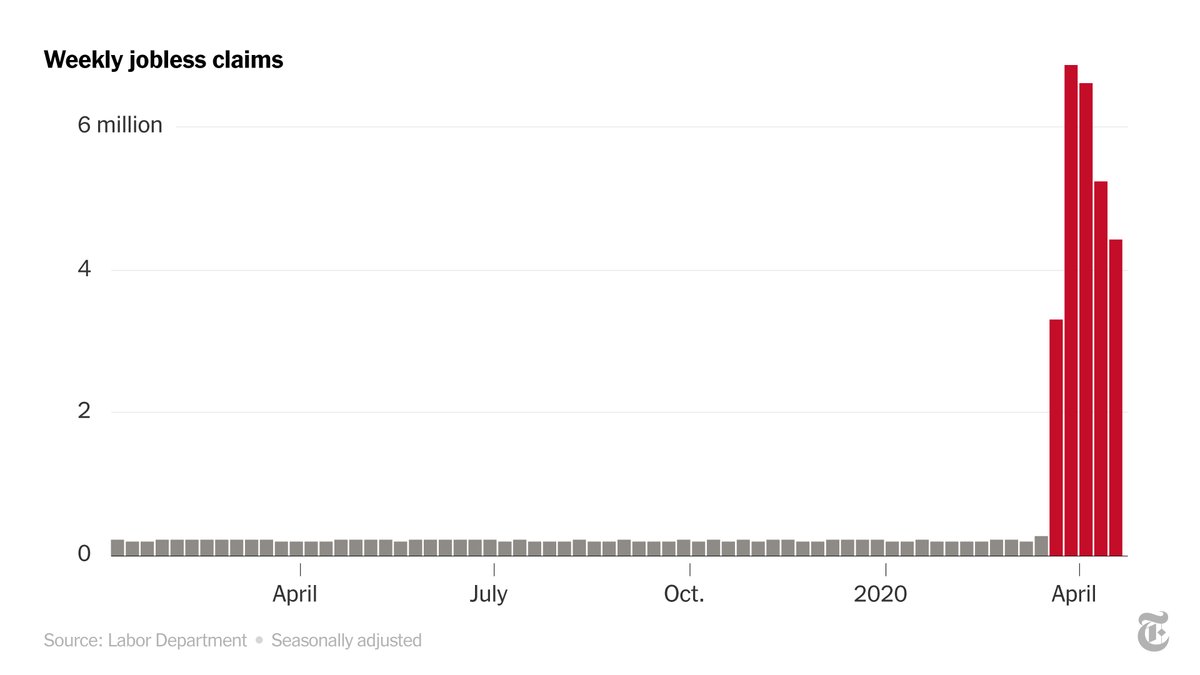
With 4.4 million added last week, the five-week total passed 26 million. The struggle by states to field claims has hampered economic recovery.

Nearly a month after Washington rushed through an emergency package to aid jobless Americans, millions of laid-off workers have still not been able to apply for those benefits — let alone receive them — because of overwhelmed state unemployment systems.

Across the country, states have frantically scrambled to handle a flood of applications and apply a new set of federal rules even as more and more people line up for help. On Thursday, the Labor Department reported that another 4.4 million people filed initial unemployment claims last week, bringing the five-week total to more than 26 million.

“At all levels, it’s eye-watering numbers,” Torsten Slok, chief international economist at Deutsche Bank Securities, said. Nearly one in six American workers has lost a job in recent weeks.

Delays in delivering benefits, though, are as troubling as the sheer magnitude of the figures, he said. Such problems not only create immediate hardships, but also affect the shape of the recovery when the pandemic eases.

Laid-off workers need money quickly so that they can continue to pay rent and credit card bills and buy groceries. If they can’t, Mr. Slok said, the hole that the larger economy has fallen into “gets deeper and deeper, and more difficult to crawl out of.”

Hours after the Labor Department report, the House passed a $484 billion coronavirus relief package to replenish a depleted small-business loan program and fund hospitals and testing. The Senate approved the bill earlier this week.

Even as Congress continues to provide aid, distribution has remained challenging. According to the Labor Department, only 10 states have started making payments under the federal Pandemic Unemployment Assistance program, which extends coverage to freelancers, self-employed workers and part-timers. Most states have not even completed the system needed to start the process.

Ohio, for example, will not start processing claims under the expanded federal eligibility criteria until May 15. Recipients whose state benefits ran out, but who can apply for extended federal benefits, will not begin to have their claims processed until May 1.

Pennsylvania opened its website for residents to file for the federal program a few days ago, but some applicants were mistakenly told that they were ineligible after filling out the forms. The state has given no timetable for when benefits might be paid.

Reports of delays, interruptions and glitches continue to come in from workers who have been unable to get into the system, from others who filed for regular state benefits but have yet to receive them, and from applicants who say they have been unfairly turned down and unable to appeal.

Florida has paid just 17 percent of the claims filed since March 15, according to the state’s Department of Economic Opportunity.

“Speed matters” when it comes to government assistance, said Carl Tannenbaum, chief economist at Northern Trust. Speed can mean the difference between a company’s survival and its failure, or between making a home mortgage payment and facing foreclosure.

There is “a race between policy and a pandemic,” Mr. Tannenbaum said, and in many places, it is clear that the response has been “very uneven.”

Using data reported by the Labor Department for March 14 to April 11, the Economic Policy Institute, a liberal research group, estimated that seven in 10 applicants were receiving benefits. That left seven million other jobless workers who had filed claims but were still waiting for relief.

States manage their own unemployment insurance programs and set the level of benefits and eligibility rules. Now they are responsible for administering federal emergency benefits that provide payments for an additional 13 weeks, cover previously ineligible workers and add $600 to the regular weekly check.

So far, 44 states have begun to send the $600 supplement to jobless workers who qualified under state rules, the Labor Department said. Only two — Kentucky and Minnesota — have extended federal benefits to workers who have used up their state allotment.

With government phones and websites clogged and drop-in centers closed, legal aid lawyers around the country are fielding complaints from people who say they don’t know where else to turn.

“Our office has received thousands of calls,” said John Tirpak, a lawyer with the Unemployment Law Project, a nonprofit group in Washington.

People with disabilities and nonnative English speakers have had particular problems, he said.

Even those able to file initially say they have had trouble getting back into the system as required weekly to recertify their claims.

Colin Harris of Marysville, Wash., got a letter on March 31 from the state’s unemployment insurance office saying he was eligible for benefits after being laid off as a quality inspector at Safran Cabin, an aerospace company. He submitted claims two weeks in a row and heard nothing. When he submitted his next claim, he was told that he had been disqualified. He has tried calling more than 200 times since then, with no luck.

“And that’s still where I am right now,” he said, “unable to talk to somebody to find out what the issue is.” If he had not received a $1,200 stimulus check from the federal government, he said, he would not have been able to make his mortgage payment.

Last week’s tally of new claims was lower than each of the previous three weeks. But millions of additional claims are still expected to stream in from around the country over the next month, while hiring remains piddling.

States are frantically trying to catch up. California, which has processed 2.7 million claims over the last four weeks, opened a second call center on Monday. New York, which has deployed 3,100 people to answer the telephone, said this week that it had reduced the backlog that accumulated by April 8 to 4,305 from 275,000.

Florida had the largest increase in initial claims last week, although the state figures, unlike the national total, are not seasonally adjusted. That increase could be a sign that jobless workers finally got access to the system after delays, but it is impossible to assess how many potential applicants have still failed to get in.

The 10 states that have started making Pandemic Unemployment Assistance payments to workers who would not normally qualify under state guidelines are Alabama, Colorado, Iowa, Kentucky, Louisiana, Massachusetts, Rhode Island, Tennessee, Texas and Utah.

Pain is everywhere, but it is most widespread among the most vulnerable.

In a survey that the Pew Research Center released on Tuesday, 52 percent of low-income households — below $37,500 a year for a family of three — said someone in the household had lost a job because of the coronavirus, compared with 32 percent of upper-income ones (with earnings over $112,600). Forty-two percent of families in the middle have been affected as well.

Those without a college education have taken a disproportionate hit, as have Hispanics and African-Americans, the survey found.

An outsize share of jobless claims have also been filed by women, according to an analysis from the Fuller Project, a nonprofit journalism organization that focuses on women.

Josalyn Taylor, 31, learned that she was out of a job on March 16. “I clocked in at 3 o’clock, and by 3:30 my boss called me and told me we were going to shut down for three weeks,” said Ms. Taylor, an assistant manager at Cicis Pizza in Galveston, Tex. The restaurant has yet to reopen.

Two days later, she applied for unemployment insurance, but she kept receiving a message that a claim was already active for her Social Security number and that she could not file. She has tried to clear up the matter hundreds of times — online, by phone and through the Texas Workforce Commission’s site on Facebook — with no luck.

“I used my stimulus check to pay my light bill, and I’m using that to keep groceries and stuff in the house,” said Ms. Taylor, who is five months pregnant. “But other than that, I don’t have any other income, and I’m almost out of money.”

The first wave of layoffs most heavily whacked the restaurant, travel, personal care, retail and manufacturing industries, but the damage has spread to a much broader range of sectors.

At the online job site Indeed, for example, postings for software development jobs are down nearly 30 percent from last year, while listings for finance and banking openings are down more than 40 percent.

New layoffs are expected to ease over the next couple of months, but the damage to the economy is likely to last much longer. In a matter of weeks, the shutdown has more than erased 10 years of net job gains — more than 19 million jobs.

Health and education are going to revive relatively quickly, said Rick Rieder, chief investment officer for global fixed income at BlackRock, but leisure and hospitality are going to take a lot longer.

“A lot of the people who have been furloughed won’t come back,” he said. “Companies will either close or decide not to take back those workers.”

Over the past decade, the employment landscape has shifted substantially as new types of jobs have appeared and old categories have disappeared. The U.S. economy, Mr. Rieder said, is “going to go through another period of evolution.”


4.4 million Americans sought jobless benefits last week, as economic pain continued across the United States

https://www.washingtonpost.com/business/2020/04/23/economy-coronavirus-unemployment/?fbclid=IwAR3EbJpE7nmIUWOM4HUrZVOKaBmls7Uh3gL5ewCP98q7So0s38JlPdTT-SI&utm_campaign=wp_main&utm_medium=social&utm_source=facebook

4.4 million Americans sought jobless benefits last week, as ...

The White House and Congress have tried to arrest the downturn, but the coronavirus pandemic keeps pushing Americans out of the labor force.

More than 4.4 million Americans filed for unemployment benefits last week, according to the Labor Department, a signal the tidal wave of job losses continues to grow during the coronavirus pandemic.

It’s the fifth straight week that job losses were measured in the millions. From March 15 to April 18, 26.5 million people have probably been laid off or furloughed. The number of jobs lost in that brief span effectively erased all jobs created after the 2008 financial crisis. Jobless figures on this scale haven’t been seen since the Great Depression.

The new weekly total comes on top of 22 million Americans who had sought benefits in previous weeks, a volume that has overwhelmed state systems for processing unemployment claims. Economists estimate the national unemployment rate sits between 15 and 20 percent, much higher than it was during the Great Recession in 2008 and 2009. The unemployment rate at the peak of the Great Depression was about 25 percent.

The new weekly jobless claims figure came in around economists’ predictions, which were expected “to be staggering, but not growing, which is a small mercy,” said Julia Pollak, a labor economist at ZipRecruiter. For comparison, 5.2 million people filed unemployment claims for the week ending April 11.

As the coronavirus began spreading in the United States earlier this year, many businesses rapidly began to close. Hotels, restaurants, and airlines were hit particularly hard, but few businesses were immune from the economic toll. The problems have only worsened each week, as more Americans reduced their spending and more businesses cut workers because income has fallen so sharply.

Pollack said many businesses quickly “cut to the bone” when they realized how the pandemic would gut sales. Now, many of the new layoffs stem from businesses like news organizations and tech companies that weren’t directly affected by people staying home but are suffering the consequences of vanishing ad revenue and paid subscriptions.

“We see declines across every major industry and state, although the declines hit industries at different times,” Pollak said.

Meanwhile, consumer spending, the engine behind the longest economic expansion in U.S. history, has evaporated. If they’re still operating, many offices are working with skeleton staffs and staring down months of dismal revenue.

The White House and Congress have tried to intervene, but with limited impact so far.

New funding for small businesses in a $2 trillion March emergency spending package quickly dried up in the face of overwhelming demand, prompting the Senate to expand funding by $310 billion on Tuesday. The bill would direct an additional $60 billion to a separate small-business emergency grant and loan program. The House is slated to vote on the measure Thursday afternoon.

Even with all the new government spending, hopes for a sharp economic rebound are fading, overtaken by the public fear of going back to restaurants, movie theaters, schools and gyms. The growing possibility of a “W”-shaped recovery — in which a resurgence of the virus, or a spike in defaults and bankruptcies, triggers another downturn — has analysts reframing what a reopened or rehabilitated economy might look like.

This year defies historical comparison. In 2020, 28.9 million people have filed for unemployment benefits. Halfway through the fourth month of the year, the figure has already eclipsed the full-year totals of every year but 1982 (30.4 million) and 2009 (29.8 million). At this rate, it will overtake both within a week or so.

Less than half of working-age Americans will be earning a wage next month, said James Knightley, ING Chief International Economist.

“In an election year, this means that the call for politicians to reopen the economy is only going to get louder, irrespective of the health advice,” Knightley said.

In five weeks, 9.4 percent of the working-age population has filed for unemployment insurance, said Nick Bunker, Indeed Hiring Lab’s director of economic research. That’s about twice the share of the population that lost a job during the Great Recession. In some states, such as Michigan, about one in four workers has filed an unemployment claim in the past few weeks.

“The numbers detailing the shock to the U.S. labor market are so large, and cover such a short time, that your first reaction is that they’re a typo,” Bunker said.

Employers are also unlikely to be hiring at the same levels they were before the pandemic. As of April 16, job postings on Indeed were down 34 percent compared with last year, Bunker said.

The job losses, like the epidemic itself, haven’t fallen evenly across the country. In three states — Hawaii, Kentucky and Michigan — about 1 in 4 workers have filed for unemployment benefits in the past 5 weeks. In Michigan, plant shutdowns and furloughs have ravaged the manufacturing economy, which had only recently recovered all the jobs it lost in the Great Recession.

On the opposite of the ledger sits South Dakota, where Gov. Kristi L. Noem (R) has resisted calls to lock down the state’s businesses to slow the spread of the coronavirus. Only 6 percent of the state’s labor force has applied for unemployment benefits. It may be a regional trend: Neighboring Wyoming and Nebraska, and nearby Utah, also have unusually low claims numbers.

As part of its sprawling stimulus package, Washington has rolled out relief for millions of households and small businesses struggling to make ends meet. But money for struggling businesses quickly ran dry, and system glitches have prevented $1,200 stimulus checks from reaching some of the neediest.

On Tuesday, the Senate passed a bill to expand the Paycheck Protection Program for small businesses by $310 billion, and flood a separate small-business emergency grant and loan initiative by an additional $60 billion.

Meanwhile, many low-income veterans and Social Security recipients still haven’t received the stimulus money in their bank accounts, while other IRS checks are going to dead people. People who didn’t file tax returns last year or don’t have direct-deposit information may have weeks more to wait.

In the wake of the Great Recession, the number of unemployed — about 15 million — was significantly higher than the number who claimed benefits, and the unemployment rate still peaked at just 10 percent. Economists expect the United States to blow by that figure when April’s jobs data are released on May 8.

Granted, this comes as unemployment eligibility and benefits have been greatly expanded. The government has relied on the unemployment insurance system to deliver relief to out-of-work Americans as it forces millions of businesses to close during temporary stay-at-home orders. The soaring numbers are, for once, a sign of the system working as intended.


Henry Ford Health to furlough 2,800 workers

https://www.beckershospitalreview.com/finance/henry-ford-health-to-furlough-2-800-workers.html?utm_medium=email

Henry Ford furloughing 2,800 employees due to COVD-19 financial ...

Financial damage from the COVID-19 pandemic is forcing Detroit-based Henry Ford Health System to furlough 2,800 workers, the health system announced April 22. 

The six-hospital system decided to furlough employees who are not directly involved in patient care after recording a $43 million loss in operating income in March due to the cancellation of elective procedures, temporary site closures, and expenses related to personal protective equipment and other supplies needed to care for COVID-19 patients. The health system expects more significant losses in April and May.

“I know that news concerning furloughs is painful — especially for an organization like ours, whose greatest strength has always been our people,” Henry Ford President and CEO Wright Lassiter III wrote in an email to employees. “We value each team member’s unique contribution and this decision does not change that. But, we must face these realities head on.”

In addition to the furloughs, the health system’s executives and senior leaders will begin contributing 10 percent to 25 percent of their salaries to funds created to support employees.

Henry Ford Health reported a net operating loss of $36.2 million for the first three months of this year, compared to operating income of $39.4 million in the same period of 2019. 


Mayo Clinic furloughs, cuts hours of 30,000 employees to help offset $3B in pandemic losses

https://www.beckershospitalreview.com/finance/mayo-clinic-furloughs-cuts-hours-of-30-000-employees-to-help-offset-3b-in-pandemic-losses.html?utm_medium=email

Information for Orlando Residents - Orlando - Mayo Clinic

Rochester, Minn.-based Mayo Clinic said it will furlough or cut the hours of about 30,000 staff members to help offset about $3 billion in losses incurred by the COVID-19 pandemic, according to The Post Bulletin.

Mayo Clinic announced that it would need to take several cost cutting measures, including furloughs, earlier in April. However, the system didn’t disclose the number of employees that would be affected.

The temporary reduction in workforce is one of the ways the system is working to offset a $3 billion loss from the pandemic. Even with the cost-cutting measures, Mayo anticipates a $900 million shortfall this year.

The furloughs or reduced hours affect about 42 percent of Mayo Clinic’s 70,000 employees across its campuses in Arizona, Florida and Minnesota. 

Affected employees will still receive healthcare benefits.

The furloughs will begin in May and be spread throughout the rest of the year, Mayo Clinic spokesperson Ginger Plumbo told the publication. The duration of the furlough will vary depending on the hospital unit, she added.

The furloughs will not affect physicians at the system, but physicians will receive a 10 percent wage reduction. In addition, senior managers will receive pay cuts of 15 percent and top executives will take a 20 percent reduction.

The furloughs, cut hours and wage reductions are expected to save $1.4 billion.

Mayo Clinic also has been taking other cost-cutting measures, including a hiring freeze and halting major construction projects.

Mayo Clinic is also tapping into its reserves to bring $900 million in cash to the system.


Operating margins plummet at US hospitals, Kaufman Hall says

https://www.healthcaredive.com/news/Kaufman-hospitals-operating-margin-decline/576491/

Third Quarter Investment Report: Moving Into Choppy Waters « CPEA ...

Dive Brief:

  • Operating margins at the nation’s hospitals have plummeted due to large-scale volume and revenue declines coupled with flat to rising expenses, according to a new report from Kaufman Hall.
  • Based on March data from more than 800 U.S. hospitals, average operating margins dropped 150% year over year, plunging non-profit hospitals, which historically operate on already thin margins, into troublesome territory.
  • The data paint a dire picture for U.S. hospitals. “These initial numbers only reflect the first two weeks of the COVID-19 response and likely indicate more negative results in the future,” Jim Blake, managing director at Kaufman Hall, said in a statement.

Dive Insight:

Hospitals depend heavily on elective surgeries for revenue, but had to cancel or postpone many of them starting last month in order to preserve coveted COVID-19 resources such as personal protective equipment, beds and staff.

Those measures have upended the financial health of the entire industry in a matter of just weeks, according to new data and analysis from Kaufman Hall.

“We anticipate April will be significantly worse, and at this point, no one knows how long hospitals will continue on their current path,” Blake said.

Despite the ongoing pandemic, patient volumes overall have plunged. During March, the median hospital occupancy rate was 53%, with operating room minutes down 20% year-over-year and emergency room visits down 15% year over year, according to the report.

At the same time, hospitals’ labor expenses were up 3% year over year, and non-labor expenses were up 1%. In order to rein in operating costs, some health systems have begun to furlough or lay off workers.

While non-profit systems are especially vulnerable given their razor-thin margins, major for-profit systems are also struggling financially.

HCA Healthcare, Community Health Systems and Tenet Healthcare have all pulled their 2020 guidance in response to the pandemic. In its first quarter report Tuesday, HCA attributed a steep decrease in volumes and 45% drop in profit to the pandemic.

And Jefferies analyst wrote in a note Tuesday they are reducing their volume and earnings expectations for those companies for this year and 2021 based on the pandemic. “Our belief is that high unemployment translates to reduced commercial insurance coverage and disposable income to fund co-pays/deductibles, which results in fewer physician visits and procedures,” they wrote.

Under these circumstances, the federal government has attempted to financially support struggling hospitals through ongoing coronavirus relief legislation.

First came accelerated Medicare payments based on reimbursement data, in the form of loans that providers will have to pay back.

Separately, the Coronavirus Aid, Relief, and Economic Security Act passed by Congress in March benchmarked $100 billion in funding to provide financial support to struggling hospitals.

$30 billion first round was announced April 8 and given to providers based on historic Medicare payments. A second round of CARES act funding for systems in hot spots is next, although the timing is unclear.

On Tuesday the Senate approved a separate $484 billion aid package, the Paycheck Protection Program and Health Care Enhancement Act, that would send an additional $75 billion in emergency funds to hospitals. It also allocates $25 billion to expand testing for the virus across the country.

The White House expressed support for the package. It still needs House approval, which could happen as soon as this week.

The latest package comes in response to depleted funding for the Small Business Administration’s Paycheck Protection Program. Upon replenishing those funds, smaller health systems may be eligible for forgivable PPP loans used to meet payroll and other operating costs, but only if they have 500 or fewer employees.


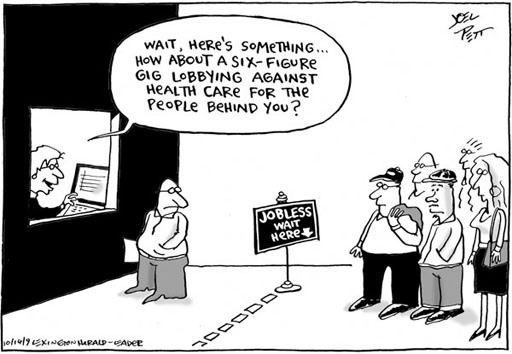
Cartoon – Job Opportunity

Political Cartoon: “Overheard In The Unemployment Line” by Joel ...

What is work sharing and how can it help the labor market?

https://www.brookings.edu/blog/up-front/2020/04/16/what-is-work-sharing-and-how-can-it-help-the-labor-market/?utm_campaign=Brookings%20Brief&utm_source=hs_email&utm_medium=email&utm_content=86505163

What is work sharing and how can it help the labor market?

When economic conditions worsen, as they did beginning in March 2020 because of the COVID-19 pandemic, employers often respond by laying off their employees. This can lead to very undesirable outcomes for society at large. Research shows that losing a job often causes decreased long-term earnings, health problems, and other adverse outcomes, the effects of which can last generations (Abraham and Houseman 2014). Layoffs create future costs for employers as well—once demand picks back up, firms will have to expend valuable resources on significant search, hiring, and training costs.

The U.S. unemployment insurance (UI) system can help. Its core function is to replace some of the earnings of workers who have lost their jobs, helping them to stay afloat during tough economic times. But the UI system can also support workers and employers as they reduce, rather than eliminate, employees’ work hours.

WHAT IS WORK SHARING?

A program called work sharing, or short-time compensation, encourages employers to temporarily reduce the hours of their employees rather than lay them off during an economic downturn. Work sharing allows employers to keep their skilled workforce and reestablish a full-time schedule when economic conditions improve. With this approach, employees continue to be paid for the hours they work, collecting pro-rated unemployment benefits that help cover the work hours they lose. For example, employers could reduce everyone’s hours by 20 percent and employees would qualify for 20 percent of the weekly unemployment benefit amount.

In a Hamilton Project proposal, economists Katharine Abraham and Susan Houseman described reforms that would facilitate the use of work sharing. The importance of these reforms for addressing the current economic downturn was discussed further in a recent webcast titled, “Unemployment Insurance during the COVID-19 Pandemic: Reducing the Impact of this Economic Downturn.”

WHAT IS THE RATIONALE FOR WORK SHARING? HOW MANY JOBS COULD IT SAVE?

Work sharing provides employers a way to respond to a decrease in demand by cutting back on hours rather than laying workers off. This approach maintains employer-employee connections, minimizing layoffs and supporting workers who have their hours reduced. Work sharing can be particularly helpful when the drop in demand is expected to be temporary, as many think likely for this pandemic-caused recession.

The value of preserving relationships between employers and employees is twofold. First, it can avoid huge spikes in permanent job losses that are financially ruinous for many families. Workers continue their employment, albeit with reduced hours, and avoid many of the damaging effects of losing a job (like loss of health insurance coverage). Second, both employers and workers will avoid costly search, hiring, and training once demand eventually picks back up.

Throughout the Great Recession, when only 17 states offered the option, use of work-sharing was very limited. Abraham and Houseman estimate that if work sharing had been available for the entire country during the Great Recession—and take-up rates had been similar to our European counterparts—work-sharing programs could have saved up to 1 million jobs, or 1 in 8 of the net jobs that were lost during the Great Recession.

HOW WIDESPREAD ARE WORK-SHARING PROGRAMS?

Today, 26 states, covering nearly 70 percent of the workforce, have operational work-sharing programs in place. But work sharing has been little used in the earliest days of this recession. As of the week ending in March 28, just 0.3 percent of the more than 8.2 million people claiming UI benefits received work-sharing benefits.

To expand coverage, Abraham and Houseman propose that Congress pass legislation that requires states to have a work-sharing program as a part of their UI system to participate in the federal–state UI system. Further, in order to encourage state take-up, they propose that the U.S. Department of Labor modify its funding formula to more accurately fund state administrative burdens associated with implementing and promoting work-sharing programs.

WHAT ELSE CAN BE DONE TO MAKE IT EASY FOR EMPLOYERS TO USE THE PROGRAM?

First, states could look for opportunities to expedite the process of starting up a work-sharing plan and paying benefits. Second, states could remove policies that tend to discourage the use of work sharing and push employers toward layoffs. For example, some states bar employers who have heavily used the UI system in the past from participating in work-sharing programs. Additionally, some states impose higher effective UI tax rates on employers who choose work-share programs than if they laid off their workers. Designed to prevent abuse of the UI system, these policies may discourage work sharing, especially during downturns. Abraham and Houseman recommend that Congress add a prohibition against the use of these policies to the existing criteria for state eligibility to participate in the federal–state UI system.

HOW CAN WORK-SHARING PROGRAMS BE FURTHER INCORPORATED INTO THE EXISTING UI SYSTEM?

Under current law, sharp increases in a state’s unemployment rate trigger extensions to the benefits available in that state; the federal government covers half the cost of those extensions. That same federal-state program could enhance the use of work sharing. Abraham and Houseman propose that the federal government cover half the cost of work-sharing programs when UI extended benefits are triggered in a state. As explained below, Congress has recently gone beyond this proposal, but only on a temporary basis.

HOW IS WORK SHARING ADDRESSED IN THE CORONAVIRUS AID, RELIEF, AND ECONOMIC SECURITY ACT (CARES ACT)?

The CARES Act, signed into law on March 25, 2020, encourages states and employers to use work-sharing programs. The federal government will reimburse 100 percent of the cost of short-time compensation benefits paid in states that have work-sharing programs in place. For those states that do not have a work-sharing program, the CARES act includes funds to pay for short-time benefits at a 50 percent federal coverage rate. Finally, the CARES Act allocates grant funding for states to promote and improve the implementation and administration of work-sharing programs.


Beginning the long, winding journey back from coronavirus

https://mailchi.mp/39947afa50d2/the-weekly-gist-april-17-2020?e=d1e747d2d8

45cat - The Beatles - The Long And Winding Road / For You Blue ...

It was another brutal week in the coronavirus pandemic, with more than 2.1M cases and nearly 150,000 deaths worldwide. The US continued to be the hardest-hit country, reaching a daily record 4,591 deaths from COVID-19 on Thursday. The national death toll is now more than 35,000, though there are signs that the number of new cases in the US has begun to plateau, raising hopes that the worst days may be drawing to a close. Meanwhile, with strict stay-at-home measures continuing in most places across the country, the economic toll of the virus mounted. New unemployment claims rose by another 5.2M, bringing the estimated number of American jobs claimed by the virus to 22M, eliminating a decade’s worth of job growth, and raising the unemployment rate to an estimated 17 percent.

As the growth in new cases flattened, attention turned this week to plans to “reopen” the American economy. Despite insisting early in the week that he alone would decide when and how to reopen the country, President Trump yesterday unveiled a set of non-binding, “Opening Up America Again” guidelines for state and local officials to use in judging when to loosen restrictions. The guidelines suggest a three-stage, gated approach, gradually allowing individuals and employers to return to normal activities based on criteria including disease trends, hospital capacity, and the availability of robust testing. Progressing from one stage to the next is predicated on maintaining a downward trajectory in new cases—with any signs of a resurgence indicating a need to reimpose restrictions.

Missing from the White House plan are specific details about how states, cities, and healthcare providers are to procure and pay for the many millions of tests and extensive contact tracing that will need to be available to allow businesses, public transport systems, and other essential services to resume activity. By week’s end, about 3.5M coronavirus tests had been conducted nationally, but the daily number of tests conducted has plateaued, and the test-positivity rate is still troublingly high. Public health experts continue to warn that testing must ramp up significantly before any steps toward reopening can be considered, a difficult challenge given widespread reports of shortages of testing supplies and trained lab technicians. To bolster testing capacity, the Centers for Medicare and Medicaid Services (CMS) this week nearly doubled the amount it will pay laboratories to analyze tests using high-throughput equipment.

Three coalitions of states—in the Northeast, Midwest, and West Coast—were formed this week to coordinate regional efforts to reopen the economy. Among the issues they’ll need to address: interstate travel restrictions, coordinated purchasing of critical supplies, investments in contact tracing capabilities, and ongoing surveillance of the virus’ spread. With federal agencies taking a back seat to states (“You are going to call your own shots,” the President told governors on a call this week), it became clear that the road back from the coronavirus pandemic will be circuitous, with a patchwork of different timelines and approaches in different locations based on local conditions and resources.

In the words of William Gibson, “The future is here—it’s just not very evenly distributed.”


Cartoon – Unemployment Today

Social distancing in the unemployment line: Political Cartoons ...

Another 5.2 million jobless claims filed last week amid coronavirus crisis

https://www.axios.com/coronavirus-unemployment-filings-caded026-fce4-43cc-8dc0-5f0037747b69.html?stream=top&utm_source=alert&utm_medium=email&utm_campaign=alerts_all

Arrow

Another 5.2 million Americans filed for unemployment last week, the Labor Department announced Thursday.

Why it matters: With the more than 16 million jobless claims filed over the past three weeks, more jobs have now been lost in the last month than were gained since the Great Recession.

The big picture: The weekly unemployment filings report has become a must-watch for Wall Street and economists. It offers the timeliest glimpse into how efforts to contain the coronavirus outbreak are ravaging the job market.

  • And economists say that as bad as these weekly numbers look on the surface, they’re likely even higher. There are widespread complaints that state labor departments are having trouble processing the never-before-seen wave of jobless filings.

The bottom line: In just one month, the coronavirus economic shutdown has caused a staggering 22 million Americans to lose their jobs.