Cartoon – All Lives Matter

Cartoons: U.S. 'underestimated' COVID-19 spread; Disney reopens

Cartoon – Masks are for the Weak!!!

Gun Control and Gun Rights Cartoons | US News

Cartoon – Under Control

Coronavirus | The Manchester Journal | Manchester Breaking News ...

The Constitution doesn’t have a problem with mask mandates

https://theconversation.com/the-constitution-doesnt-have-a-problem-with-mask-mandates-142335?utm_medium=email&utm_campaign=Latest%20from%20The%20Conversation%20for%20July%2022%202020%20-%201684316250&utm_content=Latest%20from%20The%20Conversation%20for%20July%2022%202020%20-%201684316250+Version+A+CID_3a4842bdc1542ab5ad1725fad090f099&utm_source=campaign_monitor_us&utm_term=The%20Constitution%20doesnt%20have%20a%20problem%20with%20mask%20mandates

The Constitution doesn't have a problem with mask mandates

Many public health professionals and politicians are urging or requiring citizens to wear face masks to help slow the spread of the COVID-19 virus.

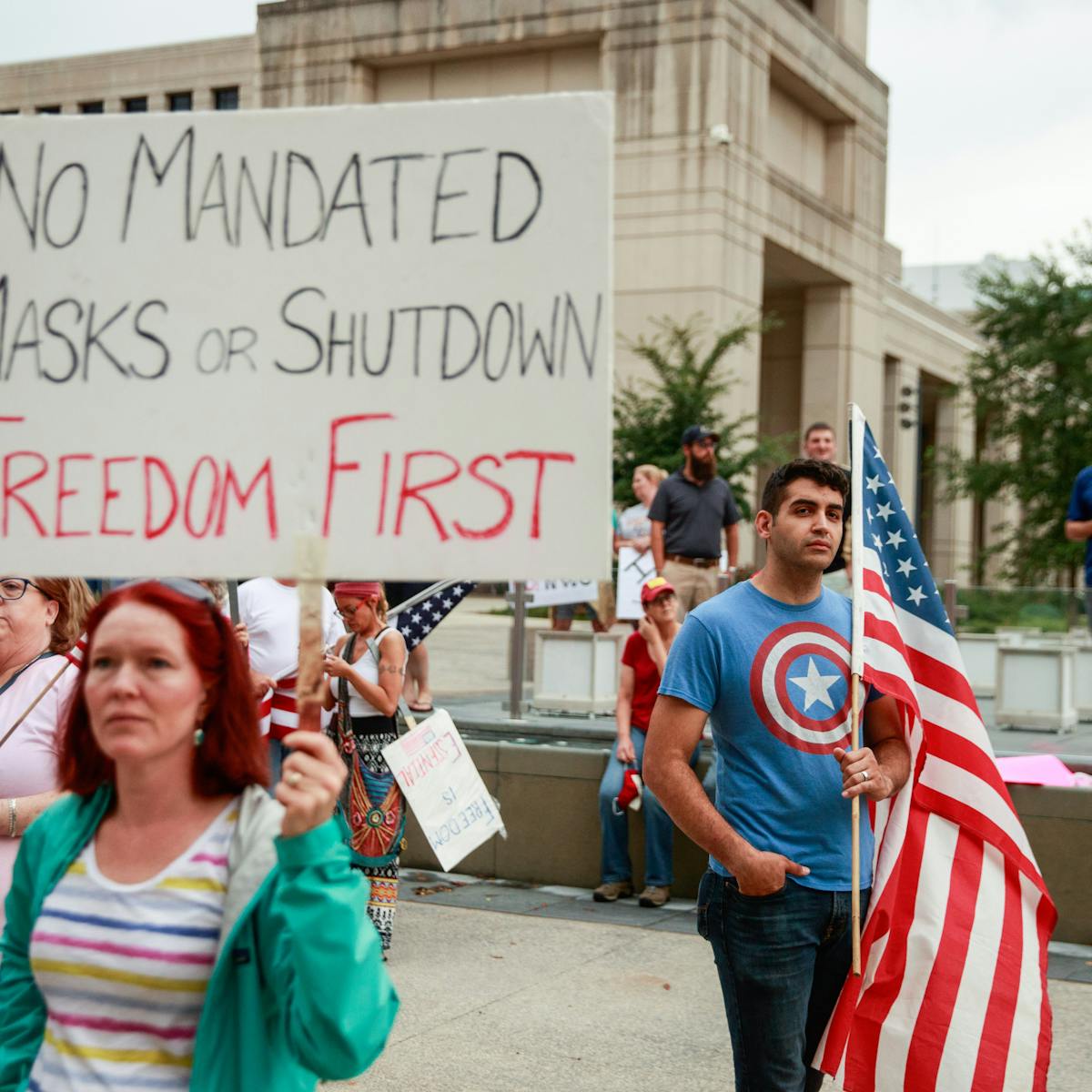
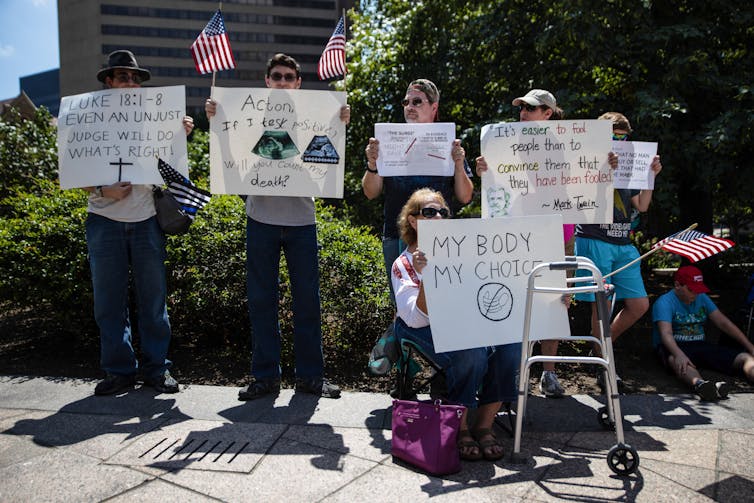
Some Americans have refused, wrongly claiming mask decrees violate the Constitution. An internet search turns up dozens of examples.

“Costco Karen,” for instance, staged a sit-in in a Costco entrance in Hillsboro, Oregon after she refused to wear a mask, yelling “I am an American … I have rights.”

A group called Health Freedom Idaho organized a protest against a Boise, Idaho, mask mandate. One protester said, “I’m afraid where this country is headed if we just all roll over and abide by control that goes against our constitutional rights.”

As one protester said, “The coronavirus doesn’t override the Constitution.”

Speaking as a constitutional law scholar, these objections are nonsense.

The objections

It is not always clear why anti-maskers think government orders requiring face coverings in public spaces or those put in place by private businesses violate their constitutional rights, much less what they think those rights are. But most of the mistaken objections fall into two categories:

Mandatory masks violate the First Amendment right to speech, assembly, and especially association and mandatory masks violate a person’s constitutional right to liberty and to make decisions about how to their own health and bodily integrity.

They’re not mutually exclusive claims:lawsuit filed by four Florida residents against Palm Beach County, for example, argues that mask mandates “interfere with … personal liberty and constitutional rights,” such as freedom of speech, right to privacy, due process, and the “constitutionally protected right to enjoy and defend life and liberty.” The lawsuit asks the court to issue a permanent injunction against the county’s mask mandate.

Responding to a reporter who asked why President Donald Trump appeared unconcerned about the absence of masks and social distancing at a campaign rally in Tulsa, Vice President Mike Pence said: “I want to remind you again freedom of speech and the right to peaceably assemble is in the Constitution of the U.S. Even in a health crisis, the American people don’t forfeit our constitutional rights.”

What the First Amendment does – and doesn’t – do

The First Amendment protects freedom of speech, press, petition, assembly and religion.

There are two reasons why mask mandates don’t violate the First Amendment.

First, a mask doesn’t keep you from expressing yourself. At most, it limits where and how you can speak. Constitutional law scholars and judges call these “time, place, and manner” restrictions. If they do not discriminate on the basis of the content of the speech, such restrictions do not violate the First Amendment. An example of a valid time, place and manner restriction would be a law that limits political campaigning within a certain distance of a voting booth.

Additionally, the First Amendment, like all liberties ensured by the Constitution, is not absolute.

All constitutional rights are subject to the goverment’s authority to protect the health, safety and welfare of the community. This authority is called the “police power.” The Supreme Court has long held that protecting public health is sufficient reason to institute measures that might otherwise violate the First Amendment or other provisions in the Bill of Rights. In 1944, in the case of Prince v. Massachusetts, for example, the Supreme Court upheld a law that prohibited parents from using their children to distribute religious pamphlets on public streets.

The right to liberty

Some anti-maskers object that masks violate the right to liberty.

The right to liberty, including the right to make choices about one’s health and body, is essentially a constitutional principle of individual autonomy, neatly summarized as “My body, my choice.”

The 1905 case of Jacobsen v. Massachusetts shows why mask mandates don’t violate any constitutional right to privacy or health or bodily integrity. In that case, the Supreme Court upheld a smallpox vaccination requirement in Cambridge, Massachusetts.

The court said that the vaccination requirement did not violate Jacobsen’s right to liberty or “the inherent right of every freeman to care for his own body and health in such way as to him seems best.”

As the court wrote, “There are manifold restraints to which every person is necessarily subject for the common good. On any other basis, organized society could not exist with safety to its members.” In a 1995 New York case, a state court held that an individual with active tuberculosis could be forcibly detained in a hospital for appropriate medical treatment.

Even if you assume that mask mandates infringe upon what the Supreme Court calls “fundamental rights,” or rights that the court has called the “very essence of a scheme of ordered liberty,” it has consistently ruled states can act if the restrictions advance a compelling state interest and do so in the least restrictive manner.

Rights are conditional

As the Jacobsen ruling and the doctrine of time, place and manner make clear, the protection of all constitutional liberties rides upon certain necessary – but rarely examined – assumptions about communal and public life.

One is that is constitutional rights – whether to liberty, speech, assembly, freedom of movement or autonomy – are held on several conditions. The most basic and important of these conditions is that our exercise of rights must not endanger others (and in so doing violate their rights) or the public welfare. This is simply another version of the police power doctrine.

Unfortunately, a global pandemic in which a serious and deadly communicable disease can be transmitted by asymptomatic carriers upsets that background and justifies a wide range of reasonable restrictions on our liberties. Believing otherwise makes the Constitution a suicide pact – and not just metaphorically.


Scientists caught between pandemic and protests

https://www.axios.com/black-lives-matter-protests-coronavirus-science-15acc619-633d-47c2-9c76-df91f826a73c.html

Scientists accused of double standards on coronavirus and Black ...

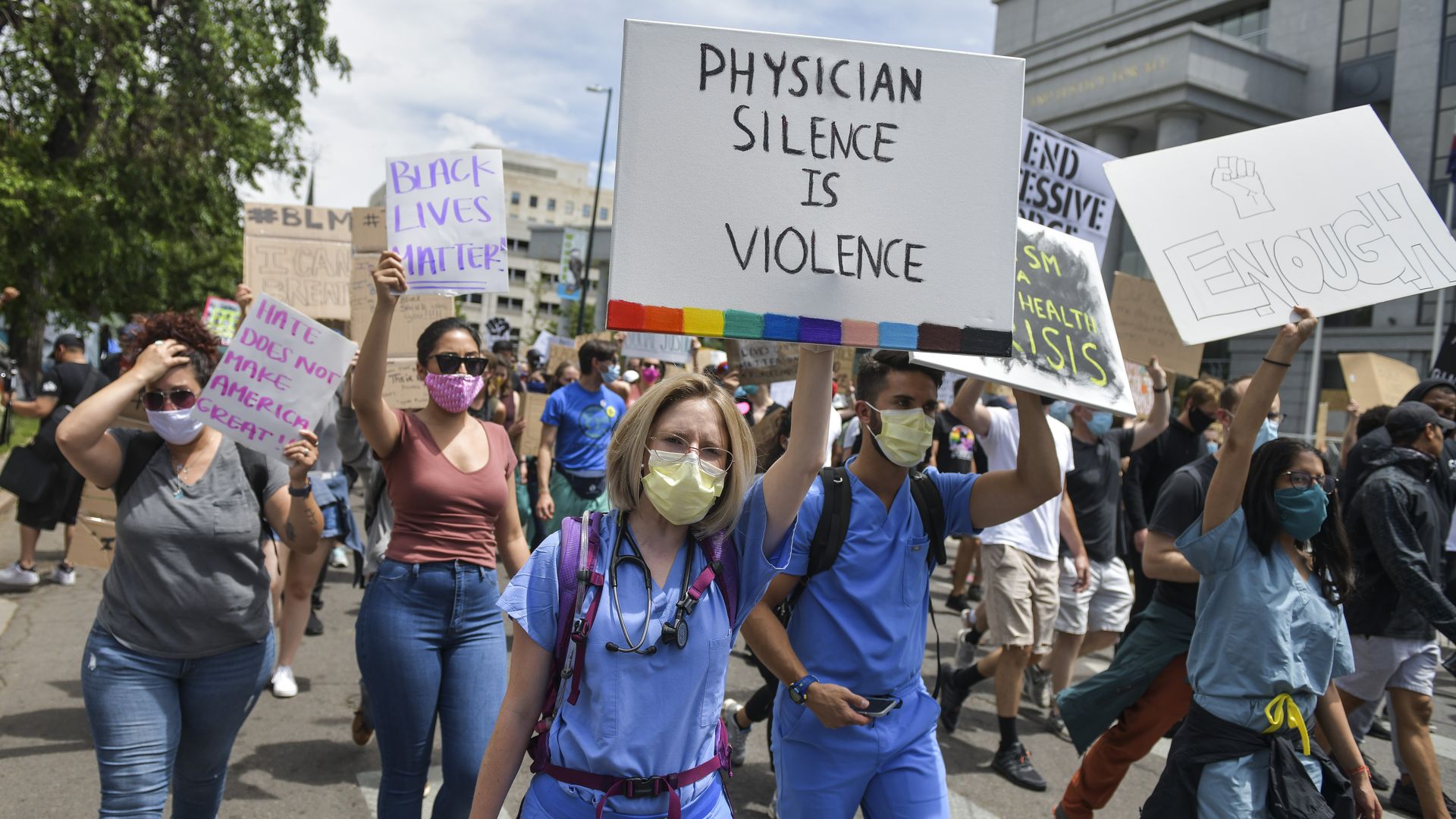
When protests broke out against the coronavirus lockdown, many public health experts were quick to warn about spreading the virus. When protests broke out after George Floyd’s death, some of the same experts embraced the protests. That’s led to charges of double standards among scientists.

Why it matters: Scientists who are seen as changing recommendations based on political and social priorities, however important, risk losing public trust. That could cause people to disregard their advice should the pandemic require stricter lockdown policies.

What’s happening: Many public health experts came out against public gatherings of almost any sort this spring — including protests over lockdown policies and large religious gatherings.

  • But some of the same experts are supporting the Black Lives Matter protests, arguing that addressing racial inequality is key to tackling the coronavirus epidemic.
  • The systemic racism that protesters are decrying contributes to massive health disparities that can be seen in this pandemic — black Americans comprise 13% of the U.S. population, but make up around a quarter of deaths from COVID-19. Floyd himself survived COVID-19 before he was killed by a now former police officer in Minneapolis.
  • “While everyone is concerned about the risk of COVID, there are risks with just being black in this country that almost outweigh that sometimes,” Abby Hussein, an infectious disease fellow at the University of Washington, told CNN last week.

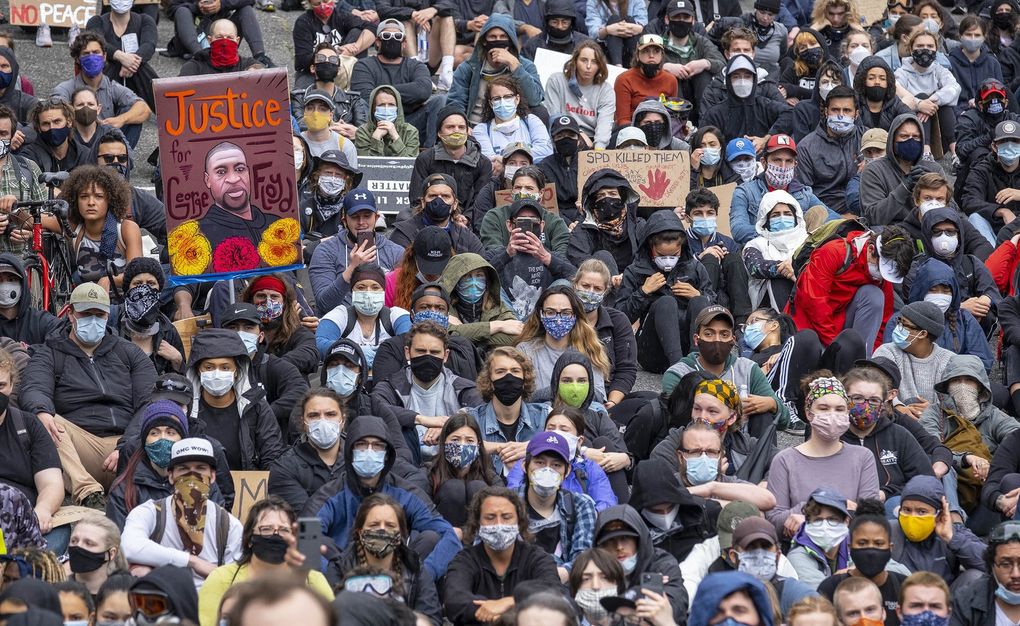
Yes, but: Spending time in a large group, even outdoors and wearing masks — as many of the protesters are — does raise the risk of coronavirus transmission, says Michael Osterholm, director of the Center for Infectious Disease Research and Policy at the University of Minnesota.

  • In a Twitter thread over the weekend, coronavirus expert Trevor Bedford estimated that each day of protests would result in some 3,000 additional infections, which over time could lead to hundreds of additional deaths each day.
  • Public health experts who work in the government have struck a cautionary note. Mass, in-person protests are a “perfect setup” for transmission of the virus, Anthony Fauci told radio station WTOP last week. “It’s a delicate balance because the reasons for demonstrating are valid, but the demonstration puts one at additional risk.”

The difference in tone between how some public health experts are viewing the current protests and earlier ones focused on the lockdowns themselves was seized upon by a number of critics, as well as the Trump campaign.

  • “It will deepen the idea that the intellectual classes are picking winners and losers among political causes,” says Tom Nichols, author of the “The Death of Expertise.”
  • Politico reported that the Trump campaign plans to restart campaign rallies in the next two weeks, with advisers arguing that “recent massive protests in metropolitan areas will make it harder for liberals to criticize him” despite the ongoing pandemic.

The current debate underscores a larger question: What role should scientists play in policymaking?

  • “We should never try to harness the credibility of public health on behalf of our judgments as citizens,” writes Peter Sandman, a retired professor of environmental journalism. He tells Axios some scientists who supported one protest versus others “clearly damaged the credibility of public health as a scientific enterprise that struggles to be politically neutral.
  • But some are pushing back against the very idea of scientific neutrality. “Science is part of how we got to our racist system in the first place,” Susan Matthews wrote in Slate.
  • Medical science has often betrayed the trust of black Americans, who receive less, and often worse, care than white Americans. That means — as Uché Blackstock, a physician and CEO of Advancing Health Equity, told NPR — that the pandemic presents “a crisis within a crisis.”

The big picture: The debate risks exacerbating a partisan divide among Americans in their reported trust in scientists.

  • 53% of Democrats polled in late April — about a month before Floyd’s death — reported a “great deal of confidence in medical scientists to act in the public interests” versus 31% of Republicans.
  • If science-driven policymaking continues to be seen as biased, it will have repercussions for public trust in issues beyond the pandemic, including climate change, AI and genetic engineering.

What to watch: If there is a rise in new cases in the coming weeks, there will be pressure to trace them — to protests, rallies and the reopening of states. How experts weigh in could affect how their recommendations will be viewed in the future — and whether the public, whatever their political leanings, will follow them again.


Cartoon – Importance of Transparency

Corrupt Politician Cartoons and Comics - funny pictures from ...

Protests essential despite risk of coronavirus spread, healthcare workers say

https://www.beckershospitalreview.com/public-health/protests-essential-despite-risk-of-coronavirus-spread-healthcare-workers-say.html?utm_medium=email

After months of pleading for social distancing, health officials ...

Though the protests that erupted after a black man died in police custody might result in spikes of COVID-19, some healthcare workers say that they are important, as racial disparities in healthcare is also a public health issue, according to The Wall Street Journal.

Public health experts and healthcare workers across the country are joining in the protests that began after George Floyd died at the hand of police in Minneapolis in late May. He is the most recent example of police brutality against black people and joins a long list of deaths of African Americans in police custody.

Healthcare experts and workers are saying though the protests may result in a new wave of coronavirus cases, the issue at hand is more important and the potential benefits outweigh the risks, especially since the risk of transmission is lower outside than inside when precautions are taken.

Darrell Gray, MD, a black gastroenterologist at the Ohio State University Wexner Medical Center in Columbus, has been attending protests, telling the Journal, “I prioritize being at protests and peaceful demonstrations because I strongly believe that they can be leveraged to produce change.” He said that he is taking precautions, wearing a face mask and distancing himself as much as possible.

Dr. Gray also said that the pandemic has disproportionately affected black communities, as the underlying conditions that are linked to more severe COVID-19 illness, such as diabetes and high blood pressure, are more rampant in those communities.

Jennifer Nuzzo, DrPH, an epidemiologist and senior scholar at the Johns Hopkins Center for Health Security in Baltimore, also supports the protests, though she has not been able to attend one in person as yet due to time constraints.

She told the Journal although she is worried about virus transmission, “there are some categories of risk that are, for me, completely worth it.” These protests are in those categories, she said.

Dr. Nuzzo and other health experts have also said protesters can reduce the risk of transmission by wearing masks, trying to maintain 6 feet of social distance when possible and making sure they are washing their hands often or using hand sanitizer.

More than 1,000 public health and infectious disease experts and community stakeholders signed an open letter last week saying that demonstrations were important for combating race-based health inequities, largely a result of racism, the Journal reports.


Cartoon – Pillars of Democracy

Exhibit highlights cartoonists' focus on First Amendment | WTOP

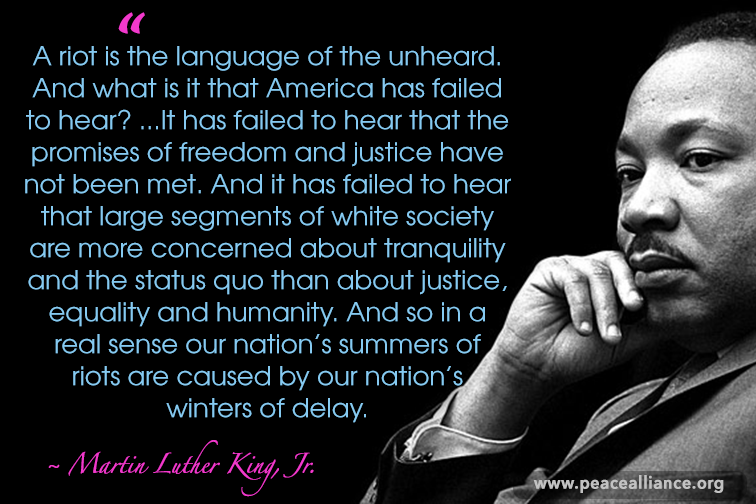
“What is it that America has failed to hear?”

https://mailchi.mp/9f24c0f1da9a/the-weekly-gist-june-5-2020?e=d1e747d2d8

The Peace Alliance's tweet - ""A riot is the language of the ...

“What is it that America has failed to hear?” asked Dr. Martin Luther King, Jr. in March of 1968, calling riots the “language of the unheard”. “It has failed to hear that the promises of freedom and justice have not been met.” Stubbornly, shamefully, we continue to turn a deaf ear: to structural racism; to institutionalized inequality; to a pandemic of police brutality and bigotry that chokes off the breath of black Americans as surely as a virus in the lungs or a boot on the neck. But the sound in the streets is thunderous.

We in healthcare must listen. We must hear that what killed George Floyd, and Breonna Taylor, and Eric Garner, and Tamir Rice, and Philando Castile, and Trayvon Martin, and Ahmaud Arbery, and countless others, as surely as the terrible actions of any single person, was the pervasive, insidious virus of racism, long since grown endemic in our country.

This week’s protests are a kind of ventilator, providing emergency breath for a national body in crisis. We must work—urgently—on the therapeutics of structural change and the vaccines of education and understanding.

At Gist Healthcare we are listening, and learning. As a team, we’ve committed to each other to be attentive, invested, empathetic allies, and to dedicate our individual and collective time, talents and treasure to antiracist work, in healthcare and beyond. Our contribution may not be large, and it will never be enough, but at least we hope it will be positive. We’d like to hear your thoughts and suggestions as well. For the moment, and for our colleagues, friends, and families, we stand with the protestors.

Black Lives Matter.


Guns in Michigan Capitol: Defense of liberty or intimidation?

https://www.csmonitor.com/USA/Politics/2020/0504/Guns-in-Michigan-Capitol-Defense-of-liberty-or-intimidation

Guns in coronavirus protests: Defense of liberty or intimidation ...

WHY WE WROTE THIS

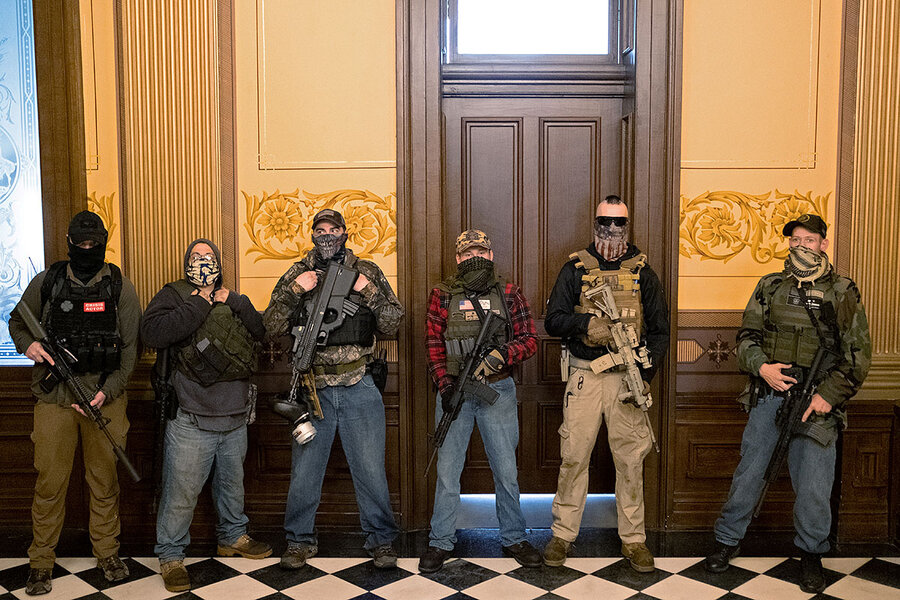
Bringing assault weapons to the Michigan Legislature for a protest against coronavirus restrictions? To one group, it’s why the Second Amendment exists. To many others, it’s unfathomable.

It was a first for Michigan state Sen. Sylvia Santana. Before heading to the statehouse in Lansing last Thursday, she slipped into a bulletproof vest.

Ms. Santana’s husband, a sheriff’s deputy, warned her about potential trouble at a rally to protest the decision to extend a coronavirus lockdown.

A group of armed white men entered the Capitol and shouted at lawmakers. To Ms. Santana, some were dressed like they were “going to war.” Several Confederate flags, a swastika, and a misogynistic sign aimed at Gov. Gretchen Whitmer could be seen outside.

“I thought that was very scary,” says Ms. Santana, an African American who represents parts of Detroit and all of neighboring Dearborn. “We’re there to do a job, and it’s not to dodge bullets as we try to do our jobs in a bipartisan fashion to make sure we’re keeping all Michiganders safe.”

Four days on from the protest, her concern lingers. The pandemic has intensified many societal fault lines – from health care inequities to political polarization – and gun control is no exception. Feeling that state officials are overreaching, a tiny minority of protesters are flexing their Second Amendment rights in Michigan and beyond.

But at a time of crisis, their crusade against the perceived tyranny of government is seen by many as tyrannical in its own right – recklessly using their liberties to intimidate others.

The core question is: Where should the line be drawn? For protesters, guns in statehouses is one of the purest expressions of the power the Second Amendment invests in citizens. But no constitutional right is absolute.

“Where do people who see no problem with guns downtown or near a hospital or in the legislature, where do they draw the line?” Sanford Levinson, co-author of “Fault Lines in the Constitution.” “That’s an interesting question both politically and legally, because courts are really receptive to line drawing. I don’t think you’d find any judge who says, ‘Yeah, I welcome guns in my courtroom.’”

In that way, the struggle over whether to allow firearms in legislatures “is part of the culture war,” he adds.

Are hard-line tactics effective?

Today, 21 state capitols allow guns in some form, according to a Wall Street Journal report. But only a few, including Michigan, allow citizens to openly carry under the rotunda. Many Republican-led states balk at open carry in the people’s hall for personal safety reasons, and courts have upheld bans in places like legislatures and polling places, holding that guns can chill other people’s rights.

Elements of race have long played a role. The modern gun control movement is linked to the signing of the Mulford Act in 1967, which banned open carry in California. The bill gained momentum after two dozen Black Panthers legally brought firearms to the state capitol to protest against it. The National Rifle Association backed the bill.

Incidents like the one in Michigan, however, could do more to damage gun rights than advance them. “It’s really now an open question to what extent hard-line pro-gun policies are politically advantageous,” says Mr. Levinson, also a visiting professor at Harvard Law School in Cambridge, Massachusetts.

Ms. Santana was certainly not persuaded. “I, as a state lawmaker, want to hear your concerns and your position on the issue. But I don’t feel that bringing assault weapons to the capitol and using symbols of hatred will make me understand your issue better.”

The scenes in Michigan, which has been hit hard by COVID-19, only make it harder to have already difficult conversations, others say. Part of self-defense is respecting the preferences other people have for their own security, which might mean leaving guns at home when overtones of intimidation are possible.

“When your eyes look at these pictures of groups of people … in a public building that is supposed to be a center of democratic exchange and debate, and you see a group of people carrying military weapons, that is not a vision of democracy,” says Hannah Friedman, a staff attorney at Giffords Law Center to Prevent Gun Violence in San Francisco. “That’s a vision of intimidation by a minority of people.”

Such concerns were heightened further this weekend, when employees at businesses in Stillwater, Oklahoma, faced a threat of violence with a gun while trying to force customers to wear masks, as mandated by the local government.

“I think we were heard”

But Ashley Phibbs has a different view.

Ms. Phibbs, a project manager and mother who helped organize the Michigan rally, acknowledged with regret that many in attendance didn’t abide by social distancing rules. She also confirmed the display of hate symbols. But she insisted those were agitators and not part of her group, Michigan United for Liberty, which has sprung up to oppose what members see as repressive COVID-19 restrictions.

“I know how it can seem to people who aren’t active in rallies and who are looking at it from the outside in, and I try to be very understanding of that,” says Ms. Phibbs. “But … I don’t think that anyone was there to really make anyone fearful. I didn’t see anything that would have really caused fear, aside from loud noises from the people yelling. But a lot of people are also sometimes afraid of guns in general.”

In the end, she says, “I think we were heard. I think overall [the rally] was positive.”

Knowing your audience

Other gun-rights advocates saw problems with the optics.

As he watched news from Michigan Thursday, Caleb Q. Dyer saw some familiar faces. The New Hampshire barista and former state legislator had been a keynote speaker at a Michigan Libertarian Party event last year.

But he worried that his friends in Michigan were sending “mixed messages” by failing to abide by public health rules.

In fact, he usually brings witty protest gear – such as a sign that says “arm the homeless” – to disarm fear. It’s a fine line, he says, between free speech and armed intimidation.

“People aren’t ready to have the discussion that a lot of these gun-carrying protesters want to have, which is that none of these laws are even remotely effective or just,” says Mr. Dyer. “But they’re not going to have that discussion if they cannot carry themselves in such a way that the opposition won’t think … that they’re murderous and violent.”