


Cartoon – Health Workers

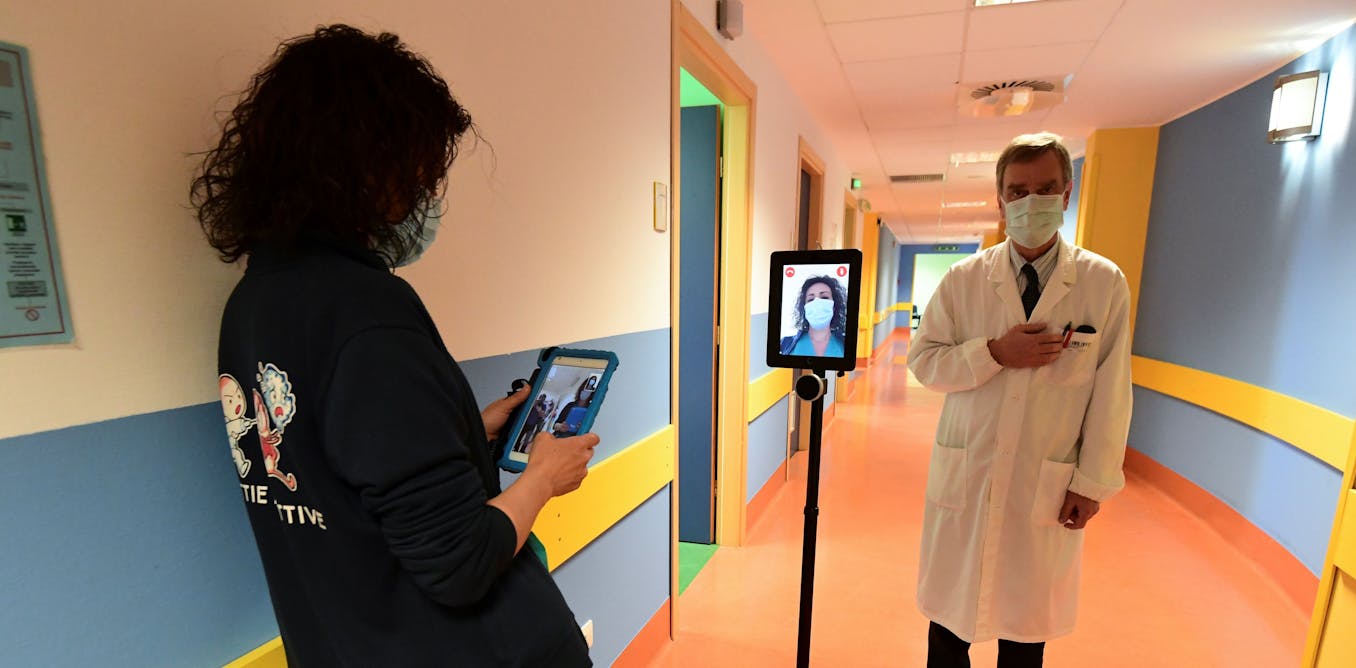
A cylindrical robot rolls into a treatment room to allow health care workers to remotely take temperatures and measure blood pressure and oxygen saturation from patients hooked up to a ventilator. Another robot that looks like a pair of large fluorescent lights rotated vertically travels throughout a hospital disinfecting with ultraviolet light. Meanwhile a cart-like robot brings food to people quarantined in a 16-story hotel. Outside, quadcopter drones ferry test samples to laboratories and watch for violations of stay-at-home restrictions.
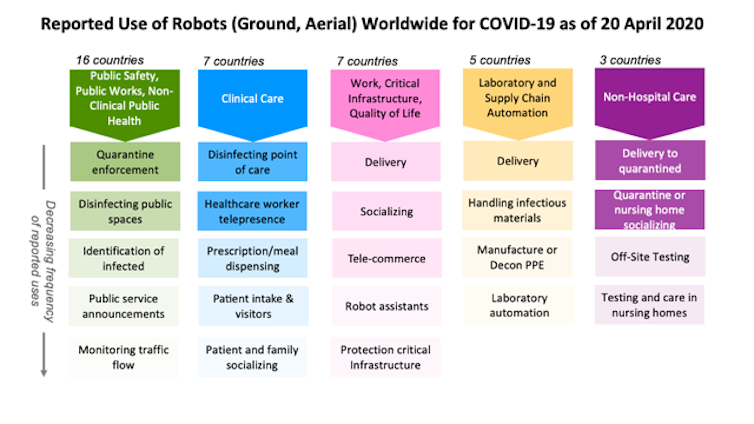
These are just a few of the two dozen ways robots have been used during the COVID-19 pandemic, from health care in and out of hospitals, automation of testing, supporting public safety and public works, to continuing daily work and life.
The lessons they’re teaching for the future are the same lessons learned at previous disasters but quickly forgotten as interest and funding faded. The best robots for a disaster are the robots, like those in these examples, that already exist in the health care and public safety sectors.
Research laboratories and startups are creating new robots, including one designed to allow health care workers to remotely take blood samples and perform mouth swabs. These prototypes are unlikely to make a difference now. However, the robots under development could make a difference in future disasters if momentum for robotics research continues.
As roboticists at Texas A&M University and the Center for Robot-Assisted Search and Rescue, we examined over 120 press and social media reports from China, the U.S. and 19 other countries about how robots are being used during the COVID-19 pandemic. We found that ground and aerial robots are playing a notable role in almost every aspect of managing the crisis.
In hospitals, doctors and nurses, family members and even receptionists are using robots to interact in real time with patients from a safe distance. Specialized robots are disinfecting rooms and delivering meals or prescriptions, handling the hidden extra work associated with a surge in patients. Delivery robots are transporting infectious samples to laboratories for testing.
Outside of hospitals, public works and public safety departments are using robots to spray disinfectant throughout public spaces. Drones are providing thermal imagery to help identify infected citizens and enforce quarantines and social distancing restrictions. Robots are even rolling through crowds, broadcasting public service messages about the virus and social distancing.
At work and home, robots are assisting in surprising ways. Realtors are teleoperating robots to show properties from the safety of their own homes. Workers building a new hospital in China were able work through the night because drones carried lighting. In Japan, students used robots to walk the stage for graduation, and in Cyprus, a person used a drone to walk his dog without violating stay-at-home restrictions.
Every disaster is different, but the experience of using robots for the COVID-19 pandemic presents an opportunity to finally learn three lessons documented over the past 20 years. One important lesson is that during a disaster robots do not replace people. They either perform tasks that a person could not do or do safely, or take on tasks that free up responders to handle the increased workload.
The majority of robots being used in hospitals treating COVID-19 patients have not replaced health care professionals. These robots are teleoperated, enabling the health care workers to apply their expertise and compassion to sick and isolated patients remotely.
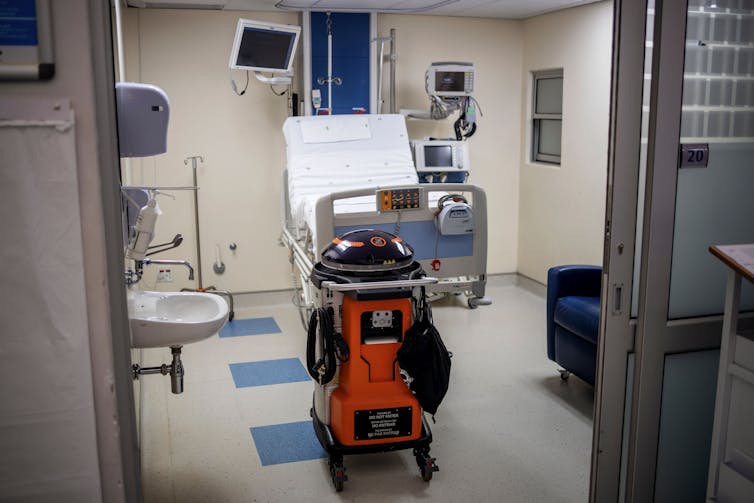
A small number of robots are autonomous, such as the popular UVD decontamination robots and meal and prescription carts. But the reports indicate that the robots are not displacing workers. Instead, the robots are helping the existing hospital staff cope with the surge in infectious patients. The decontamination robots disinfect better and faster than human cleaners, while the carts reduce the amount of time and personal protective equipment nurses and aides must spend on ancillary tasks.
The second lesson is the robots used during an emergency are usually already in common use before the disaster. Technologists often rush out well-intentioned prototypes, but during an emergency, responders – health care workers and search-and-rescue teams – are too busy and stressed to learn to use something new and unfamiliar. They typically can’t absorb the unanticipated tasks and procedures, like having to frequently reboot or change batteries, that usually accompany new technology.
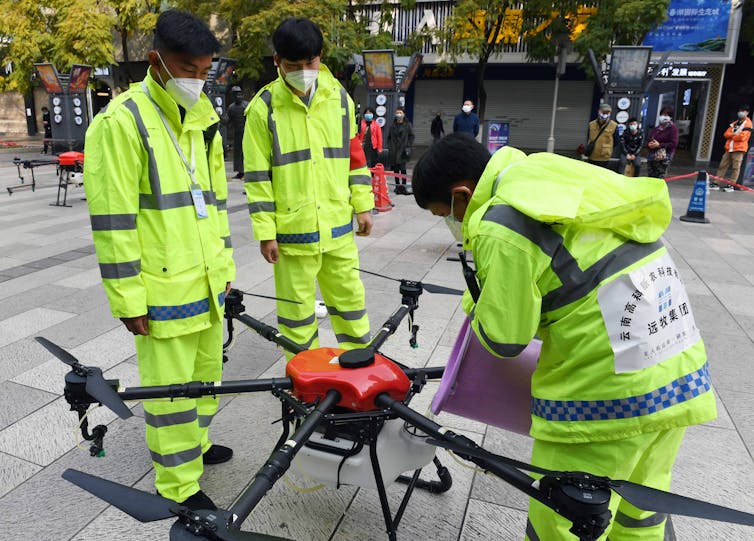
Fortunately, responders adopt technologies that their peers have used extensively and shown to work. For example, decontamination robots were already in daily use at many locations for preventing hospital-acquired infections. Sometimes responders also adapt existing robots. For example, agricultural drones designed for spraying pesticides in open fields are being adapted for spraying disinfectants in crowded urban cityscapes in China and India.
A third lesson follows from the second. Repurposing existing robots is generally more effective than building specialized prototypes. Building a new, specialized robot for a task takes years. Imagine trying to build a new kind of automobile from scratch. Even if such a car could be quickly designed and manufactured, only a few cars would be produced at first and they would likely lack the reliability, ease of use and safety that comes from months or years of feedback from continuous use.
Alternatively, a faster and more scalable approach is to modify existing cars or trucks. This is how robots are being configured for COVID-19 applications. For example, responders began using the thermal cameras already on bomb squad robots and drones – common in most large cities – to detect infected citizens running a high fever. While the jury is still out on whether thermal imaging is effective, the point is that existing public safety robots were rapidly repurposed for public health.
The broad use of robots for COVID-19 is a strong indication that the health care system needed more robots, just like it needed more of everyday items such as personal protective equipment and ventilators. But while storing caches of hospital supplies makes sense, storing a cache of specialized robots for use in a future emergency does not.
This was the strategy of the nuclear power industry, and it failed during the Fukushima Daiichi nuclear accident. The robots stored by the Japanese Atomic Energy Agency for an emergency were outdated, and the operators were rusty or no longer employed. Instead, the Tokyo Electric Power Company lost valuable time acquiring and deploying commercial off-the-shelf bomb squad robots, which were in routine use throughout the world. While the commercial robots were not perfect for dealing with a radiological emergency, they were good enough and cheap enough for dozens of robots to be used throughout the facility.
Hopefully, COVID-19 will accelerate the adoption of existing robots and their adaptation to new niches, but it might also lead to new robots. Laboratory and supply chain automation is emerging as an overlooked opportunity. Automating the slow COVID-19 test processing that relies on a small set of labs and specially trained workers would eliminate some of the delays currently being experienced in many parts of the U.S.
Automation is not particularly exciting, but just like the unglamorous disinfecting robots in use now, it is a valuable application. If government and industry have finally learned the lessons from previous disasters, more mundane robots will be ready to work side by side with the health care workers on the front lines when the next pandemic arrives.

The names came from all over the country — New York and Alabama, Puerto Rico and Nevada, California and Michigan, Florida and Maryland, New Jersey and the District.
A man in blue scrubs stood behind Jones as she read, holding a metallic gold sign painted with the message: “20 seconds won’t scrub ‘hero’ blood off your hands.”
“Let us remember and honor the ultimate sacrifice these nurses paid,” Jones said. “We commit ourselves to fight like hell for the living.”
The protest stood in stark contrast to demonstrations in recent days in some parts of the country in which protesters have demanded the reopening of nonessential businesses. Nurses have been spotted at those gatherings, too, standing arms crossed, in opposition to demonstrators, many of whom are unmasked and milling in crowds.
More than 9,000 health-care workers in the United States have tested positive for the novel coronavirus, according to figures from the Centers for Disease Control and Prevention. Those numbers are believed to be an undercount of infections due to a lack of tests in many areas.
The nurses said Tuesday that they wanted to bring their demands for more personal protective equipment directly to President Trump’s doorstep.
Health-care providers in hospitals, clinics, nursing homes, assisted-living facilities and rehabilitation centers have for weeks asked lawmakers and government agencies for more protective equipment to shield themselves and their vulnerable patients from the spread of covid-19.
National Nurses United last month petitioned the Occupational Safety and Health Administration to institute an emergency safety standard that would provide nurses with more protective gear, including N95 respirator masks, face shields, gowns, gloves and shoe coverings.
Health-care workers, governors and other officials have for weeks demanded that Trump enforce the Defense Production Act to order mass production of those materials. Many have also petitioned Congress to mandate Trump use his authority to help boost the production of such gear.
Last week, a protest in the shadow of the Capitol displayed the faces of health-care workers demanding better protection on 1,000 signs. The sign represented protesters that organizers said would not have been safe if gathered together on the Capitol lawn.

Today I stood with some of my fellow nurses and faced a tidal wave of ignorance, fear, and abuse.
I was mocked. I was called more names than I can remember. I was told I was ignorant, unintelligent, and compassionless. I was accused of being a fake nurse, a paid protester, a fraud. I was told I was nothing. I had cigarette smoke blown in my face. I was sexually harassed. A few times, I was surrounded on all sides by multiple people yelling at me.
Desperation and fear bring out the worst in people. I will admit, I cried a bit. How could I not in the face of so much hate?
But I when I did, I was crying for my fellow healthcare workers on the front lines, who are working their asses off fighting this illness, who are being put at worse risk because of the lack of essential protective equipment in this country. I cried for those who have left their families behind to go help where the situation is most dire. I cried for those who have died and will continue to die, after working their hardest to help those who needed them.
I cried for every protester who doesn’t know how they are going to make ends meet, that are afraid for their businesses, their jobs, their homes, and their lives. I cried for every American who has received less than adequate help from the government, who felt like this is the only way for them to get the resources they need, and who have been failed by our president who has not implemented the measures required to help and protect our most vulnerable people.
I cried for every person at this protest that will inevitably get sick, and increase the spread in our state when we had been doing a pretty good job of flattening the curve and delaying the spread of covid-19 in Arizona. I cried for every person who will be infected by those that contracted the disease today.
But more important than the few tears I shed today, was that I stood strong for what is right.
I stood for using science, not feelings, to make important decisions in a pandemic. I stood for the healthcare workers who are going to keep working our hardest to help heal the sick, whether they appreciate it or not. I stood for those who couldn’t. I stood for the lives we have lost, many unnecessarily, to this virus. I stood strong and looked every protester fighting to open Arizona in the eye, so they would have to stare into the face of some of the individuals they are hurting with their ignorance. My hands cramped up from standing in this position so long, but I kept standing until everything died down.
And I will keep standing.
https://nowthisnews.com/news/health-care-workers-stand-up-to-people-protesting-stay-at-home-orders
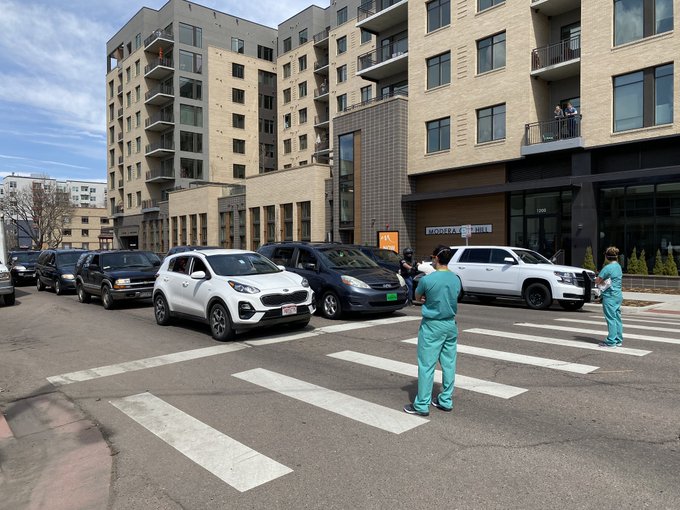
Remarkable scene at 12th and Grant, where two healthcare workers from a Denver-area hospital — they declined to say which or give their names — are standing in the crosswalk during red lights as a “reminder,” they say, of why shutdown measures are in place.
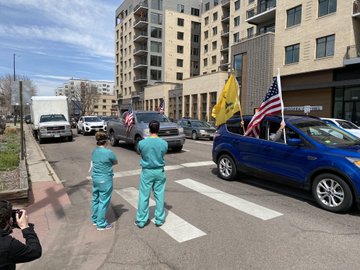
Two health care workers blocked a parade of protesters in Denver, Colorado on Sunday, who were storming the capitol to protest the state’s stay-at-home order.
Powerful images and videos of the standoff were widely shared on social media of the two unidentified people wearing scrubs and N95 masks, standing in a crosswalk blocking protesters’ vehicles. The two were identified as health care workers by photographers on the scene.
One video shared by Twitter user Marc Zenn, captured cars lined up and beeping their horns at the two medical workers, with a woman hanging out of her vehicle’s window shouting “Go to China if you want communism. Go to China,” and “You get to go to work, why can’t we?”
They say they’ve been treating COVID patients for weeks. Today most of the people driving by have been “very aggressive,” they say. I’ve been standing here for a few minutes and already seen two people get in their faces.
Hundreds of people showed up on foot and in their vehicles for two separate protests in Colorado’s capitol on Sunday. The protests were reportedly planned by ReOpen Colorado and “various Libertarian parties,” according to a local Denver news outlet. People attending the march were shown carrying American flags, “Don’t Tread on Me” flags, and signs about reopening businesses and schools.
“Coloradans have a first amendment right to protest and to free speech, and the Governor hopes that they are using social distancing and staying safe,” Colorado Gov. Jared Polis’ office said in a statement. “No one wants to reopen Colorado businesses and lift these restrictions more than the Governor, but in order to do that, Coloradans have to stay home as much as possible during this critical period, wear masks and wash their hands regularly to slow the spread of this deadly virus.”
As of Monday morning, Colorado has more than 9,700 cases of COVID-19, leading to at least 420 deaths, according to the Johns Hopkins coronavirus tracker. The state of Colorado is set to continue its stay-at-home order until at least April 26, to slow the transmission of the virus.
Colorado isn’t the only state where protesters are demonstrating against their government’s stay-at-home orders—Several other states held protests over the weekend including Utah, Idaho, and Washington state. Last week, parts of Michigan, New York, Ohio, Virginia, North Carolina, and others also saw a wave of demonstrators.
President Trump encouraged the protesters last week during his Friday press briefing and in tweets which said to “liberate” multiple states holding protests.
In a Politico poll, 81% of Americans agreed we “should continue to social distance for as long as is needed to curb the spread of coronavirus, even if it means continued damage to the economy.” An NBC News poll found that 60% of responders agreed with keeping at-home restrictions.

“I am posting, for once, about something other than my dog.
I have seen 4 patients die, 5 get intubated, 2 re-intubated, witnessed family consent to make 2 more patients DNRs, sweat my butt off during CPR, titrated so many drips to no avail, watched vent settings increase to no avail. We are exhausted and at a total loss.
All of this in two shifts in a row.
Some of you people have never done EVERYTHING you could to save someone, and watched them die anyway, and it shows.
I would have no problem if you fools worried about your “freedom” all went out and got COVID. If only you could sign a form stating that you revoke your right to have medical treatment based on your cavalier antics and refusal to abide by CDC and medical professionals’ advice. If you were the only people who got infected during your escapades to protest tyranny, great. But that’s sadly not how this works.
You wanna complain because the garden aisle is closed? If you knew a thing about gardening, you’d know it’s too early to plant in Michigan. Your garden doesn’t matter. If killing your plants would bring back my patients, I would pillage the shit out of your “essential” garden beds.
Upset because you can’t go boating…in Michigan…in April…in the cold-ass water? You wanna tell my patient’s daughter (who was sobbing as she said goodbye to her father over the phone) about your first-world problems?
Upset because you can’t go to your cottage up north? Your cottage…your second property…used for leisure. My coworkers can’t even stay in their regular homes. Most have been staying in hotels and dorms, not able to see their spouses or babies.
All of these posts, petitions online to evade “tyranny”, it’s all such bullshit. I’m sorry you’re bored and have nothing to do but bitch and moan. You wanna pick up a couple hours for me? Yeah, didn’t think so. I wouldn’t trust most of you with patient care, anyway. Not just because of the selfish lack of humanity your posts exude, but because most of those posts and petitions are so riddled with misspellings and grammatical errors, that it makes me question your cognitive capacity.
Shoutout to my coworkers, the real MVPs.”


With mandatory social distancing guidelines and stay-at-home orders in effect throughout the region, and given the grueling demands of their jobs as the deadly coronavirus continues to spread, it would have been nearly impossible to assemble 1,000 health-care workers outside Congress this week.
Instead, volunteers put up 1,000 signs to stand on the lawn in their absence.
Activists who are used to relying on people power to amplify messages and picket lawmakers have been forced to use alternative protest tactics amid the pandemic.
Half a dozen volunteers with liberal activist group MoveOn pressed lawn signs into the grass outside the Capitol as the sun peaked over the Statue of Freedom.
On each sign was a message.
Some, bearing the blue Star of Life seen on the uniforms of doctors, first responders and emergency medical technicians, reiterated a hashtag that has made the rounds on social media for weeks, accompanying posts from desperate front-line workers who say they are running out of necessary protective equipment: #GetUsPPE.
Others showed photos of medical workers in scrubs and hair nets and baseball caps. Some wore face shields and plastic visors. Others donned gloves.
One barefaced doctor in a white lab coat held up a hand-drawn sign. “Trump,” it said. “Where’s my mask?”
Health-care providers in hospitals, clinics, nursing homes, assisted-living facilities and rehabilitation centers have for weeks begged for more PPE to protect themselves and their vulnerable patients.
States and hospitals have been running out of supplies and struggling to find more. The national stockpile is nearly out of N95 respirator masks, face shields, gowns and other critical equipment, the Department of Health and Human Services announced last week.
“Health-care workers are on the front lines of this crisis, and they’re risking their lives to save ours every day, and our government, from the very top of this administration on down, has not used the full force of what they have with the Defense Production Act to ensure [workers] have the PPE they need and deserve,” said Rahna Epting, the executive director of MoveOn. “We wanted to show that these are real people who are demanding that this government protect them.”
Unlike protests that have erupted from Michigan to Ohio to Virginia demanding that states flout social distancing practices and reopen the economy immediately, organizers with MoveOn said they wanted to adhere to health guidelines that instruct people not to gather in large groups.
“Normally, we’d want everyone down here,” said MoveOn volunteer Robby Diesu, 32, as he looked out over the rows of signs. “We wanted to find a way to show the breadth of this problem without putting anyone in harm’s way.”
A large white sign propped at the back of the display announced in bold letters: “Social distancing in effect. Please do not congregate.”
The volunteers who put up the signs live in the same house and have been quarantining under the same roof for weeks. Still, as they worked, several wore masks over their face to protect passersby — even though there were few.
A handful of joggers stopped to take pictures as the sun rose.
One man, who spoke on the condition of anonymity because he is a government employee, said he supported the idea.
“I’m so used to seeing protests out here by the Capitol that it really is bizarre to see how empty it is,” he said. “But this is really impressive to me.”
By sharing images and video on social media of front-line workers telling their stories, MoveOn organizers said they hope to galvanize people in the same way as a traditional rally with a lineup of speakers.
Activists planned to deliver a petition to Sen. Chris Murphy (D-Conn.) with more than 2 million signatures urging Congress to require the delivery of more PPE to front-line workers. Murphy has been a vocal critic of the Trump administration’s coronavirus task force and its reliance on private companies to deliver an adequate amount of critical gear, such as N95 respirator masks, medical gowns, gloves and face shields, to health-care workers.
“In this critical hour, FEMA should make organized, data-informed decisions about where, when, and in what quantities supplies should be delivered to states — not defer to the private sector to allow them to profit off this pandemic,” the senator wrote last week in a letter to Vice President Pence, co-signed by 44 Democratic and two independent senators.
Organizers said the signs would remain on the Capitol lawn all day, but that the demonstration was only the beginning of a spate of atypical ones the group expects to launch this month.
Epting described activists’ energy as “more intense” than usual as the pandemic drags on.
“The energy is very high, the intensity is very high,” she said. “That’s forcing us to be creative and ingenuitive in order to figure out how to protest in a social distancing posture and keep one another safe at the same time.”


 HENRY KOTULA