You might need an ambulance, but your state might not see it as ‘essential’

Ambulance services can receive state money once declared essential services.

When someone with a medical emergency calls 911, they expect an ambulance to show up.

But sometimes, there simply isn’t one available.

Most states don’t declare emergency medical services (EMS) to be an “essential service,” meaning the state government isn’t required to provide or fund them.

Now, though, a growing number of states are taking interest in recognizing ambulance services as essential — a long-awaited move for EMS agencies and professionals in the field, who say they hope to see more states follow through. Experts say the momentum might be driven by the pandemic, a decline in volunteerism and the rural health care shortage.

EMS professionals have been advocating for essential designation and more sustainable funding “for longer than I’ve been around — longer than I’ve been a paramedic,” said Mark McCulloch, 42, who is deputy chief of emergency medical services for West Des Moines, Iowa, and who has been a paramedic for more than two decades.

Currently, 13 states and the District of Columbia have passed laws designating or allowing local governments to deem EMS as an essential service, according to the National Conference of State Legislatures, a think tank that has been tracking legislation around the issue.

Those include Connecticut, Hawaii, Indiana, Iowa, Louisiana, Maine, Nebraska, Nevada, Oregon, Pennsylvania, South Carolina, Virginia and West Virginia.

And at least two states — Massachusetts and New York — have pending legislation.

Idaho passed a resolution in March requiring the state’s health department to draft legislation for next year’s legislative session.

Meanwhile, lawmakers in Wyoming this summer rejected a bill that would have deemed EMS essential, according to local media.

“States have the authority to determine which services are essential, required to be provided to all citizens,” said Kelsie George, a policy specialist with the National Conference of State Legislatures’ health program.

Among those states deeming EMS as essential services, laws vary widely in how they provide funding. They might provide money to EMS services, establish minimum requirements for the agencies or offer guidance on organizing and paying for EMS services at the local level, George said.

The lack of EMS services is acute in rural America, where EMS agencies and rural hospitals continue to shutter at record rates, meaning longer distances to life-saving care.

“The fact that people expect it, but yet it’s not listed as an essential service in many states, and it’s not supported as such really, is where that dissonance occurs,” said longtime paramedic Brenden Hayden, chairperson of the National EMS Advisory Council, a governmental advisory group within the U.S. Department of Transportation.

More financial support

There isn’t a sole federal agency dedicated to overseeing or funding EMS, with multiple agencies handling different regulations, and some federal dollars in the form of grants and highway safety funds from the Department of Transportation. Medicaid and Medicare offer some reimbursements, but EMS advocates argue it isn’t nearly enough.

“It forces it as a state question, because the federal government has not taken on the authority to require it,” said Dia Gainor, executive director for the National Association of State EMS Officials and a former Idaho state EMS director. “It’s the prerogative of the state to make the choice” to mandate and fund EMS.

In states that don’t provide funding, EMS agencies often must rely on Medicaid and Medicare reimbursements and money they get from local governments.

Many of the latter don’t have the budgets to pay EMS workers, forcing poorer communities to turn to volunteers. But the firefighter and EMS volunteer pool is shrinking nationally as the volunteer force ages and fewer young people sign up.

Overhead for EMS agencies is expensive: A basic new ambulance can cost $200,000 to $300,000. Then there are the medicine and equipment costs, as well as staff wages and farther driving distances to medical centers in rural areas.

“The fact that people expect it, but yet it’s not listed as an essential service in many states, and it’s not supported as such really, is where that dissonance occurs.”

– Paramedic Brenden Hayden, chairperson of the National EMS Advisory Council

By contrast, police departments are supported and receive funds from the U.S. Department of Justice along with local tax dollars, and fire departments are supported by the U.S. Fire Administration, although many underserved areas also rely on volunteer firefighters to fill gaps.

“We need more if we’re going to save this industry and [if] we’re going to be available to treat patients,” Hayden said. “EMS in general represents a rounding error in the federal budget.”

What’s more, reimbursements only occur if a patient is taken to an emergency room. Agencies may not receive compensation if they stabilize a patient without transporting them to a hospital.

Gary Wingrove, president of the Paramedic Foundation, an advocacy group, has co-authored studies on the lack of ambulance service and on ambulance costs in rural areas. The former Minnesota EMS state director argues that reimbursements should be adjusted on a cost-based basis, like critical-access medical centers that serve high rates of uninsured patients and underresourced communities.

A rural crisis

About 4.5 million people across the United States live in an “ambulance desert,” and more than half of those are residents of rural counties, according to a recent national study by the Maine Rural Health Research Center and the Rural Health Research & Policy Centers. The researchers define an ambulance desert as a community 25 minutes or more from an ambulance station.

Some regions are more underserved than others: States in the South and the West have the most rural residents living in ambulance deserts, according to the researchers, who studied 41 states using data from 2021 and last year.

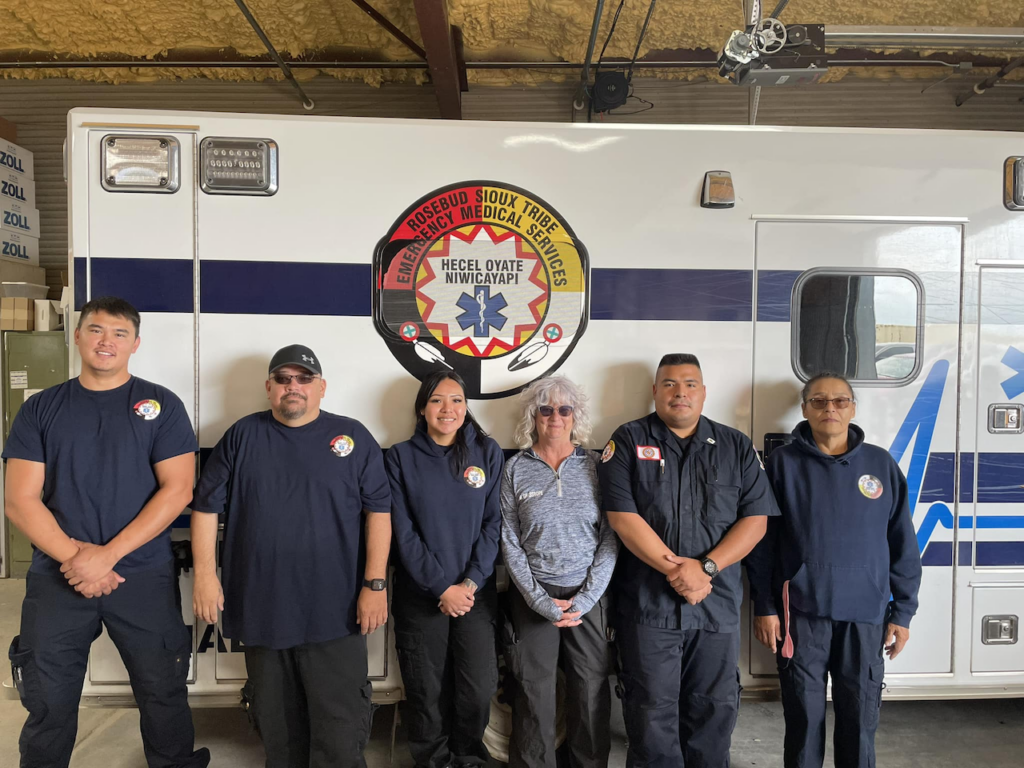
In South Dakota, the Rosebud Sioux Reservation covers a 1,900-square-mile area in the south-central part of the state.

State Rep. Eric Emery, a Democrat, is a paramedic and EMS director of the tribe’s sole ambulance station, providing services to 11,400 residents.

Emery and his colleagues respond to a variety of critical calls, from heart attacks to overdoses. They also provide care that people living on the reservation would otherwise get in the doctor’s office — if it didn’t take the whole day to travel to one. Those services might include taking blood pressure measurements, checking vital signs or making sure that a diabetic patient is taking their medicine properly.

Nevertheless, South Dakota is one of 37 states that doesn’t designate emergency medical services as essential, so the state isn’t required to provide or fund them.

While he and his staff are paid, remote parts of the reservation are often served by their respective county volunteer EMS agencies. It would simply take Emery’s crew too long — up to an hour — to arrive to a call.

“Something I wanted to tackle this year is to really look into making EMS an essential service here in South Dakota,” Emery said. “Being from such a conservative state that’s very conservative when it comes to their pocketbook, I know that’s probably going to be a really hard hill to climb.”

Ultimately, Wingrove said, officials need to value a profession that relies on volunteers to fill funding and staffing gaps.

“We’re looking for volunteers to make decisions about whether you live or die,” he said.

“Somehow, we have placed ourselves in a situation where the people that actually make those decisions are just not valued in the way they should be valued,” he said. “They’re not valued in the city budget, the county budget, the state budget, the federal budget system. They’re just not valued at all.”


Thought of the Day: On Unity

Firearm-related Injuries Cost US Healthcare $1B Annually

ttps://medcitynews.com/2023/04/gun-violence-healthcare-costs/?utm_medium=email&_hsmi=255846167&_hsenc=p2ANqtz-_dvFU0DOP4iOPFuqoTdvRwnXBSHTQJaXxK9BOrg5BQ0cQ_7PuWJ_KN4z0KqlHL0yQZCndlLTqNJEKp6soK6s2MU_0Z4w&utm_content=255846167&utm_source=hs_email

In just 2020, deaths from gun violence cost the U.S. healthcare system $290 million, or about $6,400 per patient, according to a report from the Commonwealth Fund. These costs are mostly covered by Medicaid and other government insurance programs.

The U.S. healthcare system sees about 30,000 inpatient hospital stays and 50,000 emergency room visits due to gun violence each year, leading to more than $1 billion in initial medical costs, according to a new analysis.

The Commonwealth Fund published these results last week and relied on three data sources for its analysis: the 2019 Global Burden of Disease study, the Small Arms Survey and the U.S. Government Accountability Office.

Even after leaving the hospital, patients are faced with challenges. A year after a gun injury, medical spending rises about $2,495 per person per month. In addition, those who suffer firearm injuries are more likely to form mental health challenges and substance use disorders.

“The impact of gun violence reaches far beyond the hospital room,” the analysis states.

Firearm-related deaths are increasing, according to the Centers for Disease Control and Prevention. In 2021, almost 49,000 Americans died from firearms, compared to 45,000 in 2020.

Additional findings from the report include:

  • In 2019, the U.S. had a higher rate of firearm deaths than any other country. Its rate of firearm deaths was almost five times as much as France, the second-highest country.
  • Eight times more people in the U.S. died from firearm violence in 2019 compared to Canada, the second-highest country.
  • More people died from self-harm by firearm in the U.S. than any other country in 2019, more than three times higher than France and Switzerland.
  • More women were killed by guns in the U.S. than any other country in 2019.
  • In the U.S., there are 67 million more firearms than people. That difference is higher than the population of the United Kingdom, which has 66.2 million people.
  • In the U.S., 52% of people who are admitted to hospitals for firearm injuries are Black, 29% are White, 14% are Hispanic and 5% are another race or ethnicity. Black Americans account for 50% of firearm injury hospital costs, while White Americans account for 27%, Hispanic Americans account for 17% and other races or ethnicities account for 6%.
  • About 48% of firearm-related inpatient hospital stays are in the American South, while 20% are in the Midwest, 20% are in the West and 12% are in the Northeast. The South accounts for 44% of firearm injury hospital costs, while the West accounts for 26%, the Midwest accounts for 18% and the Northeast accounts for 11%.

How can boards keep up with health system growth?

https://mailchi.mp/c6914989575d/the-weekly-gist-march-31-2023?e=d1e747d2d8

It feels like governance questions are coming to the fore in a lot of places these days, at least judging by several recent conversations we’ve had with health system CEOs. Probably not surprising, given the number of potential mergers and other partnerships under consideration.

As one CEO told us, growth by M&A raises particularly thorny issues for a not-for-profit system board. “Our governance structure grew out of a single hospital board, which was made up of community members and local physician leaders,” he told us. As the system acquired hospitals in adjacent markets, the combined board took on a representational character—each hospital had local stakeholders involved in governance. “Now we’re talking about merging with an out-of-state system, and our board suddenly seems way too parochial and unsophisticated. Everyone’s still asking what’s in it for their community.” That’s a frustration we hear frequently.

There are legitimate reasons why a tax-exempt community institution should have local representation on the board, advocating for local priorities and resources. But a larger, multi-state board must also oversee the entire portfolio of assets, and make trade-offs across markets, sometimes making decisions that favor one hospital over another.

The larger system board also has a greater need for sophistication, both on business and healthcare issues, as its members are often responsible for billions of dollars of assets. What frequently results from this tension is a nesting series of system and community boards, with varying degrees of accountability—a recipe for tangled, lengthy decision processes, and an enormous time-sink for senior system executives. We’re keeping our eye out for next-generation solutions to the governance question in healthcare—let us know what you’re seeing.

Has the backlash against physician employment begun?

https://mailchi.mp/d62b14db92fb/the-weekly-gist-february-10-2023?e=d1e747d2d8

Given the economic situation most hospitals face today, it was only a matter of time before we started to hear comments like we heard recently from a system CEO. 

“We’ve got to pump the brakes on physician employment this year,” she said. “This arms race with Optum and PE firms has gotten out of control, and we’re looking at almost $300K per year of loss per employed doc.”

 Of course, that system (like most) has been calling that loss a “subsidy” or an “investment” for the past several years, justified by the ability to pursue an integrated model of care and to grow the overall system book of business.

But with non-hospital competitors unfettered by the requirement to pay “fair market value” for physicians, the bidding war for doctors has become unsustainable for many hospitals. Around half of physicians are now employed by hospitals, with many more employed in other corporate settings.

There’s a growing sense that the pendulum has swung too far in the direction of employment, and now the phrase “stopping the bleed”—commonplace in the post-PhyCor days of the early 2000s—has begun to ring out again.
 
One challenge: finding ways to talk openly about “pumping the brakes” with the board, given that most systems have key physician stakeholders as part of their governance structure. Twice in the last month we’ve had CEOs ask us about reconfiguring their boards so that there are fewer doctors involved in governance—a sharp about-face from the “integration” narrative of just a few years ago.

It’s a tricky balance to strike. We recently heard a fascinating statistic that we’re working to verify: a third of all hospital CEO turnover in the last year was driven by votes of no-confidence by the medical staff. True or not, there’s no doubt that running afoul of physicians can be a career-limiting move for hospital executives, so if we’re about to enter an era of dialing back physician employment strategies, it’ll be fascinating to see how the conversations unfold. We’ll continue to keep an eye on this shift in direction and would love to know what you’re hearing as well, and to discuss how we might be of assistance in navigating what are sure to be a series of difficult choices.

MetroHealth fires CEO over more than $1.9M in unreported bonuses

The board of trustees at Cleveland-based MetroHealth System has fired President and CEO Akram Boutros, MD.

Dr. Boutros was fired Nov. 21 after the board received findings of a probe into compensation issues involving more than $1.9 million in supplemental bonuses, Vanessa Whiting, chair of the board, said in a statement posted on the health system’s website. The probe found that between 2018 and 2022, Dr. Boutros authorized the compensation for himself, without disclosure to the board.

“We have taken these actions mindfully and deliberately but with sadness and disappointment,” Ms. Whiting said. “We all recognize the wonderful things Dr. Boutros has done for our hospital and for the community. However, we know of no organization permitting its CEO to self-evaluate and determine their entitlement to an additional bonus and at what amount, as Dr. Boutros has done.”

Dr. Boutros took the helm of MetroHealth in 2013. Last year, Dr. Boutros announced his plans to retire at the end of 2022. In September, MetroHealth named Airica Steed, EdD, RN, its next president and CEO. Dr. Steed, who is executive vice president and system COO of Sinai Chicago Health System, will take the helm of MetroHealth Dec. 5, according to Ms. Whiting’s statement. Meanwhile, Nabil Chehade, MD, executive vice president and chief clinical transformation officer at MetroHealth, will assume the CEO’s duties on an interim basis.

Ms. Whiting said MetroHealth discovered the compensation issues related to Dr. Boutros while preparing for the CEO transition, and an internal investigation took place, led by the Tucker Ellis law firm.

She said Dr. Boutros admitted to conducting self-assessments of his performance under specific metrics he established and authorizing payment to himself of more than $1.9 million in supplemental bonuses between 2018 and 2022.

According to Ms. Whiting, Dr. Boutros repaid more than $2.1 million in October, representing the supplemental bonus money paid without board approval for performance in calendar years 2017 through 2021, plus more than $124,000 in interest.

She said the board has also implemented immediate CEO spending and hiring limitations through Dec. 31, 2022, and Dr. Boutros has self-reported to the Ohio Ethics Commission.

MetroHealth’s internal investigation is ongoing.

Among Dr. Boutros’ accomplishments at MetroHealth were helping annual revenue increase from $785 million to more than $1.5 billion; growing the health system’s workforce from 6,200 to nearly 8,000 while seeing employee minimum wage increase to $15 per hour; and developing Ohio’s only Ebola treatment center.

The Other Machiavelli: Finding lessons for leaders in a lesser-known work by the Florentine political philosopher

However cynical it may seem, Machiavelli’s The Prince has long been recognized as a source of insights for anyone trying run a business or gain power in one. A ferocious little treatise of under 100 pages, The Prince was aimed at Lorenzo de’ Medici, the iron-handed Florentine ruler, by an author hoping to regain the proximity to power that he formerly enjoyed.

But modern corporations aren’t principalities ruled by autocrats. They are, in fact, more like republics, their leaders dependent on the support of directors, employees, customers, investors, and one another. That is why, in turning to Machiavelli for management wisdom, we would be well served to leave aside The Prince in favor of another of his works, one that is less known but perhaps more to the point. Don’t be fooled by the academic-sounding title; Discourses on Livy has a great deal to teach us about leadership in any organization resembling a republic. Chances are, that includes your business.

Published posthumously in 1531, Discourses draws on the ancient Roman historian (among others) to analyze the nature of power in public life. Like The Prince, this is not a handbook for saints. But the author was a brilliant student of human nature, and not one to underestimate the potential of a determined individual. In Discourses, he firmly asserts the importance of an individual founder in establishing or renovating a republic—and by extension, for our purposes, a business. A prudent founder, he writes, “must strive to assume sole authority.”

Yet a single person cannot sustain an enterprise in the long run. That is only possible if the founder’s vision and talents result in an institution supported by stakeholders who can carry the venture into the future. “Kingdoms which depend only upon the exceptional ability of a single man are not long enduring,” Machiavelli writes, “because such talent disappears with the life of the man, and rarely does it happen to be restored in his successor.”

Besides, princes have no monopoly on wisdom. Despite the notorious unpredictability of the mob, the author acknowledged the wisdom of crowds when he asserted that “the multitude is wiser and more constant than a prince.” Machiavelli was also insightful about succession: “After an excellent prince, a weak prince can maintain himself,” he observed with admirable economy in one chapter’s epigraph, “but after a weak prince, no kingdom can be maintained with another weak one.”

Many of the epigraphs are bull’s-eyes of this kind. Take this one, for example: “Whoever wishes to reform a long-established state in a free city should retain at least the appearance of its ancient ways.” This is worth doing even if you make massive changes, because, Machiavelli notes, “men in general live as much by appearances as by realities; indeed, they are often moved more by things as they appear than by things as they really are.”

Honesty may be the best policy, but that is not a maxim ever attributed to Machiavelli. In keeping with the notion that people attend largely to appearances, he says leaders compelled to do something by necessity should consider pretending their course of action was undertaken out of generosity. In another chapter, he argues, “Cunning and deceit will serve a man better than force to rise from a base condition to great fortune.”

Machiavelli, of course, took a hard-headed view of humanity, believing that people act largely out of self-interest, whether to gratify their egos or sate their desire for material wealth, and that, for better or worse, actions tend to be judged by their consequences. Indeed, he was very much what philosophers call a consequentialist, arguing that, in some contexts, bad things must be done to achieve good ends achievable in no other way. This is not to say that law-breaking or other unethical acts are justified—even some of Machiavelli’s contemporaries considered such advice controversial—but every business leader knows that hard decisions must be made, be it the closing of a venerable division or taking a company in a risky new direction, for the long-term good of the enterprise.

Even when advocating something like mercy, Machiavelli did so with consequences in mind. He argued, for example, that failure should not be harshly punished, especially if it arises from ignorance rather than malice. Roman generals, he notes, had difficult and dangerous jobs, and Rome understood that if military leaders had to worry about “examples of Roman commanders who had been crucified or otherwise put to death when they had lost a day’s battles, it would be impossible for that commander, beset by so many suspicions, to make courageous decisions.”

If punishment should not be meted out lightly, neither should rewards be delayed. If you don’t cultivate loyalty and support from others in good times through open-handedness, Machiavelli says, those people certainly won’t have your back when things get rough. Doling out rewards only in the face of tough competition or harsh circumstances will lead subordinates to believe “that they gained this favour not from you but from your adversaries, and since they must fear that after the danger has passed you will take back from them what you have been forced to give them, they will feel no obligation to you whatsoever.”

Republics, in his view, have no choice but to grow, for “it is impossible for a republic to succeed in standing still.” Companies are the same. But acquisitions—whether in battle or by purchase—must be carried out with care, for “conquests made by republics which are not well organized, and which do not proceed according to Roman standards of excellence, bring about their ruin rather than their glorification.”

Finally, Machiavelli was well aware of the risks of advice-giving, so much so that he gave one chapter the title “Of the danger of being prominent in counselling any enterprise, and how that danger increases with the importance of such enterprise.” Consultants, take note. Just don’t let the clients catch you reading Machiavelli.

The less-discussed consequence of healthcare’s labor shortage

How Could You Be Affected by the Healthcare Labor Shortage? - Right Way  Medical

The healthcare industry’s staffing shortage crisis has had clear consequences for care delivery and efficiency, forcing some health systems to pause nonemergency surgeries or temporarily close facilities. Less understood is how these shortages are affecting care quality and patient safety. 

A mix of high COVID-19 patient volume and staff departures amid the pandemic has put hospitals at the heart of a national staffing shortage, but there is little national data available to quantify the shortages’ effects on patient care. 

The first hint came last month from a CDC report that found healthcare-associated infections increased significantly in 2020 after years of steady decline. Researchers attributed the increase to challenges related to the pandemic, including staffing shortages and high patient volumes, which limited hospitals’ ability to follow standard infection control practices. 

“That’s probably one of the first real pieces of data — from a large scale dataset — that we’ve seen that gives us some sense of direction of where we’ve been headed with the impact of patient outcomes as a result of the pandemic,” Patricia McGaffigan, RN, vice president of safety programs for the Institute for Healthcare Improvement, told Becker’s. “I think we’re still trying to absorb much of what’s really happening with the impact on patients and families.”

An opaque view into national safety trends

Because of lags in data reporting and analysis, the healthcare industry lacks clear insights into the pandemic’s effect on national safety trends.

National data on safety and quality — such as surveys of patient safety culture from the Agency for Healthcare Research and Quality — can often lag by several quarters to a year, according to Ms. McGaffigan. 

“There [have been] some declines in some of those scores more recently, but it does take a little while to be able to capture those changes and be able to put those changes in perspective,” she said. “One number higher or lower doesn’t necessarily indicate a trend, but it is worth really evaluating really closely.”

For example, 569 sentinel events were reported to the Joint Commission in the first six months of 2021, compared to 437 for the first six months of 2020. However, meaningful conclusions about the events’ frequency and long-term trends cannot be drawn from the dataset, as fewer than 2 percent of all sentinel events are reported to the Joint Commission, the organization estimates.

“We may never have as much data as we want,” said Leah Binder, president and CEO of the Leapfrog Group. She said a main area of concern is CMS withholding certain data amid the pandemic. Previously, the agency has suppressed data for individual hospitals during local crises, but never on such a wide scale, according to Ms. Binder.  

CMS collects and publishes quality data for more than 4,000 hospitals nationwide. The data is refreshed quarterly, with the next update scheduled for October. This update will include additional data for the fourth quarter of 2020.

“It is important to note that CMS provided a blanket extraordinary circumstances exception for Q1 and Q2 2020 data due to the COVID-19 pandemic where data was not required nor reported,” a CMS spokesperson told Becker’s. “In addition, some current hospital data will not be publicly available until about July 2022, while other data will not be available until January 2023 due to data exceptions, different measure reporting periods and the way in which CMS posts data.”

Hospitals that closely monitor their own datasets in more near-term windows may have a better grasp of patient safety trends at a local level. However, their ability to monitor, analyze and interpret that data largely depends on the resources available, Ms. McGaffigan said. The pandemic may have sidelined some of that work for hospitals, as clinical or safety leaders had to shift their priorities and day-to-day activities. 

“There are many other things besides COVID-19 that can harm patients,” Ms. Binder told Becker’s. “Health systems know this well, but given the pandemic, have taken their attention off these issues. Infection control and quality issues are not attended to at the level of seriousness we need them to be.”

What health systems should keep an eye on 

While the industry is still waiting for definitive answers on how staffing shortages have affected patient safety, Ms. Binder and Ms. McGaffigan highlighted a few areas of concern they are watching closely. 

The first is the effect limited visitation policies have had on families — and more than just the emotional toll. Family members and caregivers are a critical player missing in healthcare safety, according to Ms. Binder. 

When hospitals don’t allow visitors, loved ones aren’t able to contribute to care, such as ensuring proper medication administration or communication. Many nurses have said they previously relied a lot on family support and vigilance. The lack of extra monitoring may contribute to the increasing stress healthcare providers are facing and open the door for more medical errors.

Which leads Ms. Binder to her second concern — a culture that doesn’t always respect and prioritize nurses. The pandemic has underscored how vital nurses are, as they are present at every step of the care journey, she continued. 

To promote optimal care, hospitals “need a vibrant, engaged and safe nurse workforce,” Ms. Binder said. “We don’t have that. We don’t have a culture that respects nurses.” 

Diagnostic accuracy is another important area to watch, Ms. McGaffigan said. Diagnostic errors — such as missed or delayed diagnoses, or diagnoses that are not effectively communicated to the patient — were already one of the most sizable care quality challenges hospitals were facing prior to the pandemic. 

“It’s a little bit hard to play out what that crystal ball is going to show, but it is in particular an area that I think would be very, very important to watch,” she said.

Another area to monitor closely is delayed care and its potential consequences for patient outcomes, according to Ms. McGaffigan. Many Americans haven’t kept up with preventive care or have had delays in accessing care. Such delays could not only worsen patients’ health conditions, but also disengage them and prevent them from seeking care when it is available. 

Reinvigorating safety work: Where to start

Ms. McGaffigan suggests healthcare organizations looking to reinvigorate their safety work go back to the basics. Leaders should ensure they have a clear understanding of what their organization’s baseline safety metrics are and how their safety reports have been trending over the past year and a half.

“Look at the foundational aspects of what makes care safe and high-quality,” she said. “Those are very much linked to a lot of the systems, behaviors and practices that need to be prioritized by leaders and effectively translated within and across organizations and care teams.”

She recommended healthcare organizations take a total systems approach to their safety work, by focusing on the following four, interconnected pillars:

  • Culture, leadership and governance
  • Patient and family engagement
  • Learning systems
  • Workforce safety

For example, evidence shows workforce safety is an integral part of patient safety, but it’s not an area that’s systematically measured or evaluated, according to Ms. McGaffigan. Leaders should be aware of this connection and consider whether their patient safety reporting systems address workforce safety concerns or, instead, add on extra work and stress for their staff. 

Safety performance can slip when team members get busy or burdensome work is added to their plates, according to Ms. McGaffigan. She said leaders should be able to identify and prioritize the essential value-added work that must go on at an organization to ensure patients and families will have safe passage through the healthcare system and that care teams are able to operate in the safest and healthiest work environments.

In short, leaders should ask themselves: “What is the burdensome work people are being asked to absorb and what are the essential elements that are associated with safety that you want and need people to be able to stay on top of,” she said.

To improve both staffing shortages and quality of care, health systems must bring nurses higher up in leadership and into C-suite roles, Ms. Binder said. Giving nurses more authority in hospital decisions will make everything safer. Seattle-based Virginia Mason Hospital recently redesigned its operations around nurse priorities and subsequently saw its quality and safety scores go up, according to Ms. Binder. 

“If it’s a good place for a nurse to go, it’s a good place for a patient to go,” Ms. Binder said, noting that the national nursing shortage isn’t just a numbers game; it requires a large culture shift.

Hospitals need to double down on quality improvement efforts, Ms. Binder said. “Many have done the opposite, for good reason, because they are so focused on COVID-19. Because of that, quality improvement efforts have been reduced.”

Ms. Binder urged hospitals not to cut quality improvement staff, noting that this is an extraordinarily dangerous time for patients, and hospitals need all the help they can get monitoring safety. Hospitals shouldn’t start to believe the notion that somehow withdrawing focus on quality will save money or effort.  

“It’s important that the American public knows that we are fighting for healthcare quality and safety — and we have to fight for it, we all do,” Ms. Binder concluded. “We all have to be vigilant.”

Conclusion

The true consequences of healthcare’s labor shortage on patient safety and care quality will become clear once more national data is available. If the CDC’s report on rising HAI rates is any harbinger of what’s to come, it’s clear that health systems must place renewed focus and energy on safety work — even during something as unprecedented as a pandemic. 

The irony isn’t lost on Ms. Binder: Amid a crisis driven by infectious disease, U.S. hospitals are seeing higher rates of other infections.  

“A patient dies once,” she concluded. “They can die from COVID-19 or C. diff. It isn’t enough to prevent one.”