GOP floats Medicare changes while ducking details

https://www.axios.com/2022/11/03/gop-floats-medicare-reform

Some House Republicans aren’t waiting for the election to think about overhauling Medicare. But it’s hard to tell if there are specifics behind the talking point.

Why it matters: Past GOP attempts to cut Medicare landed with a thud, and Democrats in recent weeks have been hammering on the message that Republicans are intent on gutting the program.

  • The critical moment could be next year’s talks on the debt ceiling, if Republicans flip one or both houses of Congress.

What they’re saying: “If we’re going raise the debt ceiling, we can’t just raise it without focusing on some way to address the debt and the deficit,” Rep. Bruce Westerman (R-Ark.), a member of the House GOP’s health care task force, told Axios, adding Medicare should be made “sustainable over time.”

  • “We’re going to have a lot of hearings on this,” Rep. Jason Smith (R-Mo.), the current top Republican on the Budget Committee who wants to move up to chairman of Ways and Means, told Axios. “I’m not going to get into the inner details.”
  • “Everything is on the table, we haven’t really nailed down any specific policies one way or the other,” Rep. Buddy Carter (R-Ga.), who is running to chair the House Budget panel. “I think it could be wrapped up with that [debt ceiling talks], that’s shaping up to be pretty dynamic.”

Yes, but: Not all Republicans are eager to kick off their time in the majority with another grinding health care fight against a Democratic president. Health policy experts are also skeptical of how realistic Medicare reform may be, recalling failed GOP agendas from the pre-Trump years.

  • Senate GOP Leader Mitch McConnell (R-Ky.) earlier this year rebuked a plan from Sen. Rick Scott (R-Fla.) that would sunset all federal legislation every five years — including entitlement programs. McConnell told reporters a plan that “sunsets Social Security and Medicare within five years … will not be part of the Republican Senate majority agenda.”
  • House GOP Leader Kevin McCarthy (R-Calif.) raised eyebrows when he told Punchbowl News last month that he wouldn’t “predetermine” if Medicare and Social Security would be involved in talks on raising the debt ceiling. McCarthy later tried to clarify in a CNBC interview that “I never mentioned Social Security or Medicare.”
  • Joseph Antos, a senior fellow and health care scholar at the American Enterprise Institute, puts the odds of Medicare reform as “pretty unlikely,” adding, “I don’t see any major changes happening over the next two years, and I think Republicans might wait to see what Medicare policies the Republican presidential candidate will push.”

The big picture: While a GOP Medicare push is not certain, Democrats are seizing on the possibility.

  • “They’re coming after your Social Security and Medicare in a big way,” President Biden said Tuesday in a speech in Florida, saying Republicans would create “chaos” by risking government default over demands to raise the debt limit next year.

Between the lines: Republicans are not being specific about the changes they would push. But there’s a limited universe of possibilities.

  • The proposed budget of the Republican Study Committee, an influential group of House Republicans, includes proposals like raising the Medicare eligibility age to 67 to align with Social Security, and converting Medicare to a “premium support” system where seniors received a subsidy they could use on private plans competing against traditional Medicare.
  • Tricia Neuman, a Medicare expert at the Kaiser Family Foundation, said such a policy would have “uneven” results, where “some could save money but others might have to pay a whole lot more.”
  • Other GOP-backed Medicare changes are less partisan, like “site neutral” reforms to pay hospital outpatient departments the same rates as doctors’ offices, though hospitals oppose those measures.
  • The Committee for a Responsible Federal Budget, recently issued a fiscal blueprint to reduce the budget deficit, which included reforms such as changing Medicare provider payments, benefit design and payroll taxes, but included nothing about changing eligibility requirements.

The bottom line: Republicans point to the Medicare trust fund’s projected insolvency date in 2028 to argue change is needed to make the program sustainable. But any change is hard, and cuts that hit beneficiaries are not the only way to seek savings.

  • “McCarthy won’t shoot down talk of addressing debt because it matters to him and his caucus, and you can’t do debt without entitlement reform, but he knows at this point there’s no interest from Democrats, and any entitlement reform will require serious political capital from Ds and Rs,” said a former GOP leadership aide. “The last time those conversations happened in a meaningful way was in 2011.”

An overhaul for Medicare’s pay transformation program

The Biden administration is trying to jump start a Medicare program that pays health providers based on patient outcomes rather than by how many services they perform.

Why it matters: The alternative payment effort was created through the Affordable Care Act, but participation has plateaued since 2018 amid waning interest from providers.

Driving the news: The Biden administration finalized an overhaul of the initiative, known as the Medicare Shared Savings Program, on Tuesday. Changes include offering groups of providers in rural and other underserved areas upfront payments to help them start out in the program.

  • The rule includes other provisions to make it less financial risky for provider groups to join, and makes it easier for participants to earn money back from the government year after year — a central perk of joining the program.

Zoom out: Medicare traditionally pays on a “fee-for-service” basis pegged to the number of patients seen and volume of procedures performed.

  • But one of the main funding sources for Medicare is set to run dry in 2028 if the federal government doesn’t make changes. Advocates say the solution at least partially lies in value-based care programs, like the Shared Savings Program.
  • Under the program, doctors, hospitals and other providers join form groups known as accountable care organizations. ACOs take responsibility for the care of a set of traditional Medicare patients.
  • If ACOs reduce total care costs for their members, they can get back a portion of that savings from the government. ACOs at more advanced stages of the program must pay the government back if total patient spending crosses a threshold.

By the numbers: ACOs have saved the federal government more than $17 billion since 2012, according to the National Association of Accountable Care Organizations.

  • In 2022, 483 ACOs participated in the program and took care of more than 11 million Medicare enrollees. But that’s down from 517 ACOs participating in 2020.
  • CMS set a goal last year to bring all 63 million-plus Medicare beneficiaries into a value-based care model by 2030. ACOs are a key player in achieving the goal.

Go deeper: Providers and value-based care advocates are also pushing Congress to extend a 5% pay bump for providers that participate in advanced alternative payment models, including some tracks of the Medicare Shared Savings Program. The bonus expires Dec. 31.

  • “If the bonus is not continued, it will soften or dampen the momentum toward alternative payment models, because it would create this mentality, or the view, that we’re not serious about that transformation,” said Mara McDermott, vice president at McDermott+Consulting and executive director of the Value Based Care Coalition.
  • Losing the bonus would also make it harder to recruit new providers into alternative payment models, she added.
  • The American Medical Association and five other health care groups launched a separate coalition Tuesday to rally around an extension of the 5% bonus.
  • “Patients and the healthcare system in the United States quite literally cannot afford to return to the days before Medicare incentivized healthcare providers for generating good results,” Clif Gaus, CEO of the National Association of ACOs, said in a news release about the coalition.

Also notable: The rule finalized Tuesday outlines physician payment rates for 2023. Interventional radiologists and vascular surgeons will see the largest Medicare cuts among physician specialties next year, though the final cuts are slightly lower than what CMS proposed in July.

  • Congress could stave off the cuts when they come back to Washington later this month.
  • “The Medicare payment schedule released today puts Congress on notice that a nearly 4.5 percent across-the-board reduction in payment rates is an ominous reality unless lawmakers act before Jan. 1,” American Medical Association President Jack Resneck said in a statement.
  • CMS finalized a slew of other policy proposals Tuesday, including provisions to reduce barriers to behavioral health care.

The next health care wars are about costs

All signs point to a crushing surge in health care costs for patients and employers next year — and that means health care industry groups are about to brawl over who pays the price.

Why it matters: The surge could build pressure on Congress to stop ignoring the underlying costs that make care increasingly unaffordable for everyday Americans — and make billions for health care companies.

[This special report kicks off a series to introduce our new, Congress-focused Axios Pro: Health Care, coming Nov. 14.]

  • This year’s Democratic legislation allowing Medicare to negotiate drug prices was a rare case of addressing costs amid intense drug industry lobbying against it. Even so, it was a watered down version of the original proposal.
  • But the drug industry isn’t alone in its willingness to fight to maintain the status quo, and that fight frequently pits one industry group against another.

Where it stands: Even insured Americans are struggling to afford their care, the inevitable result of years of cost-shifting by employers and insurers onto patients through higher premiums, deductibles and other out-of-pocket costs.

  • But employers are now struggling to attract and retain workers, and forcing their employees to shoulder even more costs seems like a less viable option.
  • Tougher economic times make patients more cost-sensitive, putting families in a bind if they get sick.
  • Rising medical debt, increased price transparency and questionable debt collection practices have rubbed some of the good-guy sheen off of hospitals and providers.
  • All of this is coming to a boiling point. The question isn’t whether, but when.

Yes, but: Don’t underestimate Washington’s ability to have a completely underwhelming response to the problem, or one that just kicks the can down the road — or to just not respond at all.

Between the lines: If you look closely, the usual partisan battle lines are changing.

  • The GOP’s criticism of Democrats’ drug pricing law is nothing like the party’s outcry over the Affordable Care Act, and no one seriously thinks the party will make a real attempt to repeal it.
  • One of the most meaningful health reforms passed in recent years was a bipartisan ban on surprise billing, which may provide a more modern template for health care policy fights.
  • Surprise medical bills divided lawmakers into two teams, but it wasn’t Democrats vs. Republicans; it was those who supported the insurer-backed reform plan vs. the hospital and provider-backed one. This fight continues today — in court.

The bottom line: Someone is going to have to pay for the coming cost surge, whether that’s patients, taxpayers, employers or the health care companies profiting off of the system. Each industry group is fighting like hell to make sure it isn’t them.

Affordable Care Act (ACA)’s required coverage of preventive care services in further jeopardy

https://mailchi.mp/f1c5ab8c3811/the-weekly-gist-october-28-2022?e=d1e747d2d8

The plaintiffs in Braidwood v. Becerra filed a motion on Monday asking a US District Court judge in Texas—the same judge who ruled the entire ACA unconstitutional in 2018—to block enforcement of the ACA’s no-cost requirement for preventive care services. This judge already sided with the plaintiffs in September, ruling the government cannot require a company to fully cover preventive HIV drugs, also known as PrEP therapy, for its employees, on the grounds that doing so violates owners’ religious freedom.

In that ruling, the judge also asserted that the government’s system for deciding what preventive care services should be covered under the ACA is unconstitutional. This latest motion now asks him to invalidate all parts of the ACA requiring preventive health services on the grounds that the Preventive Services Task Force was never appointed by Congress, and thus lacks the authority to say which services insurers must cover. The final ruling is expected early next year, after which the case will certainly be appealed, regardless of outcome. 

The Gist: Given the judge’s initial ruling in Braidwood last month, this motion from the plaintiffs was expected. While the US Supreme Court reversed a 2018 ruling by this judge that struck down the entire ACA, it could potentially find the narrow targeting of this case more reasonable, making preventive care coverage optional for employers. 

If that happens, millions of Americans would once again have to pay for some of the most common and highest-value healthcare services, including screening tests for a variety of cancers, sexually transmitted infections, and diabetes. That additional financial burden, along with likely tightening of health plan benefit designs, would create barriers to access and exacerbate health disparities.

Where do patients go when hospitals shut down capacity?

https://mailchi.mp/f1c5ab8c3811/the-weekly-gist-october-28-2022?e=d1e747d2d8

Last week we met the CEO of the flagship hospital of a large academic health system. Like nearly every hospital, they are challenged in finding the staff they need to keep the hospital running at full capacity. Keeping all the hospital’s units open has been critical: “Over the past three months, we have been busting at the seams…more patients, and they’re sicker. And we’re not even really into flu season yet.” We asked what had changed, given that summer usually is lighter than other seasons for hospital admissions. 

His diagnosis: local community hospitals, also strapped for staff, had begun to regularly shut down units to keep premium labor spend in check. “If they’re not running at full capacity, the patients still have to go somewhere. Given that we’re both the quaternary care provider and the community’s safety net, they’re coming downtown to us. We don’t have the luxury to shut down.” The system had to ramp up agency nursing to accommodate the demand, leading to a sharp rise in labor costs.

This CEO wasn’t backing away from the system’s mission, and vowed to expand capacity as much as they could, but felt that policymakers and payers needed to understand the dynamics in the market: “We’re getting criticized for not being able to control our costs, despite the fact that we’re absorbing what other hospitals can’t handle.” As we head into winter, flu will surely spike, and another COVID surge is possible—the hospitals at the top of the “care chain” will become even more strained in their mission to accommodate their communities’ needs. 

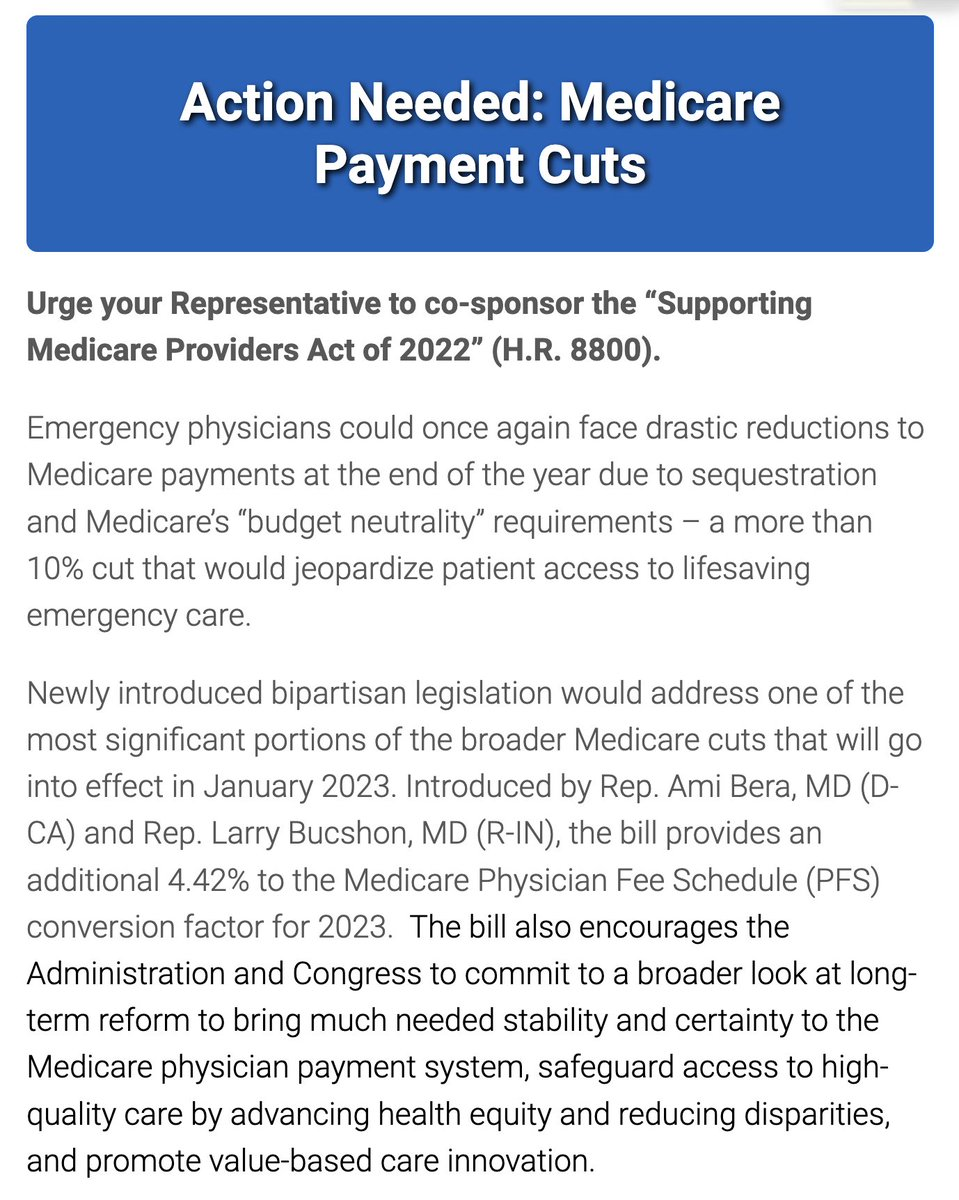
H.R.8800 – Supporting Medicare Providers Act of 2022

Due to the ongoing recess leading to the midterm elections, very important legislation introduced in September, H.R. 8800 – Supporting Medicare Providers Act of 2022, has stalled.

This critical, bipartisan legislation would stabilize Medicare for physicians and patients because it:

  1. Stops the 4.42% of the Medicare cuts related to the budget neutrality adjustment in the Medicare Physician Fee Schedule (MPFS), helping to buoy physician practices that are still recovering from the pandemic;
  2. Protects patients access to care, particularly in underserved communities; and
  3. Provides a commitment to long-term Medicare payment reform.

Poll: Voters may cross party lines for lower health care costs

https://www.axios.com/2022/10/20/midterm-election-voters-health-care

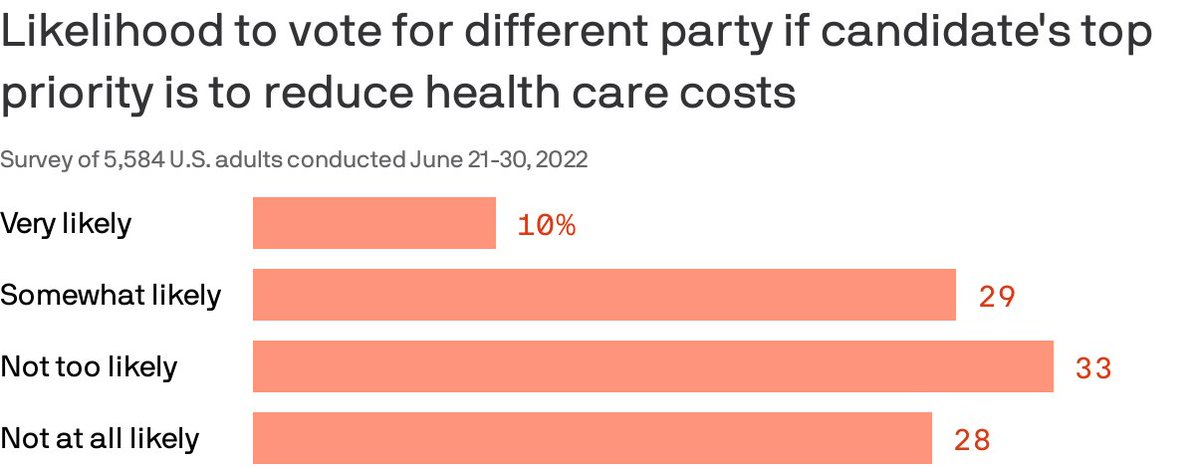
Almost 40% of Americans are willing to split their ticket and vote for a candidate from the opposing party who made a top priority of lowering health costs, according to a Gallup/West Health poll published Thursday.

Why it matters: Though candidates haven’t been talking much about medical costs in the run-up to the midterms, the issue remains enough of a priority that it could erode straight party-line voting.

By the numbers: 87% of Americans polled said a candidate’s plan to reduce the cost of health care services was very or somewhat important in casting a vote.

  • The issue cut across partisan lines, with 96% of Democrats and 77% of Republican respondents saying a candidate with a health care costs plan was an important factor.
  • 86% also said a plan to lower prescription drug prices is very or somewhat important. That’s especially true for seniors.

Of note: Democratic voters were more likely than Republicans to say they would cross party lines because health costs are a top priority. Four in 10 Democrats said they were likely to do so compared to about 1 in 5 Republicans.

 Federal Public Health Emergency (PHE) Extended

https://mailchi.mp/tradeoffs/research-corner-5267789?e=ad91541e82

Earlier this month, the Biden administration officially extended the federal public health emergency (PHE) declaration it had set in place for COVID-19. That means the PHE provisions will stay in effect for another 90 days — until mid-January at least.

When the PHE does end, a number of rules developed in response to the pandemic will sunset. One of those is a provision that temporarily requires states to let all Medicaid beneficiaries remain enrolled in the program — even if they have become ineligible during the pandemic.

Estimates suggest that millions could lose Medicaid coverage when this emergency provision ends. Among those who would lose coverage because they are no longer eligible for the program, about one-third are expected to qualify for subsidized coverage on the Affordable Care Act (ACA) marketplaces. Most others are expected to get coverage through an employer. It remains an open question, though, how many people will successfully transition to these other plans. 

recent paper by health economics researcher Laura Dague and colleagues in the Journal of Health Politics, Policy, and Law sheds light on these dynamics. The authors used a prior change in eligibility in Wisconsin’s Medicaid program to estimate how many people successfully transitioned to a private plan when their Medicaid eligibility ended.

Wisconsin’s Medicaid program is unique. Back in 2008 — before the ACA passed — Wisconsin broadly expanded Medicaid eligibility for non-elderly adults. After the ACA came into effect, Wisconsin reworked its Medicaid program in a way that made about 44,000 adults (mostly parents) with incomes above the federal poverty line ineligible for the program. To remain insured, they would have to switch to private coverage (via Obamacare or an employer). 

Using data from the Wisconsin All-Payer Claims Database (APCD), the researchers found that:

  • Only about one-third of those 44,000 people had definitely enrolled in private coverage within two months of exiting the Medicaid program.
     
  • The remaining two-thirds of people were uninsured or their insurance status couldn’t be determined.
     
  • Even using the most optimistic assumptions to fill in that missing insurance status data, the authors estimated only up to 42% of people might have had private coverage within three months.
     
  • Nearly 1 in 10 enrollees had re-entered Medicaid coverage within six months, possibly due to fluctuations in household income. 

This paper has several limitations. Health insurers are not required to participate in Wisconsin’s APCD, so the authors may not be capturing all successful transitions from Medicaid to private insurance. The paper also does not distinguish between different types of private insurance: Some coverage gains may have resulted from employer-based insurance rather than the ACA marketplace. 

Still, the findings suggest that when a large number of Wisconsin residents lost Medicaid eligibility in 2014, many were not able to transition from Medicaid to private coverage. Wisconsin’s experience can help us understand what might happen when the national public health emergency ends and Medicaid programs resume removing people from their rolls.

Still a long way away from real “value” 

https://mailchi.mp/cd392de550e2/the-weekly-gist-october-21-2022?e=d1e747d2d8

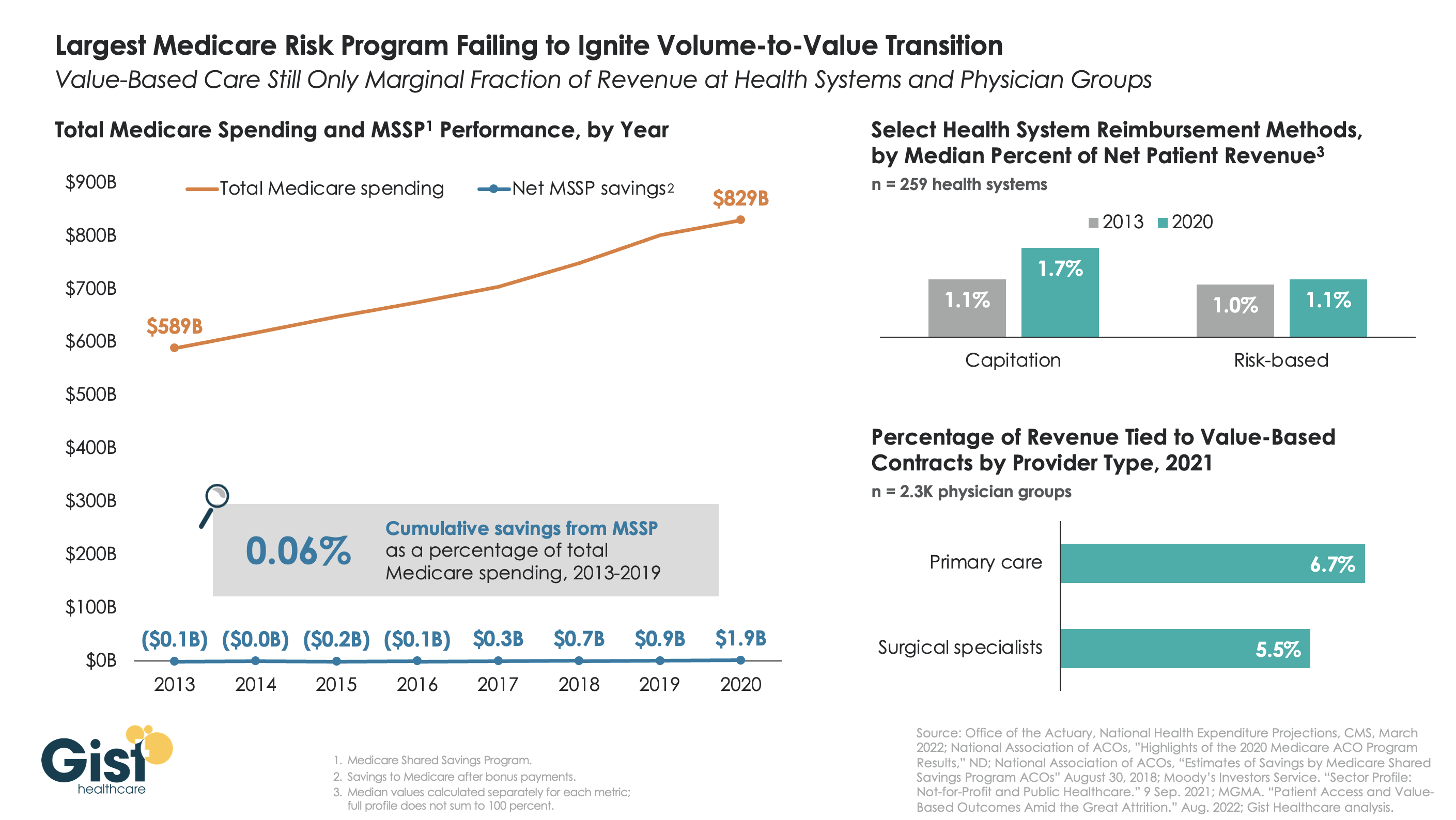
The belief that healthcare should, and would, transition from “volume to value” was a key pillar of the Affordable Care Act (ACA). However, with more than a decade of experience and data to consider, there is little indication that either Medicare or the healthcare industry at large has meaningfully shifted away from fee-for-service payment. Using data from the National Association of Accountable Care Organizations, the graphic below shows that the Medicare Shared Savings Program (MSSP)—the largest of the ACA’s payment innovations, with over 500 accountable care organizations (ACOs) reaching 11M assigned beneficiaries—has led to minimal savings for Medicare. In its first eight years, MSSP saved Medicare only $3.4B, or a paltry 0.06 percent, of the $5.6T that it spent over that time.  
 
Policymakers had hoped that a Medicare-led move to value would prompt commercial payers to follow suit, but that also hasn’t happened. The proportion of payment to health systems in capitated or other risk-based arrangements barely budged from 2013 to 2020—remaining negligible for most organizations, and rarely amounting to enough to influence strategy. The proportion of risk-based payment for doctors is slightly higher, but still far below what is needed to enable wholesale change in care across a practice.

While Medicare has other options if it wants to increase value-based payment, like making ACOs mandatory, it’s harder to see how the trend in commercial payment will improve, as large payers, who are buying up scores of care delivery assets themselves, seem to have little motivation to deal providers in on risk. 

While financial upside of moving to risk hasn’t been significant enough to move the market to date, we aren’t suggesting health systems throw out their population management playbook—to meet mounting cost labor pressures, systems must deliver lower cost care, in lower cost settings, with lower cost staff, just to maintain economic viability moving forward.

Insurers under fire for Medicare Advantage billing practices

https://mailchi.mp/4587dc321337/the-weekly-gist-october-14-2022?e=d1e747d2d8

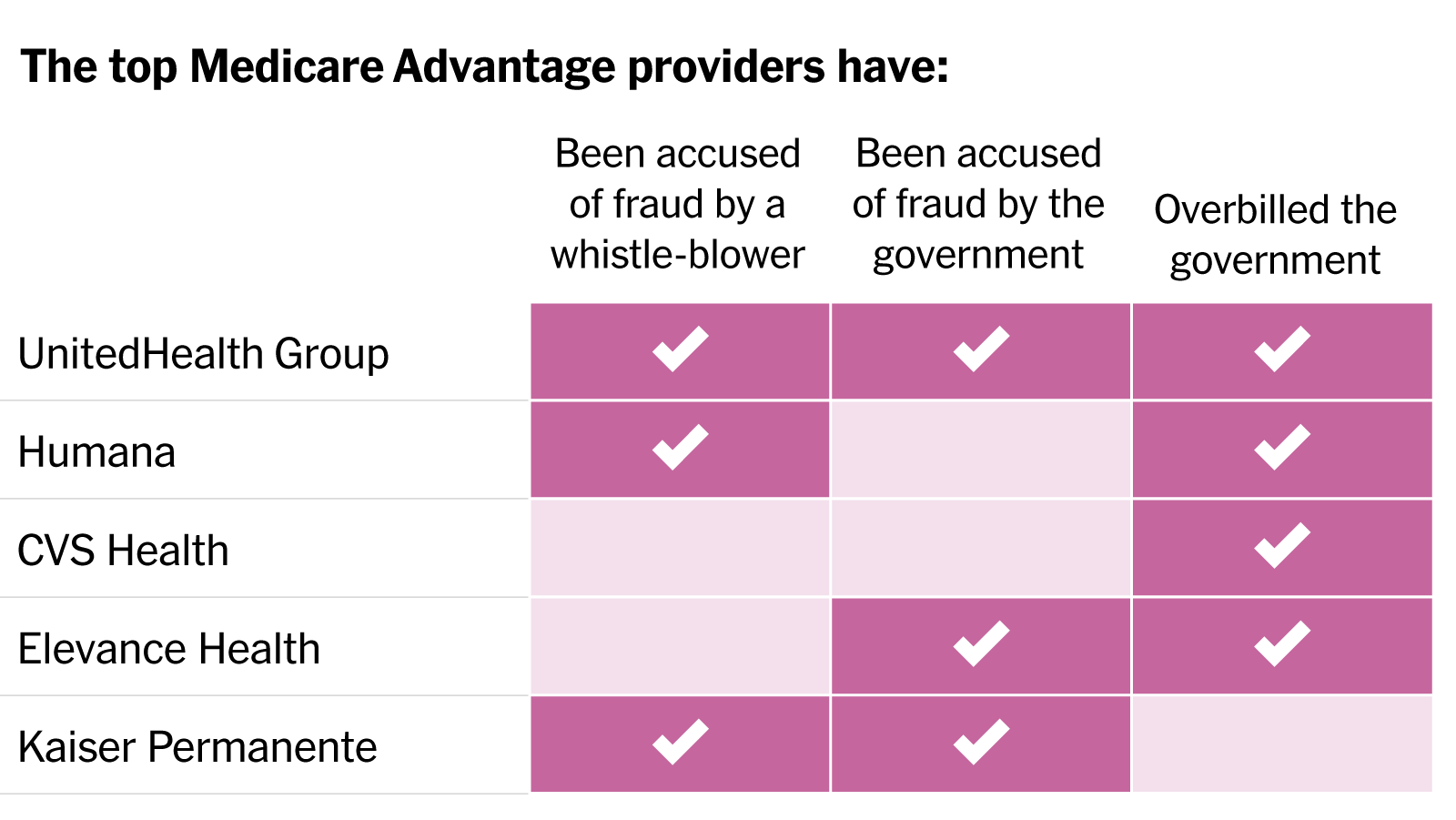
 In a blistering article published in the New York Times, reporters Reed Abelson and Margot Sanger-Katz detail widespread fraud allegations involving the nation’s largest MA insurers. Nine of the ten largest plans have been accused by the government of fraud or overbilling, generally for upcoding practices that exaggerate the disease burden among their beneficiaries, without providing them more care. Insurers have disputed most allegations, and regulators have been slow to punish known infractions. As a growing steam of seniors continue the enter the program, aggressive risk adjustment has significantly increased the government’s costs. The Centers for Medicare and Medicaid Services has yet to reduce payments in response to overbilling, despite having the power to do so.

The Gist: While these practices were well known to many in the healthcare industry, MA’s growth—set to overtake traditional Medicare enrollment next year—has added a spotlight worthy of national attention. While many beneficiaries report being satisfied with their MA benefits, the program was also intended to improve the cost efficiency of senior care.

With payers gaming the system to garner record profits, the government has seen higher per-enrollee spending in MA compared to traditional Medicare. There are some signs that the strings are starting to tighten for insurers, as many of the largest are losing Medicare star bonuses in 2023, impacting both plan revenue and ability to market throughout the year. However, reduced quality bonuses change nothing about the underlying MA payment structure, and could even drive insurers to more profit-seeking behavior.