11 health systems with strong finances

Here are 11 health systems with strong operational metrics and solid financial positions, according to reports from Fitch Ratings, Moody’s Investors Service and S&P Global Ratings.

1. Morristown, N.J.-based Atlantic Health System has an “Aa3” rating and stable outlook with Moody’s. The health system has strong operating performance and liquidity metrics, Moody’s said. The credit rating agency expects Atlantic Health System to sustain strong performance to support capital spending. 

2. Greensboro, N.C.-based Cone Health has an “AA” rating and stable outlook with Fitch. The health system has a leading market share and a favorable payer mix, Fitch said. The health system’s broad operating platform and strategic capital investments should enable it to return to stronger operating results, the credit rating agency said. 

3. Falls Church, Va.-based Inova Health System has an “Aa2” rating and stable outlook with Moody’s. The health system has a consistently strong operating cash flow margin and ample balance sheet resources, Moody’s said. Inova’s financial excellence will remain undergirded by its favorable regulatory and economic environment, the credit rating agency said. 

4. Vineland, N.J.-based Inspira Health Network has an “AA-” rating and stable outlook with Fitch. The health system has strong operating performance, a leading market position in a stable service area and a growing residency program, Fitch said. The credit rating agency expects the system’s growing outpatient footprint and an increase in patient volumes to support its operating stability. 

5. Oakland, Calif.-based Kaiser Permanente has an “AA-” rating and stable outlook with Fitch. The health system has a strong financial profile, and the system’s operating platform is “arguably the most emulated model” for nonprofit healthcare delivery in the U.S., Fitch said. By revenue base, Kaiser is the largest nonprofit health system in the U.S., and it is the most fully integrated healthcare delivery system in the country, according to the credit rating agency. 

6. Mass General Brigham has an “Aa3” rating and stable outlook with Moody’s and an “AA-” rating and stable outlook with S&P. The Boston-based health system has an excellent clinical reputation, good financial performance and strong balance sheet metrics, Moody’s said. The credit rating agency said it expects Mass General Brigham to maintain a strong market position and stable financial performance. 

7. Rochester, Minn.-based Mayo Clinic has an “Aa2” rating and stable outlook with Moody’s. The credit rating agency said Mayo Clinic’s strong market position and patient demand will drive favorable financial results. The health system “will continue to leverage its excellent reputation and patient demand to continue generating favorable operating performance while maintaining strong balance sheet ratios,” Moody’s said. 

8. Methodist Health System has an “Aa3” rating and stable outlook with Moody’s. The Dallas-based system has strong operating performance, and investments in facilities have allowed it to continue to capture more market share in the fast-growing Dallas-Fort Worth, Texas, area, Moody’s said. The credit rating agency said it expects Methodist Health System’s strong operating performance and favorable liquidity to continue.

9. Traverse City, Mich.-based Munson Healthcare has an “AA” rating and stable outlook with Fitch. The health system has a strong market position, a good payer mix and robust cash-to-adjusted debt levels, Fitch said. The credit rating agency expects the system to weather an expected period of weakened operating cash flow margins. 

10. Albuquerque, N.M.-based Presbyterian Healthcare Services has an “Aa3” rating and stable outlook with Moody’s and an “AA” rating and stable outlook with Fitch. Presbyterian Healthcare Services is the largest health system in New Mexico, and it has strong revenue growth and a healthy balance sheet, Moody’s said. The credit rating agency said it expects the health system’s balance sheet and debt metrics to remain strong. 

11. University of Iowa Hospitals and Clinics has an “Aa2” rating and stable outlook with Moody’s. The Iowa City-based health system, the only academic medical center in Iowa, has strong patient demand and excellent financial management, Moody’s said. The credit rating agency said it expects the health system to continue to manage the pandemic with improved operating cash flow margins.
Becoming a healthcare platform

https://mailchi.mp/d73a73774303/the-weekly-gist-may-27-2022?e=d1e747d2d8

As we’ve been discussing over the past few years, several environmental forces—shifting consumer behavior, evolving demographics, new technology, and a flood of new market entrants—are pushing health systems to adopt a more consumer-centric business model. Systems must develop the capabilities needed to create an omnichannel consumer loyalty and population management platform. This platform will be the foundation for connecting consumers, curating providers, and coordinating care.
 
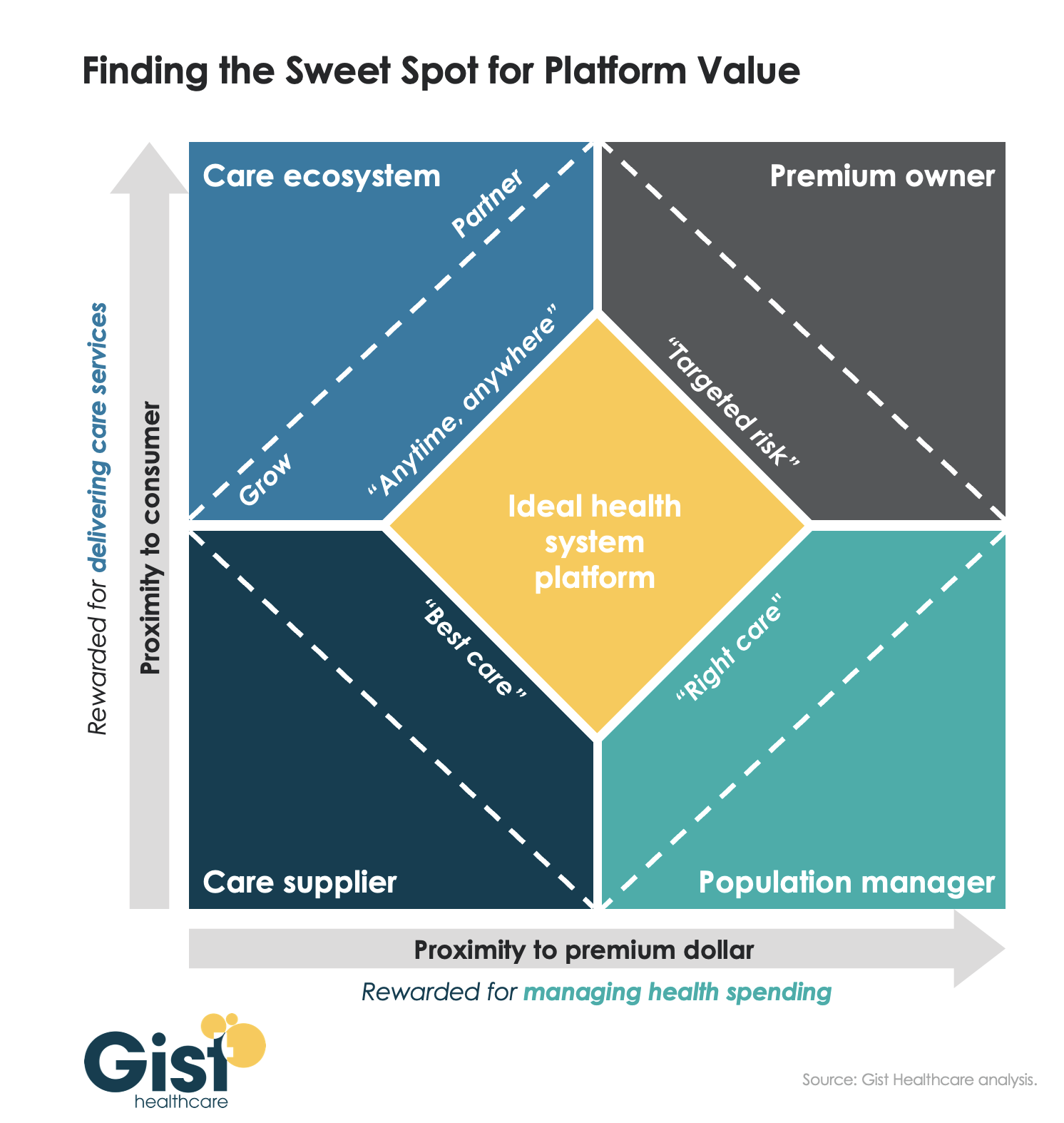
To achieve this vision, health systems must deliver value across two dimensions: increasing their proximity to the consumer (our y-axis) and their proximity to the premium dollar (our x-axis), as shown in the graphic above. Traditionally, health systems have operated primarily in the lower-left quadrant, as “care suppliers.” Some have spent considerable time and resources across the last decade, pushing closer to the premium dollar, to become “population managers.” But, importantly, managing population health is neither patient-facing, nor something consumers demand and seek.

To build deeper consumer loyalty, health systems must also move up the y-axis, creating a “care ecosystem” that provides “anywhere, anytime” care through multiple channels, including virtual and home-based solutions. And for certain populations, like Medicare Advantage, it will make sense for many systems to also explore becoming the “premium owner”, owning the full care budget and ensuring the incentives to design a consumer-centric offering. 

The ideal health system platform should combine all four of these identities, tailored to the local market situation.

Understanding the impact of the growing dominance of Medicare Advantage (MA)

https://mailchi.mp/d73a73774303/the-weekly-gist-may-27-2022?e=d1e747d2d8

recent piece in JAMA argues that policymakers need to be proactive in addressing how the rise of MA enrollment will affect the Medicare program as a whole, including its role in national quality and utilization measurement, rural healthcare access, and graduate medical education. The ability to monitor care delivered to the traditional, fee-for-service Medicare beneficiary population has been critical for assessing cost growth and shifting care patterns, distributing subsidies, and basing MA payments—all things that will become increasingly difficult as traditional Medicare becomes both smaller and less representative of the entire Medicare population.  

The Gist: Traditional Medicare has been a springboard for national healthcare policy goals and industry-wide innovations. However, consumers’ preference for, and policy shifts supporting, the growth of Medicare Advantage are proving to be unstoppable.

Providers must prepare for a future in which a shrinking minority of beneficiaries are enrolled in traditional Medicare. If current trends continue, Medicare policymakers must bolster ongoing support for medical education, and build a higher standard of transparency and quality reporting for MA carriers and providers to maintain the sustainability of one of the country’s greatest healthcare data resources.

Financial updates from 16 health systems

The health systems listed below recently released financial results for the quarter ended March 31.

1. Livonia, Mich.-based Trinity Health had $15.13 billion in revenue for the nine months ended March 31, up from $15.12 billion in the same period last year. It reported operating income of $139.7 million in the first nine months of fiscal year 2022, down 79 percent from operating income of $653.9 million in the same period a year earlier.

2. Rochester, Minn.-based Mayo Clinic recorded revenue of $3.9 billion for the three months ended March 31, representing about a 7 percent increase compared to the same period one year prior. Mayo Clinic ended the first quarter of this year with an operating gain of $142 million. In the same quarter last year, Mayo posted operating income of $243 million. 

3. Advocate Aurora Health, which has dual headquarters in Milwaukee and Downers Grove, Ill., recorded operating revenue of $3.6 billion in the first quarter of 2022. This represents a 9 percent increase over the comparable period in 2021, in which Advocate Aurora had $3.3 billion in revenue. Advocate Aurora ended the period with an operating income of $2.5 million. In the same period in 2021, Advocate Aurora recorded an operating income of $51 million. 

4. Chicago-based CommonSpirit Health saw revenues decline 6.6 percent year over year to $8.3 billion in the third quarter of fiscal year 2022, which ended March 31. CommonSpirit recorded an operating loss of $591 million in the three-month period ended March 31, compared to operating income of $539 million in the same period a year earlier. 

5. Renton, Wash.-based Providence saw its operating revenue hit $6.3 billion for the three months ended March 31. In the same quarter one year prior, Providence recorded operating revenue of $6.4 billion. It recorded an operating loss of $510.2 million in the first quarter of 2022, compared to $221.9 million from the same quarter a year prior.

6. Boston-based Mass General Brigham recorded operating revenue of $4.04 billion in the second quarter of fiscal year 2022, up from the $4.02 billion recorded in the same period one year prior. Mass General Brigham posted an operating loss of $193.2 million. In the same period one year prior, Mass General Brigham recorded an operating gain of $250.2 million.

7. Johnson City, Tenn.-based Ballad Health‘s total revenue reached $564.8 million in the third quarter of fiscal year 2022, a slight increase from the same period last year at $558.9 million. It reported an operating loss of $37.3 million for the three months ended March 31, compared to an operating income of $16 million in the same period last year.

8. Altamonte Springs, Fla.-based AdventHealth saw its revenue increase to $3.7 billion for the three months ended March 31, up nearly 8 percent from the same period last year. AdventHealth ended the first quarter of 2022 with an operating loss of $46.8 million. In the same quarter of 2021, AdventHealth recorded an operating income of $179.1 million. 

9. Oakland, Calif.-based Kaiser Permanente reported total operating revenue of $24.2 billion for the three months ended March 31, up from $23.2 billion the year prior. Kaiser recorded an operating loss of $72 million. In the same quarter last year, Kaiser recorded an operating income of $1 billion.

10. For the three months ended March 31, Sacramento, Calif.-based Sutter Health recorded revenue of $3.6 billion, up 3.7 percent from $3.4 billion recorded in the same period one year prior. Sutter Health ended the period with a $95 million operating gain. In the first quarter of 2021, Sutter had an operating loss of $49 million.

11. St. Louis-based Ascension reported operating revenue of $6.7 billion in the first three months of this year, up from $6.6 billion in the same period of 2021. Ascension ended the most recent quarter with an operating loss of $671.1 million, compared to an operating loss of $16.7 million in the same period last year.

12. Indianapolis-based Indiana University Health System had $1.93 billion in revenue for the three months ended March 31, a 2.9 percent increase year over year from $1.87 billion. IU Health posted an operating loss of $29.8 million for the first quarter of 2022, compared to an operating income of $192.7 million last year.

13. Franklin, Tenn.-based Community Health Systems had $3.1 billion in net operating revenue for the first quarter of 2022, a 3.3 percent increase from the $3 billion reported for the same period last year. The system posted a 17.2 percent decrease in its operating income, to $270 million for the three months ended March 31, compared to $326 million for the same period last year.

14. King of Prussia, Pa.-based Universal Health Services had a 9.3 percent increase in revenue year over year for the first quarter of 2022. Net revenue was $3.3 billion for the three months ended March 31, up from a little over $3 billion in the same period of 2021. UHS’ operating income fell by 21.2 percent year over year for the first quarter of 2022 to $232.9 million, compared to $295.7 million for the same period last year.

15. Nashville, Tenn.-based HCA Healthcare reported revenues of $15 billion in the first quarter of this year, up from $14 billion in the same period of 2021. HCA’s net income in the first quarter of 2022 totaled $1.3 billion, down from $1.4 billion in the same quarter a year earlier.

16. Dallas-based Tenet Healthcare posted net revenue of $4.8 billion in the quarter ended March 31, down 0.8 percent from the same period last year. Tenet recorded an operating income of $648 million in the first quarter of 2022. In the same period last year, Tenet’s operating income was $520 million.

The 18 health systems Walmart sends its employees to for care in 2022

In an effort to rein in healthcare costs for its employees, Walmart sends them directly to health systems that demonstrate high-quality care outcomes, otherwise known as Centers of Excellence.

Through the COE program, Walmart will cover the travel and treatment costs for employees seeking a range of services, but only with providers the company is contracted with. Walmart then reimburses with bundled payments negotiated with the providers.

To determine which providers get access to its 1.6 million employees, Walmart starts by examining health systems. Lisa Woods, vice president of physical and emotional well-being at Walmart, and her team analyze public data, distribute requests for information and conduct detailed on-site visits.

Below are the 18 health systems or campuses to which Walmart will refer patients for defined episodes of care in 2022. (See how COE participants have evolved since 2019 or 2021.)

Cardiac

Cleveland Clinic 

Geisinger Medical Center (Danville, Pa.)

Virginia Mason Medical Center (Seattle)

Weight loss surgery

Emory University Hospital (Atlanta)

Geisinger Medical Center (Danville, Pa.)

Intermountain Healthcare (Salt Lake City)

Northeast Baptist Hospital (San Antonio)

Northwest Medical Center (Springdale, Ark.)

Ochsner Medical Center (New Orleans)

Scripps Mercy Hospital (San Diego)

University Hospital (Cleveland)

Spine surgery

Emory University Hospital (Atlanta)

Geisinger Medical Center (Danville, Pa.)

Carolina NeuroSurgery & Spine Associates (Charlotte, N.C.)

Mercy Hospital Springfield (Mo.)

Mayo Clinic Arizona (Phoenix)

Mayo Clinic Florida (Jacksonville)

Mayo Clinic Minnesota (Rochester)

Memorial Hermann-Texas Medical Center (Houston)

Ochsner Medical Center (New Orleans)

Virginia Mason Medical Center (Seattle)

Breast, lung, colorectal, prostate

or blood cancer

Mayo Clinic Arizona (Phoenix)

Mayo Clinic Florida (Jacksonville)

Mayo Clinic Minnesota (Rochester)

Hip and knee replacements

Emory University Hospital (Atlanta)

Geisinger Medical Center (Danville, Pa.)

Johns Hopkins Bayview Medical Center (Baltimore)

Kaiser Permanente Irvine (Calif.) Medical Center

Mayo Clinic Florida (Jacksonville)

Mayo Clinic Minnesota (Rochester)

Mercy Hospital Springfield (Mo.)

Northeast Baptist Hospital (San Antonio)

Ochsner Medical Center (New Orleans)

Scripps Mercy Hospital (San Diego)

University Hospital (Cleveland)

Virginia Mason Medical Center (Seattle)

Organ and tissue transplants

(except cornea and intestinal)

Mayo Clinic Arizona (Phoenix)

Mayo Clinic Florida (Jacksonville)

Mayo Clinic Minnesota (Rochester)

Massachusetts hospitals to spotlight payers’ record pandemic profits

The Massachusetts Health and Hospital Association is planning to release its semiannual health plan performance report next month and will focus on payers’ finances and enrollment in 2021. 

In a May 23 newsletter, the association highlights the 22 percent increase in payers’ net worth during the COVID-19 pandemic, which totals $6.1 billion for all plans in the state. The newsletter also points to the combined $1.2 billion profit made in 2020 and 2021, which exceeds the previous five years combined.

The newsletter does point to the important role insurers played during the pandemic, including providing coverage of medical care, new therapies, vaccinations and COVID-19 testing. Under federal law, payers also provided rebates to premium payers as healthcare utilization decreased significantly. Some payers independently provided financial support to stabilize providers and used their resources to support the pandemic response.

“Despite these new expenses and efforts related to the COVID-19 emergency, health insurance company profits were substantially higher than at any point in recent history given the overwhelming effect of decreased medical utilization,” the newsletter said.

The association also criticized the decrease in claims payouts during the pandemic, arguing surplus revenue should have been used to increase payouts and not increase profits. 

The hospital group stated that four specific payers, Harvard Pilgrim Health Care, UnitedHealthcare of New England, Tufts Associated HMO and HMO Blue from BCBS Massachusetts have risk-based capital ratios that approach or exceed 600 percent.

The Trend of Health System Mergers Continues

While healthcare is delivered locally, the business of healthcare
is regional, and the regions are only getting bigger.
Hospital
and health system mergers alike have continued to shift from
local to regional, and the recently announced merger between Advocate Aurora
Health and Atrium Health clearly highlights that the regions are only getting
bigger.


Advocate Aurora, with a presence in Illinois and Wisconsin, and Atrium Health,
with a presence in North Carolina, South Carolina, Georgia, and Alabama, will
combine to create a $27 billion health system that will span six states and make it
one of the leading healthcare delivery systems in the country. The combined
organization, which will transition to a new brand, Advocate Health, will operate
67 hospitals and over 1,000 sites of care, employ nearly 150,000 teammates, and
serve 5.5 million patients. Together, Advocate Health will become the 6th largest
system in the country behind Kaiser Permanente, HCA Healthcare, CommonSpirit
Health, Ascension, and Providence.


We have seen a number of large health systems come together recently,
including Intermountain Healthcare + SCL Health to create a $15 billion revenue
system, Spectrum Health + Beaumont ($14 billion), NorthShore University Health
System + Edward-Elmhurst Healthcare
($5 billion), LifePoint Health + Kindred
Healthcare
($14 billion), and Jefferson Health + Einstein Healthcare Network ($8
billion).


The exact reasoning for each merger differs slightly, but one of the common
threads across all is scale.
But not scale in the traditional M&A sense. Rather,
scale in covered lives; scale in physician infrastructure and alignment; scale in
clinical and operational capabilities; scale in technology, innovation, and
partnerships with non-traditional players; scale for capital access; and scale for
insurance risk to compete in a value-based world. It is no longer the strong
acquiring the weak. Rather, strong players are coming together to gain scale to
face the headwinds in a unified manner.

For Advocate Aurora and Atrium, coming together is about leveraging their combined clinical excellence,
advancing data analytics capabilities and digital consumer infrastructure, improving affordability, driving health equity, creating a next-generation workforce, research, and environmental sustainability. Together, they have pledged $2 billion to disrupt the root causes of health inequities across underserved communities and create more than 20,000 new jobs.


Both Advocate Aurora and Atrium are no strangers to mergers. Advocate and Aurora came together in 2018, and prior to that Advocate was intending to merge with NorthShore before being blocked due to anti-trust. Atrium has grown over the years, merging with systems such as Navicent Health in Georgia in 2018, Wake Forest Baptist Health in North Carolina 2020, and Floyd Health System in Georgia in 2021. In the newly proposed merger, Advocate Aurora and Atrium are coming together via a joint operating arrangement where each entity will be responsible for their own liabilities and maintain ownership of their respective assets but operate together under the new parent entity and board. This may allow the combined entity more flexibility in local decision-making. The current CEOs, Jim Skogsbergh and Eugene Woods will serve as co-CEOs for the first 18 months, at which point Skogsbergh will retire, and Woods will take over as the sole CEO.


Mergers can come in various shapes and structures, but the driving forces behind consolidation are not unique. With the need to compete in value-based care, adequately manage risk, gain scale across covered lives, physicians, and points of access, successfully deliver affordable high-quality care, and the need to deal with the vertical and horizontal consolidation of the large-scale payers, the markets that health systems operate in must be large enough to be effective and relevant. We fully expect to see more of these larger scale health system mergers in the near term.


The physical delivery of healthcare is local, but, again, the business of healthcare is not; it is regional, and the regions are only getting bigger.

Hospitals urge Justice Department to probe insurers over routine denials

The American Hospital Association, on behalf of its nearly 5,000 healthcare organizations, is urging the Justice Department to probe routine denials from commercial health insurance companies. 

Specifically, the AHA is asking the Justice Department to establish a task force to conduct False Claims Act investigations into the insurers that routinely deny payments to providers, according to a May 19 letter to the department. 

The request from the AHA comes after HHS’ Office of Inspector General released a report April 27 that found Medicare Advantage Organizations sometimes delayed or denied enrollees’ access to services although the provider’s prior authorization request met Medicare coverage rules. 

“It is time for the Department of Justice to exercise its False Claims Act authority to both punish those MAOs that have denied Medicare beneficiaries and their providers their rightful coverage and to deter future misdeeds,” the AHA said in a letter to the Justice Department. “This problem has grown so large — and has lasted for so long — that only the prospect of civil and criminal penalties can adequately prevent the widespread fraud certain MAOs are perpetrating against sick and elderly patients across the country.”

Read the full letter here.

Mass General Brigham to cut spending by $70M a year

Boston-based Mass General Brigham submitted a cost-reduction plan to Massachusetts regulators May 16, which includes a promise to cut healthcare spending by $70 million a year. 

The health system was ordered by the Massachusetts Health Policy Commission in January to develop a plan to reduce costs after the watchdog determined it had pushed healthcare spending above acceptable levels in the last few years. Specifically, the commission found that Mass General Brigham had substantially higher-than-average commercial spending from 2014 to 2019. The health system spent $293 million those years, more than any other provider in the state.

To achieve its spending reduction goal, Mass General Brigham said it would focus on four items: cutting prices, reducing utilization, shifting care to lower-cost sites and expanding value-based care. 

A key savings driver in Mass General Brigham’s plan is to lower outpatient and ConnectorCare rates to improve affordability. ConnectorCare is a program of subsidized private health insurance plans for patients whose family income doesn’t exceed 300 percent of the federal poverty level and who are not eligible for MassHealth, Medicare or other affordable health coverage. The health system expects to save about $53.8 million in spending a year through reducing these rates.

“Mass General Brigham is committed to expanding access to consumers, particularly in ambulatory care. To achieve improved access, we are focused on decreasing the price variation between Mass General Brigham pricing and the marketplace,” Mass General Brigham said in the performance improvement plan. 

The health system said it expects to save $10.8 million in spending a year by reducing unnecessary hospitalizations, emergency room visits and post-acute care and reducing use of high-cost outpatient imaging. 

The health system said it expects to save $5.3 million in spending a year by shifting care to lower-cost settings, such as moving to “hospital at home,” expanding telehealth or using other ambulatory sites. 

In addition to reducing utilization, shifting care to lower-cost sites and reducing price, Mass General Brigham said it is committed to expanding value-based care.

Mayo Clinic posts $142M operating gain, bucking national trend

Rochester, Minn.-based Mayo Clinic ended the first quarter of 2022 with an operating gain, unlike many health systems across the U.S. 

In the quarter ended March 31, Mayo Clinic recorded revenue of $3.9 billion, representing about a 7 percent increase compared to the same period one year prior. The health system saw a boost in medical service revenue and grant revenue, according to its financial report released May 19.

Mayo Clinic’s expenses also rose in the first quarter of 2022 to $3.8 billion. In the comparable quarter in 2021, Mayo Clinic’s expenses were $3.4 billion. The health system attributed the 10 percent expense increase to a boost in salaries and wages as well as supply costs. 

Mayo Clinic ended the first quarter of this year with an operating gain of $142 million. In the same quarter last year, Mayo posted operating income of $243 million.

The health system also recorded nonoperating losses of $369 million in the first quarter of 2022

Despite losses from nonoperating items, Mayo Clinic ended the quarter with $17.5 billion in net assets, up from $13.2 billion recorded in the same period one year prior.

“The year 2022 begins with new challenges that follow nearly two years of pandemic operations,” Mayo Clinic said in the financial report. “Workforce shortages and corresponding labor cost inflation, persistent supply chain disruptions and shortages, a higher interest rate environment, and capital market volatility have all taken center stage for management attention.”