Medical costs projected to increase 6% by 2020, says PwC

https://www.healthcarefinancenews.com/news/medical-costs-projected-increase-6-percent-2020-says-pwc?mkt_tok=eyJpIjoiWldZeVlXTm1aVEF6TVdKbSIsInQiOiJjbWFzeVA2TGlWZkNkXC9odGxcLzdLczFZSDYxd1hoYW04b0wxY0ljQ25zblpYN1VWc2FMWFFCQWpmc2tCYmE4d1Z3eVdMd2htY3JiSjZ3N2Urek43SHFJbWFsckdRbUNycFJoQjhzZm5VcGpJUUhKUDlBMWF2eGJzRUhmZGFlUUx0In0%3D

Utilization is still being dampened by high deductibles and other cost sharing, but at the expense of employee satisfaction.

Medical costs are rising, and by this time next year costs will likely show a modest increase of about 6% over the past two years, according to a new report from PwC, PricewaterhouseCoopers.

After figuring in health plan changes such as increased employee cost sharing and network and benefit changes, PwC’s Health Research Institute, which conducted the study, projects a net growth rate of 5 percent. Even with employers’ actions, market forces likely will still overrun the efforts to quell them.

Prices, not utilization, are continuing to fuel healthcare spending. Utilization is still being dampened by high deductibles and other cost sharing, but at the expense of employee satisfaction with their health plan. In response, employers are inserting themselves more forcefully into the healthcare delivery equation.

WHAT’S THE IMPACT

Beyond market forces, HRI identified three “inflators” that will, influence the medical cost trend.

One is that drug spending will grow faster. Between 2020 and 2027, retail drug spending under private health insurance is projected to increase at a rate of 3 percent to 6 percent a year as the impact of generics on spending plateaus, biosimilars continue to see slow uptake, and costly new therapies enter the market.

Chronic diseases will also be a major issue. Obesity and Type 2 diabetes continue to produce high rates of hypertension and cardiovascular disease. Sixty percent of adults have a chronic disease, with 40 percent managing two or more. For employers, per capita health spending on someone with a complex chronic illness is eight times that of a healthy person.

Lastly, employers are beginning to recognize the importance of helping their employees manage their mental health and wellbeing. Nearly 75 percent of employers offer mental health disease management programs, the report found. Anytime access is expanded, costs will go up in the short term, though it may have the opposite effect long-term.

And speaking of the opposite effect, there are a few “deflators” HRI recognized that will likely slow down the medical cost trend.

HRI predicts that in 2020, more companies will take action to make sure healthcare is accessible to their employees, opening and expanding clinics as a strategy to control the cost trend. Thirty-eight percent of large employers offered a worksite clinic in 2019, up from 27 percent in 2014.

Also, payers are designing plans to encourage members to choose free-standing facilities and in-home care rather than more expensive sites. How those benefits are designed, and how employees perceive the costs, will shape the effectiveness of site of care strategies. Payers and employers are aiming to grow the role of telemedicine as employees grow more comfortable with it, especially if out-of-pocket costs are lower and the quality doesn’t suffer.

WHAT ELSE YOU SHOULD KNOW

The trend has implications for employers, payers, providers and even pharmaceutical and life science companies.

For payers, it becomes important to  benchmark the prices paid commercially against a common reference point such as Medicare. With this information it’s possible to pursue value-based arrangements with high-performing and lower-cost providers, in addition to negotiating better contracted rates on existing fee-for-service arrangements.

For providers, a value line strategy is necessary as employers and consumers look for high quality care for a low cost. Providers armed with a value line strategy are more likely to be included in health plans’ high-performance networks, and are better positioned to directly contract with employers.

Providers should also understand what risk they can take on to guarantee a health outcome, and the cost structure needed to make them profitable in doing so. Providers should understand and manage both the risk inherent in their ability to deliver care and the risk of the population they’re managing — from health status to the social determinants impacting their health — to help them design appropriate clinical interventions and non-clinical support services.

For employers, it becomes imperative to understand their role as the purchaser of healthcare for employees and join the ranks of employer activists, pursuing new solutions to lower costs, improve access and enhance quality. Pharmaceutical and life science companies, meanwhile, should go beyond the basic outcomes-based arrangements currently in place and consider exploring and expanding alternative financing arrangements, such as subscription models for unlimited access to a product for a set period of time, or a mortgage model to finance expensive specialty drugs over time.

THE LARGER TREND

The PwC study loosely mirrors the findings of an October report from the Altarum Center for Value in Health Care, which found prices and spending in healthcare growing steadily, but at a moderate pace.

The country’s healthcare spending habits are at a level nearly double that of similar countries. Spending per capita in the U.S. is more than $9,000, compared to just over $5,000 in other Western nations, and because prices are growing slowly but steadily, spending is doing the same.



When a hospital wields monopoly power

https://www.axios.com/newsletters/axios-vitals-1b40c794-c913-4681-b2ac-7a6e9746718f.html?utm_source=newsletter&utm_medium=email&utm_campaign=newsletter_axiosvitals&stream=top

Illustration of a giant health plus on top of a pile of cash, the ground underneath is cracking.

NorthBay Healthcare, a not-for-profit hospital system in California, recently gave a candid look into how it operates, telling investors it has used its negotiating clout to extract “very lucrative contracts” from health insurance companies.

Why it matters: This is a living example of the economic theories and research that suggest hospitals will charge whatever they want if they have little or no competition, Axios’ Bob Herman reports.

Details: NorthBay owns two hospitals and several clinics in California’s Solano County. Kaiser Permanente owns the only other full-service hospital in the county, and Sutter Health operates some medical offices. (A NorthBay spokesperson argued the system is “more akin to the David among two Goliaths.“)

Three health insurers have terminated their contracts with NorthBay over the past couple years. During a June 19 call with bondholders, executives explained why this has happened.

“We’ve been able to maintain very lucrative contracts without the competition. And what the payers are saying is, they would like us to be like 90% of the rest of the United States in terms of contract structure.”

Jim Strong, interim CFO, NorthBay Healthcare

Between the lines: NorthBay’s revenue has increased by 50% over the past few years, from $400 million in 2013 to $600 million in 2018, due in large part to its natural monopoly and oligopoly over hospital services.

  • This is exactly what we should expect to happen when sellers have the upper hand over buyers, economists say.

NorthBay also serves as a cautionary tale for price transparency, the policy fix du jour.

  • If the health care system is consolidated, consumers don’t have anywhere else to go,” said Sunita Desai, a health economist at NYU. “Even if they see the prices of a given hospital, they’re limited in terms of how much they can ‘shop’ across providers.”


The Lessons of Washington State’s Watered Down ‘Public Option’

Jay Inslee, the governor of Washington, signing a measure in May that puts the state on track to create the nation’s first “public option” health insurance.

Jay Inslee, the governor of Washington, signing a measure in May that puts the state on track to create the nation’s first “public option” health insurance.

A big health care experiment for Democrats shows how fiercely doctors and hospitals will fight.

For those who dream of universal health care, Washington State looks like a pioneer. As Gov. Jay Inslee pointed out in the first Democratic presidential debate on Wednesday, his state has created the country’s first “public option” — a government-run health plan that would compete with private insurance.

Ten years ago, the idea of a public option was so contentious that Obamacare became law only after the concept was discarded. Now it’s gaining support again, particularly among Democratic candidates like Joe Biden who see it as a more moderate alternative to a Bernie Sanders-style “Medicare for all.”

New Mexico and Colorado are exploring whether they can move faster than Congress and also introduce state-level, public health coverage open to all residents.

But a closer look at the Washington public option signed into law last month, and how it was watered down for passage, is a reminder of why the idea ultimately failed to make it into the Affordable Care Act and gives a preview of the tricky politics of extending the government’s reach into health care.

On one level, the law is a big milestone. It allows the state to regulate some health care prices, a crucial feature of congressional public option and single-payer plans.

But the law also made big compromises that experts say will make it less powerful. To gain enough political support to pass, health care prices were set significantly higher than drafters originally hoped.

“It started out as a very aggressive effort to push down prices to Medicare levels, and ended up something quite a bit more modest,” said Larry Levitt, senior vice president for health reform at the Kaiser Family Foundation.

So while Washington is on track to have a public option soon, it may not deliver the steep premium cuts that supporters want. The state estimates that individual market premiums will fall 5 percent to 10 percent when the new public plan begins.

“This bill is important, but it’s also relatively modest,” said David Frockt, the state senator who sponsored the bill. “When I see candidates talking about the public option, I don’t think they’re really grasping the level of opposition they’re going to face.”

During the Affordable Care Act debate, more liberal Democrats hoped a public option would reduce the uninsured rate by offering lower premiums and putting competitive pressure on private plans to do the same. President Obama backed it, saying in 2009 that such a policy would “keep the private sector honest.”

The public option came under fierce attack from the health care industry. Private health plans in particular did not look forward to competing against a new public insurer that offered lower rates, and fought against a government-run plan that they said “would significantly disrupt the coverage that people currently rely on.” The policy narrowly fell out of the health care law but never left the policy debate.

Congressional Democrats have started to revisit the idea in the past year, with health care as a top policy issue in the 2018 midterm elections.

“During the midterm elections, Medicare for all was gaining a lot of traction,” said Eileen Cody, the Washington state legislator who introduced the first version of the public option bill. “After the election, we had to decide, what do we want to do about it?”

Ms. Cody introduced a bill in January to create a public option that would pay hospitals and doctors the same prices as Medicare does, which is also how many congressional public option proposals would set fees. The Washington State Health Benefit Exchange, the marketplace that manages individual Affordable Care Act plans, estimates that private plans currently pay 174 percent of Medicare fees, making the proposed rates a steep payment cut.

“I felt that capping the rates was very important,” Ms. Cody said.“If we didn’t start somewhere, then the rates were going to keep going up.”

Doctors and hospitals in Washington lobbied against the rate regulation, arguing that they rely on private insurers’ higher payment rates to keep their doors open while still accepting patients from Medicaid, the public plan that covers lower-income Americans and generally pays lower rates.

“Politically, we were trying to be in every conversation,” says Jennifer Hanscom, executive director of the Washington State Medical Association, which lobbies on behalf of doctors. “We were trying to be in the room, saying rate setting doesn’t work for us — let’s consider some other options. As soon as it was put in the bill, that’s where our opposition started to solidify.”

Legislators were in a policy bind. The whole point of the public option was to reduce premiums by cutting health care prices. But if they cut the prices too much, they risked a revolt. Doctors and hospitals could snub the new plan, declining to participate in the network.

“The whole debate was about the rate mechanism,” said Mr. Frockt, the state senator. “With the original bill, with Medicare rates, there was strong opposition from all quarters. The insurers, the hospitals, the doctors, everybody.”

Mr. Frockt and his colleagues ultimately raised the fees for the public option up to 160 percent of Medicare rates.

“I don’t think the bill would have passed at Medicare rates,” Mr. Frockt said. “I think having the Medicare-plus rates was crucial to getting the final few votes.”

Other elements of the Washington State plan could further weaken the public option. Instead of starting an insurance company from scratch, the state decided to contract with private insurers to run the day-to-day operations of the new plan.

“It would have cost the state hundreds of millions of dollars just to operate the plan,” said Jason McGill, who recently served as a senior health policy adviser to Mr. Inslee. He noted that insurers were required to maintain large financial reserves, to ensure they don’t go bankrupt if a few patients have especially costly medical bills.

“Why would we do that when there are already insurers that do that? It just didn’t make financial sense. It may one day, and we’ll stay on top of this, but we’re not willing to totally mothball the health care system quite yet.”

Hospitals and doctors will also get to decide whether to participate in the new plan, which pays lower prices than private competitors. The state decided to make participation voluntary, although state officials say they will consider revisiting that if they’re unable to build a strong network of health care providers.

Most federal versions of the public option would give patients access to Medicare’s expansive network of doctors and hospitals.

Although Mr. Frockt is proud of the new bill, he’s also measured in describing how it will affect his state’s residents. After going through the process of passing the country’s first public option, he’s cautious in his expectations for what a future president and Democratic Congress might be able to achieve. But he does have a clearer sense of what the debate will be like, and where it will focus.

“This is a core debate in the Democratic Party: Do we build on the current system, or do we move to a universal system and how do we get there?” he said. “I think the rate-setting issue is going to be vital. It’s what this is all about.”


Supreme Court rejects HHS’ Medicare DSH changes

https://www.modernhealthcare.com/legal/supreme-court-rejects-hhs-medicare-dsh-changes?utm_source=modern-healthcare-alert&utm_medium=email&utm_campaign=20190603&utm_content=hero-readmore

The U.S. Supreme Court on Monday ruled that HHS improperly changed its Medicare disproportionate share hospital payments when it made billions of dollars in cuts.

In a 7-1 decision, the justices said HHS needed a notice-and-comment period for the Medicare DSH calculation change. Justice Neil Gorsuch wrote in the decision that HHS’ position for not following the procedure was “ambiguous at best.”

“Because affected members of the public received no advance warning and no chance to comment first, and because the government has not identified a lawful excuse for neglecting its statutory notice-and-comment obligations, we agree with the court of appeals that the new policy cannot stand,” Gorsuch wrote.

The case was highly technical, and hinged on a dueling interpretations of agency activity that constitutes a “substantive legal standard” in a payment policy change to Medicare.

Under the new Medicare DSH formula, the CMS began to lump Medicare Advantage enrollees in with traditional Medicare enrollees to calculate a hospital’s DSH payment.

But Medicare spending is about $700 billion per year, and the program covers nearly one-fifth of Americans.
“Not only has the government failed to document any draconian costs associated with notice and comment, it also has neglected to acknowledge the potential countervailing benefits,” Gorsuch wrote. “Notice and comment gives affected par-ties fair warning of potential changes in the law and an opportunity to be heard on those changes—and it affords the agency a chance to avoid errors and make a more informed decision.”

The majority opinion also emphasized the size and scope of Medicare, noting that “even seemingly modest modifications to the program can affect the lives of millions.” “As Medicare has grown, so has Congress’s interest in ensuring that the public has a chance to be heard before changes are made to its administration,” Gorsuch wrote.

During oral arguments in the case in January, Gorsuch and Justice Sonia Sotomayor doubled down on the economic magnitude of the change, which HHS estimated to be between $3 billion and $4 billion between fiscal 2005 and 2013.

Justice Stephen Breyer dissented from the majority, and Justice Brett Kavanaugh recused himself because he participated in the U.S. Court of Appeals for the D.C. Circuit ruling that the Supreme Court upheld.

Breyer wrote he believed the government had the legal grounds to skip the public comment period in this policy.
“The statutory language, at minimum, permits this interpretation, and the statute’s history and the practical consequences provide further evidence that Congress had only substantive rules in mind,” he wrote. “Importantly, this interpretation of the statute, unlike the court’s, provides a familiar and readily administrable way for the agency to distinguish the actions that require notice and comment from the actions that do not.”


Breaking down blockchain’s role in healthcare

https://www.healthcarefinancenews.com/node/138760?mkt_tok=eyJpIjoiTVRWbU1UVmpOak13T1RZeSIsInQiOiJxVjJhTTVib1QwQkp3Qkl4QVExeUZTZVFoUDZYZ1NHa3U1VGhrQmQ5NklQdnc1c2g3WXJnMXJja09ldTVZTDRNSnZIZUJZQWxGTmg5M2JpS1BZb085UzFHblZvU3FTejVjRFRjV1BcL1ZcL1VoSzBCc2hPcEpVeHJ5c1BKaW9JMnFYIn0%3D

Image result for Breaking down blockchain's role in healthcare HIMSS

HIMSS Director of Informatics Mari Greenberger says that as pilot tests move into production, healthcare organizations should rally around a use case and understand who needs to be involved to reduce redundancies and costs.


Hospital Boards Seeing Low Turnover Rates, AHA Finds

Click to access aha-2019-governance-survey-report_v8-final.pdf

https://www.healthleadersmedia.com/strategy/hospital-boards-seeing-low-turnover-rates-aha-finds

A survey of hospital and health system CEOs noted opportunities for improvement in board governance, alongside some positive trends.

The boards of trustees governing U.S. hospitals and health systems have relatively low turnover rates in an industry that’s shifting rapidly, according to a survey report released Wednesday by the American Hospital Association.

The survey asked more than 1,300 CEOs of nonfederal community hospitals and health systems in the U.S. about their organizations’ governance structures and practices, then the AHA compared their responses to data collected in a similar survey five years ago.

The researchers found that the policies and norms in place for most healthcare organizations result in low levels of board turnover.

The report cited several related opportunities for improvement:

  • Nearly a third of all respondents said their boards do not use term limits at all.
  • More than 75% of respondents said their organizations either didn’t replace board members during their terms or kept reappointing them (when eligible) within the past three years, rather than recruiting a fresh face.
  • Formal assessments were not conducted within the past three years for boards, board members, or chairpersons at 31% of respondent organizations.
  • Older board members are increasingly common. Overall, 12% of board members were age 71 or older in 2018, up from 9% in 2005, the report states. The percentage of members age 50 or younger was 22% last year, down from 29% in 2005.

Luanne R. Stout, president of Stout Associates based in the Dallas/Fort Worth area and a retired Chief Governance Officer of Texas Health Resources, wrote in commentary included with the report that healthcare organizations have a number of options when trying to foster a healthy degree of board turnover.

“Term limits (usually three or four consecutive, three-year terms) are helpful in accomplishing board turnover; however, some boards are reluctant to adopt term limits for fear of losing highly valued board members,” Stout wrote. “Boards that annually review board member attendance, performance and contribution can achieve desired levels of rotation and competency enhancement without utilizing term limits.”

The AHA report also notes some positive trends around healthcare board governance, including the following:

  • There has been some increase in racial and ethnic diversity among board members. The survey found 58% of respondents had boards with at least one non-white member, up from 53% in 2014. (That means about 42% of boards were still composed last year entirely of white members.)
  • A majority of boards restructured to improve their governance.
  • Nearly half of all system boards include members from outside the communities served.

“This year’s survey demonstrates how hospitals and health system boards are rising to meet tomorrow’s challenges through redefining roles, responsibilities and board structures,” said AHA President and CEO Rick Pollack in a statement. “These changes are not surprising given the continued transformation in where, how, when and from whom patients receive care.”


The hospitals staying silent on Medicare for All

https://www.axios.com/hospitals-medicare-for-all-health-care-bernie-sanders-5d28dc00-05cd-411b-98cc-556ddfa12c9b.html

Doctors and nurses treat a patient in a hospital trauma room.

Large hospital systems and trade groups have vociferously criticized Democrats’ “Medicare for All” proposals, but rural facilities and public hospitals that treat mostly low-income patients are sitting on the sidelines of the debate.

Why it matters: Safety nets and many rural hospitals could hypothetically benefit under Medicare for All, but expressing support would put them at odds with their larger brethren.

Between the lines: The Partnership for America’s Health Care Future has become one of the loudest industry-funded voices against Medicare for All.

  • Pharmaceutical companies, health insurers and others are part of PAHCF. But 10 hospital systems and lobbying groups, like Ascension and the American Hospital Association, drive PAHCF.
  • Chip Kahn, the head of the Federation of American Hospitals, said PAHCF was his “brainchild,” according to Modern Healthcare.

Yes, but: Some hospital constituencies aren’t part of the anti-single-payer lobbying.

  • America’s Essential Hospitals, the trade group for safety net hospitals, and the National Rural Health Association, which represents rural hospitals and providers, are not part of PAHCF. They also don’t have official positions on Medicare for All.
  • A spokesperson for AEH said the group recognizes industry peers “have raised reasonable questions” about Medicare for All, but “our focus right now is where our members want it: on stopping the $4 billion cut” to supplemental Medicaid payments.
  • “With specific legislation not moving forward at this time, I don’t see us weighing in anytime soon,” NRHA CEO Alan Morgan said. “I don’t see us at odds. We just haven’t entered the national debate yet.”
  • In an interview, Kahn would not discuss on the record why those two groups were not part of PAHCF.

The big picture: Hospitals that mostly care for poor and uninsured patients could see higher, more stable revenues if everyone had Medicare — a program that often pays higher base rates than Medicaid and infinitely higher rates than nothing at all.

  • Cook County’s public hospital system in Chicago, for instance, gets 79% of its gross patient revenue from the uninsured and Medicaid. That system and multiple other hospitals did not respond to interview requests.
  • Separately, Medicare pays rural “critical access” hospitals 101% of their allowable costs, although those payments have suffered since Congress instituted mandated cuts in 2013.

The intrigue:If you’re trying to solve the problem that we want to get everybody covered and we want to level the playing field between the hospitals that take care of the poor people and hospitals that take care of the rich people, Medicare for All is something we better take a look at,” Eric Dickson, CEO of UMass Memorial Health Care, told Politico.


Democrats Yet To Successfully Explain Medicare For All

https://www.forbes.com/sites/brucejapsen/2019/05/26/from-bernie-to-warren-democrats-yet-to-successfully-explain-medicare-for-all/#3e8b63126daf


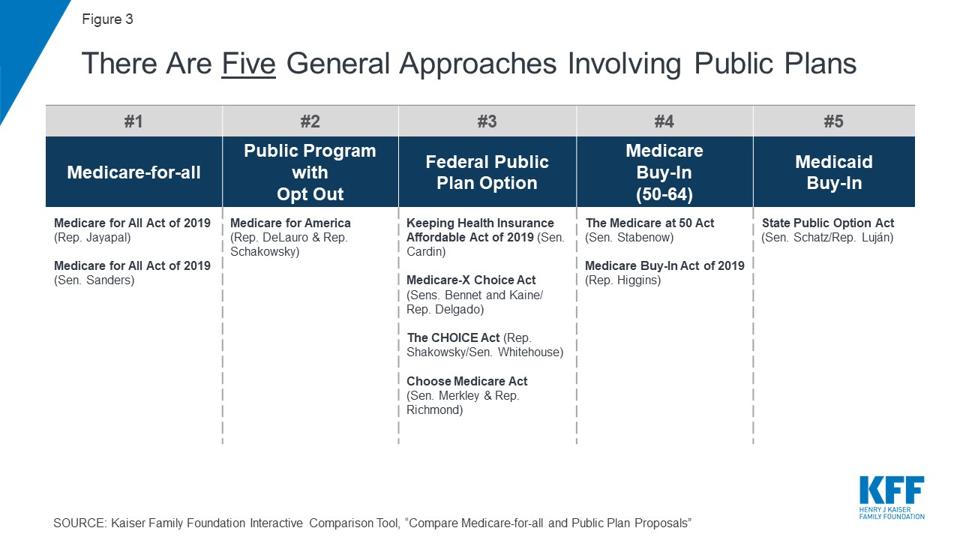
Kaiser Family Foundation Medicare For All briefing on national public healthcare plan approaches introduced in Congress (May 21, 2019).

Even with two dozen Democrats running for President and most touting an expansion of Medicare benefits to everybody, the public is still unclear how a national single payer health plan like “Medicare for All” will benefit them.

A briefing from experts at the nonpartisan Kaiser Family Foundation for health reporters last week revealed there are five general approaches to expanding coverage involving public plans.

Within those approaches are 10 national plans introduced in Congress that include everything from a single payer version of Medicare for All that would uproot private coverage to a “public program with an opt out” that would be offered along side commercial coverage. Other plans would allow Americans to buy into Medicare as young as 50 years old or buy into Medicaid coverage for the poor.

But no matter the effort to expand health insurance coverage, much is to be done to educate the public at large even as single payer supporters like Sens. Bernie Sanders, Elizabeth Warren and Kamala Harris push Medicare for All on the campaign trail.

“Our polling shows some Americans are unaware of how the implementation of a national health plan could impact them,” said Mollyann Brodie, Kaiser’s senior vice president and executive director, public opinion and survey research. “For example, many people (55%) falsely assume that would be able to keep their current health insurance under a single-payer plan.”

Democrats on the campaign trail hoping to challenge President Donald Trump should Republicans nominate him to run for re-election in 2020 see rising support for a national health plan that would make the government the only insurance carrier.

Kaiser data shows 56% favor a national health plan “in which all Americans would get their insurance from a single government plan.” Just 40% favored such a national health plan 20 years ago, Kaiser data shows.

“Our polls have shown a modest increase in support for the idea of a national health plan,” Kaiser’s Medicare for All presentation showed. Some of these health insurance expansions would be single payer versions of “Medicare for All’ like that proposed by Sanders in the U.S. Senate and Rep. Pramila Jayapal (D-Washington) in the U.S. House of Representatives that would uproot private coverage and replace it with government run Medicare.

Other public approaches would involve a “public program with an opt out” known as Medicare for America or a “Medicare Buy in” like that proposed by Sen. Debbie Stabenow (D-Michigan). Other public plans would involve a so-called “federal public plan option” that would be offered along side commercial coverage on a government exchange and there are also Medicaid buy-in proposals being floated in a number of states.

Politically, the lack of knowledge of Medicare for All and public option proposals offers opportunities for both Democrats who favor Medicare for All and Republicans who want to derail a government expansion of health benefits, particular an approach that would essentially replace much of the private system.

“As the public learns more about the implications of each of these proposals, support may increase or decrease,” Kaiser’s Brodie said.


Who is blocking ‘Medicare for All’?

Who is blocking ‘Medicare for All’?

Who is blocking 'Medicare for All'?

Decades of corporate-friendly politics and policy have decimated communities throughout the country. Centrist Democrats who have chosen corporate profits over people’s needs have aided and abetted this decimation. People are hungry for big ideas to improve their lives and to change the rules that serve only to make the rich richer.

Nowhere is this hunger more apparent than in the demand for improved “Medicare for All”. During a hearing at the House Budget Committee this week it was also apparent that the center-right and their wealthy donors won’t go down without a fight when it comes to health care. 

With guns-a-blazing, they are out to block an incredibly successful and popular program: Medicare, from being improved, expanded and provided to everyone.

Yet polling shows that across party lines,majority of Americans are in favor of Medicare for All. And why not? Right now, nearly 30 million people in this country are uninsured; 40 million can’t afford health-care co-pays and deductibles and 45,000 die annually as a result of not having access to health care.

Those reaping the excessive profits from our illnesses and injuries are in a panic. They’re laying all their chips on the table to make sure Medicare for All never becomes reality. It would mean the end of private insurance companies that profit mightily off the most costly and least effective health-care system in the industrialized world.

So, to continue to rake in their profits, they’ve created the Partnership for America’s Health Care Future, a partnership of corporate hospitals, insurance and drug companies. They must have a lot to lose: last year alone, the group spent $143 million developing attack ads and launching fear campaigns to kill Medicare for All.

It’s time to admit it, while nearly every modern country in the world provides quality, accessible health care for free or very inexpensively to their citizens, the United States stands alone in its willingness to let corporations suck the last pennies out of sick or injured people.

Well, the jig is up. Decades under a corporate-run private health insurance system have proven that we can’t rely on profiteers to provide access to quality health care. We need a publicly held system that is accountable to the people who rely on it. We are able to do so and save trillions of dollars over the next decade.

Medicare for All would reduce national health-care spending by anywhere between $2 trillion to $10 trillion over ten years. Research shows that countries with single-payer systems spend much less on drugs.

Yet opponents continue to decry the “costs” of Medicare for All. They will continue to focus on the cost to taxpayers, conveniently avoiding the truth that already we pay excessive health care costs through insurance premiums, co-pays and deductibles.

Americans suffer from poor health outcomes because they can’t afford to see a doctor until their illness becomes catastrophic. Many weigh the choice between financial ruin and life-saving medicines and treatment. In one of the richest countries in the world that is nothing short of shameful.

The U.S. is a country with abundant resources and more than enough wealth to go around. It’s time to share the wealth in America. It’s a new day and it starts with Medicare for All. Buckle up — because the fight is just beginning.