Due to global shortages of iohexol and iodixanol, contrast media products injected into patients during CT scans and other commonly used diagnostic imaging studies, some providers are having to postpone non-emergency imaging.
GE Healthcare, one of two major suppliers of contrast media in the US, has experienced manufacturing disruptions at its Shanghai facility amid China’s COVID lockdowns, and the company estimates the shortages could last through June. It is increasing production at an Ireland factory, and shipping via air cargo to the US, to speed up delivery.
The Gist: This shortage will have wider ranging impacts than just delayed imaging procedures, as so many treatment decisions rely on the results of imaging tests. Contrast fluids are also used for vascular imaging, heart catheterization, and spinal interventions. A prolonged shortage could have far-reaching implications, limiting doctors’ ability to plan surgeries, monitor cancer progression, and perform imaging-guided treatments.
Like so many recent supply shortages, this latest one shines a spotlight on providers’ “just-in-time” supply chain, and their over-reliance on single-source vendors.
Hospitals’ labor costs rose by more than a third from pre-pandemic levels by March 2022, according to a report out Wednesday from Kaufman Hall.
Heightened temporary and traveling labor costs were a main contributor, with contract labor accounting for 11% of hospitals’ total labor expenses in 2022 compared to 2% in 2019, the report found.
Contract nurses’ median hourly wages rose 106% over the period, from $64 an hour to $132 an hour, while employed nurse wages increased 11%, from $35 an hour to $39 an hour, the report found.
Dive Insight:
The new data from Kaufman Hall supports concerns hospital executives expressed while releasing first quarter earnings results, as higher-than expected labor costs spurred some operators, like HCA, to lower their financial full-year guidance.
The ongoing use of contract labor amid shortages driven by heightened turnover was a key factor executives cited for higher costs, and follows the findings from Kaufman Hall’s latest report.
More than a third of nurses surveyed by staffing firm Incredible Health said they plan to leave their current jobs by the end of this year, according to a March report. While burnout is driving them to leave, higher salaries are the top motivating factor for taking other positions, that report found.
Kaufman Hall’s report, which analyzes data from more than 900 hospitals across the country, found hospitals spent $5,494 in labor expenses per adjusted discharge in March compared to $4,009 roughly three years ago.
Costs rose for hospitals in every region, though the South and West experienced the largest increases from pre-pandemic levels as those expenses rose 43% and 42%, respectively.
The West and Northeast/Mid-Atlantic regions saw the highest expenses consistently from 2019 to 2022, according to the report.
“The pandemic made longstanding labor challenges in the healthcare sector much worse, making it far more expensive to care for hospitalized patients over the past two years,” said Erik Swanson, senior vice president of data and analytics at Kaufman Hall.
“Hospitals now face a number of pressures to attract and retain affordable clinical staff, maintain patient safety, deliver quality services and increase their efficiency,” Swanson said.
The report also notes that hospitals are competing with non-hospital employers also pursuing hourly staff, though those companies can pass along wage increases to consumers through higher prices “in a way healthcare organizations cannot,” the report said.
Some hospitals, like HCA Healthcare and Universal Health Services, are looking to raise prices for health plans amid rising nurse salaries, according to reporting from The Wall Street Journal.
Another recent report from group purchasing organization Premier found the CMS underestimated hospital labor spending when making payment adjustments for the 2022 fiscal year, resulting in hospitals receiving only a 2.4% rate increase compared to a 6.5% increase in hospital labor rates.
To match the rates hospitals are now paying staff, an adequate inpatient payment update for fiscal 2023 is needed, that report said.
The CMS proposed its IPPS rule for FY 2023 on April 18 that includes a 3.2% hike to inpatient hospital payments, which provider groups like the American Hospital Association rebuked as “simply unacceptable” considering inflation and rising hospital labor costs.
St. Louis-based Ascension reported higher expenses in the three months ended March 31 and ended the quarter with a loss, according to financial documents filed April 29.
The 143-hospital system reported operating revenue of $6.69 billion in the first three months of this year, up from $6.56 billion in the same period of 2021.
Ascension’s operating expenses climbed to $7.34 billion in the first three months of 2022, up from $6.59 billion in the same period a year earlier. The increase was attributed to several factors, including higher salaries, wages and supply expenses.
Looking at the first nine months of the current fiscal year, Ascension’s operating expenses increased 8.7 percent year over year. Staffing challenges, increased use of contract labor and overtime spend pushed Ascension’s total salaries, wages and benefits up 10.1 percent year over year in the nine months ended March 31.
Ascension ended the most recent quarter with an operating loss of $671.14 million, compared to an operating loss of $16.71 million in the same period last year.
After factoring in nonoperating items, Ascension reported a net loss of $884.74 million for the three months ended March 31. A year earlier, the health system posted net income of $957.32 million. For the first nine months ended March 31, Ascension reported net income of $145.21 million, compared to $4.77 billion in the same period a year earlier.
As of March 31, Ascension had 295 days cash on hand, compared to 336 days as of June 30, 2021.
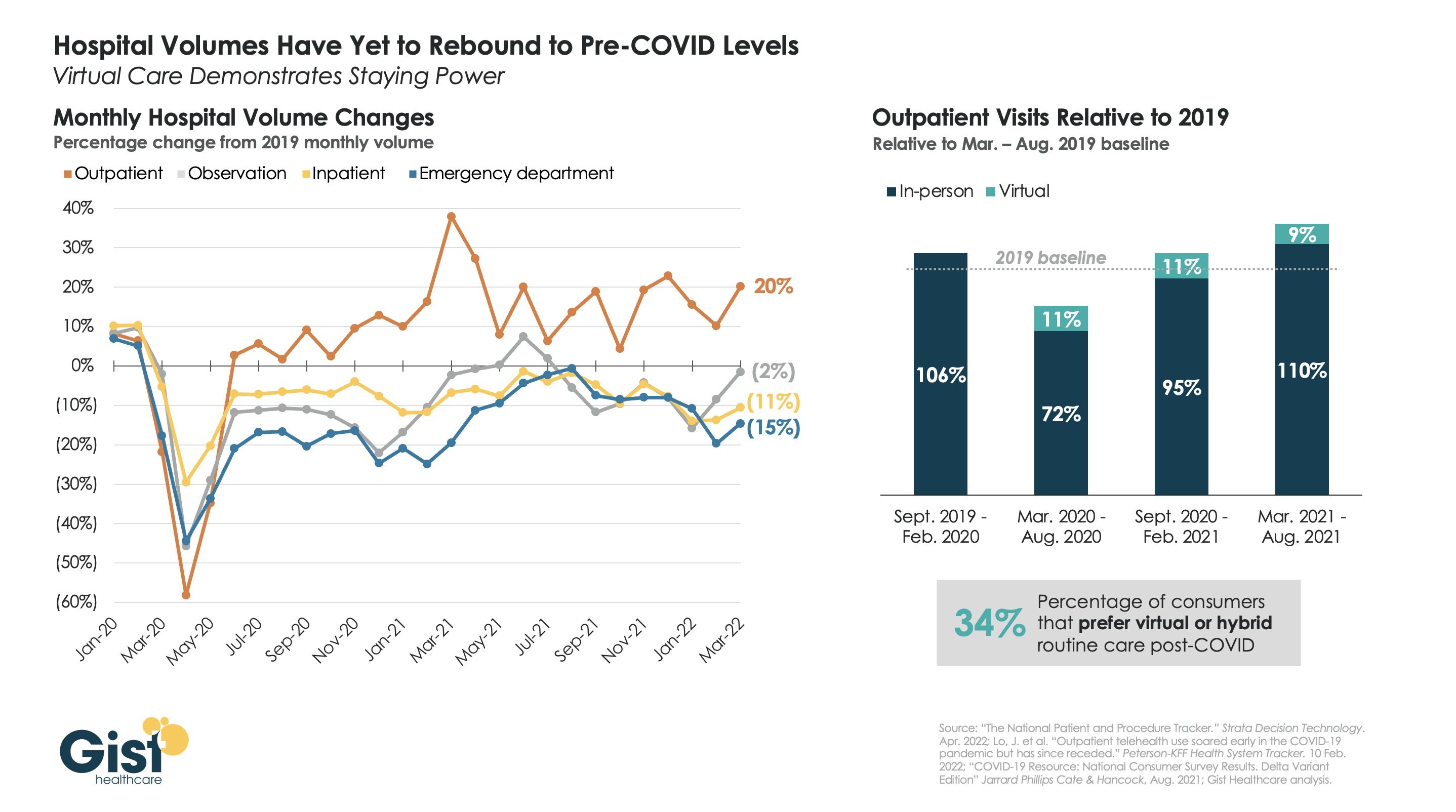
More than two years after the pandemic’s onset, some types of hospital volume still haven’t returned to pre-pandemic levels. The graphic above uses recent data from analytics firm Strata Decision Technology to track monthly hospital volume across various care settings.
While outpatient volume continues to exceed pre-COVID levels, inpatient, emergency department (ED), and observation volume is still below the 2019 baseline.The unpredictability of volume trends is likely to continue, as COVID continues to ebb and flow regionally, and care continues to shift outpatient.
By contrast, the volume of virtual care visits has remained consistent, even as consumers return to in-person outpatient visits, driving up the overall level above the pre-pandemic baseline. Some of this increase in outpatient visit volume has been driven by consumers turning to urgent care clinics or doctors’ offices—either in-person or virtually—for their lower-acuity care needs.
While temporary reimbursement and licensing policies for telehealth have been the main stumbling blocks for many organizations’ longer-term planning for virtual visits, about half of states have now implemented permanent payment parity for telemedicine. As such, provider organizations that are still taking a “wait and see approach” must develop an economically sustainable virtual care model to reduce costs and meet evolving consumer demands.
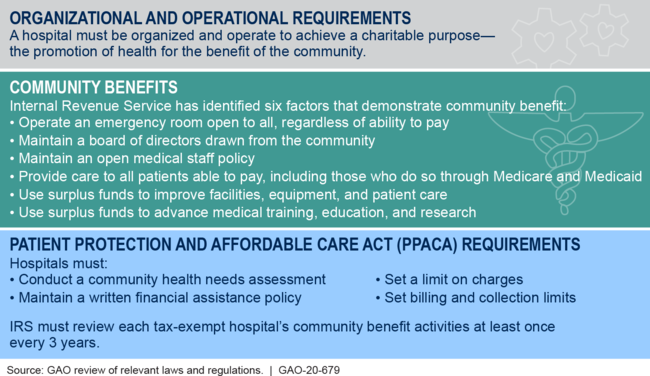
A report from The Lown Institute, a Boston-based think tank, finds that many health systems—227 of the 275 evaluated—spend less on providing “community benefit” than the value of their tax exemptions. The American Hospital Association (AHA) criticized the report’s methodology, claiming it “cherry-picks categories of community investment.” This report builds on previous analyses that have found that, taken together, nonprofit hospitals spend less on charity care than government or for-profit hospitals.
The Gist:Policymakers and academics, prompted by massive capital projects, high executive salaries, and—especially—aggressive pricing and billing strategies, are increasingly questioning whether nonprofit health systems provide sufficient community benefit to retain their tax-exempt status. A recent piece in Health Affairs suggests updating the community benefit standard, which the Internal Revenue Service (IRS) uses to evaluate nonprofit status, to focus on social determinants of health and measurable health outcomes.
We’d expect tougher scrutiny on this topic in the future, especially if state budgets come under pressure from a deterioration in the broader economy.
Organizations should prepare themselves for a continuation of quits as a new culture of quitting becomes the norm as the annual quit rate stands to jump up nearly 20 percent from annual pre pandemic levels, according to Gartner.
The pre pandemic average for quits stood at 31.9 million, but that figure could rise to 37.4 million this year, said executive consultancy Gartner in an April 28 news release.
“An individual organization with a turnover rate of 20 percent before the pandemic could face a turnover rate as high as 24 percent in 2022 and the years to come,” Piers Hudson, senior director in the Gartner HR practice said in the news release. “For example, a workforce of 25,000 employees would need to prepare for an additional 1,000 voluntary departures.”
The reason for the likely increase in quits is new flexibility in work arrangements and employees’ higher expectations, according to Gartner. A misalignment between leaders and workers is also contributing to the attrition.
“Organizations must look forward, not backward, and design a post-pandemic employee experience that meets employees’ changing expectations and leverages the advantages of hybrid work,” said Mr. Hudson.
Hospitals’ estimated annual financial losses due to 340B discount restrictions have doubled since December 2021, according to a report from the advocacy group 340B Health.
A growing number of drugmakers have imposed limits on 340B discounts to safety net hospitals for drugs dispensed at community-based pharmacies. Between December and March, six more drugmakers imposed restrictions.
340B Health surveyed more than 500 hospitals from November to December 2021 and again in March to assess how these increasing restrictions are affecting patients and hospitals.
Four findings:
1. The median annual financial effect on disproportionate share hospitals, rural referral centers and standalone community hospitals went from $1 million in December to $2.2 million in March.
2. Among these hospitals, 10 percent of leaders said they expect annual losses of $21 million or more.
3. Leaders from rural critical access hospitals said they also expect the median annual financial effect of 340B discount restrictions to double from $220,000 to $448,000.
4. Eighty percent of hospitals surveyed anticipated having to cut some patient care services if the restrictions become permanent.
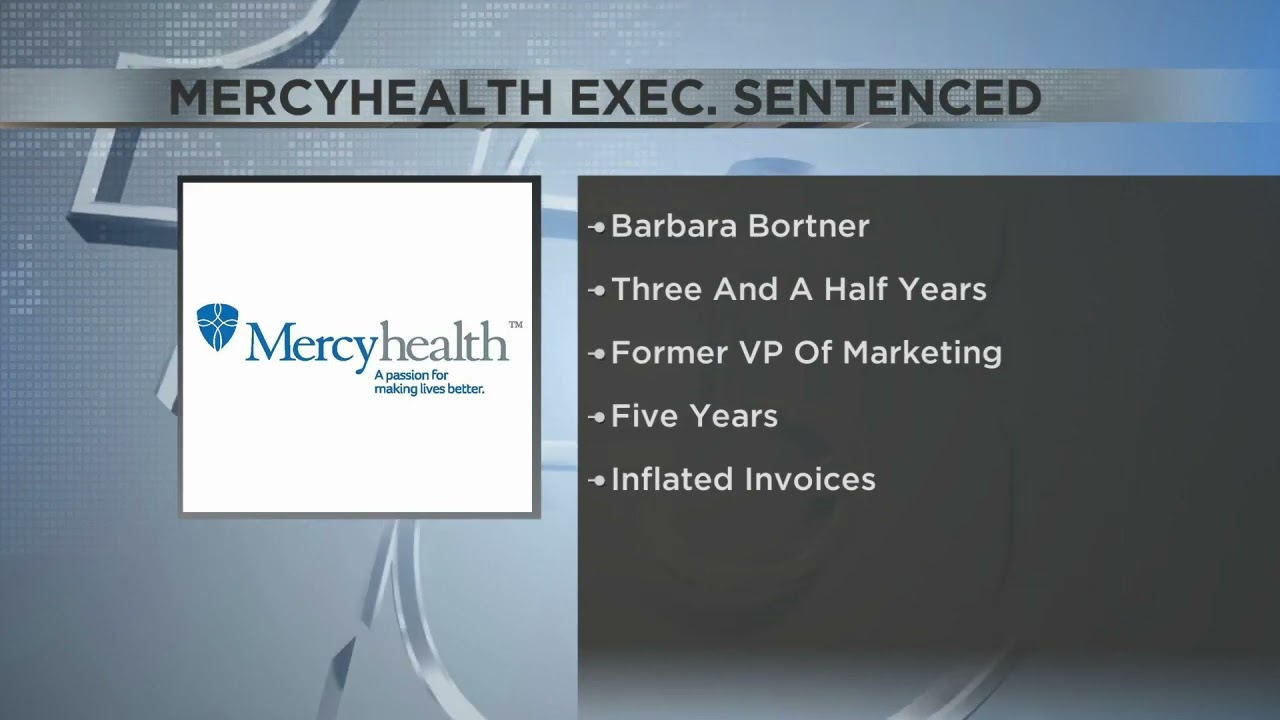
A former vice president of Janesville, Wis.-based Mercyhealth was sentenced to 3 ½ years in prison May 4 for wire fraud and tax evasion in relation to a $3.1 million kickback scheme, according to the U.S Justice Department.
Barbara Bortner, 57, Mercyhealth’s former vice president of marketing and public relations, pleaded guilty to the scheme in October 2021.
Ms. Bortner was charged in September 2021. She admitted getting kickbacks from Ryan Weckerly, owner of a marketing agency hired by the health system, from 2015 to 2020.
Prosecutors said Ms. Bortner and Mr. Weckerly created a scheme in which Mr. Weckerly’s marketing agency, Morningstar Media Group, inflated invoices sent to Ms. Bortner for marketing work he did for Mercyhealth. In exchange, Ms. Bortner receive kickbacks from the funds received.
Prosecutors also said Ms. Bortner agreed to maintain Morningstar Media as its primary marketing group in exchange for the kickbacks.
Mr. Weckerly pleaded guilty in November 2021 and will be sentenced May 17.
Mercyhealth fired Ms. Bortner in August 2021, weeks before the charges were filed against her. Mercyhealth said the fraud didn’t affect patient care.
Several hospitals are trimming their workforces due to financial and operational challenges, and some are offering affected workers new positions.
1. MetroWest Medical Center in Framingham, Mass., eliminated live interpretation services in April and laid off an undisclosed number of employees, the MetroWest Daily News reported. Hospital leaders said a “minimal number of positions” were eliminated when the hospital ended the services. Workers affected by the layoffs can apply for open positions at the hospital, according to the Daily News.
2. Watsonville (Calif.) Community Hospital is preparing to lay off 658 workers, according to a notice filed with the state and shared with Becker’s Hospital Review. The hospital, which filed for Chapter 11 bankruptcy in December, expects the layoffs to occur between May 16 and May 23. Healthcare group Pajaro Valley Health Care District was approved by a bankruptcy judge to purchase the hospital in February after no other qualified bids were submitted. The group needs to gather at least $20 million by July to purchase the hospital, Santa Cruz Sentinel reported April 4.
3. Memorial Hospital at Gulfport (Miss.)laid off its chief medical officer and vice president of system development in April. Regarding the layoffs, Memorial Hospital at Gulfport CEO Kent Nicaud said the hospital is facing financial challenges, such as increased labor costs, and is aiming to return to an organizational structure it had three or four years ago.
4. Toledo, Ohio-based ProMedica’s health plan, Paramount, is laying off about 200 employees in July after losing a Medicaid contract. Anthem acquired Paramount’s Medicaid contract, and ProMedica and Anthem have been working to identify open roles for employees affected by the layoffs.
5. MarinHealth Medical Centerlaid off 104 revenue cycle and supply chain employees in April after entering into a contract with Optum to provide those services, according to a notice filed with state regulators in February. Greenbrae, Calif.-based MarinHealth said that as a result of the contract with Optum, all non-contractual revenue cycle and supply chain employees were terminated from employment with the hospital on April 9. Optum offered jobs to most workers affected by the layoffs. Employees who accepted an offer began employment with Optum on the first work day following separation from MarinHealth, a spokesperson for the hospital told Becker’s Hospital Review.
6. St. Mary’s Medical Center in West Palm Beach, Fla., laid off 49 employees, including 21 registered nurses, when it stopped providing mental health services in April, according to a notice filed with state regulators.
7. NYC Test & Trace Corps, the city’s initiative for COVID-19 testing and contact tracing, ended universal contact tracing in April. NYC Health + Hospitals, which led the program in collaboration with the city’s department of health and other agencies, is planning to lay off 874 workers as a result of the program scaling back, according to a notice filed with state regulators March 4. The health system said affected temporary employees would be laid off at the end of April. Managerial employees affected by the layoffs will have their employment terminated between May 13 and May 27, according to the notice.
Resident and fellow physicians at Palo Alto, Calif.-based Stanford Health Care have voted in favor of representation by the Committee of Interns and Residents, according to a May 3 news release.
Of the nearly 1,050 ballots counted, 835 were in favor of representation, the National Labor Relations Board website showed.
The vote comes after resident physicians led a protest in December 2020 against Stanford’s COVID-19 vaccination plan that excluded house staff from the initial round of shots. The health system immediately revised the plan to prioritize resident physicians.
In February, physicians also demanded the health system voluntarily recognize the Committee of Interns and Residents as their exclusive representative for collective bargaining.
Now the union said its members are looking forward to negotiations.
“Our doctors are united by our desire to provide the best possible patient care and strong worker protections,” said Ben Solomon, MD, a pediatric resident physician, said in the release. “One thing the pandemic has made abundantly clear, in addition to the widespread equity issues in our healthcare system, is that our needs as physicians cannot be separated from those of our patients.”
The National Labor Relations Board must certify the election results before they are final. Stanford does not plan to challenge the results, the health system said in a statement shared with Becker’s on May 3.
“As we begin the collective bargaining process, our goal remains unchanged: providing our residents and fellows with a world-class training experience,” Stanford said. “We will bring this same focus to negotiations as we strive to support their development as physician leaders.”
The Committee of Interns and Residents is a local chapter of the Service Employees International Union. The union represents more than 20,000 resident physicians and fellows, including University of Massachusetts physicians in training, who unionized in March 2021.









 HENRY KOTULA