Economy adds 431K jobs in March, unemployment down to 3.6 percent

The U.S. added 431,000 jobs and the unemployment rate dropped to 3.6 percent in March, according to data released Friday by the Labor Department.

Job growth fell slightly short of expectations, as consensus estimates from economists projected a gain of roughly 490,000 jobs in March and a decline in the jobless rate to 3.7 percent.

But resilient consumer spending and historically strong demand for workers helped power the U.S. economy to another study job gain.

The Labor Department also revised the January and February job gains up by a combined 95,000, bringing the total of jobs added by the U.S. economy in 2022 up to 1,685,000 million.

More Americans who left the workforce during the pandemic appeared to be returning to the job hunt in March, a promising sign as businesses struggle to fill a record number of openings. The labor force participation rate ticked higher to 62.4 percent and the employment-population ratio—the proportion of working-age adults in the labor force—rose to 60.1 percent.

Wage growth also accelerated in March with average hourly earnings rising 5.6 percent over the past 12 months, up from 5.1 percent in February. 

The wage growth comes as inflation batters the Biden administration and Democrats politically, contributing to the president’s approval ratings being stuck in the low 40s. This has contributed to the anxiety in his party in a midterm election year, as Democrats are worried they could lose both the House and Senate majorities in this fall’s elections.

Gas prices have risen further with the Russian war in Ukraine and the international sanctions on Moscow. President Biden on Thursday announced he would be released 1 million barrels of oil a day from the nation’s strategic reserves to try to offer some help to lower gas prices.

The administration has touted the strength of the job market and the overall economy in the face of attacks from Republicans on inflation. And the March report offered more good news.

Overall, job-seekers continued to enjoy ample opportunities to find work at businesses across the economy even in the face of the highest annual inflation in 40 years. And businesses hit hardest by the pandemic-driven recession were among the top job-gainers in March.

The leisure and hospitality industry added 112,000 jobs in March, with restaurants and bars adding 61,000 jobs and accommodation businesses adding 25,000. Employment in the sector is still down 1.5 million from the onset of the pandemic.

Professional and business services companies gained 102,000 jobs in March and retailers added 49,000 employees, pushing both sectors well above their pre-pandemic employment levels.

The manufacturing, construction, and financial sectors also saw strong jobs gains last month.

The strong March job haul is the latest in a string of stellar employment reports. The U.S. has gained an average of 562,000 jobs each month in 2022—the same rate as in 2021, when the country added a record-breaking 6.8 million jobs

Even so, steady monthly job growth has done little to bolster Biden’s approval ratings and voters’ views about his handling of the economy. While job growth, consumer spending, the stock market and property values rebounded rapidly from the recession, a 7.9 percent annual increase in prices has wiped out the political benefit of a strong economy otherwise.

Will baby boomers unretire?

Economists are curious as to whether baby boomers who accelerated their retirement during the pandemic will return to the workforce, and if so, at what rate. 

About 2.6 million older workers retired above ordinary trends since the start of the pandemic two years ago, according to a Bloomberg report citing estimates from the Federal Reserve Bank of St. Louis. Despite this boom, applications for Social Security benefits have remained fairly flat, based on calculations by the Boston College Center for Retirement Research. About 0.1 percent of the U.S. population 55 and older have applied each month, which is in line with pre-pandemic applications.

Pandemic surges in stock and real estate values made this an “opportune time for some workers to step out of the labor force and stay out of the labor force,” Lowell Ricketts, data scientist for the Institute for Economic Equity at the St. Louis Fed, told Bloomberg. “But we’re still expecting a steady, steady trend that some might want to come back,” he noted, citing remote and hybrid work as attractors for seniors eyeing a return to the job market, particularly amid high inflation. 

Bureau of Labor Statistics data on labor participation shows that some baby boomers have come back, while many remain on the sidelines. Pre-pandemic, “unretirement” was not uncommon in the United States, due to financial hardship or personal choice. It’s still too soon to say whether the pandemic has challenged this dynamic.

Some “retirees” may have only one foot out the door, too. The Social Security Administration’s Office of the Chief Actuary suggested older people may have “retired” from one job and continued working in another, which explains why they haven’t applied for benefits, Bloomberg reports. 

Early retirements have stood to further disrupt the healthcare labor force throughout the pandemic. For instance, census microdata from the Current Population Survey provided by the University of Minnesota shows 14,500 nurses had recently retired as of March 2021, an increase of 140 percent over that figure in March 2019, according to a Pew report. The figure represents people who worked in the profession the past year but said they were now retired and not looking for work.

Read the Bloomberg report in full here

New jobless claims fall to 187,000, setting more than five-decade low

https://finance.yahoo.com/news/weekly-jobless-claims-week-ended-march-19-2022-183206198.html

U.S. jobless claims set a more than 50-year low last week as the red-hot labor market shows few signs of cooling in the near-term.

The Labor Department released its latest weekly jobless claims report Thursday at 8:30 a.m. ET. Here were the main metrics from the print, compared to consensus estimates compiled by Bloomberg:

  • Initial jobless claims, week ended March 19: 187,000 vs. 210,000 expected and a revised 215,000 during prior week
  • Continuing claims, week ended March 12: 1.350 million vs. 1.400 million expected and a revised 1.417 million during prior week

At 187,000, new jobless claims improved for a back-to-back week and reached the lowest level since September 1969. Continuing claims also fell further to reach 1.35 million — the least since January 1970.

The labor market has remained a point of strength in the U.S. economy, with job openings still elevated but coming down from record levels as more workers rejoin the labor force from the sidelines.

Going forward, however, some economists warned that new cases of the fast-spreading sub-variant of Omicron, known as BA.2, could at least temporarily disrupt mobility and economic activity across the country. As of this week, about one-third of COVID-19 cases in the U.S. have been attributed to the sub-variant, though overall new infections have still been trending down from January’s record high. The impact on the labor market — and on demand in the service sector especially — remains to be seen.

Right now, U.S. cases are in the sweet spot between the bottom of the initial Omicron wave and the impending explosion in BA.2 cases, but this probably won’t last long,” Ian Shepherdson, chief economist at Pantheon Macroeconomics, wrote in a note this week. “Our bet … is that the coming BA.2 wave will trigger a modest but visible pull-back in the discretionary services sector, thereby dampening consumption in the first month of the second quarter.”

Still, many economists and policymakers have pointed out that the labor market withstood prior disruptions due to the Omicron wave earlier this year. Non-farm payrolls grew more than expected in each of January and February despite the outbreak.

And Federal Reserve Chair Jerome Powell reiterated his assessment of the labor market’s strength earlier this week, just days after calling the current job market “tight to an unhealthy level” in his post-Fed meeting press conference last week.

“The labor market has substantial momentum. Employment growth powered through the difficult Omicron wave, adding 1.75 million jobs over the past three months,” Powell said in a speech Monday. By many measures, the labor market is extremely tight, significantly tighter than the very strong job market just before the pandemic.”

The tightness of the labor market has also strongly informed the Fed’s decisions in pressing ahead with tightening monetary policy, with the economy showing clear signs of strength and the ability to handle less accommodative financial conditions. Last week, the Fed raised interest rates by 25 basis points in its first rate hike since 2018. And St. Louis Fed President Jim Bullard, the lone dissenter of that decision who had called for a more aggressive 50 basis point rate hike last week, justified his vote in part given the strength of the U.S. labor market even in the face of decades-high rates of inflation.

“U.S. labor markets are today already stronger than they have been in a generation,” Bullard said in a statement.

Labor Market Trends

January jobs report: Payrolls jump by 467,000 as unemployment rate rises to  4.0%

Good morning. Here’s Axios chief economic correspondent Neil Irwin and markets correspondent Emily Peck with what you need to know about today’s surprising jobs numbers.

After days of doom-and-gloom talk about how bad the January jobs numbers would be due to the Omicron variant, they turned out to be, um, great?

  • Employers added 467,000 jobs last month, despite millions out sick.

Why it matters: It’s rare for any jobs numbers to be stunning, but these were. They leave little doubt that this remains a tight job market in which employers are doing everything they can to hold on to their workers.

The big picture: Some of the biggest job gains were in categories that have strong seasonal patterns, normally adding workers in the fall and then cutting those temporary workers in January.

  • But employers, desperate for staff, appear to have held onto those workers in greater numbers than in a normal year.
  • Due to the statistical process of seasonal adjustment, “cutting fewer workers than usual for this time of year” gets translated as “adding lots of jobs.”

By the numbers: Leisure and hospitality added 151,000 jobs; retail added 61,000; and transportation and warehousing added 54,000.

Between the lines: The report offered more evidence that this is an exceptionally tight labor market with inflationary pressures brewing, giving the Federal Reserve the green light for interest rate increases.

  • Average hourly earnings rose a robust 0.7%, and are up 5.7% over the last year. Employers are being forced to pay up to fill their job openings.

Yes, but: Omicron really did have an effect. The report said 6 million people were unable to work because their employers were closed or lost business due to the pandemic, up from 3.1 million in December.

What they’re saying: “Had the prior relationship between Covid cases and employment held true, 800k daily new Covid cases would have led to 2.3 million job losses,” Julia Pollak, chief economist at ZipRecuiter, tweeted. “Instead, we saw 467,000 job GAINS!”

The bottom line: This is an incredibly strong labor market that is poised to strengthen further as Omicron fades.

U.S. added 467,000 jobs in January despite omicron variant surge

The U.S. economy added 467,000 jobs in January as the omicron variant spiked to record heights, with the labor market performing better than many expected two years after the pandemic began.

The unemployment rate ticked up slightly to 4 percent, from 3.9 percent the month before.

The monthly report, released by the Department of Labor, stems from a survey taken in mid-January, around the time the omicron variant was beginning to peak, with close to 1 million new confirmed cases each day. The rapid spread during that period upended many parts of the economy, closing schools, day cares, and a number of businesses, forcing parents to scramble.

But the labor market, according to the new data, performed very well during that stretch.

In addition to the robust January, the Department of Labor also revised upward the figure for December’s jobs report, to 510,000 from 199,000, and November, to 647,000 from 249,000. That means that there were some 700,000 more jobs added at the end of last year than previously estimated — showing a labor market with momentum heading into the new year.

The data sets show a labor market that continues to recover at a strong pace from the pandemic’s worst disruption in March and April of 2020.

New outbreaks and variants have sent shockwaves through the economy since then, but the labor market has continued to return, with companies working to add jobs and wages steadily rising.

The industries experiencing growth in January were lead by the leisure and hospitality sector, which added 151,000 jobs on the month, mostly in restaurants and bars. Professional and business services added 86,000 jobs. Retailers added 61,000 jobs in January, which is typically an off month. Transportation and warehousing added 54,000 jobs.

The labor market’s participation rate, a critical measurement that has never fully recovered from losses during the pandemic’s earliest days, also went up significantly, to 62.2 percent from 61.9 percent. That shows more people are reentering the labor force, looking for work.

Average hourly earnings increased by 23 cents on the month to $31.63, up 5.7 percent over the last year. However, those gains for many people have largely been wiped out by rising prices from inflation.

The data was collected during a tumultuous period. Nearly nine million workers were out sick around the time the survey was taken, and some of them could have been counted as unemployed based on the way the survey is conducted.

January is traditionally a weak month for employment when retail and other industries shed jobs after the holiday season. Economists say that seasonal adjustments made to the survey’s data to account for this have the potential to distort the survey in the other direction, given that the holiday shopping boom appeared to take place earlier this year than typical.

As such, predictions for job growth for the month had been all over the map. Analysts surveyed by Dow Jones predicted an average of about 150,000 jobs added for the month, in what would be the lowest amount added in a year. Some economists predicted job losses, of up to 400,000.

Last year was a strong year for growth in the labor market, with the country adding an average of more than 550,000 jobs a month — regaining some 6.5 million jobs lost in the pandemic’s earlier days, after the Department revised its numbers. The country has about 2.9 million fewer jobs than it had before the pandemic, according to the figures released Friday.

Omicron is going to make it look like things dropped off a cliff in January, but overall they did not,” said Drew Matus, chief market strategist for MetLife Investment Management.

Some economists like Matus say that the prospects for such rapid regrowth are more complicated this year, with the fiscal measures that boosted the economy during the pandemic’s first two years, like generous government aid, and record low interest rates from federal bankers, having largely expired, and the country’s confidence in a virus-free future dented after the winter wave.

Since the rollout of vaccines last year, there have been hopes that a return to a more typical rhythm of life could encourage some of the roughly two million people who have left the labor force during the pandemic to seek work anew, but thus far, continued threats from variants — and uncertainty after more closures of schools, daycares, and office — have prevented this from materializing in a substantial way.

There are signs that the omicron exacted a toll on the economy during its peak.

Weekly unemployment claims swelled mid-month to its highest level since October, though the numbers have come down in the two weeks since. Other statistical markers like passenger traffic at airports, hotel revenues, and dining reservations also took a hit during the month.

Recent months continue to be marked by incredible churn in the labor market, as record numbers of workers are switching jobs. In December, some 4.3 million people quit or changed jobs — a number which was down from an all-time high in November but still at elevated. Employers continue to report near record numbers of job openings: the Bureau of Labor Statistics said they reported some 10.9 million openings last month.

9 hospitals laying off workers

Layoffs are back in NC: Emerson Electric to close facility; Global Brands  cutting jobs | WRAL TechWire

Several hospitals across the U.S. are laying off workers over the next three months. 

Below are nine hospitals and health systems that laid off employees or announced plans to implement layoffs since Oct. 1. 

1. Community Hospital Long Beach (Calif.) plans to lay off 328 employees early next year, according to a notice filed with state regulators. The hospital said the layoffs are set to begin after Jan. 31, 2022, and may come in stages. The layoffs are a result of Community Hospital Long Beach ending acute care and closing its emergency department. 

2. Watsonville (Calif.) Community Hospital is preparing to lay off 677 workers, according to a notice filed with the state Nov. 29. The hospital entered Chapter 11 bankruptcy Dec. 5 and announced a tentative sale agreement with the Pajaro Valley Healthcare District Project. If the sale to the nonprofit group or another buyer is finalized by Jan. 28, all 677 employees will be terminated by Watsonville Community Hospital. CEO Steven Salyer said all potential buyers are being asked to offer employment to the hospital’s workers. If the sale isn’t finalized, the hospital will close after the bankruptcy court authorizes those steps, and all employees would be terminated Jan. 28, according to the notice to the state. Funds made available through the bankruptcy process may allow the hospital to delay the layoffs.

3. Pensacola, Fla.-based Baptist Health Care said in a notice filed with state regulators that it is eliminating 233 jobs in February when it outsources various services to Wayne, Pa.-based Compass One Healthcare. Affected employees were offered positions with Compass One at the same or higher wages, according to the Nov. 22 layoff notice. 

4. West Reading, Pa.-based Tower Health filed a notice in early November with state regulators indicating it would lay off 293 employees by Dec. 31. The health system said the layoffs would affect workers at Jennersville Hospital in West Grove, Pa., which Tower Health was planning to close by the end of the year. In late November, the health system announced it entered into a definitive agreement to sell Jennersville Hospital and another facility to Canyon Atlantic Partners, a hospital management firm based in Austin, Texas. The health system subsequently called off that deal. It plans to close Jennersville Hospital on Dec. 31 and Brandywine Hospital in Coatesville, Pa., on Jan. 31. The closures will result in the loss of more than 800 jobs, according to the Philadelphia Business Journal

5. Columbia University Irving Medical Center in New York City is laying off 56 workers in February, but affected employees will be offered employment with NewYork-Presbyterian Hospital, according to a notice filed with the state Nov. 8. The layoffs are due to the integration of electronic medical records systems at Columbia University Irving Medical Center and NewYork-Presbyterian Hospital, according to the notice. 

6. Ascension Technologies, the IT subsidiary of St. Louis-based Ascension, outsourced about 330 tech jobs in November, according to a notice filed with the state. Affected employees could apply for other positions within Ascension Technologies or with the new vendor that took over the tech support for application and platforms, collaboration and end-user engineering, network and telecom and field services areas.

7. Middletown, N.Y.-based Garnet Health laid off 66 workers Oct. 29 when it closed its skilled nursing unit, according to a notice filed with the state. 

8. Kindred Hospital Northwest Indiana, a 70-bed long-term acute care hospital in Hammond, is closing, resulting in 110 layoffs, according to a notice filed with the state in August. The layoffs started Oct. 10. Kindred said the closure is a result of Mishawaka, Ind.-based Franciscan Health’s decision to downsize its Hammond hospital, a move that will eliminate Kindred’s space on the campus. 

9. Garland (Texas) Behavioral Hospital, part of King of Prussia, Pa.-based Universal Health Services, is closing and laying off its 119 employees, according to the Dallas Morning News. The layoffs started Oct. 7, according to a notice filed with the state. 

New jobless claims totaled 184,000 last week, reaching lowest since 1969

https://finance.yahoo.com/news/weekly-unemployment-claims-week-ended-dec-4-2021-192034644.html

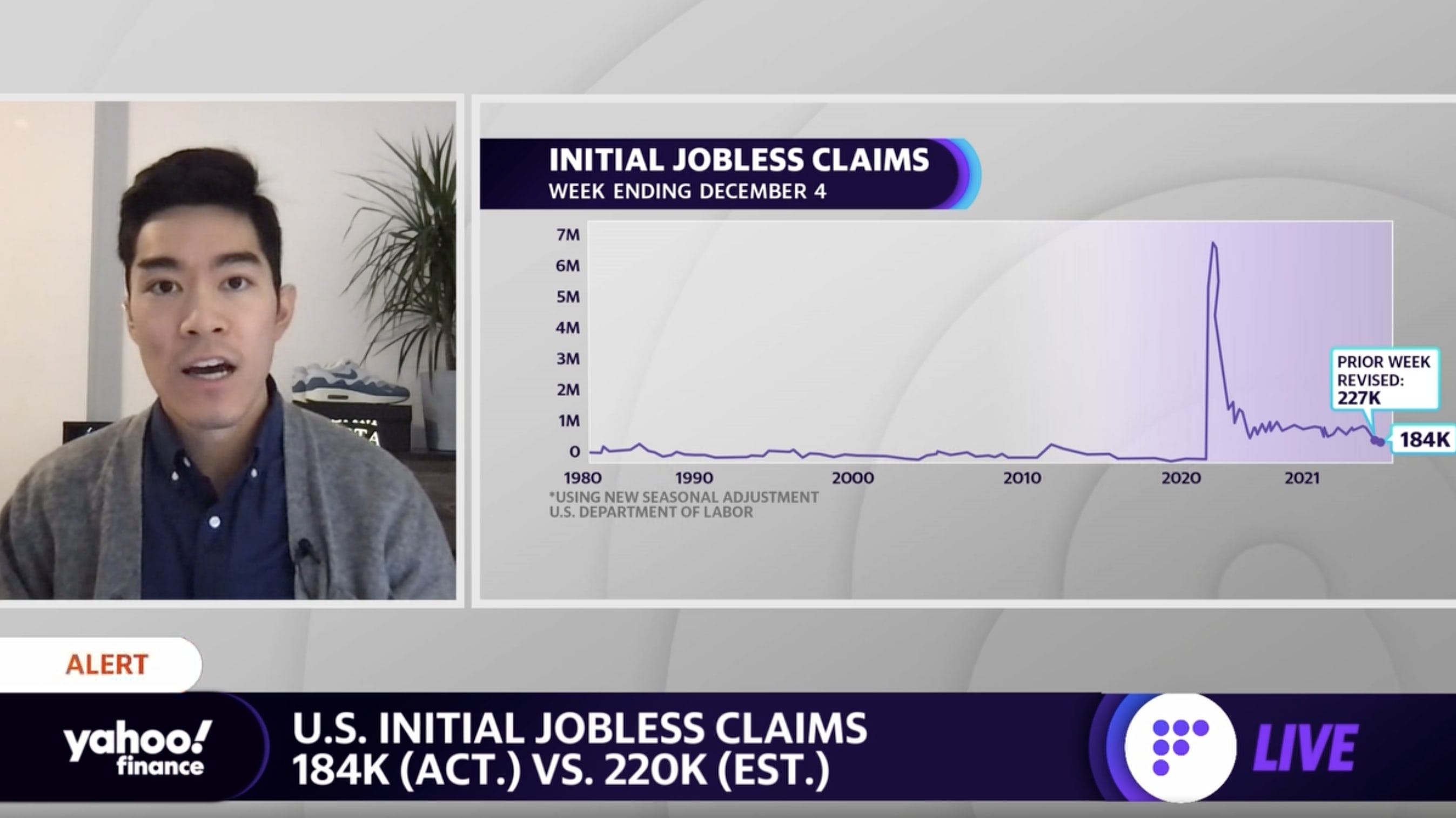
Weekly U.S. jobless claims fell to 184,000, lowest level since 1969

New initial jobless claims improved much more than expected last week to reach the lowest level in more than five decades, further pointing to the tightness of the present labor market as many employers seek to retain workers. 

The Labor Department released its weekly jobless claims report on Thursday. Here were the main metrics from the print, compared to consensus estimates compiled by Bloomberg:

  • Initial unemployment claims, week ended Dec. 4: 184,000 vs. 220,000 expected and an upwardly revised 227,000 during prior week 
  • Continuing claims, week ended Nov. 27: 1.992 million vs. 1.910 million expected and a downwardly revised 1.954 million during prior week

Jobless claims decreased once more after a brief tick higher in late November. At 184,000, initial jobless claims were at their lowest level since Sept. 1969. 

“The consensus always looked a bit timid, in light of the behavior of unadjusted claims in the week after Thanksgiving in previous years when the holiday fell on the 25th, but the drop this time was much bigger than in those years, and bigger than implied by the recent trend,” Ian Shepherdson, chief economist for Pantheon Macroeconomics, wrote in an email Thursday morning. “A correction next week seems likely, but the trend in claims clearly is falling rapidly, reflecting the extreme tightness of the labor market and the rebound in GDP growth now underway.”

After more than a year-and-a-half of the COVID-19 pandemic in the U.S., jobless claims have begun to hover below even their pre-pandemic levels. New claims were averaging about 220,000 per week throughout 2019. At the height of the pandemic and stay-in-place restrictions, new claims had come in at more than 6.1 million during the week ended April 3, 2020. 

Continuing claims, which track the number of those still receiving unemployment benefits via regular state programs, have also come down sharply from pandemic-era highs, and held below 2 million last week. 

“Beyond weekly moves, the overall trend in filings remains downward and confirms that businesses facing labor shortages are holding onto workers,” wrote Rubeela Farooqi, chief U.S. economist for High Frequency Economics, in a note on Wednesday. 

Farooqi added, however, that “the decline in layoffs is not translating into faster job growth on a consistent basis, which was evident in a modest gain in non-farm payrolls in November.” 

“For now, labor supply remains constrained and will likely continue to see pandemic effects as the health backdrop and a lack of safe and affordable child care keeps people out of the workforce,” she added. 

Other recent data on the labor market have also affirmed these lingering pressures. The November jobs report released from the Labor Department last Friday reflected a smaller number of jobs returned than expected last month, with payrolls growing by the least since December 2020 at just 210,000. And the labor force participation rate came in at 61.8%, still coming in markedly below its pre-pandemic February 2020 level of 63.3%. 

And meanwhile, the Labor Department on Wednesday reported that job openings rose more than expected in October to top 11 million, coming in just marginally below July’s all-time high of nearly 11.1 million. The quits rate eased slightly to 2.8% from September’s record 3.0% rate. 

“There is a massive shortage of labor out there in the country that couldn’t come at a worst time now that employers need workers like they have never needed them before. This is a permanent upward demand shift in the economy that won’t be alleviated by companies offering greater incentives to their new hires,” Chris Rupkey, FWDBONDS chief economist, wrote in a note Wednesday. “Wage inflation will continue to keep inflation running hot as businesses fall all over themselves in a bidding war for talent.”

Delta variant wallops job market

https://click1.email.thehill.com/ViewMessage.do;jsessionid=F9613966312B9A8532D428B13E03C0A9

Today’s Big Deal: A dismal August jobs report.

Economy adds just 235K jobs in August as delta hammers growth

That’s it for today. Thanks for reading and check out The Hill’s Finance page for the latest news and coverage. We’ll see you Friday.

The U.S. added 235,000 jobs in August and the unemployment rate fell to 5.2 percent as the economy appeared to falter under surging coronavirus cases, according to data released Friday by the Labor Department.

  • Economists had expected employment growth to slow slightly in August to a gain of roughly 750,000 jobs, according to consensus forecasts, amid falling consumer confidence and disruptive school closures. 
  • Declines in restaurant reservations, air travel and other key drivers of the recovery also raised red flags about the August jobs haul.

“Today’s report has the delta variant written all over it. It is clear that the recent surge in COVID-19 cases is a strong headwind to the labor market,” wrote Nick Bunker, economic research director at Indeed. I break it down here.

Delta homes in on pandemic-sensitive industries: The August jobs report showed setbacks in sectors of the economy hit hardest by the pandemic and crucial to the comeback from its economic blow.

  • The leisure and hospitality sector did not add any net jobs in August as a 42,000-job decline in restaurants and bars wiped out a 36,000-job gain in arts and entertainment. 
  • Employment in retail, another hard-hit sector, also fell by 29,000 thanks to steep losses at grocery stores and building material and garden supply stores. 

“The industry breakdown in employment growth shows clear signs that the increased COVID-19 spread is behind this relatively weak number,” Bunker wrote. “Yet, the labor market is still recovering.”

Signs of resilience: While job growth slowed significantly in August, the first full month since the delta surge picked up in mid-July, the labor market still showed signs of holding strong.

  • Labor force participation stayed even at 61.7 percent in August and the employment to population ratio — a broader gauge of job market strength — ticked up 0.1 percentage points to 58.5 percent. 
  • The number of Americans who have been jobless for 27 weeks or longer, known as the “long-term unemployed,” also dropped from 3.4 million to roughly 3.2 million. Those who suffer long-term unemployment often struggle to return to work and are hired at lower rates than those without long periods of joblessness.

Stronger days…behind? Upward revisions to June and July’s blockbuster jobs gains were another positive sign for the economy. June’s job haul was revised up from 938,000 to 962,000, and July’s was revised up from 943,000 to 1,053,000 — the first seven-digit job gain since August 2020.  

“The underlying momentum is still there. We just have to see if we can keep up the pace until this surge is behind us,” Bunker said.

Unemployment claims jumped to 419,000 last week, a sudden increase reflecting an unsettled labor market

Unemployment claims jumped last week, as the delta variant of the coronavirus sparked rising caseloads around the country and renewed fears about the potential for more restrictions and business closures.

The number of new claims grew to 419,000 from 368,000, the third time in six weeks that they had ticked up, according to data from the Department of Labor.

Economists said the uptick was concerning but cautioned that it was too early to tell whether it was a one week aberration or telegraphed a more concerning turn for the labor market.

“The unexpected bump in claims could be noise in the system, but it’s also not hard to see how the rise of the covid-19 delta variant could add thousands of layoffs to numbers that already are double what they were pre-Covid,” said Robert Frick, corporate economist at Navy Federal Credit Union.

Overall, unemployment numbers have been falling gradually from the peaks at other stages of the pandemic, but they are still well above pre-pandemic averages.

The jobless numbers have provided a jarring catalogue about the economic devastation wrought by the pandemic — spiking to records as the pandemic unfolded in March 2020, and remaining at historic high levels throughout most of 2020.

The coronavirus surge last fall helped precipitate a rise in claims that saw the labor market, as seen in the monthly jobs report, slide backward too.

But until recently, the last few months been marked by strong jobs growth and a sense of optimism as vaccinations picked up, giving economists hope that the country was back on track to recovering the nearly 7 million jobs it is still down from before the pandemic.

Now, the delta variant is driving an alarming increase in covid-19 cases around the country, according to public health officials: the number of new cases increased more than 40 percent in the last week, sending jitters through the stock market, and is raising questions about whether state and local health authorities will reinstitute restrictions to slow the virus’ spread.

A new mandate in Los Angeles county to wear masks indoors has sparked protests and anger from local officials, as other counties where cases are increasing mull similar actions.

Frick said that the report showed the potential for unemployment claims to start trending upward after months of steady declines.

“There’s definitely a correlation, however loose, that the rise in covid does cause a rise in claims,” he said. “My fear is that the rise in the delta variant could cause claims to go back up…Certainly one week doesn’t show that. But I wouldn’t be surprised if we start to see claims rise.”

Texas for example, where cases have grown 54 percent in the last week, lead the way with an increase of 10,000 new claims.

However, there are also lots of signs that the economy continues to rebound despite rising caseloads.

The more than 2.2 million people that the Transportation Security Administration said it screened at airports on Sunday was the most since late February 2020 — and nearly three times the amount it was on the same day last year.

Restaurant dining has largely rebounded in recent months, at times surpassing the levels from before the pandemic — on Saturday the number of diners was 1 percent higher than the same day in 2019, according to data from Open Table.

Last week, some 12.5 million claims were filed for unemployment insurance overall, according to the most recent numbers — down from 32.9 million filed at the same point last year.

Nevada, Rhode Island and California topped the list of states with the highest number of people on unemployment, the Labor Department said.

Economic concerns in recent months have been more focused on the ways that workers are still held back from filling some of the more than 9 million job openings in the country, than unemployment, with high hopes that school re-openings in the fall will help many parents get back into the labor force.

Pay cut forces Health Partners to lay off 560 workers

When layoffs become inevitable: The painful story

Health Partners, one of the largest home healthcare providers in Michigan, laid off 560 employees at the beginning of July, including nurses, nursing assistants, therapists and direct care workers, according to Crain’s Detroit Business

The layoffs occurred July 1 and happened as the Bingham Farms-based company is winding down business. The job losses are attributed to a 2019 state law capping Health Partners’ payment rates at 55 percent of what it bills insurance companies to care for injured motorists, said Chad Livengood, a senior editor at Crain’s Detroit Business

Health Partners owner John G. Prosser II, who has been in the home health business for decades, said the company couldn’t absorb the losses from the new fee schedule, which cuts payments by 45 percent, according to Crain’s

Other home healthcare companies in Michigan haven’t met the same fate as Health Partners because they rely more heavily on Medicaid, workers’ compensation insurance or private payers, according to the report. 

Read more here