Nearly half a million people in the United States have contracted the novel coronavirus in the last seven days, according to a Reuters tally, as cases and hospitalizations set fresh records in hot spots in the Midwest.
More than 5,600 people died from the virus nationwide in the last week, with hospitalizations shooting up 13%, a Reuters analysis showed.
Illinois, which has emerged as a hot spot in recent weeks, reported over 31,000 new cases in the last seven days, more new infections than any other state except Texas.
To try and contain the surge, Illinois Governor J.B. Pritzker imposed fresh rounds of restrictions in six of 11 regions.
Indoor dining in bars and restaurants will be suspended by Wednesday and gatherings will be limited to 25 people under a state formula that triggers ‘mitigation’ when the positivity rate tops 8% for at least two days in a row. The affected areas include some Chicago suburbs.
Other states have walked back reopening plans to curb the spread of the virus as cooler weather sets in across most of the nation.
Idaho Governor Brad Little on Monday announced indoor gatherings of more than 50 people would be prohibited, and outdoor gatherings are to be capped at 25% capacity.
Health experts believe the virus is surging because of private social gatherings, colder temperatures driving people inside, and fatigue with COVID-19 precautions.
Beyond the Midwest, the Texas city of El Paso is also facing a surge in cases that is overwhelming local hospitals, with officials setting up an alternate care facility to help relieve medical centers.
“We are seeing all sorts of patients. The narrative historically has been the above-65, those with multiple co-morbidities. But we’re seeing 20-year-olds. We’re seeing 30-year-olds, 40-year-olds,” Dr. Ogechika Alozie, an infectious disease specialist in El Paso, told Reuters. “There’s that exhaustion, but again, we buckle up and we take care of the patients.”
U.S. President Donald Trump, facing a tough re-election battle on Nov. 3, lashed out again at reports that the coronavirus is surging, and reiterated his false claim that the country is “rounding the turn” in its battle with the virus that has killed more than 225,800 people.
Pennsylvania, a hotly contested ‘battleground’ state in next week’s election, on Tuesday reported a fresh record in new coronavirus cases, according to the state’s health department.
The number of people hospitalized with the coronavirus has climbed significantly from a month ago, straining cities that have fewer resources to weather the surges.
The patient who died on Tuesday morning at Aurora St. Luke’s Medical Center was rolled out of her room under a white sheet. One nurse, fighting back tears, stood silently in the hall as the outline of the body passed by — one more death in an eight-month-old pandemic that has no end in sight.
“Those moments, they hit the soul,” said Jodie Gord, a nurse manager who oversees a team of about 120 people at the hospital in Milwaukee.
Aurora St. Luke’s is far from alone in coming under strain. Hospitals around the United States are reeling from the rampaging spread of the coronavirus, many of them in parts of the country that initially had been spared the worst.
Approaching the eve of the election, President Trump has downplayed the steep rise in cases, attributing much of it to increased testing. But the number of people hospitalized for the virus tells a different story, climbing an estimated 46 percent from a month ago and raising fears about the capacity of regional health care systems to respond to overwhelming demand.
The exploding case numbers point to a volatile new phase in the pandemic, coming after earlier waves hit large cities such as New York, then Sun Belt states like Florida and Arizona. While some of those places have begun to bring the virus under control, the surge of hospitalizations is crippling some cities with fewer resources.
In El Paso, where the number of people hospitalized with Covid-19 has more than tripled over the past three weeks, doctors at University Medical Center have started airlifting some patients to hospitals as far away as San Antonio while treating others in a field hospital in a nearby parking lot. Across the border in Mexico, the mayor of Ciudad Juárez, himself hospitalized after testing positive for the virus for the second time, is urging a temporary ban on U.S. citizens crossing into his city.
“We have never seen this in El Paso,” said Dr. Joel Hendryx, chief medical officer at University Medical Center, one of the largest hospitals along the border. Citing the need for field hospitals, Dr. Hendryx drew a sharp contrast to the city’s earlier surge in July, when mitigation measures drove case numbers down.
Dr. Hendryx’s hospital had 195 inpatient coronavirus cases as of Tuesday compared with about 30 a month ago. In addition to the parking lot tents, officials in El Paso are converting the downtown convention center into a 50-bed hospital. Hundreds of health workers from other parts of Texas are deploying to El Paso, including an ambulance strike team with paramedics from the Houston area.
The situation is also becoming critical in states such as Idaho, Missouri, New Mexico and Utah, with frontline workers exhausted and hospitals struggling to find replacements for those testing positive each day.
At St. Luke’s Magic Valley Medical Center in Twin Falls, Idaho, where more than one-third of patients have Covid-19, administrators are sending children to a hospital in Boise, two hours away. The influx of patients from rural areas with little health infrastructure is similarly straining hospitals in Wisconsin, where cases have increased 53 percent from two weeks ago.
Across the country, case numbers have risen to fearsome new levels in recent days, with the seven-day average for new cases exceeding 70,000 for the first time in the pandemic. Twenty-six states are at or near record numbers for new infections. More than 500,000 cases have been announced in the past week. And exactly zero states are seeing sustained declines in case numbers.
On a per capita basis, smaller cities and rural counties in the Upper Midwest and Mountain West are struggling most acutely. North Dakota, South Dakota, Wisconsin and Montana lead the country in new infections per capita. Of the 12 metro areas with the highest rates of new cases over the past two weeks, 10 are in North Dakota or Wisconsin.
But the dismal trend lines are not confined to those regions. North Carolina, New Mexico, Pennsylvania, Rhode Island and West Virginia have recently set seven-day records for new cases. And more big cities are starting to spiral, with alarming trends emerging in Chicago, Milwaukee and Newark.
And while the escalating case numbers had not been accompanied by a steep rise in deaths, that trend is starting to change. About 800 deaths are now being recorded across the country each day, far fewer than in the spring but up slightly from earlier this month.
Cities and towns nationwide are rushing to impose new restrictions. In Idaho, Gov. Brad Little backtracked on reopening but stopped short of a statewide mask mandate. Mr. Little limited indoor gatherings to 50 people, required masks at long-term care facilities and placed new restrictions on how bars and restaurants could serve their customers.
In Newark, all nonessential businesses will have to close at 8 p.m. beginning on Tuesday. Mayor Lori Lightfoot of Chicago imposed a curfew under which nonessential businesses must shut down from 10 p.m. to 6 a.m., and bars without a food license are no longer allowed to serve customers indoors.
In Fargo, N.D., Mayor Tim Mahoney used his emergency powers to pass the first mask mandate in the state. The mayors of Nixa and Ozark in Missouri imposed mask mandates after appeals by nearby hospitals overwhelmed by coronavirus hospitalizations.
On one of the I.C.U. floors at Aurora St. Luke’s in Milwaukee, the mood was somber on Tuesday morning as doctors and nurses made their rounds. Twenty of the 24 beds were filled, and many of the patients were on ventilators.
But the staff put on a brave face. They gave thumbs-up to patients from the hallways, walked into rooms to greet others and assisted one woman as she ate her breakfast.
Before noon, an older woman was transferred to the I.C.U. from the Covid-19 floor. Within 30 minutes of her arrival, loud beeping sent staff members running to her room, frantically grabbing personal protection gear.
The patient’s oxygen levels had plummeted to dangerously low levels, and she was going into cardiac arrest. A nurse practitioner called the patient’s family, making it clear there was a possibility she would not make it.
A staff member performed compressions on the woman in hopes of keeping her alive. After several minutes, her condition stabilized — for the moment.
She was the second patient who needed such care in just three hours. When the nurses and doctors stepped away for a breath, the woman lay on the bed, now intubated, eyes glazed over and her face pale. It was hard to see any clear signs of breathing.
Some staff members patted each other on the back. Others took deep breaths. A health care worker walked out of the patient’s room, holding a small plastic bag in her hand. Inside was jewelry to give to the family, said Ms. Gord, the nurse manager, in case the woman died.
Staff members still seemed in shock over the death of the other patient from that morning. She had become dear to the I.C.U. team, said Ms. Gord, who stood quietly and with obvious emotion as the stretcher slipped past. “Bless her soul,” she murmured. “Sweet little lady.”
Staff members said they were fighting constant exhaustion. “What’s going to happen when we cannot take care of these patients?” said Dr. Pedro Salinas, a critical care specialist, who worries about how much longer the staff can endure. “They are emotionally and mentally exhausted.”
The prospect of ending up in an overcrowded hospital ward is making some who are sick with the virus hesitant to check in. At the hospital in El Paso, staff members said some Covid-19 patients were arriving in the emergency room so debilitated that they required intubation almost immediately.
Sandra Garcia, 31, an El Paso resident who tested positive for the coronavirus last week, said she had been grappling with fatigue, shortness of breath and a loss of taste and smell, but had refrained from seeking care in the city’s crowded hospitals.
In the meantime, she is caring for a 13-year-old who also has Covid-19 and 5-year-old twins, who are all studying online from home. Ms. Garcia said she questioned why Dee Margo, El Paso’s mayor, had failed to order a shutdown of the city to curb the spike in cases.
“He’s just trying to get re-elected and it’s disgusting,” Ms. Garcia said.
Last week, Mr. Margo announced new restrictions such as closing parks to league and tournament play, but he said an order for a full city shutdown would need to come from the governor of Texas.
Dr. German Hernandez, a nephrologist who has been caring for patients at several hospitals in El Paso, said the situation was so acute that patients on oxygen were being kept in rooms in the trauma area of University Medical Center. He said that could be devastating in the event of a disaster such as the August 2019 mass shooting at a Walmart in the city that left 23 people dead.
“God forbid we have another Aug. 3 shooting because we can’t handle it right now,” Dr. Hernandez said. “We have no buffer.”
The fall Covid-19 surge keeps growing, with 29 states setting new records this month for the most new daily cases since the pandemic began, according to data from Johns Hopkins University.
And it’s not just due to more testing. The average number of daily new cases this past week is up 21% compared to the previous week, according to JHU. But testing has increased only 6.63% over the same time frame, according to the Covid Tracking Project. “We’re rising quickly. If we just go back about six, seven weeks ago to Labor Day, we were at about 35,000 cases a day,” said Dr. Ashish Jha, dean of Brown University School of Public Health.”
At least 73,240 new US cases and 985 deaths were reported Tuesday, according to JHU. “I would not be surprised if we end up getting to 100,000” new cases a day, Jha said. The surge is hitting all regions of the country. As of Wednesday, 40 states were trending in the wrong direction, with at least 10% more new cases this past week compared to the previous week, according to JHU. Missouri is the only state with at least 10% fewer cases, and the remaining nine states are relatively steady.
Without changes, ‘half a million people will be dead’
This month, 11 states reported their highest single day of new deaths since the pandemic began.
And because a vaccine probably won’t be available to most Americans until the middle of next year, personal responsibility will be key to saving American lives.“If we continue our current behavior, by the time we start to go down the other side of the curve, a half a million people will be dead,”said CNN medical analyst Dr. Jonathan Reiner, a professor of medicine at George Washington University.Under the current conditions, the daily US death toll is projected to reach 2,000 by January 1, according to the University of Washington’s Institute for Health Metrics and Evaluation.In the past nine months, more than 8.7million people in the US have been infected with coronavirus, and more than 226,000 have died.
Imminent threats to hospital capacity
Even after setting up a field hospital at the state fairgrounds, Wisconsin is facing a dire predicament with hospital capacity. “There is no way to sugarcoat it. We are facing an urgent crisis, and there is an imminent risk to you and your family,” Gov. Tony Evers said.
In Ohio, admissions to intensive care units have doubled since the beginning of this month, Gov. Mike DeWine said. Colorado is also worried about hospital capacity as the number of daily new cases skyrocketed this month. “If these trends continue, it would exceed May hospitalization numbers,” Gov. Jared Polis said. “And the modeling suggests that if we don’t change what we’re doing, it’ll exceed all of the existing hospital capacity by the end of the year. This thing moves quick, and we need to change the way we live.”The city and county of Denver has reduced the maximum allowed occupancy of restaurants, retailers and some other businesses from 50% to 25%, according to a statement Tuesday.”Why we’re doing this is to send a clarion call to everyone that we have a responsibility to once again put our hands on this boulder and begin to push it back up the hill,” Denver Mayor Michael Hancock said.
The president’s comments at a recent rally are false and contribute to the spread of misinformation, they say.
Hospital groups are pushing back against President Trump’s claims this week that doctors are over-reporting COVID-19 deaths for financial gain. Trump made the comments at a Wisconsin rally on Saturday.
“You know some countries they report differently,” Trump is quoted as saying in Newsweek. “If somebody’s sick with a heart problem, and they die of COVID they say they die of a heart problem. If somebody’s terminally ill with cancer and they have COVID, we report them. And you know doctors get more money and hospitals get more money. Think of this incentive. … We’re going to start looking at things.”
WHAT’S THE IMPACT
Hospitals and health systems are eligible to receive higher payments for complex coronavirus-related treatment under the Coronavirus Aid, Relief and Economic Security Act, under which they receive a Medicare add-on payment of 20%. However, American Hospital Association President and CEO Rick Pollack refuted Trump’s claims.
Asked to respond, the AHA referred to a viewpoint article written by Pollack in September, in which he sought to dispel what he called certain “myths.”
“Hospitals do not receive extra funds when patients die from COVID-19,” Pollack said. “They are not over-reporting COVID-19 cases. And they are not making money on treating COVID-19.
“The truth is,hospitals and health systems are in their worst financial shape in decades due to the coronavirus. In some cases, the situation is truly dire. An AHA report estimates total losses for our nation’s hospitals and health systems of least $323 billion in 2020. There is no windfall here.”
Pollack also noted that healthcare organizations adhere to strict coding guidelines and use the COVID-19 code for Medicare claims only for confirmed cases. Inappropriate coding can result in criminal penalties and exclusion from the Medicare program altogether.
In a more recent and direct response to the president’s latest comments, American Medical Association President Dr. Susan Bailey bemoaned that physicians are being pulled into a public battle over the legitimacy and motivation behind their work.
“The assault on public health and the undermining of efforts to defeat COVID-19 began with unfounded suspicions about the science and evidence of this novel coronavirus and how it spreads,” Bailey said on Tuesday. “It grew with speculation about harmful and unproven treatments for COVID-19, false claims that masks were a source of infections, and by misleading suggestions that increased testing alone explains why case counts are surging.
“It expanded again with inaccurate, dangerous statements about children being ‘almost immune’ from the most serious effects of COVID-19, a reckless plan of ‘focused protection’ and naturally acquired ‘herd immunity’ as a pathway out of this pandemic, and most recently with wild and highly offensive claims that physicians are inflating the number of COVID-19 cases and deaths to increase our incomes.”
Bailey said that many public health officials have been threatened and intimidated, prompting some to quit or retire, and decried the “campaign of misinformation” as a betrayal of public trust that threatens the work being done to treat and contain the virus.
“Our AMA will always stand on the side of patients and physicians, of science and evidence, and of free and honest conversations that build the trust that is so crucial to our work,” she said. “We will not hesitate to call out political intimidation and fear-driven rhetoric that undermines this trust or that interferes with our ability to deliver the very best care to patients.”
The American College of Emergency Physicians also issued a statement, calling Trump’s assertions “reckless” and “false.”
“To imply that emergency physicians would inflate the number of deaths from this pandemic to gain financially is offensive, especially as many are actually under unprecedented financial strain as they continue to bear the brunt of COVID-19,” ACEP wrote. “These baseless claims not only do a disservice to our health care heroes but promulgate the dangerous wave of misinformation which continues to hinder our nation’s efforts to get the pandemic under control and allow our nation to return to normalcy.”
THE LARGER TREND
The numbers of COVID-19 cases continue to bring grim news, especially in the U.S., which struggled early in the pandemic to secure testing capacity and necessary personal protective equipment for frontline healthcare workers.
As of Wednesday morning, the Johns Hopkins University coronavirus tracker showed more than 8.7 million confirmed cases of the virus in the U.S., with the death toll climbing to over 226,000. Both lead the world. Second on the list is India (7,990,322 cases, 120,010 deaths), while Brazil comes in third (5,439,641 cases, 157,946 deaths).
In Thursday’s second and final Presidential debate, former Vice President Joe Biden warned that a “dark winter” lies ahead in the coronavirus pandemic, and with cases, hospitalizations, and deaths on the rise across the country, it now appears that we are headed into a “third wave” of infections that may prove worse than both the initial onset of COVID on the coasts and the summertime spike in the Sun Belt.
Yesterday more than 71,600 new cases were reported nationwide, nearing a late-July record. Thirteen states hit record-high hospitalizations this week, measured by weekly averages, most in the Midwest and Mountain West. Several Northeastern states, which had previously brought the spread of the virus under control, also experienced substantial increases in infections, leading schools in Boston to suspend all in-person instruction. Of particular concern is hospital capacity, which is already being strained in the more rural areas now being hit by COVID cases. With infection spikes more geographically widespread than in earlier waves, fewer medical workers are available to lend support to hospitals in other states, leading to concerns about hospital staffing as admissions rise.
As hospitalizations increase, so too will demand for therapeutics to help shorten the course and moderate the impact of COVID. This week, Gilead Sciences’ antiviral drug remdesivir, previously available under an Emergency Use Authorization (EUA) from the federal government, became the first drug to win full approval from the Food and Drug Administration (FDA) to treat patients hospitalized with COVID-19. The approval was based on clinical studies that showed that remdesivir can reduce recovery time, and also includes use for pediatric COVID patients under the age of 11.
Meanwhile, the FDA cleared AstraZeneca to resume US clinical trials of its coronavirus vaccine, which had been suspended for a month following an adverse patient event. It’s widely expected that one or more drug companies will submit their vaccine candidates for EUA sometime next month, although new polling data released this week indicates that the American public is growing more skeptical in their willingness to take an early vaccine against the virus, with only 58 percent of respondents saying they would get the shot when it first becomes available, down from 69 percent in August. (Only 43 percent of Black respondents say they would get the vaccine, compared to 59 percent of Whites—a racial divide that reveals deep distrust based on the history of inequities in the US healthcare system.)
In many respects, the coming month will surely prove to be a pandemic turning point, revealing the magnitude of the next wave of COVID, the direction of US public health policy, the prospects for reliable therapeutics, and the timing of a safe and effective vaccine. We’ll soon know whether we are, indeed, headed for a winter of darkness.
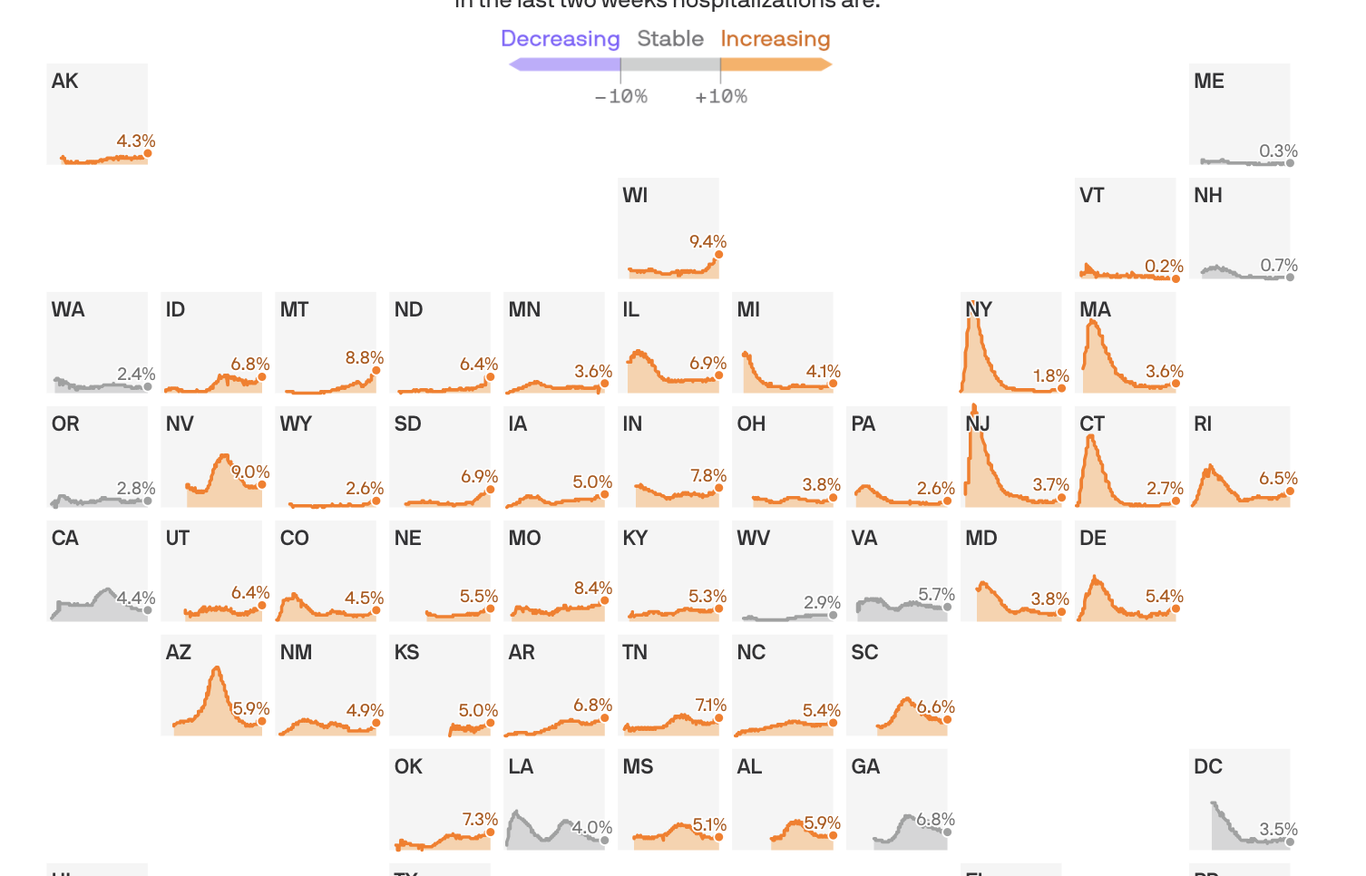
Share of hospital beds occupied by COVID-19 hospitalizations
States shown from first date of reported data, from March 17 to Oct. 17, 2020
In the last two weeks hospitalizations are:
Coronavirus hospitalizations are increasing in 39 states, and are at or near their all-time peak in 16.
The big picture: No state is anywhere near the worst-case situation of not having enough capacity to handle its COVID-19 outbreak. But rising hospitalization rates are a sign that things are getting worse, at a dangerous time, and a reminder that this virus can do serious harm.
By the numbers: 39 states saw an increase over the past two weeks in the percentage of available hospital beds occupied by coronavirus patients.
Wisconsin is faring the worst, with 9.4% of the state’s beds occupied by COVID patients.
Sixteen states are at or near the highest hospitalization rates they’ve seen at any point in the pandemic.
Yes, but: The all-time peak of coronavirus hospitalizations happened in the spring, when 40% of New Jersey’s beds were occupied by COVID patients. Thankfully, even the the worst-performing states today are still a far cry from that.
Between the lines:These numbers, combined with the nationwide surge in new infections, confirm that the pandemic in the U.S. is getting worse — just as cold weather begins to set in in some parts of the country, which experts have long seen as a potentially dangerous inflection point.
They also suggest that most parts of the country won’t need to pause or scale back non-coronavirus treatments, as hospitals did in the spring when no one was quite sure how bad things could get.
In rural areas, however, even a modestly sized outbreak can strain local hospital capacity.
Dueling petitions about what to do about COVID19 — the Great Barrington Declaration and the John Snow Memorandum — are circulating online amongst physicians, public policy makers, and academics. I am not against policy statements, consensus building, or even petitions, but both of these documents trouble me. They are the dropping anchors when we should be open to sailing where the wind blows.
Let’s start with the obvious. SARS-CoV-2 kills people. When infected, older people and those with serious comorbidities are more likely to die than younger people. This age-gradient (extra risk of death among older people) is steep. At the same time, dramatic interventions to halt SARS-CoV-2 — such as closing schools, business, travel, economic activity, normal hospital functions — also kills people. Some of these deaths occur immediately — a person with a heart attack is dissuaded from seeking care, an uncontrolled tuberculosis epidemic in a low income nation, or even depression and suicide — and some of the downsides take a long time to kill: loss of upward mobility and economic potential for the next generation will shorten lives.
Downsides to lockdowns can also be hard to predict. Harms may include destabilizing democratic governments, civil unrest, and political turmoil. The goal of policy in each and every place on earth is to minimize the total harm to the people who live there. It may vary by place and even moment based on viral spread, age of population, safety nets (or lack there-of), and a number of other factors, including values and preferences.
First, consider the Great Barrington Declaration. It’s just 540 words long, and outlines a strategy of focused protection. Based on the idea that the risk of death varies dramatically with age, it proposes we shield and protect the vulnerable while allowing the young, and others at lower risk, to get on with life as normally as possible. It offers some ideas about how to guard nursing homes, which have experienced massive causalities, and endorses simple measures like handwashing. It nods to the idea that the herd immunity threshold (fraction of people in a population who have become immune before viral spread abates) is not a fixed value: it depends on the way in which populations mix and interact and on simple measures we choose to take, such as improved hygiene. It recommends that schools, universities, bars, and restaurants be allowed to open fully.
Limitations to the statement are its lack of guidance as to who exactly the vulnerable are, how they should shield themselves, and the fact that it lumps together very different things — such as bars and schools. Open bars can be replaced with drinking beers in the backyard with a friend seated at a distance with little loss of pleasure, but education, particularly for the poor, is one of the few ladders left in American society for a better life, a place to feed children, and a vehicle for detecting abuse. Another limitation is its lack of acknowledgement that in moments of explosive spread, temporary measures likely need to be taken to prevent, for example, hospitals from overflowing. Surely, policy responses must depend on the specifics of the time and place.
The John Snow Memorandum was filed in response. It’s longer, at 930 words. It calls Great Barrington’s suggestions to achieve immunity through naturally occurring infections a “dangerous fallacy unsupported by scientific evidence.” Instead it advocates for continued restrictions, along with social programs to minimize the harms of these restrictions. Signers believe this would lower viral spread to very low levels where contact tracing can be utilized to eliminate outbreaks. Finally, the strategy ends when we have an effective vaccine, which it predicts will occur in the coming months.
Limitations to the Snow memorandum include: How exactly will one create social programs to minimize the harms, and what exactly will those programs look like? What will you do in places like the U.S. where even basic economic stimulus talks have stalled? Millions of people are entering poverty in this country, and many more may face starvation globally. How precisely and quickly will you help them? Those who criticize the Barrington authors for not providing a plan to protect the vulnerable from the virus, must criticize the Snow authors for not explaining how they will shield the vulnerable from the harms of restrictions. Additionally, calling for contact tracing is easy, but practically, this faces severe limitations in a nation like the U.S. when many individuals contacted are reluctant to share information. Here too the Snow memorandum falls short on specifics.
The declaration and memorandum are both online and taking signatures, but is this how complex policy should be decided? I find the idea that the fate of the globe will hinge on who garners the most signatures to be Kafkaesque.
Worse, the dueling petitions further divide us, when we should be talking together and working together. It does not escape me that many forces seek to tie these petitions to the Republican and Democratic parties — a dangerous but growing movement to equate pandemic policy with politics.
Signing these petitions may already be a form of identity or virtue signaling, letting others in our political circles know that we are on the virtuous team. Moreover, having signed them, we may be less likely to be willing to change our mind: To think one moment “we ought to open universities,” and the next moment, “let’s consider alternative policies, if hospitalizations rise.”
Instead of these divisive petitions, surely there are things we can all agree to. There is a hierarchy of importance to activities and events in life. Bars, strip clubs, conferences for work — fall on the low end. Schools for young kids, particularly public schools in poor or minority communities, and hospitals are among the most important. There are simple interventions that we can test in controlled trials and implement in the meantime, such as face-shields, plexiglass barriers, widespread hand sanitizer, and masks. We must prioritize schools over bars, and policy must remain individualized (to specific nation/state/county and local preferences) and fluid — able to scale up and down, as we balance the harms of the virus with the harms of closure.
Finally, we have to separate rules from behavior. You can allow restaurants to open, but it won’t help the economy if no one eats there. And, you can close everything, but you won’t slow the spread if people have backyard barbecues with dozens of people. What are the best ways to encourage desired behavior? That’s a harder problem.
Finally, there is no one-size-fits-all solution. What works in a remote island nation with a strong safety net, that can cut off contact with the rest of the world, may not work in a nation with hundreds of millions who face the threat of starvation if the economy grinds to a halt.
We need fewer pompously named petitions and instead, a COVID policy response that engages with people who hold views and perspectives different than our own; which acknowledges the lives lost from the virus and lost through the response; which is nimble and responsive to new data, new facts, and new perspectives; which engages values and preferences and local norms and the messy reality of the world as it is, not as we wish it were.
And, almost most importantly, one which is bipartisan, spanning political ideology, which unites rather than divides us.
More Americans are now in the hospital with Covid-19 than at any other point since late August, causing some states to nearly run out of hospital beds, as coronavirus infections continue to increase nationwide ahead of a potential end-of-year surge.
KEY FACTS
Some 37,048 coronavirus patients were hospitalized as of Wednesday, the highest level in almost two months according to new data from the COVID Tracking Project, though total hospitalizations are still below their mid-April peak of almost 60,000.
Among hospitalized patients, 7,156 were in ICUs and 1,776 are currently on ventilators — both of those numbers have increased slightly in recent weeks.
Texas leads the nation with more than 4,000 patients in hospitals, followed by California and Florida, though all three states’ hospital counts declined since the summer.
Hospitalizations and new cases soared in Wisconsin over the last month, and officials opened an emergency field hospital near Milwaukee this week as medical centers across the state fear they will run out of space.
Hospital numbers are also on the rise across other parts of the Midwest and South: Missouri reported a new record this week, and levels in Kentucky and Ohio are both within striking distance of their summertime peaks.
BIG NUMBER
217,933. That’s the total number of Americans who have died from Covid-19, according to figures from Johns Hopkins University. Daily fatalities are still below their peak in April, but they remain steady at more than 700 per day.
KEY BACKGROUND
When the coronavirus first surged in the New York City area, some hospitals nearly buckled under the pressure, contending with thousands of sick patients and inadequate protective equipment. Covid-19 cases gradually decreased nationwide but never fully subsided. The West Coast and Deep South dealt with cascading upticks after states loosened coronavirus restrictions during the summer, and the Midwest and small states like South Dakota are now struggling to open up more hospital capacity as new infections surge. Some experts warncases could spike yet again over the fall and winter, straining the nation’s medical system and making it tough to get sick patients the medical attention they need.
CRUCIAL QUOTE
“When we see an overwhelming number of patients get infected, a lot of them are going to need hospitalization and support,” Dara Kass, a New York-based emergency room physician, told CBS News on Thursday. “We’re seeing hospitals in Wisconsin be overwhelmed with no ICU beds … This is a big concern of those of us who are looking to prevent as many deaths as possible.”


:no_upscale()/cdn.vox-cdn.com/uploads/chorus_asset/file/21986301/2_US_Positive.png)

 HENRY KOTULA