
The Five Most Interesting Transactions Announced in 2023

Earlier this month, we released our year-end report on hospital and health system M&A activity in 2023. As a follow-up to that report, here are our thoughts on the five most interesting transactions announced in the past year.[1]

  1. The creation of Risant Health and its planned acquisition of Geisinger Health. This was the transaction that created the most buzz in 2023, promising the formation of a platform—supported by Kaiser Permanente—dedicated to the advancement of value-based care. Risant Health will be created by the Kaiser Foundation Hospitals and will acquire Geisinger as its first member. It will seek to add additional systems to the platform once the acquisition of Geisinger has been finalized.
  2. Novant Health’s acquisition of three hospitals from Tenet Healthcare. This transaction represented several of the 2023 M&A trends highlighted in our year-end report. It offers an example of for-profit health system portfolio realignmentTenet announced that the proceeds of the sale—a pre-tax book gain of approximately $1.6 billion—will be used primarily for debt retirement. It also offers an example of regional market development, as Novant continues to expand its network in North and South Carolina. And with a valuation of the deal at 16 times adjusted EBITDA—based on the $2.4 billion sale price and $150 million adjusted EBITDA reported in the press release—this transaction reflects the value of investing in high-growth markets: in this case, coastal South Carolina.
  3. Henry Ford Health System’s joint venture with Ascension. Offering another example of regional market development, this transaction, when finalized, would also provide an example of how secular and faith-based organizations can work together in partnership. The press release announcing the transaction noted that both organizations “are committed to working to maintain the Catholic identity of the Ascension Michigan facilities included in the transaction.”
  4. The combination of BJC Health System and Saint Luke’s Health System. This transaction, announced in May 2023, closed on January 1, 2024, and provides an example of the cross-market transactions that have emerged as a significant trend in hospital and health system M&A. Also—given the relatively close geographic alignment of the two systems—it provides another example of regional market development. It is the largest of the regional development transactions called out in our year-end report: others included the Novant/Tenet transaction described above, as well as the combination of Froedtert Health and ThedaCare in eastern Wisconsin and Vandalia Health’s development of a statewide network in West Virginia.[2]
  5. Centura Health’s acquisition of Steward Health’s Utah care sites. In another example of a for-profit system divesting its interest in a geographic market, Steward Health announced the sale of its Utah care sites—including five hospitals and more than 35 medical group clinics—to Centura Health, which is part of CommonSpirit Health. CommonSpirit will own the assets, which will be managed by Centura Health. For Centura, the transaction offers an opportunity to enter the growing Utah market, which has demographics similar to its home base in Colorado.

We are early in the year, but 2024 has started with a bang: the announced acquisition of Summa Health, based in Akron, Ohio, by General Catalyst’s Healthcare Assurance Transformation Corporation (HATCo).[3]  The acquisition, when completed, would launch HATCo on its path to fulfill one of the three goals set forth during the October 2023 announcement of its formation: “acquiring and operating a health system for the long term where we can demonstrate the blueprint of [healthcare] transformation for the rest of the industry.”
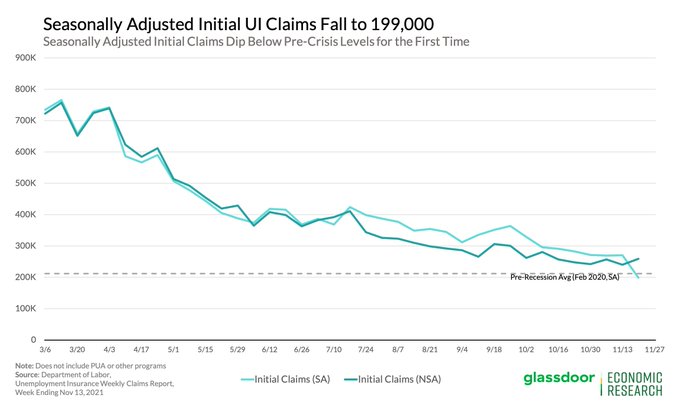

Jobless claims plunge to 199K, lowest level since 1969

Jobless claims plunge to 199K, lowest level since 1969

For the 1st time during the pandemic, initial UI claims have dipped below pre-crisis levels, falling to 199,000 (vs the Feb 2020 avg: 211,700). Layoffs are hitting new lows amid ongoing labor shortages as employers look to hold onto hard-to-find workers.

New weekly claims for jobless aid plunged to the lowest level in more than 50 years last week, according to data released Wednesday by the Labor Department.

In the week ending Nov. 20, there were 199,000 initial applications for unemployment insurance, according to the seasonally adjusted figures, a decline of 71,000 from the previous week. Claims fell to the lowest level since November 1969 and are now well below the pre-pandemic trough of 225,000 applications received the week of March 14, 2020.

The steep drop in unemployment applications comes after several strong months of job growth and rising consumer spending heading into the holiday shopping season. While high inflation has stressed many household budgets, U.S. job growth, economic production, stock values and corporate profits have all steamed ahead.

“Getting new claims below the 200,000 level for the first time since the pandemic began is truly significant, portraying further improvement,” said Mark Hamrick, chief economic analyst at Bankrate.com.

“The strains associated with higher prices, shortages of supplies and available job candidates are weighed against low levels of layoffs, wage gains and a falling unemployment rate,” he continued. “Growth will likely be above par for the foreseeable future, but within the context of historically high inflation which should relax its grip on the economy to some degree in the year ahead.”

The U.S. added 531,000 jobs in October and job growth in the previous months was revised substantially higher after a string of what first appeared to be meager gains. While businesses have struggled to hire enough workers to meet surging consumer demand, the decline in jobless claims appears to be a sign of an improving labor market.

“Layoffs are hitting new lows amid ongoing labor shortages as employers look to hold onto hard-to-find workers,” said Daniel Zhao, senior economist at Glassdoor, in a Wednesday thread on Twitter.

Even so, Zhao said the sharp decline below pre-pandemic levels may have been due to a lower than expected seasonal impact on hiring.

“As you can see from the above chart, this is in part due to the seasonal adjustment expecting a much larger jump in non-seasonally adjusted claims, so this dip below pre-crisis levels may be short-lived,” he explained.

Rational Exuberance for Medicare Advantage Market Disrupters

Insurers Running Medicare Advantage Plans Overbill Taxpayers By Billions As  Feds Struggle To Stop It | Kaiser Health News

Medicare Advantage (MA) focused companies, like Oak Street
Health (14x revenues), Cano Health (11x revenues), and Iora
Health (announced sale to One Medical at 7x revenues), reflect
valuation multiples that appear irrational to many market observers. Multiples may be
exuberant, but they are not necessarily irrational.


One reason for high valuations across the healthcare sector is the large pools of capital
from institutional public investors, retail investors and private equity that are seeking
returns higher than the low single digit bond yields currently available. Private equity
alone has hundreds of billions in investable funds seeking opportunities in healthcare.
As a result of this abundance of capital chasing deals, there is a premium attached to the
scarcity of available companies with proven business models and strong growth
prospects.


Valuations of companies that rely on Medicare and Medicaid reimbursement have
traditionally been discounted for the risk associated with a change in government
reimbursement policy
. This “bop the mole” risk reflects the market’s assessment that
when a particular healthcare sector becomes “too profitable,” the risk increases that CMS
will adjust policy and reimbursement rates in that sector to drive down profitability.


However, there appears to be consensus among both political parties that MA is the right
policy to help manage the rise in overall Medicare costs and, thus, incentives for MA
growth can be expected to continue.
This factor combined with strong demographic
growth in the overall senior population means investors apply premiums to companies in
the MA space compared to traditional providers.


Large pools of available capital, scarcity value, lower perceived sector risk and overall
growth in the senior population are all factors that drive higher valuations for the MA
disrupters.
However, these factors pale in comparison the underlying economic driver
for these companies. Taking full risk for MA enrollees and dramatically reducing hospital
utilization, while improving health status, is core to their business model.
These
companies target and often achieve reduced hospital utilization by 30% or more for their
assigned MA enrollees.

In 2019, the average Medicare days per 1,000 in the U.S. was 1,190. With about
$14,700 per Medicare discharge and a 4.5 ALOS, the average cost per Medicare day is
approximately $3,200. At the U.S. average 1,190 Medicare hospital days per thousand,
if MA hospital utilization is decreased by 25%, the net hospital revenue per 1,000 MA

enrollees is reduced by about $960,000. If one of the MA disrupters has, for example, 50,000 MA lives in a market, the
decrease in hospital revenues for that MA population would be about $48 million. This does not include the associated
physician fees and other costs in the care continuum. That same $48 million + in the coffers of the risk-taking MA
disrupters allows them deliver comprehensive array of supportive services including addressing social determinants of health. These services then further reduce utilization and improves overall health status, creating a virtuous circle. This is very profitable.


MA is only the beginning. When successful MA businesses expand beyond MA, and they will, disruption across the
healthcare economy will be profound and painful for the incumbents. The market is rationally exuberant about that
prospect.

10 health systems with strong finances

How to assess the financial strength of an insurance company | III

Here are 10 health systems with strong operational metrics and solid financial positions, according to reports from Fitch Ratings, Moody’s Investors Service and S&P Global Ratings.

1. St. Louis-based BJC HealthCare has an “AA” rating and stable outlook with S&P. The health system has a leading market share and highly regarded reputation, particularly for its flagship hospitals that are affiliated with Washington University School of Medicine in St. Louis, S&P said. The health system consistently has produced stable earnings and cash flow, even during the COVID-19 pandemic, according to the credit rating agency. 

2. Cleveland Clinic has an “Aa2” rating and stable outlook from Moody’s. The credit rating agency said the health system benefits from its reputation as an international brand, which will allow it to grow revenue outside of the Ohio market. Moody’s said it maintains good cash flow margins and therefore very strong liquidity.

3. Fountain Valley, Calif.-based MemorialCare has an “AA-” rating and stable outlook with Fitch. The health system has a strong financial profile and maintains high liquidity, Fitch said. The credit rating agency expects the system to generate cash flows of approximately 7 percent in the years after fiscal 2021. 

4. Winston-Salem, N.C.-based Novant Health has an “AA-” rating and stable outlook with Fitch. The health system has a solid market position in four regions and strong financial metrics that support the rating. The credit rating agency said Novant Health’s acquisition of New Hanover Regional Medical Center in Wilmington, N.C., will benefit the system financially and strategically in the long term.

5. OhioHealth has an “Aa2” rating and stable outlook from Moody’s. The credit rating agency said the health system has a leading market position with several growth opportunities in an attractive market and a favorable payer market that contributes to stability. Moody’s also said OhioHealth’s ongoing cost reductions and management discipline will continue to support strong margins and liquidity levels. 

6. Rady Children’s Hospital and Health Center in San Diego has an “Aa3” rating and stable outlook with Moody’s. The credit rating agency said that Rady Children’s has an extremely high market share in San Diego County and benefits from its status as a regional referral center for tertiary and quaternary pediatric services. The health system also has very strong liquidity, Moody’s said. 

7. Stanford (Calif.) Health has an “AA” rating and stable outlook with Fitch. The credit rating agency said the hospital has a broad reach and benefits, as it is a clinical destination for high-acuity services, a largely favorable service area and a close relationship with Stanford University. Fitch said it expects the health system’s post-2021 EBITDA margin to be closer to its historical 11 percent operating margin. 

8. Spectrum Health in Grand Rapids, Mich., has an “Aa3” rating and stable outlook with Moody’s. The credit rating agency said the health system has a stable operating performance and strong balance sheet metrics. In particular, the system generated positive margins even without federal relief aid in fiscal year 2020. Moody’s added that the health system will continue to benefit from a strong market share for patient care in western Michigan. 

9. SSM Health in St. Louis has an “AA-” rating and stable outlook with Fitch. The credit rating agency said it has a strong financial profile and a solid market presence in multiple states with no dependence on any one location. Fitch also said its expanding health plan is a credit positive. 

10. Birmingham, Ala.-based UAB Medicine has an “Aa3” rating and stable outlook with Moody’s. The credit rating agency said the health system has high patient demand, strong margins and a leading market share in Birmingham. The credit rating agency expects UAB Medicine to generate strong cash flow in fiscal year 2021.