What Trump and the GOP have planned for healthcare

Health systems are rightly concerned about Republican plans to cut Medicaid spending, end ACA subsidies and enact site neutral payments, says consultant Michael Abrams, managing partner of Numerof, a consulting firm.

“Health systems have reason to worry,” Abrams said shortly after President Donald Trump was inaugurated on Monday. 

While Trump mentioned little about healthcare in his inauguration speech, the GOP trifecta means spending cuts outlined in a one-page document released by Politico and another 50-pager could get a majority vote for passage.

Of the insurers, pharmaceutical manufacturers and health systems that Abrams consults with, healthcare systems are the ones that are most concerned, Abrams said.

At the top of the Republican list targeting $4 trillion in healthcare spending is eliminating an estimated $2.5 billion from Medicaid. 

“There’s no question Republicans will find savings in Medicaid,” Abrams said.

Medicaid has doubled its enrollment in the last couple of years due to extended benefits made possible by the Affordable Care Act, despite disenrolling 25 million people during the redetermination process at the end of the public health emergency, according to Abrams.

Upward of 44 million people, or 16.4% of the non-elderly U.S. population are covered by an Affordable Care Act initiative, including a record high of 24 million people in ACA health plans and another 21.3 million in Medicaid expansion enrollment, according to a KFF report. Medicaid expansion enrollment is 41% higher than in 2020.

The enhanced subsidies that expanded eligibility for Medicaid and doubled the number of enrollees are set to expire at the end of 2025 and Republicans are likely to let that happen, Abrams said. Eliminating enhanced federal payments to states that expanded Medicaid under the ACA are estimated to cut the program by $561 billion.

If enhanced subsidies end, the Congressional Budget Office has estimated that the number of people who will become uninsured will increase by 3.8 million each year between 2026 and 2034. 

The enhanced tax subsidies for the ACA are set to expire at the end of 2025. This could result in another 2.2 million people losing coverage in 2026, and 3.7 million in 2027, according to the CBO.

WHY THIS MATTERS

For hospitals, loss of health insurance coverage means an increase in sicker, uninsured patients visiting the emergency department and more uncompensated care.

“Health systems are nervous about people coming to them who are uninsured,” Abrams said. “There will be people disenrolled.”

The federal government allowed more people to be added to the Medicaid rolls during the public health emergency to help those who lost their jobs during the COVID-19 pandemic, Numerof said. Medicaid became an open-ended liability which the government wants to end now that the unemployment rate is around 4.2% and jobs are available.

An idea floating around Congress is the idea of converting Medicaid to a per capita cap and providing these funds to the states as a block grant, Abrams said. The cost of those programs would be borne 70% by the federal government and 30% by states.

This fixed amount based on a per person amount would save money over the current system of letting states report what they spent.

Another potential change under the new administration includes site neutral Medicare payments to hospitals for outpatient services.

The HFMA reported the site neutral policy as a concern in a list it published Monday of preliminary federal program cuts totaling more than $5 trillion over 10 years. The 50-page federal list is essentially a menu of options, the HFMA said, not an indication that programs will actually be targeted leading up to the March 14 deadline to pass legislation before federal funding expires.

Other financial concerns for hospitals based on that list include: the elimination of the tax exemption for nonprofit hospitals, bringing in up to $260 billion in estimated 10-year savings; and phasing out Medicare payments for bad debt, resulting in savings of up to $42 billion over a decade.

Healthcare systems are the ones most concerned over GOP spending cuts, according to Abrams. Pharmacy benefit managers and pharmaceutical manufacturers also remain on edge as to what might be coming at them next.

THE LARGER TREND

President Donald Trump mentioned little about healthcare during his inauguration speech on Monday.

Trump said the public health system does not deliver in times of disaster, referring to the hurricanes in North Carolina and other areas and to the fires in Los Angeles.

Trump also mentioned giving back pay to service members who objected to getting the COVID-19 vaccine.

He also talked about ending the chronic disease epidemic, without giving specifics.

“He didn’t really talk about healthcare even in the campaign,” Abrams said.

However, in his consulting work, Abrams said, “The common thread is the environment is changing quickly,” and that healthcare organizations need to do the same “in order to survive.”
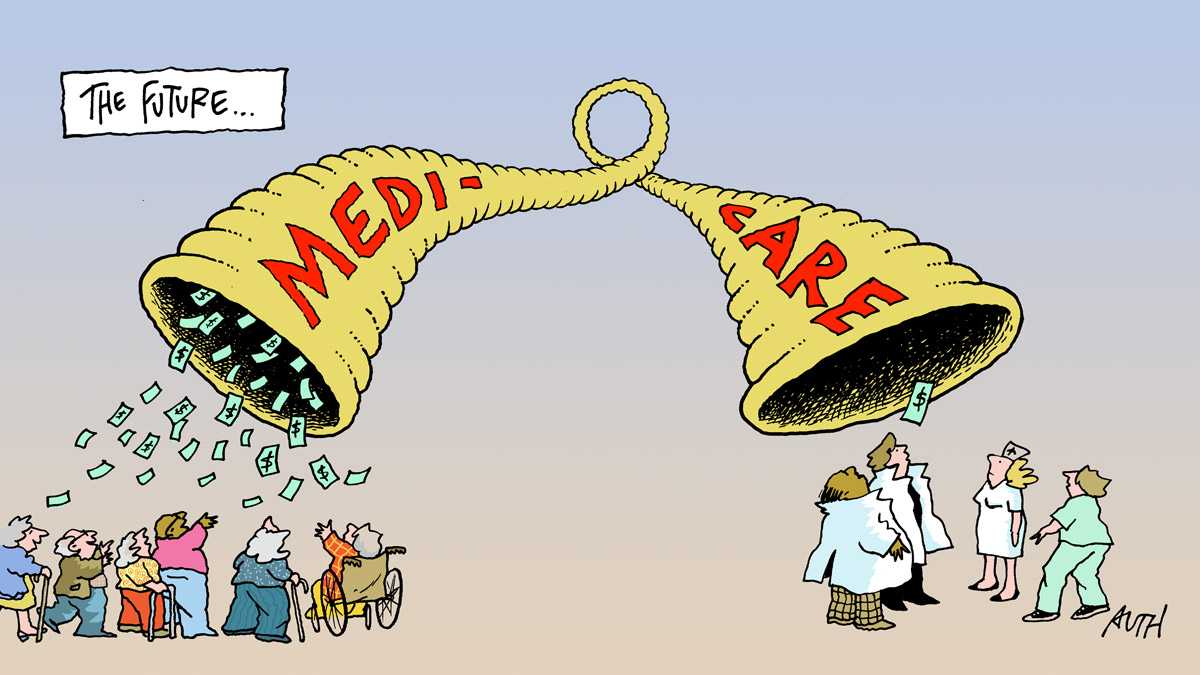
Cartoon – The Future of Medicare

ObamaCare Medicare: ObamaCare and Medicare

Administration’s Record on Health Care

President Trump’s Record on Health Care

President Trump's Record on Health Care | KFF

A review of Trump’s health care record so far. Avoiding the problematic issue of Trump’s alleged plan, analysts at the nonpartisan Kaiser Family Foundation released a report this week that examines President Trump’s record on health care over the last three and half years. Some highlights from the overview and the full analysis:

  • On the Affordable Care Act: “From the start of his presidential term, President Trump took aim at the Affordable Care Act, consistent with his campaign pledge leading up to the 2016 election. He supported many efforts in Congress to repeal the law and replace it with an alternative that would have weakened protections for people with pre-existing conditions, eliminated the Medicaid expansion, and reduced premium assistance for people seeking marketplace coverage. While the ACA remains in force, President Trump’s Administration is supporting the case pending before the U.S. Supreme Court to overturn the ACA in its entirety that is scheduled for oral arguments one week after the election.”


  • On Medicare and Medicaid: “The Administration has proposed spending reductions for both Medicaid and Medicare, along with proposals that would promote flexibility for states but limit eligibility for coverage under Medicaid (e.g., work requirements).”


  • On drug prices: “The President has made prescription drug prices a top health policy priority and has issued several executive orders and other proposals that aim to lower drug prices; most of these proposals, however, have not been implemented, other than one change that would lower the cost of insulin for some Medicare beneficiaries with diabetes, and another that allows pharmacists to tell consumers if they could save money on their prescriptions. The Trump Administration has also moved forward with an initiative to improve price transparency in an effort to lower costs, though it is held up in the courts.”


  • On the response to the coronavirus: “The Trump administration has not established a coordinated, national plan to scale-up and implement public health measures to control the spread of coronavirus, instead choosing to have states assume primary responsibility for the COVID-19 response, with the federal government acting as back-up and ‘supplier of last resort.’ The President has downplayed the threat of COVID-19, given conflicting messages and misinformation, and often been at odds with public health officials and scientific evidence.”


President Trump’s Record on Health Care – Issue Brief


Can we ‘TRUST’ the ‘CARES ACT’ to ‘HEAL’ our nation?

https://www.washingtonpost.com/business/2020/08/01/cares-trust-heals-heroes-congress-stimulus/?utm_campaign=wp_post_most&utm_medium=email&utm_source=newsletter&wpisrc=nl_most

Social Security Error Leads to Unpaid Medicare Coverage

A groan-up look at Congress’s aspirational acronyms for its various stimulus bills.

Two of the things missing from the increasingly bitter debate about how to handle covid-19’s effect on our people, our businesses and our economy are a sense of humor and bipartisanship.

So as a public service, let me try to bring both of those to bear by doing a deep dive into the various pieces of stimulus legislation currently running around in Our Nation’s Capital.

No, I’m not going to give you a detailed, sleep-inducing analysis featuring numbers and experts opining about various provisions. Instead, I’m going to look at the names — which I find hilariously tortured — of the various pieces of legislation.

Possibly because I’m both a recovering English major and a non-Washingtonian, I like to know the full names of the legislation — like the Cares Act — that I’m writing about. And these names are just great. Let’s start with the Cares (or as I prefer to call it, CARES) Act.

Do you know what the full name of that legislation is? Probably not. Okay, I’ll tell you. It’s the Coronavirus Aid, Relief and Economic Security Act. A name clearly invented to produce a seemingly empathetic acronym.

Now, let’s move on to two total groaners — the Democrats’ and Republicans’ proposals for more stimulus legislation. Remember, I’m not talking about the proposals’ provisions — I’m talking about their names. The Democrats’ candidate in the current stimulus battle is the Heroes (or rather HEROES) Act. The full name of this piece of work, which has been passed by the House, is the Health and Economic Recovery Omnibus Emergency Solutions Act. My favorite part is “Omnibus,” which clearly is in the title because an acronym meister needed an O, and Omnibus was better than Outsized or Over-the-top.

Showing that they would not be out-acronymed, the Republicans named their legislation, which is currently kicking around (and being kicked around) in the Senate, the Heals (or HEALS) Act. That stands for Health, Economic Assistance, Liability protection and Schools Act. The lowercase p in “protection” let the acronym mavens call the legislation HEALS rather than HEALPS.

And finally, there’s legislation that’s been around for several years but that I discovered only recently when Mitch McConnell and his crew stuck it into the HEALS Act. It’s a proposal that would let a congressional committee, operating outside of public sight, propose cuts and changes to Social Security, Medicare and some other federal programs that use trust funds. It’s called the Time to Rescue United States Trusts (or TRUST) Act. I’ve looked at it only superficially — but from what I’ve seen, I don’t think there’s any reason to trust it.

I hope you’ve noticed that I’m doing equal-opportunity name mocking: the Cares and Trust acts, which are bipartisan; the Heroes Act, which is Democratic; and the Heals (or HEALPS) Act, which is Republican.

What do I propose to do about these contorted names? I’m glad you asked. My answer, naturally, is to propose a piece of legislation of my own: The Get Rid Of Acronyms Now Act. That, my friends, would be a true GROAN-er.


Medicare trustees again sound alarm about looming depletion of hospital fund

https://www.fiercehealthcare.com/payer/medicare-trustees-again-sound-alarm-about-looming-depletion-hospital-fund?mkt_tok=eyJpIjoiTW1Gak1tTm1NMkZtTkdKaSIsInQiOiJGTGdcL1g2RWlXK2JRSmJQY29nZDZ6ZWszRlVxSnpHaEFwT1RaWkpITVRmTCtDeGpTeUVWWk9PYlZGdlZETFFBaVA1N2xRaXVLV2lpK0h1RVBrWk84dWw3RCtEUzZ5eXpSSkJlMHNYYzlURGYwcXZSY3BJYW9aYmsxRTJXUHpMbFAifQ%3D%3D&mrkid=959610

CMS Solicits Advice on New Medicare Payment Rules

The Medicare board of trustees held steady with its prediction on when the program’s hospital fund will run dry: 2026. 

In an annual report (PDF) released Wednesday, the trustees said hospital expenditures exceeded income by $5.8 billion last year. They expect similar trends to continue until the fund runs out in six years. The 2026 estimate has remained the same over the past several years of reports.

Medicare’s Hospital Insurance Trust Fund has missed the trustees’ tests of short-term financial adequacy every year since 2003, according to the report. It also marks the third year in a row that the trustees have issued a funding warning for the program. 

Total Medicare spending in 2019 was $796 billion, according to the report.

The trustees did say that despite the looming depletion of the fund, Congress has never allowed the hospital fund to fully run out. And the sooner policymakers act, the more time they have to roll out an extensive plan, the trustees said.

“The financial projections in this report indicate a need for substantial changes to address Medicare’s financial challenges,” the trustees said. “The sooner solutions are enacted, the more flexible and gradual they can be.”

“The early introduction of reforms increases the time available for affected individuals and organizations—including health care providers, beneficiaries, and taxpayers—to adjust their expectations and behavior,” they said.

While the fund backing Part A remains a risk, the funds for prescription drug coverage in Parts B and D are set to be stable for the foreseeable future, according to the report.  

That’s because these segments of the program are designed differently from the hospital benefit. Income and premium revenue reset annually, which allows the program to build a reserve for Part B contingencies and cover expected costs. 

The trustees also projected that Part B premiums will be about $153 in 2021. Premiums will be finalized in the fall.

The trustees caution, however, that the constant evolution in medicine makes it hard for long-term projections to be reliable. They also note that none of the projections account for any impacts related to the COVID-19 pandemic. 

“Projections of Medicare costs are highly uncertain, especially when looking out more than several decades,” the trustees said. “No one knows whether future developments will, on balance, increase or decrease costs.”