Now the U.S. Has Lots of Ventilators, but Too Few Specialists to Operate Them

A patient was placed on a ventilator in a hospital in Yonkers, N.Y., in April.

As record numbers of coronavirus cases overwhelm hospitals across the United States, there is something strikingly different from the surge that inundated cities in the spring: No one is clamoring for ventilators.

The sophisticated breathing machines, used to sustain the most critically ill patients, are far more plentiful than they were eight months ago, when New York, New Jersey and other hard-hit states were desperate to obtain more of the devices, and hospitals were reviewing triage protocols for rationing care. Now, many hot spots face a different problem: They have enough ventilators, but not nearly enough respiratory therapists, pulmonologists and critical care doctors who have the training to operate the machines and provide round-the-clock care for patients who cannot breathe on their own.

Since the spring, American medical device makers have radically ramped up the country’s ventilator capacity by producing more than 200,000 critical care ventilators, with 155,000 of them going to the Strategic National Stockpile. At the same time, doctors have figured out other ways to deliver oxygen to some patients struggling to breathe — including using inexpensive sleep apnea machines or simple nasal cannulas that force air into the lungs through plastic tubes.

But with new cases approaching 200,000 per day and a flood of patients straining hospitals across the country, public health experts warn that the ample supply of available ventilators may not be enough to save many critically ill patients.

“We’re now at a dangerous precipice,” said Dr. Lewis Kaplan, president of the Society of Critical Care Medicine. Ventilators, he said, are exceptionally complex machines that require expertise and constant monitoring for the weeks or even months that patients are tethered to them. The explosion of cases in rural parts of Idaho, Ohio, South Dakota and other states has prompted local hospitals that lack such experts on staff to send patients to cities and regional medical centers, but those intensive care beds are quickly filling up.

Public health experts have long warned about a shortage of critical care doctors, known as intensivists, a specialty that generally requires an additional two years of medical training. There are 37,400 intensivists in the United States, according to the American Hospital Association, but nearly half of the country’s acute care hospitals do not have any on staff, and many of those hospitals are in rural areas increasingly overwhelmed by the coronavirus.

“We can’t manufacture doctors and nurses in the same way we can manufacture ventilators,” said Dr. Eric Toner, an emergency room doctor and senior scholar at the Johns Hopkins Center for Health Security. “And you can’t teach someone overnight the right settings and buttons to push on a ventilator for patients who have a disease they’ve never seen before. The most realistic thing we can do in the short run is to reduce the impact on hospitals, and that means wearing masks and avoiding crowded spaces so we can flatten the curve of new infections.”

Medical association message boards in states like Iowa, Oklahoma and North Dakota are awash in desperate calls for intensivists and respiratory therapists willing to temporarily relocate and help out. When New York City and hospitals in the Northeast issued a similar call for help this past spring, specialists from the South and the Midwest rushed there. But because cases are now surging nationwide, hospital officials say that most of their pleas for help are going unanswered.

Dr. Thomas E. Dobbs, the top health official in Mississippi, said that more than half the state’s 1,048 ventilators were still available, but that he was more concerned with having enough staff members to take care of the sickest patients.

“If we want to make sure that someone who’s hospitalized in the I.C.U. with the coronavirus has the best chance to get well, they need to have highly trained personnel, and that cannot be flexed up rapidly,” he said in a news briefing on Tuesday.

Dr. Matthew Trump, a critical care specialist at UnityPoint Health in Des Moines, said that the health chain’s 21 hospitals had an adequate supply of ventilators for now, but that out-of-state staff reinforcements might be unlikely to materialize as colleagues fall ill and the hospital’s I.C.U. beds reach capacity.

“People here are exhausted and burned out from the past few months,” he said. “I’m really concerned.”

The domestic boom in ventilator production has been a rare bright spot in the country’s pandemic response, which has been marred by shortages of personal protective equipment, haphazard testing efforts and President Trump’s mixed messaging on the importance of masks, social distancing and other measures that can dent the spread of new infections.

Although the White House has sought to take credit for the increase in new ventilators, medical device executives say the accelerated production was largely a market-driven response turbocharged by the national sense of crisis. Mr. Trump invoked the wartime Defense Production Act in late March, but federal health officials have relied on government contracts rather than their authority under the act to compel companies to increase the production of ventilators.

Scott Whitaker, president of AdvaMed, a trade association that represents many of the country’s ventilator manufacturers, said the grave situation had prompted a “historic mobilization” by the industry. “We’re confident that our companies are well positioned to mobilize as needed to meet demand,” he said in an email.

Public health officials in Minnesota, Mississippi, Utah and other states with some of the highest per capita rates of infection and hospitalization have said they are comfortable with the number of ventilators currently in their hospitals and their stockpiles.

Mr. Whitaker said AdvaMed’s member companies were making roughly 700 ventilators a week before the pandemic; by the summer, weekly output had reached 10,000. The juggernaut was in part fueled by unconventional partnerships between ventilator companies and auto giants like Ford and General Motors.

Chris Brooks, chief strategy officer at Ventec Life Systems, which collaborated with G.M. to fill a $490 million contract for the Department of Health and Human Services, said the shared sense of urgency enabled both companies to overcome a thicket of supply-chain and logistical challenges to produce 30,000 ventilators over four months at an idled car parts plant in Indiana. Before the pandemic, Ventec’s average monthly output was 100 to 200 machines.

“When you’re focused with one team and one mission, you get things done in hours that would otherwise take months,” he said. “You just find a way to push through any and all obstacles.”

Despite an overall increase in the number of ventilators, some researchers say many of the new machines may be inadequate for the current crisis. Dr. Richard Branson, an expert on mechanical ventilation at the University of Cincinnati College of Medicine and an author of a recent study in the journal Chest, said that half of the new devices acquired by the Strategic National Stockpile were not sophisticated enough for Covid-19 patients in severe respiratory distress. He also expressed concern about the long-term viability of machines that require frequent maintenance.

“These devices were not built to be stockpiled,” he said.

The Department of Health and Human Services, which has acknowledged the limitations of its newly acquired ventilators, said the stockpile — nine times as large as it was in March — was well suited for most respiratory pandemics. “These stockpiled devices can be used as a short-term, stopgap buffer when the immediate commercial supply is not sufficient or available,” the agency said in a statement.

Projecting how many people will end up requiring mechanical breathing assistance is an inexact science, and many early assumptions about how the coronavirus affects respiratory function have evolved.

During the chaotic days of March and April, emergency room doctors were quick to intubate patients with dangerously low oxygen levels. They subsequently discovered other ways to improve outcomes, including placing patients on their stomachs, a protocol known as proning that helps improve lung function. The doctors also learned to embrace the use of pressurized oxygen delivered through the nose, or via BiPAP and CPAP machines, portable devices that force oxygen into a patient’s airways.

Many health care providers initially hesitated to use such interventions for fear the pressurized air would aerosolize the virus and endanger health care workers. The risks, it turned out, could be mitigated through the use of respirator masks and other personal protective gear, said Dr. Greg Martin, the chief of pulmonary and critical care at Grady Health Systems in Atlanta.

“The familiarity of taking care of so many Covid patients, combined with good data, has just made everything we do 100 times easier,” he said.

Some of the earliest data about the perils of intubating coronavirus patients turned out to be incomplete and misleading. Dr. Susan Wilcox, a critical care specialist at Massachusetts General Hospital, said many providers were spooked by data that suggested an 80 percent mortality rate among ventilated coronavirus patients, but the actual death rate turned out to be much lower. The mortality rate at her hospital, she said, was about 25 to 30 percent.

“Some people were saying that we should intubate almost immediately because we were worried patients would crash and have untoward consequences if we waited,” she said. “But we’ve learned to just go back to the principles of good critical care.”

Survival rates have increased significantly at many hospitals, a shift brought about by the introduction of therapeutics like dexamethasone, a powerful steroid that Mr. Trump took when he was hospitalized with the coronavirus. The changing demographics of the pandemic — a growing proportion of younger patients with fewer health risks — have also played a role in the improving survival rates.

Dr. Nikhil Jagan, a critical care pulmonologist at CHI Health, a hospital chain that serves Iowa, Kansas and Nebraska, said many of the coronavirus patients who were arriving at his emergency room now were less sick than the patients he treated in the spring.

“There’s a lot more awareness about the symptoms of Covid-19,” he said. “The first go-around, when people came in, they were very sick right off the bat and in respiratory distress or at the point of respiratory failure and had to be intubated.”

But the promising new treatments and enhanced knowledge can go only so far should the current surge in cases continue unabated. The country passed 250,000 deaths from the coronavirus last week, a reminder that many critically ill patients do not survive. The daily death toll has been rising steadily and is approaching 2,000.

“Ventilators are important in critical care but they don’t save people’s lives,” said Dr. Branson of the University of Cincinnati. “They just keep people alive while the people caring for them can figure out what’s wrong and fix the problem. And at the moment, we just don’t have enough of those people.”

For now, he said there was only one way out the crisis: “It’s not that hard,” he said. “Wear a mask.”

Comparing pandemic intervention strategies

https://mailchi.mp/4422fbf9de8c/the-weekly-gist-november-20-2020?e=d1e747d2d8

As we navigate the greatest health crisis of our lifetimes, it turns out that many aspects of our experiences in 2020 aren’t as “unprecedented” as we may think. The widely varied pandemic responses by local and state officials (and resulting political polarization) occurring today also transpired over 100 years ago during the Spanish Flu. 

Lessons from a century ago may be worth revisiting: the left side of the graphic above details the health and economic case for public health mitigation strategies. Cities that enacted “longer interventions” (including mask mandates, closures, business capacity restrictions, and social distancing measures) in 1918 experienced fewer deaths per capita, as well as higher employment gains through 1919, compared to “similar” cities that enacted “shorter interventions.” For example, Los Angeles, which declared a state of emergency and banned all public gatherings early in the pandemic, had 25 percent fewer deaths per capita, and a 27 percentage-point greater gain in subsequent employment than San Francisco, which mainly focused on urging residents to wear masks in public.
 
Fast forward to today, when we’re also seeing significant differences between COVID containment policies at the state level. The right side of the graphic shows that states with the weakest overall pandemic containment policies are currently experiencing the worst outbreaks, measured here by hospitalizations per capita. States like Hawaii and New York, which maintained many of the strict mitigation strategies first put into place in the spring, are seeing those restrictions pay off with fewer hospitalizations during the latest spike.

Conversely, Iowa and the Dakotas have fewer, and less stringent, public health measures, and are now seeing the highest surges in the country today. (New Mexico shows that state-level policy decisions don’t explain everything—it’s currently battling a serious outbreak despite maintaining some of the strongest containment measures over the course of the pandemic.) 

As we head into the worst COVID wave so far, the debate over whether saving “lives” or “livelihoods” should dominate the pandemic response rages on. History shows that higher levels of public health intervention can both save lives and result in stronger economic recovery.

Striving to maintain normal operations in the third wave

https://mailchi.mp/4422fbf9de8c/the-weekly-gist-november-20-2020?e=d1e747d2d8

What Does 'Batten Down the Hatches' Mean?

In talking to our health system members from across the country in the past few weeks, we’ve heard that the COVID surge is happening everywhere. Nearly everyone we’ve talked to has told us that their inpatient census of COVID patients is as high or higher now than during the initial wave of the pandemic in March and April. And nearly everyone is expecting it to get much worse over the next few weeks, as hospitalizations increase in the wake of the explosion of cases we’re seeing now.

But there is something striking in our conversations in comparison to eight months ago: no one seems to be panicking. Crisis management processes that were developed and honed early in the pandemic are proving very helpful now. Normal patient care services are continuing despite the uptick in COVID volume, and protections are in place to keep the care environment segregated and COVID-free as possible.
 
While dozens of health systems, many in the hardest hit states in the Midwest and Great Plains, have announced plans to curtail elective care during this third wave, the decisions are based on individual hospital capacity and staffing, instead of being mandated by states. Having largely worked through the “COVID backlog” across the summer and early fall, system leaders want to avoid canceling surgeries again, and few are expecting state governments to force them to. 

Many of our members have drawn up plans for selective cancellations depending on capacity, but we’re not likely to see sweeping shutdowns again—unless the workforce becomes so overstretched that it impacts operations.

That’s good news, and will likely lead to less interrupted patient care. And it’s good news for hospitals’ and doctors’ economic survival, as many would not be able to absorb the body blow of another widespread shutdown. Fingers crossed.

Missouri’s COVID-19 data reports send ‘dangerous message to the community,’ say health systems

Marion County reports six additional COVID-19 cases | KHQA

A group of health system leaders in Missouri challenged state-reported hospital bed data, saying it could lead to a misunderstanding about hospital capacity, according to a Nov. 19 report in the St. Louis Business Journal.

A consortium of health systems, including St. Louis-based BJC HealthCare, Mercy, SSM Health and St. Luke’s Hospital, released urgent reports warning that hospital and ICU beds are nearing capacity while state data reports show a much different story.

The state reports, based on data from TeleTracking and the CDC-managed National Healthcare Safety Network, show inpatient hospital bed capacity at 35 percent and remaining ICU bed capacity at 29 percent on Nov. 19. However, the consortium reported hospitals are fuller, at 84 percent capacity as of Nov. 18, and ICUs at 90 percent capacity based on staffed bed availability. The consortium says it is using staffed bed data while the state’s numbers are based on licensed bed counts; the state contends it does take staffing into account, according to the report.

Stephanie Zoller Mueller, a spokesperson for the consortium, said the discrepancy between the state’s data and consortium’s data could create a “gross misunderstanding on the part of some and can be a dangerous message to the community.”

Sanford Health CEO: I’ve had COVID-19, won’t wear a mask as ‘symbolic gesture’

Sanford Health CEO to be inducted into SD Hall of Fame

Sioux Falls, S.D.-based Sanford Health President and CEO Kelby Krabbenhoft shared his thoughts about having COVID-19 and why he won’t be wearing a mask in an email to health system staff, according to the Grand Forks Herald

In the 1,000-word email sent Nov. 18, Mr. Krabbenhoft said he had COVID-19, but he’s now back in his office working without a mask. He said he won’t be wearing a mask because doing so would only be a “symbolic gesture.” He considers himself immune from the virus.

“The information, science, truth, advice and growing evidence is that I am immune for at least seven months and perhaps for years to come, similar to that of chicken pox, measles, etc. For me to wear a mask defies the efficacy and purpose of a mask and sends an untruthful message that I am susceptible to infection or could transmit it,” Mr. Krabbenhoft wrote. “I have no interest in using masks as a symbolic gesture when I consider that my actions in support of our family leave zero doubt to my support of all 50,000 of you. My team and I have a duty to express the truth and facts and reality and not feed the opposite.” 

The CDC says those who have had COVID-19 should take steps to reduce the risk of spreading the virus, including wearing a mask in public places and staying at least 6 feet away from other people. 

In his email, Mr. Krabbenhoft argues the “on-again, off-again” use of masks is absurd. “Masks have been a symbolic issue that frankly frustrates me,” he wrote. 

“On the other hand, for people who have not contracted the virus and may acquire it and then spread it … it is important for them to know that masks are just plain smart to use and in their best interest,” Mr. Krabbenhoft wrote. 

The health system CEO concluded his letter by sharing his optimism for the future, noting that some Sanford Health workers would be among the first to get a COVID-19 vaccine once it is available. 

Sanford Health didn’t respond to Becker’s Hospital Review‘s request for comment by deadline. 

Read the Grand Forks Herald article here, which includes full text of the email Mr. Krabbenhoft sent to employees.

250,000 lives lost: How the pandemic compares to other deadly events in U.S. history

At least 250,000 people in the United States have died of covid-19, the disease caused by the coronavirus, since February, and many public health officials warn the pandemic is just entering its deadliest phase. Yet, as the country confronts this horrifying death toll, there is little understanding of what a loss of this size represents.

Here is some historical perspective about losing a quarter of a million people, looking at major events in our past that have cost American lives.

More than 58,000 Americans were killed during the decade-plus of involvement in the Vietnam War. So the pandemic’s fatalities represent four Vietnam Wars since February.

During the Korean War, nearly 37,000 Americans were lost; covid-19 has claimed nearly seven times more.

During World War II, the country mourned 405,000 members of the “Greatest Generation.” The pandemic has taken nearly two-thirds as many people, a lot of them old enough to remember the fight against the Nazis and the Japanese.

And World War I? 116,000 U.S. dead in two years of fighting. The pandemic has more than doubled that number in a fraction of the time.

What about our deadliest conflict, the Civil War? Death toll estimates range from 600,000 to 850,000. Even at the high end of that range, the pandemic has permanently taken nearly 30 percent as many family members from Thanksgiving tables.

On Sept. 11, 2001, almost 3,000 people were killed in terrorist attacks in New York, Washington and Shanksville, Pa.

The deadliest day of the pandemic so far — Sept. 18 — surpassed that, at 3,660 deaths. Wednesday, as the virus surged across the country, the daily death toll had risen again to 1,894. Public health officials fear that by the end of this month, the United States could lose more people per day from the pandemic than the 2,403 Americans killed in the Japanese attack on Pearl Harbor on Dec. 7, 1941.

And how does this pandemic compare to others in U.S. history?

The Centers for Disease Control and Prevention keeps records on four of them. The 2009 H1N1 pandemic killed 12,469 Americans. The 1968 Influenza A pandemic killed about 100,000 people. And the 1957-1958 Influenza A pandemic took 116,000 U.S. lives.

The deadliest event in U.S. history was the 1918 flu pandemic, which is estimated to have killed 675,000 Americans.

One of the more conservative disease models currently projects the United States could reach 438,000 deaths, more than during World War II, by March 1, 2021.

The pandemic is as bad as it’s ever been

Coronavirus cases rise by 40% - Axios

No state in America could clear the threshold right now to safely allow indoor gatherings, Axios’ Sam Baker and Andrew Witherspoon report.

The big picture: This is bad as the pandemic has ever been — the most cases, the most explosive growth and the greatest strain on hospitals.

  • If businesses were closed right now, it would not be safe to reopen them. And holiday travel will be risky no matter where you’re coming from or where you’re going.

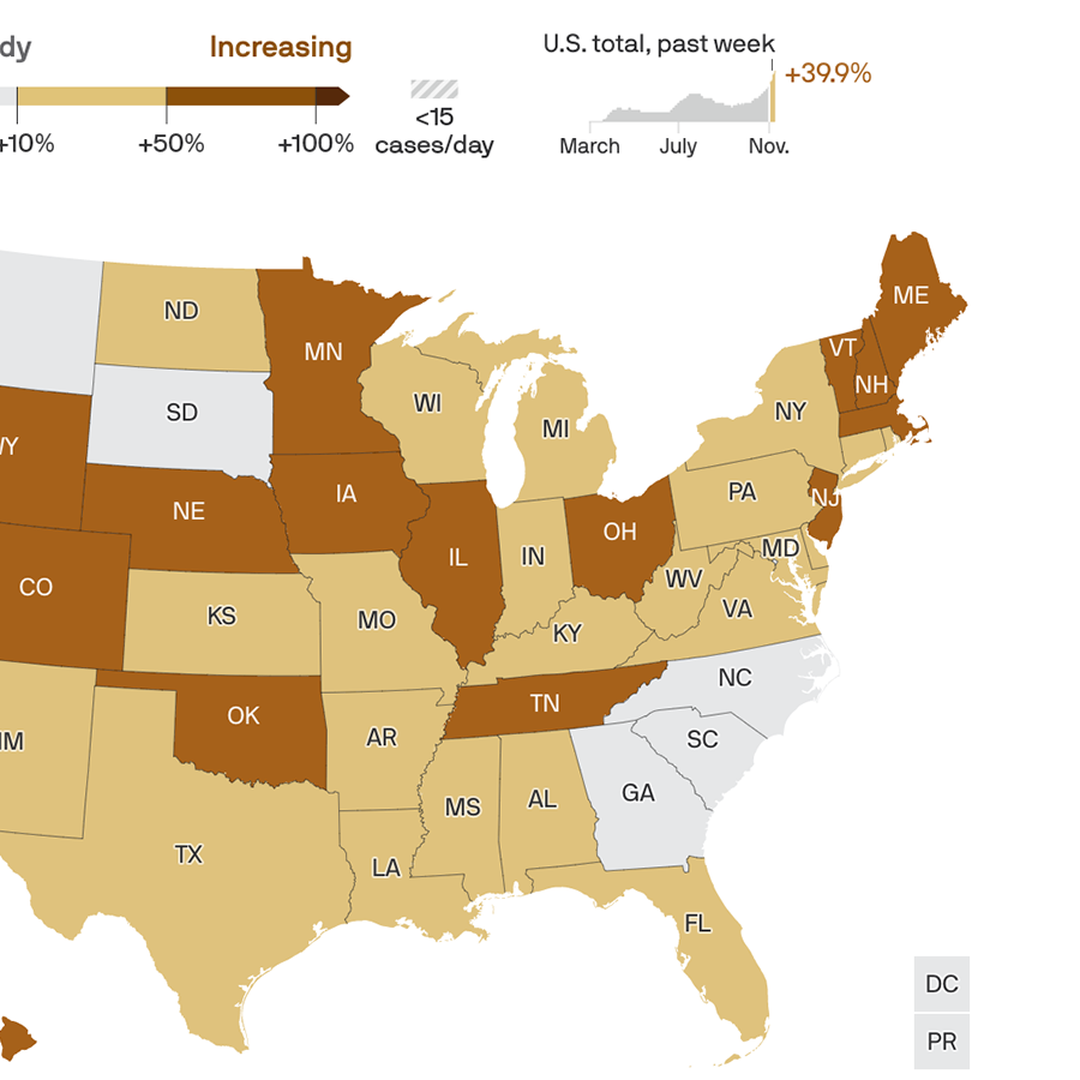
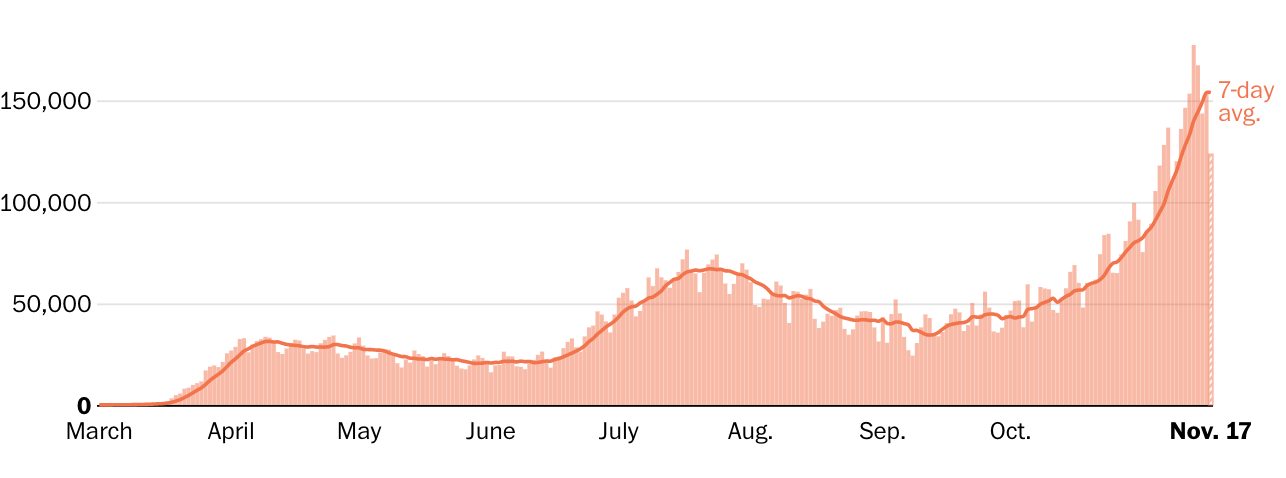
By the numbers: Over the past week, the U.S. averaged more than 154,000 new cases per day, the highest rate of the entire pandemic.

  • The number of new infections rose in 46 states, held steady in three, and declined in only one — Hawaii.
  • This week’s nationwide totals are a 30% increase over last week, which was a 40% increase over the week before that. Daily infections have been rising by at least 15% for the past six weeks.
  • Testing was up about 11% over the past week. The U.S. is now conducting about 1.5 million tests per day. That’s a lot, but cases clearly are still rising faster than testing.

Between the lines: Whatever metric you might use to decide whether it’s safe to have a large Thanksgiving get-together, or to sit inside a bar or restaurant, the answer is probably no.

  • Experts recently told The Atlantic that they wouldn’t feel comfortable attending an indoor dinner party at all, but that it would be least risky in areas with only about 10–25 new cases per day, per 100,000 people.
  • At most, only about 27% of American counties meet that standard.

The bottom line: Eating and drinking indoors with large groups of people, at a time when 150,000 people are contracting the virus every day, is about as risky as it gets.

At least 247,000 people have died from coronavirus in the U.S.

(The Washington Post, as of 3:55 p.m. Eastern)

At least 11,357,000 cases have been reported.

The disease caused by the novel coronavirus has killed at least 247,000 people in the United States since February and has enveloped nearly every part of the country.

As health officials long predicted, autumn brought soaring case counts, strained hospital capacity and increased deaths nationwide, as the virus is not only popping up in new places but also circling back to areas that once appeared to have it contained. Nearly all metrics in most of the country are trending in the wrong direction.

During an April peak, the seven-day-average U.S. death toll hit more than 2,000 per day, but cases were concentrated largely in the Northeast. During a July lull, average deaths sank to a low of 463 per day, although cases surged in the Sun Belt.

By early November, however, the country was recording more new cases than ever — well over 100,000 per day — and many states reported record-high caseloads and hospitalizations. The average U.S. deaths per day again shot past 1,000, despite improvements in treatment that make survival more likely.

In the past week in the U.S….New daily reported cases rose 26% New daily reported deaths rose 13.5% Covid related hospitalizations  rose 23.9%.

Among reported tests, the positivity rate was 10%.

The number of tests reported rose 9.6%  from the previous week.

Numbers in this article have fluctuated as testing and reporting criteria have evolved, particularly in areas that were hit early. Three spikes in the deaths chart above reflect large, one-time adjustments: In mid-April, New York City added more than 3,700 deaths. New Jersey added more than 1,800 on June 25. And in September, The Post changed its methodology for reporting deaths in New York and added a one-day increase of more than 2,700 on Sept. 18.

Health officials, including the country’s top infectious disease expert, Anthony S. Fauci, have said the virus has killed more people than official death tolls indicate.

No longer concentrated solely in a few urban areas or in nursing homes, prisons and factories, the virus seems to flourish wherever people let down their guard.

New York, which was slammed with the new disease in spring and where at least 33,000 have died, is one of several states experiencing a second or even third wave.

Sun Belt states had serious outbreaks after Memorial Day when people flocked to beaches. By late summer, parts of the Midwest were inundated. In August and September, clusters appeared in newly reopened college campuses, particularly in the Northeast and Midwest. By October, Upper Midwest, Great Plains and Western states that had previously been mostly spared were reporting major outbreaks, including MinnesotaWisconsinArkansasthe Dakotas and Alaska.

In November, most states reported record-high case counts and greater demand for hospital beds. Several set records for single-day fatalities.

In the absence of a federal plan, containment strategies vary by state and locality and have often reflected political polarization. The mounting crush of cases this fall, however, has prompted officials of both parties to tighten mask mandatesreimpose restrictions on gatherings and discourage holiday travel and gatherings to try to squelch the spread.

A majority of states and many retail chains required masks in public places by late July, and public health officials touted them as one of the easiest ways to stop the pandemic. Still, some people in even the hardest-hit areas refuse to wear them, despite evidence that they protect wearers and those around them.

People older than 65 and those with obesity and underlying health problems are the mostly likely to die from covid-19, but a large percentage of infections occur in younger, more mobile people. People younger than 40 tend to become less sick but also unknowingly may pass the disease to others around them.

The virus rarely kills children, although researchers have linked it to a mysterious and deadly inflammatory syndrome.

Outbreaks of covid-19 have hit Black, Hispanic and Native American communities particularly hard.

Sparsely populated areas don’t have the huge raw numbers that cities have reported, but some rank among the highest in deaths and cases per capita.

By late October, covid-19 had been documented in all but three U.S. counties and areas in Montana, the Dakotas and Idaho had some of the highest per capita caseloads.

People in very rural areas may be more vulnerable to covid-19 than urbanites, according to a Post analysis of CDC data.

Testing was slow to begin in the United States, and a system has yet to be standardized.

Demand has often overwhelmed testing infrastructure, muddying the ability of officials to get a true picture of the virus’s reach. In June, CDC Director Robert Redfield estimated that, based on antibody tests, the actual number of U.S. residents who had been infected by the virus was likely to be 10 times as high as the number of confirmed cases. More recently, conflicting CDC guidelines about whether people without symptoms should be tested caused confusion and inhibited contact tracing.

A sharp increase in hospitalizations in late October and November demonstrates that the virus is spreading, not just that more testing is finding more asymptomatic cases. A group of Illinois health-care workers predicted in a Nov. 10 open letter to state and Chicago officials that “Illinois will surpass its ICU bed capacity by Thanksgiving.”

Some hospitals, straining to find beds and health-care workers to handle the crush of patients, are considering unusual measures.

In North Dakota, health-care workers who test positive but have no symptoms can continue working in covid-19 wards, according to Gov. Doug Burgum (R). Some facilities in Oklahoma, Kansas and Ohio are limiting routine care and deferring non-emergency surgeries.

Not all news is bleak, however.

On Nov. 9, Pfizer announced that its promising vaccine — one of many in the works — appeared more than 90 percent effective in an ongoing trial. The same day, regulators granted emergency authorization to an antibody treatment that may keep mild illness from becoming severe.

And the next day, Fauci told CNN that the average American may have access to a vaccine by April.

1 Million Covid Kids

https://services.aap.org/en/pages/2019-novel-coronavirus-covid-19-infections/children-and-covid-19-state-level-data-report/

More than half a million children in the U.S. have had COVID-19

State-level reports are the best publicly available data on child COVID-19 cases in the United States. The American Academy of Pediatrics and the Children’s Hospital Association are collaborating to collect and share all publicly available data from states on child COVID-19 cases (definition of “child” case is based on varying age ranges reported across states; see report Appendix for details and links to all data sources).

As of November 12th, over 1 million children have tested positive for COVID-19 since the onset of the pandemic. The age distribution of reported COVID-19 cases was provided on the health department websites of 49 states, New York City, the District of Columbia, Puerto Rico, and Guam. Children represented 11.5% of all cases in states reporting cases by age.

A smaller subset of states reported on hospitalizations and mortality by age; the available data indicated that COVID-19-associated hospitalization and death is uncommon in children.

The number of new child COVID-19 cases reported this week, nearly 112,000, is by far the highest weekly increase since the pandemic began. At this time, it appears that severe illness due to COVID-19 is rare among children. However, there is an urgent need to collect more data on longer-term impacts on children, including ways the virus may harm the long-term physical health of infected children, as well as its emotional and mental health effects.

Summary of Findings (data available as of 11/12/20) :

(Note: Data represent cumulative counts since states began reporting)

Cumulative Number of Child COVID-19 Cases*

  • 1,039,464 total child COVID-19 cases reported, and children represented 11.5% (1,039,464/9,037,991) of all cases
  • Overall rate: 1,381 cases per 100,000 children in the population

Change in Child COVID-19 Cases*

  • 111,946 new child COVID-19 cases were reported the past week from 11/5-11/12 (927,518 to 1,039,464)
  • Over two weeks, 10/29-11/12, there was a 22% increase in child COVID-19 cases (185,829 new cases (853,635 to 1,039,464))

Testing (10 states reported)*

  • Children made up between 5.0%-17.4% of total state tests, and between 3.9%-18.8% of children tested were tested positive

Hospitalizations (23 states and NYC reported)*

  • Children were 1.2%-3.3% of total reported hospitalizations, and between 0.5%-6.1% of all child COVID-19 cases resulted in hospitalization

Mortality (42 states and NYC reported)*

  • Children were 0.00%-0.21% of all COVID-19 deaths, and 16 states reported zero child deaths
  • In states reporting, 0.00%-0.15% of all child COVID-19 cases resulted in death

* Note: Data represent cumulative counts since states began reporting; All data reported by state/local health departments are preliminary and subject to change

Download Full Report  (11/12/2020) 

Download Full Report  (11/5/2020) 

Download Full Report  (10/29/2020) 

Additional Information

What will the world look like after COVID-19?

Home | Bill Gates

Like a lot of people, I have really gotten into listening to podcasts over the last year. They’re such an immersive way to learn about the world, and I like how the format lets you dive as deep on a topic as you want. So, I was inspired to start one of my own—but I knew I couldn’t do it on my own.

I couldn’t ask for a better partner on this project than Rashida Jones. A mutual friend suggested that the two of us might have a lot to talk about, and it turned out he was right. I already knew she was a talented actor, but I was impressed by her thoughtful perspective on the world. So, we decided to start a podcast that lets us think through some of today’s most pressing problems together. In our first episode, Rashida and I explore a big question that is top of mind for many people: what will the world look like after COVID-19?

I know it’s hard to imagine right now while new cases are surging around the world, but there will come a time when the COVID-19 pandemic is behind us. I think it’s safe to assume that society will be changed forever, given how disruptive the virus has been to virtually every part of our lives.

Unfortunately, we still have a long way to go before life truly gets back to “normal.” Rashida and I were joined by Dr. Anthony Fauci, the director of the National Institute of Allergy and Infectious Diseases, to discuss what to expect in the months to come. I’ve had the opportunity to work with Dr. Fauci on a number of global health issues over the years, including the quest for an HIV vaccine and cure. He’s such a quiet and unassuming guy normally, so it’s been wild to watch him become a huge celebrity.

Dr. Fauci and I are both optimistic that a vaccine will bring an end to the pandemic at some point in the near future. But what the world looks like after that is a lot less clear. I suspect that some of the digitization trends we’ve seen—especially in the areas of online learning, telemedicine, and remote work—will become a regular part of our lives. I hope this episode leaves you hopeful about the future and curious about what comes next.