“Doing Good to Build Trust”

Elizabeth Wilkins: 

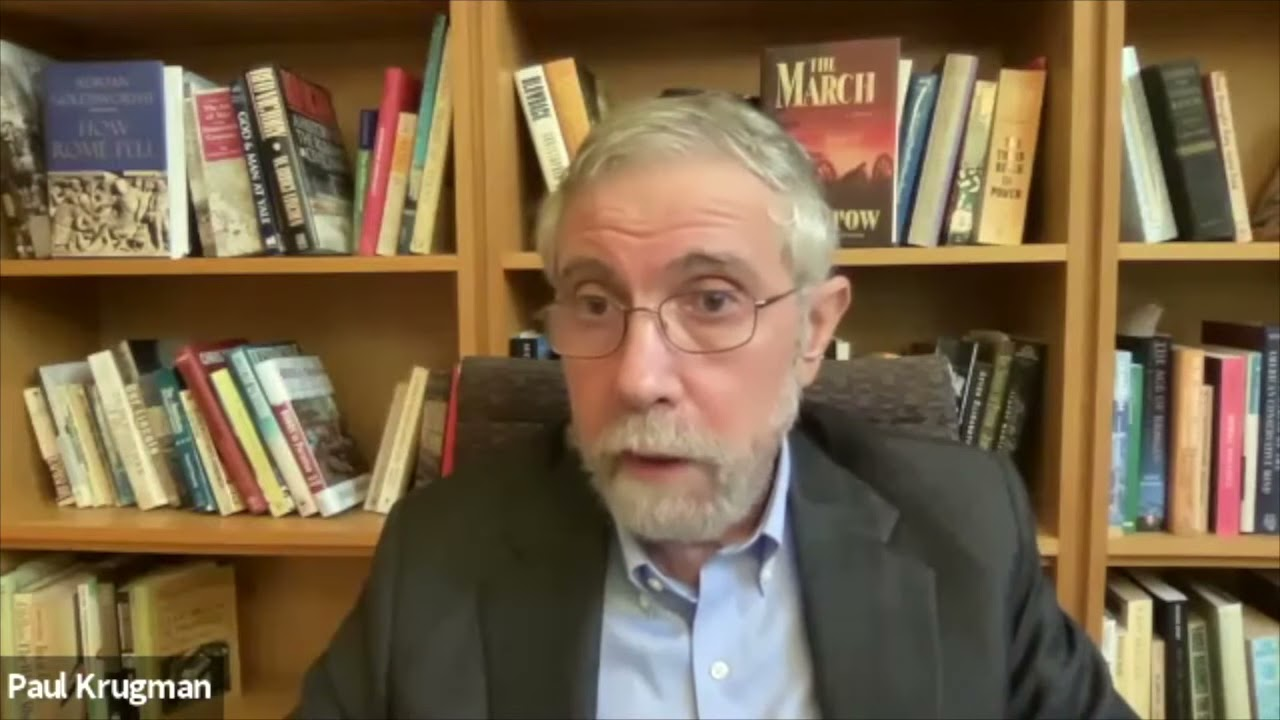
Hi, everybody. I’m Elizabeth Wilkins, president and CEO of the Roosevelt Institute, and I am delighted to be here today with some big news and a very special guest. I am thrilled to announce that Nobel Prize–winning economist Paul Krugman will be joining the Roosevelt Institute as a senior fellow. Paul is one of the world’s most cited economists and widely read commentators, and for good reason. His longtime New York Times column and his Substack now prove that he is not just a bold thinker, he is one of the clearest and most dynamic communicators in the field—skills that come in handy when you want to break through the noise of this moment and get people thinking about what the future of our economy and democracy might look like. And, of course, this is what Roosevelt is all about: understanding where we are in the moment and where we need to go. 

So, Paul, I’m so excited to talk with you today. I started at Roosevelt in February, so we’re both new kids on the block here, and I will start with a question that I am getting a lot recently: Why your interest in affiliating with Roosevelt, and why now?

Paul Krugman: 

Well, now I think because partly having retired from the New York Times, I’m free to pursue other affiliations. The Times is kind of a jealous organization. But now that I’m no longer there, I can do this. Roosevelt has been a tremendous reservoir of progressive thinking and progressive economics. I was heavily reliant on Roosevelt research particularly during the aftermath of the 2008 financial crisis—I’ve been around for a while here. [There’s] still novel stuff going on, and this seemed like a good affiliation to have in these times, to join the ranks of people with Roosevelt affiliations who have been providing really urgent commentary. 

Elizabeth: 

Thank you for the kind words. We appreciate it. One of the things that made your Times column such a hit for decades was the unique voice that you bring to economics: your ability to break down orthodoxy and cut to the core of what’s happening in plain terms. It almost goes without saying that there is a lot to cut through right now. We’ve seen attacks on government programs and on whole government agencies. And as you have noted and I have noted, the fate of Social Security and our social compact hangs in the balance right now. So, can you talk—with a little bit of your perspective on economic history—about what you think makes this moment unique? And through all this noise, what people should be paying attention to, and why? 

Paul: 

We are in a moment where we’ve lived, really since the New Deal in—whatever you want to call it—the Keynesian consensus. We’ve lived in a world where, we by no means went to socialism, but we had capitalism with some of the rough edges sanded off. Not as many of the rough edges that I would like, but we have Social Security, we’ve had Medicare since the 60s. We have Medicaid. We have the Affordable Care Act. We have a whole bunch of social insurance programs. We have government efforts to at least somewhat regulate the excesses and harms of markets. And now we are at a moment where there’s a real possibility that we may really lose that. We’re talking about possible retrogression, and the possibility of moving forward after this current moment has passed. But we really are at a point where the certainties of the underlying continuity of a fairly decent social compact is at risk. And so this is really new. 

Elizabeth:

I really like that phrase, this “capitalism with the rough edges sanded off.” And what I’m hearing you say is basically the idea of the social compact is that, yes, we have capitalism, but we also have a commitment to providing a measure of security for people, and that’s the deal we have struck. You write a ton about the New Deal and FDR [Franklin D. Roosevelt]. Can you just expand a little bit about how to think about that trade-off, how long that consensus has held, and if there are any other moments in our economic history where there have been similar threats to that compact that we can learn from? 

Paul: 

I like to think about—it’s 1933, and the world economy has collapsed. There are a lot of reasonable people [who] have concluded that capitalism is irredeemable and can’t be saved, and that on the other hand, you have a lot of forces of repression out there. And along comes several countries—with the US in some ways leading the New Deal order, which says, no, we’re not actually going to go socialist. We’re not going to seize the commanding heights of production, but we are going to try to make sure that extreme hardship is vanished, as far as we can manage. We’re going to try to make sure that workers feel that they are a part of, and that they have rights and claims to, the system. There was very much this moment when we reached a kind of—I don’t know if it’s a compromise or a synthesis—but the idea of a basic standard of decency, the Four Freedoms. While at the same time saying that it’s not evil to make profits. It’s not evil to be personally ambitious. But we are going to try to make it so that everyone shares in the gains from economic activity. 

And that really held. I mean, there was the moment when the Reagan administration came in, which represented, in many ways, a turn away from that New Deal consensus. But not to the extent that we have now. In moments of economic stress, people tend to say, well, maybe this thing doesn’t work anymore. The 1970s with stagflation, the aftermath of the 2008 financial crisis. That has basically been the case during attempts to turn away from the basic structure (which in the US context have always been a turn to the right, but in principle, you could imagine a turn to the left, but that hasn’t ever really happened in this country). And until right now, it has always seemed that the public wouldn’t stand for it. When push came to shove, when George W. Bush tried to privatize Social Security, it was a sort of resounding, “no, you don’t. We love Social Security.” But the possibility that we will have either explicitly or de facto undermining of those institutions seems much higher right now just because we live in such—well, we’re not gonna talk about the politics particularly, but there’s a possibility that we’ll lose it, that it will go away. And the one thing that I would say is that there’s this political action by itself, but there’s also the importance of getting the facts clear, getting the way the world works clear. No, there are not 10 million dead people receiving Social Security benefits. No, tax cuts and deregulation are not the only way to achieve economic growth. These are really critical things. Facts matter, analysis matters. 

Elizabeth: 

I’m just gonna pick up on that last thing you said about facts matter, analysis matters, and maybe go a little bit toward your true economist side. It’s not just Social Security we’re talking about. As you know and just mentioned, we’re in the middle of a tax and budget fight where we are very much looking at a situation where tax cuts for the wealthy might be traded for cuts to the programs that are specifically for our most vulnerable, like Medicaid and SNAP. This obviously has both political economy and democratic implications. It also has economic implications. Can you talk a little bit about this idea of what it means—this kind of wealth transfer, frankly, from the poorest to the richest, both in terms of hard facts, economics, and growth? And in terms of the social compacts that we’ve been talking about. 

Paul: 

It’s become increasingly clear that taking care of the most vulnerable members of society—it’s something you should do. It’s a moral obligation. But it’s also good economics, especially by the way of children. If you ask, a dollar spent on ensuring adequate health care and nutrition for children clearly pays off with multiple dollars of economic performance, because those children grow up to be more productive adults. 

One way to say this is that conservative economic doctrine is all about punishing, it’s all about incentives: Poverty should be painful and wealth should be glorious. And what that all misses is the importance of just plain resources. That if low-income families cannot devote the resources to their children that you need to make those children fully productive adults—some will manage despite that, but just plain making sure that everybody in the country has the resources to make the most of themselves and their children is an enormously practical thing. It’s not just soft-hearted liberal talk, though I am a soft-hearted liberal, but it’s also just what you need to do if you want to make the most of your country’s potential. 

Elizabeth: 

I’m going to take another policy area, one actually that you know a lot about. It’s the area of focus that won you your Nobel Prize. You, in recent months, have been saying that one of the biggest risks of the Trump administration’s economic agenda is their chaotic tariff policy. We are currently recording the day after Liberation Day. And last year you predicted that the cronyism of those tariffs might be the biggest story in the long run, in addition to the chaos. So can you walk us through those risks, the chaos and the cronyism, and to what degree you’re seeing that play out for American workers and consumers? And, you know, why—I mean, there’s a lot of reasons why—but why are these tariffs different than the years that we’ve seen them in the past? 

Paul: 

There’s a standard economics case against tariffs, which is that it basically leads your economy to turn away from the things it’s really good at and start doing the things that it’s not especially good at. So for example, in New York, there’s lots of memories of the garment industry, but we really don’t wanna bring the garment industry back. Those were pretty bad jobs, and it happens to be stuff that can be done—where they can do it reasonably well—in Bangladesh, which desperately needs that industry, and we should be doing the things that we’re really good at instead. So that’s the classic case. What we’re discovering is that the rise of this hostility toward trade has additional costs. And the most immediate one is just plain that we don’t know what it’s gonna be. 

As you said, we’re recording this the day after Liberation Day, which—nobody knows. I have to say that the actual tariff announcement shocked a lot of people, because it was both much bigger and much more arbitrary than people expected. I wouldn’t have been really shocked if there was a 15 percent across-the-board tariff, because that had been foreshadowed. But instead, there’s different tariffs for every country and this wasn’t really on anybody’s playbook. And nobody knows whether it [will] persist. 

Think of yourself as being a business person trying to make decisions. You’re going to make an investment in your business—or are you? I mean, should you be spending money and making commitments on the basis that, okay, we’re gonna have 20 percent tariffs on all goods from Europe, or should you make it on the proposition that, “look, that’s crazy, those won’t last”? And both of those are defensible propositions. Anything you do, if you invest on the assumption that the tariffs are here to stay, then you’ll have made a terrible decision if they don’t. And so there’s a lot of paralysis that comes from the chaos. I’ve always been skeptical of people who invoke uncertainty as a reason that policy is holding the economy back, but because it’s often used as an argument against progressive policies: Oh, you know, your universal health care goals, that creates uncertainty. But in this case, this really is a major harmful issue. 

We have not yet seen the cronyism, but it’s clearly potential. The whole root of—the reason why trade is where the dramatic stuff is happening [is because] US law creates a lot of discretion for the executive branch in tariff setting. Tariffs were only supposed to be applied as remedies for specific kinds of shocks or specific kinds of threats, but the decision about whether those conditions apply lies with the executive branch. So a president who wants to can do whatever they want on trade. And in the past, that’s always been held back by concern about: How will other countries react? What about the system? We built this global trading system. So it’s always been assumed that the president would have a wider view. 

But if you take that away, then it’s not just arbitrary in terms of what are the overall levels of tariffs, it’s who gets a tariff break. And in fact, every time we do impose tariffs, there tend to be some exemptions. There are good reasons why sometimes you might want to exempt somebody from a tariff. But if it’s all arbitrary, the exemption might come because you go golfing with the president. And so that creates a lot of problematic incentives. We actually saw that in 2017, 2018, when the US was putting on tariffs—which looked trivial compared to what’s now on the plate—but it was very clear that industries and companies that were politically tied to the administration in power were much more likely to get exemptions than those that weren’t. So we actually saw this. We live in amazing times, and I mean that in the worst way. But everything that happened in the first go-around of what we called the trade war, it was really nothing—it was a skirmish compared with what’s happening now. But now, the possibilities are huge. 

There’s a whole field of economic research on what the field calls rent-seeking. Economies where the way to succeed in business is not to be good at business, but to be good at cultivating political connections. And much of that actually was about tariffs and import quotas, but typically in developing countries. So there was a large concern that in places like Brazil or India, they were actually sacrificing a lot of potential gainful economic activity because businesses were focused instead on currying political favor. Well, could that happen here? Yes, it could. Very much down the road. I mean, I have to say that the speed and scale of the stuff that’s going on makes me think that we may have a global trade war and massive disruption before we even get around to the cronyism. But it’s down there, it’s in there. It’s in the mix. 

Elizabeth: 

We have seen, before yesterday, a real stop-start, put-on put-off, someone complains and we delay for a month. So I think we’ll really have to see, post-yesterday, where this goes. And this is a helpful roadmap for what to look for. 

Paul: 

And we should bear in mind also that the rest of the world has agency too. And part of the issue here is that the chaotic nature of the rollout is—again, the rest of the world has agency. And if you want to avoid getting into a lot of tit-for-tat, you probably want to at least explain what you’re doing and not be offending other countries unnecessarily. But, of course, we are doing that. I mean, to make Canada turn anti-American really takes—I didn’t think that—that wasn’t on my dance card for my career. 

Elizabeth: 

Roosevelt has argued for a long time for the strategic and targeted use of tariffs alongside industrial policy. And also, of course, alongside a strong sense of what rules and regulations you have to use to control unproductive uses of corporate and market power in that context, to make sure that the incentive structure that you’re creating actually targets the gains that you’re trying to make. But we’ve also argued for a way to transition into those things that takes account of some of the concerns that you’ve raised in terms of creating a stable business environment for investment, creating predictability, explaining things to mitigate the risk of fallout. And we’ve heard members of the administration say, “hey, yes.” [They] admit that this is going to be a little bit painful for a while, but it’ll be beneficial in the end. 

You started to say this, but can you just pick apart for us when we hear someone say, “there might be a little bit of turmoil for a while,” what are the real costs of what that kind of turmoil might be for businesses, workers, consumers? 

Paul: 

I actually don’t buy—I mean, yes, there’s short-term pain, but it’s not short-term pain in exchange for a long-run gain, by any economic model I can think of applying. It’s actually short-term pain in return for probably even bigger long-term pain. The story about how this gets better is really not there. 

I’m not a purist free trader. I’m not a laissez-faire guy. I mean, there’s a kind of idealized version of the post–New Deal consensus, which is, leave economic activity up to the markets, and then we’ll have a social safety net. But that has never been enough. We always need some additional stuff. We always need some industrial policy. And I think we need it more than we have actually had. But the reality is that you still want to have a lot of [trade]. International trade has, for the most part, been a plus for the US economy. There were distributional issues, but even there, it’s probably been a net-plus for the great majority of workers. And you’d want to mitigate the parts that aren’t. So the idea that shutting it down is going to produce a better outcome 5, 10 years down the pike, there’s really no clear argument to that effect. What is true is that we have this additional overlay, which is that nobody knows what the world is gonna look like next year. And so this is a tremendous inhibiting force. 

Normally, when people say that, well, protectionism causes recessions, my answer has been no. There are lots of reasons not to like protectionism, but there’s no story about how it causes recessions. But protectionism where nobody knows what it’s gonna be, where nobody knows what the tariff rates are gonna be next year, that could cause a recession. So we may have the first real tariff-induced recession that I’m aware of in history, like, now. 

Elizabeth: 

That will give us something to keep an eye on over the next year and more. 

I’m gonna change topics a little bit. We started, a little bit, to talk about power in the economy. Who has it? Who doesn’t? It’s something that you’ve explored. In your book Conscience of a Liberal, you wrote something that I really like: “The New Deal did more than create a middle-class society. It also brought America closer to its democratic ideals by giving working Americans real political power and ending the dominant position of the wealthy elite.”

Particularly in the environment we’re in today, what do you think policymakers should be thinking about in terms of what we can do to bring that New Deal power lens both to this moment and to a moment where we would have the ability to set the rules to put our country on a better course? 

Paul: 

There are two ends to that. One is just giving ordinary working- or middle-class people effective vehicles to exert political influence. And of course, we have the vote. (There may be that there’s no “of course” about that, but in principle, at least we have votes.) But I don’t think we really realized how much a strong union movement contributed toward making democracy work better. You can say, well, why isn’t the individual right to vote enough? And the answer is, look, there’s collective action problems. Politics is completely pervasive of things that would be good if everybody did them, but maybe [there’s] no individual incentives. So organizing politically is always hard, and unions are a big force in that—or were. And to some extent, still are, but much less than they used to be. And that’s really important. We are a less democratic country in practice because we don’t have workers organized. That’s one end of it, and there may be other ways, although I have to admit that I’m not all that creative. I think the success of unions in really making America more American in the postwar generation is something that we have never managed to find other routes to do. 

Then on the other hand, there’s the question of the influence of malefactors of great wealth. The influence of vast wealth. And you don’t have to get too much into current events to say, well, we can really see that. I have to say, going back now, it looks like the plutocrats of the Gilded Age, by contemporary standards, were remarkable in their restraint and discretion. They didn’t try to buy influence as openly as the plutocrats today do. So now there are things you can do. It’s funny that our great grandfathers were much more open than we are in saying that one of the purposes of progressive taxation is to actually limit extreme wealth. And not simply because it’s more money to serve the common people, but because extreme wealth distorts democracy. Woodrow Wilson was much more willing to say things that would be regarded as extremely radical leftism now. 

So really to reclaim who we are as a nation, [who we] are supposed to be, we need to work on both those ends. We need to try to empower basically working Americans, ordinary workers to have a role. And maybe there are other things besides unions, but that’s the obvious route.

And then you also need to try both with rules about money and politics, but also perhaps, if we can eventually, [through] constraining policy that limits the accumulation of enormous fortunes. That also limits that distortion because we really are in a situation now where it’s—all of the warnings about, as FDR would have said, the powers of organized money seem far more acute now than they ever did in the past. 

Elizabeth: 

You mentioned ideas that once were acceptable to say in polite company that seem more radical now. This is sort of the business of Roosevelt, to think big about how we can solve these questions of the maldistribution of power in the economy and do them at a structural level. And how to make ideas about that part of the common sense. You’ve talked about how that is part of what happened with the New Deal—that New Deal institutions that were at first considered novel and radical, by the Eisenhower presidency had become [a] normal part of American life. How did that happen in your view, that change in the common sense? And what made them so enduring and what lessons can we find for today about how to reorient what seems impossible and what seems a normal part of life? 

Paul: 

One of the things that strikes me when I look at history, both of economic institutions and of economic ideas, is that lots of things seem radical and scary until people have had a chance to experience them. So there’s the famous Nancy Pelosi quote—often out of context—where she said that for people to really understand the Affordable Care Act, we have to pass it. And it wasn’t like we were going to pull one over on people. It was that, as long as it was merely a theoretical thing, as long as it was something in prospect, it was possible to tell scare stories about death panels and just say, what will this do? But then after a few years, it becomes part of the fabric of life. And then, by the time we actually came fairly close to losing it, people were outraged because even imperfect as it is, Obamacare is a terrifically important safety net for many people. 

You see that on a much larger scale [with] the New Deal changes. So if you go back to when FDR did his really stem-winding address in 1936 about the “I welcome their hatred” thing. The thing that was really the flash point—[that] was widely portrayed on one side of the political spectrum as an outrageous step that would destroy the market economy—was actually not Social Security, but unemployment insurance. It was like, “oh my god. You’re gonna actually pay people when they don’t have jobs.” And it turned out that hey, that’s okay. In fact—unemployment insurance was the most important thing that got us through COVID with minimal hardship. And now there are people, there’s always people who want to do away with these safety net programs. But things that can be made to sound ominous and radical when no one has actually experienced them can, after a few years, become part of the landscape. 

The New Deal first got us through the Great Depression, then got us through the war. And by the time the war was over, we had become a very different country—and I would say a much better country—in which people accepted that, yeah, we have a kind of public responsibility to limit extreme inequality, to limit extreme hardship. 

Elizabeth:  

I want to close this out with a note that you struck in your final New York Times column last December. It was a tough one. You wrote, “optimism has been replaced by anger and resentment,” and that “the public no longer has faith that the people running things know what they’re doing, or that we can assume that they’re being honest.”

I think that applies to government. It also applies to a lot of institutions across the board. So here is my question for you: What do you think it will take to rebuild trust in public institutions? And also, on a more personal level, how do you find the hope that we can make it there from here? 

Paul: 

Well, there’s nothing like actually doing good to build trust. If we can find our way past the current turmoil, I think that there’s an underlying reservoir of optimism still in America. And if we can get our way past this, all of these things that led us to this rather scary moment, then a few years of good governance can actually do wonders. I mean, I’m older than you are, and certainly older than a lot of the people I deal with, but I remember the 1990s. And although there are many imperfections and lots of things, it’s hard to remember just how positive people were feeling about America by the end of that decade. And that was thrown away through a variety of bad decisions. But still, it’s not that distant. It’s not that inconceivable. 

And so I would think that the way forward is to get people in power who really do try to use it for good, get good programs, get good policy, get decent people. And there’s a lot of strengths in America. And this atmosphere of distrust and feeling that everyone is out to get you is self-serving. That will go away fairly quickly if it’s demonstrably not true. 

Now personally, I’m terrified. I’m not giving up, but you can see a lot of the things that we read about in the history books about how societies go wrong are no longer abstract. We can see those emotions, we can see those forces out there. But the truth is that a better environment is actually—people become more generous, more positive when things are going okay. And we really don’t want to have a situation where [this] zero-sum, “I’ve got mine, I don’t want anybody else to get it” thinking is validated by experience. So, try to make things work is how we go from here. 

Elizabeth: 

I can tell you one of the things that gives me hope, Paul, is that in a moment where we are watching some institutions capitulate and fold in a way that is really disheartening, we also have some voices that are getting louder, not softer, and I think one of them is yours. So I wanna say how appreciative I know I am personally and how excited I know the [Roosevelt] Institute is generally to have you on as a senior fellow, in part because I really do think you are a voice out there that’s making sense of what’s happening. That’s helping us put into a context that we can understand the flood of news that we are experiencing. And, again, to demonstrate what it looks like to be a consistent voice with good analysis and moral clarity about what’s happening now, and also who we have been in the past and who we could be again. So we really appreciate your work, and we really appreciate you taking the time to chat today. 

Paul: 

Well, thank you, and I’m glad to be on board. 
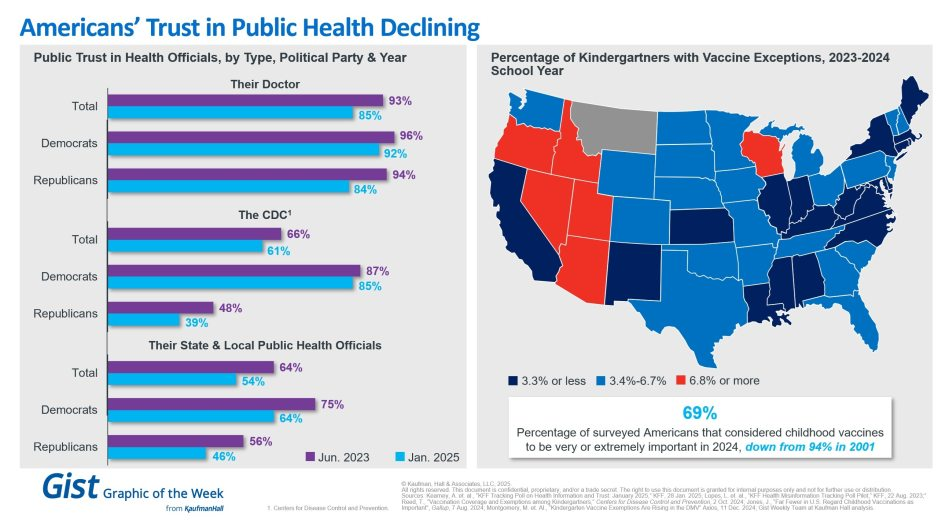
The State of Trust in Public Health in America

https://www.kaufmanhall.com/insights/infographic/state-trust-public-health-america

In light of the recent confirmation of Secretary Kennedy to lead HHS and new survey data on trust in public health, this graphic highlights Americans’ declining positive perception of public health officials. Among respondents’ personal doctors, the CDC and their state and local public health officials, trust in all three, regardless of political identification, has decreased from June 2023 to January 2025. 

Respondents trusted their doctors more than public health officials, and there is less difference by political identification. In 2025, only 61% of surveyed Americans reported that they trusted the CDC. That prevalence drops to 39% among Republicans and increases to 85% among Democrats.

Another important public health indicator, the percentage of kindergarteners with vaccine exemptions, also illustrates the challenging place in which public health officials find themselves. During the 2023-2024 school year, about 3.3% of kindergartners received an exemption, an increase from 2022-2023 that still does not provide a complete picture. Exemption rates vary widely by state, with 6 states having exemption rates more than double the median. These differences are a reflection of how easy it is to receive an exemption in some states rather than a clear trend.

The shift also underscores how easily an outbreak could occur in some states. Alarmingly, the perceived importance of vaccines has dramatically decreased, from 94% in 2001 to 69% in 2024. 

We will have to wait and see what Kennedy, long considered a vaccine skeptic, does regarding vaccines, but amid immense distrust in the healthcare system, providers’ role of giving thorough, honest information to their patients is more important than ever.

Why thousands cheered a tragedy: unpacking America’s healthcare anguish

https://www.linkedin.com/pulse/why-thousands-cheered-tragedy-unpacking-americas-robert-pearl-m-d–apdhc/

The murder of UnitedHealthcare CEO Brian Thompson in December 2024 represented a horrific and indefensible act of violence. As a physician and healthcare leader, I initially declined to comment on the killing. I felt that speculating about the shooter’s intent would only sensationalize a terrible act.

Regardless of the circumstances, vigilante violence has no place in a free and just society.

Now, more than a month later, I feel compelled to address one aspect of the story that has been widely misunderstood: the public’s reaction to the news of Thompson’s murder. Specifically, why tens of thousands of individuals “liked” and “laughed” at a post on Facebook announcing the CEO’s death.

What causes someone to ‘like’ murder?

News analysts have attributed the social media response to America’s “simmering anger” and “frustration” with a broken healthcare system, pointing to rising medical costs, insurance red tape and time-consuming prior authorization requirements as justifications.

These are all, indeed, problems and may explain some of public’s reaction. Yet these descriptions grossly understate the lived reality for most of those affected. When I speak with individuals who have lost a child, parent or spouse because of what they perceive as an unresponsive and uncaring system, their pain is raw, intense. What they feel isn’t frustration—it’s agony.

By framing healthcare’s failures in terms of statistical measures and policy snafus, we reduce a deeply personal crisis to an intellectual exercise. And it’s this very detached, cognitive approach that has allowed our nation to disregard the emotional devastation endured by millions of patients and their families.

When journalists, healthcare leaders and policymakers cite eye-popping statistics on healthcare expenditures, highlight exorbitant insurer profits or deride the bloated salaries of executives, they leave out a vital part of the story. They omit the unbearable human suffering behind the numbers. And I fear that until we approach healthcare as a moral crisis—not merely an economic or political puzzle to solve—our nation will never act with the urgency required to relieve people’s profound pain.

A pain beyond reason

In Dante’s Inferno, hell is a place where suffering is eternal and the cries of the damned go unheard. For countless Americans who feel trapped in our healthcare system, that metaphor rings true. Their anguish and pleas for mercy are met with silence.

It is this sense of abandonment and powerlessness, not mere frustration, that fuels both a desperate rage and an anger at a system and its leaders who appear not to care. The response isn’t one of glee—it’s a visceral reaction born of pain and unrelenting remorse.

As a clinician, I’ve seen life-destroying pain in my patients—and even within my own family. When my cousin Alan died in his twenties from a then-incurable cancer, my aunt and uncle were powerless to save him. Their grief was profound, unrelenting and eternal. They never recovered from the loss. But Alan’s death, heartbreaking as it was, stemmed from the limits of science at the time.

What millions of Americans endure today is different. Their loved ones die not because cures don’t exist but because the healthcare system treats them like a number. Bureaucratic inefficiencies, profit-driven delays and systemic indifference produce avoidable tragedies.

To appreciate this depth of pain, imagine standing behind a chain-link fence, watching someone you love being tortured. You scream and plead for help, but no one listens. That is what healthcare feels like for too many Americans. And until all of us acknowledge and feel their pain, little will improve.

Curing America’s indifference

When we focus solely on cold numbers—the millions who’ve lost Medicaid coverage, the hundreds of thousands of avoidable deaths each year, or the life-expectancy gap between the U.S. and other nations—we strip healthcare of its humanity.

But once we stop framing these failures as bureaucratic inefficiencies or frustrations and, instead, focus on the devastation of having to watch a loved one suffer and die needlessly, we are forced to confront a moral imperative. Either we must act with urgency and resolve the problem or admit we simply don’t care.

In the halls of Congress, lawmakers continue to weigh modest reforms to prior authorization requirements and Medicaid spending—baby steps that won’t fix a system in crisis. The truth is that without bold, transformative action, healthcare will remain unaffordable and inaccessible for millions of families whose anguish will grow.

Here are three examples of the scale of transformation required:

  1. Reverse the obesity epidemic with a two-part strategy. Congress will need to tax ultra-processed, sugary foods that drive hundreds of billions of dollars in healthcare costs each year. In parallel, lawmakers should cap the manufacturer-set price of weight-loss medications like Ozempic and Wegovy to be no higher than in peer nations.
  2. Change clinician payments from volume to value. Current fee-for-service payment systems incentivize unnecessary tests, treatments and procedures rather than better health outcomes. Transitioning to pay-for-value would reward healthcare providers, and specifically primary care physicians, who successfully prevent chronic diseases, better manage existing conditions, and reduce complications such as heart attacks, strokes and kidney failure.
  3. Empower patients and save lives with generative AI. Tools like ChatGPT can help reduce the staggering 400,000 annual deaths from misdiagnoses and 250,000 more from preventable medical errors. By integrating AI into healthcare, we can enable at-home care, continuous disease monitoring and personalized treatment, making medical care safer, more accessible and more efficient.

If elected officials, payers and regulators fail to act, they will have chosen to perpetuate the unbearable pain and suffering patients and families endure daily. They need to hear the cries of people. The time for transformative action is now.

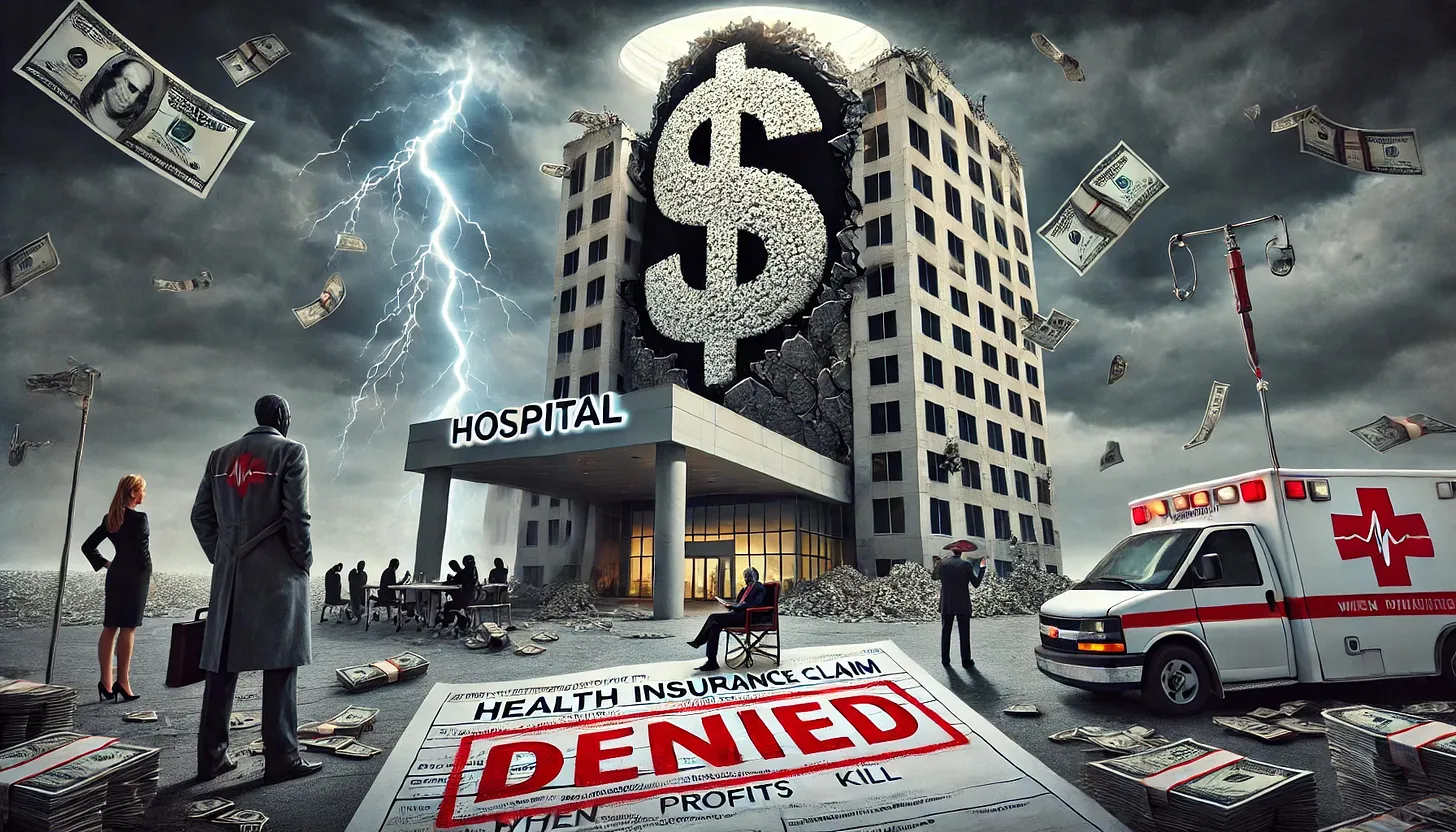
When Profits Kill: The Deadly Costs of Treating Healthcare as a Business

The recent assassination of the CEO of UnitedHealthcare — the health insurance company with, reportedly, the highest rate of claims rejections (and thus dead, wounded, and furious customers and their relations) — gives us a perfect window to understand the stupidity and danger of the Musk/Trump/Ramaswamy strategy of “cutting government” to “make it more efficient, run it like a corporation.”

Consider health care, which in almost every other developed country in the world is legally part of the commons — the infrastructure of the nation, like our roads, public schools, parks, police, military, libraries, and fire departments — owned by the people collectively and run for the sole purpose of meeting a basic human need.

The entire idea of government — dating all the way back to Gilgamesh and before — is to fulfill that singular purpose of meeting citizens’ needs and keeping the nation strong and healthy. That’s a very different mandate from that of a corporation, which is solely directed (some argue by law) to generate profits.

The Veterans’ Administration healthcare system, for example, is essentially socialist rather than capitalist. The VA owns the land and buildings, pays the salaries of everybody from the surgeons to the janitors, and makes most all decisions about care. Its primary purpose — just like that of the healthcare systems of every other democracy in the world — is to keep and make veterans healthy. Its operation is nearly identical to that of Britain’s beloved socialist National Health Service.

UnitedHealthcare similarly owns its own land and buildings, and its officers and employees behave in a way that’s aligned with the company’s primary purpose, but that purpose is to make a profit. Sure, it writes checks for healthcare that’s then delivered to people, but that’s just the way UnitedHealthcare makes money; writing checks and, most importantly, refusing to write checks.

Think about it. If UnitedHealthcare’s main goal was to keep people healthy, they wouldn’t be rejecting 32 percent of claims presented to them. Like the VA, when people needed help they’d make sure they got it.

Instead, they make damn sure their executives get millions of dollars every year (and investors get billions) because making a massive profit ($23 billion last year, and nearly every penny arguably came from saying “no” to somebody’s healthcare needs) is their real business.

On the other hand, if the VA’s goal was to make or save money by “being run efficiently like a company,” they’d be refusing service to a lot more veterans (which it appears is on the horizon).

This is the essential difference between government and business, between meeting human needs (social) and reaching capitalism’s goal (profit).

It’s why its deeply idiotic to say, as Republicans have been doing since the Reagan Revolution, that “government should be run like a business.” That’s nearly as crackbrained a suggestion as saying that fire departments should make a profit (a doltish notion promoted by some Libertarians). Government should be run like a government, and companies should be run like companies.

Given how obvious this is with even a little bit of thought, where did this imbecilic idea that government should run like a business come from?

Turns out, it’s been driven for most of the past century by morbidly rich businessmen (almost entirely men) who don’t want to pay their taxes. As Jeff Tiedrich notes:

“The scariest sentence in the English language is: ‘I’m a billionaire, and I’m here to help.’”

Rightwing billionaires who don’t want to pay their fair share of the costs of society set up think tanks, policy centers, and built media operations to promote their idea that the commons are really there for them to plunder under the rubric of privatization and efficiency.

They’ve had considerable success. Slightly more than half of Medicare is now privatized, multiple Republican-controlled states are in the process of privatizing their public school systems, and the billionaire-funded Project 2025 and the incoming Trump administration have big plans for privatizing other essential government services.

The area where their success is most visible, though, is the American healthcare system. Because the desire of rightwing billionaires not to pay taxes have prevailed ever since Harry Truman first proposed single-payer healthcare like most of the rest of the world has, Americans spend significantly more on healthcare than other developed countries.

In 2022, citizens of the United States spent an estimated $12,742 per person on healthcare, the highest among wealthy nations. This is nearly twice the average of $6,850 per person for other wealthy OECD countries.

Over the next decade, it is estimated that America will spend between $55 and $60 trillion on healthcare if nothing changes and we continue to cut giant corporations in for a large slice of our healthcare money.

On the other hand, Senator Bernie Sanders’ single-payer Medicare For All plan would only cost $32 trillion over the next 10 years. And it would cover everybody in America, every man woman and child, in every medical aspect including vision, dental, psychological, and hearing.

Currently 25 million Americans have no health insurance whatsoever.

If we keep our current system, the difference between it and the savings from a single-payer system will end up in the pockets, in large part, of massive insurance giants and their executives and investors. And as campaign contributions for bought off Republicans. This isn’t rocket science.

And you’d think that giving all those extra billions to companies like UnitedHealthcare would result in America having great health outcomes. But, no.

Despite insanely higher spending, the U.S. has a lower life expectancy at birth, higher rates of chronic diseases, higher rates of avoidable or treatable deaths, and higher maternal and infant mortality rates than any of our peer nations.

Compared to single-payer nations like Canada, the U.S. also has a higher incidence of chronic health conditions, Americans see doctors less often and have fewer hospital stays, and the U.S. has fewer hospital beds and physicians per person.

No other country in the world allows a predatory for-profit industry like this to exist as a primary way of providing healthcare. Every other advanced democracy considers healthcare a right of citizenship, rather than an opportunity for a handful of industry executives to hoard a fortune, buy Swiss chalets, and fly around on private jets.

This is one of the most widely shared graphics on social media over the past few days in posts having to do with Thompson’s murder…

Sure, there are lots of health insurance companies in other developed countries, but instead of offering basic healthcare (which is provided by the government) mostly wealthy people subscribe to them to pay for premium services like private hospital rooms, international air ambulance services, and cosmetic surgery.

Essentially, UnitedHealthcare’s CEO Brian Thompson made decisions that killed Americans for a living, in exchange for $10 million a year. He and his peers in the industry are probably paid as much as they are because there is an actual shortage of people with business training who are willing to oversee decisions that cause or allow others to die in exchange for millions in annual compensation.

That Americans are well aware of this obscenity explains the gleeful response to his murder that’s spread across social media, including the refusal of online sleuths to participate in finding his killer.

It shouldn’t need be said that vigilantism is no way to respond to toxic individuals and companies that cause Americans to die unnecessarily. Hopefully, Thompson’s murder will spark a conversation about the role of government and the commons — and the very real need to end the corrupt privatization of our healthcare system (including the Medicare Advantage scam) that has harmed so many of us and killed or injured so many of the people we love.

In Healthcare, Most think We’re Shrewd and They’re Screwed

I never met Brian Thompson. His senseless death is first and foremost a human tragedy.

Second, it’s a business story that continues to unfold. Speculation about the shooter’s motive and whereabouts runs rampant.

But media attention has seized on a larger theme: the business of health insurance and its role in U.S. healthcare. 

Headlines like these illustrate the storyline that has evolved in response to the killing: health insurance is part of a complicated industry where business practices are often geared to corporate profit.

In this coverage and social media postings, health insurer denials are the focal point: journalists and commentators have seized on the use of Artificial intelligence-based tools used by plans like United, Cigna, Aetna and most others to approve/deny claims and Thompson’s role as CEO of UHG’s profitable insurance division.

The bullet-casing etchings “Deny. Defend. Depose” is now a T-shirt whistle to convey a wearer’s contempt for corporate insurers and the profit-seeking apparatus in U.S. healthcare. 

Laid bare in the coverage of Brian’s death is this core belief: the majority of Americans think the U.S. health system is big business and fundamentally flawed.

As noted in last week’s Gallup Poll, and in previous polling by Pew, Harris, Kaiser Family Foundation and Keckley, only one in three Americans believe the health system performs well. Accessibility, costs, price transparency and affordability are dominant complaints. They believe the majority of health insurers, hospitals and prescription drug companies put their financial interests above the public’s health and wellbeing. They accept that the health system is complex and expensive but feel helpless to fix it.

This belief is widely held: its pervasiveness and intensity lend to misinformation and disinformation about the system and its business practices. 

Data about underlying costs and their relationship to prices are opaque and hard to get. Clinical innovation and quality of care are understood in the abstract: self-funded campaigns touting Top 100 recognition, Net Promoter Scores are easier. The business of healthcare financing and delivery is not taught: personal experiences with insurers, hospitals, physicians and drugs are the basis for assessing the system’s effectiveness…and those experiences vary widely based on individual/household income, education, ethnicity and health status.  

The majority accept that operators in every sector of healthcare apply business practices intended to optimize their organization’s finances. Best practices for every insurer, hospital, drug/device manufacturer and medical practice include processes and procedures to maximize revenues, minimize costs and secure capital for growth/innovation. 

But in healthcare, the notion of profit remains problematic: how much is too much? and how an organization compensates its leaders for results beyond short-term revenue/margin improvement are questions of growing concern to a large and growing majority of consumers.

In every sector, key functions like these are especially prone to misinformation, disinformation and public criticism:

  • Among insurers, provider credentialing, coverage allowance and denial management, complaint management and member services, premium pricing and out-of-pocket risks for enrollees, provider reimbursement, prior authorization, provider directory accuracy, the use of AI in plan administration and others.
  • Among hospitals, price setting, employed physician compensation, 340B compliance, price and cost transparency, revenue-cycle management and patient debt collection, workforce performance composition, evaluation and compensation, integration of AI in clinical and administrative decision-making, participation in gainsharing/alternative payment programs, clinical portfolio and others.
  • And across every sector, executive compensation and CEO pay, Board effectiveness, and long-term strategies that balance shareholder interests with broader concern for the greater good.

The bottom line:

The public is paying attention to business practices in healthcare. The death of Brian Thompson opened the floodgate for criticism of health insurers and the U.S. healthcare industry overall. It cannot be ignored. The public thinks industry folks are shrewd operators and they’re inclined to conclude they’re screwed as a result.

Two Lawsuits. Two Issues. One Clear Message.

Last Monday, two lawsuits were filed that strike at a fundamental challenge facing the U.S. health system:

In the District Court of NJ, a class action lawsuit (ANN LEWANDOWSKI v THE PENSION & BENEFITS COMMITTEE OF JOHNSON AND JOHNSON) was filed against J&J alleging the company had mismanaged health benefits in violation of the Employee Retirement Income Security Act (“ERISA”). As noted in the 74-page filing “This case principally involves mismanagement of prescription-drug benefits. “Over the past several years, defendants breached their fiduciary duties and mismanaged Johnson and Johnson’s prescription-drug benefits program, costing their ERISA plans and their employees millions of dollars in the form of higher payments for prescription drugs, higher premiums, higher deductibles, higher coinsurance, higher copays, and lower wages or limited wage growth… Defendants’ mismanagement is most evident in (but not limited to) the prices it agreed to pay one of its vendors—its Pharmacy Benefits Manager (“PBM”)—for many generic drugs that are widely available at drastically lower prices.”

The issue is this: what liability risk does a self-insured employer have in providing health benefits to their employees?

Is the structure of the plan, the selection of providers and vendors, and costs and prices experienced by employees subject to litigation? What’s the role of the employer in protecting employees against unnecessary costs?

On the same day, in the District Court of Eastern Wisconsinan 85-page class action lawsuit was filed against Advocate-Aurora Health (AAH) claiming it “uses its market power to raise prices, limit competition and harm consumers in Wisconsin:

  • Forces commercial health plans to include all its “overpriced facilities” in-network even when they would prefer to include only some facilities.
  • Goes to “extreme efforts to drive out innovative insurance products that save commercial health plans and their members money.”
  • Suppresses competition through “secret and restrictive contract terms that have been the subject of bipartisan criticism.”
  • Acquires new facilities, which then allows it to raise prices due to reduced competition

without intervention, the health system will continue to use “anticompetitive contracting and negotiating tactics to raise prices on Wisconsin commercial health plans and their members and use those funds for aggressive acquisitions and executive compensation.”

The issue is this: is a health system’s liable when its consolidation activities result in higher prices for services provided communities and employers in communities where they operate?

Is there a direct causal relationship between a system’s consolidation activities and their prices, and how should alleged harm be measured and remedied?

Two complicated issues for two reputable mega-players in the U.S. health system. Both lawsuits were brought as class actions which guarantees widespread media attention and a protracted legal process. And each contributes directly to the gradual erosion of public trust in the health system since the plaintiffs essentially claim the business practices of J&J and Advocate-Aurora willfully harm the individuals they pledge to serve.

In the November 2023 Keckley Poll, I asked the sample of 817 U.S. adults to assess the health system overall. The results were clear:

  • 69% think the system is fundamentally flawed and in need of major change vs. 7% who think otherwise.
  • 60% believe it puts its profits above patient care vs. 13% who disagree.
  • 74% think price controls are needed vs. 7% who disagree.
  • 83% believe having health insurance that’s ‘affordable and comprehensive’ is essential to financial security vs 3% who disagree.
  • 52% feel confident in their ability to navigate the U.S. system “when I have a problem” vs. 32% who have mixed feelings and 16% who aren’t.
  • And 76% think politicians avoid dealing with healthcare issues because they’re complex and politically risky vs/ 6% who think they tackle them head-on.

The poll also asked their level of trust and confidence in five major institutions “to develop a plan for the U.S. health system that maximizes what it has done well and corrects its major flaws.”

Clearly, trust and confidence in the health system is low, and expectations about solutions fall primarily on hospitals and doctors. Lawsuits like these widen suspicion that the industry’s dominated first and foremost by Big Businesses focused on their own profitability before all else. And they pose particular problems for sectors in healthcare dominated by not-for-profit and public ownership i.e. hospitals, home care, public health agencies and others.

My take

These lawsuits address two distinct issues: the roles of employers in designing their health benefits for employees including the use of PBMs, and the justification for consolidation of hospital and ancillary services in markets. 

But each lawsuit s predicated on a legal theory that prices set by organizations are geared more to corporate profits than public good and justifiable costs.

Pricing is the Achilles of the health system. Pushback against price transparency by some, however justified, has amplified exposure to litigation risk like these two  and contributed to the public’s loss of trust in the system.

It is unlikely greater price transparency and business practice disclosures by J&J and Advocate-Aurora could have avoided these lawsuits, but it’s clearly a message that needs consideration in every organization.

Healthcare organizations and their trade groups can no longer defend against lack of transparency by defaulting to the complexity of our supply chains and payment systems. They’re excuses. The realities of generative AI and interoperability assure information driven healthcare that’s publicly accessible and inclusive of prices, costs, outcomes and business practices. In the process, the public’s interest will heighten and lawsuits will increase.

P.S. Nashville is known as a hot spot for healthcare innovation including transparency solutions. Check out this meeting February 29: https://www.eventbrite.com/e/leaping-into-the-future-of-healthcare-2024-insights-tickets-809310819447

Resources

Lawsuit 119120873885 (documentcloud.org)

Microsoft Word – Aurora Class Action Complaint (FINAL filed Feb. 5 2024) (aboutblaw.com) February 5, 2024

Podcast: All Healthcare Is Politics?

Does Your Vote Affect Your Healthcare?

What role should the federal government play in addressing major healthcare issues? And does the way you vote affect your prospects for a long and healthy life? We talked about it on today’s episode of the 4sight Friday Roundup podcast.

  • David Johnson is CEO of 4sight Health.
  • Julie Vaughan Murchinson is Partner of Transformation Capital and former CEO of Health Evolution.
  • David Burda is News Editor and Columnist of 4sight Health.

Subscribe on Apple PodcastsSpotify, and other services.

Biden moves to shore up testing and mask supply as Omicron wave appears to ease

https://mailchi.mp/d57e5f7ea9f1/the-weekly-gist-january-21-2022?e=d1e747d2d8

Covid omicron variant expected to hit New York in 'coming days,' NY health  commissioner says

 This week the Biden Administration unveiled actions to make at-home COVID tests and N95 masks available, free of charge, to hundreds of millions of Americans. However, even as US COVID hospitalizations have now surpassed last winter’s previous peak, two newly-approved COVID antiviral drugs remain scarce. Just as fast as Omicron has surged across the country, it may be starting to recede, with cases beginning to drop in several states in the Northeast. Modelers now project the incredibly contagious variant will infect 40 percent of Americans and more than half the human race by the end of March.

The Gist: Absent another significant variant, experts are cautiously optimistic that enough of the US population will soon have either infection-acquired or vaccine-induced immunity that we may be nearing the end of the pandemic, and the beginning of “endemic COVID.” 

The US must now shift from COVID “war footing” to learning how to live with the virus long term. That will mean tackling difficult and politically-charged decisions, such as what level of testing and masking are sustainable, and how many COVID deaths we are willing to tolerate.

Did you know that as of January 1st, Omicron represents 95.4% of US cases?

May be an image of text that says '100% As of January 1, Omicron represents 95.4% of US cases Other 75% lota Gamma 50% Omicron Omicron Alpha 25% Delta 0% Mar 13 May 22 Jun 26 Jul31 Jul Sep 11 Oct 23 Source: Centers for Disease Control Apr17 17 Estimated proportions of COVID-19 infection in the US (March 13, 2021 to Jan 1, 2022) USAFACTS Nov 27 revention'

In the second year of the COVID-19 pandemic, a lot changed in how the US responded to the virus and adapted to new variants.

Did you know that as of January 1st, Omicron represents 95.4% of US cases?

Find out more: https://usafacts.org/vis…/coronavirus-covid-19-spread-map/