COVID-19 sparks national security concerns with top brass in quarantine

COVID-19 sparks national security concerns with top brass in quarantine

COVID-19 sparks national security concerns with top brass in quarantine

The quarantining of most of the Joint Chiefs of Staff, coming on the heels of President Trump’s COVID-19 diagnosis, is raising fears that U.S. adversaries might seek to exploit a perceived weakness.

Few expect any sort of overt military action, but there are other ways to wreak havoc on the United States.

Chief among them is disinformation. Experts have been warning ever since Trump tested positive for the coronavirus last week that disinformation is likely to kick into overdrive.

Now, with six of the seven members of the Joint Chiefs of Staff waylaid at home, warnings are being amplified about the national security implications of the growing COVID-19 outbreak among U.S. leadership.

“All these kinds of things are just a huge distraction for us where our national security apparatus is consumed with matters domestic and internal,” former Director of National Intelligence James Clapper said at a Washington Post event after news broke of the Joint Chiefs quarantining. “So this is an ideal time for adversaries, particularly in adversary intelligence services, to look for ways to further confuse us, to distract us.”

Adding that “you can bet particularly our good friends the Russians are doing this,” Clapper warned of them “further sowing seeds of disinformation.” 

“They will appeal to all the various tribes and continue to capitalize on the polarization in this country,” he said. “So it is a vulnerable time, and it’s an opportunity for them while we’re not looking and not being alert to further sow seeds of disinformation, casting doubt, discord, distrust in the country.”

The quarantining of top military officers stems from the Coast Guard’s No. 2 admiral contracting COVID-19. The Coast Guard announced Tuesday that its vice commandant, Adm. Charles Ray, tested positive for the coronavirus on Monday after feeling mild symptoms over the weekend.

The test result came after Ray met with most of the Joint Chiefs of Staff at the Pentagon on Friday.

That put Joint Chiefs of Staff Chairman Gen. Mark Milley into quarantine, as well as the chiefs of the Army, Navy, Air Force, Space Force and National Guard. The vice chairman, Gen. John Hyten, was also in the meetings and is quarantining.

The only member of the Joint Chiefs who didn’t meet with Ray was Marine Corps Commandant Gen. David Berger, who was traveling.

Berger’s deputy, Gen. Gary Thomas, met with Ray instead and went into quarantine Tuesday. The Marine Corps announced Wednesday evening that he has tested positive for the virus.

Gen. Paul Nakasone, commander of U.S. Cyber Command and director of the National Security Agency, also met with Ray and went into quarantine.

It’s unclear exactly where Ray caught the virus, but his schedule within the incubation period included a visit to the White House, which is now considered the epicenter of a coronavirus outbreak that includes Trump himself.

Ray — along with Milley, Defense Secretary Mark Esper and other top defense officials — attended a White House ceremony for Gold Star families on Sept. 27.

The event happened the day after Trump announced he was nominating Amy Coney Barrett for the Supreme Court, a gathering for which several attendees have since been diagnosed with COVID-19.

Since Trump’s diagnosis, the Department of Defense has sought to allay any national security concerns.

When Trump’s positive test was first announced last week, the Pentagon insisted there has been “no change to DoD alert levels.”

After news broke Tuesday of the Joint Chiefs quarantining, chief Pentagon spokesman Jonathan Hoffman reiterated that “there is no change to the operational readiness or mission capability of the U.S. Armed Forces.”

“Senior military leaders are able to remain fully mission capable and perform their duties from an alternative work location,” Hoffman said in a statement.

The military chiefs are well-equipped to work from home, and besides Ray and Thomas, none have tested positive for the virus yet.

But the development has raised questions about whether adversaries will try to take advantage of the situation nonetheless.

After the military quarantines were revealed, House Armed Services Committee Chairman Adam Smith (D-Wash.) said “the national security implications of the president’s recklessness cannot be overstated” even though the military “can still operate while leadership is quarantined.”

“Since announcing that he tested positive for the virus, the president’s antics have been downright reckless and harmful,” Smith said in a statement. “Our adversaries are always looking for any weakness to exploit. President Trump’s pathetic attempts to exude strength aren’t fooling anyone — Americans know he is weak and so do those who wish us harm.”

Rep. Jackie Speier (D-Calif.), another senior member of the Armed Services Committee, questioned why so many senior military leaders were meeting in person in the first place, as well as attending a White House reception in which they were pictured maskless.

“What if the Joint Chiefs’ responsibilities cannot be done remotely while they are isolating?” Speier wrote in a series of questions on Twitter. “How many other senior military leaders have tested positive? Why weren’t we safeguarding the health of senior military leaders like the natural security asset that it clearly is?”

Barry Pavel, senior vice president and director of the Atlantic Council’s Scowcroft Center for Strategy and Security, stressed that there is “no degradation in operational command and control” from the Joint Chiefs quarantining.

But, he added, adversaries such as Russia and China could misperceive that the United States is distracted and decide to act. For example, he cited concerns about China moving against Taiwan or Russia trying to grab more territory.

Pavel also listed what he called Russia’s “non-kinetic war” against the United States in the cybersecurity, influence and disinformation realm.

“This is a KGB officer’s most wildest dream coming true almost on a daily basis,” he said. “And so I think it’s a big threat. Who knows what proportion of our current public divisions are sown by Russian influence and bots or are just part of our current division. I don’t know the answer to that question. But they’re certainly right now exploiting it.”

To diminish those concerns, Pavel said, the Pentagon should keep emphasizing its military readiness, as well as demonstrating it by taking actions like publicizing a previously planned exercise.

“It’s probably a good idea to keep repeating those messages,” he said, “to be reiterating those messages, sending them publicly, privately, by third parties and through various forms of military activity so adversaries have no misunderstanding about our readiness and capabilities despite the chairman being quarantined in his quarters.”

Cartoon – Anti-Science or Pro-Myth?

Twitter | Daily cartoon, Editorial cartoon, Cartoon

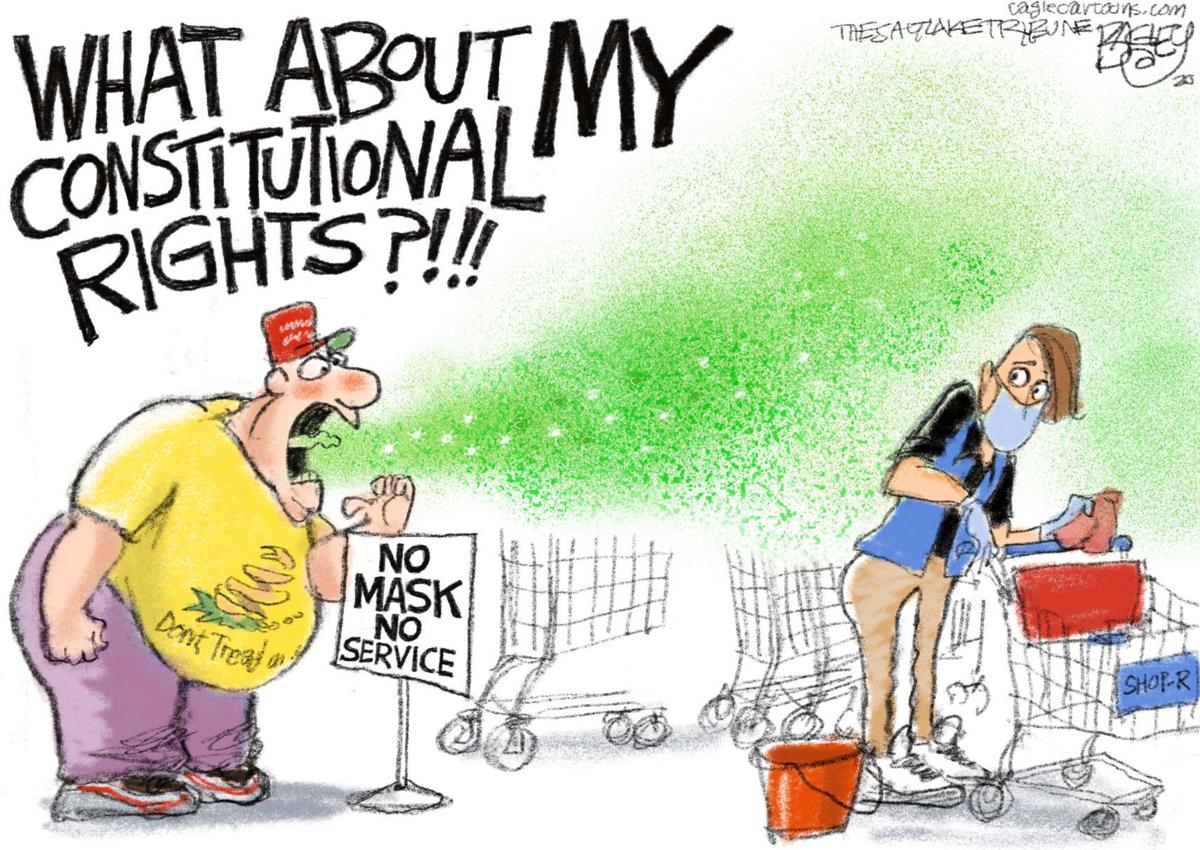
Cartoon – I’m DONE wearing a MASK

Editorial cartoon for June 19, 2020 | West Central Tribune

Cartoon – Constitutional Rights vs. Civility

Saturday cartoon

Cartoon – Come in We’re Open

No mask, no service | Opinion | dailyindependent.com

The first presidential debate: 7 healthcare takeaways

https://www.beckershospitalreview.com/hospital-management-administration/the-first-presidential-debate-7-healthcare-takeaways.html?origin=CFOE&utm_source=CFOE&utm_medium=email&oly_enc_id=2893H2397267F7G

5 key takeaways from Joe Biden and Donald Trump's 1st presidential debate -  ABC News

President Donald Trump and former Vice President and Democratic presidential nominee Joe Biden sparred over the future of the ACA, the COVID-19 pandemic and health insurance during a 90-minute debate in Cleveland Sept. 29.

Seven takeaways for healthcare leaders:

The ACA

1. Moderator and Fox News host Chris Wallace opened the debate with the topic of President Trump’s nomination of Judge Amy Coney Barrett of the U.S. Court of Appeals for the 7th Circuit to the U.S. Supreme Court. In the first few minutes of the debate, the discussion turned to the future of the ACA should Ms. Coney Barrett join the Supreme Court. A week after the November presidential election, the Supreme Court is set to hear a lawsuit, supported by the Trump administration, that seeks to overturn the ACA. 

2. If the Supreme Court overturns the ACA, Mr. Biden said 22 million Americans would lose insurance and 100 million would lose protections for preexisting conditions. HHS said in 2017 as many as 133 million Americans have preexisting conditions, and a KFF analysis estimates 54 million Americans have conditions serious enough to lead to coverage denials if the ACA is overturned.

3. Mr. Wallace questioned the president about his promise to repeal and replace the ACA, adding that President Trump hadn’t released a comprehensive plan to replace the health law despite pledges to do so. The president disagreed with that, saying he had gotten rid of the individual mandate. Mr. Wallace said eliminating the mandate was not a comprehensive plan. Mr. Wallace called President Trump’s recent executive orders on preexisting conditions and surprise billing “largely symbolic.” President Trump disagreed, but did not tell how the executive orders would be implemented.

Drug prices 

4. The president said drug prices would be coming down “80 or 90 percent.” The president highlighted insulin, which he said he’s getting so inexpensively, “it’s like water.” Insulin continues to retail for about $300 per vial, according to STAT, but cheaper insulin prices could be coming for some seniors. CMS recently said it is expanding the number of Medicare Advantage plans that provide insulin for a $35 or less monthly copay.

Public option

5. In an exchange with Mr. Biden, President Trump accused the Democratic Party of wanting “socialist medicine,” and claimed Mr. Biden wants to end private insurance. Mr. Biden denied those claims and said his health plan, which includes expanded ACA subsidies and a public option, would allow employees to keep their private health insurance. He has not supported Medicare-for-All proposals.

COVID-19

6. On the topic of the pandemic, Mr. Wallace asked President Trump about differing timelines for a vaccine that have been presented by him versus federal scientists like CDC Director Robert Redfield, MD. The president said he has spoken with Pfizer, Moderna and Johnson & Johnson, who’ve said “they can go faster” on a vaccine, but “it’s a very political thing.” He added that the military is already set up to distribute vaccines. Mr. Biden questioned Americans’ trust in the process. A Sept. 29 poll from the Axios/Ipsos Coronavirus Index found 8 in 10 Americans wouldn’t likely get a first generation COVID-19 vaccine if the president said it was safe.

7. President Trump and Mr. Biden took different stances on masks. Mr. Biden cited Dr. Redfield’s renewed call to wear masks, and said masking up and social distancing would save 100,000 lives between now and January. President Trump responded by saying, “They’ve said the opposite.” He alluded to early in the pandemic when public health experts, including Anthony Fauci, MD, director of the National Institute of Allergy and Infectious Diseases, were slow to recommend widespread mask-wearing before scientists better understood how the virus spreads. The CDC currently recommends that every American wear a mask.


U.S. Still in First Wave of COVID-19, Fauci Says

https://www.webmd.com/lung/news/20200925/us-still-in-first-wave-of-covid-19-fauci-says

US still in first Covid-19 wave and should be prepared for 'challenge' of  fall and winter, Fauci says

Anthony Fauci, MD, says talk about a second wave of the coronavirus is premature because the United States is still dealing with the first one.

The idea of a second wave is based on the 1918 flu pandemic, when many cases were seen in the spring, he says. The spring cases “literally disappeared” and were followed by a spike in flu cases in the fall, he told CNN’s Sanjay Gupta, MD, on Thursday in an online conversation organized by Emory University.

“Rather than say, ‘A second wave,’ why don’t we say, ‘Are we prepared for the challenge of the fall and the winter?’” said Fauci, director of the National Institute of Allergy and Infectious Diseases and a member of the White House coronavirus task force.

Flu shots are an important measure to help the U.S. get through the winter, he said.

He and other health care professionals have observed that the Southern Hemisphere has had a very light flu season, probably because measures to curb the coronavirus, such as social distancing and mask-wearing, have limited the spread of the flu.

“If we listen to the public health measures, not only would we diminish the effect of COVID-19, we might get away with a very, very light flu season if we combine that with getting the flu vaccine,” Fauci said.

In a separate interview, he said the arrival of the coronavirus vaccine will not stop the need for tried-and-true measures such as mask-wearing, hand-washing, and social distancing.

In a Facebook Live conversation with New Jersey Gov. Phil Murphy, Fauci said the coronavirus vaccine will not be 100% effective and won’t be taken by the entire population. That means the virus could still spread.

“So when a vaccine comes, we look at it as an important tool to supplement the public health measures that we do,” he said. “It will allow us to more quickly and with less stringency get back to some degree of normal. But it is not going to eliminate the need to be prudent and careful with our public health measures.”

Fauci said that vaccinating 75% to 80% of the population “would be a really good accomplishment.” He expects 700 million doses to be produced by the end of this year or early 2021.


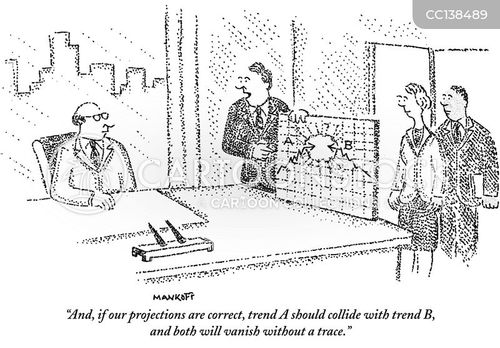
Cartoon – Coronavirus Projections

Cartoon – Coronavirus Projections | HENRY KOTULA

U.K. upgrades COVID alert level as Europe sees worrying rise in infections

https://www.axios.com/coronavirus-united-kingdom-european-cdc-4856ab47-29b2-43f2-b6c4-9a62d6867830.html

U.K. upgrades COVID alert level as Europe sees worrying rise in infections  - Axios

The U.K. could see up to 50,000 coronavirus cases per day by mid-October if current growth continues, top scientific advisers warned in a televised address from Downing Street on Monday.

The big picture: The U.K. has upgraded its coronavirus alert level from three to four as infections appear to be “high or rising exponentially.” Meanwhile, recent European Center for Disease Prevention and Control (ECDC) data shows that over half of all European Union countries are seeing an increase in COVID-19 cases.

What they’re saying: “At the moment, we think that the epidemic is doubling roughly every seven days” in the U.K., chief scientific adviser Patrick Vallance said.

  • England’s chief medical officer Chris Whitty stressed that unemployment and poverty are risks of taking strong action against the virus — like enforcing stay-at-home orders — but that more deaths will occur if aggressive action is not taken.

Where it stands: ECDC data shows that Spain, France, the Czech Republic, Croatia and Romania have recorded more than 120 confirmed COVID-19 cases per 100,000 inhabitants in the last 14 days, according to AP.

  • In Madrid, the rate of infection is nearly three times higher than the national average, at 683 cases per 100,000 inhabitants, per AP. Spain, one of the first epicenters of the virus in Europe, is faring the worst of countries tracked by the ECDC.
  • France has seen 31,285 deaths since the start of the pandemic, one of the highest death tolls in Europe. This weekend, France reported a record 13,000 new infections in 24 hours.
  • The Czech Republic reported 3,000 new cases on Thursday, almost as many as the country saw in all of March.
  • Croatia has recorded over 14,000 new COVID-19 cases per day since Sept. 16, while Romania is seeing over 11,000 new infections per day, according to Johns Hopkins data.

What to watch: Analysts expect the British government to announce short-term restrictions after Prime Minister Boris Johnson met with ministers over the weekend, AP reports.

  • German Chancellor Angela Merkel is planning second-wave prevention with her “Coronavirus Cabinet.” These plans include walk-in “fever clinics” to separate coronavirus patients from others.
  • Police in Madrid are limiting travel in working-class neighborhoods that have seen high transmission rates, while parks are closed and restaurants and shops must limit their occupancy at 50%.
  • Czech Republic’s Health Minister Adam Vojtech resigned Monday because of rising cases.
  • There are 20 new testing centers set to open in Paris and surrounding suburbs this week.


U.S. reaches 200,000 coronavirus deaths

https://www.axios.com/united-states-200000-coronavirus-deaths-17dc9d72-933b-473d-aa65-b7887eafffa2.html?stream=top&utm_source=alert&utm_medium=email&utm_campaign=alerts_all

The U.S. now has more than 200,000 coronavirus deaths - Axios

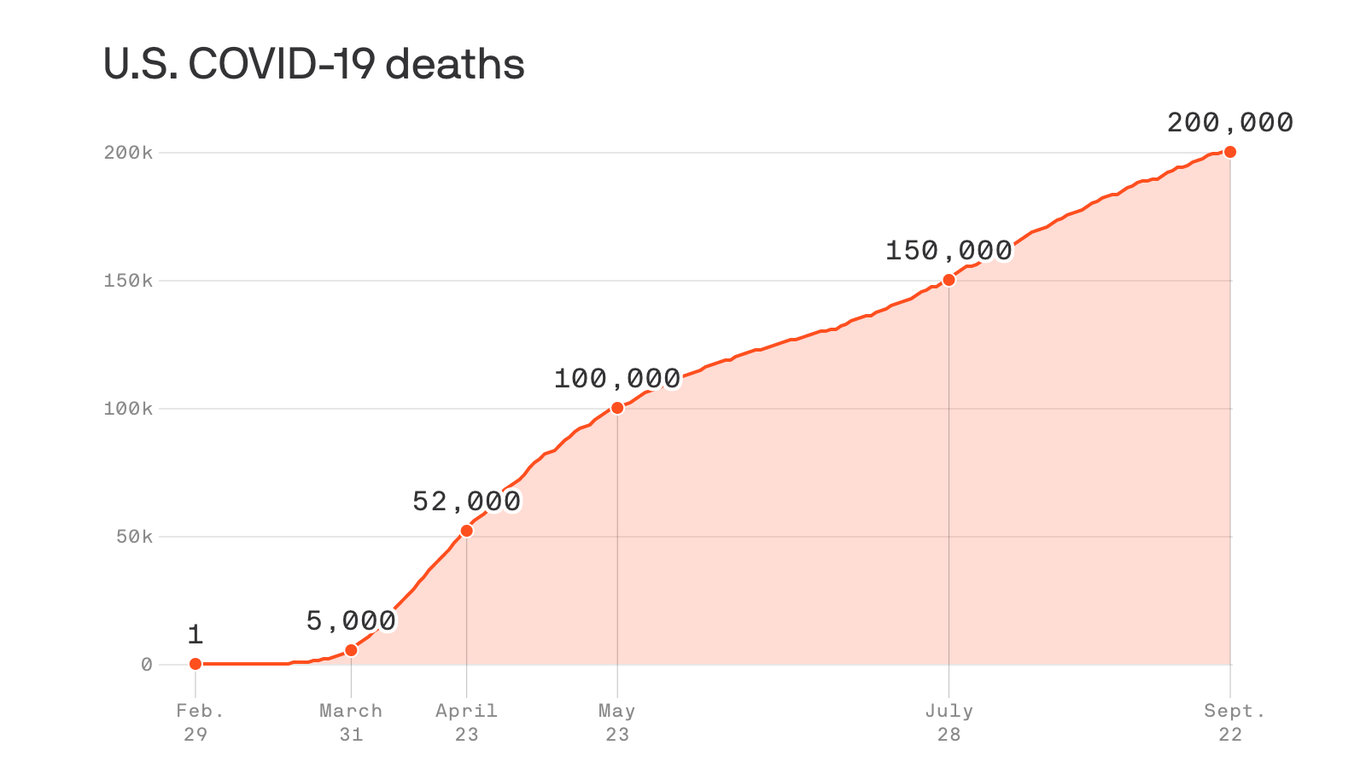
The coronavirus has now killed 200,000 Americans, according to Johns Hopkins data.

The big picture: Whatever context you try to put this in, it is a catastrophe of historic proportions — and is yet another reminder of America’s horrific failure to contain the virus.

  • The coronavirus has killed a bigger share of the American population than it has in almost any other wealthy country.
  • The death toll here is equivalent to roughly 65 Sept. 11 attacks. Three times more Americans have died from COVID than died in the Vietnam war — in only a fraction of the time.

This crisis has hit people of color especially hard.

  • Black and Latino Americans are dying at about three times the rate of white Americans.
  • They have also suffered far more from the economic fallout, which has fallen largely on lower-wage, service-industry workers.

And deaths keep coming — we’re averaging roughly 830 per day — even as the country increasingly sees the pandemic as background noise, as live sports resume and schools reopen and interest in news about the pandemic wanes.

Between the lines: The percentage of infected people who ultimately die from the coronavirus is lower now than it was in the outbreak’s earliest months, partly because doctors have gotten better at treating the virus and partly because outbreaks are now occurring within younger and lower-risk groups.

  • Overall cases are on a downward trajectory right now, following an enormous spike over the summer.
  • But the U.S. has never managed to get the virus firmly under control. Cases and deaths could get worse again as the weather gets colder and people move indoors, and the onset of flu season could make treatment more difficult.